 by
Tom Gurney
Tom Gurney BSc (Hons) is an art history expert with over 20 years experience
Email:
tomgurney1@gmail.com
/ Phone:
+44 7429 011000
The David Children by Thomas Sully: Introduction
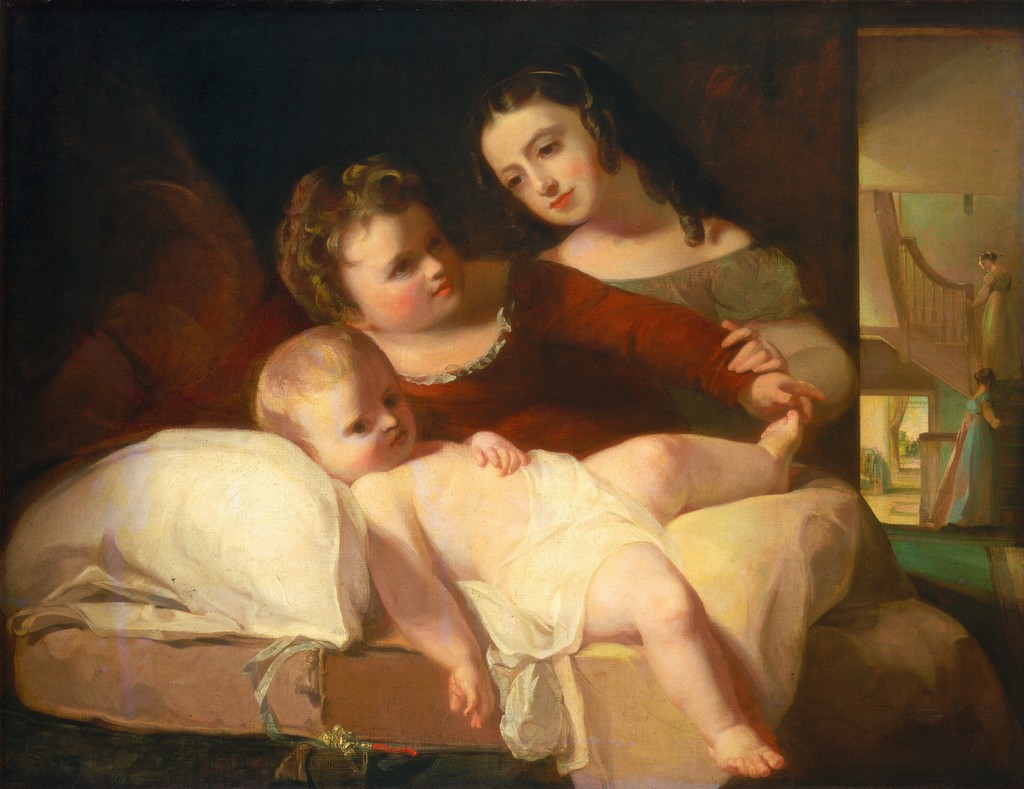
Thomas Sully’s The David Children places a reclining infant in the foreground while two older children lean toward him. A bright pillow, red dress and sequence of reaching hands bring the group close to the viewer. At the right, the room opens unexpectedly into a deep staircase interior. Painted in 1826, the canvas belongs to the National Gallery of Art in Washington, in the Chester Dale Collection. [1]
The three sitters are Julia, Ferdinand and Stephen David. The composition gives each a different position, but the older children’s attention makes Stephen its principal focus. The result is more complicated than a row of individual likenesses: Sully organises the family group through bodily contact, contrasts of colour and an unusually expansive view into the house. [2]
At a Glance
- Artist Thomas Sully
- Title The David Children
- Date 1826
- Sitters Julia, Ferdinand and Stephen David
- Medium Oil on canvas
- Dimensions 87 × 112.4 cm
- Collection National Gallery of Art, Washington
- Accession 1948.13.1
- Credit Chester Dale Collection
This work across Thomas Sully’s career
Musidora
1813–35; Met panelThe Torn Hat
1820Portrait of the Artist
1821; Met canvasJohn Quincy Adams
1824; NGA oil studyQueen Victoria
1838; full-length Met canvasMother and Son
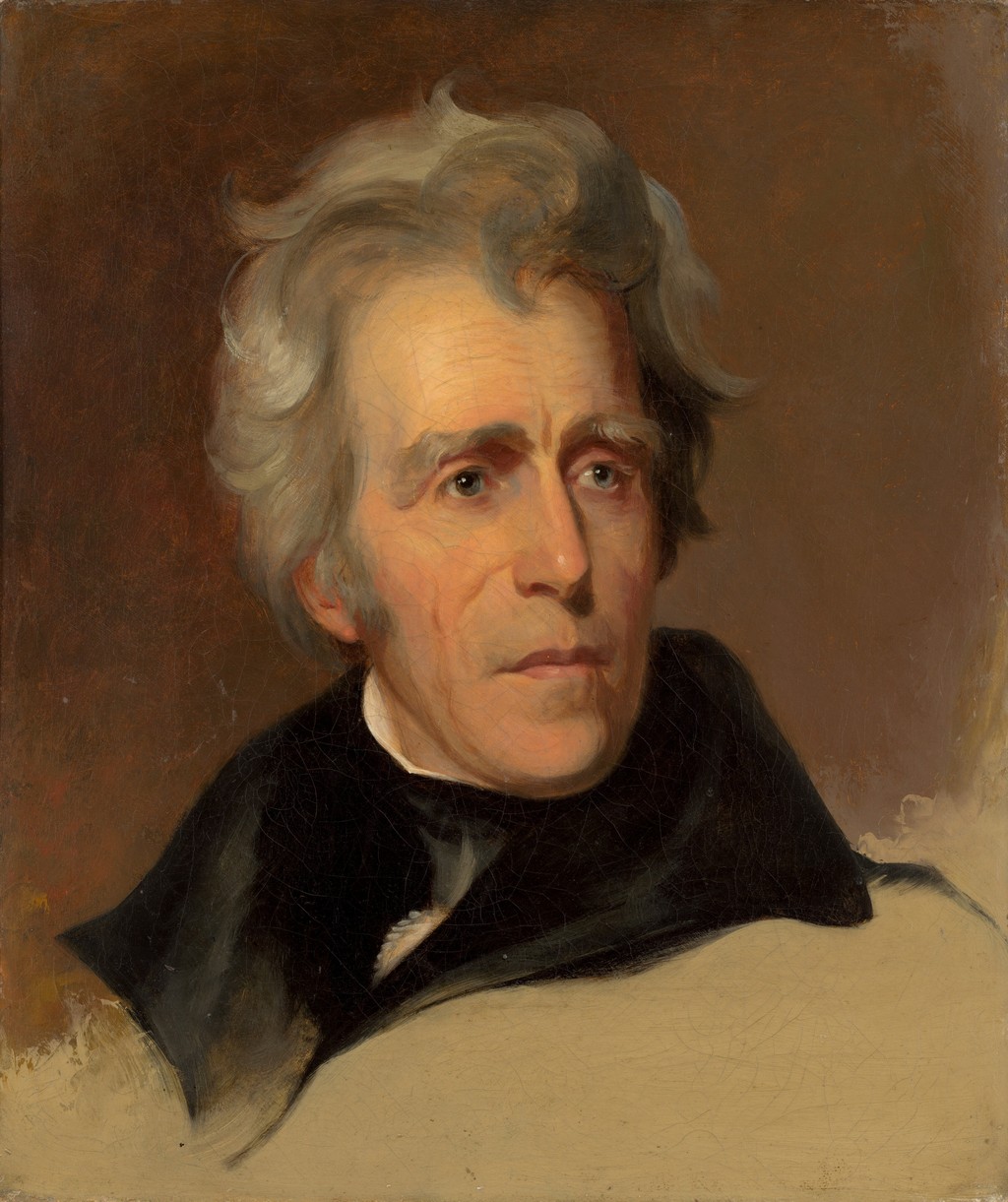
1840; inscription dateAndrew Jackson
1845; after the 1824 life portraitNotes and sources
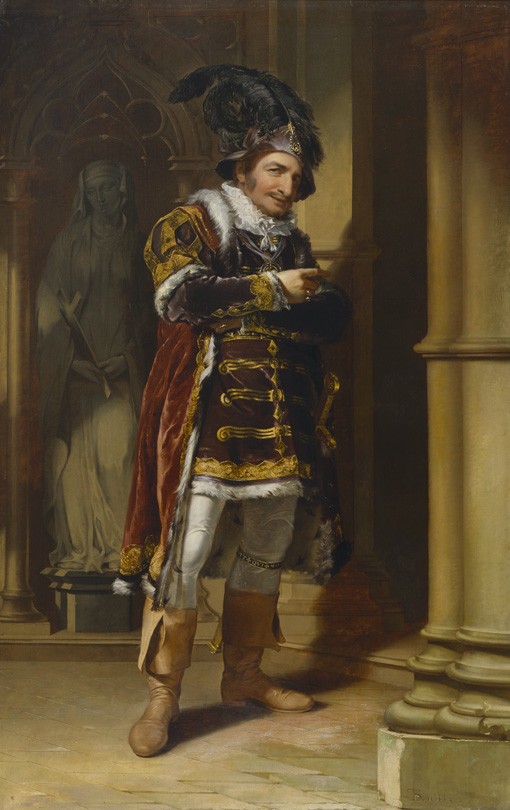
George Frederick Cooke as Richard III. Actor and theatrical role meet in an imposing full-length portrait. [3]
Musidora. A turned figure beside a pool belongs to a literary episode, not a named portrait sitter. [4]
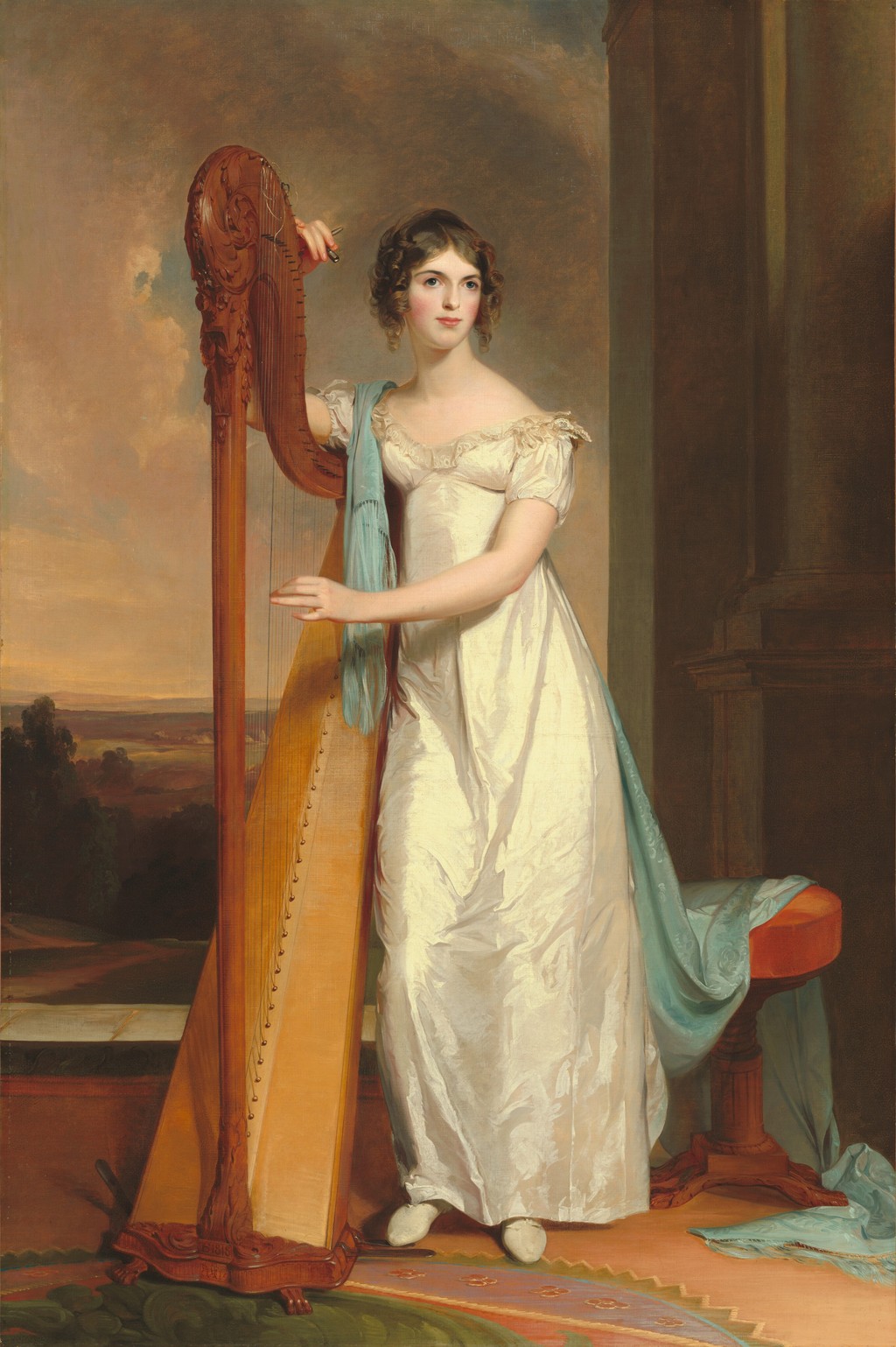
Lady with a Harp: Eliza Ridgely. The harp connects the sitter’s accomplishment with the arrangement of her body. [5]
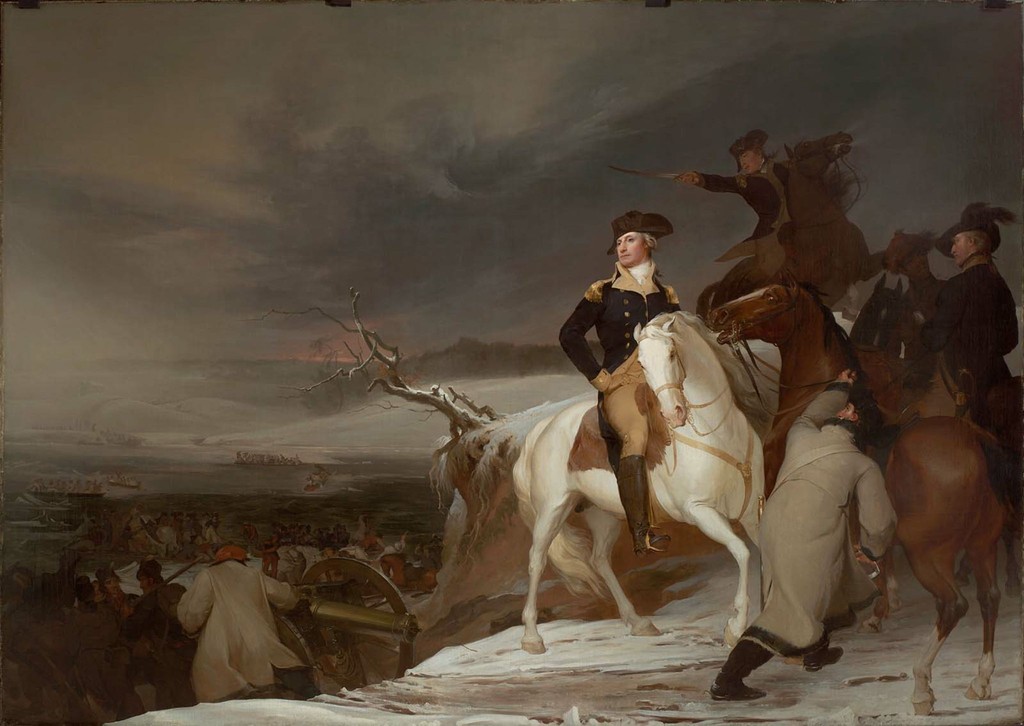
The Passage of the Delaware. Washington is mounted on shore while the crossing proceeds around him. [6]
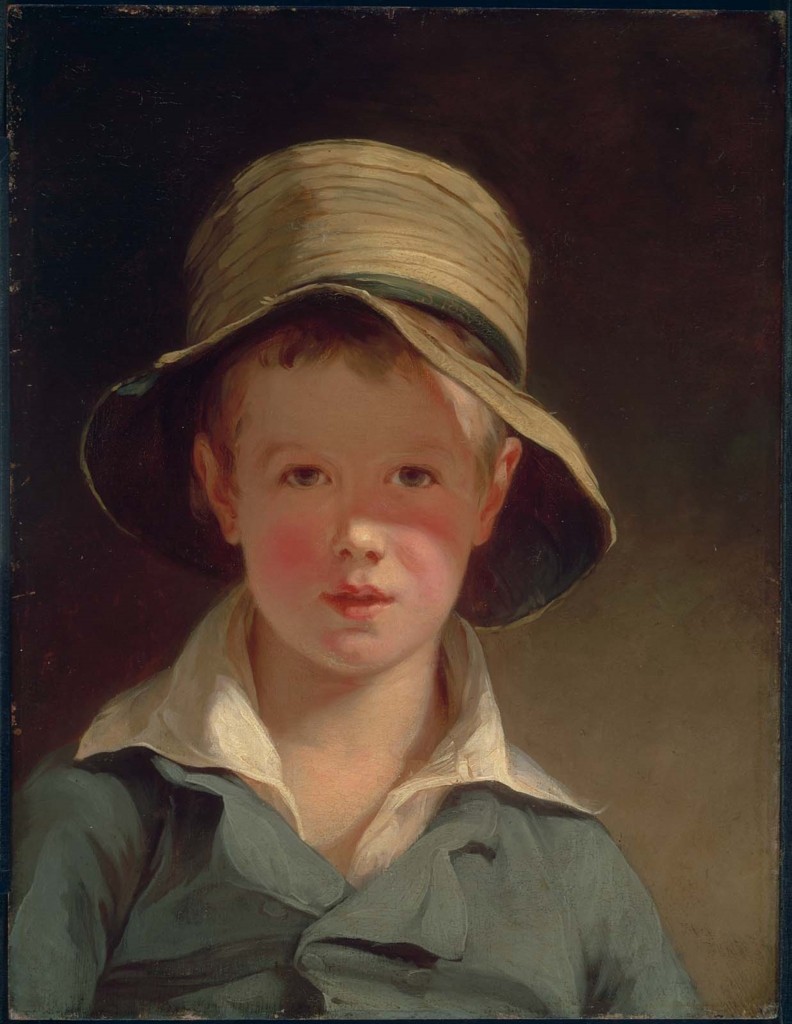
The Torn Hat. A worn hat and directed light give the artist’s son an informal presentation. [7]
Portrait of the Artist. A raised brush joins the painter’s hand to the illuminated head. [8]
John Quincy Adams. A developed likeness supplied information for a larger portrait project. [5]
The David Children (current article). The older children direct attention toward the reclining infant. [5]
The Vanderkemp Children. A portfolio and overlapping hands connect the three children. [5]
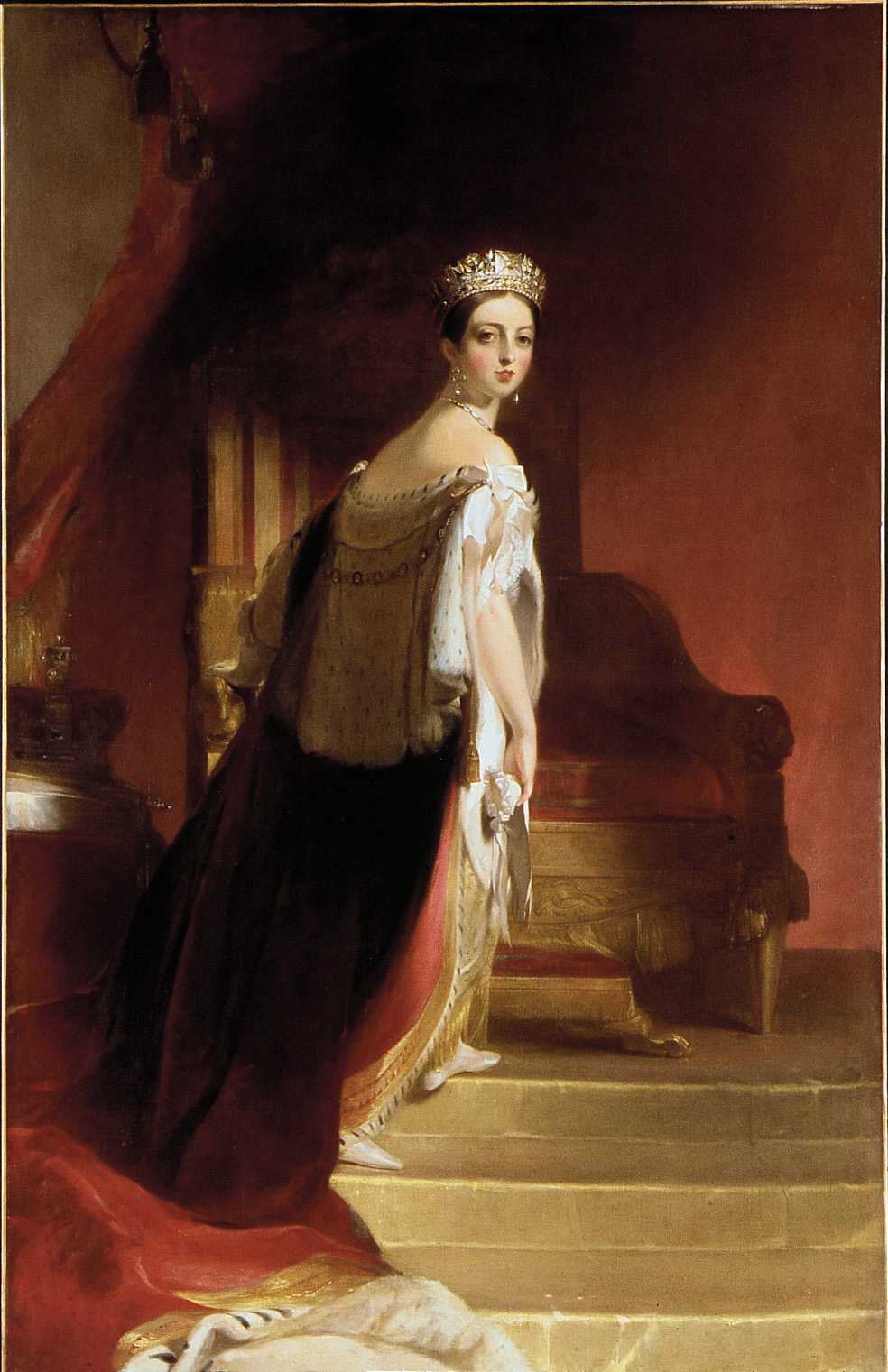
Queen Victoria. The royal likeness extends through robes, insignia and a ceremonial setting. [9]
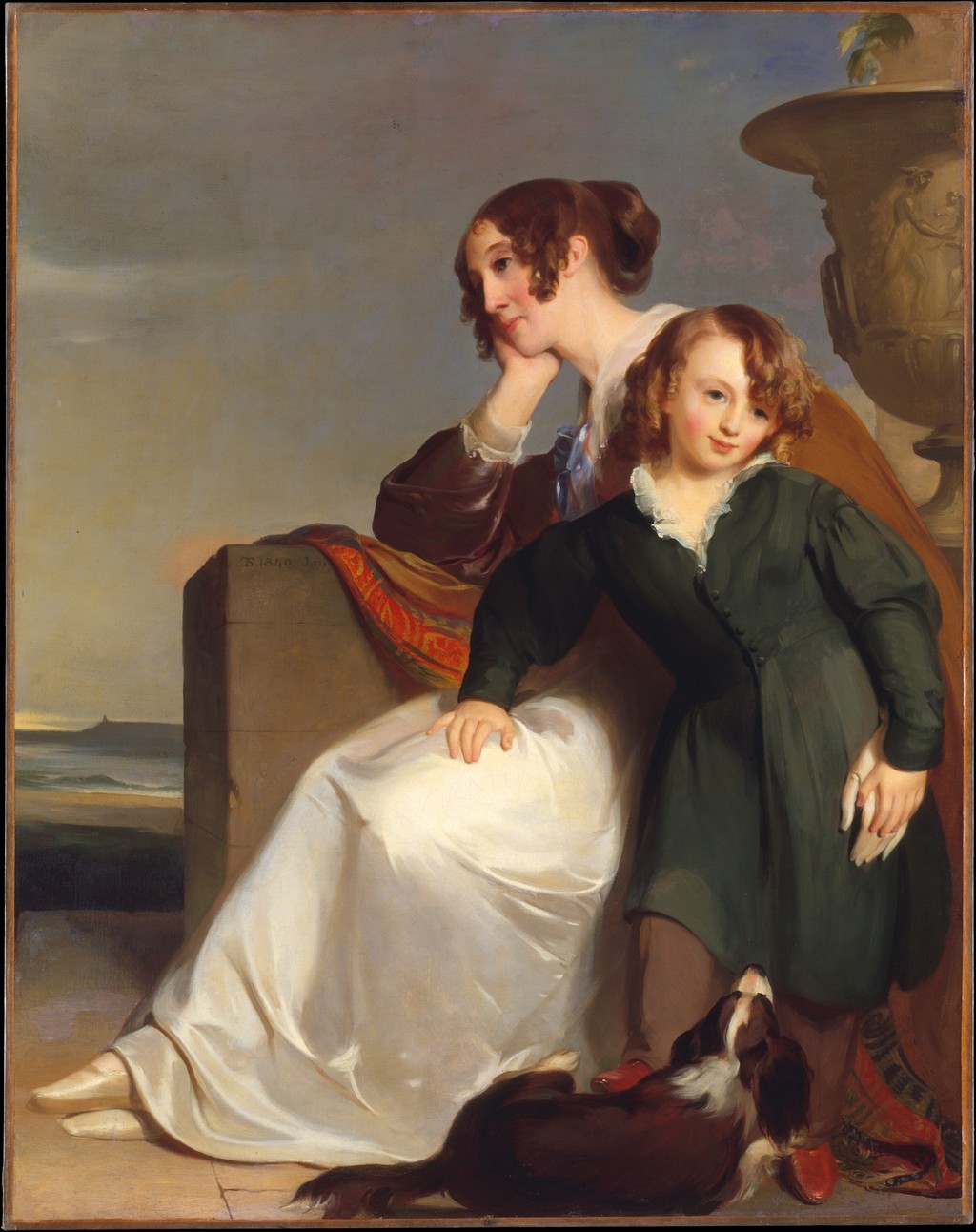
Mother and Son. Jane Darley and her son are connected through touch and differing gazes. [10]
The Coleman Sisters. Contrasting dresses, heights and gestures hold three individual likenesses together. [5]
Andrew Jackson. This later version must be distinguished from its earlier life source. [5]
Contents
- A group seen from a low viewpoint
- The family and the 1826 commission
- The white pillow and the red dress
- A coral toy and possible religious parallels
- Looking at old masters in America
- The staircase behind the children
- Studies, revisions and a family of painters
- The surviving object and its museum history
- Annotated details
A group seen from a low viewpoint
Stephen lies across the lower foreground, his head supported by a large white pillow. His body extends diagonally toward the right, with one arm dropping beside the cushion. Ferdinand, wearing red, leans over him and reaches toward his foot. Julia appears behind them in green, bringing a third face into the upper part of the group.
The low viewpoint makes the pillow and infant especially prominent. Rather than looking down into a scene of children gathered on the floor, the viewer meets the reclining figure almost at his own level. Ferdinand’s inclined head and Julia’s downward attention reinforce the movement toward Stephen. The adults visible in the distance occupy much less of the canvas.
The arrangement gives a small gesture considerable importance. Ferdinand touches the infant’s foot, connecting his extended arm with the pale body below. Julia’s hand joins the older child’s wrist. The hands therefore make a chain through the group, linking three bodies whose different heights might otherwise separate them.
The pose does not establish a spontaneous incident witnessed by the painter. It is a carefully organised presentation of children in relation to one another. Its vitality comes from the way the gestures remain readable within the formal arrangement.
Annotated Details from The David Children
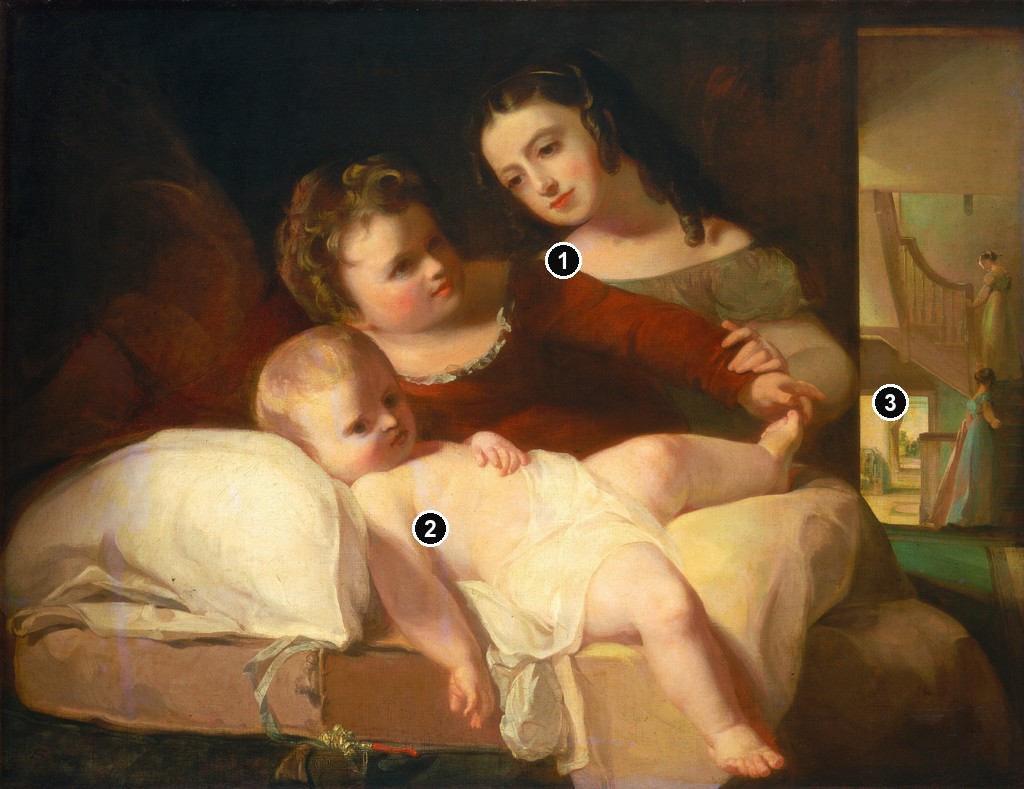
The numbered points identify visible features discussed in this article. Return from each detail to the whole composition. Thomas Sully, The David Children, 1826. Julia, Ferdinand and Stephen David. Oil on canvas, 87 × 112.4 cm. National Gallery of Art, Washington, Chester Dale Collection, 1948.13.1. CC0. Image source. CC0; National Gallery of Art Open Access. Numbers added to a separate overview; detail images cropped from the source. The complete unnumbered image is retained in this article.
Details from THE DAVID CHILDREN
Compare the cropped details with the complete images above. Notice how their colours, shapes and positions contribute to the larger compositions.
Older children together
The two older children turn towards the infant rather than posing as separate, unrelated figures. Their arms and inclined heads direct attention into the family group.
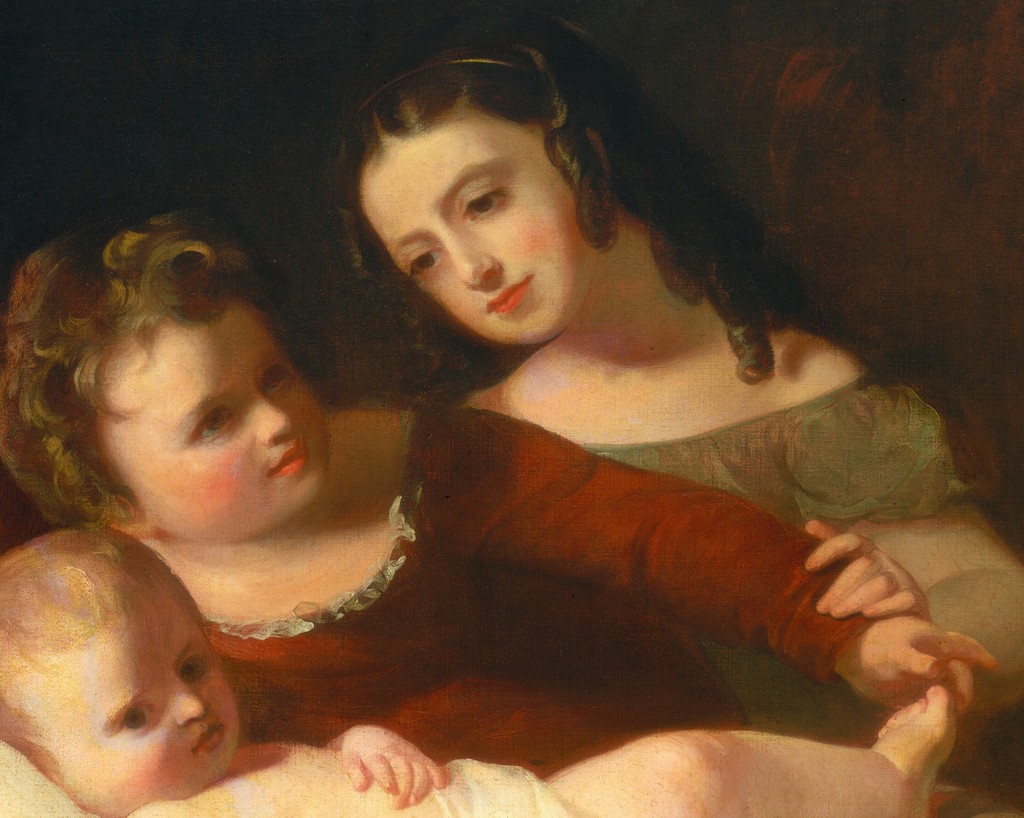
Infant and pale cloth
The infant lies across a broad field of pale cloth and cushion. The brightest passages spread across the foreground, carrying the eye towards the small face and reaching hands.
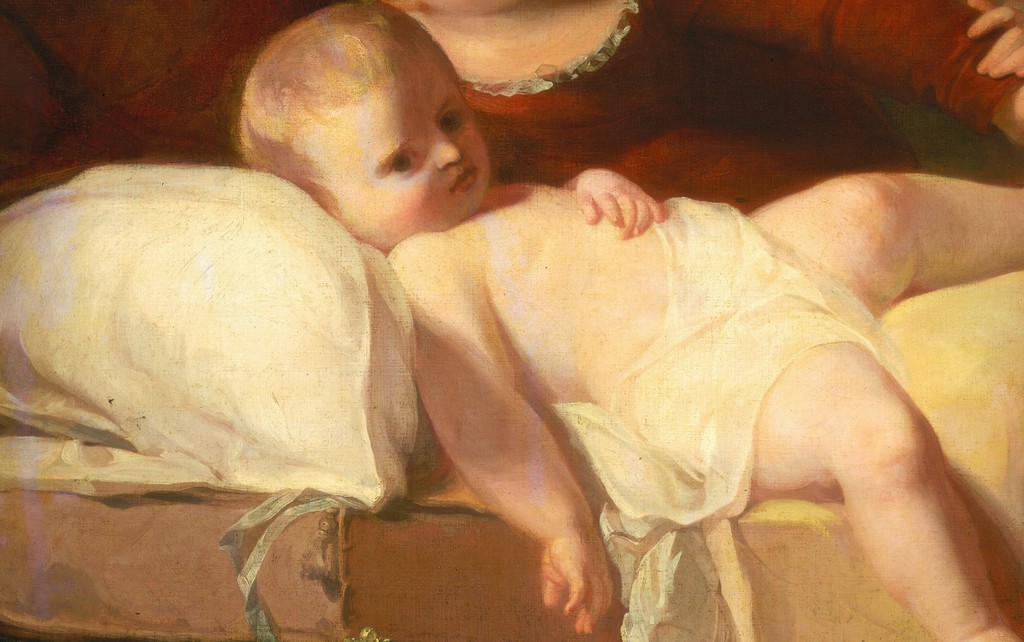
Staircase beyond
The opening at the right reveals a deeper interior beyond the clustered children. This narrow passage contrasts with the large, close forms in the foreground.
The family and the 1826 commission
The children were members of the Philadelphia family of Jean Terford David and Mary Sicard David. Both parents came from French immigrant families. Sully had painted their portraits before undertaking this group of their children, so the commission belonged to an existing relationship between painter and patrons. [2]
The NGA catalogue reports that the painting was executed between 26 April and 16 May 1826 for two hundred and fifty dollars. It also connects it with the Pennsylvania Academy of the Fine Arts exhibition that year, where it appeared under the descriptive title Group of Children Portraits . [2]
The name David can encourage a misleading assumption about a direct relationship with the French painter Jacques-Louis David. The catalogue records a family tradition concerning an artistic connection, but that is not established genealogy. The portrait’s French associations are better grounded in the parents’ documented family background than in an unproved link to a famous namesake.
Knowing the sitters’ identities also keeps the painting from becoming only an example of a general subject. Stephen is an individual infant represented with Julia and Ferdinand, even where their arrangement invites comparison with other kinds of imagery. The family likeness and the broader compositional associations need not cancel one another.
The white pillow and the red dress
The pillow is a large, light form, with folds that spread toward the left edge. Against it, the infant’s warmer skin remains distinguishable without a sharp contrast at every boundary. The pale cloth below his body continues the light passage downward, while Ferdinand’s red dress introduces a stronger colour immediately behind him.
The red is important because it gives the leaning figure weight. Without it, the two older faces might seem to float above the infant. The broad dress anchors Ferdinand between Stephen’s pale body and Julia’s darker green costume. A smaller sequence of warm colours in faces, hair and hands helps the group remain connected across those contrasting garments.
The surrounding drapery and room are comparatively dark. This lets the light across the pillow and infant become the principal event. The contrast is not simply between light and darkness: the red and green passages keep the shadowed parts active, while smaller changes of tone model the faces above.
Viewed from a distance, these colour relationships establish the grouping before the smaller details can be recognised. Close looking then reveals the hands, the infant’s open fingers and the different directions of the eyes. Sully moves between broad masses and intimate actions within the same image.
A coral toy and possible religious parallels
A coral-and-bells toy lies in the foreground near the pillow. The NGA catalogue discusses its historical protective associations and places it within a wider comparison between the reclining infant and representations of the Christ Child. The older children’s attention and the infant’s extended body contribute to that proposed reading. [2]
The comparison is an interpretation of the composition, rather than a change in the identity of the sitters. The painting remains a portrait of the David children. Nor does the infant’s limp arm establish that he is dead, ill or represented in mourning. A formal resemblance to religious art cannot by itself supply an event in the family’s biography.
The toy also has a visible function independent of symbolism. It occupies the foreground, where its smaller scale and darker accents interrupt the broad white forms of pillow and cloth. It draws attention toward the lower boundary and reinforces the sense that the children inhabit a space extending beyond their faces.
Beginning with those physical relationships makes the proposed religious analogy more precise. A viewer can compare pose, grouping and accessory without needing to identify the painting as a literal Holy Family scene or assume that Sully intended every association later writers have found in it.
Looking at old masters in America
The NGA catalogue connects the composition with Sully’s access to European paintings in Joseph Bonaparte’s collection at Bordentown, New Jersey. It reports a visit during the period when this canvas was in progress and proposes that an old-master picture may have suggested aspects of the design. [2]
That is a plausible context, but it does not identify one securely documented source painting that Sully copied. A visit, an interest in older art and a compositional resemblance establish an avenue for interpretation rather than a complete chain of borrowing. The group can be discussed in relation to European models while retaining the difference between influence and a demonstrated copy.
The American setting matters to the question. Sully did not need to be abroad at that moment to see European works. Collections and exhibitions could bring such pictures into his working environment. The family commission and the study of older painting were therefore potentially connected activities within the same period of his Philadelphia practice.
Watch: Thomas Sully
Choose a film to explore the artist’s work, its interpretation and its wider setting.
Thomas Sully: A Lesson in Conservation
The Columbus Museum explores the conservation of a painting by Thomas Sully.
Watch on YouTubeThe staircase behind the children
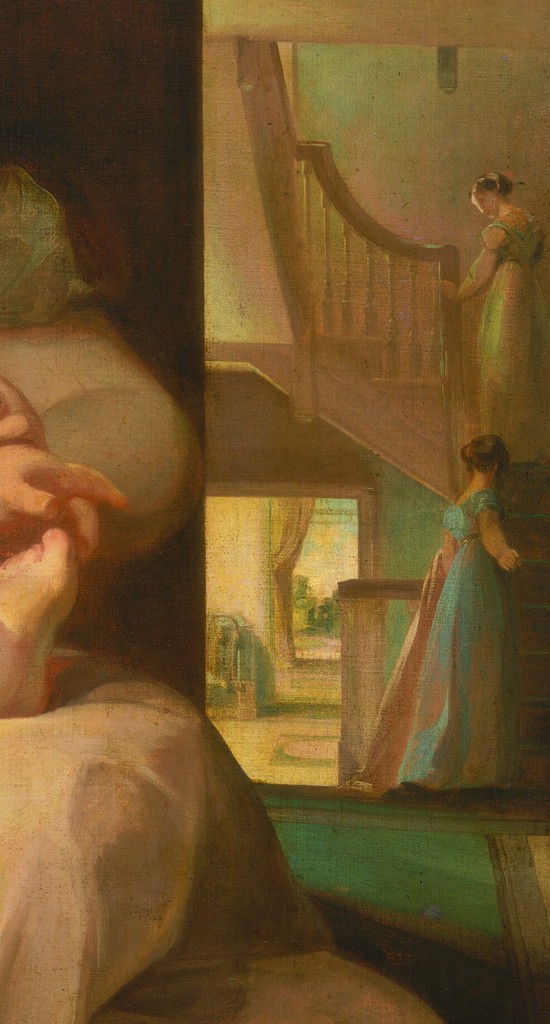
The room’s most surprising feature is the narrow opening at the right. Beyond the close foreground group, the space recedes through a sequence of walls, steps and landings. Two women appear at different levels of the staircase, making its depth legible through their relative scale and position.
Their small figures create a contrast with the children’s bodies. The foreground seems close enough to touch, while the stairway draws the eye far into the house. The bright vertical passages at the right prevent this secondary area from disappearing entirely into darkness. Looking between the two spaces changes the apparent scale of the whole scene.
The NGA catalogue relates the interior to the David residence on Walnut Street in Philadelphia. It records the period address as 173 Walnut Street, later renumbered 711. The numbering change matters if the painting is connected with the building’s history; using the later number as though it were the 1826 address would obscure that chronology. [2]
The background figures are not securely identified in this account. Their presence should not be converted into an assumed family relationship or occupation. Within the composition, what can be seen clearly is their role in measuring the depth of the interior and extending the scene beyond the tightly gathered children.
Studies, revisions and a family of painters
The catalogue records preparatory work for the portrait and reports that X-radiography revealed a change to Julia’s arm. This is evidence that the final relationship of limbs was adjusted, rather than simply transferred without revision from a single completed sketch. [2]
It also notes that Sully’s daughter Jane later copied studies of two of the children. That is a separate activity from making the large 1826 group, but it helps show how family portraits could generate further images. The original commission did not necessarily end the usefulness of a study or the family’s interest in having a likeness repeated. [2]
Jane appears as the mother in Sully’s Mother and Son . Remembering her work as a painter creates a useful connection between the two pages: she belonged to the practice of portrait making as well as to the circle of family members represented by her father. The later painting should not reduce her to a passive presence in that professional world.
The surviving object and its museum history
The technical record published in 1998 describes lining, earlier repairs and other interventions in the canvas. It also records alterations to the signature and evidence that the bottom edge may have been slightly reduced. These findings belong to the history of the physical object, not to a judgement that every visible irregularity originated with Sully. [2]
The current NGA provenance identifies the painting with the Chester Dale bequest in 1963. Its accession number begins 1948, but that number alone should not be used to override the museum’s more specific ownership record. Earlier stages of its passage through dealers contain uncertainties that remain in the Gallery’s account. [1]
Compared with The Vanderkemp Children , this is a much more spatially expansive family portrait. The Vanderkemp siblings gather around one portfolio against a relatively compressed background. Here, Sully brings the infant forward while opening the house behind him. The closeness of family contact and the depth of the surrounding room become two connected experiences of the same painting.
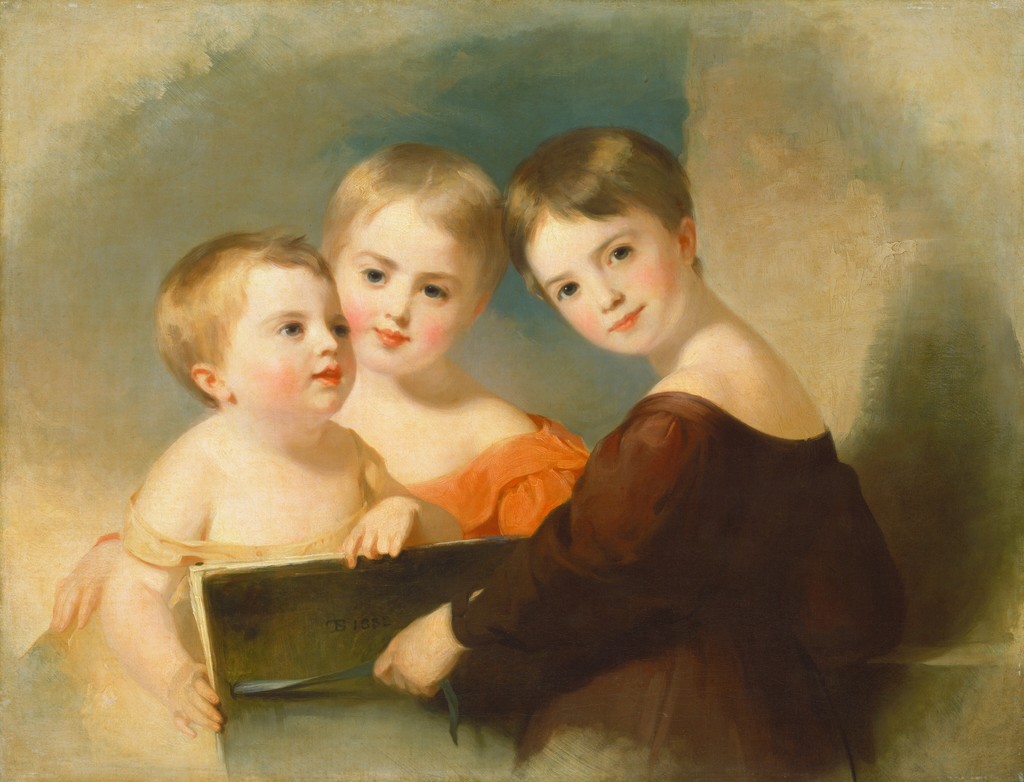
Thomas Sully, The Vanderkemp Children, 1832. Left to right: John Jacob, Jr., Bertha Frances and Pauline Elizabeth. Oil on canvas, 70.9 × 90.5 cm. National Gallery of Art, Washington, Gift of Countess Mona Bismarck, 1966.11.1. CC0.
Image source
.
CC0; National Gallery of Art Open Access
.
Artworks directory
A selection documented in the linked articles, with related studies and a print after Sully listed separately. Dates identify individual objects; Musidora’s date range does not imply continuous work. This is not a catalogue raisonné. The Drawing filter includes watercolour and reproductive printmaking.
| Name | Date | Medium |
|---|---|---|
| Captain Charles Stewart | 1811–1812 | Painting — oil on canvas |
| George Frederick Cooke as Richard III | 1811–1812 | Painting — oil on canvas |
| Musidora | 1813–35; Met panel | Painting — oil on wood |
| Lady with a Harp: Eliza Ridgely | 1818 | Painting — oil on canvas |
| The Passage of the Delaware | 1819 | Painting — oil on canvas |
| The Torn Hat | 1820 | Painting — oil on panel |
| Portrait of the Artist | 1821; Met canvas | Painting — oil on canvas |
| John Quincy Adams | 1824; NGA oil study | Painting — oil on canvas |
| John Quincy Adams (watercolour study) | 1824; Met 38.146.1 | Drawing — watercolour, black chalk and graphite on paper |
| John Quincy Adams (Durand after Sully) | 1826; PAFA 1876.9.184a | Drawing — etching and engraving on paper |
| The David Children | 1826 | Painting — oil on canvas |
| The Vanderkemp Children | 1832 | Painting — oil on canvas |
| Queen Victoria | 1838; full-length Met canvas | Painting — oil on canvas |
| Queen Victoria (life study) | 1838; Met 14.126.1 | Painting — oil on canvas |
| Mother and Son | 1840; inscription date | Painting — oil on canvas |
| The Coleman Sisters | 1844 | Painting — oil on canvas |
| Andrew Jackson | 1845; after the 1824 life portrait | Painting — oil on canvas |
Frequently Asked Questions
They are Julia, Ferdinand and Stephen David, children of Jean Terford David and Mary Sicard David. [2]
It is a family portrait. Scholars have compared the infant’s pose and grouping with religious imagery, but that is an interpretation rather than the identification of its sitters as biblical figures. [2]
The catalogue identifies a coral-and-bells toy and discusses its historical associations. [2]
It belongs to the National Gallery of Art in Washington, Chester Dale Collection, accession 1948.13.1. [1]
Discussion
Look again at the images and ideas explored in The David Children by Thomas Sully. These editorial prompts invite your observations.
Reader Insights
Trace the chain of hands and arms. How does it direct attention toward the infant?
What happens to your sense of scale when you look from the children to the distant staircase figures?
Compare this painting with The Vanderkemp Children. How does Sully use the surrounding space differently in the two family groups?
Join the Conversation
Share a detail, comparison or question about The David Children by Thomas Sully below.
References
- National Gallery of Art Open Data: current object record for The David Children , object 34957, 1948.13.1. Museum object page. View source 1 · View source 2
- National Gallery of Art: American Paintings of the Nineteenth Century , Part II, 1998, pp. 165–168. View source
- Pennsylvania Academy of the Fine Arts, George Frederick Cooke as Richard III, 1811–1812, 1812.1. View source
- Metropolitan Museum of Art, Musidora, 1813–35, 21.48. View source
- National Gallery of Art, Open Data: selected Sully object and published-image records. View source
- Wikimedia Commons / MFA image source, The Passage of the Delaware: original image and PD-Art record. View source
- Wikimedia Commons / MFA source image, The Torn Hat: 16.104 image and PD-Art rights. View source
- Metropolitan Museum of Art, Portrait of the Artist, 1821, 94.23.3. View source
- Metropolitan Museum of Art, Queen Victoria,1838,2021.140. View source
- Metropolitan Museum of Art, Mother and Son, 1840, 14.126.5. View source
- Splash image source.
Thomas Sully, The David Children, 1826. Julia, Ferdinand and Stephen David. Oil on canvas, 87 × 112.4 cm. National Gallery of Art, Washington, Chester Dale Collection, 1948.13.1. CC0. CC0; National Gallery of Art Open Access .
View source