 View the object record
at the Frick Collection
Private collection. Public-domain image via Wikimedia Commons.
 by Tom Gurney
Tom Gurney BSc (Hons) is an art history expert with over 20 years experience
Published on June 19, 2020 / Updated on August 29, 2026
Email: tomgurney1@gmail.com / Phone: +44 7429 011000
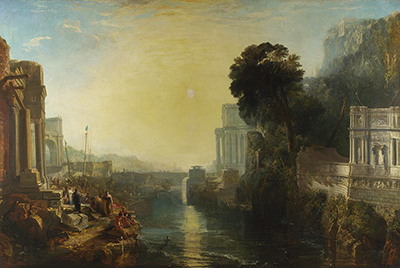
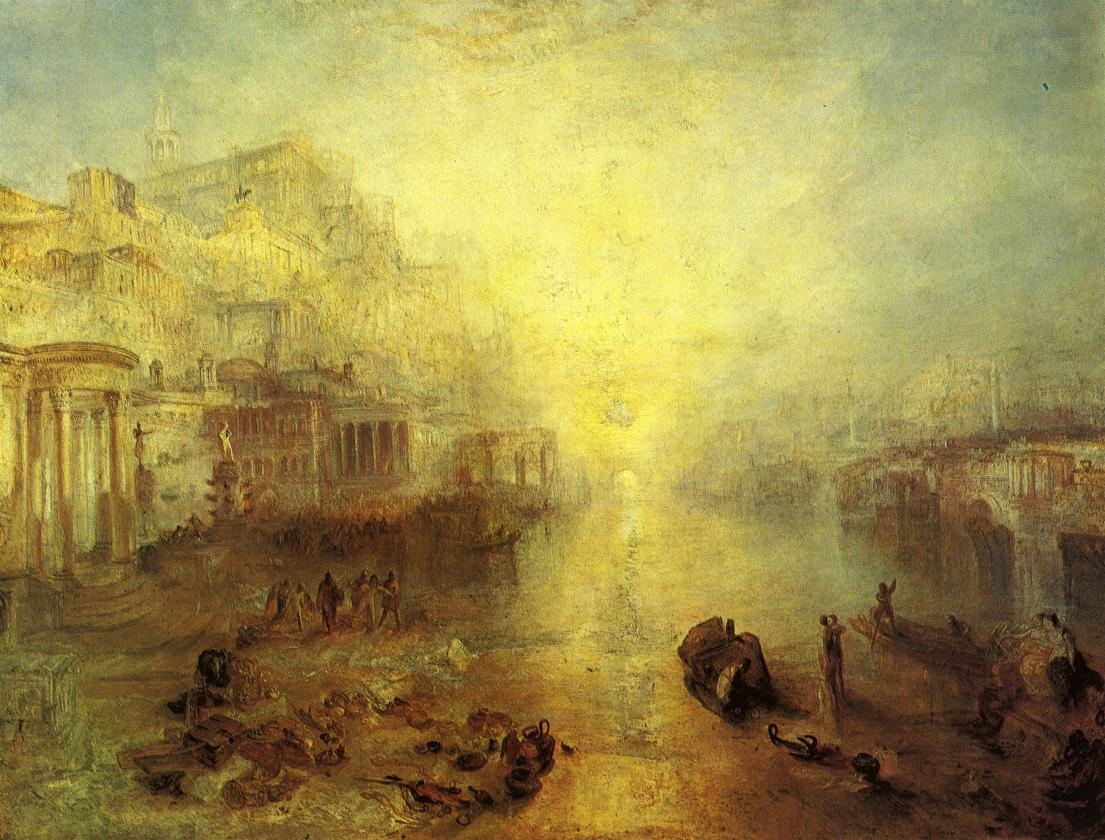
J. M. W. Turner's Ancient Italy - Ovid Banished from Rome is a painting about losing a place at the instant when it appears most desirable. Rome rises beside a luminous river, crowded with temples, arches, statues and human life. A low sun burns near the centre of the composition, throwing a road of reflected light across the water. Boats pass through the radiance. People gather on both banks. Yet the title turns this abundance into an image of separation: the city belongs to the poet who must leave it, and its beauty becomes the measure of his exclusion.
Turner exhibited the oil at the Royal Academy in 1838. It measures 94.6 by 125 centimetres and is now in a private collection. The original catalogue listed it as number 192 under the title Ancient Italy - Ovid banished from Rome. No explanatory verse followed the entry.[1][6] The subject was the Roman poet Publius Ovidius Naso, ordered by Augustus in AD 8 to live at Tomis on the Black Sea. Ovid never returned. His poems from banishment made his departure, his distant survival and his hoped-for remembrance into one of antiquity's most enduring accounts of political displacement.[8][15]
Turner does not reconstruct one documented instant. Ovid's remembered final departure occurred at night and toward dawn; the painting gives him a sunset. His legal punishment allowed preparation and preserved his property, while a small figure at the left appears to be hurried or restrained. Ovid died years later at Tomis, but a tomb bearing his name already stands within Turner's Rome.[4][9] These contradictions are purposeful. The painting folds the poet's last night, his years of writing abroad, his anticipated death and his literary survival into a single radiant farewell.
That compression gives the work unusual emotional range. It can be approached as a classical landscape, an account of imperial power, a meditation on memory, a response to Ovid's Tristia, and a picture about what art preserves when authority controls where a person may live. Its light is magnificent without being consoling. The sun does not rescue Ovid from exile. It makes the world he is losing impossible to ignore.
The Moment Before Rome Is Lost
The title supplies the action, but Turner refuses the clarity of a theatrical climax. There is no monumental Ovid at the centre, no enthroned Augustus issuing a sentence and no emphatic gesture that explains every surrounding figure. Instead, a minute human event occurs at the lower left while Rome and its river fill almost the entire field. The imbalance is the first source of the painting's power. One person's removal is nearly invisible against the city that has authorised it.
This does not make Ovid unimportant. His smallness defines the scale of what he confronts. The architecture climbs in successive terraces until individual buildings become a pale accumulation. The population spreads along embankments and through boats. The river carries traffic beyond the immediate drama. Rome appears able to continue without the poet, which is precisely the cruelty of banishment: the expelled person experiences rupture while the centre maintains its ordinary motion.
The sun changes that apparent indifference. Placed close to the middle, it illuminates the whole city as though Rome were being fixed in memory at the instant of departure. The reflection stretches toward the viewer, while the banks curve and the boats recede into haze. Ovid's direction of travel remains uncertain, but the light establishes an emotional vector. Everything pulls back toward the city even when movement must lead away from it. The landscape gives visible form to attachment under compulsion.
The Frick Collection describes the architecture as a display drawn from different Roman periods and stresses uncertainty over Ovid's exact location. It also identifies the setting sun with final farewell and with the ending of a golden age.[1] Those observations help explain why the image feels at once historically expansive and personally immediate. Turner is not asking where a single ancient street ran. He is constructing the total Rome an exile might carry in the mind: sacred, imperial, domestic, crowded and already becoming the past.
The painting therefore begins where ordinary departure scenes end. Luggage, boats and farewell gestures are present, but travel is not the main promise. The journey offers no new freedom and no chosen destination. It is a state punishment whose deepest effect is imaginative. Rome becomes most complete when possession of it has become impossible. Turner's sunset holds that painful threshold open.
What the Eye Meets
The canvas is almost square by the standards of many of Turner's panoramic works, yet it generates an extraordinary breadth. Sky and water form two luminous expanses divided by a low, crowded horizon. On the left, architecture rises sharply from the river. On the right, buildings and figures remain lower, allowing the distance to open. A bright central interval joins rather than separates the two halves.
The lower left is dense with information. A round-columned temple stands close to the edge. Steps, walls and terraces create several levels of movement. Figures gather in compressed groups, and a cluster near the water appears to conduct someone toward a vessel. Boxes, cloth, vessels, shields and other possessions scatter across the foreground. Some lie in shadow, some catch yellow or pale highlights, and many resist exact identification. Their abundance suggests a household broken into portable things.
Farther left and above, the city multiplies. Colonnades sit over arches; statues and vertical accents rise among roofs; towers interrupt the haze. Turner's forms are precise enough to evoke Roman magnificence but unstable enough to avoid becoming an architectural inventory. Openings repeat across the mass, carrying light through structures that might otherwise become an opaque wall. The city seems both built and atmospheric, enduring and already dissolving.
The centre belongs to the sun and river. A vertical band of reflection moves down the water, broken by ripples and boats. Distant vessels emerge as dark marks within brightness. Their minute scale enlarges the space, while their ordinary activity prevents the setting from becoming an empty dream. The water is a working channel as well as a symbolic boundary.
Turner controls the transition between the immediate bank and the remote city through intervals rather than a single recession. A dark object projects from the lower edge; pale goods lead to the apparent departure group; boats mark successive distances; arcades repeat smaller openings above them. Each scale change asks the eye to pause. The sun may command first attention, but the narrative emerges only through repeated movement between radiance and obstruction. Looking becomes analogous to recollection: a total impression arrives quickly, while its human causes are recovered slowly.
At the right, boats approach or wait near the bank. Figures stand, bend, embrace or turn toward one another. One dark frontal craft interrupts the reflection; longer vessels extend laterally behind it. A woman appears to bend in grief, while nearby people support or gather around other bodies. Frick scholarship has related these groups to separation, love and transformation across Ovid's writings, but no complete cast list can be recovered from the forms.[4] Their partial legibility matters. Ovid's poetry enters the landscape as a field of human relations, not as a row of labelled personifications.
Different reproductions alter the apparent red, gold and yellow balance. The current public-domain image replaced a markedly warmer version after concerns about inaccurate colour.[5] The stable evidence lies in structure: the centred sun, broad reflection, pale distance, dark foreground intervals and architecture lifted into radiance. Exact digital colour values cannot stand in for examination of the private oil.
Contents
- The Moment Before Rome Is Lost
- What the Eye Meets
- A City Built from Memory
- The Led Figure
- Possessions on the Shore
- Figures Across the Water
- The Sentence of AD 8
- Carmen et Error
- Relegation and Pictorial Violence
- The Last Night in Tristia 1.3
A City Built from Memory
Turner's Rome is persuasive because it refuses archaeological consistency. It gathers temples, bridges, arcades, funerary monuments, palatial masses and river buildings into an urban vision larger than any single viewpoint could contain. The Frick catalogue calls attention to its mixture of periods.[1][3] Ancient Italy is not represented by one surviving ruin. It is imagined as an accumulation of histories still alive at the hour of Ovid's departure.
Nineteenth-century commentators tried to map the view. They proposed the Tiber as the river, the Aventine on the left, the old Pons Sublicius in the distance, a form related to the Mausoleum of Augustus or Castel Sant'Angelo on the right, and the Temple of Vesta farther away. Such readings show how strongly Turner's inventions evoke known Rome, but they should remain proposals. The forms do not settle into a consistent surveyed panorama.[20]
This topographical instability is especially appropriate to exile. Memory does not preserve a city as a measured plan. It selects, combines, enlarges and illuminates. Sacred buildings may stand beside monuments from another age; an embankment may carry several remembered routes at once. Turner's city operates according to emotional proximity. What matters most gathers into view.
The approach also lets Rome embody more than private nostalgia. Temples establish religious belonging. Arches and immense terraces indicate political power. Crowds and river commerce give the capital social and economic life. The tomb introduces remembrance and death. Ovid is not merely losing a beautiful skyline. He is being removed from the civic structure in which worship, patronage, readership, household and reputation had meaning.
Augustus is absent, yet imperial authority permeates the city. The emperor's decision does not require his bodily appearance because Rome itself carries the force of the sentence. Its monumental order contrasts with the loose possessions and pressured movement below. The city can hold a poet's books and fame while refusing his body. Architecture becomes the durable face of power, even as Turner's haze makes that durability visually uncertain.
The result differs from a ruin picture. This Rome is active, populous and richly built. Turner imagines antiquity before its visible collapse, but the sunset and tomb make later loss unavoidable. The viewer knows that Ovid will die abroad and that the civilisation around him will itself become historical memory. The painting gives ancient life the atmosphere through which modern viewers usually approach remains. Flourishing and elegy occur simultaneously.
The density of the left bank also challenges a familiar division between ideal landscape and urban history. Nature does not provide a peaceful escape from politics. Water, sky and sunlight intensify the authority of the built capital by making it appear almost cosmically favoured. Conversely, the architecture does not master atmosphere: upper forms fade, edges loosen and stone becomes coloured vapour. Rome is powerful enough to expel Ovid yet incapable of escaping time. Turner lets political permanence and material transience occupy the same forms.
The Led Figure
Near the left bank, a small cluster contains the figure most often identified as Ovid. He seems to be guided, pulled or hurried toward the water. The action is easy to miss because the figures are minute and surrounded by objects, steps and other groups. Turner makes recognition depend on the title, then leaves the visual evidence open enough to sustain doubt.
The Frick interpretation explicitly asks whether this is Ovid and notes that the apparently forceful removal conflicts with the legal conditions of his punishment.[1][4] That discrepancy is not a trivial error to be repaired by inventing guards or an arrest record. It opens the difference between law and experience. A sentence can preserve citizenship and property while still destroying a person's life at the centre.
If the led figure is Ovid, he is not given the body of a conventional history-painting hero. His scale is closer to the boats, containers and anonymous workers around him than to the towering city. No profile or costume secures his identity. His significance comes from relation: to the figures directing him, to the belongings on the ground, to the vessel and to the Rome behind him.
If the figure is not definitively Ovid, the painting becomes no less specific. His story is distributed across the scene. The inscribed tomb names him. The possessions imply departure. Mourning and paired figures extend the emotional language of his poetry. The sunset establishes finality. Ovid may be less a single body to find than the consciousness through which the whole city is seen.
That possibility fits the exile poems. Ovid repeatedly turns his own person into a literary figure, addressing his books, wife, friends, emperor and distant readers. He is physically at Tomis while his language returns to Rome. Turner similarly separates presence from identity. A tiny body may be departing at the bank, while the larger Ovid exists in the painting's structure of remembrance.
The ambiguity also prevents melodrama from becoming too easy. A large bound poet could reduce the political event to recognisable victim and villain. Turner's reticence asks the viewer to notice how exclusion works within a functioning society. The river traffic continues, the crowds remain occupied and the sun still shines. The violence lies partly in how small a state-imposed catastrophe can look from the scale of a capital.
Possessions on the Shore
The scattered foreground objects turn an imperial sentence into material disruption. Chests, textiles, containers, metal forms and possible shields lie between the city and water. They have not yet become an orderly cargo. Their uneven placement makes the bank resemble a household opened and dispersed under pressure.
Ovid's penalty allowed him to retain property, and his departure was not the total confiscation associated with the harshest form of exile.[9][10] That legal distinction gives the objects a particular force. They are not necessarily plunder. They represent the painful permission to carry fragments of a life that cannot be carried whole. Ownership remains while belonging is withdrawn.
Turner does not let the objects become a decorative still life. Their angles interrupt the bank, and their highlights lead the eye between the apparent departure group and the tomb. Some forms may suggest wealth or cultivated domesticity, but exact labels are risky. The visual truth is accumulation: too much to absorb quickly, too little to substitute for Rome.
The goods also slow narrative time. A vessel may wait, yet packing appears incomplete. Ovid's Tristia describes delay, numbness and repeated inability to prepare for leaving.[11] Turner's scattered belongings are not a literal transcription of that poem, but they provide a material equivalent for suspended action. The sentence has been issued; departure must happen; the mind and household cannot make themselves ready.
Within a classical landscape, such ordinary things are striking. Temples and statues usually claim the dignity of history. Here, containers and folded matter occupy the nearest zone. They insist that political power reaches into rooms, clothing, tools and intimate possessions. Banishment is not only a line on an imperial decree. It reorganises every object according to whether it can accompany the condemned person.
The objects further connect visual art with Ovid's concern for books. His exile poetry repeatedly imagines texts travelling where he cannot. A written volume is the ideal portable possession: physically small, able to cross boundaries and capable of representing an absent author. Turner does not need to identify a painted box as a library. The whole foreground asks what can be transported when a civic identity cannot.
Scale turns the belongings into a counter-city. Rome is vertical, integrated and apparently permanent; the goods are low, separated and exposed. One represents a social world assembled over generations, the other a life reduced to movable units. Yet the portable objects have their own future. They can cross the water, be handled, opened and rearranged. The contrast is not simply monument against debris. It asks whether continuity belongs to fixed structures or to the smaller things, including books, that can survive displacement by travelling.
Figures Across the Water
The right side answers the pressured departure at the left with a looser theatre of human attachment. Boats overlap near the bank, and people gather in relationships that are emotionally legible without becoming narratively fixed. A bent woman appears to mourn. Another figure supports or approaches her. Elsewhere, bodies pair or embrace. These incidents carry grief, care, desire and separation across the luminous water.
Scholarly discussion associated with the Frick exhibition links the figures with several parts of Ovid's career: the Tristia, Heroides, Amores, Ars amatoria and Metamorphoses.[3][4] This does not mean that Turner supplied an exact emblematic programme. Rather, the groups evoke the kinds of bond that Ovid's poetry repeatedly explores: abandoned women, uncertain lovers, bodily change, erotic instruction and the grief of forced distance.
The Heroides is especially resonant as a collection of letters spoken by mythic women separated from absent men. The exile poems reverse and extend that premise when Ovid writes across distance to his wife and friends. The right-bank figures can therefore function less as illustrations of named heroines than as a chorus of relationships endangered by departure.
Their placement is important. They do not cluster around the apparent Ovid at the left. Water and light separate them. The river turns emotional connection into something visible but difficult to reach. People can see, call, wait or travel, yet the space remains open between them. Turner's broad central brightness is both a link and an interval.
The boats intensify that double meaning. A boat offers passage, but Ovid's journey is compelled. It can carry bodies and possessions while confirming separation from shore. Some vessels head into the light; others sit darkly against it. No single craft becomes a secure symbol of freedom. Mobility is governed by destination and power.
The right-hand incidents also prevent the painting from becoming solely a biography of one celebrated male poet. Women who mourn, support and embrace occupy a substantial emotional zone. Ovid's wife, left in Rome, was central to his appeals and to his imagined survival. Turner broadens her position into a community of attachment. Exile damages more than the person named in the decree.
Turner's distribution of attention complicates the traditional hierarchy of historical action. The person whose name appears in the title is hard to identify, while anonymous women and boatmen remain more visibly active. Some steady bodies, some wait, some negotiate the shore. Their gestures register consequence rather than cause. Imperial history is thus understood from below, through the work of accompanying, carrying, grieving and remaining. The canvas does not document these individuals, but it grants them the emotional knowledge that official decree leaves unstated.
The Sentence of AD 8
Publius Ovidius Naso was born at Sulmo in 43 BCE, the year after Julius Caesar's assassination. He belonged to the generation whose adult life unfolded under Augustus, when civil-war memory, imperial stability, moral legislation and literary patronage reshaped Roman culture. By AD 8 he was one of Rome's most famous living poets.
Augustus then ordered him to Tomis, a Greek-founded settlement on the western shore of the Black Sea. The decision appears to have been imperial rather than the result of an ordinary public trial. Ovid retained citizenship and property, but he was required to reside far from Rome. He died at Tomis in AD 17 or 18, after repeated appeals failed to secure recall.[8][9]
Tomis was not outside the empire, yet Ovid presented it as the extreme margin of the Roman world: cold, exposed to conflict, linguistically alien and painfully distant from the capital. Modern scholarship warns against taking every description as neutral geography. The bleakness forms part of a poetic strategy designed to move readers and influence powerful intermediaries.[8][15] Even so, physical distance and political exclusion were real.
The punishment joined imperial power to control of space. Augustus did not silence Ovid completely. The poet continued writing, and his works circulated. Instead, authority determined where his body could live and which social networks he could inhabit directly. The sentence produced a divided existence in which literary presence at Rome coexisted with physical absence.
Turner's composition makes that division spatial. The city is visible in almost impossible fullness, while the poet's body is minute and uncertain. Rome can possess the poems while expelling their author. The river becomes the boundary across which reputation, messages and images may travel more easily than the person who created them.
The choice of Ovid also complicates any simple opposition between innocent artist and crude tyrant. His poetry had engaged provocatively with elite Roman sexual life, gender, mythology and Augustan values. The cause of the sentence remains unresolved. Turner does not solve the ancient scandal. He concentrates on the condition produced by punishment: compelled departure from the world in which identity had been made.
The geographical distance was formidable. A journey from Rome toward the western Black Sea passed through multiple regions and transport stages before reaching an exposed frontier settlement. Turner does not map that itinerary. He concentrates all travel into the first crossing, when destination is still an idea and Rome remains visible. This choice protects the painting from anecdotal adventure. Its subject is not what Ovid encountered along the way but the irreversible conversion of home into a place seen from elsewhere.
Carmen et Error
Ovid's own phrase for the cause was carmen et error, “a poem and a mistake,” in Tristia 2.207.[10] The concise formula has invited two thousand years of speculation because it names one element while withholding the other. The poem is usually identified as the Ars amatoria. The error remains unknown.
The Ars amatoria offered sophisticated instruction in erotic pursuit. Its playful expertise sat awkwardly beside Augustus's programme of marriage and sexual morality, even though the work had circulated for years before AD 8. Ovid later represented it as a source of imperial offence and tried to defend the wider moral character of his writings.[8] That defence was itself part of an appeal for clemency.
The mysterious error has generated hypotheses involving the imperial family, political knowledge, accidental witnessing or participation in scandal. Ovid's language elsewhere suggests that he saw something, but does not identify it securely. A responsible account must preserve that uncertainty. Naming a particular affair or conspiracy would offer narrative satisfaction at the cost of evidence.[10]
Turner wisely excludes the alleged offence. There is no retrospective scene of erotic instruction, court intrigue or imperial discovery. The painting begins with consequence. This keeps attention on exile without pretending that the historical puzzle has been solved. The missing cause becomes another absence within an image already structured by distance.
The relationship between poetry and authority nevertheless remains central. A poem could survive, circulate and attract blame long after composition. Augustus could control the poet's residence but not entirely determine how later generations interpreted either the work or the sentence. Ovid's phrase ensured that uncertainty itself became part of his literary monument.
Turner's treatment extends that afterlife. The emperor is not visible, whereas Ovid's name is inscribed in the foreground and his story titles the canvas. Imperial Rome fills the landscape, but the expelled poet supplies its human meaning. Over time, the sentence meant to remove Ovid from the centre helped make exile inseparable from his fame. The painting does not erase Augustus's power; it shows how art can alter the terms in which power is remembered.
Ovid's pre-exile range makes that fame especially important. The Amores refined elegiac love poetry; the Heroides invented letters for abandoned mythic women; the Ars amatoria turned desire into urbane instruction; the Metamorphoses organised a vast mythological history around change; the Fasti tied Roman ritual to the calendar. Banishment did not begin his identity as a poet. It forced an already diverse career to reinterpret itself from the margin, and it encouraged later readers to find loss even within works composed before the sentence.
Relegation and Pictorial Violence
Roman law distinguished Ovid's relegatio from the more complete civil death associated with exilium. He retained citizenship and property, and the emperor's decree did not designate him an exul in the strict sense. Ovid acknowledges the distinction in Tristia 2 while continuing to describe his experience through the emotional vocabulary of exile.[9]
This precision matters because the left-hand action in Turner's painting appears harsher than the surviving record. A figure seems to be conducted forcibly toward a vessel. If interpreted as a literal arrest, the episode risks misleading. The legal sentence permitted preparation rather than documenting soldiers dragging the poet from home to boat.
The tension can be read differently. Joanna Sheers Seidenstein, discussing the painting for the Frick exhibition, proposed that Turner externalised an internal reality: Ovid experienced banishment as violence comparable with death.[4] The apparent force converts psychic and social compulsion into bodily action. What the decree made inevitable becomes visible as pressure on a small human figure.
Such transformation belongs to history painting. Turner did not witness ancient Rome, and he was not bound to illustrate administrative procedure. His task was to make the meaning of relegation apprehensible. The scattered goods, crowd, boat, tomb and radiant city together show that a formally limited punishment could still amount to destruction of a former self.
The distinction also clarifies the painting's politics. It does not need to allege secret physical brutality in order to question imperial power. Authority can devastate through lawful decisions, controlled residence and social removal. The calm city and beautiful light make that mechanism more disturbing, not less. Violence is embedded in order.
At the same time, Ovid's self-presentation was strategic. His poems magnify suffering because they seek sympathy, patronal intervention and recall. Turner inherits a literary persona already shaped by persuasion. The painting should not be treated as independent proof of every claim in the Tristia. It is a nineteenth-century response to an ancient poet's highly accomplished account of his own punishment.
The Last Night in Tristia 1.3
The third poem of the first book of Tristia remembers Ovid's final night in Rome. It is one of the crucial literary contexts for Turner's picture because it turns departure into a sequence of failed preparations, repeated farewells and broken attachments. Dickinson College's text, translation and commentary reveal how carefully the elegy orders memory rather than simply recording events.[11]
Ovid begins from the later pain of recollection. The night returns to him whenever he remembers leaving the things he loved. He describes numbness and delay, comparing himself with a person struck by lightning who remains unaware of injury. Practical action is overwhelmed by disbelief. He has had time to prepare, yet the household is not ready.
Only a few friends remain. His daughter is away, and his wife weeps and clings to him. Servants mourn as though a funeral were taking place. The domestic interior becomes a house of death before anyone has died. That fusion of household and funeral is one origin of Turner's scattered possessions and memorial imagery, though the painting transfers the scene outdoors.
Ovid looks toward the Capitol and addresses the gods of Rome. The city is not merely architecture seen from a departing road. It is a sacred order from which he is being separated. Turner enlarges this devotional glance into an entire urban vision. Temples multiply at the left, and the setting light makes every structure appear available to sight at once.
The poem unfolds through night toward approaching dawn. Friends urge that departure can no longer be delayed. Ovid tears himself from embraces, returns to speak again and struggles to move. Turner replaces this darkness with sunset. The change condenses lateness, ending and remembrance into a form landscape can sustain. It is faithful to emotional time while departing from clock time.
The result is not an illustration of one stanza. It is an atmospheric translation of the whole elegy's pressure. The city remains behind; family and possessions are disordered; movement becomes unavoidable; death imagery enters a living departure. Turner recognises that Ovid's most important landscape is the Rome reconstructed by the exile after he has lost it.
The elegy's retrospective voice is essential. Ovid does not give readers unmediated access to the last night; he tells it after distance has changed its proportions. Repetition, comparison and remembered gesture turn a private departure into a scene capable of addressing strangers. Turner adopts an equivalent distance. He paints neither from Ovid's time nor directly from Rome, but from later knowledge shaped by text and travel. Both works make memory productive while allowing it to remain visibly constructed.
Wife, Troy and a Living Funeral
Ovid's wife is the emotional centre of Tristia 1.3. She begs to accompany him, declares that his destination will also be hers and collapses when departure can no longer be postponed. Ovid leaves her at Rome, where she will act as advocate, custodian of his interests and recipient of poems. Separation creates duties on both sides of distance.[11]
Turner may echo her grief in the bent and supported figures at the right, but a one-to-one identification would be too firm. The painting broadens the wife's position into several forms of attachment. Women mourn, embrace and assist. Their bodily relations show what the sentence cuts across: marriage, household, friendship and erotic memory.
The poem repeatedly compares departure with death. Ovid's household performs mourning, and he imagines himself carried away like a corpse denied proper burial. Modern studies of the exile corpus describe this as a condition of living death.[9][14] The person continues to write and breathe while the former civic identity has ended. Turner's tomb makes the metaphor architectural.
The comparison with Troy deepens the structure. Ovid likens the household uproar to the fall of the Trojan city. Yet his Rome is not burning. Its walls, temples and people remain. The catastrophe is selective: the city is lost only to the person forced to leave it.
Commentary on the poem identifies an inversion of Aeneas. Virgil's hero escapes destroyed Troy bearing family obligations and sacred continuity toward the future foundation of Rome. Ovid leaves the completed city, cannot take its gods or his wife, and travels away from the imperial centre.[11] Turner places that reversed epic within a landscape shaped by Claudean grandeur. The small exile moves against the monumental history that Aeneas was destined to create.
This inversion changes the meaning of heroism. Ovid does not conquer, found or return. His achievement is to write from exclusion and make private grief durable. Turner responds with an image in which no heroic body commands the view. The city receives epic scale, but the poet's vulnerable absence governs its significance.
Tomis and Writing Back to Rome
After the journey east, Ovid lived at Tomis on the Black Sea. From there he produced five books of Tristia, four books of Epistulae ex Ponto and the invective Ibis. The poems address Rome persistently: the emperor, members of the imperial household, friends, patrons, his wife, readers and the poet's own books.[8][15]
This writing made distance an active literary form. Letters and poems could travel where the author could not. A book could enter Rome, approach powerful readers and plead without exposing its creator's body to the forbidden city. Ovid sometimes speaks to a volume as though it were a traveller more fortunate than himself.
Turner's river and boats give this divided mobility visual form. Vessels cross the central light and connect banks, but the named exile's movement is compulsory and one-directional. Goods can be carried; messages can return; the poet cannot. The distinction between transport and belonging runs through the composition.
Ovid's Tomis is intensely literary. He describes severe cold, hostile peoples, unfamiliar speech and constant danger. Scholarship reads these claims in relation to elegiac convention and the practical aim of persuading Rome that his punishment was unbearable.[8] Recognising artifice does not cancel suffering. It shows how suffering was shaped into an appeal capable of crossing distance.
The appeals failed. Augustus died in AD 14 without recalling him, and Tiberius did not reverse the decision. Ovid died at Tomis a few years later. The exile poems therefore changed from petitions with a possible practical outcome into the enduring record of non-return.
Failure alters the poems without making their appeals pointless. Each address re-establishes a relationship that geography and policy had weakened. Named friends are reminded of obligation; the wife receives praise and instruction; future readers are asked to judge the punishment. Language creates a social Rome parallel to the inaccessible physical one. Turner's crowded city can be read in that light: not only as what Ovid lost, but as the network of listeners his verse repeatedly tried to summon back into being.
Turner's sunset carries that knowledge backward into the departure. The viewer sees Rome with awareness that the separation will be permanent. Ovid at the bank may still hope for recall; the tomb and fading light deny that hope from historical hindsight. The painting joins the uncertainty of the departing man to the finality known by posterity.
A Tomb Before Death
At the lower left, close to the crowded shore, Turner places a tomb bearing Ovid's full name. Frick scholarship calls attention to this inscription and its strange temporal status.[1][4] Ovid had not died when he left Rome. He would die years later at Tomis. The monument therefore cannot belong to the literal moment represented.
Its impossibility is its meaning. Exile had already become a form of death in Ovid's poetry. By installing the tomb inside the city, Turner gives physical shape to the civic self that dies when the poet is removed. The living figure departs while a named memorial remains.
The tomb also answers a specific poem. In Tristia 3.3, ill and fearful of dying far from home, Ovid asks his wife to bring his bones back to Rome and bury them near the city. He supplies an epitaph for the passer-by.[12] Turner grants the wished-for Roman monument in imagination, but he does not paint the entire epitaph. The documented inscription is the poet's name, not a transcription of all his lines.
Modern classical scholarship reads Tristia 3.3 as a complex negotiation among exile, bodily death, memorial stone and poetic immortality.[13] The poem moves from anxiety about remains to confidence that Ovid's books provide a greater monument. A tomb can mark where a body lies; poetry can preserve a voice across regions and centuries.
Turner makes those forms of survival compete. The monumental city at left seems built to outlast any individual. Yet the viewer knows it as “Ovid's Rome” because the title and tomb place his story within it. Imperial buildings have become the setting for remembrance of a poet whom imperial power expelled.
The monument is easy to overlook amid the foreground abundance. That modest placement prevents it from becoming a simple triumph over Augustus. Ovid's absence remains painful and his historical grave uncertain. Posterity does not undo the sentence. It changes which name the scene ultimately preserves.
The tomb's closeness to luggage and movement prevents it from becoming a detached antiquarian object. Death stands among preparations for travel. A container can hold possessions; an urn or grave can hold remains; a book can hold a voice. Turner brings these different forms of custody together without making them interchangeable. Their shared question is what survives removal. The body is most vulnerable, objects may disperse, stone may decay, and language may outlast the civilisation that first received it.
Poetry as Monument
Ovid's claim that his books will be his lasting memorial belongs to a long Roman tradition of poetry imagining itself more durable than stone. In exile, that convention acquires practical urgency. His body may die beyond Rome, but the work already circulates through the city and can survive political exclusion.[12][13]
Turner's painting enters the same contest through another medium. It converts words written from Tomis into light, architecture, figures and distance. The result is not a portrait of the author's face. It is a memorial to his relation with Rome: the city desired, lost, addressed and remade in language.
The tomb therefore has two viewers. People within the imagined city could read the name as a civic memorial. Modern spectators read it while also seeing the departure it anticipates. We occupy a later time in which Ovid's books have survived both the emperor and the ancient city itself. The visual contradiction depends on that historical advantage.
Turner's own private painting has had a less continuous public life than works in the Turner Bequest. Engravings and exhibitions carried its image beyond successive owners. Its material history thus repeats, in a smaller way, the problem it depicts: an original object may be inaccessible while reproductions and interpretations travel.
Neither poetry nor painting abolishes exile. Art cannot return Ovid's years at Rome or place his known remains there. What it can do is resist the finality of imposed absence. The expelled person becomes present to readers and viewers who were never subjects of Augustus. Monumentality shifts from possession of territory to persistence of address.
Turner's Roman Education
Turner first travelled to Rome in 1819, when he was in his forties. He returned in 1828 and remained into 1829. These journeys supplied intense encounters with architecture, ruins, modern street life, museums, the Campagna and the changing light of the city. Yet his Roman imagination began long before direct travel.
Claude Lorrain's ideal landscapes, Richard Wilson's Italian views, reproductive prints, classical poetry and patrons' drawings had already taught British artists how Rome might be composed and remembered. Turner entered Italy with a dense visual archive. Travel allowed him to test that inherited Italy against observation rather than replace convention with simple topography.
By 1838 nearly a decade had passed since his second stay. Ancient Italy is therefore a work of recollection and synthesis. The mixed architecture is not evidence that Turner forgot what he had seen. It shows him using memory as an active method. Separate monuments and impressions are reorganised around one poetic event.
The Frick exhibition placed the painting among Turner's modern and ancient ports, emphasising how harbours and river edges let him stage passages through geography and time.[2][3] A port can unite arrival and departure, commerce and exile, antiquity and present viewing. In this canvas, the riverbank is where Rome becomes transportable as image but inaccessible as home.
Turner's first-hand knowledge also complicates the word “Ancient.” Modern inhabitants, contemporary travel and surviving fragments always mediated British access to Rome. The painter could not see Ovid's capital untouched. He created it through ruins, reconstructions, texts and the living city encountered in the nineteenth century.
That layered process suits Ovid, whose own memory of Rome was written from another place. Both poet and painter build the city after separation. Ovid's language arises at Tomis; Turner's oil arises in Britain after travel. Neither offers transparent presence. Their Romes are made vivid through distance.
Sun, River and Classical Landscape
The low central sun belongs to Turner's long dialogue with Claude, who often placed biblical or classical departures within radiant harbours. Claude's ordered intervals, framing architecture and distant light gave small figures historical grandeur by embedding them in a world larger than their action. Turner adopts that principle and pushes its illumination toward instability.
The sun is almost frontal. Its reflection descends through the river rather than merely lighting forms from the side. Buildings lose edges as they approach the brightness, while darker foreground objects gain abrupt highlights. The composition does not move neatly from solid near ground to clearly bounded distance. Water, air and stone exchange qualities.
Ralph Wornum's nineteenth-century account observed that the point of sight lies directly beneath the sun and that receding lines and cast shadows converge there.[20] This geometric concentration is crucial. The light is the organisation of space. Architecture, boats and water all submit to a luminous centre that is also the visual sign of ending.
The river amplifies the effect by interrupting reflection. Dark boats cross the bright path, and ripples fragment it into changing marks. Light promises a direction but never becomes a stable road. The eye can travel toward the sun more easily than any body can.
The canvas's moderate physical size sharpens this tension. At 94.6 by 125 centimetres it is substantial, but it does not envelop through vast scale. Turner creates immensity by compressing innumerable small forms around broad fields of air and water. Close inspection rewards attention to figures and possessions; stepping back lets them disappear into the general blaze. The viewer repeatedly experiences the relation between individual vulnerability and historical magnitude that defines Ovid's story.
Richard Wilson's broad Italian prospects offered another precedent for dignified landscape memory. Turner intensifies their atmospheric reach and narrative complexity. The city is not a background awaiting a figure. It is an active emotional field in which every architectural mass measures the exile's loss.
Exact colour descriptions must remain cautious because reproductions differ.[5] The secure point is relational: warm radiance against darker banks, pale distance against crowded foreground, brilliant reflection against boats and belongings. Turner uses contrast to make splendour and grief coexist. If the city were dim, departure would read chiefly as danger. Because it shines, exile becomes deprivation.
Ancient Italy and Modern Italy
At the same Royal Academy exhibition, Turner showed Modern Italy - the Pifferari. The Glasgow oil measures 92.6 by 123.2 centimetres, very close to the 94.6 by 125 centimetres of Ancient Italy. Butlin and Joll catalogued the modern subject as 374 and the Ovid canvas as 375.[16][17] Titles, scale and luminous Italian setting establish a deliberate conceptual pair.
The original catalogue reveals a qualification often lost in later summaries. Modern Italy was number 57, while Ancient Italy was number 192.[6][7] They occurred in different portions of the East Room sequence. Calling them companions is justified; claiming they hung side by side is not.
The modern picture centres pifferari, itinerant musicians associated with rural tradition and devotional performance. Their music and daily movement inhabit a contemporary landscape shaped by antiquity. Modern Italy is therefore not simply a fallen opposite to ancient magnificence. It asks how inherited culture continues through living, mobile and socially modest people.
The Ovid canvas approaches continuity from the other direction. Its ancient city is full and splendid, but an artist is being removed by imperial authority. Cultural greatness does not guarantee freedom for the maker. The companion picture shows tradition sustained outside monumental power; the ancient one shows power expelling a voice it cannot prevent posterity from hearing.
Munro of Novar came to own both oils, strengthening their later relationship. The acquisition history of Modern Italy is more complicated because Turner had made an arrangement involving Edward Thomas Daniell before the work passed to Munro.[19] The two should not be described as an uncomplicated simultaneous purchase unless documentation establishes that claim.
Turner returned to the ancient-modern pairing in 1839 with Ancient Rome; Agrippina Landing with the Ashes of Germanicus and Modern Rome - Campo Vaccino. The method allowed him to set imperial narrative against the lived afterlife of buildings and customs. The 1838 pair is distinct, but it establishes the productive tension: antiquity is understood through modern survival, and modern life remains crowded by antiquity.
The paired titles also change what “modern” and “ancient” mean. They are not neutral dates. Ancient Italy is reached through a literary crisis whose consequences continue into Turner's present, while modern Italy contains practices and landscapes marked by long inheritance. Time does not divide cleanly between the canvases. The pifferari carry tradition forward through performance; Ovid carries Rome forward through writing. Both subjects make culture depend on mobile people rather than on architecture alone.
The Royal Academy in 1838
The Royal Academy exhibition gave Ancient Italy its first public context and fixed the title by which its subject could be read. Catalogue number 192 names Ovid's banishment but offers no quotation or explanatory subtitle.[6][7] Turner expected viewers to bring, seek or infer enough classical knowledge to connect a minute departure with the Roman poet.
The absence of a verse matters because Turner sometimes attached poetry to exhibited landscapes. No fragment of his disputed “Fallacies of Hope” accompanies this entry. Adding one retrospectively would blur the secure evidence. Here the title and image carry the entire public programme.
The painting's bright, increasingly liberated handling challenged some contemporary expectations. A hostile review joked that Ovid should have been pleased to leave if Rome resembled Turner's version, then mocked the painter's transformation of natural colour through comparison with an exotic bird. The criticism records frustration with an art that treated colour as imaginative structure rather than local description.
Such attacks are useful only if kept in proportion. They do not demonstrate unanimous ridicule, nor do they settle how the fresh oil looked under the Academy's conditions. They show that Turner's late-classical landscapes could be perceived as excessive, artificial and difficult. What later viewers admire as atmospheric daring could appear to some contemporaries as an offence against nature.
The criticism also identifies a genuine feature while misunderstanding its purpose. Turner does “improve” or transform observed nature in the old artistic sense: he composes an ideal city, concentrates sunlight and makes colour answer to historical emotion. The Rome of AD 8 could not be recovered by optical fidelity. Invention is the means by which antiquity becomes psychologically present.
The Academy sequence placed Modern Italy and Ancient Italy within a much larger display rather than isolating them as a private diptych. Viewers encountered each among other works and at different points in the East Room. Their relationship had to be remembered across the exhibition, much as Turner's Italy itself was reconstructed across time and distance.
Munro, Private Ownership and Public Absence
Hugh Andrew Johnstone Munro of Novar bought Ancient Italy from the Royal Academy exhibition. He became one of Turner's most important collectors, owning roughly fifteen oils and 109 watercolours within a collection of about 2,500 works according to Sotheby's.[23] His patronage demonstrates that the painting's first life was not defined solely by hostile criticism.
Munro knew Turner personally and sought major examples across the artist's career. Ownership by such a collector placed the Ovid canvas within a private comparative environment, where it could be considered beside other Italian and atmospheric works. It also removed the picture from continuous public access.
At Christie's on 6 April 1878, offered as lot 96, it was bought by Agnew for 5,200 guineas and entered Kirkman Daniel Hodgson's collection. It later returned through Agnew, passed to the Paris dealer Charles Sedelmeyer and was acquired by Camille Groult. Lancaster's Turner records provide the fullest compact sequence.[18]
The Groult collection became known for major British paintings that were comparatively secluded. Martin Butlin's account of another Turner emerging from that collection describes how works could remain little seen while their reputations persisted through records and reproductions.[24] Ancient Italy descended through Pierre Bordeaux-Groult before passing through Wildenstein and Agnew in 1971, the Correa da Silva collection in 1973 and its present private ownership through Agnew in 1975.[18]
This history explains the canvas's intermittent visibility without turning absence into mystery. Private ownership involves loans, sales, inheritance and changing willingness to exhibit. It does not imply that the painting was lost. Catalogues, photographs, engravings and occasional displays maintained a public record even when the oil itself was unavailable.
The contrast with Turner Bequest works is important. Ancient Italy was sold in Turner's lifetime and never entered the national collection through his bequest. Its status is not a curatorial oversight at Tate. It belongs to a different ownership history, one that makes major loans such as the Frick's 2017 exhibition especially consequential.[2]
Engraving and Reproduction
James Tibbits Willmore engraved Ancient Italy in 1842. The process translated Turner's colour into a disciplined structure of line and tone, requiring the engraver to clarify architecture, boats, figures and reflected light without pretending to reproduce the oil materially. Rawlinson records the plate and Turner's intervention in proof.[21]
A touched proof is particularly valuable because it indicates that reproduction was not merely mechanical. Turner could correct emphasis, contour or tonal relation as the image moved into another medium. The exact Rawlinson number differs between editions of the catalogue, so the print is better identified by artist, engraver and date than by an unqualified number.
The engraving extended access beyond Munro's collection. It entered a nineteenth-century culture in which Turner's privately owned oils were often known through subscription series, art unions, illustrated books and separate impressions. The subject's city and sunset could circulate even when the original remained in a domestic interior.
The Rijksmuseum holds a later Willmore impression dated 1859-61, measuring approximately 25.1 by 33.5 centimetres.[22] Its survival demonstrates continued demand and offers evidence of how the composition was read in monochrome. Dark boats and foreground objects become stronger graphic interruptions, while the sun's force depends on untouched or lightly worked paper.
Engravings must nevertheless be used carefully. They can reveal forms that a colour reproduction obscures, but they also regularise brushwork and convert hue into value. They are early interpretations, not neutral facsimiles. A figure sharpened by the engraver may remain ambiguous in the oil.
The same caution applies to digital images. One public file was replaced because its colours were considered inaccurate.[5] High resolution improves access to inscriptions and small incidents but cannot settle the original's current tonal relationships without controlled examination. Reproduction belongs to the painting's history of travel; it is also a reminder that every remote encounter is mediated.
Exile, Empire and Afterlife
Ovid's banishment became an archetype for later Western writing about the artist under political power. His case has unusual complexity: the cause remains partly hidden, the punishment preserved important legal rights, the poems are strategic works of self-fashioning, and the author continued to address the centre that excluded him.[8][15] Turner preserves that complexity by refusing a simple courtroom or martyr scene.
Empire appears through its capacity to define centre and margin. Rome occupies almost all imaginative value; Tomis is absent beyond the implied journey. Augustus need not appear because the geography of desire already expresses imperial hierarchy. The condemned poet is required to exchange the brilliant centre for a place his writing represents as remote and hostile.
Yet the picture also exposes a limit of political control. Ovid's body never returned, but his books did not remain at the margin. They shaped the literature through which later Europe imagined love, transformation, myth and exile. Turner, painting eighteen centuries later, makes Augustus's sentence visible chiefly because Ovid gave it language.
The tomb crystallises that reversal. Imperial architecture crowds the background, but one small name directs interpretation. The city that expelled the poet becomes the setting of his memorial. This is not a claim that art defeats suffering. Ovid lost Rome and died abroad. Posterity changes remembrance, not the lived outcome.
Later visibility has renewed the work's meanings. The Frick's 2017 exhibition examined it through ports and passages.[2][3] Tate Britain's 2025-26 Turner & Constable exhibition brought it back before a London public after more than fifty years, according to the exhibition press material.[25] Each return briefly reverses the privacy imposed by ownership and allows the original surface to challenge its reproductions.
The painting remains compelling because it never reduces exile to darkness. Its Rome is beautiful, active and illuminated. Political injury occurs within civilisation, law and splendour rather than outside them. The sunset can signify the close of a golden age, Ovid's last possession of the city and the later viewer's knowledge that ancient Rome itself has vanished.[1]
Turner's final paradox is that loss creates the image. Without banishment, this Rome would not appear in such concentrated form. The poet's forced distance makes the city an object of memory; the painter's temporal and geographic distance makes it a landscape of light. Art arises from separation without redeeming its cause. Ovid is carried away, but Rome continues to face him, and us, across the water.
Discussion
How does Turner make Rome most desirable at the moment when Ovid is compelled to leave it?
Reader Insights
How does the setting sun turn departure into memory without making exile benign?
What does the fictional tomb add to a scene set years before Ovid's death?
Where do imperial authority and poetic survival become visible without one dominating figure?
Join the Conversation
Share a close observation or a source-based question for other readers.
References
- The Frick Collection, “Ancient Italy - Ovid Banished from Rome,” object and exhibition entry, https://www.frick.org/exhibitions/turner/113
- The Frick Collection, *Turner's Modern and Ancient Ports*, virtual exhibition, https://www.frick.org/exhibitions/turner/virtual_exhibition
- The Frick Collection and Yale University Press, *Turner's Modern and Ancient Ports: Passages through Time*, https://yalebooks.yale.edu/9780300223149/turners-modern-and-ancient-ports/
- *Antiques and the Arts Weekly*, review of *Turner's Modern and Ancient Ports*, https://antiquesandthearts.com/turners-modern-and-ancient-ports-passages-through-time/
- Wikimedia Commons, current public-domain image and revision history, https://commons.wikimedia.org/wiki/File:Turner_Ovid_Banished_from_Rome.jpg
- Royal Academy Chronicle, 1838 exhibition catalogue and IIIF transcription, https://chronicle250.com/1838
- Royal Academy IIIF exhibition resource, 1838, https://ra-exhibition-pmc.dlc.services/1838
- Gareth D. Williams, “Ovid's Exile Poetry,” *The Cambridge Companion to Ovid*, https://www.cambridge.org/core/books/abs/cambridge-companion-to-ovid/ovids-exile-poetry/69C316E9DB773ED7FD13729CC68A3D6F
- *Antichthon*, “Do Not Stand at My Grave and Weep: Uxorial Consolation in Ovid's Tristia,” legal status and living-death analysis, https://www.cambridge.org/core/journals/antichthon/article/do-not-stand-at-my-grave-and-weep-uxorial-consolation-in-ovids-tristia/EFABF4C19F674BDC4BF647BFA985808A
- David Menmuir, *Ovid's Relegation and the Anatomy of the Error*, Cambridge excerpt, https://assets.cambridge.org/97810095/53926/excerpt/9781009553926_excerpt.pdf
- Dickinson College Commentaries, Ovid, *Tristia* 1.3, text, translation and commentary, https://dco.dickinson.edu/ovid/tristia-i-3
- Poetry in Translation, Ovid, *Tristia* book III, including 3.3, https://www.poetryintranslation.com/PITBR/Latin/OvidTristiaBkThree.php
- *Classical Quarterly*, “Exegi Monumentum: Exile, Death, Immortality and Monumentality in Ovid, Tristia 3.3,” https://www.cambridge.org/core/journals/classical-quarterly/article/abs/exegi-monumentum-exile-death-immortality-and-monumentality-in-ovid-tristia-33/B1D4849453E39EEFEFF73875E9F4FE42
- Sabine Grebe, “Ovid's exile and death as seen in his Tristia and Epistulae ex Ponto,” PubMed, https://pubmed.ncbi.nlm.nih.gov/20873015/
- Matthew M. McGowan, *Ovid in Exile: Power and Poetic Redress in the Tristia and Epistulae ex Ponto*, Oxford Academic, https://academic.oup.com/book/2434
- Glasgow Museums/Wikimedia Commons, *Modern Italy: The Pifferari*, object and image data, https://commons.wikimedia.org/wiki/File:Turner_-_Modern_Italy_The_Pifferari,_1838,_733.jpg
- British Museum, *Modern Italy - The Pifferari*, print record and Butlin and Joll pair evidence, https://www.britishmuseum.org/collection/object/P_1861-0518-869
- Lancaster University, Ruskin Library electronic edition, *Ancient Italy - Ovid Banished from Rome*, https://www.lancaster.ac.uk/fass/ruskin/empi/notes/b129vgfm.htm
- Lancaster University, Ruskin Library electronic edition, *Modern Italy - The Pifferari*, https://www.lancaster.ac.uk/fass/ruskin/empi/notes/gsoil13.htm
- John Pye, ed., *The Turner Gallery*, historical visual, topographical and perspective readings, https://upload.wikimedia.org/wikipedia/commons/d/de/The_Turner_Gallery%3B_a_series_of_one_hundred_and_twenty_engravings_from_the_works_of_the_late_J.M.W._Turner%2C_R.A.%3B_%28IA_gri_33125008236784%29.pdf
- W. G. Rawlinson, *The Engraved Work of J. M. W. Turner*, Willmore plate and proof history, https://upload.wikimedia.org/wikipedia/commons/4/40/The_engraved_work_of_J._M._W._Turner%2C_R.A._%28IA_gri_33125001464789%29.pdf
- Rijksmuseum, James Tibbits Willmore after Turner, *Ancient Italy*, RP-P-2018-3424, https://www.rijksmuseum.nl/en/collection/object/Voorstelling%2Bvan%2BItali%C3%AB%2Bin%2Bde%2Boudheid--6ef47a15729608df119cf15feb190635
- Sotheby's, Munro of Novar collection history and Turner patronage, https://www.sothebys.com/zh/auctions/ecatalogue/2014/old-master-british-paintings-evening-l14036/lot.44.html
- Martin Butlin, “A newly discovered masterpiece by J. M. W. Turner,” National Gallery of Victoria, Groult and later ownership context, https://www.ngv.vic.gov.au/essay/a-newly-discovered-masterpiece-by-j-m-w-turner/
- Tate Britain, *Turner & Constable* press release and later exhibition history, https://www.showonshow.com/tate/2025/turner-and-constable/Turner%20and%20Constable%20press%20release.pdf