 by Tom Gurney
Tom Gurney BSc (Hons) is an art history expert with over 20 years experience
Published on June 19, 2020 / Updated on August 29, 2026
Email: tomgurney1@gmail.com / Phone: +44 7429 011000
Introduction
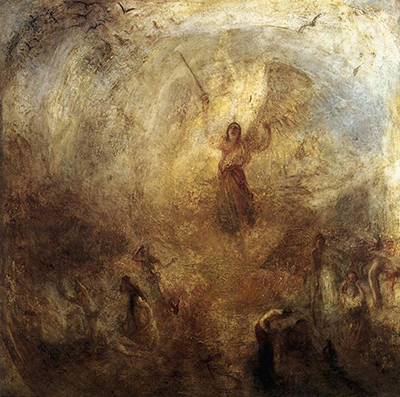
In The Angel Standing in the Sun, light is not merely cast across a landscape. It occupies the painting, overwhelms ordinary space and seems to generate the figure at its centre. A winged being rises within a white-hot solar field, one arm lifted, while birds wheel around the radiance and scattered bodies appear below. The first impression is splendour. The longer impression is judgment. Turner brings the beauty of intense colour into collision with biblical violence, making it impossible to decide whether the sun promises revelation or exposes a world of death.
Tate identifies the work as The Angel Standing in the Sun, exhibited in 1846, and assigns it accession number N00550.[1] It is an oil painting on canvas measuring 78.7 centimetres square. The National Gallery of Art recorded those details when the painting travelled from Tate for its major Turner exhibition, and identified its national ownership through the Turner Bequest of 1856.[2] Tate-linked object data independently confirms the title, medium, dimensions, date and collection.[3]
Those facts give the painting a firm physical identity, but they do not make its meaning simple. Turner did not offer a single narrative episode arranged with academic clarity. He drew together a verse from Revelation, figures associated with several biblical deaths, a circular blaze that nearly destroys depth, and paint handling that contemporary critics found both magnificent and alarming. The result belongs to the last phase of his exhibiting career, yet it returns to concerns that had occupied him for decades: the authority of the sun, the moral pressure of history, the instability of hope and the power of colour to approach experiences that outline alone cannot contain.
At a Glance
- ArtistJoseph Mallord William Turner
- TitleThe Angel Standing in the Sun
- ExhibitedRoyal Academy, 1846
- MediumOil paint on canvas
- Dimensions78.7 × 78.7 cm
- CollectionTate
- AccessionN00550
- ProvenanceTurner Bequest, accepted 1856
- Textual sourceRevelation 19:17–18
- Companion paintingUndine Giving the Ring to Massaniello, N00549
Joseph Mallord William Turner exhibited The Angel Standing in the Sun at the Royal Academy in 1846. He was then seventy-one and one of the institution's most senior members. His association with the Academy extended back to his student years: he entered its Schools in 1789, began exhibiting there in 1790, became an Associate in 1799 and a full Royal Academician in 1802.[15] The 1846 painting was therefore not the work of an outsider seeking admission. It was a deliberately public statement by an artist who understood the exhibition room, its rival colours, its crowded hanging and its argumentative press exceptionally well.
The canvas is almost exactly square, a format Turner used for several ambitious pictures of the 1840s. Although modern reproductions can make it look like an unbounded disc of colour, it is a material oil painting measuring 78.7 by 78.7 centimetres.[2][3] Its concentrated scale matters. The image is neither a vast Last Judgment altarpiece nor a conventional horizontal landscape. It compresses an apocalyptic theme into a near-square field in which the sun can expand in every direction and the corners become areas of resistance to its glare.
The central figure is visible but not crisply modelled. Wings, limbs and an upraised implement emerge through light rather than being enclosed by a continuous contour. Around the solar circumference are dark, darting marks generally understood as birds. Below, reddish and brown forms suggest a serpent, bodies and groups of mourners or killers. A historical National Gallery catalogue identified Death, Adam and Eve lamenting Abel, and Judith beside the body of Holofernes among this lower imagery.[10] These descriptions are important evidence for the painting's early reception, but Turner's handling leaves room for uncertainty. The picture is not difficult because nothing is represented. It is difficult because representation is being forced through radiance, movement and an accumulation of stories.
Contents
- Introduction
- At a Glance
- The Text from Revelation
- A Compressed History of Death
- Composition and the Loss of Ordinary Space
- Painting the Source of Light
- The Square Canvas and Its Companion
- A Possible Preparatory Study
- The Royal Academy in 1846
- Praise, Alarm and the Problem of Form
The Text from Revelation
The title comes from the nineteenth chapter of Revelation. In the biblical sequence, heaven opens, a rider appears in judgment, hostile powers face defeat, and an angel stationed in the sun summons the birds of the air to a terrible divine feast. They are called to consume the defeated mighty and their followers without distinction of rank. Turner supplied the relevant verses from Revelation 19:17-18 in the Royal Academy catalogue, so the connection is not a later guess imposed on an enigmatic image.[11]
This source immediately changes the emotional meaning of the birds. They are not decorative emblems circling a benign heavenly messenger. They are carrion birds answering a summons. Their scattered silhouettes along the outer region of the sun anticipate what will happen after judgment, even if Turner does not paint a literal field of armies. The celestial brilliance is therefore bound to bodily destruction. Light announces truth, but the truth it reveals is severe.
The location of the angel within the sun follows the biblical wording with extraordinary literal force. Turner could have placed a winged figure against a sunrise or surrounded it with rays. Instead, he makes the solar blaze the figure's environment. Angel and radiance overlap so thoroughly that wings can seem made from heat and the raised arm can seem to condense out of the light. A scholarly analysis of the painting describes the radiance as passing outward from white through yellow toward red, with the angel and light almost fused.[11] This is less a figure illuminated by the sun than an apparition whose visibility depends upon an almost unbearable intensity.
Revelation gives Turner an ending rather than a beginning. The scene belongs to an apocalyptic process in which hidden things are disclosed and worldly powers are brought to account. Yet the picture also looks strangely primordial. Its circular colour, rudimentary bodies and absence of stable architecture can suggest creation before the world has settled into familiar form. Judgment and genesis therefore approach each other. The same glare that seems capable of generating an angel also strips human life back to bodies, bones and elemental conflict.
It is tempting to name the central figure as the Archangel Michael, and that identification has often appeared in later commentary. The biblical verses Turner cited, however, say simply that an angel stands in the sun. Michael participates in the larger warfare of Revelation elsewhere, but the exhibited title does not settle the identity. Retaining the less specific designation preserves something essential about the work. Turner gives the being monumental authority without converting it into a conventional portrait with attributes that make recognition easy.
A Compressed History of Death
The lower part of the painting does not illustrate only Revelation 19. An early National Gallery description recorded a skeleton or Death driven before the angel, a chained serpent with a red mouth, Adam and Eve mourning over Abel, and Judith near the decapitated Holofernes.[10] The image thus gathers deaths from different moments and different biblical books beneath the apocalyptic sun. Instead of narrative continuity, Turner offers moral simultaneity.
Adam and Eve mourning Abel introduce the first human family and the first murder. According to Genesis, Cain kills his brother Abel, turning life outside Eden into a history marked by violence almost from its beginning. If the faint group is read in this way, the parents do more than grieve for one son. They witness what human freedom has become after expulsion: kinship itself can produce death. Their presence beneath the angel carries the history of wrongdoing from its earliest biblical instance into the final reckoning of Revelation.
The serpent deepens that return to Genesis. A chained reptile can signify the tempter subdued, evil restrained or the ancient serpent defeated at the end of sacred history. Yet Turner's creature remains visually aggressive. Its reported red mouth and extended body do not resemble a harmless emblem already forgotten. The chain suggests control, but the form retains energy. Judgment may limit evil without erasing its remembered violence.
Judith and Holofernes introduce another kind of killing. In the Book of Judith, the heroine enters the enemy commander's camp, beheads him and saves her people. Her act can be read as courage and deliverance, but it is represented through a severed head and violated body. By placing such an episode alongside Abel's murder and apocalyptic destruction, Turner refuses to divide the history of death into visually tidy categories. Innocent victim, tyrant, avenger and personification of mortality occupy the same exposed ground.
The skeleton identified as Death adds an abstraction to these stories. It is not one dead person but death made mobile. If the angel drives it forward, the motion is ambiguous: is death being expelled, commanded or merely revealed? The distinction matters because the painting does not display a peaceful world after evil has vanished. It shows a blaze under which death remains insistently visible. The angel's authority is tremendous, but the ground beneath that authority is crowded with evidence of what human history has contained.
This accumulation explains why the picture cannot be reduced to a triumphant religious vision. Triumph is present, especially in the figure's scale and the sun's dominance, but it does not cancel grief. Turner compresses the Bible's long moral history into a few barely stable forms. The result resembles memory under pressure: episodes separated by centuries surface together because they answer the same final light.
Composition and the Loss of Ordinary Space
The painting's structure is simple enough to grasp at a distance. A brilliant circular field occupies the centre. The angel rises vertically within it. Darker activity collects around the perimeter and across the lower edge. Yet that basic scheme produces a remarkably unstable experience because the usual devices of landscape recession have almost disappeared.
There is no secure horizon from which to measure distance. Architecture does not anchor scale. The ground is difficult to separate from atmosphere, and bodies do not occupy a clearly described stage. Instead, colour moves outward from the centre in broad zones. White and pale yellow project forward; orange and red intensify around them; brown and grey fragments resist at the edges. The sun becomes both a represented object and the painting's organising geometry.
Elizabeth Helsinger has argued that the solar field nearly abolishes the varied natural space that Ruskin had admired in Turner's earlier art. In her reading, light no longer opens an atmospheric world for the eye to explore. It advances toward the picture surface, crowding the fleeing or fallen figures into a reduced foreground.[12] This helps explain why the image can feel simultaneously vast and shallow. The sun implies cosmic scale, but the paint presses close to the viewer.
The angel's proportions intensify that contradiction. The being seems enormous relative to the figures below, yet the lack of a measurable setting makes size uncertain. It may be colossal, near to us, or magnified by apparition. Turner uses scale as an expression of authority rather than a calculation of physical distance. The figure dominates because everything else has been deprived of stable coordinates.
The human eye normally seeks edges when confronted by intense brightness. Turner frustrates that need. The angel's body is not cleanly detached from the radiance. Birds are reduced to rapid dark accents. Foreground groups appear and disappear within warm colour. Looking becomes an act of repeated adjustment. The viewer first receives the blaze, then searches for narrative, then loses forms back into the blaze.
That rhythm is part of the subject. The figures in the lower zone appear to recoil, fall or turn from the light, while the viewer also struggles to look steadily into the painted sun. The physical difficulty of seeing becomes an analogue for the moral difficulty of revelation. Knowledge is offered, but not gently. Turner makes disclosure feel like exposure.
Painting the Source of Light
The Spectator recognised the central technical feat in 1846. Its reviewer praised the pictures as demonstrations of how closely ordinary paint could imitate the source of light, even while complaining that Turner had abandoned form.[11] The observation remains acute. Oil colour cannot emit sunlight, yet Turner organised contrast so that a painted centre seems more luminous than the material surrounding it.
He achieves this without depending on a detailed solar disc. The brightest zone has force because it is enclosed by increasingly warm and darker colour. Pale paint expands until yellow, orange and red make its boundary perceptible. Dark accents act like apertures in the blaze: birds, limbs and foreground fragments give the eye enough resistance to register brightness. Radiance is relational. The white area appears to shine because other marks submit to it or stand sharply against it.
The paint also refuses the polished invisibility associated with some academic finish. Turner had long allowed process to remain legible, and museum scholarship has stressed how visibly his pictures declare their making.[8] In the late works, this visible handling became especially contentious because critics could not always decide whether speed and looseness were mastery, eccentricity or incompletion. In The Angel Standing in the Sun, material handling is not incidental to the theme. Streaks, veils, touches and softened boundaries produce the sensation that forms are being consumed or constituted by light.
Accounts of Turner's studio after his death describe prepared colours, simple palettes, varied brushes and his exacting attention to mixtures, though such testimony cannot identify the precise procedure used on this canvas.[8] The responsible conclusion is therefore visual rather than chemical. Turner layered and opposed light and dark oil colour so that the canvas performs a contest between visibility and dissolution. Claims about exact pigments would require direct technical evidence from N00550; the colour structure itself is plain enough to analyse without inventing a recipe.
The solar centre does not simply defeat darkness. Red and orange surround it with an atmosphere of heat, blood and fire. This makes the light morally unstable. A cool, even illumination might suggest serene truth. Turner's incandescent colour suggests truth arriving through catastrophe. The angel can be read as messenger, judge and image of artistic power precisely because the radiance is both beautiful and dangerous.
The Square Canvas and Its Companion
Turner's square pictures of the 1840s form one of the most distinctive groups in his career. The shape resists the habitual sweep of landscape, concentrating motion around a centre. In works concerned with flood, colour theory, myth and supernatural encounter, the square supports circles, vortices and enveloping atmospheres. It gives no strong preference to horizontal journey or vertical ascent. Energy can rotate and radiate.
The Angel Standing in the Sun belongs to this experiment. CAA Reviews has emphasised that Turner's square canvases of 1843-46 combine literary Romanticism with an intensified interest in physical light and in forces capable of reshaping the world.[13] That formulation is particularly useful because it prevents a false choice. The painting is neither merely a biblical illustration nor merely an exercise in luminous colour. Its achievement lies in making the two inseparable.
Historical Tate scholarship links N00550 with N00549, Undine Giving the Ring to Massaniello, Fisherman of Naples. The pair shares the late square format and was associated with Turner's practice of presenting complementary exhibition pictures, sometimes finished visually as octagons within their square painted fields.[14] Their subjects differ sharply. One draws upon apocalyptic scripture and accumulated death; the other upon a literary water-spirit and a gift of love or enchantment. Yet both place an elusive figure within a dominant element and make narrative emerge from colour.
The pairing would have sharpened viewers' awareness of opposition. Sun and water, judgment and seduction, fiery revelation and liquid transformation could answer each other across the Academy display. Turner had often used neighbouring pictures to create colouristic and thematic dialogue. The exhibition wall was not just a neutral support for isolated works; it was a field in which one painting could change the reading of another.
The near-square shape also alters the relation between frame and sun. In a wide rectangle, a central solar circle would leave lateral expanses that could develop into scenery. Here the radiance pushes quickly toward every boundary. The corners become the last regions not fully absorbed by the central event. The canvas feels pressurised, as though the sun's natural form wants to exceed the support.
A Possible Preparatory Study
Tate holds a related work on paper under the cautious title ?Study for 'The Angel Standing in the Sun', dated about 1841-46 and numbered D27595.[4] A Tate loan record published in Ontario described it as A Figure Study, possibly for The Angel Standing in the Sun, dated about 1841-45, in watercolour on paper and measuring 186 by 230 millimetres.[5] The question mark and the word "possibly" are essential. They record a credible connection without pretending that the relation is proven beyond doubt.
The study matters because it challenges the idea that the 1846 oil simply erupted from uncontrolled late inspiration. Turner explored a standing figure in watercolour during the years before the exhibition. Even if D27595 cannot be treated as a complete compositional blueprint, it shows that the problem of a body within an atmospheric field had a preparatory history. The final canvas magnifies, transforms and surrounds that problem with a much larger biblical programme.
Works on paper often allowed Turner to test how little definition a figure needed in order to remain legible. Wash could merge a body with surrounding colour more readily than a hard linear drawing. The possible study therefore bears on the oil's central paradox. Turner wanted a figure that commanded the image without becoming an academically bounded statue. The angel needed to stand, gesture and dominate while still seeming born from the sun.
The gap between study and finished work also reveals the limits of reconstruction. There is no need to invent a lost chain of drawings that explains every bird, serpent and body. Turner's surviving materials are extensive but uneven, and the Turner Bequest continues to be understood through the cataloguing of paintings, sketchbooks, drawings and watercolours as a connected yet complex body of work.[16] D27595 should be used as one piece of that evidence, not as permission to convert uncertainty into a complete origin story.
The Royal Academy in 1846
The 1846 Summer Exhibition ran from 4 May to 25 July. The Royal Academy Chronicle records 841 participating artists and 1,521 works, an enormous visual field in which paintings competed for attention and critics debated what should constitute a great national school.[9] Turner served on the selection committee alongside William Etty, Abraham Cooper, Edward Hodges Baily, Henry William Pickersgill, John Prescott Knight, Charles Landseer and Charles Robert Cockerell.[9]
That institutional role complicates any image of Turner as wholly isolated from contemporary art. His late work was controversial, but he remained embedded in the Academy's machinery. He helped judge submissions and understood the professional stakes of the annual display. Tate's account of his final sixteen years similarly rejects the stereotype of an elderly painter detached from his culture, presenting him as actively engaged with public exhibition, artistic debate and contemporary society.[6]
Within a display of more than fifteen hundred objects, The Angel Standing in the Sun had obvious competitive force. Its square shape, blazing centre and obscure narrative could arrest attention from across a room. The cited biblical text then demanded that viewers connect the radiance to divine violence. Turner was not withdrawing into a private colour experiment. He placed a difficult, learned and technically audacious picture in Britain's most visible annual art exhibition.
The Academy context also explains why finish became so contentious. Exhibition pictures were judged amid works that displayed narrative clarity, detailed modelling and polished surfaces. Turner's angel appeared where critics expected to identify forms and assess execution. Its deliberate dissolution could therefore look like a refusal of shared standards. Yet the picture's placement within that arena was itself an argument: intense colour and unstable form could carry historical and religious ambition.
The Getty Museum's account of Turner's late work stresses that his final decades remained rich in travel, narrative and experimental technique.[7] The Angel belongs to the narrative side of that achievement as much as to the experimental one. Its modern appearance should not conceal how deliberately it addresses the Academy tradition of elevated subject painting.
Praise, Alarm and the Problem of Form
The 1846 responses were divided, but not along a simple line between supporters who understood Turner and opponents who did not. Critics could recognise extraordinary skill while distrusting its use. A contemporary summary preserves three revealing reactions. The Athenaeum conceded consummate art in Turner's reconciliation of forceful, opposing colours, then regretted that no controlling restraint governed such aberrations. The Spectator called the pictures feats of painted light but complained that the figures had nearly lost form. The Times, by contrast, treated the angel as a gorgeous and magnificent creation too serious to dismiss as a joke.[11]
All three positions begin from the picture's power. Even disapproval had to account for the fact that Turner could make strong colours coexist and make oil paint seem luminous. The dispute concerned whether that power remained answerable to form, discipline and intelligibility. Was the dissolution of contour a meaningful response to supernatural light, or evidence that colour had escaped control?
The question remains productive because the painting deliberately approaches the point at which a figure stops being readable. The angel's authority depends partly on bodily recognition: wings, upright stance and raised arm. If those signs vanished completely, the biblical title would attach itself to an abstract blaze. Turner retains just enough anatomy to make disappearance dramatic. Form is not absent; it is endangered.
The Times response recognised that difficulty could be serious. By referring readers to the defence of Turner written by the "Oxford Graduate," the review invoked the first volume of Ruskin's Modern Painters, initially published anonymously.[11] The allusion placed the painting within a larger argument about truth, perception and the apparent obscurity of modern art. Turner could not be dismissed merely because his methods differed from conventional finish.
Tate's late-work scholarship warns that both Victorian stories of decline and later celebrations of Turner as an accidental abstractionist can obscure his intentions.[6] The original criticism demonstrates why both distortions arose. Contemporaries saw paint nearing the edge of legibility; later viewers saw a path toward modern art. But Turner himself attached a precise scriptural source and recognisable moral imagery to the colour. The picture tests representation rather than abandoning it.
Ruskin, Prophecy and Disillusion
No critic is more entangled with The Angel Standing in the Sun than John Ruskin. His early defence of Turner described the artist in prophetic terms, as a solitary revealer commanding the elements and resembling the great apocalyptic angel. That language made Turner more than an accomplished landscape painter. It cast him as a visionary through whom nature's mysteries became visible.[12]
The 1846 picture can look uncannily like that praise turned into an image. An immense figure occupies sun, cloud and colour while lesser beings recoil below. Helsinger therefore considers the possibility that the angel carries an ironic or self-reflexive relation to Turner himself: the artist as prophet, exposed to hostile critics and armed with the light they found excessive.[12] This is a powerful interpretation, but it should remain a proposal. No secure statement from Turner declares the angel a self-portrait.
Ruskin's later response was far darker. In the final development of his Turner criticism, he associated the painting with decline and used medicalising language about its execution. Helsinger places that judgment within Ruskin's changed understanding of Turner's symbolism. The beautiful sun no longer guaranteed benevolent revelation. It could expose corruption, grief and mortality without offering a consoling world beyond them.[12]
This reversal illuminates the painting better than a simple story of friendship and rejection. Ruskin had once treated Turnerian light as a vehicle of divine truth. The Angel gives him overwhelming light, but what does that light show? Carrion birds, murder, a severed body, a chained serpent and Death. The sun triumphs visually while hope becomes morally uncertain. Ruskin's discomfort arose partly because the work intensifies the very prophetic model he had helped construct, then deprives prophecy of easy consolation.
The possible identification of the angel with the artist gains complexity in this context. If the figure represents creative vision, the painter does not offer escape from history. He compels attention to it. Art stands in the sun and calls hidden violence into visibility. The gesture may be commanding, but the revelation is not flattering to humanity.
Turner and Ruskin should not be collapsed into the same voice. Ruskin's readings are historically consequential interpretations, not a transcript of Turner's intention. The painting exceeded even its greatest advocate's ability to stabilise it. That excess is one reason it remains compelling: it stages the ambition of prophetic art while preserving doubt about what prophecy can redeem.
More Than a Prehistory of Abstraction
Modern viewers often value late Turner because his forms appear to dissolve into colour. That response is understandable. The Angel Standing in the Sun can be seen first as a circular field of white, yellow, orange and red, interrupted by gestural marks. Yet calling it abstract without qualification removes the very tensions that make it extraordinary.
Nancy Rose Marshall argues that the late square paintings join literary Romanticism to an interest in the physical behaviour of light and in transformative force.[13] The formulation restores what formalist admiration can lose. Turner did not arrive at luminous paint by forgetting stories. He made stories undergo light. Revelation, Genesis and Judith remain active even when their figures are difficult to see.
The title and catalogue verses were part of the original encounter. Academy visitors did not face an untitled colour field. They were directed toward an angel, birds and a feast after judgment. The challenge was to reconcile those words with a picture in which the sun seemed more immediately present than the narrative bodies. Meaning arose in the friction between reading and looking.
The painting is also deeply historical in another sense. It belongs to an artist who had spent more than half a century studying landscape, old masters, classical and biblical subjects, optical effects and public exhibition. The National Gallery's career account emphasises his formation in watercolour, oil and engraving as well as his sustained Academy presence.[15] The radical surface of N00550 is the product of accumulated practice, not the cancellation of memory.
To see the work only as a forecast of twentieth-century abstraction is therefore to make its nineteenth-century strangeness less strange. Turner preserved wing, sword, serpent, bird and body because he wanted colour to bear moral and narrative weight. The sun does not replace the subject. It becomes the means through which the subject is judged.
The Work in Turner's Late Career
The final sixteen years of Turner's life produced what Tate calls an extraordinary creative flowering across oils and watercolours.[6] He continued to travel, exhibit and test how colour could carry subjects ranging from modern technology and whaling to Venice, myth and scripture. Getty's account of the late period likewise stresses innovation without severing it from lived culture and narrative purpose.[7]
The Angel Standing in the Sun is central to that reassessment because it makes old-age decline an inadequate explanation. Its obscurity is organised. The square support, concentric radiance, strategically retained silhouettes and densely layered biblical programme all indicate purposeful construction. Critics were right to experience risk, but risk is not the same as incapacity.
Nor does the possible study support an image of random execution. D27595 suggests that Turner considered the standing figure in watercolour before the exhibited oil.[4][5] His long practice of developing ideas across media continued into the 1840s. A body tested on paper could be transformed into an apparition in oil, while exhibition context supplied scale, pairing and public confrontation.
The work also looks backward across Turner's career. Earlier paintings had made sunlight a measure of maritime danger, classical splendour, imperial rise and decline, or natural sublimity. Here the sun becomes explicitly scriptural and nearly total. The landscape painter's greatest recurring agent is promoted into the arena of final judgment.
At the same time, the picture looks sideways toward its paired and related works. Undine turns elemental atmosphere toward enchantment. The Deluge canvases make circles of colour carry catastrophe, theory and renewal. Regulus uses blinding light as punishment and spectatorship. These connections do not reduce The Angel to a formula. They show Turner revisiting a profound question: what happens when the source of visibility becomes too powerful for ordinary sight?
Why The Angel Standing in the Sun Matters
The painting matters because it refuses to let light mean only hope. Western art had long associated radiance with divinity, knowledge and salvation. Turner uses all those associations, then places carrion birds and a history of murder within their field. Illumination reveals; it does not automatically comfort.
It also matters because its technical daring serves thought. The sun's apparent brilliance is built from opaque material, but the organisation of colour makes that material seem to exceed itself. The angel emerges because paint can hover between body and blaze. The foreground stories persist because small dark and red marks can carry enormous cultural memory. Turner's virtuosity is not ornament added to a biblical theme. It is the form of the theme.
The 1846 critics understood that something decisive was happening even when they disagreed about its value. They recognised a feat of light, worried over the weakening of contour, admired the gorgeous result and debated whether mastery had become aberration.[11] Their conflict belongs to the picture's history because Turner designed a work that made established criteria strain. A viewer had to choose whether clarity meant firm outline or whether blinding revelation might demand the loss of outline.
The painting's continued mystery is equally important. The early catalogue identifications help recover its narrative density, but they do not turn every foreground mark into a fixed illustration.[10] The possible study clarifies a stage in Turner's thinking but does not explain the entire composition.[4][5] Ruskin's artist-prophet reading opens a powerful self-reflexive dimension but remains interpretation.[12] Each body of evidence brings the image nearer while leaving part of it unresolved.
That unresolved quality is not emptiness. It is the condition Turner constructed for the viewer. We stand before a sun that discloses too much and bodies that can barely withstand disclosure. Beauty draws the eye toward judgment; judgment sends it back into the beauty of paint. The angel commands the centre, but the final subject may be the act of seeing under unbearable moral and visual pressure.
The Angel Standing in the Sun therefore deserves its place among Turner's most ambitious late paintings. It is at once an Academy spectacle, a biblical history painting, a meditation on the artist as revealer and an experiment in making colour behave like force. Its light is magnificent because it is dangerous, and its danger remains visible because Turner never allows splendour to erase death.
Discussion
How does Turner make magnificent light disclose judgment, violence and death without losing the angel's represented body?
Reader Insights
Where does the angel seem to emerge from light rather than stand before it?
How do the compressed biblical deaths resist a single continuous moment?
How close can contour come to dissolution while representation remains active?
Join the Conversation
Share a close observation or a source-based question for other readers.
References
- Tate, *The Angel Standing in the Sun*, N00550, exhibited 1846. https://www.tate.org.uk/art/artworks/turner-the-angel-standing-in-the-sun-n00550
- National Gallery of Art, *J.M.W. Turner* exhibition image checklist, catalogue no. 163. https://www.nga.gov/content/dam/ngaweb/press/exh/2832/2832-list.pdf
- Wikimedia Commons, Tate-linked metadata for *The Angel Standing in the Sun*, N00550. https://commons.wikimedia.org/wiki/File:Joseph_Mallord_William_Turner_(1775-1851)_-_The_Angel_Standing_in_the_Sun_-_N00550_-_National_Gallery.jpg
- Tate, *?Study for 'The Angel Standing in the Sun'*, D27595. https://www.tate.org.uk/art/artworks/turner-study-for-the-angel-standing-in-the-sun-d27595
- *Ontario Gazette*, volume 148, issue 36, Tate loan list, 5 September 2015. https://www.ontario.ca/document/ontario-gazette-volume-148-issue-36-september-5-2015/government-notices-respecting-corporations
- David Blayney Brown, Amy Concannon and Sam Smiles, eds., *Late Turner: Painting Set Free*, Tate Publishing. https://shop.tate.org.uk/late-turner-painting-set-free-/15144.html
- J. Paul Getty Museum, *J.M.W. Turner: Painting Set Free*. https://www.getty.edu/art/exhibitions/turner/
- Lawrence Gowing, *Turner: Imagination and Reality*, Museum of Modern Art. https://assets.moma.org/documents/moma_catalogue_2572_300062313.pdf
- Craig Hanson, "1846: William Dyce as a Successful Artist Scorned by the Critics," *The Royal Academy of Arts Summer Exhibition: A Chronicle, 1769-2018*, Paul Mellon Centre. https://chronicle250.com/1846
- National Gallery, *Descriptive and Historical Catalogue of the Pictures and Sculpture in the National Gallery: British Art*, object 550, 1906.
- Andrzej Gasiorek, "Seeing in the Dark: Light and Vision in the Work of Samuel Beckett," *Text Matters* 1, including the contemporary *Spectator* response to Turner. https://czasopisma.uni.lodz.pl/textmatters/article/download/6484/6086/17916
- Elizabeth K. Helsinger, "Turner and Tradition," in *Ruskin and the Art of the Beholder*. https://victorianweb.org/authors/ruskin/artofthebeholder/8.html
- Nancy Rose Marshall, review of *J.M.W. Turner*, *CAA Reviews*, 2008. https://www.caareviews.org/reviews/1210
- Tate historical collection commentary on Turner's paired late square and octagonal exhibition pictures, preserved with *Peace - Burial at Sea*. https://museum.warodai.ru/media/collection/provenance/0000238.pdf
- National Gallery, Joseph Mallord William Turner. https://www.nationalgallery.org.uk/artists/joseph-mallord-william-turner
- Tate, *J.M.W. Turner: Sketchbooks, Drawings and Watercolours* research catalogue. https://www.tate.org.uk/art/research-publications/jmw-turner