 by Tom Gurney
Tom Gurney BSc (Hons) is an art history expert with over 20 years experience
Published on June 19, 2020 / Updated on October 13, 2026
Email: tomgurney1@gmail.com / Phone: +44 7429 011000
Landscape With Historical Ambition
Turner's classical and history painting is best understood as an argument about landscape. He did not leave landscape behind when he turned to Dido, Ulysses, Hannibal, Rome or biblical catastrophe. He used historical and literary subjects to prove that landscape could carry the intellectual ambition traditionally reserved for history painting. The National Gallery notes Turner's debt to Claude and to Italianate landscape, while the Met describes an artist trained in and shaped by Royal Academy culture.[1][2] Those two facts belong together: Turner learned the hierarchy of art and then bent it toward landscape.
The result is not illustration in the narrow sense. In Turner's major classical works, architecture, sea, sky, sun and weather do as much as the named figures. Human action often appears small against the scale of empire, nature or time. The story matters, but the landscape decides how the story feels.
At a Glance
- Core argumentLandscape can carry the highest historical ambition
- Principal inheritanceClaude Lorrain and Italianate landscape
- Classical authorsVirgil and Homer
- Imperial subjectsCarthage, Rome, rise and decline
- Key subjectsDido, Hannibal and Ulysses
- Institutional settingRoyal Academy hierarchy and exhibition culture
- Other elevated subjectsBiblical catastrophe and modern history
- Figure relationshipHuman action often yields to landscape scale
- Narrative methodTitles guide but do not exhaust interpretation
- Modern consequenceHistorical seriousness extends to steam, slavery and war
Contents
- Landscape With Historical Ambition
- Claude and the Question of Inheritance
- Dido and the Rise of Empire
- Hannibal, Ulysses and the Sublime of Story
- Rome, Caligula and Imperial Imagery
- Royal Academy Culture
- Biblical and Literary Range
- A Modern Classical Painter
- Carthage as a Lifelong Problem
- Figures and the Problem of Scale
Claude and the Question of Inheritance
Claude Lorrain was central to Turner's classical ambition. The Turner Bequest condition that paired Dido Building Carthage and Sun Rising through Vapour with Claude paintings at the National Gallery makes this explicit.[3] Turner wanted his own landscapes seen beside the seventeenth-century master of ideal landscape, not merely as later British pictures but as works capable of entering the same historical conversation.
This was competitive homage. Turner absorbed Claude's harbours, luminous distances and classical associations, but he also intensified them. His suns can overwhelm, his colour can destabilise architecture, and his weather can interrupt the calm order of ideal landscape. He accepted Claude as a standard while pushing against the serenity associated with that standard.
Dido and the Rise of Empire
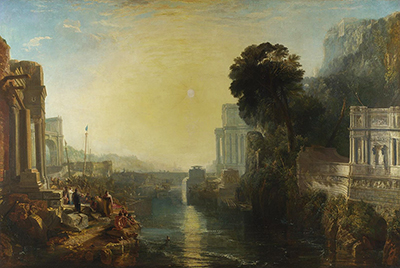
Dido Building Carthage is one of Turner's clearest statements of classical ambition. The National Gallery records the full title, Dido building Carthage, or The Rise of the Carthaginian Empire, and its 1815 date.[4] The painting is not simply a scene from Virgil. It is a landscape of foundation, light and future loss. Carthage appears radiant, but the story carries knowledge of abandonment, empire and ruin.
Turner uses architecture and light to make history feel unstable. The rising city is grand, but the sun also suggests distance and fragility. The painting's bequest pairing with Claude confirms how strongly Turner wanted this work to speak as an elevated landscape. Its subject is ancient, but its ambition is modern: to make landscape itself the bearer of historical meaning.
Hannibal, Ulysses and the Sublime of Story
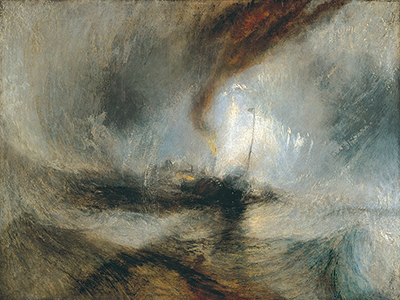
In Snow Storm: Hannibal and his Army Crossing the Alps, Turner turns classical history into a vision of natural force. The painting was exhibited in 1812.[5][2] The Carthaginian army is not denied, but it is dwarfed by storm, mountain and sweeping atmospheric motion. History painting traditionally depends on heroic action; Turner makes the environment the dominating actor.
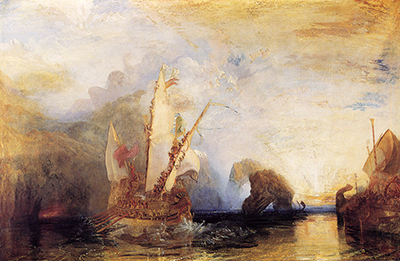
Ulysses Deriding Polyphemus, shown in 1829 and in the National Gallery's collection, works differently.[6] It is expansive, radiant and theatrical, joining Homeric narrative to brilliant colour and marine distance. Ulysses is present through the ship and the episode, but the painting's power lies in dawn, water, cloud and scale. Turner makes myth a way of staging light.
Rome, Caligula and Imperial Imagery
Turner's Roman and imperial subjects extend the same logic. Works associated with Caligula, Rome, temples and ancient power use classical architecture as a structure for thinking about ambition and decline. He was drawn to antiquity not because it provided costume, but because it carried historical weight. Ruins, bridges and palaces let him picture the tension between human power and time.
This is why his classical painting often feels double. It can be dazzlingly beautiful while also uneasy. Light may glorify empire, but it can also expose its fragility. The architectural setting may seem stable, yet the atmosphere around it often suggests change, dissolution or memory.
Royal Academy Culture
Turner's classical and history subjects also belong to Royal Academy exhibition culture. The Academy valued history painting as the highest genre, and Turner understood that hierarchy. His solution was to bring history into landscape rather than abandon landscape for figure-dominated narrative. The Met notes that Turner became a full Royal Academician and Professor of Perspective, remaining deeply involved in Academy life.[2]
Academy exhibition titles and literary associations helped guide viewers. Turner often gave works long titles or accompanying verses that opened classical, biblical or poetic frames. These frames are part of the work's public meaning, but they do not always settle every detail of interpretation.
Biblical and Literary Range
Turner's elevated subjects were not limited to Greece and Rome. Biblical and literary materials allowed him to expand landscape's moral range. Flood, plague, exile and divine light could be approached through atmosphere and space. He first exhibited selections from his unfinished poem The Fallacies of Hope with Hannibal in 1812, and excerpts accompanied later pictures. The poem itself was never completed or published as a whole.[2]
Turner used literature to deepen landscape's associations rather than reduce it to captioned narrative. A title may point to a story, but the painting often operates through weather, colour and scale before the viewer identifies every reference.
A Modern Classical Painter
Turner was a classical painter in a modern sense. He inherited Claude, Virgil, Homer, Rome and Academy hierarchy, but he treated them as active materials. His classical landscapes are not retreats from modernity. They are places where modern ambition confronts old models and discovers that landscape can carry empire, myth, ruin, violence and light.
His classical and history painting connects his sea, weather and colour subjects with the intellectual ambitions of European painting. Through it, Turner made landscape compete with the highest claims of that tradition and made history itself feel atmospheric, unstable and luminous.
Carthage as a Lifelong Problem
Carthage was not a passing subject for Turner. The National Gallery's account of Dido Building Carthage notes that he painted a group of major works concerned with the Carthaginian empire and that the rise and fall of empires preoccupied him.[4] This is crucial for understanding how he used classical history. Carthage allowed him to picture foundation, prosperity, desire, betrayal, military power and decline within a landscape language of harbours, sun and architecture.
The Carthaginian theme also gave Turner a way to think about Britain indirectly. Maritime empire, commercial wealth and imperial vulnerability were not remote ideas in his own world. By painting ancient empire through radiant harbours and looming destinies, Turner could make history feel cyclical rather than safely past. Classical subject matter became a mirror held at an angle.
In Dido Building Carthage, the city rises in splendour, yet viewers familiar with the story know that Carthage will fall and Dido will die. Turner's light does not simply celebrate. It creates tragic irony. Beauty appears under the pressure of future ruin.
Figures and the Problem of Scale
Turner has often been criticised for his figures, and it is true that he was not a figure painter in the manner of Reynolds or Haydon. But in many classical and historical works, the smallness or awkwardness of figures is part of the pictorial logic. The human body is placed within a world of architecture, sea, sun and weather that exceeds it.
This is especially clear in Hannibal. The general's army is present, but the storm dominates. The mountain and weather systems make military ambition seem fragile. In Ulysses Deriding Polyphemus, human story is carried by ships, dawn and vast marine space. The mythic figure does not need to occupy the foreground as a theatrical hero because the landscape itself has become the theatre of myth.
Turner's classical art therefore revises the expectations of history painting. Instead of using landscape as setting for figure drama, he lets landscape become the main historical force. That shift is one of his great inventions.
Literary Sources and Visual Freedom
Turner drew on Virgil, Homer, biblical tradition and modern poetry, but his paintings rarely behave like straightforward illustrations. A literary source provides a charged field of reference. Turner then uses light, atmosphere and composition to transform that field into pictorial experience.
The difference matters. In an illustrated book, the image may be expected to clarify a text. In Turner's exhibition painting, the relation is more open. The title and literary association guide the viewer, but the painting can complicate or reshape the story. Ulysses Deriding Polyphemus is not only about the episode after Ulysses blinds the Cyclops; it is also about colour, release, dawn, sea power and the instability of triumph.
This freedom helps explain why Turner's classical works remain visually powerful even when the viewer does not know every source. The paintings use literature to create scale, not to demand pedantic decoding.
Biblical History and Catastrophe
Turner's elevated subjects also include biblical catastrophe and moral drama. Floods, plagues, divine light and apocalyptic weather gave him ways to connect historical painting with natural force. These themes allowed him to move beyond classical antiquity while retaining large questions of power, judgment and human vulnerability.
In such works, Turner often avoids simple moral illustration. The atmosphere does much of the thinking. Light may suggest revelation or destruction; darkness may suggest terror, ignorance or physical obscurity. The viewer confronts a world in which the human story is inseparable from environmental force.
Biblical and classical themes therefore share a common Turnerian structure. They ask how human events look when placed under overwhelming light, weather, time or divine implication. Landscape is again more than background.
Historical Painting and Modern Subjects
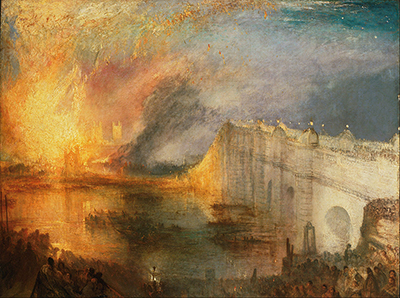
Turner's history painting also prepared the way for his modern subjects. The burning of Parliament, the Battle of Trafalgar, steam travel and slavery could be approached with the same seriousness as ancient story. Turner did not reserve grandeur for antiquity. He brought historical ambition into modern life.
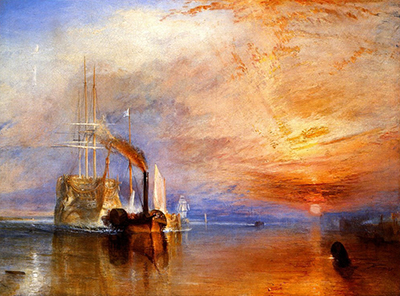
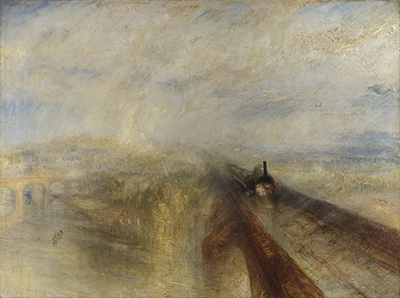
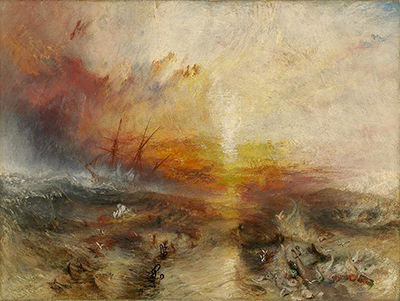
This continuity is important. The Fighting Temeraire is not classical, but it has the elegiac structure of history painting. The Slave Ship is a modern subject, but its moral scale is vast. Rain, Steam, and Speed stages modern technology with a force once associated with sublime nature or epic event. Turner's classical and history painting trained the language that later allowed modern subjects to feel momentous.
The Academy and the High Genre
The Royal Academy hierarchy made history painting the highest genre, and Turner knew that system from within. His classical subjects were therefore partly strategic. They placed him in dialogue with the genre most valued by academic theory. Yet he did not become a conventional history painter because he did not make the human figure the sole carrier of meaning.
Instead, he expanded landscape until it could perform historical work. A harbour could found an empire; a mountain storm could judge an army; a sunrise could rival Claude; a city could become an emblem of rise and decline. This was not a rejection of academic ambition. It was an appropriation of it.
The result is why Turner remains difficult to classify. He is a landscape painter whose landscapes often behave like history paintings, and a history painter whose histories are often controlled by light, water and weather.
Classical Landscape and the Sea
Turner's classical subjects often meet the sea. Harbours, fleets and coastlines allowed him to connect ancient narrative with maritime power. This link is important because Turner was also one of the great painters of modern sea subjects. Classical harbour imagery and contemporary maritime painting belong to the same career-long concern with water as a field of history.
Claude's seaports gave Turner one model, but Turner made marine space more unstable. In Dido Building Carthage, harbour and architecture suggest foundation and commerce. In Ulysses Deriding Polyphemus, the sea becomes escape, triumph and dazzling uncertainty. Maritime space carries the story because it is the medium through which empire, travel and fate move.
This connection between classical and marine art helps explain Turner's range. Ancient history did not pull him away from the sea. It gave the sea older and deeper historical meanings.
Decline, Ruin and Historical Time
Turner's classical imagination repeatedly returns to decline. The rise of Carthage implies its fall; Roman splendour implies ruin; mythic triumph carries danger. This concern with historical time is one reason his classical works rarely feel merely decorative. The landscape is beautiful, but beauty often arrives under the shadow of loss.
Ruins are the obvious signs of time, but Turner also uses light as a historical agent. A glowing sunset can suggest ending; a brilliant dawn can suggest founding; haze can make the past feel both near and unreachable. His classical painting therefore turns atmosphere into historical commentary.
This is one of the ways Turner differs from artists who use antiquity mainly as costume. For him, antiquity is a way to think about the rise and collapse of human structures. Landscape carries the evidence that power passes.
The Limits of Narrative Certainty
A known story gives Turner's classical paintings a narrative structure without fixing their mood or emphasis. His titles identify subjects, while light and atmosphere can complicate the action. Is the light triumphant or ominous? Is the city glorious or doomed? Is the sea liberating or dangerous?
Historical painting often clarifies action, while Turner can make it feel unstable, layered and atmospheric. The named subject offers a way into the picture, but its changing emphasis between figures, setting and light allows more than one reading.
Such uncertainty makes the works durable. They can sustain art-historical, literary, political and technical readings without collapsing into a single lesson.
Why Classical Turner Still Matters
The classical and history works connect the painter of late colour with Virgil, Homer, Claude, empire, biblical catastrophe and Academy ambition. They reveal the learning and competitive purpose within his landscape art, alongside its visual experimentation.
They also make the later atmospheric works more intelligible. Turner's light is not only optical; it has historical memory behind it. His seas are not only natural; they are routes of empire and myth. His ruins are not only picturesque; they are arguments about time. Classical and history painting gave Turner the large structures within which his technical daring could matter.
History Painting After Turner
Turner's approach did not solve the old hierarchy by argument alone. It changed what ambitious landscape could look like. Later viewers could see that history did not require a central heroic figure or a crowded narrative. It could be carried by sun, harbour, mountain, smoke, architecture and distance.
This is why classical Turner remains central even for those most interested in the late atmospheric works. The late pictures inherit a belief already present in the classical paintings: that light and landscape can carry the weight of meaning usually assigned to figures and stories. Turner's technical daring did not float free of subject. It grew from a career-long attempt to make landscape historically serious.
Discussion
How does Turner let landscape carry history without reducing the picture to illustration?
Reader Insights
Where does competitive homage to Claude become a distinct modern argument?
How do small figures change when weather, sea and architecture become historical actors?
Why do titles and literary sources guide interpretation without settling it?
Join the Conversation
Share a close observation or a source-based question for other readers.
References
- National Gallery, Joseph Mallord William Turner artist record, https://www.nationalgallery.org.uk/artists/joseph-mallord-william-turner
- Elizabeth E. Barker, "Joseph Mallord William Turner (1775-1851)," Met Heilbrunn Timeline, https://www.metmuseum.org/essays/joseph-mallord-william-turner-1775-1851
- National Gallery, "The Turner Bequest," https://www.nationalgallery.org.uk/about-us/history/the-turner-bequest
- National Gallery, Dido building Carthage, https://www.nationalgallery.org.uk/paintings/joseph-mallord-william-turner-dido-building-carthage
- Tate, Snow Storm: Hannibal and his Army Crossing the Alps, https://www.tate.org.uk/art/artworks/turner-snow-storm-hannibal-and-his-army-crossing-the-alps-n00490
- National Gallery, Ulysses deriding Polyphemus, https://www.nationalgallery.org.uk/paintings/joseph-mallord-william-turner-ulysses-deriding-polyphemus-homer-s-odyssey