 by Tom Gurney
Tom Gurney BSc (Hons) is an art history expert with over 20 years experience
Published on June 19, 2020 / Updated on October 13, 2026
Email: tomgurney1@gmail.com / Phone: +44 7429 011000
Turner Was Not Alone
Turner's public image often leans toward solitary genius, absorbed in weather and light. His career also developed through patrons, collectors, publishers, Academy networks, critics, dealers, executors and institutional relationships. Independence coexisted with a social world that sustained the making, circulation and survival of his works.
Patronage in Turner's career was not simple obedience to clients. It was a working ecology. Patrons gave commissions, hospitality, access, conversation, display opportunities and collecting support. Turner gave them images that could be personal, ambitious and sometimes unexpectedly challenging.
At a Glance
- Working ecologyCommissions, friendship, collecting and access
- Early formationDr Thomas Monro's circle
- Yorkshire patronWalter Fawkes of Farnley Hall
- Petworth patronGeorge O'Brien Wyndham, 3rd Earl of Egremont
- Petworth interiorsGouache studies made in 1827
- Architectural settingFour works for the Carved Room
- Later collectorHenry Vaughan
- Critical advocateJohn Ruskin
- Strategic positionIndependent within relationships
- Public afterlifeTurner Bequest and national collections
Contents
- Turner Was Not Alone
- Early Collectors and Professional Formation
- Walter Fawkes and Farnley
- Petworth and Lord Egremont
- Petworth as Working Environment
- Monro, Munro, Vaughan and Ruskin
- Independence Within Relationship
- Why Patronage Changes the Picture
- Patronage and Turner's Independence
- Dr Monro and Early Formation
Early Collectors and Professional Formation
Turner's early career depended on people who valued topographical watercolour, architectural skill and print publication. The National Gallery records his early grounding in topographical tradition and his later work across watercolours, oils and engravings.[1] That range connected him to different markets. A collector might want a finished watercolour; a publisher might want a design; an Academy audience might respond to an oil; a patron might invite him into a country-house environment.
Dr Thomas Monro, Walter Fawkes and other early supporters helped create contexts in which Turner could develop. Monro's circle encouraged copying and watercolour practice; Fawkes of Farnley Hall became an important friend and collector. These relationships did not make Turner derivative. They gave him rooms, subjects, audiences and confidence.
Walter Fawkes and Farnley
Walter Fawkes is central to understanding Turner's Yorkshire connections. Farnley Hall offered hospitality, landscape subjects and a sympathetic collecting environment. Turner's repeated visits to the north of England and his friendships with patrons show how travel and patronage overlapped. A journey was often also a social and professional event.
Fawkes's importance lies not only in purchase or friendship. He represents a kind of patron who understood Turner's seriousness and gave him space to develop ambitious works on paper. The relationship helped support Turner's identity as a travelling artist whose subjects could move between private collection, publication and exhibition.
Petworth and Lord Egremont
Petworth House is the richest surviving example of Turner within a patronal environment. The National Trust describes Turner as a frequent guest at Petworth thanks to his friendship with George O'Brien Wyndham, 3rd Earl of Egremont, and notes that by the late 1820s he was something of a fixture there.[2] Petworth offered landscape, interiors, collections, sociability and freedom of movement within a great country estate.
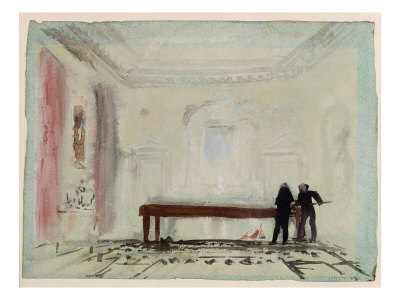
The National Trust also records that Turner produced striking gouache drawings of Petworth interiors and inhabitants in 1827, and that Egremont commissioned four final works for the Carved Room.[2] Those works included subjects connected to Petworth Park, Brighton Chain Pier and the Portsmouth and Arundel Canal. Petworth was therefore not only a house Turner visited. It was a setting where social life, patronage, modern improvement, landscape and display came together.
Petworth as Working Environment
The Petworth material is especially valuable because it shows Turner looking indoors as well as out. He observed rooms, people, leisure, light and the rituals of aristocratic life. The interior gouaches are not simply polite records. They show how a painter known for sea, storm and mountain could also study social atmosphere with wit and acuity.
The Carved Room commissions show another side of the relationship. Turner made paintings to fit an existing decorative and architectural setting, but he did not merely fill spaces. He connected the patron's estate, philanthropy and interests to broader themes of landscape, water, engineering and modern life.
Monro, Munro, Vaughan and Ruskin
Other collectors and supporters shaped Turner's afterlife as well as his career. Dr Thomas Monro provided a context for copying and watercolour development. The Scottish collector Hugh Andrew Johnstone Munro of Novar was a different supporter; he accompanied Turner to Italy in 1836.[7] Henry Vaughan later bequeathed Turner watercolours to public collections in Scotland, Ireland and London.[5] Tate's The Blue Rigi, Sunrise entered public ownership through the separate 2007 acquisition campaign.[6] John Ruskin's role was different: critic, collector, defender and later participant in the sorting and interpretation of Turner material.
Ruskin became one of Turner's most influential interpreters without providing the only account of his art. The National Gallery notes his role as a major champion, and Modern Painters helped shape the artist's Victorian reputation.[1] Patronage here becomes criticism and preservation as much as purchase.
Independence Within Relationship
Patronage supported Turner's career alongside his commercial independence and selective dealings. He owned a gallery, retained many works and planned for his legacy. The Turner Bequest itself records his conditions for the future ownership and display of his art.[3] Patronage supported him, but it did not absorb him.
This balance is crucial. Turner needed collectors, but collectors also needed Turner. His art gave them access to modern landscape ambition, technical brilliance and cultural prestige. The relationship could be friendly, strategic, tense or all three at once.
Why Patronage Changes the Picture
Seeing Turner through patrons and Petworth changes the familiar story. It reveals an artist moving through households, exhibitions, print networks and collections, not simply confronting nature alone. It also makes the works more specific. Chichester Canal, The Chain Pier, Brighton, Petworth interiors and Egremont-related subjects belong to a social landscape as well as a visual one.
The painter of light was also a professional negotiating friendship, money, status, memory and access. Petworth, Farnley, Monro, Vaughan, Ruskin and the national institutions around the bequest show how his career developed in relation to people as well as places.
Patronage and Turner's Independence
Turner earned enough to become unusually independent. The National Gallery's catalogue biography describes sustained patronage and his retention or repurchase of major works for eventual bequest to the nation.[4] Patronage gave him opportunities, while financial success and professional rank gave him room to refuse, retain, revise and shape his legacy.
The relationship between artist and patron was therefore negotiated. A patron might request a subject, provide hospitality or buy a work, but Turner often found ways to make the result exceed ordinary expectation. A country-house commission could become an experiment in light and setting. A travel subject could become a meditation on weather or history. Patronage supplied circumstances; Turner supplied transformation.
Dr Monro and Early Formation
Dr Thomas Monro's circle is important for the young Turner because it links training, copying and watercolour practice. Monro's house brought together artists and materials in a setting where copying after earlier masters and contemporaries helped sharpen technique. For Turner, such experience supported the discipline of drawing and the tonal intelligence that would later underpin more ambitious works.
This early patronal world was not glamorous in the same way as Petworth, but it mattered. It connected Turner to networks of artists, collectors and watercolour practice at a formative stage. It also shows that Turner's development depended on shared rooms and shared visual culture, not only solitary looking.
Fawkes, Friendship and the North
Walter Fawkes of Farnley Hall offered Turner more than purchase. Farnley provided friendship, access to Yorkshire scenery and a sympathetic environment for watercolours and drawings. Turner's northern connections helped sustain his attention to rivers, ruins, castles, estates and weather. They also linked travel to social belonging.
The Fawkes relationship shows a less formal side of patronage. Turner could be guest, friend and artist at once. Such relationships complicate the idea of the patron as merely a buyer. They created recurring conditions in which subjects could develop over time.
Egremont's Petworth
Petworth is the most vivid example because so much evidence remains in place and because the National Trust has documented Turner's long relationship with the house. The 3rd Earl of Egremont was a major collector and patron who made Petworth a rich environment for British art.[2] Turner returned repeatedly, enjoying unusual freedom to observe interiors, parkland, collections and social life.
The house itself mattered as a visual organism. Interiors were dense with pictures, sculpture, furniture and people; outside lay parkland shaped by landscape design. Turner could study art, society and landscape in one setting. The result was not simply a set of commissioned views but a sustained engagement with a living house.
The National Trust notes that the four Carved Room works were made for specific positions within Grinling Gibbons' carved panelling and related to subjects significant to Egremont.[2] This is patronage as spatial collaboration. Turner painted for a room, a patron, a house and a social memory.
The Petworth Interiors
The 1827 Petworth gouaches are among Turner's most fascinating social images. They show rooms, pictures, figures, leisure and light with an intimacy quite different from the public drama of Academy oils. The National Trust describes them as among his most striking views of the estate's interiors and inhabitants.[2]
These works matter because they show Turner as an observer of human environments. He is not only looking at sea and sky. He is watching how people inhabit rooms, how pictures hang, how light enters interiors and how aristocratic life arranges itself. The painter of atmosphere becomes a painter of social atmosphere.
The interiors also complicate Turner's relation to finish. Gouache allowed immediacy and compression. The works feel both rapid and exact, alive to gesture, grouping and spatial mood. Petworth gave Turner a subject where informality could become art.
The Carved Room Commissions
The Carved Room paintings show another mode of patronage. They were designed for a specific architectural setting and later reinstated after restoration work, according to the National Trust.[2] Their subjects included Petworth Park, the Chain Pier at Brighton and the Portsmouth and Arundel Canal. These were not random choices. They connected Egremont's estate, regional improvement, coastal engineering and modern infrastructure.
This matters for interpreting Turner's Petworth work. The commissions are not only picturesque. They link patronage to public improvement and modernity. Egremont's interests gave Turner subjects in which landscape, technology and local identity could meet.
Collectors After Turner
Patronage did not end with Turner's life. Collectors shaped the afterlife of his works through purchases, gifts and bequests. Henry Vaughan's bequests of Turner watercolours are one example; Ruskin's collecting and criticism is another.[5] The national settlement of the Turner Bequest shifted the scale from private collection to public inheritance.[3]
This afterlife matters because Turner carefully thought about posterity. He retained works and attached conditions to the bequest. The people around Turner bought, defended, displayed and interpreted him, but Turner himself also tried to direct the future. Patronage and self-fashioning were intertwined.
Against the Isolated Genius
The myth of Turner as isolated genius is seductive because many works feel solitary: a ship in a storm, a mountain through rain, a sun over empty water. But the making and survival of those works depended on human networks. Patrons invited him, bought him, criticised him, defended him, housed him and preserved him. Publishers and engravers circulated him. Institutions received him.
Turner turned social opportunity into pictorial invention. Houses, exhibitions, print shops and collections gave his works settings and audiences; later gifts and legal settlements shaped their survival. The images can exceed those immediate circumstances while remaining connected to them.
Patronage and Subject Choice
Patronage affected what Turner painted, but not mechanically. A commission or invitation could direct him toward a place, but his treatment might transform the subject. Petworth is the clearest example: the estate, the rooms and Egremont's interests supplied material, yet Turner's images do more than record a patron's property. They turn Petworth into a world of light, sociability, landscape and modern improvement.
The same principle applies elsewhere. Fawkes's Yorkshire connections did not simply produce views for a friend; they helped deepen Turner's northern landscape practice. Print publishers did not simply hire Turner to illustrate places; their projects encouraged him to develop a portable language of topographical drama. Collectors did not merely acquire finished goods; they helped shape the conditions in which works were imagined, retained and displayed.
Houses as Artistic Worlds
Country houses such as Petworth and Farnley were not just backdrops. They were artistic worlds. They contained collections, libraries, guests, conversation, architecture, estate landscapes and social rituals. For Turner, such environments offered concentrated material. He could study old art, contemporary taste, interior light, outdoor views and patronal identity in one setting.
Petworth's North Gallery and Carved Room are especially important because they show art embedded in architecture and social memory. The National Trust describes Petworth as a major art collection and notes the continued presence of Turner works in the house.[2] Turner's paintings for the Carved Room therefore belong to a living display context, not only to easel painting history.
This helps explain why Petworth remains so vivid in Turner studies. It preserves the relation between place, patron and image with unusual clarity.
Ruskin, Criticism and Preservation
Ruskin's importance belongs partly to criticism and partly to preservation. His defence of Turner helped shape Victorian reception, while his later involvement with Turner material affected how the artist's legacy was handled. His account is an influential interpretation rather than a neutral or exhaustive view. His role shows how collecting, criticism and interpretation can merge.
Ruskin also demonstrates that patronage can be intellectual rather than simply financial. A critic may support an artist by changing the language in which the artist is judged. In Turner's case, Ruskin helped make difficult atmospheric and late works newly defensible for a Victorian public.
Public Collections as Final Patrons
After Turner's death, public institutions became the most consequential patrons of his reputation. The National Gallery, Tate and other collections did not commission Turner in the usual sense, but they shaped how his work would be seen, studied and valued. The Turner Bequest turned private retention into public inheritance.[3]
This final stage changes the patronage story. Turner's career begins with individuals and networks, passes through collectors and country houses, and ends with national institutions. The artist who negotiated with private patrons also imagined a public future. That ambition makes him unusually self-conscious about posterity.
Petworth and the Human Turner
Petworth matters finally because it makes Turner social. The interior gouaches and the repeated visits show him in relation to rooms, guests, meals, pictures, windows, parkland and friendship. They do not erase the solitary Turner of storm and sea, but they add another dimension. Turner could observe human arrangements with the same acuity he brought to weather.
The Petworth material places Turner within a world of guests, colleagues, friends and professional relationships. That social setting coexisted with his independence and supplied some of the circumstances in which his art developed.
Why Petworth Remains the Key Case
Petworth remains the key case because it joins so many forms of patronage in one place: hospitality, collecting, commissioned painting, interior display, estate landscape and social freedom. The National Trust's account makes clear that Turner returned repeatedly and that the house still preserves important evidence of that relationship.[2] Few Turner settings allow the viewer to connect artist, patron, room and landscape so closely.
For that reason, Petworth is not merely one attractive episode. It is a model for understanding how Turner could work inside a patronal world while remaining fiercely inventive. The estate gave him material; he gave it pictorial afterlife.
Discussion
How does Turner's independence look different when his social and professional networks remain visible?
Reader Insights
Where do friendship, commission and collecting overlap without becoming identical?
How did Petworth operate as a house, collection, landscape and working environment?
Which choices show Turner using patronage without surrendering artistic control?
Join the Conversation
Share a close observation or a source-based question for other readers.
References
- National Gallery, Joseph Mallord William Turner artist record, https://www.nationalgallery.org.uk/artists/joseph-mallord-william-turner
- National Trust, "JMW Turner at Petworth House and Park," https://www.nationaltrust.org.uk/visit/sussex/petworth/jwm-turner-at-petworth-house-and-park
- National Gallery, "The Turner Bequest," https://www.nationalgallery.org.uk/about-us/history/the-turner-bequest
- Judy Egerton, "Joseph Mallord William Turner," National Gallery Catalogues: The British Paintings, London, 2000, biography on patronage, financial independence and retained works, https://www.nationalgallery.org.uk/paintings/catalogues/egerton-2000/joseph-mallord-william-turner
- Charlotte Topsfield, "Henry Vaughan – 'A great Turner man'," National Galleries of Scotland, 2020, https://www.nationalgalleries.org/art-and-artists/features/henry-vaughan-great-turner-man
- Art Fund, The Blue Rigi, Sunrise, 2007 acquisition campaign, https://www.artfund.org/our-purpose/art-funded-by-you/the-blue-rigi-sunrise
- National Galleries of Scotland, Turner & Italy, 2009 exhibition history, Rome section on the 1836 journey with Munro of Novar, https://www.nationalgalleries.org/exhibition/turner-italy