 by Tom Gurney
Tom Gurney BSc (Hons) is an art history expert with over 20 years experience
Published on June 19, 2020 / Updated on August 29, 2026
Email: tomgurney1@gmail.com / Phone: +44 7429 011000
A Town Between River and Sky
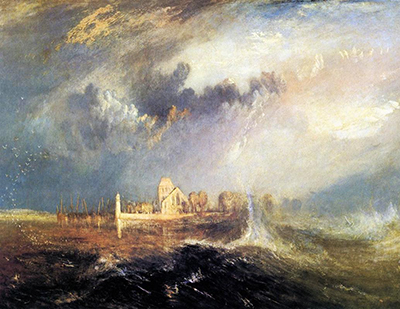
Quillebeuf lies low in J. M. W. Turner's painting, compressed into a narrow band between a tremendous sky and a river that has suddenly become unstable. A church and white lighthouse give the settlement its clearest forms. Masts rise behind them, tiny figures gather by the waterfront, and warm trees mark the right edge of the town. Yet the view is not governed by architecture. Dark weather sweeps across the left while a great pale surge climbs from the water at the right, as if river and cloud were turning around the buildings together.
Above the water, gulls lift in a loose spiral. Their white bodies begin near the dark lower-left current and multiply into the slate and ochre sky. The Calouste Gulbenkian Museum identifies this upward flight as the first of three moments in the design, followed by the town and then the local tidal phenomenon known as the mascaret or barre.[1] The sequence is not a simple left-to-right story. Birds, cloud and wave establish overlapping circles that make the whole scene appear to rotate.
The exact object is Quillebeuf, Mouth of the Seine, painted in 1833. It is oil on canvas, measures 88 by 120 centimetres, and carries inventory number 2362 in the Calouste Gulbenkian Museum in Lisbon.[1][3] Those moderate dimensions distinguish it from Turner's enormous exhibition harbours of the previous decade. Its scale is concentrated rather than panoramic, but the atmosphere makes the scene feel immense.
Turner gave Royal Academy visitors a more explanatory title: Mouth of the Seine, Quille-Boeuf. He also supplied a note about quicksands, stranded vessels and a rising tide that entered in one wave.[6] That historical caption changes what might otherwise look like a fantastic storm. The enormous white form is not a tsunami and not merely wind-whipped sea. It represents an incoming tidal bore in a notoriously difficult estuary.
The town therefore occupies a precarious position. Its church suggests duration, its lighthouse guidance and its masts maritime work, but all three stand within forces that exceed them. The river can ground a vessel before lifting and overwhelming it. Weather reduces visibility just when navigation requires exact local knowledge. Gulls respond instantly to the disturbed water while human structures can only wait inside the event.
The Gulbenkian describes Turner's method as a combination of naturalistic observation, memory and sensitive recreation.[1] That formulation is essential. Quillebeuf is recognisable and arose from repeated travel on the Seine, yet the painting is not a neutral record of one witnessed incident. Turner gathered the town, the dangerous bore, storm light and maritime signs into a studio construction designed for public exhibition.
Its drama comes from holding those kinds of truth together. Topography fixes the name. The Academy note explains the physical danger. Local history reveals a community shaped by pilots, shoals and rescue. Paint then exceeds documentation, making water rise into air and buildings dissolve in humid light. Quillebeuf is a real place, but Turner makes its identity inseparable from the difficulty of seeing and surviving it.
At a Glance
- ArtistJoseph Mallord William Turner
- Current titleQuillebeuf, Mouth of the Seine
- Route titleQuillebeuf at the Mouth of Seine
- Royal Academy titleMouth of the Seine, Quille-Boeuf
- Date1833
- MediumOil on canvas
- Dimensions88 × 120 cm
- CollectionCalouste Gulbenkian Museum, Lisbon
- Inventory2362
- Royal AcademyNo. 462, 1833
Contents
- A Town Between River and Sky
- The Exact Painting and Its Royal Academy Name
- The Wave Turner Explained
- What a Mascaret Is
- Quillebeuf and the Work of Navigation
- Repeated Journeys Along the Seine
- From Blue-Paper Watercolour to Oil
- Steam, Sail and the Published Seine
- Gulls, Circles and the Turning Composition
- Lighthouse, Church and Cemetery
The Exact Painting and Its Royal Academy Name
The current museum record gives the firm identity: Joseph Mallord William Turner, Quillebeuf, Mouth of the Seine, England, 1833, oil on canvas, 88 centimetres high by 120 centimetres wide.[1] Google Arts & Culture preserves the same object through its Gulbenkian partnership.[3] The inherited wording “at the Mouth of the Seine” and the museum's more compact title refer to this single canvas, not to separate versions.
The nineteenth-century title varied orthographically. At the Royal Academy the place appeared as Quille-Boeuf, while modern French usage is Quillebeuf-sur-Seine. Historical catalogues also use Quilleboeuf. Such variation is normal for a British artist, English exhibition catalogues and a Norman place name passing through later scholarship. It should be explained, not silently regularised into evidence for multiple works.
Turner's painting was number 462 in the Royal Academy Summer Exhibition of 1833.[5][6] The exhibition opened on 6 May and continued until 20 July. It contained 1,226 works by 618 artists, making the canvas one object within a densely hung and highly competitive annual display.[4] The explanatory note helped it command attention by telling viewers that the apparent atmospheric upheaval referred to a specific navigation hazard.
The note described an estuary so dangerous from quicksands that any vessel taking the ground could be stranded and overwhelmed by the rising tide, which “rushes in in one wave.”[6] Turner did not leave the viewer to decide whether the surge was cloud, spray or fantasy. Grounding and tidal arrival supplied a compact maritime narrative. A ship need not be visibly shattered for disaster to be imminent; losing movement on the wrong bank was enough.
The modern museum calls the local phenomenon mascaret or barre.[1] Those words clarify the historical setting, but the surviving Academy wording located for this article does not securely establish that Turner printed either term in 1833. The distinction matters because it separates two layers of evidence. Turner's note made the incoming one-wave tide explicit; the museum relates that description to the local name and physical phenomenon.
The title “Mouth of the Seine” should also remain historical rather than be corrected by present geography. Nineteenth-century river works radically changed channels, banks and tidal behaviour. Turner's wording belongs to an estuary understood through sailing routes and dangerous reaches rather than one fixed coordinate on a modern chart. Quillebeuf functioned as a threshold where vessels entering for Rouen still faced the river's hardest conditions.
The Wave Turner Explained
The surge at centre-right is the painting's most spectacular form. It rises in a pale, curved mass from dark water and bends towards the sky, partly veiling the buildings behind it. Its edges are unstable: opaque white gives way to grey, blue and warm mist, while broken strokes below suggest foam rushing across a rough surface.[2] The form looks both bodily and immaterial, a wall of water already becoming atmosphere.
Turner's Academy note makes the event legible through the fate of a grounded vessel.[6] In an estuary threaded with quicksands and shifting shoals, taking the ground was not a harmless pause. A hull that could not answer tide or current might be struck broadside, inundated or left at the mercy of rapidly changing water. The warning supplies suspense even where a particular ship cannot be identified.
The museum extends that narrative by describing a huge wave that sinks ships and by identifying a sinking vigil or signal tower as its symbolic sign.[1] In the official high-resolution image, a dark slanting form and sparse uprights can be detected through the pale lower-right haze, but they are difficult to isolate with certainty.[2] The tower should therefore be understood through the institution's interpretation rather than treated as an obvious independently readable object.
No named vessel or documented accident belongs securely to the picture. Turner did not title it after a wreck, give a date of loss or provide victims' identities. The canvas compresses a recurring kind of danger into one exemplary event. Its power depends on recognition that this could happen to any craft that grounded in the wrong place as the tide arrived.
That distinction separates Quillebeuf from a conventional shipwreck painting. There is no single broken hull dominating the foreground, no rescue boat whose crew can be counted, and no clear division between survivors and spectators. Danger is distributed through the entire environment. The wave threatens vessels, the town loses definition, gulls scatter upward and the waterfront figures become almost too small to read.
The surge is also integrated rather than inserted. Its curve continues movements already established by cloud and birds. Pale paint connects it with the open atmosphere to its right, while denser white strokes join it to foreground foam. Turner makes the wave simultaneously the climax of a local narrative and a structural force that circulates through the canvas.
Weather magnifies the bore but does not replace it. The left sky carries dark, rain-heavy colour; lower water is turbulent; visibility breaks down near the surge. A viewer might call the whole event a storm, yet Turner's caption insists on rising tide. The painting combines meteorological darkness with a tidal mechanism whose sudden arrival was feared independently of wind.
The wave thus exists on three levels. It is a physical hazard recognised by pilots and river communities. It is a narrative agent capable of overwhelming stranded craft. It is also paint, a luminous mass through which solid forms disappear. Turner allows no separation between those levels: the estuary's danger is understood precisely through the way vision fails inside it.
What a Mascaret Is
A tidal bore forms when a rising tide enters a shallow, gently sloping and narrowing estuary strongly enough to create a surge that travels upstream. Instead of water levels increasing everywhere with quiet uniformity, a front or train of waves advances against the river's seaward flow. Peer-reviewed research uses tidal bore as the broad term and reserves mascaret for a conspicuous high-steepness regime.[7]
The Seine and Garonne are the two major French estuaries most associated with the phenomenon. In local Seine usage, the breaking front could be called la barre.[9] The words therefore describe related aspects of one tidal process: the general bore, its forceful visible form and the bar-like front encountered on the river.
Near Quillebeuf the bore was historically reported as breaking rather than merely undulating.[9] Estuary geometry helps explain why. Incoming water met shallow channels, bars, narrowing reaches and the existing river current. The front could steepen as it moved, while local depths and banks altered its shape. The result was dynamic rather than a fixed wall travelling unchanged from sea to Rouen.
Modern measurements show that lower-frequency tidal bores can still form in the Seine and that a first undulation may exceed one metre.[7] Such research confirms the process after extensive engineering, but it cannot be used as a ruler for Turner's canvas. The painted surge has been enlarged and organised within an expressive composition. Assigning it a modern measured height or speed would confuse hydrological evidence with pictorial scale.
Historical numbers require similar caution. Accounts gathered by hydraulic researcher Hubert Chanson describe numerous vessel losses on the lower Seine and very large bore estimates.[9] They communicate a genuine culture of danger, yet nineteenth-century reporting methods, locations and water conditions vary. The strongest claim is not one record measurement. It is that the bore interacted with shoals and constrained navigation across generations.
The phenomenon is sometimes misunderstood as a tsunami because both can appear as an advancing wall. Their causes differ. A tsunami begins with a major displacement of water, commonly from seismic activity; the Seine bore came with the astronomical tide entering a particular estuary. Calling Turner's wave a tsunami removes the local knowledge built into his Academy note.
Nor is mascaret simply a poetic name for storm surf. Turner's sky may be turbulent, but the bore moved upstream inside a river. A vessel could face its force far from an open-sea breaker. This is why quicksands and grounding mattered: the greatest danger came when a ship lost the ability to manoeuvre before the front reached it.
Scientific explanation does not diminish the painting's sublimity. It makes Turner's selection more exact. He chose a natural event in which ordinary tidal regularity becomes abrupt and spatially visible. Time seems to acquire a front. The tide does not merely rise; it arrives, turning a predictable cycle into an encounter that could still exceed the control of ships and shore.
Quillebeuf and the Work of Navigation
Quillebeuf's identity was inseparable from guiding vessels through the lower Seine. The port is attested deep in the medieval period; an official French heritage record includes a fishing right from 1040.[10] Over centuries, the settlement developed specialised knowledge of currents, banks, channels and tidal timing. What appears in Turner's painting as a small line of buildings belonged to a large system connecting the Channel with Rouen.
The institutional history of Seine pilotage records organised pilots at Quillebeuf, Villequier and Caudebec, with Quillebeuf's group becoming particularly important. Its sailors obtained a privilege to practise between Honfleur and Caudebec, a dangerous reach in which maritime and river navigation met.[8] Local authority came from repeated practical knowledge rather than from an assumption that captains could read the estuary from general seamanship alone.
A navigation guide of 1763 warned masters not to proceed without local pilots because of banks and currents.[8] The warning remained relevant in Turner's era. Channels shifted, shoals changed the available depth, whirlpools threatened hulls and fog could erase the landmarks needed for orientation. Sailing vessels also depended on favourable wind, so a technically navigable reach could become impassable through calm.
Ships bound for Rouen often waited at Le Havre or Honfleur, or reduced their draught by unloading part of their cargo, before entering the Seine.[8] Once committed, timing mattered. Pilots had to consider the vessel's depth, the position of banks, the tide and places where taking the ground might be less disastrous. Turner's catalogue note concentrates this entire discipline into the moment when such judgement has failed or conditions have defeated it.
Calm created a different form of labour. When vessels stalled near Quillebeuf, seven to fourteen rowing tow-boats could go out, each carrying six men, sometimes travelling as far as the estuary ports.[8] Human muscle then substituted for absent wind. The scale of that operation shows why the tiny waterfront figures in Turner's canvas should not be dismissed as ornament, even though none can be assigned a precise role.
The wider population also participated in rescue. The pilotage history records more than sixty endangered ships hauled to safety by local effort in 1758.[8] Ropes from shore, towing crews and knowledge of where a hull might survive transformed river danger into collective work. Quillebeuf's church, lighthouse and crowded edge belonged to a community accustomed to reading emergencies in the water.
Progress could be slow. The journey from the estuary to Rouen, roughly 120 kilometres, might take several days under difficult conditions.[8] Travel literature and later prints could make the Seine appear a continuous scenic journey, but navigation consisted of pauses, assistance, waiting and renewed judgement. The river was both thoroughfare and obstacle.
Quillebeuf's municipal history also records the opening of a local hydrography school in 1793, evidence that practical pilotage was supported by formal instruction.[12] Theory did not replace experience; it helped organise knowledge demanded by the shifting river.
Turner's painting compresses that working history without illustrating one procedure. Masts show traffic, lighthouse and church establish orientation, and minute figures occupy the bank. The bore then tests every system at once. Local expertise could greatly reduce danger, but no skill abolished the tide, quicksand or sudden loss of visibility. The sublime here is not nature encountered by an isolated spectator; it is nature encountered by a labouring port.
Repeated Journeys Along the Seine
Turner knew the Seine through repeated travel rather than one expedition. He visited Normandy several times in the 1820s and early 1830s, returning to river towns, ports and bends while gathering material for paintings and publications. Accounts differ over the exact number of stops at Quillebeuf, so repeated observation is more reliable than a rigid visit count.
The Gulbenkian explicitly combines observation with memory and recreation in its account of the oil.[1] Those terms describe a method Turner had developed throughout his travelling life. Small pencil studies could secure shorelines, towers and vessel arrangements quickly. Colour notes or washes preserved selected effects. Back in Britain, separate records and remembered weather could be reorganised for an image much more unified than any one sketch.
In 1829 and 1832 Turner gathered extensive material for publisher Charles Heath's Seine project, issued through Turner's Annual Tour and Wanderings by the Seine.[17] The river offered scenic architecture and modern transport, but also a ready-made sequence. A traveller could move from the estuary towards Rouen and Paris while images alternated between town views, castles, shipping and bends in the water.
Quillebeuf stood at a particularly productive junction. It offered an identifiable church and lighthouse, a celebrated pilot community, dangerous navigation and a tidal phenomenon already embedded in local reputation. The town could function as topography, maritime history and natural drama without ceasing to be one compact place.
Travel did not necessarily give Turner the exact event seen in the oil. He may have witnessed disturbed tide or heard accounts from those who knew it, but no secure record identifies one bore, one stranded ship or one sinking tower as the canvas's origin. The Academy note communicates general danger rather than eyewitness testimony about a dated accident.
This openness allowed different experiences to combine. A dark storm field might come from one journey, the luminous profile of the town from another, and the surge from direct sight, local description or accumulated imagination. Such combination is not falsification. It is the means by which a landscape painter converts changing conditions into a design that can be seen all at once.
Turner's travelling also involved modern systems. He crossed water in passenger vessels and steamers, observed working craft and represented steam tugs on the Seine.[14] His Quillebeuf should not be isolated from those practical encounters. Even where mechanical power is not the painting's clearest motif, the artist understood a river corridor undergoing technological change.
The 1833 oil was completed for a London exhibition audience rather than for local hydrographic instruction. It needed to work among hundreds of other pictures, at a distance and in a crowded room. Turner intensified the circular flight, dark-light contrast and towering bore while retaining enough topographic specificity to make Quillebeuf more than an invented coast. Travel supplied the facts; exhibition painting made them collide.
From Blue-Paper Watercolour to Oil
A small related watercolour known as Quilleboeuf reveals another form of Turner's engagement with the town. Catalogued in the Turner Bequest as CCLIX-103, it was made around 1830-32 in watercolour, bodycolour and pen on blue paper and measures approximately 140 by 189 millimetres.[15][16] It was associated with the Seine publication and translated into engraving for the 1834 volume.
The sheet and oil share the town as a central motif. Church, river architecture and the low settlement establish continuity between travel-derived design and exhibition painting. Yet the relationship is not one of mechanical enlargement. The small work belongs to a reproducible travel sequence; the canvas converts Quillebeuf into a concentrated encounter among birds, weather and tidal force.
Blue paper gave Turner a middle tone on which he could move in both directions. Pale bodycolour created light, while darker pen and wash supplied structure. The support therefore participated in atmosphere before every area was covered. That method is relevant to the visual thinking behind the Seine designs, but it should not be transferred literally to the oil. Canvas, oil paint and exhibition scale required different material decisions.
The publication process introduced another transformation. An engraver translated colour and wash into a printable pattern of line and tone. The resulting image could circulate through books, reaching readers who had never travelled along the Seine or attended the Royal Academy. Quillebeuf became part of an itinerary consumed through reading as well as a painting encountered in a gallery.
The oil refuses the descriptive clarity often required by travel illustration. Its right side dissolves in pale vapour, the bore obscures architecture and the gulls fragment into strokes. Recognition remains, but it is continually threatened by atmosphere. The image does not merely tell readers what Quillebeuf looks like. It makes viewers experience how quickly stable landmarks can become uncertain.
This difference also concerns time. A publication view can present the town as one stop in a sequence, followed by the next bend or castle. The oil suspends travel at the instant of danger. Movement up the Seine is arrested by a surge moving in the opposite direction. The viewer cannot continue until the painted wave has been confronted.
Turner's reuse of the motif demonstrates how repeated subjects generated new meanings. A church and lighthouse first useful for identifying a town could later become points of fragile order. A river journey promoted through travel could become the setting for forces that resist passage. The same observed facts changed function when moved between paper, print and oil.
Neither version is more truthful in a simple sense. The blue-paper design preserves one economy of travel observation; the canvas joins that knowledge to the Academy note and a much stronger atmospheric invention. Together they show Turner working serially before modern serial painting: returning to one location because every medium and purpose disclosed a different problem.
Steam, Sail and the Published Seine
Another related design, Between Quilleboeuf and Villequier, expands the river's technological context. Dating from about 1830-32, it combines watercolour, bodycolour and pen on blue paper, measures about 138 by 190 millimetres and derives from a pencil record in the Tancarville and Lillebonne Sketchbook.[15][16] Robert Brandard engraved the subject in 1834; Tate holds an impression measuring 10.4 by 14.8 centimetres.[13]
The composition shows small steam vessels helping sailing ships negotiate a hazardous bend. National Gallery scholarship notes that this relationship, with compact modern power guiding a much larger traditional vessel, anticipates in some sense the motif later used in The Fighting Temeraire.[14] That is a valuable comparison, but the Quillebeuf design was not a direct preparatory study for the 1839 oil.
Its immediate importance lies in what it proves about the Seine. Turner observed remorqueurs, or steam tugs, working there in 1830-32.[14] He understood their practical use and could make them visible within a landscape. Quillebeuf's 1833 oil therefore cannot be explained by claiming that Turner knew only sail or rejected mechanical navigation.
Instead, the two images make different selections. Between Quilleboeuf and Villequier stages assisted passage: technology helps vessels find a safe course around natural danger. The oil stages exposure: town and shipping face a tidal surge that no clear machine dominates. One image concerns navigation through a hazard; the other makes the hazard temporarily overwhelming.
The Seine publication included additional views, among them Chateau de Tancarville, with Town of Quilleboeuf, also engraved by Brandard in 1834.[19] Across the sequence, castles, towns, sailing vessels and steam traffic situate the river between inherited history and contemporary mobility. The images offered British readers scenery already being changed by faster travel.
Steam service had reduced journey times on the river since the early 1820s, and Turner's designs gave steamboats notable prominence.[20] Their smoke and compact hulls provided visual contrasts with old towers and broad sails. Yet modernity in these works is not a simple story of replacement. Steam assists sail; ancient settlements remain active; weather and shoals still set conditions.
Engraving further modernised Turner's travel art by multiplying it. Brandard's work transformed the original wash and bodycolour into lines capable of repeated printing. Charles Heath's enterprise joined artistic invention to publishing, distribution and tourism.[17][18] The river travelled outward as an image even as readers imagined moving inward towards Rouen.
Against that network, the Academy oil appears deliberately singular. Its painted surface cannot be reduced to reproductive line, and its bore interrupts the confidence of an itinerary. Nevertheless, oil and print belong to one sustained investigation. Turner saw the Seine as scenery, workplace, technological corridor and unstable natural system, then allowed each medium to emphasise a different relation among them.
Gulls, Circles and the Turning Composition
The gulls are the painting's most numerous active forms, though they should not be counted as if each mark were equally distinct. They begin against dark water at lower left, rise through the weather field and spread towards the upper centre. Some are small white hooks, others paired strokes, while a few lower birds have darker accents that suggest turning wings.[2]
Their movement is more than anecdotal. The Gulbenkian calls the flock's spiral crucial to the disciplined balance of the composition and describes an uninterrupted multiplication of circles.[1] Birds connect the river surface to the sky, carrying disturbance upward before the great surge on the opposite side returns atmospheric motion towards the water.
Cloud reinforces the rotation. Dark slate and ochre masses curve across the left rather than lying in flat horizontal bands. Near the centre, warmer openings and pale vapour begin to turn the eye down towards Quillebeuf. On the right, the bore rises in a broad arc whose inner edge resembles a breaking column of cloud.
Foreground foam completes smaller loops. White strokes bend across black-green water, while red-brown and grey currents sweep laterally beneath them. No single perfect spiral governs every mark, but enough curved vectors recur to keep the surface mobile. The design feels centripetal and dispersive at once: forms gather around the town, then fly or dissolve away from it.
Quillebeuf itself provides resistance. Church, lighthouse and waterfront form a low horizontal interval in the turning field. Their vertical accents are small but decisive. Without that architectural measure, the scene might become an indeterminate vortex; with it, every atmospheric curve acquires scale and consequence.
The circular design also joins different kinds of movement. Gulls respond bodily, beating wings into the air. The tide advances hydraulically. Cloud travels meteorologically. The viewer's eye follows pictorially. Turner does not make these motions scientifically identical, but he rhymes them until the estuary appears to operate as one system.
That unity helps explain why the bore is difficult to isolate. It does not stand before a passive landscape like a theatrical prop. Its pale substance merges with sky, while the cloud's darkness seems already present in the river. Distinctions among water, spray and air become unstable precisely where the event is strongest.
The vortex can look strikingly modern, but it remains anchored to birds, buildings and a named tidal phenomenon. To treat it only as a prophecy of abstraction would remove the knowledge that gives the marks urgency. Turner approached dissolution through the exact pressures of place: disturbed gulls, an endangered port, poor visibility and water arriving against the expected direction of the river.
Lighthouse, Church and Cemetery
At the centre of the canvas, a short white cylindrical lighthouse stands beside the larger mass of Notre-Dame-de-Bonport. The lighthouse's bright body and dark cap are sharply economical, while the church offers a square tower, steep roof, broad gable and round-arched openings.[2] These forms identify Quillebeuf even as weather threatens to erase them.
The church is the historic parish church, with building phases extending across different periods.[11] Its visible entrance has a Romanesque-looking round arch, but the whole structure should not be assigned to one style from the painting alone. Turner selected the profile needed at his distance rather than documenting masonry phase by phase.
The lighthouse is equally vulnerable to over-identification. Quillebeuf had successive navigational lights and structures, and modern local accounts do not align neatly on their chronology. The painted lighthouse is secure because the museum names it; its equation with one surviving tower or one construction date is not. Turner may also have simplified what he saw to make the white vertical read against dark air.
The Gulbenkian groups lighthouse, church and cemetery into what it calls a “tragic trilogy.”[1] This is an interpretive framework rather than a recorded symbolic programme written by Turner. It draws attention to three forms of orientation and mortality: guidance for vessels, spiritual community and the place of the dead.
The cemetery itself is less individually visible than the two buildings. Warm ochre and red-brown forms gather to the church's right, where trees and low structures meet the rising surge.[2] The museum's identification gives that zone meaning, but no grave or named burial can be read confidently. The effect is collective, a settlement's memory placed beside its working river.
Lighthouse and church also serve practical pictorial functions. Their verticals interrupt the town's horizontal line. White and cream paint create a bridge from dark left weather to pale right vapour. Their relatively firm edges give the eye a last moment of stable architecture before forms dissolve towards the bore.
Tiny waterfront figures intensify the contrast. They occupy the bank near these landmarks but are too small for reliable identities. Some pale marks may indicate people watching or working; none can be made into a named pilot, mourner or rescuer. Human scale is present precisely through its inability to command the event.
The town therefore avoids becoming either pure symbol or mere map. Its structures arose from real communal needs, and its church has an independent architectural history. Turner then organised them as a compact centre of guidance, belief and mortality. The bore does not destroy that centre visibly, but it makes every form look temporary inside the river's cycle.
Paint Dissolving into Weather
The official high-resolution image reveals an unusually varied painted surface.[2] Across the left sky, slate, green-grey, ochre and smoky brown appear in thin, overlapping fields. Some transitions are translucent and softly rubbed; others leave more decisive sweeps. The effect is not a uniformly dark ground but weather continually opening and closing.
Small white gull marks sit on and within those fields. They can be crisp at one scale and almost disappear at another. Turner needed only a bend, paired stroke or dark accent to turn paint into a bird. Their economy contrasts with the broad cloud masses and allows a large flock to remain visually light.
The town condenses detail. Fine dark lines create masts, roof edges and windows; cream and ochre blocks establish church and waterfront; tiny pale touches imply figures. These marks are not equally finished. Some architecture is firm enough for recognition, while adjacent forms fade into warm haze. Variable definition makes the settlement appear seen through moving air rather than diagrammed.
At centre-right, pale paint becomes more opaque. White, grey and cool blue build the surge, with warmer undertones showing through or around it. Broken edges prevent the mass from becoming a solid column. The same colours continue into the sky, so the viewer has to decide repeatedly where water ends and cloud begins.
Foreground water carries heavier contrasts. Dark brown, green-black and grey strokes sweep beneath bright cream and white foam. The directional handling gives the lower edge weight and agitation. Against that density, the pale right distance seems to lose substance, extending the museum's description of a progressive elimination of forms.[1]
Oil is crucial to the effect. Turner could move between thin veils, semi-opaque scumbles, narrow lines and dense highlights on one canvas. The handling may evoke watercolour because light appears to pass through some passages, but the material remains oil on canvas. Calling it watercolour-like should describe an optical quality, not change the medium.
No object-specific technical report currently secures a pigment list, ground composition or exact order of work. It would be tempting to name colours chemically or assign every broad mark to a particular tool, but the reproduction cannot support that precision. Nor can visible cracking justify a diagnosis of varnish, abrasion or restoration.
What can be said is already substantial. Turner calibrated opacity to narrative. Firm linear details hold the town briefly in view; translucent cloud creates unstable depth; thicker pale paint gives the bore force; scattered white marks make gulls and foam flash against darkness. Material difference becomes a way of describing how an estuary is seen when air and water exchange appearances.
Six Marine Paintings in 1833
Quillebeuf appeared within one of Turner's most concentrated Royal Academy displays. He submitted six paintings in 1833, all marine subjects.[4] The group included Rotterdam, two Venice scenes, two works involving Dutch maritime history or Van Goyen, and Mouth of the Seine, Quille-Boeuf. Together they joined contemporary travel, remembered naval culture and direct engagement with earlier European painters.
Two titles named artistic predecessors explicitly: Canaletto and Jan van Goyen. Royal Academy historian Martin Myrone describes such works as Turner's knowing encounter with art history, open to tribute, competition and critique.[4] Quillebeuf did not name an Old Master, yet its place among those paintings encouraged viewers to see maritime landscape as a field in which Turner tested his modern authority.
The Academy itself stood near an institutional change. The royal mews at Charing Cross had been demolished for a building intended to house both the Royal Academy and National Gallery.[4] Questions of national artistic inheritance were therefore unusually visible. Turner, deeply involved in Academy life and attentive to his historical reputation, exhibited a group capable of speaking to travel, commerce and the museum future of painting.
Press discussion was extensive and mostly favourable, though not without familiar doubts. The Morning Chronicle complained that Turner had not improved through closer acquaintance with nature and common sense. The Examiner, by contrast, praised splendid sea pieces conceived and executed with poetic imagination, and another notice commended a chaste, natural and original style.[4]
Colour remained contentious. A reviewer raised the spectre of “yellow fever,” while a young American visitor, Thomas Gold Appleton, claimed Turner was often called the “Ochre Man.” Myrone stresses that no other evidence confirms this supposed nickname.[4] It should be treated as one elusive report, not as a securely established label used throughout London.
These comments illuminate the exhibition climate rather than supplying a complete review of Quillebeuf alone. Turner's six works were discussed together, and some remarks applied more directly to individual Venetian or Dutch subjects. The responsible conclusion is that number 462 entered a display in which his marine painting commanded attention and his colour continued to test definitions of nature.
John Ruskin later remembered early Academy Turners from before 1836, including Quilleboeuf, as achievements beyond imitation but of little charm in colour to his younger self.[21] At that stage he preferred the accessible naturalism and human appeal he found in painters such as Landseer and Wilkie. The recollection is valuable precisely because Ruskin later became Turner's greatest defender; admiration was not instantaneous or simple.
Quillebeuf's dark left sky and pale right bore complicate any one-note idea of Turner's yellowness. Ochre is important, but it operates beside slate, green-grey, black-brown, white and cool blue. The painting's colour argument lies in transition: weather moving from density to dissolution. Within the six-work group, it offered not a decorative tint but a river event in which colour controls danger and visibility.
From Birch to Gulbenkian
The painting's secure collecting history begins with Charles Birch of Harborne, who owned it by 1849.[1] It was with T. Horrocks Miller by 1889 and then passed to Thomas Pitt Miller. These names place the canvas within British private collecting long after its Royal Academy debut, where access depended on loans, sales and the decisions of successive owners.
Calouste Sarkis Gulbenkian acquired it from Thomas Pitt Miller through Knoedler in London on 26 April 1946.[1] The precision of that date comes from the museum's object record. It was Gulbenkian personally, not the later museum, who made the purchase. The distinction keeps the object within the biography of a collector who assembled his holdings before their permanent Portuguese home existed.
England had an important place in Gulbenkian's life and taste. He became a British national and acquired English paintings and prints across decades, with purchases extending to Turner in 1946.[22] Quillebeuf entered a collection otherwise remarkable for its chronological and geographical range rather than a narrow specialist group.
Gulbenkian assembled more than 6,000 works over more than fifty years, guided by personal judgement and advice from leading specialists.[23] He referred to treasured objects with familial affection, yet his collecting was also systematic. Inventory, provenance and controlled display allowed works from antiquity to the early twentieth century to coexist without losing individual histories.
After Gulbenkian's death in 1955, the collection followed the intentions set out for its future. About 6,440 works arrived in Portugal on 26 June 1960.[22] They were shown temporarily at the Palácio dos Marqueses de Pombal in Oeiras from 1965 until 1969. The Calouste Gulbenkian Museum then opened in Lisbon fourteen years after the collector's death.
The current museum collection comprises around 6,000 works, with roughly 1,000 on display.[23] Turner appears within the European nineteenth- and twentieth-century section alongside artists such as Manet, Degas, Renoir and Monet. That setting can encourage a modern history of light and colour, although Quillebeuf should not be reduced to a stepping stone towards later French painting.
Its movement to Lisbon altered the geography of Turner's public presence. A painting of France made by an English artist and long retained in British collections became a major Turner in Portugal. The ownership history is international, but each transition is documented rather than metaphorical: Harborne, the Miller collections, Knoedler's London transaction, Gulbenkian and finally the museum.
The canvas also acquired a new relationship with The Wreck of a Transport Ship, another Gulbenkian Turner. Their subjects both involve maritime danger, but they belong to different phases and should not be collapsed into a pair Turner designed. Collection display and later exhibitions brought them together after their independent creation and ownership histories.
The Painting After 1946
In 1973 the Gulbenkian Foundation presented the first exhibition devoted to Turner in Portugal. It marked the six-hundredth anniversary of the Anglo-Portuguese Alliance and was organised with the Tate Gallery, British Council and British Museum.[24] The project used Turner's repeated engagement with the sea to connect two maritime nations while introducing Portuguese audiences to the range of his practice.
The exhibition brought together 58 drawings and watercolours and 24 oil paintings covering about forty years of activity.[24] Quillebeuf and The Wreck of a Transport Ship were the two important oils from the Gulbenkian collection within the broader loan group. Their inclusion gave the Lisbon institution more than a hosting role: its own Turners helped anchor the retrospective.
Three decades later, The Sea and the Light concentrated on watercolour and maritime imagination. Organised by the Gulbenkian and Tate, it travelled to Baltimore in 2002, then Madrid, before reaching Lisbon in 2003.[25] The Lisbon display comprised 73 works and added the Quillebeuf oil and a Gulbenkian watercolour of Plymouth to the principal Tate selection.
That juxtaposition returned the painting to the media questions at its centre. Visitors could compare the opaque and translucent resources of oil with Turner's experiments in watercolour. Quillebeuf's pale surge and dissolved right distance may look spontaneous, but their relation to the small blue-paper Seine designs becomes richer when the differences in scale, support and exhibition purpose remain visible.
The canvas travelled again for Turner and the Sea at the National Maritime Museum in Greenwich, shown from 21 November 2013 to 21 April 2014.[26] Within a maritime institution, the bore could be read alongside Turner's broader concern with navigation, storms, conflict and coastal danger. The loan changed context, not ownership.
In 2024 the Gulbenkian organised a programme around art, nature and “the memory of a wild river.” It connected Turner's mascaret with the danger and spectacle of the historical Seine and with containment and channelisation undertaken from 1867.[27] This interpretation acknowledges that the river familiar to Turner cannot simply be recovered from its engineered modern form.
Scientific research supports that broad historical change. Embankment, dredging, reclamation and channel works altered where and how the bore appeared.[7] A phenomenon once central to local navigation became less visibly dominant. The painting consequently preserves more than a topographic profile: it holds a cultural memory of the river before large-scale engineering greatly reduced its unpredictability.
Exhibition history has kept opening different aspects of the canvas. The 1973 retrospective made it part of Portugal's first sustained encounter with Turner. The 2002-03 tour stressed sea and watercolour. Greenwich returned it to maritime history. The 2024 programme joined art to river transformation. None is a final interpretation, but together they show why one small Norman town can support questions of material, navigation, ecology and memory.
The Memory of a Wild River
The modern Seine near Quillebeuf cannot provide a transparent key to Turner's painting. Nineteenth- and twentieth-century engineering narrowed and deepened channels, reclaimed tidal land and changed the conditions under which the bore formed.[7][27] What looks exaggerated from a present bank may once have belonged to a more unstable relation among tide, shoal and river flow.
Turner did not produce a lost engineering diagram. His town is selected, the weather intensified and the surge organised into a circular composition. Yet invention does not make the image detached from history. The Academy note, pilotage record and modern hydrology converge on one central fact: vessels entering this reach faced a tide capable of turning grounding into catastrophe.
The painting makes that fact perceptual. Dark water and sky reduce certainty at the left. Gulls rise in scattered white marks. Church and lighthouse briefly gather the town into legible form. Then the pale bore climbs, obscuring architecture and exchanging substance with cloud. A viewer understands danger by experiencing the loss of stable distinctions.
Human knowledge remains present. Pilots read currents and bars; tow-boats compensated for calm; whole groups hauled threatened vessels from shore.[8] The lighthouse offered guidance and the church marked communal continuity. Turner did not oppose an untouched wilderness to helpless civilisation. He showed a working settlement whose expertise existed because the river could never be taken for granted.
The related prints add modern technology to that balance. Steam vessels could guide sail around a hazardous bend, and publication could distribute the river as scenery to an expanding travelling public.[13][14][20] Quillebeuf was therefore neither outside modernity nor conquered by it. The oil catches a moment when old local knowledge, mechanical assistance and natural force coexisted.
Its circular design refuses a simple narrative of progress. Birds, cloud, tide and eye keep returning movement through the scene. The wave may pass, stranded ships may be saved or lost, and the town will emerge again, but another tide follows. Cyclical time competes with the linear journey upriver and with the later history of engineering control.
That tension gives the lighthouse, church and cemetery their force. In the museum's “tragic trilogy,” they stand for guidance, belief and mortality.[1] Even without fixing that symbolism as Turner's stated intention, the three landmarks register different human responses to uncertainty. They help people travel, gather and remember, while remaining physically small beneath the weather.
The painting's modern afterlife depends on this density. It can be admired as a bold experiment in light and colour, studied as evidence of Seine travel, interpreted through tidal science, or placed within histories of publishing and collecting. Each approach becomes weaker if isolated. Colour matters because it describes a dangerous bore; the bore matters because a real navigation culture confronted it; memory matters because the estuary was later transformed.
Return finally to Quillebeuf's narrow centre. The white lighthouse, cream church and tiny waterfront marks occupy only a fraction of the canvas. Around them, gulls spiral through darkness and a pale wall rises from the river. Turner makes the town legible at the instant its visibility fails. That paradox is the work's enduring achievement: a precisely named place becomes most vivid while water, air and paint threaten to dissolve it.
Discussion
How does Turner transform a specific navigation hazard into a composition where river, town, birds and weather circulate together?
Reader Insights
How does the Academy note change the reading of the pale surge?
Why does the small town remain structurally central?
How do gulls, cloud and tidal bore create one circular system?
Join the Conversation
Share a close observation or a source-based question for other readers.
References
- Calouste Gulbenkian Museum, [*Quillebeuf, Mouth of the Seine*](https://gulbenkian.pt/museu/en/works/quillebeuf-mouth-of-the-seine/), inventory no. 2362.
- Calouste Gulbenkian Museum, [official high-resolution reproduction of *Quillebeuf, Mouth of the Seine*](https://content.gulbenkian.pt/inarte/museu/79396_3840x2868.jpg).
- Google Arts & Culture and Calouste Gulbenkian Museum, [*Quillebeuf, Mouth of the Seine*](https://artsandculture.google.com/asset/quillebeuf-mouth-of-the-seine-joseph-mallord-william-turner/6wGNbvVjZA3bgw?hl=en-GB).
- Royal Academy Chronicle 250, [“1833: In Search of the Ochre Man”](https://chronicle250.com/1833), by Martin Myrone.
- Royal Academy, [1833 Summer Exhibition catalogue](https://www.royalacademy.org.uk/art-artists/exhibition-catalogue/ra-sec-vol65-1833), volume 65.
- Historical Turner exhibition catalogue, [Academy record for *Mouth of the Seine, Quille-Boeuf*](https://upload.wikimedia.org/wikipedia/commons/e/e8/Turner%27s_celebrated_landscapes_-_sixteen_of_the_most_important_works_of_J._M._W._Turner%2C_reproduced_from_the_large_engravings_in_permanent_tint_by_the_autotype_process_%28IA_gri_33125010795413%29.pdf), catalogue no. 462 and explanatory note.
- Natalie Bonneton, Philippe Bonneton, Jean-Paul Parisot, Aldo Sottolichio and Guillaume Detandt, [“Tidal bore and Mascaret - examples of the Garonne and Seine rivers”](https://comptes-rendus.academie-sciences.fr/geoscience/articles/fr/10.1016/j.crte.2012.09.003/), *Comptes Rendus Geoscience* 344, no. 10, 2012.
- Seine Pilotage Station, [“History of Piloting on the Seine”](https://www.pilote-seine.fr/en/history/).
- Hubert Chanson, University of Queensland, [“The Seine River Mascaret”](https://staff.civil.uq.edu.au/h.chanson/mascaret.html).
- French Ministry of Culture POP, [Port de Quillebeuf-sur-Seine](https://pop.culture.gouv.fr/notice/merimee/IA27000309), heritage record.
- French Ministry of Culture POP, [Eglise paroissiale Notre-Dame-de-Bonport](https://pop.culture.gouv.fr/notice/merimee/IA00018886), Quillebeuf-sur-Seine.
- Quillebeuf-sur-Seine municipality, [local hydrography-school history](https://www.quillebeuf.fr/zoom-historique/phare/).
- Tate, [*Between Quilleboeuf and Villequier*](https://www.tate.org.uk/art/artworks/turner-between-quilleboeuf-and-villequier-t05609), engraved by Robert Brandard after Turner, T05609.
- National Gallery, London, [catalogue entry for *The Fighting Temeraire*](https://www.nationalgallery.org.uk/paintings/catalogues/egerton-2000/the-fighting-temeraire), including Turner's Seine steamboat studies.
- National Gallery of Greece, [*Turner* exhibition catalogue](https://library.nationalgallery.gr/assets/media/PDF/766.pdf), entries for CCLIX-103 and CCLIX-104.
- A. J. Finberg, [*A Complete Inventory of the Drawings of the Turner Bequest*, volume 2](https://upload.wikimedia.org/wikipedia/commons/e/ed/A_complete_inventory_of_the_drawings_of_the_Turner_bequest_-_with_which_are_included_the_twenty-three_drawings_bequeathed_by_Mr._Henry_Vaughan_%28IA_completeinventor02nati_0%29.pdf).
- Leitch Ritchie and J. M. W. Turner, [*Wanderings by the Seine*](https://upload.wikimedia.org/wikipedia/commons/a/ab/Wanderings_by_the_Seine_%28IA_wanderingsbysein00ritc_1%29.pdf), historical digitised edition.
- W. G. Rawlinson, [*The Engraved Work of J. M. W. Turner*](https://upload.wikimedia.org/wikipedia/commons/4/40/The_engraved_work_of_J._M._W._Turner%2C_R.A._%28IA_gri_33125001464789%29.pdf), Seine publication entries.
- National Galleries of Scotland, [*Chateau de Tancarville, with Town of Quilleboeuf*](https://www.nationalgalleries.org/art-and-artists/22012), engraved by Robert Brandard after Turner, 1834.
- Christie's, [*The Confluence of the Seine and the Marne*](https://www.christies.com/en/lot/lot-6386990), Seine-series essay.
- John Ruskin, [*Praeterita*](https://www.lancaster.ac.uk/media/lancaster-university/content-assets/documents/ruskin/35Praeterita.pdf), retrospective discussion of Turner's early Academy paintings.
- Calouste Gulbenkian Museum, [“Calouste Gulbenkian: An Art Collector in England”](https://gulbenkian.pt/museu/en/read-watch-listen/calouste-gulbenkian-an-art-collector-in-england/).
- Calouste Gulbenkian Museum, [Gulbenkian Museum Collection](https://gulbenkian.pt/museu/en/gulbenkian-museum-collection/) and [collector biography](https://gulbenkian.pt/museu/en/calouste-sarkis-gulbenkian/).
- Gulbenkian History of Art Exhibitions, [*Turner (1775-1851): Drawings, Watercolours and Oils*](https://gulbenkian.pt/historia-das-exposicoes/exhibitions/244/), 1973.
- Gulbenkian History of Art Exhibitions, [*The Sea and the Light: Turner Watercolours in the Tate Collection*](https://gulbenkian.pt/historia-das-exposicoes/exhibitions/945/), 2002-03.
- Calouste Gulbenkian Foundation, [Annual Report 2013](https://cdn.gulbenkian.pt/wp-content/uploads/2015/07/Relatorio-e-Contas-2013.pdf), loan to *Turner and the Sea* at Greenwich.
- Calouste Gulbenkian Foundation, [“Turner and the memory of a wild river”](https://gulbenkian.pt/agenda/arte-e-natureza-turner-e-a-memoria-de-um-rio-selvagem/), 2024.