 by Tom Gurney
Tom Gurney BSc (Hons) is an art history expert with over 20 years experience
Published on June 19, 2020 / Updated on August 29, 2026
Email: tomgurney1@gmail.com / Phone: +44 7429 011000
No Safe Distance
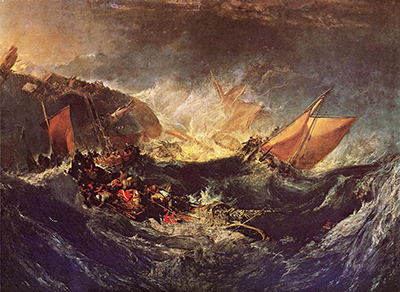
The Wreck of a Transport Ship does not place disaster beyond a reassuring strip of shore. It puts the spectator at water level, amid a sea that seems to rise from the lower edge of the canvas. A vast wreck leans out of the left side. Overloaded boats struggle below it. At the right, another craft climbs so steeply that its ochre sail appears almost to stand on the wave. Between them, spray, spars, rigging and people are driven into a single field of unstable movement.[1][2]
Joseph Mallord William Turner painted this monumental oil around 1810. It measures 173 by 245 centimetres and is now in the Calouste Gulbenkian Museum in Lisbon, where it bears inventory number 260.[1] Its scale matters. The width allows separate emergencies to coexist, while the height lets Turner raise walls of water above the figures. Yet size alone does not explain the effect. The composition withholds the ordinary means by which a viewer might organise a marine scene: there is no firm horizon, no clearly legible coast, no distant harbour and no secure foreground.
The eye first encounters fragments rather than a complete account. The dark body of the transport is too close and too sharply inclined to be understood immediately. A reddish sail or torn piece of canvas cuts through its shadow. People gather in dense knots, but their actions overlap. Oars point in different directions. White spray erases the middle distance. The right-hand sail briefly offers a taut geometric shape, only for the curling water below it to make that order precarious.[2]
This is not confusion caused by careless description. The Gulbenkian characterises the space as deliberately chaotic and asymmetrical, constructed through diagonals of broken masts and oars set against the curves of swirling water.[1] Turner makes the difficulty of seeing part of the event. A person caught in such seas could not step back, survey every vessel and calculate a clear course. The painting makes vision share something of that pressure.
Tate scholarship sharpens the point by comparing the canvas with Turner's earlier The Shipwreck of 1805. In that work, the spectator remains just outside the vortex, watching rescue craft among waves and debris. In the later painting, according to David Blayney Brown, the viewer is effectively awash with the sailors and soldiers.[3] The distinction does not depend on an illusion that the painted sea is literally real. It depends on the removal of pictorial safety.
That removal also changes the moral temperature of the image. These people do not perform one easily summarised act of heroism. They row, reach, cling, brace themselves and support one another, but every craft remains endangered. The transport that should carry people and material across the sea has become an immense obstacle. Smaller boats may be instruments of rescue or merely the next vessels to be overwhelmed. The painting sustains that uncertainty to the end.
At a Glance
- ArtistJoseph Mallord William Turner
- Current titleThe Wreck of a Transport Ship
- Datec. 1810
- MediumOil on canvas
- Dimensions173 × 245 cm
- CollectionCalouste Gulbenkian Museum, Lisbon
- Inventory260
- CommissionerHon. Charles Pelham
- PaymentMay 1810
- Former titleThe Wreck of the Minotaur (rejected)
Contents
- No Safe Distance
- An Exact Object and an Unfixed Event
- Why the Ship Is Not HMS Minotaur
- A Transport Without a Name
- The Great Wreck at Left
- Boats, Soldiers and Human Scale
- Diagonals Against Swirling Water
- Two Studies and a Convincing Fiction
- From The Shipwreck of 1805
- Dutch Tradition and a Britain at War
An Exact Object and an Unfixed Event
The museum record is precise about the physical object and cautious about the event. The current title is The Wreck of a Transport Ship; the date is circa 1810; the medium is oil on canvas; the origin is England.[1] Those facts establish what survives. They do not identify the vessel, coast, voyage or historical loss. The generic title is therefore not a weak substitute for a missing story. It accurately marks the limit of present knowledge.
Older scholarship sometimes gives the canvas as 172.7 by 241.2 centimetres, while the Gulbenkian records 173 by 245.[1][3] Such a small discrepancy may reflect different measuring conventions or records. It does not justify speculation about alteration. More consequential is the date. “Circa 1810” allows for a period of development around that year rather than pretending that a signed completion date has been found.
Two preparatory drawings help define that period. Tate identifies D05383 and D05398, both dated about 1805-10, as studies for this painting.[4][5] A further document fixes the transaction near its end: the Hastings Sketchbook records a payment from the Hon. Charles Pelham to Turner in May 1810.[3] The evidence does not reveal every stage between first idea and finished canvas, but it establishes that the composition was forming before a later disaster with which it became famous.
The title's word “transport” supplies genuine context without supplying a name. A transport vessel carried people or material rather than fighting as a line-of-battle ship. The visible red coats and pale cross-belts among the figures support Tate's description of soldiers as well as sailors.[2][3] Even so, clothing cannot identify a regiment. Nor does military use prove that the ship belonged permanently to the Royal Navy. During wartime, hired merchant vessels could be equipped for transport service.
This distinction matters because the canvas looks documentary. Its ship structures, crowded boats, physical labour and varied clothing suggest observed knowledge. The apparent specificity invites a viewer to ask, “Which wreck?” Turner provides no inscription that answers. The composition instead turns plausible details into a catastrophe without a fixed location. Its realism is strong enough to encourage historical identification and broad enough to resist one.
The absence of a named event also keeps the image from becoming an illustration with a known outcome. If the ship were securely identified, later knowledge would tell us who survived, where help lay and how the loss unfolded. Here, every visible action remains present tense. The near boat may rise over one swell and fail at the next. The craft on the right may escape or capsize. The mass at left may include people leaving the transport, people returning towards it or people with nowhere else to go.
The museum's interpretation responds to this open condition by stressing human insignificance before turbulent water.[1] That reading is grounded in scale and composition rather than a casualty list. The painting's exact identity and its uncertain subject thus work together. One preserves the material and institutional record; the other preserves the force of an event that cannot be reduced to a recovered ship's log.
Why the Ship Is Not HMS Minotaur
For much of its later history, the painting was known as The Wreck of the Minotaur. HMS Minotaur was lost on the Haak Sands on 22 December 1810, with about 570 deaths in Tate's account.[3] A violent winter wreck, a large military vessel and immense loss made the association emotionally plausible. Chronology makes it impossible as Turner's original subject.
Pelham's payment to Turner was recorded in May 1810, seven months before the Minotaur sank.[3] The two related studies are also dated within the preceding 1805-10 span.[4][5] Turner cannot have begun a picture in response to an event that had not occurred and already received payment for it. This is not an argument from stylistic probability. It is a direct conflict between documentary dates.
The Minotaur name was applied retrospectively when the canvas was shown in Edinburgh in 1851.[3] By then the work was around four decades old and Turner had died. The new identification seems to have arisen from the painting's persuasive appearance, perhaps assisted by the continuing cultural memory of the disaster. A generic but convincing wreck was converted into a specific national tragedy.
That conversion offers an instructive example of how titles shape looking. Once told that the ship is the Minotaur, a viewer may treat every red coat as a known serviceman, every broken timber as evidence from Haak Sands and every boat as part of a documented final sequence. The title appears to resolve ambiguity, but it does so by importing facts the canvas cannot contain. The visual details then seem to confirm a story that was attached after their creation.
Institutional records now correct the mistake without erasing its history. The Gulbenkian explicitly states that the old theory has been rejected.[1] Tate explains the payment evidence and the 1851 retitling.[3] The responsible reading is therefore double: the painting was not created as the Minotaur, yet the mistaken name became an important part of its reception and reproduction.
Another proposal has linked the image to the troop ship Sceptre, lost during a sudden storm in Table Bay near Cape Town in November 1799.[3] That suggestion has an attraction. A troop transport suits the red-coated figures, and an earlier date would fit the period in which Turner's marine imagination was developing. But the evidence does not identify the sketched vessel, coast or survivors. Nothing known of Turner's experience proves that he witnessed the loss.
Replacing Minotaur with Sceptre as a certainty would repeat the original error in a different form. Tate presents it as a suggestion, not a solved identity.[3] The current title remains stronger because it says only what the image and record can sustain. The vessel had a transport function; it is wrecked; the disaster is not securely named.
Paradoxically, the failed identification demonstrates Turner's achievement. Viewers did not attach a famous loss because the scene looked vague. They did so because it looked frighteningly particular. The broken ship, soldiers, overloaded boats and directional violence seemed to demand a historical referent. The correction restores uncertainty while leaving that visual conviction intact.
A Transport Without a Name
Britain's wars against Revolutionary and Napoleonic France depended on movement by sea. Armies serving beyond the island needed ships for troops, horses, weapons, stores, provisions and the sick or wounded. Royal Museums Greenwich records that the Transport Board had been established to hire and equip vessels for military movement and that its surviving papers extend into prisoner and medical responsibilities during the long wars.[9] A transport was therefore part of an administrative system as well as a ship.
Turner's canvas reveals the human risk inside that system. Maritime power is often pictured through warships under command, ordered fleets or victorious combat. Here the people who sustain military reach are packed into small boats while their carrier lies disabled. Uniforms remain visible, but hierarchy is hard to read. The sea has reduced organised transport to improvised survival.
The great vessel at left need not have been built expressly for the state. The Transport Board hired merchant shipping, and vessels could be adapted to carry particular loads. The generic title leaves that status open. It also avoids anachronistically treating every military-associated ship as a commissioned vessel entitled to an HMS prefix. What matters visually is the reversal of purpose: a craft designed to convey a large group now threatens those clustered around it.
The foreground boat makes logistical scale bodily. Red-coated figures with pale straps lie or crouch close to people in striped and earth-coloured clothing.[2] Long oars cross over bodies. Space is so limited that rowing, supporting the injured and simply remaining aboard interfere with one another. The crowd does not form a ceremonial unit. It is a compressed population in which trained identities offer little command over the water.
No secure evidence names a regiment, campaign, voyage, cargo or port. Such inventions would make the account more vivid only by making it false. The picture's military context can be developed from the title, clothing and wartime transport system without assigning the scene to Corunna, the Baltic, the Cape or another theatre. Indeed, the lack of geographical signs is part of its reach.
Tate describes Britain's surrounding sea as protection and threat. The navy and merchant fleet sustained national life, while invasion, blockade, shipwreck and sinking remained collective fears.[3] The Wreck of a Transport Ship brings those conditions together. The sea that enabled Britain to project force also exposed every soldier and sailor sent across it. Naval mastery could not abolish storm, shoal, collision, structural failure or human error.
The painting does not turn that vulnerability into a simple anti-war declaration. No statement from Turner identifies such an intention. Yet the image differs sharply from triumphal maritime art. There is no enemy flag, decisive commander or victorious manoeuvre. Human effort is real, but the forces being resisted are not political opponents. The transport's wreckage makes a wartime infrastructure visible at the moment it ceases to function.
This is why the generic title remains productive. It does not strip the scene of history. It places the event within a broad and recognisable historical system while refusing a spurious anecdote. The ship stands for no named loss, but its soldiers, boats and broken mass belong to the material world of a maritime nation at war.
The Great Wreck at Left
The left side carries the painting's heaviest form. A dark hull or deck structure tilts steeply, fills much of the lower sky and continues beyond the canvas edge.[2] Turner does not provide a detached profile from which the vessel's type could be catalogued. The viewer is too close. The wreck arrives as mass, shadow and broken construction before it resolves into ship anatomy.
Near the outer edge, splintered timbers project upward. A broad dark opening sits below a crowded upper line. A reddish-brown triangular form, probably sailcloth or a sail, cuts vertically through the shadow. Spars, rigging and pale wreckage interrupt one another. The ship seems at once enormous and difficult to hold together visually, an apt equivalent for a structure being physically dismantled.[2]
Figures gather along its inclined side and around the nearby craft. Their small heads and coloured garments provide the principal measure of scale. Because the hull extends out of view, the spectator must imagine still more weight beyond the frame. The result differs from a distant wreck reduced by perspective. This vessel overwhelms through proximity.
The exact angle is important. A horizontal hull would imply temporary stability even in a storm. Turner's transport is so severely canted that decks, ladders and openings no longer support ordinary movement. People appear to negotiate surfaces designed for another orientation. What was architecture has become terrain, and what was shelter has become a dark wall against which waves break.
The broad mass also controls light. Much of the left is built from black-green, brown, olive and muted grey, so the warm sail and red clothing emerge as compressed sparks rather than decorative colour.[2] White water at the base repeatedly bites into the darkness. The vessel's apparent solidity is therefore attacked along its edge, where foam and hull meet.
Turner avoids one theatrical instant such as a mast snapping cleanly in two. The damage appears distributed. Broken poles, collapsed canvas, tilted structure and scattered timber suggest that catastrophe has been unfolding for some time. The crowded boats imply evacuation already under way, yet the waves offer no indication that its worst phase has passed.
The museum describes splintering masts as part of the composition's diagonal system.[1] Some individual timbers are legible; others merge with oars or wreckage. That ambiguity is pictorially useful. Human-made lines proliferate, but few remain attached to a stable function. An oar may still propel a boat, while a spar of similar shape has become dangerous debris.
At the base of the wreck, boats and people overlap so tightly that the border between ship and sea is almost lost. This prevents the hull from becoming a monumental object admired by itself. Its scale is always measured against bodies. The dark transport occupies far more painted area than any person, but it cannot save them. Its immensity has become part of their danger.
Boats, Soldiers and Human Scale
The foreground craft is the painting's emotional centre without being a conventional focal point. It stretches across the lower left and middle, overloaded with people whose positions are difficult to disentangle.[2] Some lean over the side, some pull at oars, some lie low, and some appear to support companions. Their proximity creates urgency because each action consumes space another person needs.
Several red coats with pale belts stand out against the dark water. They make the transport's military function visible and support Tate's description of soldiers in the scene.[3] Striped shirts and plainer brown, cream or blue-grey garments introduce sailors and other passengers. The picture does not provide enough certainty to assign every occupation, age or relationship. Its social force comes from mixture rather than a recovered roll call.
One red-coated figure near the centre seems to brace or embrace a pale-clothed person. Nearby bodies bow forward under effort or exhaustion. A figure at the lower edge appears dangerously low against the water. These gestures suggest mutual assistance, but Turner does not isolate them into moral emblems. Support happens inside continuing instability.
The oars make that instability visible. Some align with the boat; others cross at awkward angles or disappear under bodies and foam. Rowing requires rhythm and clear water, yet the overloaded craft offers neither. Each long wooden line becomes both a tool and an additional obstacle. The museum's opposition between straight diagonals and curved water operates at the level of human labour: effort travels one way while the sea turns another.[1]
A second crowded boat lies nearer the transport. Its people form a dense horizontal band under the dark wreck. It may be receiving survivors, pulling away or struggling to remain alongside. The canvas does not settle the sequence. Nor does it guarantee that distance from the transport equals safety, because the foreground craft is already caught in larger waves.
On the right, another small vessel presents a different problem. Its ochre sail remains raised and catches enough light to become the painting's clearest plane.[2] Figures cluster along its high left side as the bow or forward structure rises. Rigging draws taut lines through the grey air. Sail power has not failed completely, yet the craft's steep angle makes propulsion look inseparable from the risk of overturning.
The sea joins these groups without unifying their fate. A dark trough separates the foreground survivors from the right-hand vessel; exploding spray partly conceals the centre. No rescuer commands all three zones. The spectator must move between simultaneous crises, much as attention in an actual emergency would be divided.
The Gulbenkian calls the human element insignificant and lost before the waves.[1] Insignificant here does not mean unimportant. Turner expends concentrated detail on clothing, posture, faces and collective effort. The people matter intensely, but they do not control the scale in which they act. Their visual smallness is the means by which their value and exposure are felt together.
Diagonals Against Swirling Water
The composition is held together by conflict rather than balance in repose. The transport falls into the scene from the left. Oars and spars slash across the foreground. The right-hand mast and sail rise in the opposite direction. Curved waves roll beneath and against those lines, repeatedly changing the path through which the eye tries to travel.[1][2]
The strongest curve begins in the dark lower foreground, sweeps towards the central trough and rises into the white crest at right. Another surge curls around the foreground boat. Behind it, pale spray expands upward and leftward, obscuring wreckage. These arcs do not form a neat decorative spiral; they create overlapping systems whose directions cannot be followed to a calm centre.
Straight objects register human construction. Masts, yards, oars, ropes and hull edges belong to vessels built for controlled movement. In the storm, those lines have been detached from their hierarchy. A mast may be broken, an oar misaligned, a rope slack or a spar adrift. The sea's curves do not merely surround the ships; they reorganise their components.
The right sail offers the most coherent geometry. Its warm triangular surface appears almost luminous against the grey-green sky. Dark rigging defines its edges, while the mast leans with the rising craft.[2] For a moment the eye finds a recognisable working system. Then the wave below climbs into a high white crest, and the triangle reads as a fragile plane exposed to force.
The central spray performs an opposite operation. Instead of sharpening a shape, it removes distinctions. Pale tan canvas, timber, wave and air converge behind a burst of cream and grey. This area prevents a clean visual bridge from left wreck to right boat. It must be crossed as turbulence.
At the bottom centre-right, a rectangular structure with draped or striped forms floats among spars.[2] It might contain timber, canvas and bodies, but the official reproduction does not separate every element. The ambiguity increases unease because the spectator cannot decide whether the object is equipment, improvised flotation or human loss. Responsible description should preserve that uncertainty.
The tiny piece of debris near the right wave makes another scale comparison. It bobs close to a wall of water that occupies a large fraction of the height. A familiar small object cannot stabilise the scene; it only measures how completely the sea has fragmented the transport's ordered contents.
Asymmetry keeps the canvas from feeling staged around a central hero. The largest mass is cut off at left, while the brightest sail is displaced to the right. The most detailed human group lies low and left of centre. The highest spray occupies neither exact middle nor edge. Turner distributes visual claims so that no single one can master the whole.
This organisation explains why the painting can feel chaotic without becoming formless. Recurring diagonals, curves, warm accents and white crests connect its incidents. They do not restore equilibrium. Structure exists as pressure, making the spectator's eye enact the same contest between purposeful movement and irresistible water that governs the figures.
Two Studies and a Convincing Fiction
The two surviving studies make clear that Turner's realism was constructed. D05383 and D05398 belong to the small Shipwreck (1) Sketchbook and are dated around 1805-10.[4][5] They are rapid ink experiments on horizontal leaves, not finished records supplied with a ship's name and coordinates.
In one, a large stricken vessel dominates the upper and left areas while small craft and agitated marks gather below. In the other, broken forms and curving lines spread across the sheet. Tate notes that the vessel is larger and lies in deeper water than in many of the book's other wreck studies.[3] The resemblance to the oil rests in scale relationships and compositional forces rather than exact detail.
The sketchbook itself preserves the wider working process. It has blue and pink marbled covers, 26 leaves of cream laid paper and an approximate leaf size of 116 by 184 millimetres. Its paper was made by John Larking and carries an 1801 watermark or countermark. Turner labelled it “97. Shipwreck” and “Subscriber's List.”[3] Within it, studies of wrecks and distressed vessels coexist with ships including Victory and lists of subscribers to the 1807 print after The Shipwreck.
That mixture resists the idea of one book devoted to one witnessed catastrophe. It is a portable repository in which observation, memory, print business and invention overlap. Turner could revisit a motif, test different wreck positions and carry elements forward over several years. The current painting emerged from that continuing marine preoccupation.
The studies are especially valuable because they precede the false Minotaur title. They show the large transport wreck forming before December 1810.[3][4][5] No retrospective naming can alter that visual and documentary sequence. At the same time, the sheets do not solve the subject. Neither labels a troop ship, event or coast.
Turner had ample opportunities to observe ships, boats, weather and rough water even if he did not see this wreck. Knowledge of how a hull tilts, how people crowd into boats and how spars scatter could be combined with reported disasters and earlier marine art. The result might be fictive as an event while remaining credible in each local pressure.
Tate describes the painting's realism as a clever illusion developed through experimental sketches.[3] “Illusion” here need not mean deceit. Painting routinely creates a coherent experience from selected and transformed material. Turner's achievement is to make the constructed event feel less like an arrangement of motifs than a crisis already under way.
The sketchbook also corrects a romantic myth of spontaneous chaos. The oil's agitation arose through revision. Turner tested the relative size of wreck and people, the depth of water and the scattering of forms before committing them to a canvas more than two metres wide. The finished disorder is the product of sustained design.
From The Shipwreck of 1805
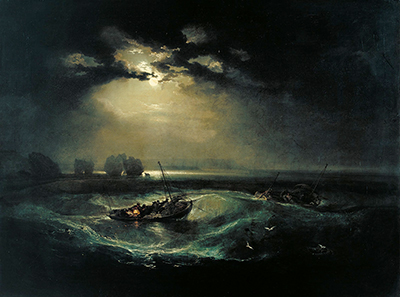
Five years before the transport wreck's approximate date, Turner exhibited The Shipwreck in his own London gallery. The Tate canvas measures 170.5 by 241.6 centimetres, almost the same monumental class as the Lisbon painting.[6] It established that shipwreck could support the ambition, scale and seriousness usually associated with history painting.
Sir John Leicester bought the 1805 work, then exchanged it in 1807, allegedly because a death at sea in his family made it unbearable.[3] Whether every detail of that explanation can be verified, the story records the emotional intensity attached to the image. The work was not treated as neutral marine description.
Its reproduction extended that reach. Charles Turner, who was not related to the painter, engraved a large mezzotint published in 1807. It was the first reproductive print after a J. M. W. Turner painting.[3] Tate owns a proof, P79356, coloured and corrected by the artist.[7] The print translated the storm's tonal drama into a form that subscribers could own beyond the original canvas.
Charles Pelham appears among those subscribers.[3] His later purchase of The Wreck of a Transport Ship therefore followed an existing engagement with Turner's wreck imagery. This continuity is stronger evidence than a hypothetical commission tied to one newspaper report. Patron and artist both returned to the marine disaster as a subject with pictorial and emotional value.
The two paintings share a large horizontal field, small boats, crowded survivors, shattered shipping and violent water. Yet the later work changes their relationship. In The Shipwreck, the main wreck lies farther away and the circulating rescue action can be surveyed. Even amid turmoil, the viewer retains a degree of separation.[3][6]
In the Lisbon canvas, the transport's dark side is thrust close at left, the foreground boat approaches the lower edge and the right wave rises as if outside the scene's internal distance.[2] The spectator no longer watches the vortex from beyond it. The canvas makes the viewing position another unstable point within the same sea.
The later painting also increases the density of human incident. Soldiers and sailors occupy overlapping craft. Their coloured clothing and gestures are more insistently modelled against the dark water. The wreck itself is larger and less easily grasped. Where the 1805 work organises rescue around a central disaster, the transport wreck divides danger across the entire width.
This is development rather than repetition. Turner did not abandon the earlier conception; he tested how much nearer it could come, how completely shore could disappear and how many independent struggles one field could sustain. The 1807 print helped establish a market for the first answer. Pelham's acquisition supported the second, more immersive one.
Dutch Tradition and a Britain at War
The Gulbenkian places the painting within the English marine tradition and names Willem van de Velde the Younger as a particularly important inheritance.[1] The connection reaches beyond a general category of “influence.” The Van de Veldes helped establish in Britain a sophisticated pictorial language for ships, weather, naval events and the changing state of the sea.
Royal Museums Greenwich explains that their arrival transformed British marine painting and that Turner owned drawings by the family. An early biographical anecdote even has him point to a print after Van de Velde and declare that it made him a painter.[10] The saying is reported tradition rather than a recording of the moment, but it accurately reflects the depth with which later viewers understood the relationship.
Van de Velde's legacy included close knowledge of vessels and the ability to organise many ships across a broad water space. Turner absorbed that authority, then subjected it to different pressures. In The Wreck of a Transport Ship, ship detail does not yield navigational clarity. It makes destruction more credible. Rigging, sail, hull and boat remain recognisable just long enough for the spectator to feel them failing.
French marine painting, especially Claude-Joseph Vernet's storm and shipwreck subjects, offered another established model. Royal Museums Greenwich's Turner & the Sea places both Van de Velde and Vernet behind Turner's achievement while emphasising how he challenged inherited representation.[11] No single canvas needs to be declared a point-for-point source. The broader tradition supplied conventions of storm, wreck, rescue, scale and spectatorship that Turner could intensify.
The historical moment gave those conventions immediate national weight. Britain in 1810 was engaged in a global maritime war. Naval force protected trade and the island itself; merchant and transport shipping sustained campaigns and travel. The sea represented mobility, wealth and defence, but also blockade, invasion, sinking and separation.[3][11]
Turner's scene withholds the consolations of battle painting. There is no identifiable enemy and no tactical success. The red-coated soldiers are not advancing; they are crowded into vulnerable craft. The transport is not a sign of efficient imperial reach; it is broken. The image exposes the dependency that underlay maritime power.
Some scholars have read Turner's shipwrecks as metaphors for the threats facing Britain while Napoleon's armies dominated much of Europe.[3] The interpretation is persuasive as context, especially because the painting eliminates topography and presents collective rather than individual danger. It should not be converted into a secret political code. No document states that each wave represents an army or that the transport embodies one policy.
Turner's transformation of Dutch and French marine art is therefore inseparable from his own period. He inherited a language capable of describing ships and storms, then used it for a maritime nation whose security and anxiety arose from the same water. The result honours the tradition's seriousness while denying the viewer its most reassuring forms of order.
The Marine Sublime
Nineteenth-century responses repeatedly called the painting sublime, but the word had more than a loose meaning of impressive scale. Eighteenth- and early nineteenth-century writers connected sublimity with forces that exceed ordinary comprehension, especially when terror, motion, power and vastness act upon the spectator.
Edmund Burke made terror the ruling principle of the sublime and treated the ocean as an exemplary object because its extent carried latent danger.[21] The spectator's pleasure depended on not being in actual immediate peril. Christine Riding's Tate study describes this as a problem of distance: shipwreck art must transport viewers towards danger while they remain physically safe before an image.[8]
Hugh Blair located the ocean's force not in breadth alone but in perpetual motion and irresistible mass. Dugald Stewart likewise treated the storm-agitated sea as a pre-eminent sublime spectacle. Brown uses both writers to reconstruct the language around Turner's marines.[3] Their ideas help explain why the painting's water matters as motion rather than background.
The wave at lower right is crucial to that motion. It rises from the edge nearest the spectator and cuts across any imagined path out of the scene.[2] The absence of shore removes the visual sign of safety that appears in many earlier shipwreck compositions. The foreground is itself water, and its direction carries the eye inward rather than allowing it to stand apart.
Scale intensifies the effect, but the human figures prevent vastness from becoming abstract. Their bent bodies, bright coats and small faces make fear legible. A wall of water becomes sublime because it threatens someone whose effort can be understood. Conversely, the people's minuteness is felt because Turner paints enough detail to make them present.
Obscurity also has a role. The dark hull cannot be surveyed whole. Spray hides the centre. Sky and sea share olive, grey and brown tones. Wreckage merges with figures. Burke associated obscurity with terror because uncertain danger gives imagination room to expand.[21] Turner turns that principle into pictorial experience without allowing the painting to become simply illegible.
The spectator's safe distance is not literally abolished. Canvas, frame and museum remain. The achievement lies in bringing aesthetic security close to its threshold. Tate describes the pleasure offered by the later wreck as being almost drowned by the terror it represents.[3] The picture intensifies participation while preserving enough form for contemplation.
This historically grounded sublime differs from admiration of spectacular weather alone. It includes the mind's movement between recognition and uncertainty, sympathy and self-preservation, order and force. The painting does not ask viewers to celebrate actual suffering. It asks them to confront how fragile human systems appear when set against a sea that cannot be negotiated by sight, rank or will.
Paint Holding and Unmaking Form
The secure technical description begins and ends with oil on canvas unless supported by direct observation.[1] No accessible object-specific conservation study identifies pigments, ground layers, varnish history or exact tools. The high-resolution museum image nevertheless allows careful discussion of visible effects.
The sky is built from dark olive-grey, brown and blue-grey fields whose transitions often appear thin and broad.[2] It contains little open light. Subtle horizontal and diagonal movements keep the upper half active without filling it with sharply bounded clouds. This low-contrast darkness lets the denser wreck and spray emerge gradually rather than as cut-out silhouettes.
The ship and people are more materially concentrated. Dark paint gives the left wreck weight, while small warm notes separate clothing, sailcloth and exposed structure. Faces and garments are not equally finished; selected highlights and colour changes make crowded figures readable at a distance.[2] Turner's control lies in deciding where differentiation is necessary and where forms can merge.
White and cream paint carry the storm's greatest physical emphasis. In the central spray and wave crests, broken opaque-looking marks sit over darker passages, creating turbulence through interruption. They do not outline every wave. They register moments when water turns, breaks or catches light. Dark green-black troughs between them make the crests appear higher.[2]
Linear elements provide another register. Rigging on the right is fine and taut; oars in the foreground are thicker and more forceful; splintered spars around the transport are irregular. These lines sharpen local structures, then disappear under spray or bodies. Their interrupted continuity makes damage visible without requiring an inventory of every broken part.
Colour directs attention economically. Red military coats gather the eye around the people. The large ochre sail on the right is the warmest coherent plane, balanced by the smaller reddish canvas near the wreck. Neither hue dominates the sea. They are islands of human material within a field of grey-green and brown.
The visible surface should not be turned into an unsupported recipe. Terms such as scumbled or opaque can describe appearance, but they do not identify every tool or sequence. Cracking visible in a digital reproduction is not evidence for a current diagnosis. The image's internal colour and contrast may also reflect photography and treatment choices unknown to the viewer.
Walter Armstrong wrote in 1902 that some Turner oils had sunk or darkened and named the painting, then called The Wreck of the Minotaur, among his examples.[20] That observation belongs to the history of how the work appeared and was judged at that date. It cannot establish its present condition after another century of care.
What can be said securely is that Turner's paint alternately holds and dissolves form. A sail becomes a clear triangle; spray erases the object behind it. A red coat locates a body; dark water absorbs its edge. A rope describes tension; foam breaks its path. Material handling enacts the same struggle between construction and disintegration that governs the subject.
Deep Tragedy in 1849 and Dread Reality in 1851
The painting remained in the Yarborough collection for decades before appearing at the British Institution in 1849. Exhibited as Shipwreck, number 38, it belonged to a substantial group lent by the Earl of Yarborough.[15] The title was still generic, two years before the Minotaur identification was attached in Edinburgh.
The Athenaeum critic treated it as the most compelling work in the collection and as a “great conception” of an appalling event.[15] The praise did not rest on photographic exactness. Turner was credited with expressing the tempest through mind and hand rather than relying on melodramatic sentiment or a merely optical trick.
The review noticed the ship and crew reduced to toys before the elements, the vessel on its beam ends, broken masts and people exposed to waves.[15] It also described rocks, a feature that modern inspection cannot identify securely. That mismatch is useful. Period criticism records how viewers organised the turbulence; it does not convert every perception into topographic fact.
For the critic, individual incidents generated terror and sympathy, but the painting's greatest merit lay in their combination. The result was “deep tragedy” expressed through “the sublimest poetry of the art.”[15] The wording places Turner above a compiler of maritime detail. Truth arose from the total structure of fear, scale and movement.
When the canvas was shown in Edinburgh in 1851, Lady Trevelyan called it one of the most sublime and awful pictures ever produced and described its “dread reality.”[3] Her language captures the paradox behind the later title. The event was not securely real, yet the experience of it appeared real enough to demand a name.
The Edinburgh display attached the Minotaur subject retrospectively.[3] Turner's death in December 1851 means the historical identity cannot be assumed to carry his authority. Instead, it records a nineteenth-century desire to join sublime invention with national memory. A recognised disaster offered a narrative equal to the image's emotional magnitude.
These responses also show that the painting's dark, crowded and asymmetrical structure was not dismissed as incoherence. Viewers found a kind of truth in the way incidents resisted separation. Terror came from combination: huge ship, tiny people, broken equipment, overloaded boats and waves acting at different angles.
Reception did more than praise the canvas. It altered its identity. The 1849 critic made it a supreme generic shipwreck; the 1851 display made it the Minotaur. Both stages depended on the same pictorial conviction. Modern scholarship can reject the named event while still learning from the intensity with which those viewers encountered the work.
Barlow and the Minotaur Afterlife
The retrospective title acquired durable material form through Thomas Oldham Barlow's large reproductive print of 1856. Yale's impression is a mezzotint and etching with chine colle, with an image measuring 58.7 by 82.2 centimetres. Its principal title is The Wreck of the Minotaur, while The Wreck of a Transport Ship appears as an additional title.[16]
An inscription identifies the sheet as an artist's copy from a plate presented by the Earl of Yarborough to the Artists' General Benevolent Institution. It carries the Latin motto Vincit Amor Patriae, commonly rendered as love of country conquers.[16] Title, institutional benefit and patriotic motto gave the image a public national frame that the circa-1810 canvas had not originally possessed.
The V&A records another Barlow mezzotint from about 1856 and links it with Rawlinson number 811.[17] The British Museum holds an open-letter state published in London by Henry Graves & Co and notes other states.[18] These records show that the engraving was not a single private impression. It was a reproducible image with a publication history.
Mezzotint was especially suited to Turner's dark marine. Its worked tonal field could translate the heavy sky, black wreck and bursting lights of foam, while etched or engraved lines retained rigging and structure. Translation inevitably changed colour and surface, but it carried composition and title to viewers who could not see the Yarborough oil.
The print therefore helped reverse the proper evidential order. Instead of a title describing a documented event represented by the painting, the print's confident Minotaur title encouraged the painting to be read as evidence for the event. Repetition across impressions made that association familiar.
Historical books continued it. Walter Thornbury listed the work in the Yarborough collection as the wreck of the Minotaur on the Haak Sands in 1810.[19] Walter Armstrong used the same name in 1902 and discussed the painting within Turner's development and the apparent darkening of some oils.[20] Neither writer had the advantage of the May payment argument as now synthesised by Tate.
This afterlife should not be treated as mere error to be discarded. It reveals the mechanisms through which artworks gain identities: exhibition labels, criticism, reproductive prints, catalogues and repeated ownership descriptions. The false title became historically consequential even though it remained chronologically impossible.
Current scholarship performs a more difficult task than simple renaming. It separates the circa-1810 object from the December disaster, preserves the 1851 and 1856 layers as reception history, and returns to the less specific transport title.[1][3] The painting becomes no less powerful when released from the Minotaur. Its power is shown to have generated the attribution.
Pelham, Yarborough and Gulbenkian
The painting's first secure owner was the Hon. Charles Pelham, who paid Turner in May 1810 and later became 1st Earl of Yarborough.[1][3] His relationship to the work was not an isolated transaction. His name appears among subscribers to the 1807 mezzotint after The Shipwreck, suggesting that he already valued Turner's treatment of marine catastrophe.[3]
Pelham's later life gives that interest a broader maritime setting. The Royal Yacht Squadron identifies him as an early leader and its first commodore. He led club yachts on coastal and cross-Channel cruises, and his large Falcon became the club's flagship.[13] The Squadron also records his stated wish to promote naval science and architecture.[14]
Those activities mostly postdate the painting and cannot prove its original commission terms. They do, however, make continued ownership intelligible. Pelham was not simply a collector who happened upon one wreck scene. Maritime art, sailing and ship design formed parts of a sustained interest, while his subscription and purchase show engagement with Turner's wreck imagery before his formal commodore role.
The canvas remained with successive Earls of Yarborough.[1] It was lent from the family collection in 1849, acquired the Minotaur association in 1851 and served as the model for Barlow's 1856 print. Its long residence allowed title and reputation to accumulate around one private object.
The current museum provenance ends that sequence with Charles Alfred Worsley Pelham, 4th Earl of Yarborough. Calouste Sarkis Gulbenkian bought the work in London through Arthur Ruck on 24 July 1920.[1] The record does not supply a price, and none is needed to establish the importance of the transfer. After roughly 110 years in the same aristocratic line, the painting entered one of the twentieth century's major private collections.
Gulbenkian assembled more than 6,000 objects across many cultures and periods, guided by close personal involvement and specialist advice.[23] His collection later came to Lisbon, where the museum opened in 1969.[24] The wreck is one of two Turner oils there, alongside Quillebeuf, Mouth of the Seine. Their pairing encompasses very different marine dangers: an unnamed open-sea catastrophe around 1810 and a specific Seine tidal hazard exhibited in 1833.
The work became central to Turner's Portuguese reception. In 1973 the Gulbenkian Foundation organised the first Turner exhibition in Portugal, bringing together 58 drawings and watercolours and 24 oils. The two collection paintings anchored the loan group.[22] The historical exhibition dated the wreck around 1807, a reminder that even modern chronology developed before the current circa-1810 record stabilised.
In 2013-14 the painting returned to Britain for Turner and the Sea at the National Maritime Museum. Royal Museums Greenwich brought together more than 120 works, including the 1805 Shipwreck, and reported more than 130,000 visitors. The Lisbon canvas had not been seen in the United Kingdom for roughly thirty-five years.[11][12] Direct comparison restored it to the early marine sequence from which the false event title had partly detached it.
The Gulbenkian's 2021 Summer Guests project later placed contemporary work in dialogue with the historic collection, including an intervention beneath Turner's wreck.[25] Such a setting changes the questions asked of the painting without changing its identity or ownership. It adds another layer to an object already transformed by private collecting, public exhibition, patriotic print and scholarly correction.
What endures through those layers is Turner's refusal of safety. A transport without a name breaks apart; people crowd into boats; a sail still draws while water rises beneath it. The scene is composite or imagined, but not emotionally vague. Its fiction proved so convincing that later generations tried to make it a record of HMS Minotaur. The strongest modern account does something more impressive: it accepts that Turner could create historical force without illustrating one recoverable event.
Discussion
How does Turner make an imagined or composite disaster feel historically specific while denying the viewer a safe position?
Reader Insights
Why did the rejected Minotaur title remain persuasive for so long?
How does the lower-edge wave place the viewer inside the danger?
What survives visually when diagonals, spray and waves break stable form?
Join the Conversation
Share a close observation or a source-based question for other readers.
References
- Calouste Gulbenkian Museum, “The Wreck of a Transport Ship”: https://gulbenkian.pt/museu/en/works/the-wreck-of-a-transport-ship/
- Calouste Gulbenkian Museum, official high-resolution reproduction of *The Wreck of a Transport Ship*: https://content.gulbenkian.pt/inarte/museu/79395_3840x2713.jpg
- David Blayney Brown, “Sea Pictures: Turner's Marine Sublime and a Sketchbook of c.1803-10,” Tate Research Publication, January 2013: https://www.tate.org.uk/art/research-publications/the-sublime/david-blayney-brown-sea-pictures-turners-marine-sublime-and-a-sketchbook-of-c1803-10-r1141418
- Tate, J. M. W. Turner, *Study for 'The Wreck of a Transport Ship'*, D05383: https://www.tate.org.uk/art/artworks/turner-study-for-the-wreck-of-a-transport-ship-d05383
- Tate, J. M. W. Turner, *Study for 'The Wreck of a Transport Ship'*, D05398: https://www.tate.org.uk/art/artworks/turner-study-for-the-wreck-of-a-transport-ship-d05398
- Tate, J. M. W. Turner, *The Shipwreck*, N00476: https://www.tate.org.uk/art/artworks/turner-the-shipwreck-n00476
- Tate, Charles Turner and J. M. W. Turner, *A Shipwreck*, P79356: https://www.tate.org.uk/art/artworks/turner-a-shipwreck-p79356
- Christine Riding, “Shipwreck, Self-preservation and the Sublime,” Tate Research Publication, January 2013: https://www.tate.org.uk/art/research-publications/the-sublime/christine-riding-shipwreck-self-preservation-and-the-sublime-r1133015
- Royal Museums Greenwich, “Transport Board, In-Letters and Orders”: https://www.rmg.co.uk/collections/archive/rmgc-object-491969
- Royal Museums Greenwich, “The Artists Who Inspired J. M. W. Turner”: https://www.rmg.co.uk/stories/art-culture/sea-drawings-art-van-de-veldes/artistic-legacy
- Royal Museums Greenwich, *Turner & the Sea*, library record: https://www.rmg.co.uk/collections/library/rmgl-152360
- Royal Museums Greenwich, *Annual Review 2014-15*: https://www.rmg.co.uk/sites/default/files/RMG_AnnualReview_2014-15.pdf
- Royal Yacht Squadron, “Past Flag Officers”: https://www.rys.org.uk/the-rys/history/past-flag-officers
- Royal Yacht Squadron, “The RYS & Yachting”: https://www.rys.org.uk/the-rys/history/rys-yachting
- *The Athenaeum*, 16 June 1849, no. 1129: https://archive.org/details/sim_athenaeum-uk_1849-06-16_1129
- Yale Center for British Art, Thomas Oldham Barlow, *The Wreck of the Minotaur*, 1856, B1977.14.8364: https://collections.britishart.yale.edu/catalog/tms:31129
- Victoria and Albert Museum, Thomas Oldham Barlow, *The Wreck of the Minotaur*, circa 1856, E.5361-1946: https://collections.vam.ac.uk/item/O602810/the-wreck-of-the-minotaur-print-turner-joseph-mallord/
- British Museum, Thomas Oldham Barlow after J. M. W. Turner, *The Wreck of the Minotaur*, 1856, 2010,7081.5931: https://www.britishmuseum.org/collection/object/P_2010-7081-5931
- Walter Thornbury, *The Life of J. M. W. Turner, R.A.*, volume 2: https://archive.org/details/lifeofjmwturnerr02thor
- Walter Armstrong, *Turner*, 1902: https://archive.org/details/gri_33125009276722
- Edmund Burke, *A Philosophical Enquiry into the Origin of Our Ideas of the Sublime and Beautiful*: https://www.gutenberg.org/ebooks/15043
- Calouste Gulbenkian Foundation, History of Art Exhibitions, Turner retrospective, 1973: https://gulbenkian.pt/historia-das-exposicoes/exhibitions/244/
- Calouste Gulbenkian Museum, “Calouste Sarkis Gulbenkian”: https://gulbenkian.pt/museu/en/calouste-sarkis-gulbenkian/
- Calouste Gulbenkian Museum, “Gulbenkian Museum Collection”: https://gulbenkian.pt/museu/en/gulbenkian-museum-collection/
- Calouste Gulbenkian Museum, “Summer Guests”: https://gulbenkian.pt/museu/en/summer-guests/