 by Tom Gurney
Tom Gurney BSc (Hons) is an art history expert with over 20 years experience
Published on June 19, 2020 / Updated on October 13, 2026
Email: tomgurney1@gmail.com / Phone: +44 7429 011000
Turner and the Usefulness of Labels
Turner is often called a Romantic painter. The label connects his work with imagination, heightened feeling, travel, weather, historical memory, individual vision and the power of nature. His art also includes careful topography, Academy ambition, print culture, patronage, technical experiment, classical history, modern technology and market intelligence. Romanticism describes important aspects of this range rather than a single mood or a complete definition of his career.
The sublime describes subjects in which scale, danger, obscurity, storm, mountain, sea or catastrophe overwhelm ordinary control. Turner repeatedly worked with such effects. Yet not every blurred sky or bright horizon is sublime. Sometimes light is analytical, decorative, commercial, devotional, theatrical or simply observed. Loose handling alone does not establish a sublime subject or effect.
At a Glance
- RomanticismUseful frame, not a total definition
- SublimeScale, danger, obscurity and overwhelmed control
- Natural forcesSea, mountain, storm, light and fire
- Modern forcesSteam, railways, smoke and urban disaster
- Viewer positionMastery replaced by exposure and uncertainty
- Historical dimensionEmpire, war, slavery and public memory
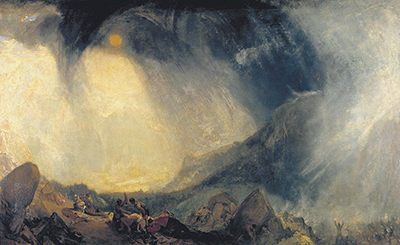
- Primary exampleSnow Storm: Hannibal Crossing the Alps
- British contextPicturesque, beautiful and sublime traditions
- Technical basisTraining, composition, medium and timing
- Critical boundaryLoose handling is not itself the sublime
Contents
- Turner and the Usefulness of Labels
- Nature as Force
- Mountains and Historical Terror
- Sea, Shipwreck and Unstable Vision
- Fire, Modernity and Public Disaster
- Romantic Imagination and Discipline
- The Viewer Before the Work
- Beyond the Label
- Romanticism Without Escape
- The Sublime of Weather
Nature as Force
Turner's sublime often begins with nature as force rather than backdrop. Seas break, storms twist, mountains absorb armies, fires alter cities and sunlight can dazzle until forms seem unstable. The Met describes Turner as an artist whose work provoked strong responses and whose expressive handling became central to later admiration.[1] His forceful subjects are not merely dramatic choices; they alter the viewer's relationship to the picture.
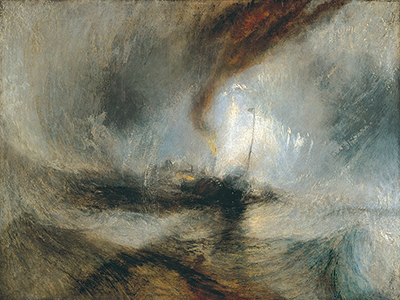
In works such as The Shipwreck, Snow Storm: Hannibal and his Army Crossing the Alps and Snow Storm - Steam-Boat off a Harbour's Mouth, human structures are exposed as fragile. Boat, army and technology do not vanish, but they are measured against powers they cannot fully command. That measurement is one of Turner's recurring sublime strategies.
Mountains and Historical Terror
The Alpine sublime becomes especially clear in Hannibal, exhibited in 1812.[2][1] The historical subject is ancient warfare, but the storm takes command. Turner turns the army into a vulnerable human mass within a revolving field of weather and mountain force. History is not denied; it is humbled.
This is a Romantic transformation of history painting. Instead of presenting heroic figures as the centre of meaning, Turner lets atmosphere and landscape carry moral scale. The result is not anti-historical. It suggests that human ambition is historical precisely because it meets forces larger than itself.
Sea, Shipwreck and Unstable Vision
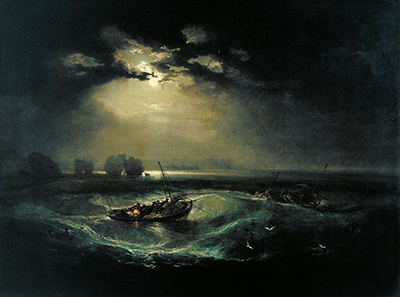
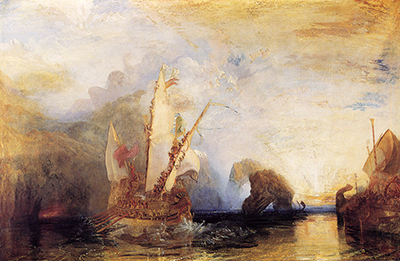
The sea was one of Turner's richest sublime subjects. Christine Riding and Richard Johns' Turner & the Sea examines his maritime art in relation to earlier marine painting, contemporary maritime affairs and public exhibition.[3] Sea subjects let Turner combine travel, naval culture, trade, danger, weather and pictorial experiment. They also gave him a field in which vision itself could become unstable.
In shipwreck and storm pictures, water often refuses to remain a flat surface. It rises, twists, reflects and obscures. Spray and cloud confuse boundaries. The viewer is not given the calm distance of a map; the image asks for bodily response. This is one reason Turner can feel so modern while remaining rooted in older maritime and sublime traditions.
Fire, Modernity and Public Disaster
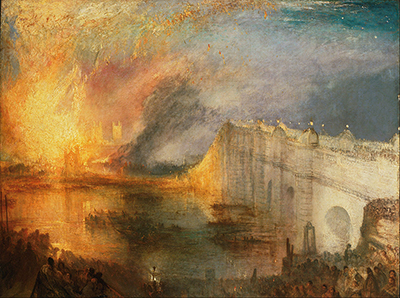
Turner's sublime was not limited to wild nature. Fire and modern technology could also overwhelm. The burning of the Houses of Parliament, steam power, railways and industrial smoke brought sublime force into contemporary life. These subjects matter because they prevent a nostalgic view of Turner as only a painter of mountains and seas.
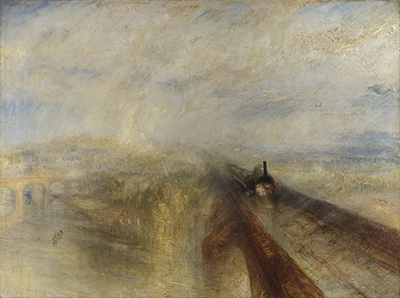
Modernity in Turner often appears as speed, heat, collision or glare. Rain, Steam, and Speed is not sublime in exactly the same way as Hannibal, but it stages a related problem: human invention entering weather and landscape with unprecedented force. The modern world becomes something to be seen through rain, light and velocity.
Romantic Imagination and Discipline
Turner's most intense effects rest on training, memory and technique as well as immediate response. The National Gallery records his early Academy training and his grounding in watercolour, oil and engraving.[4] Tate's works-on-paper holdings show a long practice of drawing, travel notation and experiment.[5] The dramatic image often has a disciplined archive behind it.
Composition, colour, medium, scale and timing give Turner's storms and fires their force. Sweeping movement and contrasts of light can create an overwhelming sensation within a structured image. The emotional effect is inseparable from those pictorial relationships.
The Viewer Before the Work
The sublime also changes the viewer's position. A picturesque view can invite possession: the viewer surveys, recognises and enjoys. A sublime Turner often resists that mastery. The eye is drawn in, disoriented, dazzled or made aware of its own limits. This is true whether the subject is an Alpine storm, a wrecked ship, a burning city or late light over water.
Romanticism enters here not as decorative emotion, but as a theory of encounter. Turner makes the viewer feel that landscape is not passive scenery. It can exceed knowledge, unsettle confidence and carry historical force.
Beyond the Label
Turner's Romanticism coexists with professional, experimental, commercial, scholarly and institutional commitments. The sublime is one of his most powerful modes, but it is one mode among many. His art also includes observation, wit, rivalry, patronage, print strategy and technical research.
Romanticism and the sublime connect Turner's repeated interest in experiences that exceed easy control. Mountain, sea, fire, speed and light all become ways of testing what painting can hold. Turner did not merely depict the overwhelming. He made the act of seeing feel overwhelmed, and then gave that experience form.
Romanticism Without Escape
Many of Turner's most intense subjects are modern or historically immediate: steam, railways, industrial smoke, the burning of Parliament, naval memory, slavery and public exhibition. Even his ancient and Alpine subjects were shaped by modern travel, collecting, criticism and nationalism. His Romanticism engages with that world rather than retreating from it; it is a way of intensifying experience.
Heightened feeling in Turner's art coexists with learned, professional and strategic practice. His work developed within the Royal Academy, the print market, patronage and public controversy. His Romanticism operates inside these systems, drawing on them and straining against them.
The sublime is similar. Turner did not simply choose large or frightening subjects. He used scale, obscurity and atmospheric force to question the viewer's mastery. The world in his pictures often exceeds the eye's ability to organise it. That is a pictorial, not merely thematic, achievement.
The Sublime of Weather
Weather is one of Turner's great sublime instruments. Rain, snow, mist, spray, cloud and smoke can hide information, distort distance and make the viewer feel physically implicated. Weather does not sit on top of the scene. It reorganises the scene.
In Snow Storm - Steam-Boat off a Harbour's Mouth, the storm has become almost the whole field of experience. In Hannibal, the vortex of cloud and snow overwhelms the army. In maritime works, spray and darkness threaten both vessel and viewer. Such images do not simply show bad weather. They stage vision under pressure.
This pressure is central to Turner's Romantic force. A classical landscape may offer ordered distance; a sublime Turner often denies stable distance. The viewer is not outside the event in comfort. The image creates a kind of visual exposure.
Fire and Urban Sublime
Fire gave Turner another version of overwhelming force. The burning of the Houses of Parliament in 1834 was a modern public catastrophe, witnessed and represented by several artists. For Turner, the fire joined spectacle, politics, architecture and elemental power. Flame made the modern state visible as something vulnerable to destruction.
Urban fire differs from Alpine storm because it involves built history. Parliament was not remote wilderness. It was an institution at the centre of national life. By painting fire consuming architecture, Turner brought the sublime into civic space. The event becomes both disaster and revelation: a city watches its own symbolic structures burn.
This urban sublime connects to Turner's wider treatment of modernity. Railways, steamers and industrial smoke all show that the overwhelming is not confined to nature. Human systems can produce their own force, speed and danger.
Obscurity and Imagination
Obscurity is one of the classic elements of the sublime, and Turner used it relentlessly. His late works often withhold clear boundaries. The viewer must infer ships, buildings, horizons or figures through light and atmosphere. This does not make the paintings vague. It makes perception active.
Obscurity also gives imagination room to work. A fully described scene can be mastered quickly. A Turner storm, mist or glare keeps changing as the eye searches it. The viewer becomes aware of interpretation as an act. That awareness is part of the Romantic experience of the work.
Turner's obscurity is not always dark. Brightness can obscure as powerfully as shadow. Sun, reflection and atmospheric glow can dissolve edges and overwhelm detail. His sublime includes dazzling uncertainty as well as gloom.
Human Smallness and Moral Scale
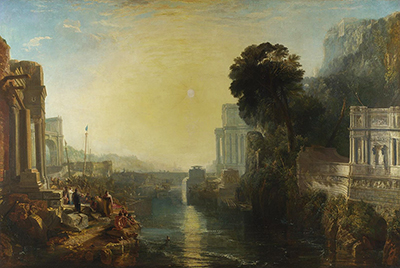
Turner repeatedly places human beings, ships, armies or buildings against forces that reduce their apparent control. This smallness can be physical, moral or historical. In sea pictures, people face water and weather. In classical works, empires rise under light that already hints at decline. In modern works, technology moves fast but remains vulnerable to atmosphere and time.
Human smallness does not amount to a simple dismissal of ambition. Artistic, imperial, technological, maritime and historical ambitions recur across Turner's subjects, often under pressure. That tension gives his sublime works their seriousness: force can appear impressive while mastery remains uncertain.
Romantic Turner and Later Viewers
Later viewers have often made Turner into a precursor of modern abstraction, Impressionism or expression. His sublime and atmospheric works gave later artists and critics new reasons to find him relevant. Those responses form an afterlife distinct from the world in which the pictures were made: Academy exhibitions, engraved publications, travel watercolours, literary titles and Old Master rivalry.
Turner's Romantic art is historically specific and unusually open to later meanings. His works remain powerful because they do not settle easily. They speak to nineteenth-century debates about nature, truth, imagination and modernity, while also inviting later viewers to recognise the instability of perception itself.
The sublime in Turner is not one subject. It is a mode of seeing under pressure. That pressure may come from mountain, sea, fire, speed, light or history. His achievement was to make painting feel equal to those forces without pretending to master them.
The Sublime and the Picturesque
Turner inherited a British visual culture in which the picturesque, the beautiful and the sublime were often distinguished. Picturesque scenery might offer variety, roughness and pleasing composition; the sublime involved scale, terror, obscurity and overwhelming force. Turner used all of these modes, but he rarely kept them separate for long. A picturesque castle can be invaded by storm; a beautiful sunset can become ominous; a sublime sea can include carefully observed detail.
This mixture matters because it keeps Turner from becoming formulaic. He did not simply choose sublime subjects and paint them with sublime effects. He often begins from recognisable topography or travel and then lets atmosphere transform it. The viewer moves from place to intensity.
That movement is deeply Romantic. It suggests that the world is not fixed by category. A view can become an experience; an experience can become a test of imagination.
Violence Without Spectacle Alone
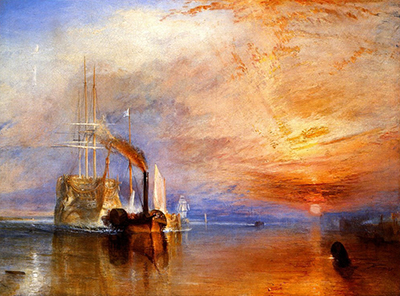
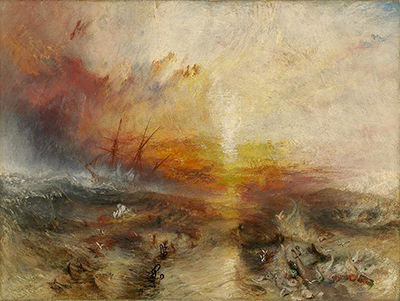
Many Turner subjects involve violence: storms, shipwrecks, war, slavery, fire and catastrophe. Yet his best works are not merely spectacular. They ask what violence does to perception and moral judgment. The Slave Ship, for example, cannot be understood as a storm picture alone; its weather and colour are bound to a history of atrocity. The Battle of Trafalgar and The Fighting Temeraire likewise turn maritime imagery toward national memory and loss.
The overwhelming effect in Turner is not always pleasurable. It can be ethically disturbing, and beauty itself can become uncomfortable when it appears in a scene of danger or suffering. The moral dimension belongs to the experience of these pictures as much as their visual grandeur.
Turner's painting can attract the eye while troubling the conscience. Romantic intensity in his art is often inseparable from moral strain.
Sound, Motion and Bodily Imagination
Turner's sublime is visual, but it often evokes sound and bodily sensation. Viewers can imagine the roar of water, the blast of wind, the heat of fire, the vibration of a train or the cold of an Alpine storm. This bodily imagination is part of why his paintings feel immersive even when they are historically distant.
He achieves this through composition as much as subject. Sweeping curves, diagonal movement, compressed space and obscured horizons all affect the viewer's bodily sense of orientation. The eye is pushed, pulled or spun. The painting becomes an event rather than a window.
This is another way Turner makes the sublime modern. He does not only represent overwhelming things; he constructs overwhelming seeing.
Romanticism and Technical Control
Loose handling can suggest force, while colour relationships and composition sustain the image. Obscurity can deepen mystery by leaving forms partly legible through storm or glare. Turner's Romanticism depends on the interaction of these technical decisions with the dramatic subject.
A sublime Turner is a made object whose power depends on pigment, support, scale, touch and timing. Even an atmospheric passage carries evidence of working methods in its edges, layers and surface. Intense feeling and material structure are not opposites.
Romantic Turner is therefore not anti-rational. He joins feeling to craft, imagination to structure and excess to control.
The Sublime and Turner's Afterlife
The sublime also shaped Turner's afterlife. Later viewers looking back at his storms, fires and luminous late works often found a painter who seemed to anticipate modern uncertainty. The pictures also retain the nineteenth-century conditions of their making: travel, Academy exhibitions, maritime culture, political events, print circulation and debates about truth to nature.
Turner's continuing power lies in that combination. He is historically specific and still unsettling. His sublime images do not merely record old theories of terror and grandeur. They keep asking viewers what it means to see when the world feels larger, faster, brighter or more violent than the eye can easily hold.
That question is why the sublime remains useful for Turner. It names not a single formula, but a recurring pressure in his art: the pressure of experience at the limits of control.
It also explains why his most forceful works can be beautiful and disturbing at the same time. They do not let pleasure and danger fall neatly apart.
That tension is central.
It is also why the works stay unresolved.
Discussion
When does a Turner subject become sublime, and when do Romantic labels conceal the discipline or specificity of the work?
Reader Insights
How does weather alter the viewer's ability to organise the scene?
What changes when fire, steam or speed produces overwhelming force?
Which technical decisions keep atmospheric intensity from becoming confusion?
Join the Conversation
Share a close observation or a source-based question for other readers.
References
- Elizabeth E. Barker, "Joseph Mallord William Turner (1775-1851)," Met Heilbrunn Timeline, https://www.metmuseum.org/essays/joseph-mallord-william-turner-1775-1851
- Tate, Snow Storm: Hannibal and his Army Crossing the Alps, https://www.tate.org.uk/art/artworks/turner-snow-storm-hannibal-and-his-army-crossing-the-alps-n00490
- Royal Museums Greenwich library record, Christine Riding and Richard Johns, Turner & the Sea, https://www.rmg.co.uk/collections/library/rmgl-152360
- National Gallery, Joseph Mallord William Turner artist record, https://www.nationalgallery.org.uk/artists/joseph-mallord-william-turner
- Tate Research Publication, J.M.W. Turner: Sketchbooks, Drawings and Watercolours, https://www.tate.org.uk/art/research-publications/jmw-turner