


 by
Tom Gurney
Tom Gurney BSc (Hons) is an art history expert with over 20 years experience
Published on October 6, 2016 / Updated on October 23, 2026
Email:
tomgurney1@gmail.com
/ Phone:
+44 7429 011000
The Pool of London
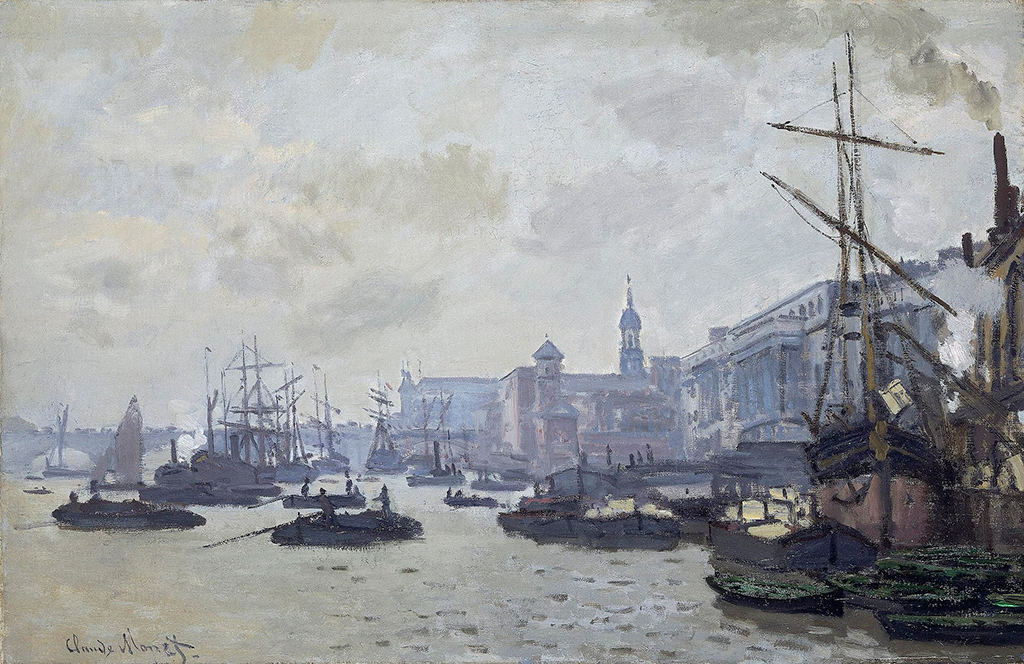
Claude Monet's The Pool of London brings a busy river and its monumental waterfront into a single, pale atmosphere. Ships and small craft occupy the Thames, while the long face of Custom House recedes along the right bank. London Bridge closes the distance rather than dominating the foreground. Painted in 1871, this is the canvas held by Amgueddfa Cymru - Museum Wales, accession NMW A 2486. It belongs to Monet's first London stay, when parks and river traffic supplied subjects well before his later bridge series. [1] [2]
At a Glance
A city assembled from boats and buildings
The nearest boats make a compact, dark group at the lower right. Their shallow shapes contrast with the tall mast above them, while other vessels occupy separate patches of water across the middle distance. The distribution opens a passage towards the far side of the picture rather than filling the entire river with detail. The viewer can look between the boats as well as at them.
Above, a broad, restless sky occupies more space than any individual building. Its cooler and warmer patches do not form a simple clear background. They contribute to the atmosphere that softens distant edges. The river repeats some of that pale light, interrupted by dark hulls and small strokes suggesting the surface.
Custom House supplies a more stable structure. Its long frontage leads diagonally back into the picture, countering the sideways movement of the boats. Architecture and shipping hold one another in balance: the city gives the river an edge, and the vessels keep that edge from becoming the sole subject.
Custom House and the purpose of the waterfront
The holding museum identifies Custom House on the right and London Bridge behind it. Princeton University Art Museum's discussion of this same painting explains the district's role in mercantile trade and the collection of customs duties. The large building therefore belongs directly to the river's commercial activity, rather than functioning only as an impressive skyline feature. [1] [4]
The building had already appeared in earlier views of the Thames. A London Museum lithograph of about 1840, The Pool, looking towards London Bridge , records the river crowded with steam and sailing craft. Its catalogue identifies David Laing's Custom House, erected in 1814-17 and partly rebuilt by Robert Smirke. That separate print establishes an earlier visual history of the setting; it is not evidence that Monet copied it. [5]
In Monet's composition the long facade creates an orderly rhythm against an irregular gathering of vessels. The contrast between fixed architecture and mobile traffic gives the painting a structure without removing the sense of everyday activity.
The working Pool before Tower Bridge
The Pool of London extended downstream from London Bridge towards Limehouse. The London Archives describes the river's dense nineteenth-century commerce and the coal barges supplying the capital. Its historical images show a skyline and waterfront shaped by activities that have since changed substantially. The Thames in Monet's painting belongs to that working geography. [6]
One familiar modern landmark was not yet there. Tower Bridge opened in 1894, more than twenty years after this canvas. Its absence is not a painterly omission or a sign that haze has swallowed the structure: it belongs to the historical date of the view. The bridge in the background is the London Bridge identified by Museum Wales. [1] [6]
This helps separate the picture from a present-day tourist panorama. The boats are not simply picturesque accessories arranged below famous monuments. Their density and variety form the visible life of a commercial river. The painting records an urban landscape in which water remained a route for labour and the movement of goods.
Haze, smoke and the restrained palette
Princeton's account connects the atmosphere of the scene with a city heavily dependent on burning coal. The hazy view is consequently part of an industrial environment, not only a poetic veil laid over an otherwise timeless river. That context need not turn the painting into a precise measurement of pollution on a particular day. It gives a historical basis for understanding why the air itself could become visually important. [4]
Within the picture, blue-violet shadows hold buildings and vessels at a distance, while warmer greys and pale yellowish passages cross the sky. Dark hulls remain legible against the water. The range is restrained, but its small variations keep the scene from settling into one uniform grey.
The separate touches in the river differ from the broader marks above. Vertical masts, horizontal boats and the receding building provide several directions within the same atmosphere. Looking closely reveals how much definition survives inside the haze. The scene is not simply disappearing: it is being organised through differences of edge, tone and scale.
The first London stay and its range of subjects
Monet stayed in London from September 1870 until May 1871, taking refuge during the Franco-Prussian War. The National Gallery places its The Thames below Westminster within the same early group as the Pool views and the two park pictures. London offered him different kinds of modern landscape rather than a single motif repeated throughout the visit. [2]
The Green Park and Hyde Park scenes show people spread across public grass and paths. The river paintings bring another kind of circulation into view: boats passing or gathering beside a built waterfront. The subjects differ, but in each case the city can be understood through ordinary uses of space rather than a ceremonial event.
The Pool of London is therefore more than an early example of the fog for which Monet's later London work became famous. Its vessels, customs building and bridge make a particular district visible. The atmosphere connects those elements without cancelling the port's identity.
Two Pool paintings with separate histories
Boats in the Pool of London is a related but different canvas. Wildenstein catalogues it as number 167, while the Cardiff work is number 168. The earlier catalogue's English titles, Boats in the Port of London and The Port of London , make the resemblance of their names especially clear. Separate entries preserve the distinction between the objects. [3]
In the Cardiff picture, the long building on the right is particularly prominent, giving the view a clear receding architectural edge. The other painting brings a more extensive near bank and its small-scale activity into the foreground. Comparison turns a shared location into a question of emphasis: how close to the river's working edge does the viewer seem to stand, and how much space is given to the open water?
The similarity is a reason to look carefully, not to combine their ownership histories. Dimensions, acquisition dates and collection identifiers are attached to individual canvases. The Museum Wales purchase of 1980 concerns this painting alone. [1] [3]
From Monet's ownership to the Welsh collection
The catalogue raisonne records the sale of this canvas from Monet to Durand-Ruel in September 1872, under the title La Tamise a Londres . Later ownership included Alexander J. Cassatt in Philadelphia and his family before the painting reached the Welsh national collection in 1980. Museum Wales independently confirms the purchase date. [3] [1]
The title history is useful as well as the ownership sequence. A reference to The Thames at London may concern this object rather than a generic London series picture. Identifying it through the catalogue number and museum accession avoids making the name carry more certainty than it can supply by itself.
Its passage through a dealer and private collections also places the river view within the wider international circulation of Monet's work. The museum destination allows the painting to be considered beside other traditions of landscape, rather than only as one item in a chronological list of the artist's travels.
A shared subject without a simple influence formula
In her scholarly study of Whistler and Monet, Katharine Lochnan compares the early Thames pictures with Whistler's river paintings and etchings. She discusses tonal range, atmosphere and compositional structure while acknowledging the limited documentary evidence for parts of their relationship. Her argument concerns visual and historical connections, not a proven instruction that Monet followed when making this canvas. [7]
That comparison broadens the question of what a working river could become in art. Shipping, warehouses and bridges had an established visual history, but artists could choose different degrees of description and different balances between objects and atmosphere. Monet's view retains substantial architecture even while colour and light loosen some of its edges.
The London group would change greatly in the following decades. Here, however, the Pool remains a distinct place, occupied by work and bounded by a recognisable bank. Its achievement lies in making those solid and moving elements share one unsettled light, not in anticipating every later painting of the Thames.
Frequently Asked Questions
Amgueddfa Cymru - Museum Wales holds it as NMW A 2486. [1]
No. The works have related subjects but separate catalogue numbers: 168 and 167 respectively. [3]
Discussion
Look again at the images and ideas explored in The Pool of London. These editorial prompts invite your observations.
Reader Insights
Compare the long architectural frontage with the irregular spread of boats.
Which forms remain sharpest within the hazy atmosphere?
How does the Cardiff canvas differ from the other Pool of London painting?
Join the Conversation
Share a detail, comparison or question about The Pool of London below.
References
- Amgueddfa Cymru - Museum Wales , The Pool of London, NMW A 2486; title, 1871 date, medium, dimensions and 1980 purchase. View source .
- National Gallery, London , The Thames below Westminster; first London stay and the early city views. View source .
- Daniel Wildenstein / Wildenstein Plattner Institute , Monet, volume II, 1996, entries 167-168, viewer page 83; distinct identities, titles and provenance. View source .
- Princeton University Art Museum , The British Passion for Landscape; discussion of this painting's commercial and atmospheric setting. View source .
- London Museum , The Pool, looking towards London Bridge, about 1840, object 59.99/101; separate print and Custom House history. View source .
- The London Archives , Tower Bridge and the Port of London; historical river commerce and the bridge's opening in 1894. View source .
- Katharine Lochnan , Whistler and Monet: Impressionism and Britain, in James McNeill Whistler in Context, Smithsonian Institution, pp.45-49; bounded comparison of the early river pictures. View source .







