


 by
Tom Gurney
Tom Gurney BSc (Hons) is an art history expert with over 20 years experience
Published on October 6, 2016 / Updated on October 23, 2026
Email:
tomgurney1@gmail.com
/ Phone:
+44 7429 011000
The Thames below Westminster
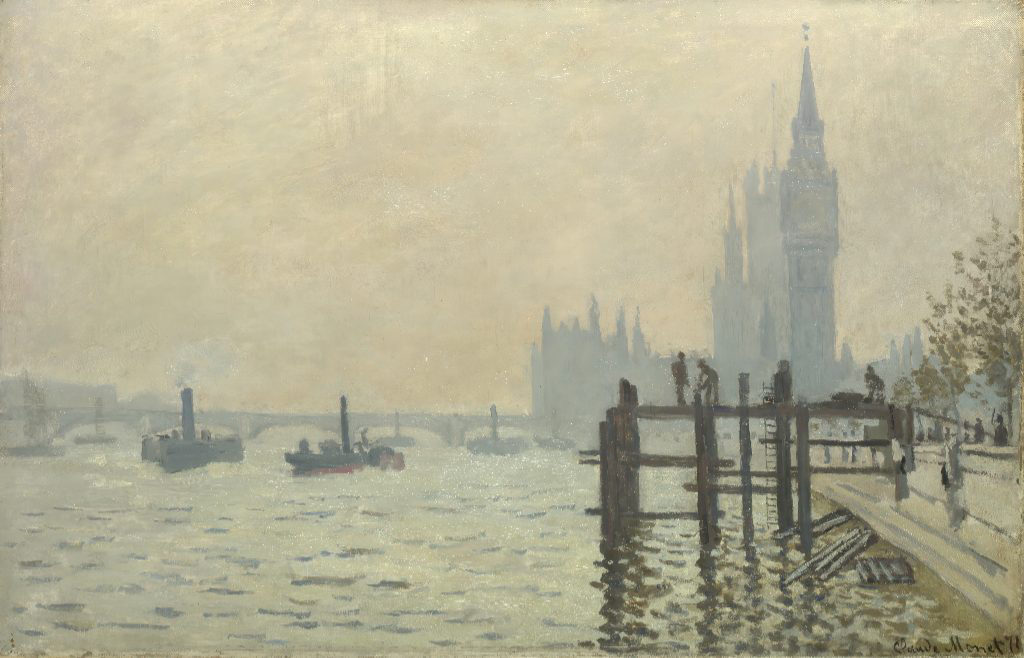
In The Thames below Westminster , Claude Monet makes the river broad and luminous while the Houses of Parliament rise through a veil of atmosphere. The wooden structure in the foreground has a much stronger presence than the distant stone buildings. Boats interrupt the water, and small figures occupy the near riverside. The National Gallery dates this oil painting to about 1871 and holds it as NG6399. It is an early London work, distinct from the much later series in which Monet returned repeatedly to the Parliament motif. [1]
At a Glance
A framework within the mist
The nearest jetty supplies a strong pattern of vertical posts and horizontal beams. Their reflections fragment in the river below, connecting the solid structure to the restless surface. Farther away, Westminster Bridge stretches across the scene with a much lighter presence. Above it, the towers and roofline of Parliament produce a more delicate rhythm against the sky.
These elements give the atmospheric view a firm organisation. The jetty is not merely an incidental object added to make the foreground interesting. Its weight allows the far bank to remain pale without leaving the composition shapeless. The distinction between near and far is carried by the strength of the marks as well as the size of objects.
The river takes up a large share of the canvas, but it is never empty. Boats, small ripples and broken reflections keep interrupting its broad light. Their horizontal movement balances the towers. The picture's quietness emerges from several opposing directions held together, rather than from an absence of activity.
A new embankment at the water's edge
Monet painted from the Victoria Embankment, according to the catalogue raisonne. This was a recently transformed riverside. Middle Temple's archival history records the ceremonial opening of the embankment roadway in July 1870, soon before Monet arrived in London. Its construction was tied to changes in transport, drainage and the use of land along the river. [2] [3]
The near bank therefore belongs to an important piece of modern engineering. In the painting, however, the result is encountered through an unfinished-looking wooden structure and figures close to the water, rather than a formal architectural elevation. The National Gallery identifies the workers as dismantling scaffolding associated with the embankment's construction. [1]
This helps explain the difference between the monumental background and the practical foreground. The new city is not only a collection of completed landmarks. It also involves temporary structures, materials and people still working at its edge. Monet allows that ordinary activity to remain inside the view.
Parliament was modern architecture in Gothic dress
The Palace of Westminster may look like an ancient presence within the haze, but most of the building was comparatively new. Parliament's official history records the devastating fire of 1834 and the subsequent reconstruction associated with Charles Barry and Augustus Welby Pugin. The new chambers came into use before the rest of the complex was largely finished by 1870. Its Gothic appearance should not obscure that nineteenth-century history. [4]
Historic England likewise dates the present Westminster Bridge to 1862, identifying Thomas Page as its designer and noting its Gothic details, chosen to accord with the Palace. The bridge and Parliament formed a recent architectural ensemble when Monet selected this view. [5]
The painter does not turn them into a precise survey. The National Gallery notes an exaggeration of the towers' height, which gives the distant building an almost fantastic aspect. Recognition and alteration coexist. London is identifiable, but the relation between its architecture, distance and atmosphere matters more than an exact record of every proportion. [1]
St Thomas' Hospital across the river
The low building at the far left is identified by the National Gallery as St Thomas' Hospital, then nearing completion. Its presence adds another newly built element to the view. The Old Operating Theatre Museum explains that the hospital had been forced to leave its earlier Southwark site because of railway development, and that its new Lambeth buildings opened in 1871. [1] [6]
Designed by Henry Currey, the hospital used separate pavilions connected by corridors. The museum relates that arrangement to Florence Nightingale's concern with ventilation and infection control. Those practical ideas are not legible as a full architectural plan in Monet's small, misty shape, but they establish how contemporary the institution was. [6]
The hospital, bridge and Parliament give the distant bank several scales and functions. Their shared atmosphere brings them into one pictorial field without making their histories identical. The scene is a meeting of new civic, medical and transport structures seen across a river that continued to carry working boats.
Different kinds of paint for sky and water
The National Gallery describes Monet's use of scumbling in the sky, with long strokes contrasting against the broken touches in the water. This is a specific account of the canvas's handling, not evidence for one method used throughout his career. The difference contributes to a sensation of air spreading above a more interrupted, moving surface. [1]
The overall range is muted, but looking closely reveals more than grey. Warm pale tones in the sky sit beside cooler shadows in the buildings; small dark and reddish accents separate boats from the water. The foreground posts are more emphatic than the bridge, and their reflections become increasingly broken towards the lower edge.
These distinctions keep the haze active. It does not cover the painting like an evenly translucent screen. Some edges remain firm, others dissolve, and colour gives distance to forms whose outlines are incomplete. The image can be luminous without depending on a clearly drawn sun. Atmosphere becomes a relationship between objects and marks rather than an extra effect added after the city has been described.
The first London visit, not the later Parliament series
Monet's first stay in London ran from September 1870 until May 1871, during the Franco-Prussian War. The small group of city views includes parks, the Pool and this Westminster scene. Those varied subjects belong to a different undertaking from the concentrated bridge and Parliament project of the later visits. [1] [2]
The Courtauld places the later campaign in 1899, 1900 and 1901. Monet worked on numerous canvases in London and continued them at Giverny, considering them as a related ensemble. Some carry dates later than his final painting visit. The dates and working conditions of that project should not be read back into the earlier canvas. [7]
The comparison is nevertheless revealing. Here a large timber framework and near-bank workers provide a tangible foreground. In the later Houses of Parliament paintings , the changing relationship between the distant building, water and atmosphere receives a much more sustained serial investigation. The motif returned, but the pictorial problem changed.
From the artist's circle into the National Gallery
Wildenstein's catalogue records Durand-Ruel's purchase of the picture from Monet in November 1872 and its subsequent passage to Ernest Hoschede and Jean-Baptiste Faure. These associations locate it within the dealer and collector networks that supported Monet before his international museum reputation was established. [2]
The National Gallery records its later acquisition by Lord Astor of Hever through the dealer Tooth's in 1936 and his bequest to the Gallery in 1971. The museum also identifies an incompletely documented part of the ownership history during 1933-45. Its provenance is therefore a researched sequence with acknowledged gaps, not a claim that every transfer is fully known. [1]
That history is separate from the painting's visible subject. It helps explain how a modest early London canvas became accessible within a major British collection, while the gallery's current research keeps the record open to correction. No assumption about present display or availability follows simply from ownership.
A city both solid and unstable
The picture brings together two ways of seeing Westminster. Its bridge, embankment, Parliament and hospital belong to a city undergoing substantial physical change. Their hard engineering and stone architecture should make a stable setting. Yet the painting makes them appear through water, distance and shifting air. Their solidity is never entirely lost, but neither is it the only thing that matters.
This is one reason the early canvas remains more than a preview of Monet's later success. It has its own balance of near work and distant monument, of temporary timber and permanent building, and of broad sky against a working river. The foreground keeps the scene close to ordinary activity even while the towers acquire a remote grandeur.
Other early London paintings pursue different versions of that encounter. The Pool of London gives more weight to shipping and waterfront commerce; Green Park distributes visitors across grass. The Thames below Westminster finds its particular order in the crossing of a newly engineered capital with an atmosphere that refuses to hold every edge still.
Frequently Asked Questions
The National Gallery dates it to about 1871. [1]
The catalogue raisonne identifies the viewpoint as the Victoria Embankment. [2]
Discussion
Look again at the images and ideas explored in The Thames below Westminster. These editorial prompts invite your observations.
Reader Insights
Compare the strength of the foreground posts with the paler bridge and towers.
How does knowing that much of the skyline was new alter the scene?
Follow the different marks in the sky, water and reflected timber.
Join the Conversation
Share a detail, comparison or question about The Thames below Westminster below.
References
- National Gallery, London , The Thames below Westminster, NG6399; object record, interpretation, technique and current provenance research. View source .
- Daniel Wildenstein / Wildenstein Plattner Institute , Monet, volume II, 1996, entry 166, viewer pages 82-83; viewpoint and early ownership. View source .
- Middle Temple , The Creation of the Victoria Embankment: Miasmas, Mass Transit and Metropolitan Modification; archival history and 1870 opening. View source .
- UK Parliament , Joint Committee on the Palace of Westminster, Restoration and Renewal report, introduction; 1834 fire, reconstruction and completion. View source .
- Historic England , Westminster Bridge, list entry 1066172; Thomas Page's 1862 bridge. View source .
- The Old Operating Theatre Museum , How Have the Buildings of St Thomas' Hospital Changed?; relocation, Henry Currey's design and 1871 opening. View source .
- The Courtauld , The Changing City: Monet and London; the separate 1899-1901 campaign and studio completion. View source .







