


 by
Tom Gurney
Tom Gurney BSc (Hons) is an art history expert with over 20 years experience
Published on October 6, 2016 / Updated on October 23, 2026
Email:
tomgurney1@gmail.com
/ Phone:
+44 7429 011000
Springtime at Giverny
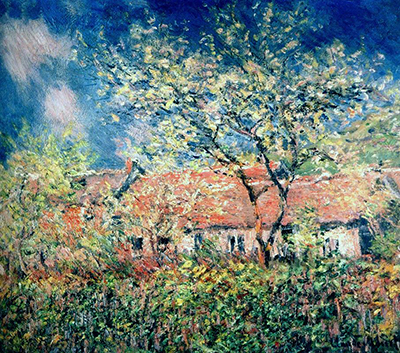
Springtime at Giverny brings a flowering tree, a red-roofed house and dense foreground vegetation into a compact landscape. Claude Monet painted it in 1886, and it belongs to the Kreeger Museum in Washington, DC, accession 1970.3. [1] The scene is not organised around a distant landmark or a dramatic event. Its interest lies in the way blossom, building and sky interrupt and illuminate one another.
At a Glance
Giverny before the familiar water garden
Monet settled in Giverny in 1883, three years before the date on this painting. He initially rented his property, buying it in 1890; the land for the water garden followed in 1893. The Giverny museum's historical account places these changes within a gradual transformation rather than a garden created fully formed at his arrival. [3]
The 1886 landscape belongs to that earlier period. Its subject is a flowering village environment, with buildings remaining visible through the vegetation. It should not be mistaken for a view of the later lily pond or its carefully developed banks.
The distinction gives the picture its own place in Monet's work. Giverny offered houses, roads, fields and seasonal trees as well as the grounds he would reshape. Looking at this canvas as a particular landscape avoids treating every early scene merely as preparation for the much later water-lily paintings.
The flowering tree and the red roof
A branching tree rises near the centre-right, spreading its blossom across the upper part of the picture. Its dark trunk remains clearly visible where it crosses the warmer roof behind it. Higher up, the smaller branches dissolve into a scattering of pale touches.
The roof supplies a contrasting kind of form. It extends broadly across the middle, with a comparatively stable sloping plane. Its red and orange notes are repeatedly interrupted by leaves and flowers, but it remains substantial enough to hold the composition together.
Below it, sections of light wall and darker openings suggest the house without presenting an uninterrupted facade. The building is partly concealed, so the viewer has to reconstruct it from glimpses. This is not an architectural elevation with vegetation added around the edges. House and tree share the same space, each changing how the other is perceived.
A foreground that resists easy entry
The lower part is filled with green growth, interspersed with warmer red-brown and yellow marks. It does not provide an open path that invites the viewer to walk towards the house. Instead, the vegetation forms a dense screen across the front of the scene.
That screen is important to the sense of distance. The house is close enough for its roof and wall to be recognisable, yet it remains beyond the foreground growth. The tree connects these levels, rising in front of the building and extending into the sky.
The composition consequently gives us several overlapping layers without separating them into rigid bands. Near foliage, blossoms, roof and open air keep crossing one another. Our eye can move through those intervals, but there is no single, unobstructed corridor into the landscape. The sense of enclosure is created by ordinary plants and buildings rather than by a closed interior.
Spring colour and the visible sky
The blossom appears light against a blue sky, but its colour is not simply white. Pale yellow, cream and pink touches gather around the darker branches. These warmer notes connect visually with the roof, while cooler passages connect with the surrounding air.
At the upper left, broad pale cloud forms interrupt the blue. They are handled differently from the many small marks of the blossom. The contrast helps the tree remain legible even where its outer branches become difficult to trace.
The greens below are equally varied. Some passages are bright and yellowish; others deepen towards blue. Those differences give the foreground texture and prevent it from becoming a single solid barrier.
Monet's painting of light is therefore inseparable from the arrangement of colour. Light is conveyed through relationships among neighbouring passages, not through a separate symbol for sunshine or a precisely identified hour of the day.
What the brushwork can tell us
The Kreeger Museum presents the painting in relation to Monet's practice of working outdoors from direct observation, attentive to natural light and atmosphere. [1] That context fits the changing spring subject, but does not require us to imagine that the whole canvas was finished in one uninterrupted sitting.
Different kinds of marks perform different tasks. The roof is built from relatively broad, connected colour, while the foliage and blossom depend on numerous smaller interruptions. Dark strokes establish the trunk and the deeper spaces between plants.
These visible differences are useful evidence for looking at the painting. They do not, by themselves, identify particular pigments, prove that colours were never mixed, or reveal a complete sequence of wet and dry paint layers. A discussion of Monet's technique becomes more accurate when it separates what can be seen from what would require a technical examination of the canvas.
A familiar subject reconsidered
Wildenstein's catalogue identifies the houses here with those in two earlier paintings, numbered 918 and988, while noting a changed foreground. [2] The connection suggests sustained attention to a recognisable local subject rather than a succession of wholly unrelated views.
A recurring building can provide continuity while the season, vegetation and framing change. In this canvas, the flowering branches become a conspicuous part of the relationship between house and sky. The foreground is not just incidental scenery: it determines how much of the building can be seen and how close the viewer seems to stand.
This kind of return is relevant to Monet's later series paintings , but the connection should not make every repeated view identical in purpose. The 1886 picture can be understood as a complete composition in its own right, with its balance of roof, tree and foreground growth.
Other springtime paintings and this canvas's history
The Fitzwilliam Museum owns a different Springtime, also dated 1886, accession PD.2-1953. That painting shows Suzanne Hoschede and Jean Monet beneath orchard trees. Its figures, larger dimensions and collection history belong to that separate work, not to the Kreeger landscape. [4]
The later Giverny in Springtime is another distinct picture. Similar English titles can group related seasonal interests without making the objects interchangeable.
For the Kreeger canvas, Wildenstein records a 1901 sale through Durand-Ruel and a later appearance in the Blackwell family sale at Christie's in 1970, followed by ownership by David and Carmen Kreeger. [2] Its present museum identity allows the work to be followed beyond the general idea of spring at Giverny. What remains most immediate, however, is the close meeting of blossom and architecture: a familiar inhabited place briefly transformed by the season.
Frequently Asked Questions
No. The subject is a flowering tree and buildings; Monet acquired the land for his water garden in 1893. [3]
No. The Fitzwilliam owns a separate 1886 canvas with Suzanne Hoschede and Jean Monet. [4]
The catalogue identifies recurring houses in his local views, but does not establish that this building is his home. [2]
Discussion
Look again at the images and ideas explored in Springtime at Giverny. These editorial prompts invite your observations.
Reader Insights
Does the roof or the blossom first organise the picture for you?
How does the dense foreground affect your sense of distance?
Which differences of brushwork help separate tree, building and sky?
Join the Conversation
Share a detail, comparison or question about Springtime at Giverny below.
References
- The Kreeger Museum , Springtime at Giverny, 1886, 1970.3, current object record. View source .
- Daniel Wildenstein , Monet catalogue raisonne, volume III, printed 402-403, entry 1062 and related spring views, WPI digital edition. View source .
- Musee des impressionnismes Giverny , Le Jardin de Monet a Giverny: l'invention d'un paysage, 2009 educational dossier, historical sections 5-11. View source .
- The Fitzwilliam Museum , Springtime, 1886,PD.2-1953, separate orchard painting. View source .







