


 by
Tom Gurney
Tom Gurney BSc (Hons) is an art history expert with over 20 years experience
Published on October 6, 2016 / Updated on October 23, 2026
Email:
tomgurney1@gmail.com
/ Phone:
+44 7429 011000
Path through the Corn at Pourville
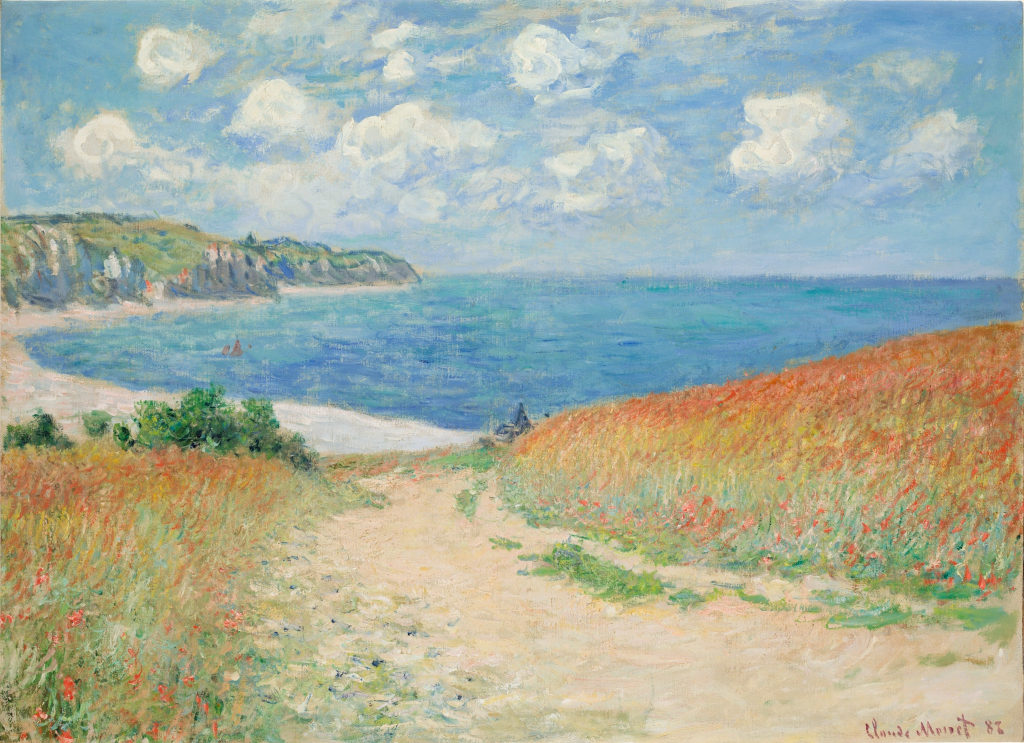
Path through the Corn at Pourville is Claude Monet's 1882 landscape of a track descending between fields towards the English Channel. The Denver Art Museum calls it Path in the Wheat Fields at Pourville, or Chemin dans les bles a Pourville. [1] Red flowers and golden stems surround the pale path, while blue water and distant cliffs open beyond it. The brilliant sea belongs to Normandy, not the Mediterranean.
At a Glance
- Artist Claude Monet
- Museum title Path in the Wheat Fields at Pourville
- Date 1882
- Medium Oil paint on canvas
- Dimensions 58.4 x 77.5 cm
- Collection Denver Art Museum, Frederic C. Hamilton Collection
- Accession 2016.365. [1]
Pourville in 1882
Monet worked on the Normandy coast during two visits in 1882, first early in the year and then from the summer into autumn. The Art Institute of Chicago's scholarly catalogue places these visits within a remarkably productive year of coastal painting, encompassing nearly one hundred canvases. [2]
Pourville offered more than a view of the sea. Fields, paths and high ground allowed Monet to place cultivated land directly against the open water. He could look towards a bay from above rather than position himself at the tideline.
This picture makes particularly effective use of that combination. The foreground belongs to a worked rural landscape, but its destination is the shore. Wheat and poppies do not soften a distant decorative background: they occupy the space nearest the spectator and determine how the water is approached.
Following the pale path
The track begins broadly at the bottom of the canvas, especially towards the right. Its pale surface bends left as it recedes, narrowing between the banks of grain. That change in width draws the viewer into the scene before the eye reaches the sea.
It is not a rigid straight line aimed at a single vanishing point. The bend slows the movement and makes the fields seem to surround the route. Small green patches interrupt the bare ground, preventing it from becoming a clean, empty ribbon.
Near the middle distance, the path meets the lighter area of the shore. The eye can then follow the beach around the bay towards the cliffs at the left. The painting thus offers several connected movements: down the track, across the water and along the curve of the coast.
That visual continuity should not be mistaken for a surveyed walking itinerary. Monet has arranged shapes within a rectangular image. The pleasure of following them does not depend on reconstructing every turn on a modern map.
Wheat, poppies and the foreground colour
The word corn in the familiar English title refers to cereal crops; the museum's wheat-field title is clearer for readers who associate corn specifically with maize. [1]
The field at the right rises diagonally towards the frame's edge. Its golden and orange tones are enlivened by many red touches. These suggest poppies among the grain, but they also work as points of colour that keep the large foreground area active.
The smaller field at the left creates a counterweight. Its outer edge is partly concealed by darker green vegetation near the shore. That patch of green makes the surrounding warm colours appear stronger and marks a transition between cultivated ground and the open beach.
Individual stems are not described with equal precision. Some marks remain upright and legible; others merge into broader bands. The foreground can therefore be read both as a field and as a densely varied surface of paint. Its warmth is heightened by the expanse of cool blue beyond it.
The bay and the chalk cliffs
The sea occupies the middle of the composition rather than a narrow strip at the horizon. Its blue changes from turquoise near parts of the shore to deeper tones further out. Shorter, lighter touches interrupt the colour without turning every movement of the water into a fully outlined wave.
At the left, the chalk cliffs recede around the bay. Their pale faces are broken by darker vertical accents, while a green band runs along their tops. The sequence gives the coast a sense of distance: the nearest forms are larger and more distinct, and the further headland becomes smaller and softer.
Tiny boats introduce another scale. They are far less prominent than the path or the fields, yet their small dark shapes help establish the breadth of the water. The landscape is not empty of human use, even though it contains no large foreground figure.
Monet's water paintings take many forms. Here, the sea's role is inseparable from the surrounding land: it provides a broad, cool opening between the warm fields and the cloud-filled sky.
Sky and an unequal balance
Clouds take up much of the upper half of the painting. Their rounded white forms are interspersed with blue and pale grey, producing a shifting pattern rather than one large, continuous cloud bank.
Below them, the distant horizon is relatively level. It gives the composition a quiet horizontal line against which the diagonal field and curved path can work. This opposition keeps the image from feeling unstable despite its unequal parts.
The cliffs occupy the left side, while the right side opens more directly towards the sea. In the foreground, the larger field is on the right. These differences balance each other across the canvas, rather than creating a symmetrical arrangement.
The picture's brightness is consequently more than a matter of choosing vivid colours. Areas of different size, direction and texture are set against one another. Open water relieves dense grain; the broad path separates warm fields; the small cliffs give the clouds and sea a measure of distance.
Observation and a constructed painting
The lively handling can make this scene feel immediate, but Monet's coastal work was not invariably completed in a single outdoor session. A letter from April 1882, discussed in the Chicago catalogue, explains that many of his studies had required ten or twelve sittings, and some twenty. [2]
That statement concerns his practice during the campaign; it is not a technical examination of the Denver canvas. It nevertheless cautions against reading every visible brushstroke as evidence of one uninterrupted burst of work.
In this painting, the path's pale colour is echoed in the beach and clouds. The darker foreground vegetation has counterparts in the cliff shadows and small boats. Those connections help unify widely separated parts of the view.
Monet's technique allowed an observed place to become a carefully organised image. The sense of fresh air survives that organisation. It is the relationship between the parts, rather than an absence of structure, that makes the landscape feel open.
The painting's journey to Denver
The museum records a purchase from Monet by Durand-Ruel in 1883, followed by ownership in American collections. The picture later belonged to Frederic C. Hamilton and entered the Denver Art Museum in 2016. [1]
Hamilton's bequest brought twenty-two Impressionist masterworks to the museum, including four paintings by Monet. The collection places this coastal landscape alongside very different subjects and conditions rather than representing the artist through one repeated motif alone. [3]
The canvas was included in Denver's Claude Monet: The Truth of Nature, held from October 2019 to February 2020. That exhibition considered the importance of places, changing atmosphere and the natural world across his career. [4]
A useful comparison is Cliff Walk at Pourville , another 1882 work from the coast but a distinct painting with a different foreground and human presence. Looking between them reveals how much Monet could change an image by shifting position, framing the shore differently and choosing whether people would guide the viewer's attention. The path in the Denver picture performs much of that guiding role itself.
Frequently Asked Questions
Path in the Wheat Fields at Pourville (Chemin dans les bles a Pourville). [1]
It dates to 1882. [1]
Denver Art Museum, Frederic C. Hamilton Collection, accession 2016.365. [1]
No. Pourville is on the Normandy coast of the English Channel. [2]
Discussion
Look again at the images and ideas explored in Path through the Corn at Pourville. These editorial prompts invite your observations.
Reader Insights
Does your eye follow the path first or move directly to the sea?
How does the warm foreground change the appearance of the blue water?
What provides balance without making the composition symmetrical?
Join the Conversation
Share a detail, comparison or question about Path through the Corn at Pourville below.
References
- Denver Art Museum , Path in the Wheat Fields at Pourville, 2016.365, object record, provenance and exhibition history. View source .
- Gloria Groom and Jill Shaw , Cliff Walk at Pourville, Art Institute of Chicago scholarly catalogue, cat. 19, 1882 coastal campaign and Monet's letters. View source .
- Denver Art Museum , The Frederic C. Hamilton Collection, bequest and collection context. View source .
- Denver Art Museum , Claude Monet: The Truth of Nature, 2019-2020 exhibition and exact painting caption. View source .







