by Tom Gurney
Tom Gurney BSc (Hons) is an art history expert with over 20 years experience
Published on October 6, 2016 / Updated on February 1, 2026
Email: tomgurney1@gmail.com / Phone: +44 7429 011000
The Beach at Sainte-Adresse (1867) by Claude Monet
Painted in 1867, The Beach at Sainte-Adresse is one of Claude Monet's early coastal masterpieces.
The painting captures a scene on the Normandy coast at Sainte-Adresse, a seaside resort just north of Le Havre on the English Channel. Monet himself would achieve considerable success here, with a number of other notable works including Garden at Sainte-Adresse
The artist had connections in Sainte-Adresse, but also had strong links to Le Havre, having spent much of his childhood here. The region boasted harbours, beaches and ever-changing environmental conditions which offered him unlimited opportunities for artistic inspiration.
Description
The Beach at Sainte-Adresse features a number of fishermen working whilst a number of sailing boats cruise past. A middle-class couple enjoy the sights, with the gentleman observing from a brass telescope. This rebalances the work away from being purely about the local working lives. It must be remembered that this was a time at which growing numbers of urban dwellers were heading out to the coast for holidays.
This subtle juxtaposition between labour and leisure gives the painting a social dimension. Monet was not simply recording a coastal landscape but documenting how tourism was reshaping life along the Normandy coast.
The scene then curves round, allowing Monet to feature a town scene in the distance. A church spire pokes into the sky, whilst a large swathe of clouds hang above, blocking out most of the sun. Aside from the bright blue tones on one of the fishing boats, most of the scene is delivered in a restrained palette, giving the impression of a relatively cool day.
It is also noticeable as to how much of the canvas is devoted to the sky - the artist is perhaps slightly raised in order to accomplish this angle. There is also a wonderful aquamarine tone to the sea, which adds some warmth to the work.
- Artist: Claude Monet
- Year: 1867
- Medium: Oil on canvas
- Movement: Impressionism
- Location Painted: Sainte-Adresse, Normandy, France
- Current Location: Art Institute of Chicago
- Dimensions: 38 × 46 cm (approx.)
- Notable Features: Fishermen, seaside leisure, sailing boats
Technique
This famous work has been studied in depth - both the artwork itself, but also the context in which Monet was living at the time. It has been proven that the work was begun outdoors, as shown in the painting, but then finished off in Monet's studio. He was an artist who loved to work in the ever-changing conditions of northern France, but intricate work, the final touches, would always be easier to deliver precisely from the comfort of a warm, sheltered studio.
Evidence exists which shows how the composition changed over time. Additional yachts and figures came and went. He considered and adjusted the balance of the work, and eventually chose to side with the working fishermen to be the dominant element on the shoreline.
In terms of palette, Monet appears to be slowly transitioning to lighter tones. In The Beach at Sainte-Adresse he is still on that journey - implementing lighter tones in some parts of the scene, but not yet everywhere. He is also continuing to experiment in how he depicted water, as well as the texture of the sand.
Monet in Sainte-Adresse
During the summer of 1867 Monet stayed with relatives in Sainte-Adresse while working on a group of coastal paintings, just as he had done so previously. This was a time of change in Monet's life, with family issues disrupting his progres as an artist. It was also a significant time of change and transition in western Europe, as railway networks started to expand, bringing new opportunities for trade and leisure - Normandy was particularly aided by these technological advancements.
Claude Monet, right before his eyes, would see a number of seaside villages with which he had become familiar as a child, start to swell into towns as more and more people flocked to the coast from Paris.
The Beach at Sainte-Adresse captures this contrast, with fishermen working alongside middle-class tourists enjoying their leisure time. Today, many of these fishing jobs have gone, whilst tourism has been shared with other international destinations.
Large Image of Beach at Sainte-Adresse, 1867
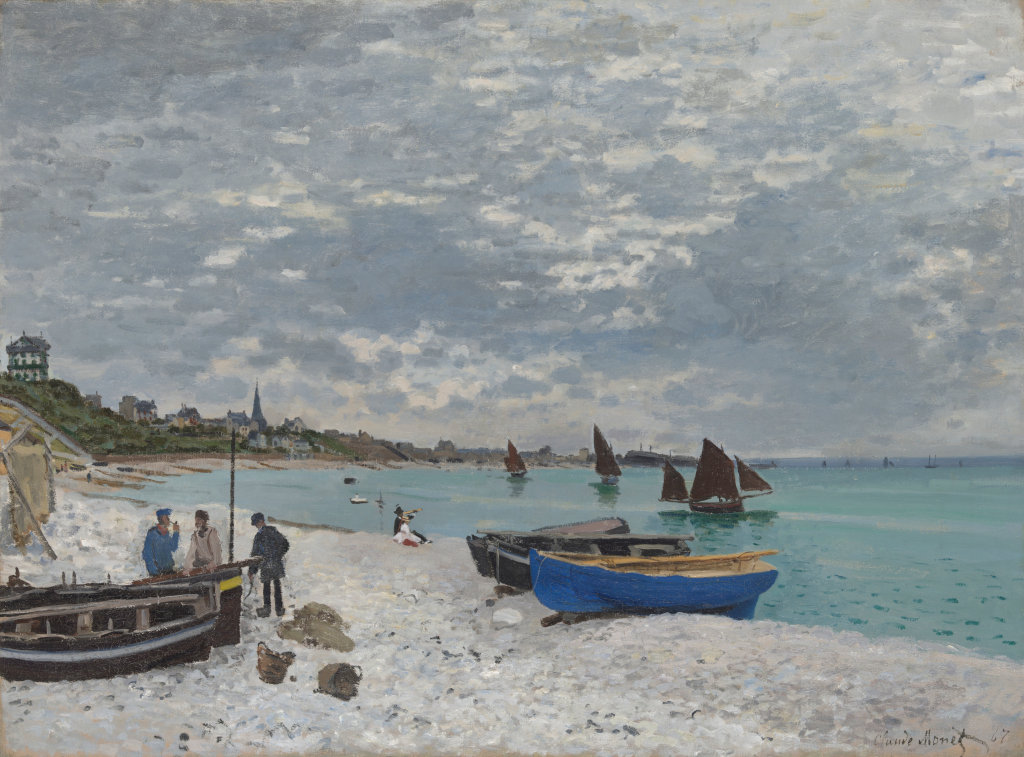
Beach at Sainte-Adresse, 1867, Claude Monet, Art Institute of Chicago
A Painting of Modern Life
Many art historians see The Beach at Sainte-Adresse as one of Monet's earliest paintings to explore the theme of modern leisure. One of the unique aspects of the Impressionists was their concentration on modern life, both in rural and urban areas. Previously, history paintings had been the acceptable art form in France.
This concentration on how the middle and working classes lived alongside each other has helped historians to visually record the changes in French society during the 19th century. Monet himself would notice this, and had a connection with both backgrounds. Others, such as Degas, might exclusively focus on the privileged few, and alternatively Realism artists like Millet would only cover the agricultural workers.
Relationship to Regatta at Sainte-Adresse
This painting is closely connected to another work Monet produced during the same summer, Regatta at Sainte-Adresse. Both paintings depict nearly the same section of coastline and were created on canvases of almost identical size. Although there is no evidence that Monet intended them to function as a formal pair, they appear to present two complementary views of the seaside resort.
While The Beach at Sainte-Adresse emphasises fishermen and working boats, Regatta at Sainte-Adresse focuses on sailing yachts and spectators gathered to watch the races. Together the paintings highlight the coexistence of traditional maritime labour and the emerging culture of seaside recreation.
Exhibition and Reception
Although the painting was created in 1867, Monet did not exhibit it publicly until nearly a decade later. He chose to include the work in the Second Impressionist Exhibition of 1876, suggesting that he regarded it as an important step in the development of his artistic style.
It also underlines how carefully Monet would submit his work to exhibitions - to consider an artwork that was nearly a decade old shows how much thought he put into this process, and his strong desire to achieve the best feedback possible, both from critics and the public alike.
Besides its position in the permanent collection of the Art Institute of Chicago, this artwork has also been used in over 30 exhibitions in its lifetime, taking in a number of other US cities, as well as Paris, London, Zürich, St Petersburg and Cologne.
Provenance
Annie Swan Coburn from Chicago purchased The Beach at Sainte-Adresse (1867) by Claude Monet on the 8th of February, 1923. The painting was then bequeathed to the Art Institute of Chicago in 1933, shortly after her death.
Conclusion
The Beach at Sainte-Adresse came about at an important moment in Monet's career. He was continuing to experiment with his technique, and also to cover different aspects of the world around him. Coastal and maritime content would now form a large part of his focus, with Sainte-Adresse and Le Havre lying behind that inspiration.
Monet was still some way from the first Impressionist exhibition, and this painting helps us to better appreciate the journey that he went on prior to that key moment.
Seen today, the work offers a vivid glimpse of life on the French coast in the nineteenth century—a moment when traditional fishing communities and the emerging culture of seaside tourism briefly shared the same shoreline.
Close-up Image Details of Beach at Sainte-Adresse
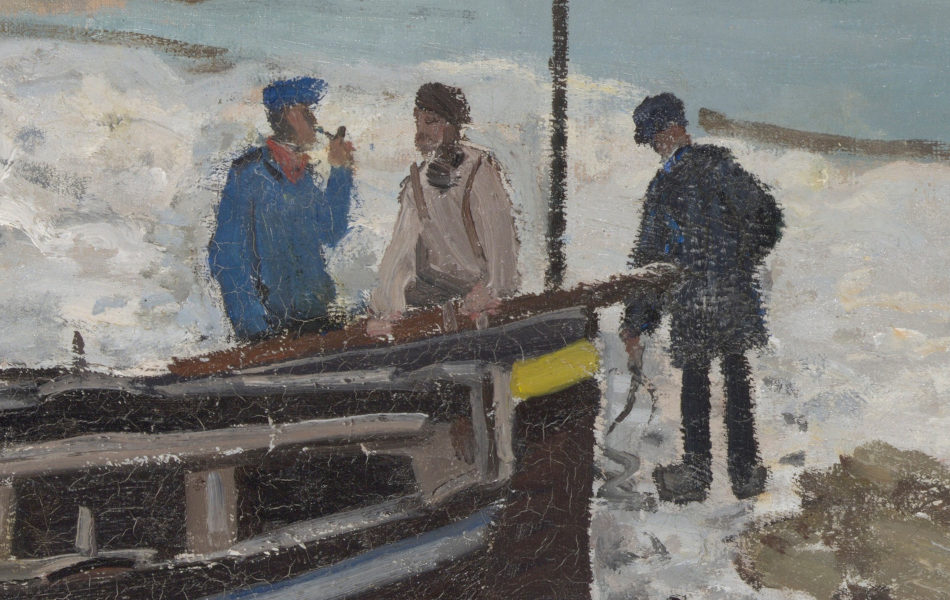
Beach at Sainte-Adresse Fishermen Chatting by Boats
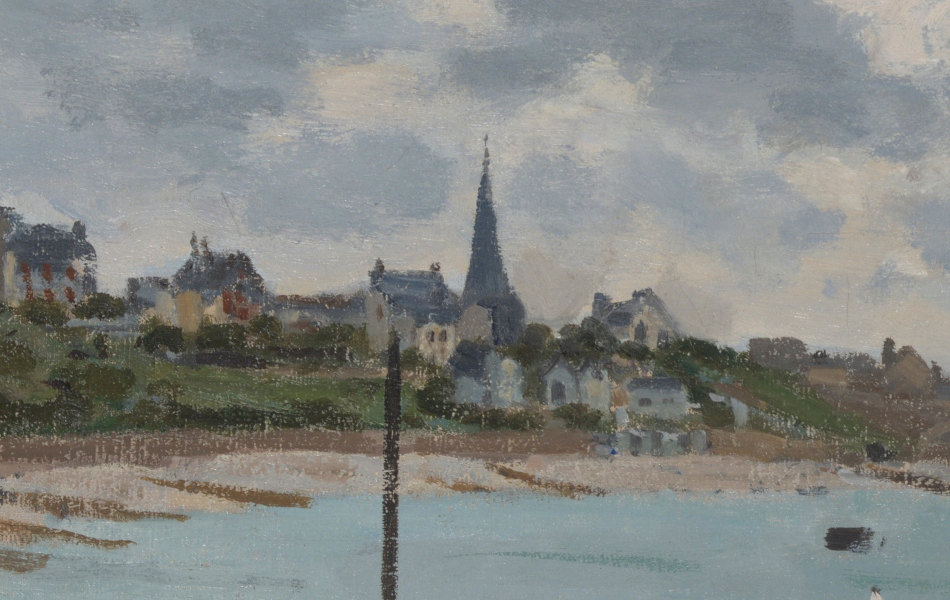
Beach at Sainte-Adresse Church and Town in Distance
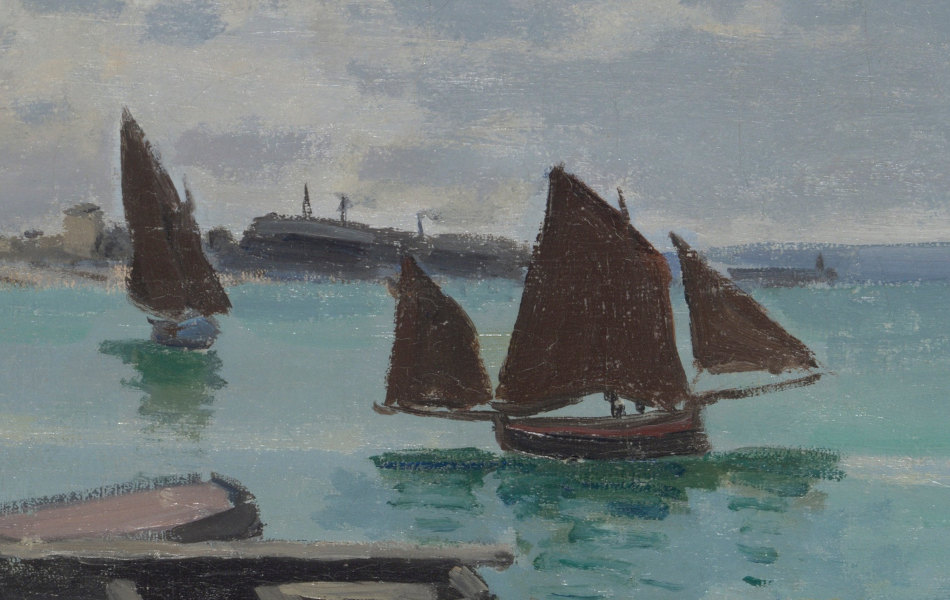
Beach at Sainte-Adresse Sailing Boats Cruise Past
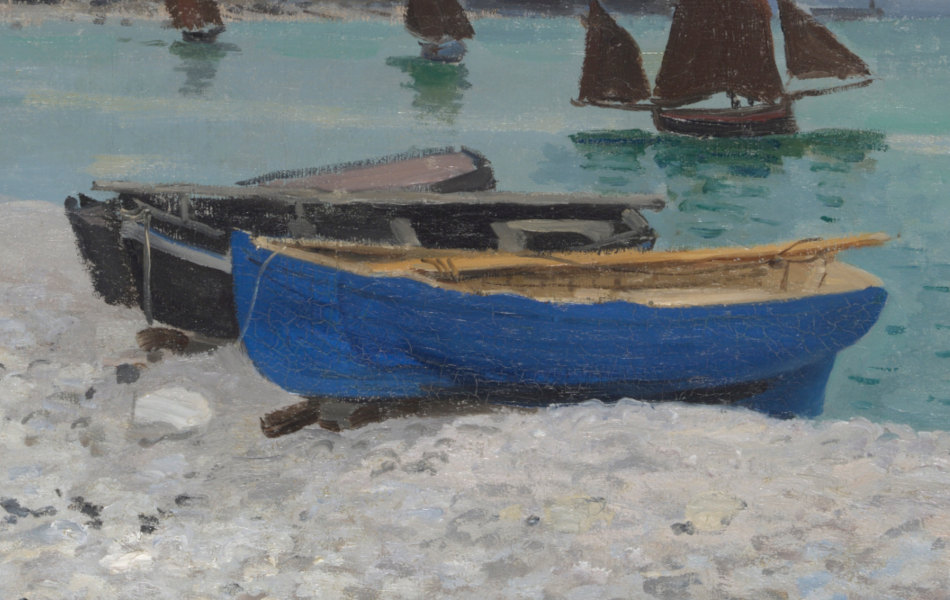
Beach at Sainte-Adresse Spare Fishing Boats Stored on Beach
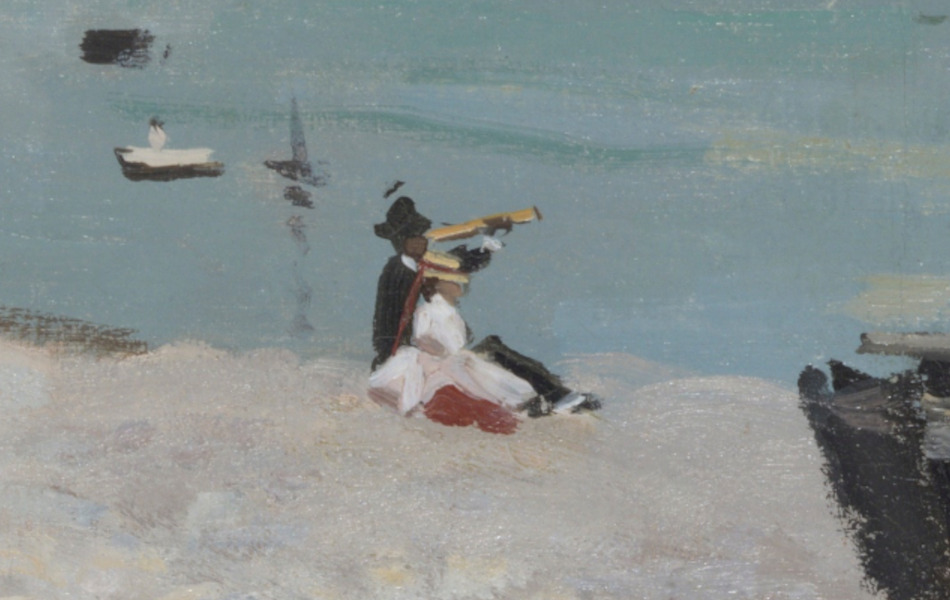
Beach at Sainte-Adresse Romantic Couple Relax on Beach Enjoying the View