


 by
Tom Gurney
Tom Gurney BSc (Hons) is an art history expert with over 20 years experience
Published on October 6, 2016 / Updated on October 23, 2026
Email:
tomgurney1@gmail.com
/ Phone:
+44 7429 011000
The Boardwalk at Trouville
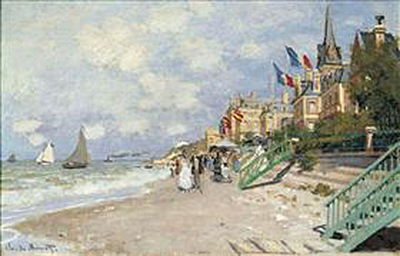
Waves come close to the walkers, green stairs descend from the buildings, and flags flutter above a narrow strip of sand. The painting often described as The Boardwalk at Trouville is Monet's high-tide Beach at Trouville , Wildenstein 157. Painted in 1870, this oil on canvas measures 48 by 73.5 centimetres in its later auction record. It is a different painting from the Wadsworth Atheneum's more conspicuous wooden-boardwalk view. [1] [2]
At a Glance
A promenade without the foreground planks
The familiar Boardwalk title can be misleading if it suggests that a long wooden pathway must occupy the foreground. Here, pale beach rather than a strongly ruled sequence of boards leads towards the distant visitors.
The catalogue raisonne explains the distinction: this is a high-tide view, with the boards removed. The related Wadsworth beach painting shows low tide with the planks in position. [1]
That difference changes the whole experience of the scene. In the Wadsworth picture, the walkway gives the eye a firm route along the shore. Here, sea and beach sweep together into the distance, and the foreground feels less geometrically prescribed.
The edge of the water forms a loose diagonal from the left towards the central figures. It is not a perfectly clean border. Pale broken strokes interrupt the meeting of wet and dry surfaces, suggesting the irregular advance and retreat of small waves.
The resort's temporary arrangements belong to the subject as much as its permanent hotels. A beach is a usable public space, but its extent changes with the tide.
The sea occupies the left side
The water has a stronger presence here than in the Hartford version. Its green-blue surface reaches well into the lower left corner, where white touches indicate breaking crests. The near waves are wide enough to register as separate bands before they become compressed farther away.
Small boats give the open water a second rhythm. A grey triangular sail and paler sails rise above dark hulls, their sloping shapes distinct from the almost horizontal horizon. They supply upright accents without forming a barrier across the sea.
The broad horizontal canvas makes room for this balance. On one side is an open expanse that can be crossed by boats; on the other is a densely developed frontage reached by stairs. The beach connects them but belongs entirely to neither.
The foreground water also makes the visitors' position more tangible. They are not standing in a distant ornamental landscape. The waves are close to the sand on which they walk, and the usable strip of shore narrows visibly as it recedes.
Stairs, hotels and flags
The nearest green staircase is cut by the lower right edge. Railings and steps make a firm angular pattern against the lighter ground, and similar structures repeat along the frontage. These access points explain the different levels between buildings and beach.
Above them, red and cream walls lead up to steep roofs and pointed architectural details. Dark foliage and shadow gather around the right edge, making the sunlit walls stand out. The architecture rises above the people without pushing them out of the picture.
Flags add a less stable pattern. Their red, white and blue touches interrupt the roofline and carry the movement of the air above the promenade. Their irregular contours are an effective contrast with the stairs' straight rails.
The flags and sails also bring the two halves of the picture into conversation. Both depend on wind, but one belongs to the resort's display and the other to boats on the water. No painted arrow tells the viewer to make that connection; the repeated light triangles and coloured flickers establish it visually.
The scene therefore contains several kinds of movement: walking figures below, air-borne fabric above, and water shifting at the left.
Looking at the beachgoers
A cluster of figures occupies the centre, where the shore begins to narrow. Pale clothing and parasols catch the light, while dark coats and hats give the group contrasting vertical marks.
The people nearest the viewer have enough definition to suggest dress and posture, but not detailed facial expression. More distant visitors become small combinations of light and dark paint. This gradual reduction helps establish depth without requiring every person to be individually described.
Their distribution matters as much as their number. The beach does not form an empty stage around one heroic figure. Walkers, standing groups and smaller shapes farther away create a shared social space.
The picture invites attention to fashionable appearance, yet it does not identify everyone who appears. It would be unsafe to turn the central figures into named portraits of Camille or particular friends. Their pictorial role is clear even where their biographies are not.
The visitors are part of the coastal view, not an interruption of it. Their clothing introduces bright notes and their upright forms link the horizontal sand to the tall buildings.
Trouville in the summer of 1870
The Musee d'Orsay places Monet and Camille at Trouville during the summer following their marriage on 28 June 1870. Its separate Hotel des Roches Noires presents the resort in a vertical composition, with flags and sky taking on particular importance. [4]
The high-tide beach belongs to that same summer, but the horizontal view gives a different account of the seafront. The buildings are only one element in a wider arrangement of beach, water, boats and visitors.
A comparison with Monet's other Trouville subjects is revealing because the town did not produce a single repeated formula. Close views of seated women, harbour scenes and architectural beach panoramas ask different things of scale and format.
Nor should the resort be described through Marcel Proust as if the novelist were documenting Monet's immediate companions. Orsay explicitly cautions that the society Proust later described belongs to a later generation. [4] The painting's own 1870 setting remains the sound starting point.
Mary Cassatt and the painting's early travels
The catalogue records Durand-Ruel buying the canvas from Monet in June 1871, then selling it to Ernest Hoschede in January 1877. At Hoschede's 1878 sale, Mary Cassatt acquired it for her family. [1]
That connection is not an attribution: the painting is Monet's, while Cassatt belongs to its ownership history. In 1883 the family exchanged it with Durand-Ruel for another Monet marine painting, catalogued as Wildenstein 73. The record cites a letter from Katherine to Alexander Cassatt dated 30 November 1883. [1]
It subsequently reached the New York collector A. W. Kingman in 1886. That year it also appeared in the New York exhibition of works in oil and pastel by the Impressionists of Paris, as number 278. [1]
These movements show how a French seaside subject circulated beyond the setting in which it was painted. Its later history includes private collections and auctions, rather than a permanent home in the Wadsworth. That museum owns the separate low-tide painting.
An older date in the Armory Show catalogue
The picture appeared in the 1913 International Exhibition of Modern Art, the Armory Show, as number 496 under the title La Promenade a Trouville . The historical entry gave the year as 1872. The University of Vienna's exhibition database preserves that catalogue information. [3]
The older date should not displace the 1870 identity used in the modern catalogue raisonne. It is evidence about how the work was described at a particular exhibition, not a second securely dated visit to be invented for this canvas. [1]
The title also helps explain why Beach and Promenade recur around the same painting. Both describe what is visible, but the catalogue number, image and dimensions are needed to separate it from neighbouring Trouville works.
A century after its creation, the canvas continued to attract exhibition attention. It was included as number 37 in the 2007-08 travelling Impressionists by the Sea exhibition. [2] The Phillips Collection's own exhibition history confirms the joint project with the Royal Academy and Wadsworth Atheneum. [5]
A changing shore rather than a fixed view
The painting's distinctive achievement is the way it holds a developed resort and an unstable shoreline together. The buildings seem solid, the stairs are carefully angled, and the visitors are dressed for public leisure. Yet the beach beneath them is continually being reshaped by water.
Monet makes that contrast visible without turning it into a dramatic confrontation. The waves are not a catastrophe, and the architecture is not a detached backdrop. Their meeting produces the scene's spatial character.
The picture rewards comparison with the low-tide canvas, but it also stands independently. Its wide sweep, nearby water, bright flags and intermittent figures create a particular arrangement of sight and movement. The differences between the two paintings are precisely what make the comparison worth making.
Frequently Asked Questions
No. This is Wildenstein 157, the high-tide view. The Wadsworth owns Wildenstein 156, with prominent foreground planks. [1]
These descriptive titles relate to the seaside walking area. The 1913 exhibition listed it as La Promenade a Trouville. [3]
No. Cassatt acquired Monet's painting for her family at the 1878 Hoschede sale. [1]
Discussion
Look again at the images and ideas explored in The Boardwalk at Trouville. These editorial prompts invite your observations.
Reader Insights
Compare the green staircase with the curve of the waterline.
Follow the repeated flags and sails across the composition.
Consider how removing the long foreground planks changes the experience of the beach.
Join the Conversation
Share a detail, comparison or question about The Boardwalk at Trouville below.
References
- Daniel Wildenstein / Wildenstein Plattner Institute , Monet catalogue raisonne, volume II, 1996, entry 157, printed pages 74-75; high-tide identity, early ownership and exhibitions. View source .
- Sotheby's , La Plage a Trouville, London, 2008, lot 10; object dimensions, John House's comparison and exhibition number 37 in 2007-08. View source .
- University of Vienna, Database of Modern Exhibitions , International Exhibition of Modern Art, 1913, entry 496; historical title and date transcription. View source .
- Musee d'Orsay , Hotel des Roches Noires, Trouville; separate 1870 painting, marriage and summer-stay context, and caution over later Proust associations. View source .
- The Phillips Collection , exhibition history, TPC.2007.4; Impressionists by the Sea, October 2007-January 2008. View source .







