


 by
Tom Gurney
Tom Gurney BSc (Hons) is an art history expert with over 20 years experience
Published on October 6, 2016 / Updated on October 23, 2026
Email:
tomgurney1@gmail.com
/ Phone:
+44 7429 011000
Hotel des Roches Noires, Trouville
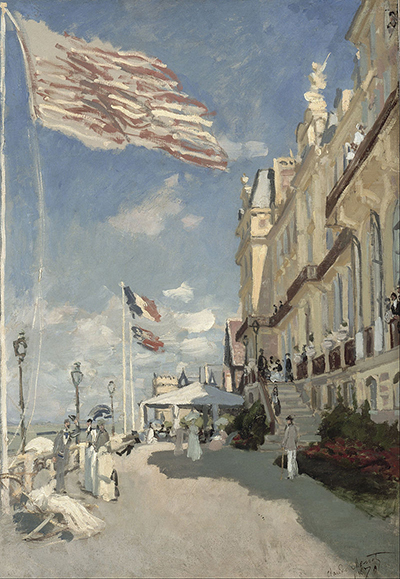
A huge striped flag streams across the sky above a seaside promenade. At the right, the pale facade of a hotel rises beyond the edge of the canvas; below, visitors gather under parasols and beside terraces. Monet's Hotel des Roches Noires, Trouville dates from 1870 and belongs to the Musee d'Orsay, accession RF 1947 30. The museum records this oil painting as 81 by 58 centimetres. [1]
At a Glance
The flag changes the scale of the scene
The nearest flag is far larger than any person in the painting. Its pole rises along the left edge, while red and pale stripes extend across the upper sky in an irregular diagonal.
Rather than carefully outlining a flat rectangle, Monet breaks the cloth into streaks and folds. Some stripes seem to lift or overlap, and their edges become difficult to follow. The fabric is readable as something stretched and disturbed by air.
Its proximity explains its commanding scale. The hotel may be a much bigger object, but the flag lies closer to the viewer's position and occupies more of our immediate field of vision. That difference gives the scene a sense of physical presence rather than a uniformly distant view.
Below it, smaller flags repeat along the promenade. Their bright marks carry the eye towards the middle distance and prevent the large foreground shape from seeming detached. The picture makes wind visible through things it moves.
Why Monet chose a tall format
A seaside view might conventionally invite a wide composition with a long horizon. Monet instead uses an upright canvas, leaving only a limited glimpse of water at the far left.
The format allows the building to rise along the right and gives a large area to sky above the visitors. Vertical poles, the tall facade and repeated architectural projections all reinforce its upward direction.
Against those structures, the nearest flag stretches across the space. It connects the left edge to the hotel side without being a solid bridge between them. Light cloud marks drift through the remaining blue-grey air.
The lower part is more compressed. Figures, parasols, lamps, stairs and planting gather around the promenade. Looking moves between this occupied ground and the open air above it. The hotel is therefore experienced from within the resort, not presented as a complete architectural elevation.
An imposing building seen from the terrace
The catalogue raisonne identifies Monet's position as the terrace. [4] From there, the frontage is viewed at an angle, with its closest portion disappearing beyond the right border.
Rows of windows, ornamental details and projecting awnings make the architecture elaborate, but not uniformly sharp. Dark window openings and touches under the awnings give the walls depth, while warmer and cooler passages suggest changing illumination.
A staircase links the raised terrace with the promenade. Small figures appear above and below it, making the difference in level understandable. Dark vegetation and red flower-like accents gather around its base.
The building also creates shade. A broad darker area spreads across the nearer ground, contrasting with the brighter figures and surfaces farther left. The hotel affects the painting's light as well as its geometry.
Its grandeur is communicated through a selective view. We do not need to see every room or the entire facade to recognise a large establishment built to command a prominent coastal position.
Who uses the promenade?
The visitors form several loose groups rather than a single formal procession. Near the left edge, a seated pale-clothed figure is cut by the frame. Farther along, parasols make rounded light and dark shapes above people standing or walking.
At the centre, a low pavilion and gathering figures create a busy transition into the distance. The nearest people are described more distinctly than those beyond, yet even they retain an abbreviated, brush-drawn character.
Such differences make the promenade feel active without fixing every gesture into a story. Some figures pause, others face the sea, and people on the raised terrace look out from beside the hotel.
The subject is public leisure, but the image does not tell us the name, income or nationality of every person. Nor does painting the hotel establish that Monet stayed there. The work records an environment he observed, not an illustrated guest register.
The figures are essential to the scale and purpose of the architecture. They show why this highly developed frontage, shaded terrace and access to the beach were desirable.
A new luxury hotel on a changing coast
The French Ministry of Culture's building record dates the hotel to 1866 and names Alphonse-Nicolas Crepinet as its architect. Originally containing 75 rooms, it expanded greatly in the decades after Monet's visit. [2]
Those early dates matter: in 1870, Monet was painting a relatively new feature of the resort, not an ancient monument already detached from contemporary life. The ornate frontage belonged to an expanding industry of seaside travel.
The Musee d'Orsay places this development within the growth of holidaymaking enabled by railways, with Normandy attracting aristocratic visitors and newly prosperous industrial and financial families. [3]
Monet's selection of subject makes sense within that context. Instead of concentrating on fishing labour or a remote stretch of shore, he gives attention to the architecture and social spaces through which visitors experienced the sea.
The Ministry's record also describes later changes, including Robert Mallet-Stevens's alterations in 1924 and conversion into apartments in 1950. [2] Those belong to the building's subsequent history, not to the appearance Monet painted in 1870.
Movement without a dramatic event
Much of the picture's energy comes from small differences between stable and unstable forms. The hotel stands firmly, but flags shift; the promenade gives people a level surface, while parasols and clothing respond to the air.
Monet's brushwork strengthens that contrast. Long architectural directions remain legible even where details are freely touched in. The flag and clouds have less settled edges, and some distant figures are little more than clusters of marks.
Nothing requires an exceptional occurrence. Ordinary wind, summer visitors and the meeting of sunlight and shade are enough to animate the scene. That is part of its modernity: the environment of everyday recreation becomes a sufficient subject.
The visible handling of paint also keeps the image from becoming a polished advertisement for the hotel. There is too much irregularity and shifting emphasis for a completely controlled presentation. Looking remains an encounter with changing conditions, not merely a record of attractive amenities.
Proust belongs to the hotel's later history
The hotel is often connected with Marcel Proust, but the chronology needs care. The Ministry of Culture records his association with it from 1880 to 1915, beginning a decade after Monet's painting. [2]
Orsay warns that the society evoked in Proust's writing belongs to a later generation than the one shown here, although the hotel helped inspire the fictional Balbec setting. [1]
A literary comparison can therefore enrich the building's reception without identifying Proust among Monet's visitors. The picture is not a direct illustration of a novel that had yet to be written.
Its continuing literary associations were explored in the Museo Nacional Thyssen-Bornemisza's 2025 Proust and the Arts exhibition, which included this canvas. [5] That later context shows how one coastal place can enter the histories of both painting and literature while the dates and circumstances remain distinct.
The painting's place among the Trouville works
The hotel canvas differs markedly from Monet's horizontal Beach at Trouville and boardwalk views . Here, architecture and a looming flag dominate; elsewhere, the beach and its walking surfaces establish a wider recession.
These are related choices of subject, not interchangeable versions of one composition. Each changes the viewer's position within the resort and the balance between figures, structures and atmosphere.
The catalogue traces this painting through the Laroche family, a 1947 gift to the French national collection, and its later transfer to Orsay in 1986. [4]
Its particular force remains the combination of grandeur and immediacy. A prestigious hotel rises at the edge, but the nearest flag keeps the scene unsettled. The coast is modern, occupied and built upon, yet still defined by air, light and movement.
Frequently Asked Questions
It belongs to the Musee d'Orsay in Paris, accession RF 1947 30. [1]
No evidence identifies him here. His documented association with the hotel began in 1880, after this 1870 scene. [2]
No. It is a separate upright canvas, identified as Wildenstein 155. [4]
Discussion
Look again at the images and ideas explored in Hotel des Roches Noires, Trouville. These editorial prompts invite your observations.
Reader Insights
Compare the nearest flag's scale with the people below it.
Notice how the building casts shade across the promenade.
Consider how little open sea is needed to establish this coastal setting.
Join the Conversation
Share a detail, comparison or question about Hotel des Roches Noires, Trouville below.
References
- Musee d'Orsay , Hotel des Roches Noires, Trouville, 1870, RF 1947 30; current object record and curatorial interpretation. View source .
- French Ministry of Culture, POP / Merimee , Ancien Hotel des Roches Noires, PA14000023; 1866 construction, architect, Proust chronology and later alterations. View source .
- Musee d'Orsay , The Spectacular Second Empire, 1852-1870; railways, coastal tourism and the hotel's opening. View source .
- Daniel Wildenstein / Wildenstein Plattner Institute , Monet catalogue raisonne, volume II, 1996, entry 155, printed page 74; terrace viewpoint and collection history. View source .
- Museo Nacional Thyssen-Bornemisza , Proust and the Arts, 2025; later exhibition context featuring the Orsay painting. View source .







