


 by
Tom Gurney
Tom Gurney BSc (Hons) is an art history expert with over 20 years experience
Published on October 6, 2016 / Updated on October 23, 2026
Email:
tomgurney1@gmail.com
/ Phone:
+44 7429 011000
The Boardwalk on the Beach at Trouville
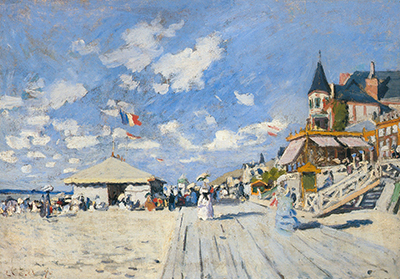
A wooden walkway runs towards a crowd of seaside visitors beneath a bright blue, cloud-filled sky. To the left stands a broad-roofed pavilion; to the right rise stairs and elaborate resort buildings. Monet painted The Boardwalk on the Beach at Trouville in 1870. Also catalogued as On the Boardwalk at Trouville , this 50 by 70 centimetre oil painting is Wildenstein 157a, a distinct canvas from his other beach panoramas. [1] [2]
At a Glance
The walkway gives the viewer a position
The nearest planks begin at the bottom edge and run towards a pale-clothed figure in the middle distance. They put the viewer on a walking surface rather than at a detached lookout above the beach.
Dark seams divide the boards, but Monet varies their width and emphasis. Some strokes continue sharply, while others dissolve into lighter paint. The surface remains readable without becoming an exercise in exact carpentry.
To the left, sand spreads across a broader area. Its warmer yellow and cream marks contrast with the cooler grey-blue boards. The two surfaces meet near the central figures, giving the eye a choice between moving along the walkway and drifting towards the beach.
The right side has a different direction again. The stairs descend diagonally from the buildings towards the promenade. Their balustrades and shadow pull across the main line of recession, creating a lively junction between horizontal walking and changing levels.
This is a picture about access as well as scenery. Built surfaces allow visitors to move through a coastal environment that would otherwise be less convenient for fashionable shoes and long dresses.
The pavilion and its gathering crowd
A low, broad pavilion occupies the left centre. Its pale roof forms a flattened triangular shape above a much darker band of people and supports. It is one of the most immediately recognisable features separating this painting from the other Trouville views.
The building gives the scattered beachgoers a point around which to gather. Dark coats, bright clothing and small parasols accumulate near its base, while a flagpole rises above the roof into the sky.
Monet does not need to give the pavilion a detailed interior. The contrast between its bright roof and shadowed underside is enough to establish shelter, depth and scale. The people provide a sense of its everyday use without turning the scene into a single narrated incident.
The roof also interrupts what might otherwise have been an uninterrupted band of sky above the beach. Its shallow slope answers the sharper roofs on the right, creating a relationship between modest beach architecture and the more imposing resort frontage.
The result is an organised social landscape. Even where the sea is scarcely visible, the arrangement of buildings, flags and visitors makes the coastal setting unmistakable.
A sky made from separate touches
The sky occupies a large part of the canvas. Its blue is not a flat background behind the buildings: pale grey and white touches spread across it in uneven groups, with blue openings between them.
Some marks are short and rounded, others longer and slanting. Their variety prevents the clouds from forming one smooth, solid mass. The eye keeps shifting between the light marks and the spaces around them.
The strongest blue appears above the low central horizon, while paler passages soften parts of the upper and left sky. These differences make the air feel extensive rather than merely decorative.
The foreground contains a related play of separated touches. Grey seams, cream highlights and patches of blue shadow describe the boards and sand. The sky and ground are unlike in subject, yet connected by the active handling of paint.
This visible brushwork does not tell us exactly how long the painting took. It explains the impression of liveliness, but is not proof that the whole canvas was completed in a single uninterrupted sitting.
Seaside buildings and modern leisure
At the right, a rounded turret and steep dark roof rise above red, cream and ochre walls. Awnings and terraces provide intermediate layers between the tall architecture and the beach.
The nearest stairs are particularly assertive. Pale railings cut across darker gaps, while a broad shadow falls over the lighter ground below. Their repeated uprights supply a different rhythm from the loose marks used for clothing and clouds.
The Musee d'Orsay situates such resort subjects within the expansion of seaside holidays under the Second Empire, assisted by the railways. Monet's Trouville paintings show a coastline adapted to leisure, not simply an untouched natural shore. [4]
That history is visible here in small practical details. Walkways, stairs, shade and gathering places bring urban habits to the beach. The visitor can enjoy the sea air while remaining within a carefully equipped environment.
This does not establish the wealth, identity or accommodation of every figure. The painting offers a particular view of resort life, not a complete census of Trouville's residents and visitors.
A different viewpoint from the other beach paintings
The catalogue raisonne places Monet's viewpoint nearer to Deauville than those used for the preceding two beach canvases. [2] That shift helps account for the changed relationship between buildings, boardwalk and water.
In the Wadsworth Beach at Trouville , the long plank perspective dominates beside a developed frontage. The separate high-tide painting brings waves close to the walkers. Here, the pavilion and people occupy much of the middle distance, with only a narrow glimpse of open sea at the far left.
The comparison is not a hunt for a more accurate version of one view. Each arrangement directs attention differently. Here the sky, crowded beach facilities and point of access matter more than an extensive marine panorama.
Monet's vertical Hotel des Roches Noires offers another contrast. Orsay's account emphasises flags moving above comparatively stable figures. [5] The horizontal boardwalk canvas distributes its activity more widely, between pavilion, walkway, stairs and cloud-filled air.
Boudin and the beach as a modern subject
Eugene Boudin had already made Trouville's visitors and atmosphere an important subject. The Phillips Collection's 1863 Beach at Trouville presents a smaller group, including a seated woman, a strolling couple and a dog. [3]
That comparison is useful because seaside leisure can be painted at very different scales. Boudin's intimate grouping and Monet's wider gathering both allow dress, posture and air to carry meaning without a grand historical event.
The Phillips also cautions that Boudin's apparently rapid image was probably assembled from on-site sketches, with reworking in the arrangement of figures. [3] Such evidence belongs to that particular panel, but it is a helpful reminder not to equate a lively surface with the absence of thought.
Monet's boardwalk is structured by strong diagonals and carefully balanced masses. The freedom of the clouds and crowd works against that organisation, not in place of it. The subject joins informal observation to a consciously arranged picture.
A private painting with documented public appearances
The National Gallery's 2018 loan record lists a probable purchase from Monet by Durand-Ruel in 1882, followed by Georges Petit in 1883. It later belonged to Gabriel Weil-Martignan and passed by descent before a Christie's sale in London on 9 December 1997. [1]
The same record documents its appearance at the Musee Marmottan Monet's 2014 Les Impressionnistes en prive , as catalogue number 42. In 2018 it was lent from a private collection for Monet and Architecture . [1]
Those dates describe documented moments in the painting's history. They do not promise its present availability for viewing or establish a current owner's identity.
Its relative unfamiliarity should not obscure its specificity. The pale pavilion, broad wooden approach and lively sky give it a character of its own. Within Monet's Trouville paintings , it records a shore experienced through the structures and routines of a modern resort.
Frequently Asked Questions
It is Wildenstein 157a, a separate work from the Wadsworth canvas and the high-tide Beach at Trouville. [2]
The painting is dated 1870 and carries the lower-left signature Cl. M. 70. [2]
The National Gallery's 2018 record identifies a private lender in Milan. That historical record is not a guarantee of its present location or display. [1]
This view concentrates on the boardwalk, pavilion, visitors and buildings; the sea is only a narrow opening at the far left.
Discussion
Look again at the images and ideas explored in The Boardwalk on the Beach at Trouville. These editorial prompts invite your observations.
Reader Insights
Compare the pale pavilion roof with the steep roof at the right.
Follow the board seams towards the central white-clothed figure.
Notice how the scattered cloud marks differ from the regular stair railings.
Join the Conversation
Share a detail, comparison or question about The Boardwalk on the Beach at Trouville below.
References
- National Gallery, London , Monet and Architecture, 2018, loan record X9538; identity, dimensions, provenance and 2014 exhibition history. View source .
- Daniel Wildenstein / Wildenstein Plattner Institute , Monet catalogue raisonne, volume II, 1996, entry 157a, printed page 75; signature, date and viewpoint nearer Deauville. View source .
- The Phillips Collection , Eugene-Louis Boudin, Beach at Trouville, 1863; comparison with an earlier beach subject and caution over apparent speed of execution. View source .
- Musee d'Orsay , The Spectacular Second Empire, 1852-1870; railway expansion, coastal leisure and Monet's resort subjects. View source .
- Musee d'Orsay , Hotel des Roches Noires, Trouville; separate vertical painting and its handling of flags, figures and sky. View source .







