


 by
Tom Gurney
Tom Gurney BSc (Hons) is an art history expert with over 20 years experience
Published on October 6, 2016 / Updated on October 23, 2026
Email:
tomgurney1@gmail.com
/ Phone:
+44 7429 011000
On the Beach at Trouville
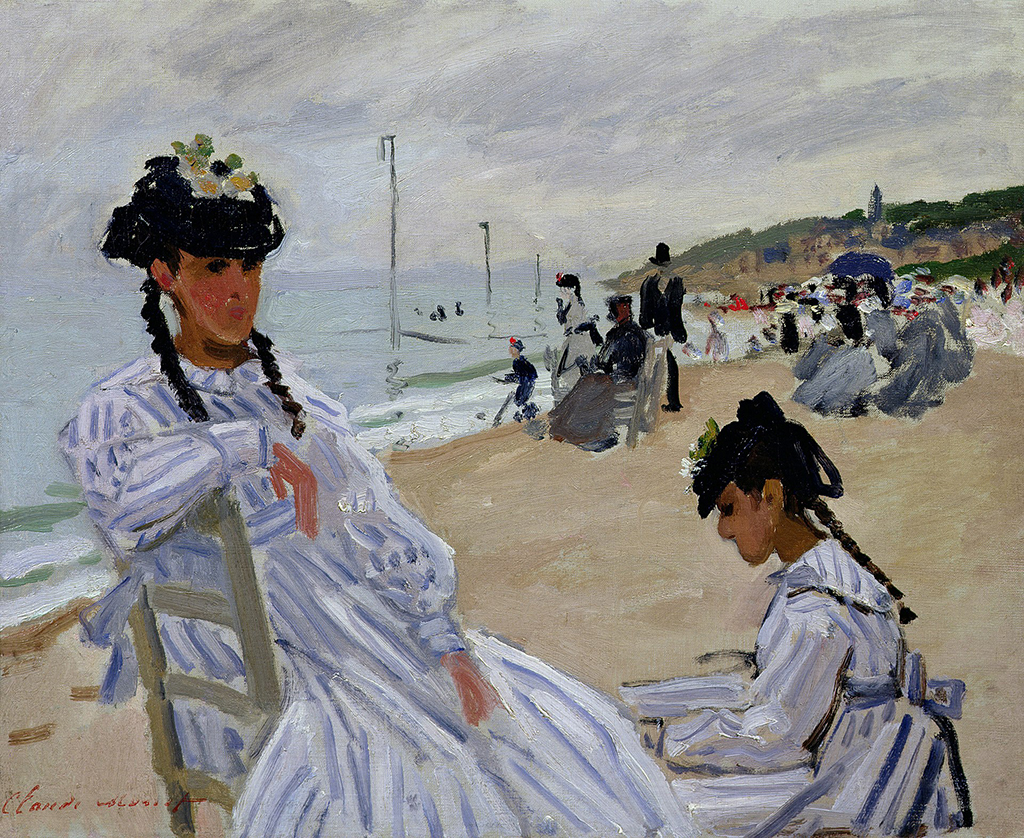
Two women in pale striped dresses occupy the foreground, while a crowded beach curves away behind them. Monet's On the Beach at Trouville , or Sur la plage a Trouville , belongs to the Musee Marmottan Monet in Paris. The museum dates this oil painting to 1870 and records its size as 38 by 46 centimetres. It is inventory 5016, Wildenstein 162, rather than one of the several other Trouville canvases with similar titles. [1] [2]
At a Glance
Two figures seen at close range
The woman at the left faces towards the viewer. Her upper body rises prominently against the pale water and sky, while the spreading skirt extends beyond the bottom of the picture. The other woman sits lower at the right, her head inclined and her face seen in profile.
Their poses are different, but their clothing creates a strong relationship. Both wear light dresses marked with blue and lavender strokes, and dark hats break up the paler surroundings. Black ribbons and the shapes of hair add smaller accents.
The unequal scale and position make the foreground active. The left figure is not balanced by an identical upright on the other side; instead, the right figure turns into the space of the composition. Her lowered gaze contrasts with the more outward-facing presence at the left.
The viewer is close enough to register these differences without receiving a detailed account of every feature. Monet makes posture, clothing and placement do much of the work that a more formal portrait might assign to precise facial description.
Striped dresses as visible brushwork
The stripes do more than describe fashion. On the left figure's sleeve they change direction as the fabric bends around the arm. Across the bodice and skirt, longer blue-grey strokes suggest folds without tracing every seam.
The right-hand dress is treated differently according to its position. Strokes run along the back and lower skirt, interrupted by darker bands and a bow-like shape at the waist. The marks help establish how the sitter turns away.
White paint is not uniformly white. Cool blue and lavender passages give the fabric shadow and structure, while warmer touches connect it with faces, hands and sand. The dresses appear light because of relationships among colours, not because they are left unvaried.
The brushstrokes remain conspicuous. At close range, a sleeve can seem to dissolve into separate touches; from farther away, those touches describe a person. That shifting recognition is part of the painting's energy.
The similarity of the dresses should not be used to invent a story that both figures represent Camille. Repeated clothing colours are a compositional relationship, not proof of an experimental double portrait.
The shoreline opens space behind them
The water reaches the left foreground and then recedes diagonally towards the right. Bands of white surf mark its meeting with the sand, leading the eye behind the large figures rather than stopping at them.
This line is crucial because the seated women occupy so much of the canvas. Without a strong recession, their closeness could flatten the entire scene. Instead, the beach opens into several successive distances.
Near the middle, a small blue-clothed figure stands close to the water. Farther back, upright visitors and seated groups gather along the shore. A cluster of parasols forms a broken band towards the right, below a low green and ochre hillside.
Pale boat shapes and thin masts add delicate verticals at the left. Their lightness contrasts with the stronger dark marks in the foreground hats. The distant people and equipment are not absent of detail, but their detail is scaled differently.
The result is an intimate encounter embedded in a public place. Monet gives the nearest figures weight while allowing the ordinary activity of the resort to continue around them.
Who are the women?
The Marmottan's current account describes Camille and her cousin as models for this group of small Trouville paintings. [1] An older catalogue raisonne, however, left the models in this particular canvas unidentified and rejected its frequent description as Camille and her sister at Sainte-Adresse. [2]
Those are not equivalent statements. The museum supplies a present interpretation, while the catalogue documents an earlier uncertainty and an incorrect place association. It is sensible to preserve that distinction rather than confidently attach an unsupported name to the companion.
The painting's composition does not depend on resolving every biographical detail. A face directed towards us and a lowered profile create different kinds of attention, whether or not a particular family relationship can be established beyond doubt.
Nor should their expressions be turned into an imagined conversation. We can describe the visible poses and the contrasting directions of their gazes; the thoughts and exchanges of the sitters are not recoverable from those marks alone.
From Boudin's beach crowds to Monet's close view
Eugene Boudin had already made fashionable beachgoers a recurring subject. Monet took that coastal world seriously while developing a more forceful proximity to the figures.
The National Gallery of Art's scholarly catalogue Manet and Modern Paris reproduces this Marmottan work while discussing Monet's vigorous handling of faces, connecting its occasional sharpness with his early experience of caricature. [3]
That is an interpretation of style, not a reason to treat the sitters as comic inventions. The strongly marked faces and abrupt dark accents can coexist with an observant account of light on clothing and the beach.
Monet's Trouville subjects also vary considerably among themselves. A distant promenade crowd, a single upright portrait and two seated women demand different distributions of space. The resort provides continuity, but not a ready-made formula.
Here, the closeness of the foreground is the decisive choice. The coast is experienced through people sitting within it, rather than through a detached view of its hotels or horizon.
Similar titles, separate paintings
Yale owns another close view of Camille on the beach, described in its collection publication as a horizontal painting with a parasol and a diagonal shore. [4] London's National Gallery has a separate two-woman Trouville scene, while Marmottan also owns the narrow Camille on the Beach .
The work here can be distinguished by its pair of blue-white striped dresses, the large outward-facing figure at the left and the lower profile at the right. Those features identify it more securely than the broad English phrase Beach at Trouville.
The distinction is particularly important for technical evidence. Sand reported in London's paint or observations about Yale's priming are findings about those objects, not automatically this one. Similar locality, date and sitter do not make separate canvases materially interchangeable.
Comparison is most useful when it sharpens these differences. It shows how many ways Monet could connect a figure to a shore, not how to replace missing information about one picture with facts borrowed from another.
The family collection and later reception
The painting entered Marmottan through Michel Monet's 1966 bequest. The catalogue also records its theft from the museum on 27 October 1985 and recovery in December 1990. [2]
The larger bequest brought more than a hundred Monet works into the institution, according to the museum's history. [6] This small beach scene consequently belongs to a collection shaped by family inheritance as well as later art-historical reputation.
In 2025-26, it was one of two Trouville paintings chosen for the museum's Monet / Secheret: Paysages d'eau dialogue with the work of Jean-Baptiste Secheret. [5] That later exhibition placed Monet's coastal observations within an ongoing practice of looking at Normandy's shore.
The picture still rewards attention on its own terms. The large pale dresses, dark hats, quickly marked faces and winding waterline make a compact but spatially ambitious scene. Its apparent informality depends on a careful relation between the people nearest us and the beach extending beyond them.
Frequently Asked Questions
The catalogue rejects the older Sainte-Adresse title and identifies the work as On the Beach at Trouville. [2]
Through Michel Monet's bequest in 1966. [1]
Discussion
Look again at the images and ideas explored in On the Beach at Trouville. These editorial prompts invite your observations.
Reader Insights
Follow the waterline from the left foreground to the distant crowd.
Compare how the stripes change direction across the two dresses.
Notice the difference between the left figure's gaze and the right figure's lowered profile.
Join the Conversation
Share a detail, comparison or question about On the Beach at Trouville below.
References
- Musee Marmottan Monet , Sur la plage a Trouville, 1870, inventory 5016; current object record and interpretation. View source .
- Daniel Wildenstein / Wildenstein Plattner Institute , Monet catalogue raisonne, volume II, 1996, entry 162, printed page 77; identity, sitter uncertainty and collection history. View source .
- National Gallery of Art , Manet and Modern Paris: One Hundred Paintings, 1982, catalogue entry 54 and figure 82, page 160; exact Marmottan reproduction and discussion of Monet's handling. View source .
- Yale University Art Gallery , A Selection of European Paintings and Sculpture, catalogue entry 9; separate Camille at Trouville composition and comparison. View source .
- Musee Marmottan Monet , Monet / Secheret: Paysages d'eau, 2025-26 press publication; later dialogue featuring this Trouville painting. View source .
- Musee Marmottan Monet , Le musee et son histoire; Michel Monet's 1966 bequest and the formation of the collection. View source .







