


 by
Tom Gurney
Tom Gurney BSc (Hons) is an art history expert with over 20 years experience
Published on October 6, 2016 / Updated on October 23, 2026
Email:
tomgurney1@gmail.com
/ Phone:
+44 7429 011000
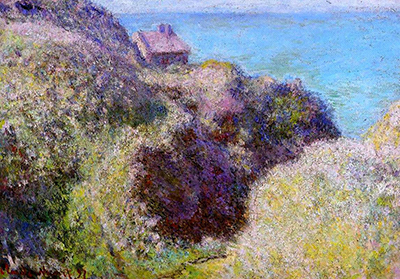
Gorge at Varengeville, Late Afternoon
Gorge at Varengeville, Late Afternoon is a coastal landscape painted by Claude Monet in 1897. A small cabin stands above a steep, shadowed hollow, with the sea stretching behind it. The painting belongs to the Harvard Art Museums' Fogg collection and is numbered 1452 in the Wildenstein catalogue. [1] Its drama comes from the contrast between bright, closely worked slopes and the dark cleft running towards the water.
At a Glance
- Artist Claude Monet
- Date 1897
- Medium Oil on canvas
- Dimensions 65 x 92 cm, rounded catalogue measurement
- Collection Harvard Art Museums, Fogg Museum
- Accession 1972.31; Wildenstein 1452. [1]
A return to the Normandy coast
Monet knew this coastline long before 1897. Jill Shaw's Art Institute of Chicago catalogue places his later Normandy campaigns in February to April 1896 and January to April 1897, when he returned to motifs he had painted in the early 1880s. Nearly fifty canvases emerged from the two visits. [2]
That history gives this scene a more precise setting than the broad description of a painter in his final years. Monet was returning to familiar country with the experience of his recent repeated-subject paintings behind him.
The coast near Varengeville offered steep changes of level rather than an uninterrupted sandy shore. A viewer could look down into a hollow and out towards the Channel within the same field of vision. The painter's position above the water is essential to the effect here: the foreground banks rise into the picture, while the sea occupies the upper distance.
How the gorge organises the picture
The dark hollow is the composition's strongest interruption. It begins near the lower centre and narrows as it passes between the opposing slopes. Its shape is irregular, more like an opening in a mass of vegetation than a neatly outlined path.
The left bank is broad and high. It fills much of the canvas and continues beyond the top-left corner, preventing the viewer from seeing its full extent. The right bank enters from the opposite edge and turns down towards the gorge. Together they create a funnel-shaped space.
This arrangement makes the landscape feel close. There is no generous foreground terrace from which to survey a complete view. The spectator seems to be looking across the cut in the cliff, confronted by surfaces that are partly hidden and partly exposed.
The hollow's darkness also supplies a point of comparison for the bright slopes. Without it, the many small touches of pale colour might merge into an even shimmer. Against the central shadow, their differences become easier to perceive.
The small cabin above the ravine
A modest building appears near the upper left, set against the sea. Its roof, walls and chimney are comparatively clear shapes in a landscape whose vegetation is described through scattered marks. The roof's sloping edges give a brief geometric pause among the irregular banks.
The building belongs to the customs-house motif that Monet repeatedly painted in this area. Shaw's account explains the earlier use of the coastal structure by customs officers and its later use by local fishermen for shelter and storage. [2]
In this view, however, architecture is not the largest or nearest object. The cabin is small enough to make the ravine and surrounding ground seem substantial. Its position near the top does not draw the eye away permanently: the darker vegetation beneath it leads attention back into the hollow.
There is no clearly developed human episode around the building. Its presence suggests a used and known coastline, but the picture does not depend on identifying an occupant, a journey or an event. Land, light and distance remain the principal subjects.
Late-afternoon light and coloured shadow
The title draws attention to a particular lighting effect. The Wildenstein catalogue compares this canvas with the preceding customs-house view and relates the greater shadow in the ravine to the sun's movement westward. [1]
The shadow is not simply a blank area of black. Violet, blue, brown and reddish touches remain visible within it. These colours allow the hollow to keep a material presence even where its details are difficult to read.
On the right, pale yellow and lilac marks gather across the sunlit bank. They create a much lighter surface than the gorge, but the transition is uneven. Small dark accents keep breaking through, suggesting variations in the ground and its cover.
The left slope contains another mixture: greens, warm pinks and pale, almost silvery touches. Its brightness is less uniform than the right bank's. The result is not a simple diagram of one illuminated side and one shaded side, but a landscape made from several interacting patches of light.
Monet's treatment of light changes the apparent weight of the ground. The brightest parts seem to open and scatter, while the hollow appears dense and compressed.
Sea, distance and the high horizon
The blue sea forms a comparatively open band behind the crowded slopes. Its horizontal reach contrasts with the gorge's downward cut and the cabin's pitched roof. A narrow strip near the top gives the distant water a boundary without making the sky a dominant part of the scene.
The sea is not perfectly flat in colour. Pale and darker marks pass across it, but the variations are gentler than those in the foreground. This difference helps establish distance. The banks feel textured and near; the water seems broad and further away.
The MuMa in Le Havre holds a different 1897 Varengeville view. Its discussion connects Monet's return with the Petit-Ailly gorge and emphasises the effect of a high horizon and simplified topography in that sunlit canvas. [3] Comparing the two works shows why a shared coastal motif does not make the paintings interchangeable.
Here, the dark ravine remains a decisive organising shape. The view is luminous, but it has not lost the abruptness of the terrain.
Brushwork and the experience of looking
Across the banks, many small touches remain distinguishable. Their direction varies with the area: some cluster into rounded masses, while others break across an edge or run down into shadow. The effect is lively without requiring every mark to describe an individual leaf or stone.
From a distance, these marks combine into larger slopes. Closer attention reveals how unstable those surfaces are. A bank that first appears green contains pink, blue and yellow notes; a shadow that initially seems uniformly dark opens into several colours.
This is a useful way to consider Monet's technique : the surface can support both the recognition of a place and an awareness of paint. The two experiences do not cancel each other.
The image alone cannot establish the exact pigments or sequence of layers. Nor does energetic handling prove that the entire painting was completed in one sitting. The visible evidence is the patterned surface itself, and the way it makes the gorge appear both solid and affected by passing light.
The painting's documented history
The catalogue records Durand-Ruel's purchase from Monet in November 1898, subsequent ownership by Mr and Mrs W. Ward Foshay, and Ella Milbank Foshay's gift to the Fogg Museum in 1972. [1]
These records distinguish this canvas from other customs-house and gorge views. The title, collection and catalogue number together identify a particular object, not a general image of the Normandy coast.
It can be considered alongside Monet's other Normandy landscapes and his repeated subjects , but it rewards attention on its own terms. The small cabin, the open sea and the deeply shadowed cut establish a balance that belongs to this view.
The most compelling contrast is not between an accurate landscape and an abstract one. It is between the apparent permanence of the ground and the temporary condition of its illumination. Monet gives both a place in the same closely worked surface.
Frequently Asked Questions
It is dated 1897 and catalogued as Wildenstein 1452. [1]
In the Harvard Art Museums' Fogg collection, accession 1972.31. [1]
No. The Chicago painting is a separate 1897 canvas, Wildenstein 1455. [2]
The deep violet ravine contrasts with the bright surrounding banks and the blue sea behind them.
Discussion
Look again at the images and ideas explored in Gorge at Varengeville, Late Afternoon. These editorial prompts invite your observations.
Reader Insights
Does the small cabin make the landscape feel more inhabited or more solitary?
How does the dark gorge change the brightness of the surrounding slopes?
At what distance do the small marks begin to merge into solid ground?
Join the Conversation
Share a detail, comparison or question about Gorge at Varengeville, Late Afternoon below.
References
- Daniel Wildenstein , Monet catalogue raisonne, volume III, printed pp. 600-601, cat. 1452, Wildenstein Plattner Institute. View source .
- Jill Shaw , The Customs House at Varengeville, Art Institute of Chicago scholarly catalogue, cat. 35, 1896-97 campaign and comparative context. View source .
- MuMa Le Havre , L'impressionnisme au fil de l'eau, Les Falaises de Varengeville, separate 1897 painting and Petit-Ailly context. View source .







