by Tom Gurney
Tom Gurney BSc (Hons) is an art history expert with over 20 years experience
Published on October 6, 2016 / Updated on February 22, 2026
Email: tomgurney1@gmail.com / Phone: +44 7429 011000
Claude Monet in Varengeville
In 1882, Claude Monet travelled along the Normandy coast in search of new inspirations for his work. Varengeville-sur-Mer would be amongst the most significant of his discoveries, a quiet clifftop village overlooking the English Channel which was packed full of artistic possibilities.
Here, Monet found one of his most poetic and structurally powerful subjects: a solitary church poised dramatically above the sea, though there were a number of other impressive works completed by Monet during his time in Varengeville.
Varengeville in 1882: Context of the Campaign
Monet's stay in Varengeville formed part of a broader Normandy campaign that included Dieppe, Pourville and Étretat. By 1882, he had already established himself as a leading Impressionist, yet he continued to seek new inspirations, both from urban and rural settings.
Varengeville offered an unusual combination of architectural presence and coastal drama. The small Church of Saint-Valery stood near the cliff edge, its stone tower silhouetted against vast skies and turbulent sea, offering endless opportunities to the precise eye of Monet - indeed his method of studying changing conditions was perfect for this environment.
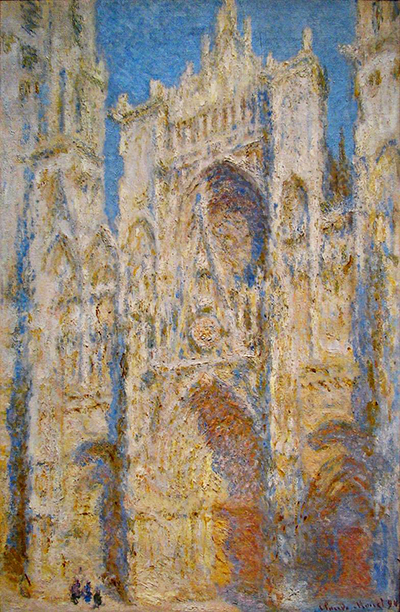
His later work with the grand and impressive Rouen Cathedral a decade later contrasted markedly with his work here in Varengeville. This church was intimate and rural, but both constructions suited the series approach in different ways.
Featured Paintings from Claude Monet's Varengeville Series
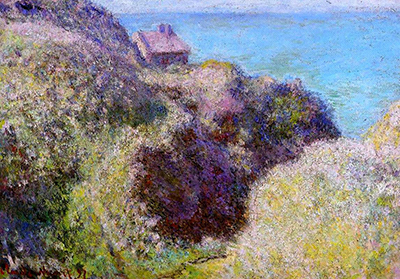
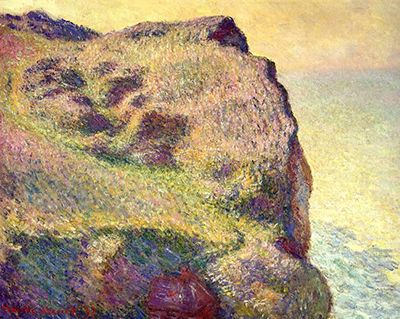
- Location Varengeville-sur-Mer, Normandy, France
- Year Painted 1882
- Primary Motif Church of Saint-Valery on the cliff
- Number of Works Approximately 6-10 canvases
- Artistic Importance Early exploration of serial landscape and architectural light effects
- Related Normandy Campaign Étretat, Pourville and Dieppe (1882)
The Church Motif: Architecture Against Atmosphere
Monet painted the church repeatedly from varying distances and elevations. He immediately recognised its potential, but needed to search for just the right position from which to capture its form. He experimented by making it the focal point in some works, whilst in other cases it is partially hidden by vegetation.
One notable point from the church was how it offered a clear vertical balance against the horizontal of the sky and sea. As a man-made building, it also contrasted against the otherwise natural surroundings found in Varengeville.
In the true Impressionist manner, Monet would dissolve the stone forms into a flurry of colour, tending to choose tones of lilac, blues and free, expressive brushwork.
Cliffs and Vegetation
The cliffs of Varengeville differ from Étretat's monumental arches. Here the coastline descends more gently, edged with grasses, wildflowers and cultivated plots. This in turn gives a different atmosphere to Monet's work here.
Foreground vegetation plays a critical role. Monet often frames the church through branches or flowering shrubs, creating layered spatial depth. He would have spent some time planning each angle, and how to balance each composition with their key components prior to starting to paint.
The openness of this environment also allowed the artist to make use of wind, or at least the suggestion of its impact by bending grasses, and gifting a feeling of movement with cloud formations. Again, Impressionism was all about a moment in time, and the changeable conditions of Varengeville were well suited to this concept.
Light and Weather Variations
Monet's Varengeville works explore climatic changes throughout the day, including morning haze, bright midday clarity and the warm glow of late afternoon. Some of his paintings would carry titles such as this in order to underline the importance of this in the colour balance of each work.
In overcast conditions, grey tones make an impression, with brighter tones then used for warmer scenes. We get a glimpse here of the Rouen series that would follow later on in Monet's career.
Relationship to Étretat and Dieppe
Varengeville bridges Monet's dramatic Étretat cliff paintings and the pastoral quiet of Pourville. Within Normandy he was able to see a great variety in nature, and then return to Paris for urban influences - he was therefore in touch with all he needed within just a small part of France.
Technique and Brushwork
Significance of Varengeville
| Title | Date | Current Location | Notes |
|---|---|---|---|
| The Church at Varengeville, Morning Effect | 1882 | Museum of Fine Arts, Boston | High vantage viewpoint |
| The Church at Varengeville | 1882 | Kimbell Art Museum | Cliff edge composition |
| Varengeville, View of the Church | 1882 | Private Collection | Vegetation framing |
| Cliff and Church at Varengeville | 1882 | Private Collection | Sea horizon emphasis |
| Varengeville, The Church Seen Through Trees | 1882 | Private Collection | Layered composition |
| The Coast at Varengeville | 1882 | Private Collection | Cliff study without church |