


 by
Tom Gurney
Tom Gurney BSc (Hons) is an art history expert with over 20 years experience
Published on October 6, 2016 / Updated on October 23, 2026
Email:
tomgurney1@gmail.com
/ Phone:
+44 7429 011000
The Pointe du Petit Ailly
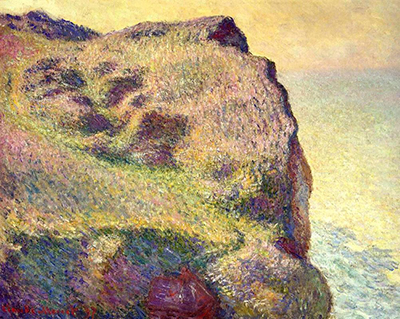
The Pointe du Petit Ailly turns a high Normandy headland into an almost overwhelming mass of colour. Claude Monet painted this oil on canvas in 1897; the work is catalogued as Wildenstein 1445. [2] A small building appears near the bottom, while sea and sky occupy the much narrower space beyond the cliff. The Musee des impressionnismes Giverny identified the painting with the Nahmad collection in its 2024 exhibition. [1]
At a Glance
A return to the Normandy coast
Petit Ailly belongs to the coastal landscape around Varengeville , not to Monet's garden at Giverny. The Kreeger Museum's account of a related painting places his 1897 work after earlier coastal visits in 1882-84. Returning to a familiar site allowed him to reconsider a subject rather than simply discover a new view. [3]
The ground itself offered strong contrasts: a steep gorge, a high headland and the open water of the Channel. A customs house associated with the Napoleonic period, later used by fishermen, provided a small human structure within this much larger setting. [3]
The landscape is recognisable, but the painting does not supply an easy route into it. There is no broad foreground path leading gently towards a distant view. Instead, the land rises immediately before us, making the experience more abrupt and less comfortable than a conventional seaside panorama.
The cliff fills the picture
The headland occupies most of the canvas. Its upper outline climbs and falls irregularly, and its right edge drops towards the water. The large form initially reads as a single barrier, but closer looking reveals smaller ridges, hollows and changes of direction across it.
At the left, a dark, curving recess interrupts the lighter ground. Across the centre, green, pink and yellow passages make the slope seem folded rather than smoothly rounded. The surface is difficult to reduce to a simple division between exposed rock and vegetation. Colour carries much of the information that a more sharply outlined landscape might deliver through drawing.
The viewpoint also hides important connections. We cannot follow the cliff continuously down to a clearly described beach. That missing transition increases the sense of height: the land appears to plunge beyond what the frame allows us to see. The composition is therefore dramatic without requiring a storm, crashing wave or human incident.
A small customs house at the lower edge
The little building is easy to miss because it sits close to the bottom of the painting. Its reddish roof and darker walls give it a compact, angular character, unlike the irregular patches of the surrounding slope. Once recognised, it changes our understanding of scale.
What first looked like a close study of uneven ground becomes a view of a much larger landform. The building is tiny in relation to the cliff, yet its straight edges make it a useful visual anchor. The contrast is not just between nature and architecture, but between two ways of organising shape.
The house does not become the centre of a narrative. No clearly described inhabitant steps outside, and the scene gives no definite account of work taking place there. It is enough that a human structure survives within the view. Its low position also prevents it from competing with the cliff's dominant silhouette.
Colour, distance and the quiet sea
The land is much more varied in colour than the water and sky. Small, broken touches accumulate across the cliff, whereas the open space at the right appears comparatively pale and continuous. This difference allows the headland to feel substantial even where its colours are unexpectedly delicate.
Pink and mauve do not simply decorate a green hillside. They help articulate shaded hollows and warmer or cooler passages across the form. The eye moves between these local differences before returning to the larger outline. Monet's technique works here through relationships, not through a separate, fixed colour for every material.
Beyond the cliff, the distinction between sea and sky is much quieter. The horizon does not cut the picture into two equally assertive zones. That restrained background makes the rougher foreground more conspicuous. The contrast suggests distance without requiring a sharply detailed ship, harbour or distant settlement. The large landmass and the open air remain different kinds of pictorial space.
Related paintings are separate objects
Monet returned to this headland in several canvases, so the title alone cannot identify every version. The Kreeger Museum owns The Pointe du Petit Ailly in Gray Weather, also dated 1897, accession 1971.7. Its collection history and dimensions belong to that separate painting, not to the canvas discussed here. [3]
MuMa in Le Havre holds another 1897 Varengeville cliff painting. The museum describes its sunny effect and the way light reduces topographic detail. [4] Comparing such works helps explain the purpose of a painting series : the location can remain recognisable while the distribution of colour, light and emphasis changes.
The nearby Gorge at Varengeville, Late Afternoon offers another route into the same coastal campaign. These comparisons are most useful when differences remain visible. Treating every Petit Ailly title as interchangeable would erase the particular framing and colour arrangement that give this painting its character.
Observation is not the same as a single sitting
The lively handling can make the painting feel immediate, but that effect does not establish how long Monet worked on it. MuMa cautions that apparent spontaneity in his landscapes can coexist with later studio completion. [4] A finished surface should not automatically be read as an untouched record of one short outdoor session.
The Art Institute of Chicago's scholarly study of its separate Customs House at Varengeville discusses evidence of outdoor work together with later reworking. Those findings concern the Chicago canvas; they are not a technical examination of this painting. [5]
Earlier coastal pictures also show how changing the viewpoint could alter the relationship between house, cliff and sea. Fondation Beyeler's exhibition guide draws attention to this variation in Monet's 1882 customs-house paintings. [6] The later return to Normandy belongs within a sustained investigation of the subject, not a simple repetition of an unchanged formula.
Exhibition and collection history
Christie's records the painting in Monet's 1898 exhibition at the Galerie Georges Petit, while leaving its exact catalogue identification between numbers 24 and 25. The uncertainty is worth retaining rather than turning one possible number into a settled fact. [2]
The same provenance records Durand-Ruel acquiring it from Monet on 28 November 1898 and Stanford Z. Rothschild Jr acquiring it in 1972. The work was later offered from the Rothschild Art Foundation. [2] These records concern ownership and circulation, not the circumstances of every brushstroke.
The 2024 Giverny museum exhibition presented it within a broader exploration of Impressionism and the sea. [1] That context restores an important part of Monet's range beyond his familiar garden subjects. His exhibition history provides one way to follow the picture's changing audiences, while the painting itself keeps attention on a compact encounter: a small house, a towering cliff and a luminous interval of open water.
Frequently Asked Questions
Monet signed and dated this canvas 1897. It is Wildenstein 1445. [2]
The Giverny museum's 2024 exhibition identified it with the Nahmad collection. That historical listing is not a promise of current public display. [1]
No. The Kreeger owns a separate Gray Weather version, accession 1971.7. [3]
Discussion
Look again at the images and ideas explored in The Pointe du Petit Ailly. These editorial prompts invite your observations.
Reader Insights
Does the small house change how large the cliff appears?
Where do you first distinguish the sea from the sky?
How does the low position of the building affect the composition?
Join the Conversation
Share a detail, comparison or question about The Pointe du Petit Ailly below.
References
- Musee des impressionnismes Giverny , Impressionism and the sea, 2024, exact painting image and collection caption. View source .
- Christie's , Claude Monet, La Pointe du Petit Ailly, Wildenstein 1445, details, provenance and exhibition record. View source .
- Danielle O'Steen , The Kreeger Museum, The Pointe du Petit Ailly in Gray Weather, separate painting and coastal context. View source .
- MuMa Le Havre , Balade impressionniste, Les Falaises de Varengeville, separate 1897 painting and studio-work caution. View source .
- Jill Shaw , Art Institute of Chicago, Cat. 35, The Customs House at Varengeville, separate object's scholarly study. View source .
- Fondation Beyeler , Monet exhibition guide, 2017, coastal viewpoints and the 1882 customs-house paintings. View source .







