


 by
Tom Gurney
Tom Gurney BSc (Hons) is an art history expert with over 20 years experience
Published on October 6, 2016 / Updated on October 23, 2026
Email:
tomgurney1@gmail.com
/ Phone:
+44 7429 011000
Jean Monet on His Hobby Horse
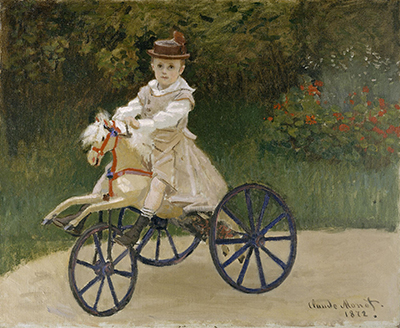
Claude Monet's Jean Monet on His Hobby Horse shows his elder son astride a wheeled toy in a garden. Painted in 1872, it belongs to the Metropolitan Museum of Art, whose current title is Jean Monet (1867-1914) on His Horse Tricycle. The more precise name draws attention to the unusual vehicle beneath the boy, rather than to a rocking horse. [1] The horse stretches forward, as though galloping, but its rider turns towards us and holds still. Bright clothing makes Jean conspicuous against the foliage: a recognisable person, with a particular toy, meeting his father's gaze.
At a Glance
- Artist Claude Monet
- Date 1872
- Medium Oil on canvas
- Dimensions 60.6 x 74.3 cm
- Collection The Metropolitan Museum of Art, New York
- Accession 2000.195; gift of Sara Lee Corporation, 2000. [1]
A small rider with a commanding presence
Jean sits above the centre of the toy's frame, his body turned slightly across the canvas while his face looks out. A brown hat, with a tall decorative feather, adds height to his pale figure. The dark eyes are emphatic within a softly modelled face. Neither a broad smile nor a dramatic gesture supplies the portrait's character; its directness depends on that concentrated encounter with the viewer.
His cream-coloured outfit spreads over the saddle and falls in folds towards the large rear wheel. Dark footwear and the striped detail near his ankle interrupt the pale clothing. Below him, the wheels make a second, more angular pattern. Their repeated spokes cut across open spaces and show the garden path through the vehicle.
The horse itself combines animation with obvious artificiality. Its extended forelegs suggest speed, yet its small body is carried by a visible wheeled structure. Red and blue accents pick out the harness. The head faces left, away from Jean's outward gaze, so the two faces pull our attention in different directions. This contrast makes the toy much more than an incidental accessory. It helps organise the whole composition.
A modern toy and the portrait tradition
The Rouen museum network interprets the painting against the long tradition of dynastic portraiture. A child mounted on a horse can recall images of privileged young heirs, but here the impressive animal has become an expensive modern plaything. The comparison is about pictorial status, not evidence that Monet intended a parody of a particular royal portrait. [3]
Clothing and equipment matter together. They present a child whose appearance and recreation receive careful attention. Rouen's account places this within nineteenth-century interest in childhood as a distinct stage of life, with its own needs and possessions. That reading gives the portrait a social dimension without reducing Jean to an illustration of a historical trend. [3]
The toy also establishes a useful distinction between the painting's familiar English title and what it actually shows. This is not a simple stick horse or an animal on curved rockers. Its three wheels remain plainly visible. Their physical specificity anchors the image in the material world of childhood, even while the painted horse promises an imaginary ride.
The Argenteuil garden
Monet settled with his family at Argenteuil in 1871. The town combined employment and industry with riverside recreation, and its railway connection kept Paris close. The National Gallery of Art's introduction to Paul Hayes Tucker's study emphasises this mixture rather than treating Argenteuil as an untouched rural retreat. [6]
The garden provides a more sheltered setting than the public riverbanks and sailing scenes associated with Monet's years there. Its hedge fills the background, leaving no large opening towards distant scenery. A band of pale path supports the rider, while scattered red flowers brighten the right side. The setting feels enclosed because its painted forms close around the figure, not because the picture tells us everything about the family's private circumstances.
The scene belongs to a rented home, not to the later garden Monet created at Giverny. Rouen identifies it with the pink house at Argenteuil. This early domestic garden already offered a place where family life and painting could meet, long before the water-lily pond became his principal subject. [3]
Likeness before spectacle
The Met's acquisition commentary stresses that Monet's main purpose was to capture Jean's likeness, despite the conspicuous clothing and tricycle. It singles out the boy's deeply set eyes and their resemblance to Camille's. The same account describes a restrained arrangement of tan, green and red, with light primer contributing to the highlights. These are observations about this canvas, not a universal formula for Monet's technique . [2]
Seen closely, the vegetation breaks into irregular marks, whereas the rider's face receives a more concentrated description. The wheel rims are firm enough to hold the vehicle together, but the foliage does not resolve into a botanical inventory. Different kinds of attention coexist within one image.
That balance complicates the idea that every Monet painting simply records a fleeting impression. Here an encounter between father and son remains central. The child is presented carefully, even though the surrounding garden admits looser handling. The portrait's freshness does not require us to invent a single uninterrupted sitting or to assume that every passage was finished outdoors.
Jean in other family paintings
Monet had already painted his son as an infant. In The Cradle - Camille with the Artist's Son Jean, dated 1867 by the National Gallery of Art, the baby lies beneath patterned fabric while Camille sits beside him. Small toys accompany the infant. Comparing it with the horse-tricycle portrait reveals a change from dependence and enclosure to an upright child with a much larger possession. The paintings are separate works, not successive episodes documented as a planned series. [4]
A different relationship between figure and setting appears in Woman with a Parasol - Madame Monet and Her Son of 1875. Camille dominates the foreground, while Jean appears farther back on the grassy rise. The National Gallery describes its wind-stirred clothing, broken sky and rapid application of paint. In that picture, the family participates in a broader outdoor effect; in the 1872 portrait, Jean and his wheeled mount occupy the principal stage. [5]
These comparisons also challenge the habit of considering Monet only through landscape. His portraits form a significant part of the familiar surroundings he chose to paint. Laura Auricchio's Met essay connects his subjects with the people and places closest to him, while noting how his homes attracted fellow painters. Domestic subject matter was part of his working life, not a separate amateur activity. [7]
A private painting and a public collection
The Met records that Monet kept the portrait throughout his life and did not exhibit it. That statement concerns the artist's own lifetime; it should not be mistaken for a claim that the picture has never appeared in a later exhibition. Sara Lee Corporation gave it to the museum in 2000. [1]
Reproductions have carried the image into other collections. The National Trust, for example, catalogues a paper print after Monet at the Sudbury Museum of Childhood. It is not another original oil painting, and its dimensions and materials belong to the reproduction. Distinguishing these objects preserves the identity of the New York canvas while acknowledging the portrait's later circulation. [8]
Its appeal rests on a productive tension. Jean appears both as an individual child and as a carefully presented young rider; the horse looks lively but remains visibly a machine; the enclosed garden combines dense foliage with an open, brightly lit path. Those relationships give the portrait its substance. It is an image of childhood built from observation, pose and possession, rather than a generic illustration of happiness or an anecdote that can be read straight from the boy's expression.
Frequently Asked Questions
In 1872. The picture shows his elder son in the family's Argenteuil garden. [1]
At the Metropolitan Museum of Art, New York, accession 2000.195. [1]
No. It is mounted on three wheels, which explains the Met's current Horse Tricycle title. [1]
The Met states that he kept it throughout his life without exhibiting it. [1]
Discussion
Look again at the images and ideas explored in Jean Monet on His Hobby Horse. These editorial prompts invite your observations.
Reader Insights
How do the wheel spokes change the relationship between the rider and the garden?
Does Jean's outward gaze make the portrait seem formal, intimate, or both?
How does this portrait differ from the child's smaller role in Woman with a Parasol?
Join the Conversation
Share a detail, comparison or question about Jean Monet on His Hobby Horse below.
References
- The Metropolitan Museum of Art , Jean Monet (1867-1914) on His Horse Tricycle, 2000.195. View source .
- The Metropolitan Museum of Art Bulletin , Recent Acquisitions: A Selection, 1999-2000, vol. 58, no. 2, p. 45, entry signed GT. View source .
- Reunion des Musees Metropolitains Rouen Normandie , Jean Monet sur son cheval mecanique. View source .
- National Gallery of Art , The Cradle - Camille with the Artist's Son Jean, 1867. View source .
- National Gallery of Art , Woman with a Parasol - Madame Monet and Her Son, 1875. View source .
- National Gallery of Art , Paul Hayes Tucker, The Impressionists at Argenteuil, 2000, publication introduction. View source .
- Laura Auricchio , Claude Monet (1840-1926), The Metropolitan Museum of Art, 2004. View source .
- National Trust Collections , print after Monet, Jean Monet on His Hobby Horse, NT 665992. View source .







