


 by
Tom Gurney
Tom Gurney BSc (Hons) is an art history expert with over 20 years experience
Published on October 6, 2016 / Updated on October 23, 2026
Email:
tomgurney1@gmail.com
/ Phone:
+44 7429 011000
Madame Monet in a Japanese Kimono: La Japonaise, 1876
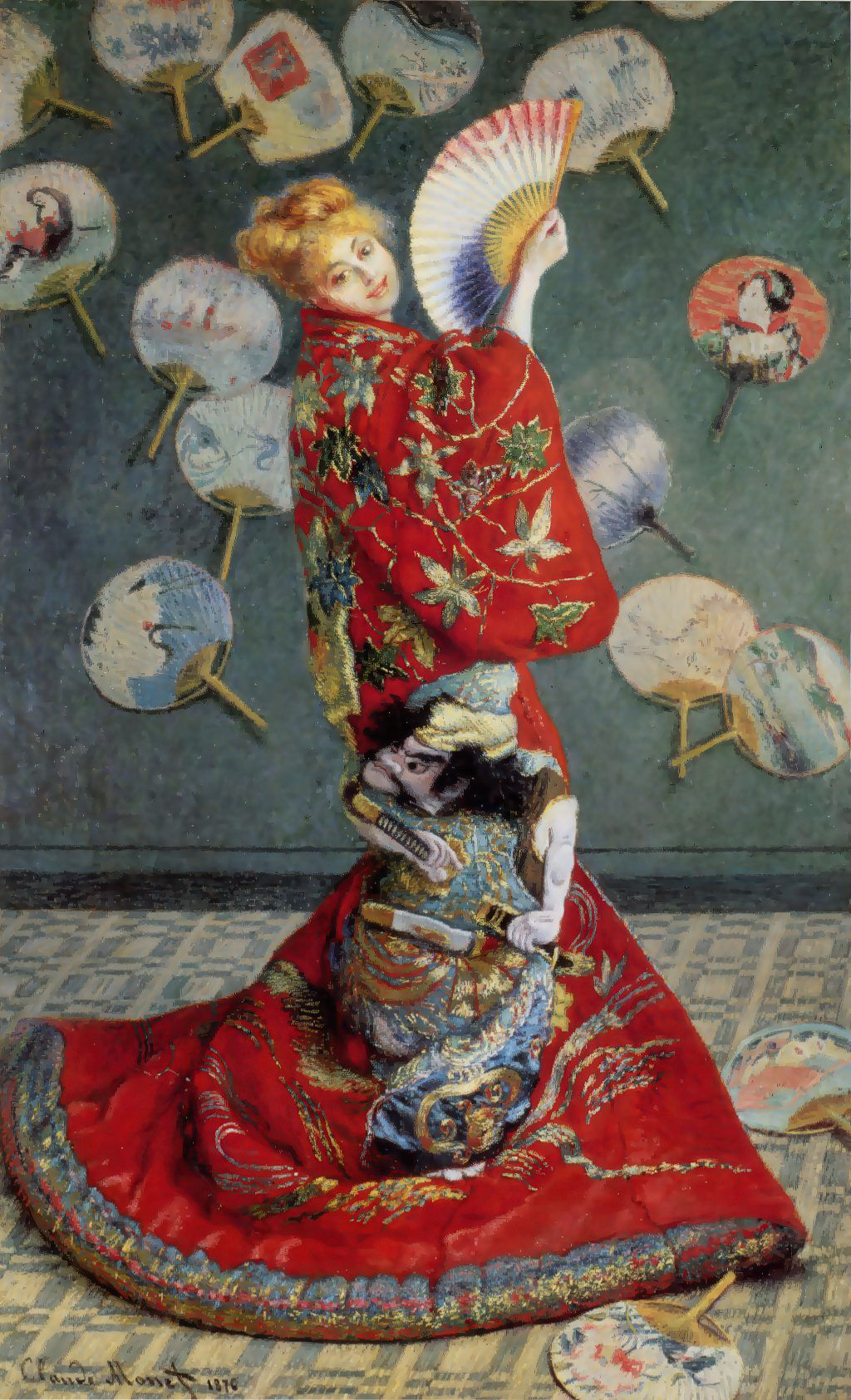
La Japonaise presents Camille Monet in an elaborate red robe, turning towards the viewer beneath a raised fan. Painted in 1876, this large oil on canvas belongs to the Museum of Fine Arts, Boston, inventory 56.147. It combines a portrait of Monet's wife with a conspicuously staged display of costume and pattern. [1]
At a Glance
A portrait arranged as a performance
Camille's body turns away while her face turns back. This twisting pose gives the figure movement without requiring her to walk across the room. The wide train extends around her feet, filling much of the lower canvas.
Her raised hand and open fan pull attention upwards. The head sits between that pale fan and the brilliant red collar, so the face remains visible despite the costume's complexity.
The picture is more than two metres high. Its scale makes the encounter almost bodily, while the surrounding objects keep reminding us that the scene has been arranged.
The Monet portraits overview follows other relationships between likeness, clothing and setting. Compared with the outdoor group in Women in the Garden , this is a much more concentrated confrontation between one figure and an ornamental interior.
The garden painting distributes attention across several women and patches of light. La Japonaise gathers that attention into a single, flamboyant silhouette.
The robe has a figure of its own
The red garment contains another commanding presence: a fierce warrior whose large face and bent body emerge across the lower part of Camille's figure. Flowers, patterned borders and other details compete with this embroidered character.
The MFA's collection guide observes how the arrangement of the robe gives the warrior an apparent animation. The costume is not a passive covering; its imagery changes the way the woman's body is read. [4]
At a distance, red establishes a broad, unified shape. Closer attention separates blues, greens, yellows and dark contours within it. The garment alternates between an almost flat decorative field and a complicated representation of raised embroidery.
The warrior's face can briefly draw attention away from Camille's. This creates an unusual rivalry between a living model and an image worn on her clothing.
Monet does not need to give every part the same finish. A recognisable eye, a sharp border or a bright fold can establish a detail while adjacent marks remain broader and less definite.
Fans, a blond wig and French identity
The fans are distributed across both wall and floor. Their rounded shapes repeat, but their images, angles and colours differ. They surround Camille without forming a tidy symmetrical border.
One can follow their handles as short diagonals that interrupt the quieter wall. The painted scenes inside them make the room a display of pictures within a picture.
Camille's blond hair is a wig. The museum interprets it as a way of emphasising her identity as a Western woman rather than presenting her as Japanese. Her folding fan also carries the red, white and blue associated with the French flag. [1] [4]
These details complicate the title. The woman is performing a role through clothing and accessories, not being identified by nationality.
The contrast is deliberate enough to invite wit, but it need not be reduced to a single joke. The portrait can simultaneously display admiration for beautiful objects, pleasure in masquerade and participation in a fashionable Parisian market.
Japonisme rather than a scene in Japan
The MFA's account of its Monet and Boston exhibition places the picture within the wider European enthusiasm for Japanese art and objects. Imported textiles, prints and decorative wares, together with the Japanese presence at the Paris International Exposition of 1867, helped make that enthusiasm increasingly visible. [5]
Japonisme describes this encounter and its reinterpretations, not a single Japanese style copied without change. A French painter could select an object for its colours, its fashionable associations, its imagery or the way it altered a composition.
Those choices were selective. A Parisian interior assembled from imported objects does not provide an unmediated account of everyday life in Japan.
The Japanese Prints article follows Monet's collecting and the importance of looking at particular prints. This portrait makes the objects conspicuous, whereas other connections may concern framing, pattern or the relationship between foreground and background.
The distinction helps prevent La Japonaise from becoming a complete explanation of everything Monet learned from Japanese art.
Reading the cultural exchange carefully
Art historian Shigemi Inaga examines how the critic Theodore Duret used Japanese art to explain and defend Impressionism. His account shows that such arguments depended on selective interpretations, not on neutral descriptions of a wholly separate culture. It also points to exchanges running in both directions, including imported colourants used in Japanese prints. [6]
That perspective is useful here. The painting belongs to a network of trade, collecting, criticism and fashion, rather than a simple story in which one country supplies inspiration and another receives it.
The MFA's 2020 exhibition placed La Japonaise beside a Yoshitoshi print showing the same narrative represented on the robe. This offered viewers a way to consider the costume's imagery, not proof that Monet copied that particular print. [5]
Recognising the Japanese objects' own histories makes the encounter more specific. It also leaves room to question the transformation of clothing and imagery into a European spectacle.
The painting's vividness does not settle those questions. It gives them a particularly conspicuous form.
A striking and disputed exhibition picture
Monet showed the painting at the second Impressionist exhibition in 1876 under the title Japonerie. The museum explains that this term referred to Western work imitating Japanese objects; the now familiar title La Japonaise was not the original exhibition title. [2]
The response was mixed. Some critics objected strongly to the figure, while others admired the colour, handling and unusual character of the work. [2]
This matters because the painting can now look comfortably familiar as a museum masterpiece. Its original viewers did not share one settled interpretation of its wit or appeal.
It also resists a narrow definition of Impressionism as small, swiftly painted outdoor landscapes. This large interior portrait depends on costume, performance and detailed decorative passages.
The Reception article explores the difference between contemporary reactions and later reputation. La Japonaise is an especially clear reminder that attention and agreement are not the same thing.
What conservation found in the paint
The MFA began a public conservation treatment in 2013. Surface coatings and wax residues had affected clarity, while some red, blue and maroon passages were fragile. Cleaning was therefore accompanied by work to stabilise vulnerable paint. [2]
The detailed update explains that a 1972 wax-resin lining had not fully resolved the instability and had contributed wax deposits at the surface. Samples from dark red areas revealed several layers, including an upper glaze, with starch present in varying amounts. Conservators described a possible connection between the starch and small fissures in that glaze. [3]
These are observations about this painting, not a formula for every Monet. The report does not justify saying that all his colours were unmixed or that every passage was executed in one rapid sitting.
The Technique guide considers that wider variety. Here, the material evidence reinforces what the eye already suggests: different parts of the picture were built to produce different effects.
It also makes the conservation history part of how the image is understood. Apparent haze or uneven gloss may relate to materials added long after Monet stopped painting.
Camille and the Boston collection
The MFA acquired La Japonaise in 1956 through its 1951 Purchase Fund. The date in the fund's name should not be confused with the painting's accession year. [1]
Within the portrait, the recognisable woman remains important even when the objects threaten to overwhelm her. Her face, turned towards us, offers a point of contact that the warrior and scattered fans cannot replace.
Yet the scene never becomes an unadorned statement of personality. The wig, pose and costume are integral to the image, not distractions that can simply be removed to discover a supposedly truer portrait underneath.
Monet holds likeness and masquerade together. The result is visually exuberant, but also more unstable than a straightforward celebration of an imported fashion: a French model, Japanese objects, competing figures and an audience invited to notice the performance.
Frequently Asked Questions
Camille Monet, the artist's wife. [1]
It is signed and dated 1876. [1]
The museum records the 1876 title as Japonerie. [2]
The Museum of Fine Arts, Boston, accession 56.147. [1]
Discussion
Look again at the images and ideas explored in Madame Monet in a Japanese Kimono: La Japonaise, 1876. These editorial prompts invite your observations.
Reader Insights
Compare Camille's face with the warrior represented on the robe.
Follow the fans across the wall and onto the floor.
Consider how a portrait can express both likeness and a deliberately staged identity.
Join the Conversation
Share a detail, comparison or question about Madame Monet in a Japanese Kimono: La Japonaise, 1876 below.
References
- Museum of Fine Arts, Boston , La Japonaise (Camille Monet in Japanese Costume), 1876, 56.147; exact object record, dimensions, interpretation and acquisition history. View source .
- Museum of Fine Arts, Boston , Conservation in Action: La Japonaise; original title, 1876 reception and treatment strategy. View source .
- Museum of Fine Arts, Boston , Conservation in Action: La Japonaise, March 2013; lining history, paint samples and material findings. View source .
- Museum of Fine Arts, Boston , A Guide to the Collections, printed pages 366-367; Camille's pose, French-coloured fan and the animated embroidered warrior. View source .
- Museum of Fine Arts, Boston , Monet and Boston: Lasting Impression, 23 October 2020; Japonisme context and the Yoshitoshi comparison. View source .
- Shigemi Inaga , Claude Monet, Between Impressionism and Japonism, in Monet and Japan, National Gallery of Australia, 2001, pages 64-76; critical framing and cultural exchange. View source .







