


 by
Tom Gurney
Tom Gurney BSc (Hons) is an art history expert with over 20 years experience
Published on October 6, 2016 / Updated on October 23, 2026
Email:
tomgurney1@gmail.com
/ Phone:
+44 7429 011000
Pink Water-Lilies, 1897-1899
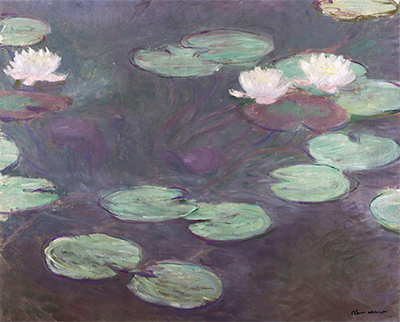
Pink Water-Lilies, known in Italy as Ninfee rosa, is an early pond painting in Rome's Galleria Nazionale d'Arte Moderna e Contemporanea. The museum dates it to 1897-1899 and identifies it as inventory 5163. Three open blossoms and a scattering of broad leaves occupy a close view of dark water. [1]
At a Glance
Three flowers without a distant view
Two blossoms gather towards the upper right, while another sits near the left edge. Their separation makes them distinct points of attention rather than a continuous bank of flowers.
The petals are pale, with pink shadows and warmer touches. One flower's light centre is especially noticeable against the cooler leaves around it. The title does not mean that every petal is painted the same pink.
There is no bridge, horizon or view of the house. Instead, the crop brings us close enough to see the notches, rims and overlapping shapes of individual lily pads.
The larger leaves near the bottom act as a foreground, but not as firm ground on which the viewer could stand. They float within the same uncertain space as the more distant groups.
The Water Lilies overview follows Monet's wider investigation. This canvas is unusually concentrated: a small number of blossoms can organise the picture because much of the surrounding water remains comparatively quiet.
Purple water and green leaves
The water is not described through a single blue tone. It shifts between violet, muted brown and grey, with softer passages suggesting what lies beneath or is reflected above.
Against this field, the leaves appear green, but their colour is far from uniform. Some are pale and cool; others carry darker edges or warmer centres.
The curved outlines do not turn every pad into a rigid disc. Broken rims and uneven strokes give the forms a degree of movement, even where the overall arrangement seems still.
Thin reddish-purple lines pass through the water near the central flowers. They suggest connections between plants and the space below without becoming a detailed botanical diagram.
These marks also complicate depth. A broad green shape can lie flat across the surface, while a narrow line seems to lead into it. The Painting Water article considers this double reading of a pond as both surface and reflected or submerged space.
Floating leaves do not mean drifting plants
Waterlily pads float, but the plants are rooted below the surface. The Royal Horticultural Society describes planting them into aquatic compost or loam, often in containers set on the pond bottom. [4]
Their leaves are therefore not simply loose objects travelling around a pond like fallen petals. Growth, seasonal change and the movement of water can alter appearances without removing those connections.
That distinction matters when looking at Monet's arrangement. The painting can suggest transience without proving that each group of pads was about to drift to a different position.
Nor does a flower colour establish an exact cultivar. Painted light, mixtures and the condition of a reproduction all affect what we see. The picture records an artistic arrangement of observed forms, not a plant nursery's identification chart.
The living subject offered change, but Monet's decisions about where to place edges, intervals and bright accents gave that change a lasting pictorial structure.
An early work in a long investigation
The national Italian catalogue places this painting in the early group of Water Lilies associated with the late 1890s. Its dating discussion draws on scholarship and a photograph showing the work in Monet's earlier Giverny studio. [2]
The museum's range of 1897-1899 is more useful than pretending that the painting supplies an exact day or hour of observation.
Its close focus also challenges a simple account in which Monet first painted the whole garden and only much later discovered water without a horizon. Different kinds of view could coexist.
The Met's separate bridge painting of 1899 provides a useful contrast. There, the arch gives the garden a strong architectural anchor; here, leaves and flowers provide the principal shapes. [6]
The Japanese Footbridge article considers another distinct canvas. Comparing such works reveals choices of framing, rather than a single inevitable progression from recognisable landscape to abstraction.
A cultivated pond at Giverny
The setting had been deliberately made. Monet acquired the water-garden land in 1893 and arranged the diversion of the Ru, a branch of the Epte. Planting and continued maintenance helped create the place he painted. [5]
The apparent closeness to nature did not exclude planning. A gardener's choices about plants and water could precede a painter's choices about viewpoint and colour.
The canvas then leaves much of that designed place outside its edges. It does not show the path, the surrounding buildings or the wider landscape.
That exclusion gives the flowers an intimacy they would not have in a panoramic view. The viewer confronts a few living forms and the uncertain water around them.
The Giverny garden article supplies the broader setting. Pink Water-Lilies makes that setting specific through a carefully restricted field of attention, rather than through a complete description of the property.
What conservation reveals
The museum's 2019 report, with an account by Luciana Tozzi, describes industrially prepared linen and an unvarnished painted surface. It distinguishes thinner passages from raised, more heavily worked strokes, noting cracking and lifting in vulnerable areas. [3]
The report also records cleaning accumulated atmospheric deposits and the discovery of revisions requiring further investigation. It does not provide a complete reconstruction of those changes.
This evidence gives the surface a material history beyond the appearance of a reproduction. A softly coloured water passage and a thicker flower accent are not merely different images; they can also have different physical structures.
The report concerns a documented conservation intervention, not a guarantee about the canvas's present condition. Nor does one unvarnished painting establish a rule for every Monet.
The Technique article separates visual interpretation from technical findings. Here the museum's examination is especially valuable because it concerns this exact object, rather than another painting with a similar title.
From the Monet family to Rome
The Italian catalogue traces the canvas from Michel Monet to Galerie Katia Granoff in Paris and then Marlborough Gallery in London, where the national gallery acquired it in 1962. [2]
This collection history distinguishes the work from other early pond views. Title and date alone are not enough: dimensions, the image and an inventory number all help establish which canvas is being discussed.
The catalogue also connects the early Water Lilies with Monet's interest in a decorative room of water paintings. That is a context for an evolving idea, not evidence that the Rome canvas was already commissioned for the later Orangerie installation. [2]
The Painting Series guide considers how a repeated motif can serve several purposes. A painting may remain an individual work even when it also contributes to a larger investigation of colour, space and display.
Close looking before monumental scale
Monet later returned to the pond in much larger formats, working through extended revisions and arrangements of panels. Temkin and Lawrence describe the development of those late decorations as a prolonged undertaking, not a single sudden discovery. [7]
The Rome picture deserves to be seen for its own solution. Its flowers remain individually legible, and the leaves retain strong contours, yet the dark water prevents their setting from becoming fully measurable.
One can follow the two upper-right blossoms across to the isolated flower at the left, then look down through the larger leaves. The intervals between these forms matter as much as the forms themselves.
The result is neither a botanical specimen sheet nor a vague impression of an entire garden. It is a particular balance of pale flowers, floating leaves and deep, muted colour, already showing how much visual complexity Monet could find in a limited section of water.
Frequently Asked Questions
It belongs to the Galleria Nazionale d'Arte Moderna e Contemporanea in Rome, inventory 5163. [1]
The museum dates it to 1897-1899. [1]
No. The leaves float, but waterlilies are rooted below the surface. [4]
It records the support, different paint textures, surface deposits and evidence of revisions; it does not fully explain every underlying change. [3]
Discussion
Look again at the images and ideas explored in Pink Water-Lilies, 1897-1899. These editorial prompts invite your observations.
Reader Insights
Compare the three open blossoms and the spaces separating them.
Follow the dark rims of the leaves against the purple-brown water.
Consider what the absence of a bridge or horizon does to your sense of scale.
Join the Conversation
Share a detail, comparison or question about Pink Water-Lilies, 1897-1899 below.
References
- Galleria Nazionale d'Arte Moderna e Contemporanea , Ninfee rosa, 1897-1899, inventory 5163; current collection record. View source .
- Italian Ministry of Culture, Catalogo Generale dei Beni Culturali , Ninfee rosa, catalogue 1200490949; dating, early context and provenance. View source .
- Luciana Tozzi / Galleria Nazionale d'Arte Moderna e Contemporanea , Report 2019, pages 48-49, Nympheas roses; conservation of this painting. View source .
- Royal Horticultural Society , How to grow waterlilies; rooted plants, floating foliage and seasonal growth. View source .
- Maison et jardins de Claude Monet , Water lily pond; construction and cultivation of the setting. View source .
- The Met , Bridge over a Pond of Water Lilies, 1899, 29.100.113; a distinct architectural garden view. View source .
- Ann Temkin and Nora Lawrence, MoMA , Claude Monet: Water Lilies, 2009, pages 5-7; the later decorative project and revision. View source .







