


 by Tom Gurney
Published on October 30, 2026 / Updated on October 30, 2026
Tom Gurney BSc (Hons) is an art history expert with over 20 years experience
Email: tomgurney1@gmail.com / Phone: +44 7429 011000
Hamlet Lithographs: Introduction
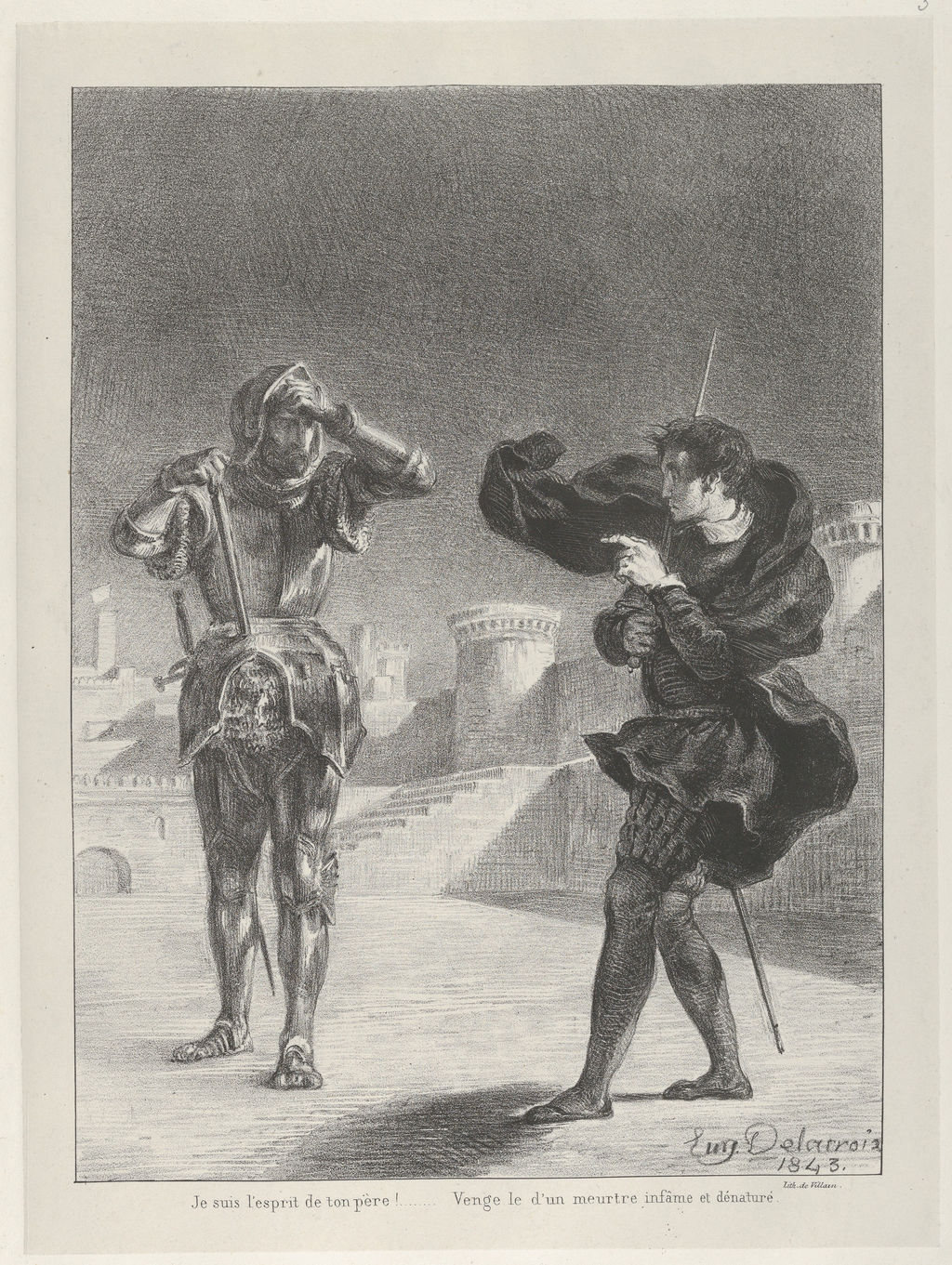
An armoured figure confronts a young man beneath a dark sky. A woman lies low in a river, her pale dress spreading into the water. A gravedigger raises a skull towards a richly dressed visitor. In Eugène Delacroix’s Hamlet lithographs, these encounters give death very different forms: an apparently substantial presence, a body slipping below the bank, a small object held at arm’s length. Their force comes from the arrangement of bodies, hands and surrounding space. Read together, they reveal an artist finding several visual languages within one play.
Delacroix began the series in 1834. Gihaut published thirteen lithographs in 1843; an expanded edition of sixteen appeared through Bertauts in 1864, after the artist’s death in 1863.[1] Those dates describe an extended undertaking and its subsequent publication, rather than a single burst of illustration. They also invite a slower kind of looking. A print allows a gesture that would pass quickly in performance to remain before us: Hamlet’s guarded hands, Ophelia’s raised arm, the gravedigger’s palm supporting the skull.
At a Glance
- First publicationThirteen lithographs, Gihaut frères, 1843 [1]
- Expanded editionSixteen lithographs, Bertauts, 1864 [1][2]
- Main impressionGhost on the Terrace, 1843; Met 22.56.7, first state of five [3]
- Painting comparisonHamlet and Horatio in the Cemetery, 1839; Louvre RF 1942 [4]
Contents
- A series made and published over time
- The ghost: armour beneath an immense sky
- Ophelia: the body and the river
- The gravediggers: a skull held out for recognition
- Returning to the cemetery painting
- Reading across the sheets
- Annotated details
A series made and published over time
The National Gallery of Art’s Hamlet portfolio is dated 1864 and contains sixteen lithographs with text and a cover. Its records include individual designs dated 1834, 1835 and 1843.[2] An edition date therefore needs to be distinguished from the date attached to a particular composition. A sheet belonging to the later portfolio can preserve a design made decades earlier. The sixteen-print edition should not be mistaken for the contents of the original thirteen-print publication.
The 2018 exhibition catalogue Delacroix places the project within the artist’s engagement with Shakespeare and the theatre, and describes a pause in work before its resumption in 1842.[5] That interrupted history helps explain why it is useful to approach the series as a sustained return to the play. Its images need not be treated as consecutive views conceived under identical circumstances. Delacroix could revisit a subject, develop it in another medium and set a new treatment beside an earlier one.
A surviving set also has a physical history of its own. Princeton University’s Graphic Arts Collection holds sixteen unbound prints from the Bertauts and Dusacq edition of 1864, given by Sinclair Hamilton in 1949. That particular set lacks its title page.[6] “The series” can mean both a group of compositions and a physical collection of printed sheets. Individual impressions, their margins and their accompanying words give the images a material presence beyond their role as illustrations.
The lettered ghost and graveyard sheets considered here carry French captions below their image boundaries. Above the lettering, gestures and glances can be read together; below it, words unfold in a line. Moving between those two forms of attention makes a productive pause. We can follow the caption towards a dramatic identification, then look back to see how much the image discloses without it. The series’ relationship with literature operates through these small acts of recognition as well as through its choice of scenes.
The ghost: armour beneath an immense sky
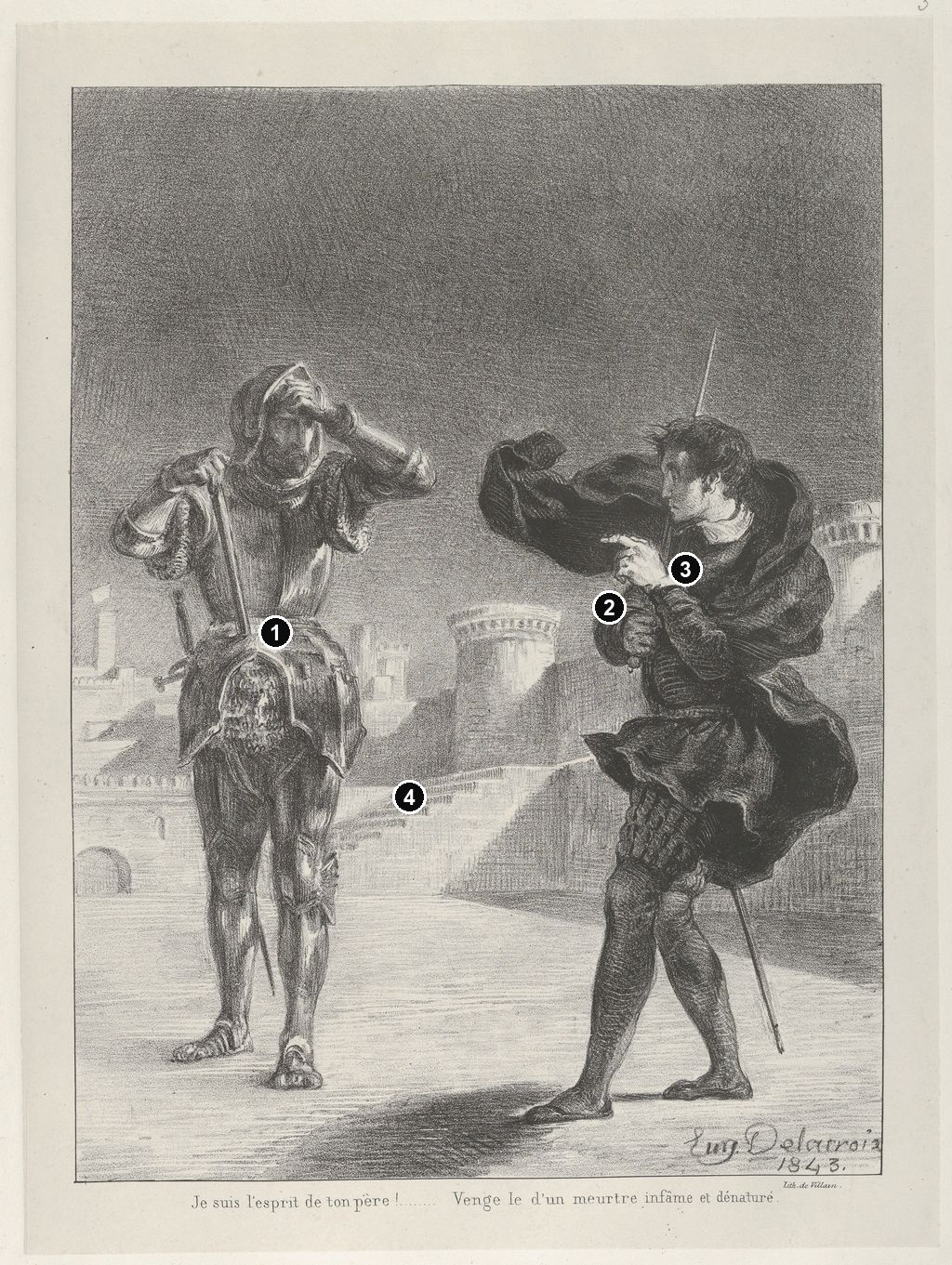
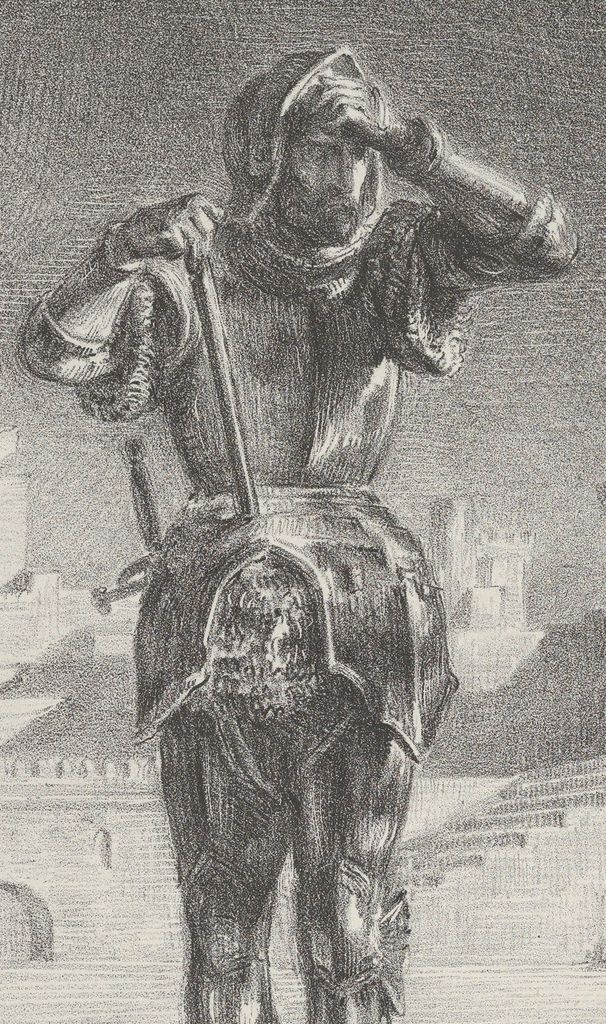
The Metropolitan Museum of Art’s Hamlet Sees the Ghost of his Father on the Terrace is an 1843 lithograph, printed by Villain; its impression is the first of five states. The museum associates the scene with Act 1, Scene 5, when the ghost reveals his murder and demands revenge.[3] This is a meeting with the dead, but its visual strangeness begins with the ghost’s weight and definition. On the left, he stands in armour, his feet planted on the terrace. The plates covering his body catch the light in hard, separate surfaces.
One hand crosses his brow or helmet. The other is raised near his shoulder, beside the long vertical object at his side. The gesture across the head partly interrupts our access to his face. His body is unmistakably present, yet his expression is less immediately available than the gleaming equipment that surrounds it. This uneven visibility gives the encounter its peculiar balance: the visitor from the dead has firm contours, while the living man seems caught in a movement he has not completed.
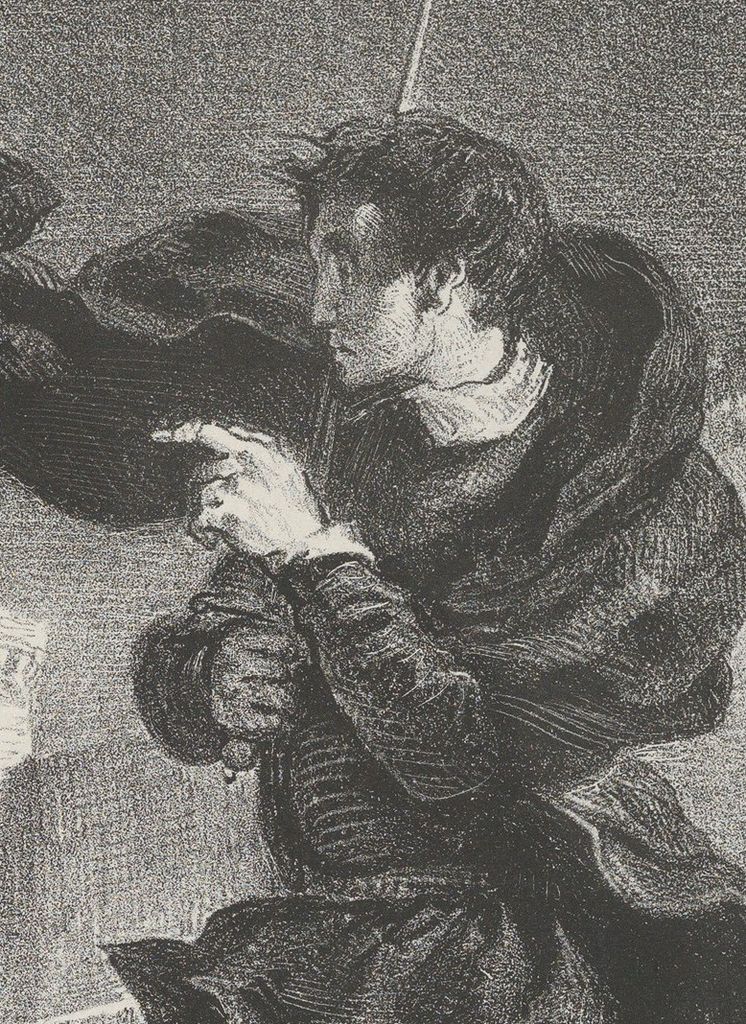
Hamlet stands on the right. His dark cloak blows leftwards, lifting away from his shoulder towards the ghost. His hands are gathered across the front of his body, and his legs hold a braced position. The spreading cloth makes a broad, unstable shape beside the narrow divisions of the armour. Although the cloak reaches into the interval between the figures, their hands do not meet. The remaining gap keeps the confrontation open. We can see Hamlet attending to the apparition without needing to turn his posture into a precise account of his thoughts.
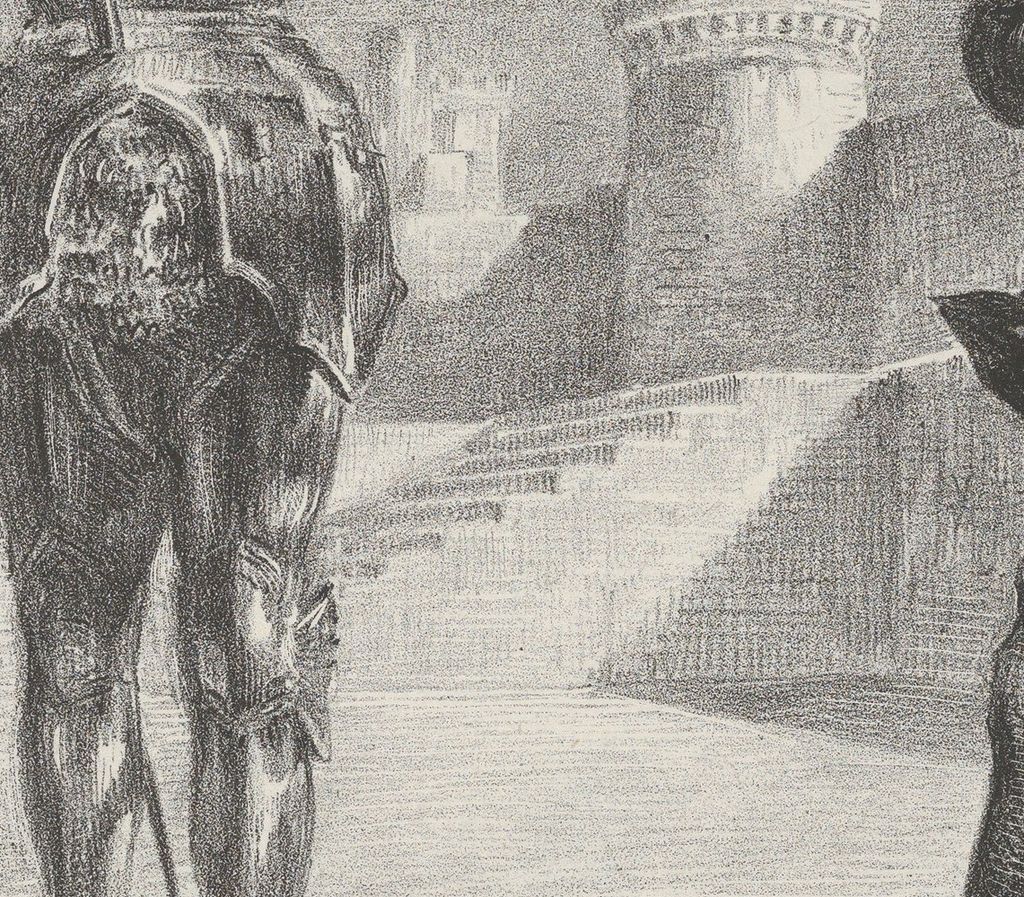
Much of the sheet belongs to the sky. Its dark, granular expanse bears down on figures whose heads sit well below the upper edge. Behind them, pale towers and ramparts establish a recognisable built setting, but their low placement makes the darkness feel larger still. The architecture supplies scale without competing with the encounter. Against this background, the ghost’s bright edges and Hamlet’s pale face become points at which the eye can briefly settle.
There is tension between stillness and movement throughout the image. Armour segments the ghost into resistant parts; the cloak carries a flowing horizontal energy. The terrace holds both figures on apparently dependable ground, while the sky offers little reassurance about the space beyond them. Delacroix gives the supernatural a body that can be looked at closely. Its disturbing quality survives that physical clarity: the armour makes the dead father visible without explaining how he can stand there.
Ophelia: the body and the river
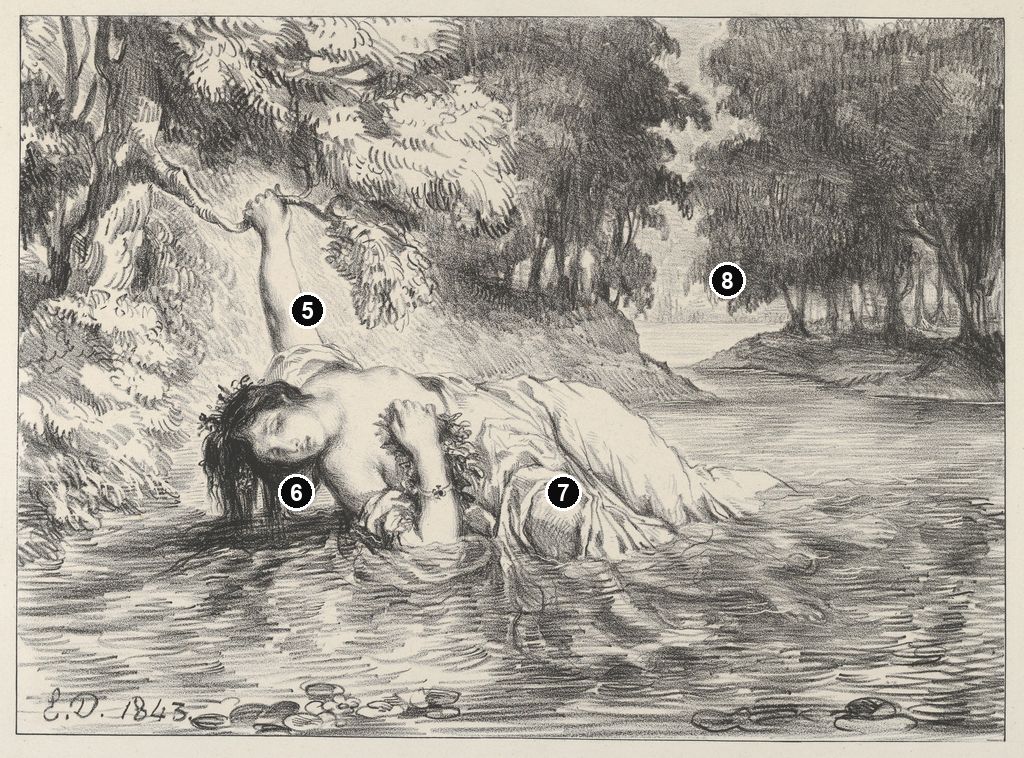
The Death of Ophelia, also dated 1843, changes the direction and pace of attention. The Met’s impression is the first of three states. The museum identifies its subject as an event reported by Gertrude in Act 4, Scene 7, rather than enacted before the audience.[1] Delacroix thus gives visible form to a narrated death. The print supplies a setting, a posture and a relationship between water and clothing that a reader or listener would otherwise have to imagine.
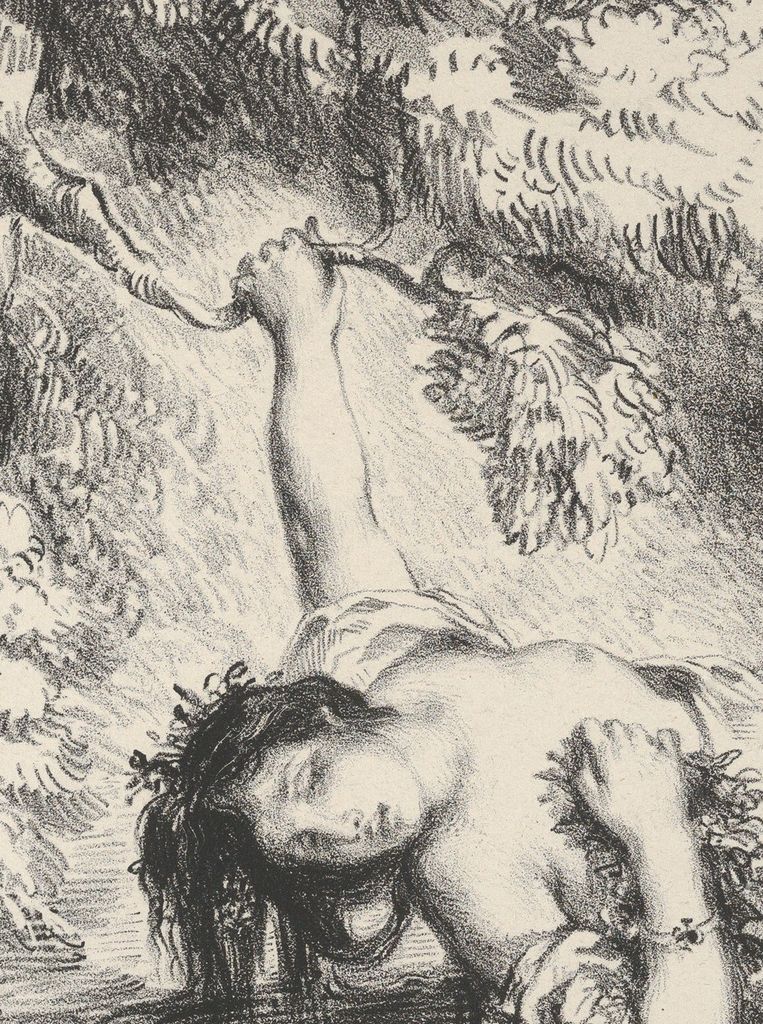
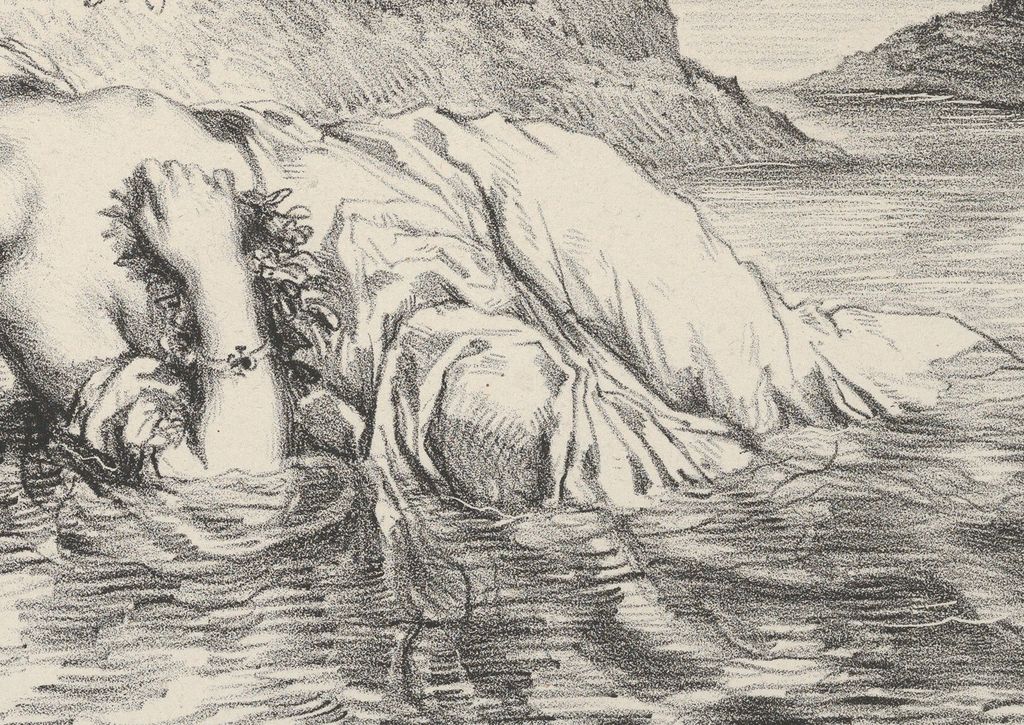
Ophelia occupies the lower left and centre of the landscape composition. Her face is close to the water, with dark hair hanging into it. One arm reaches up towards a branch at the upper left; the other bends near her upper chest. Her pale dress stretches diagonally rightwards and spreads into folds whose edges approach the surrounding ripples. The body remains legible, but its support is uncertain. The raised arm offers an upward line while the head, torso and heavy spread of fabric draw attention downwards.
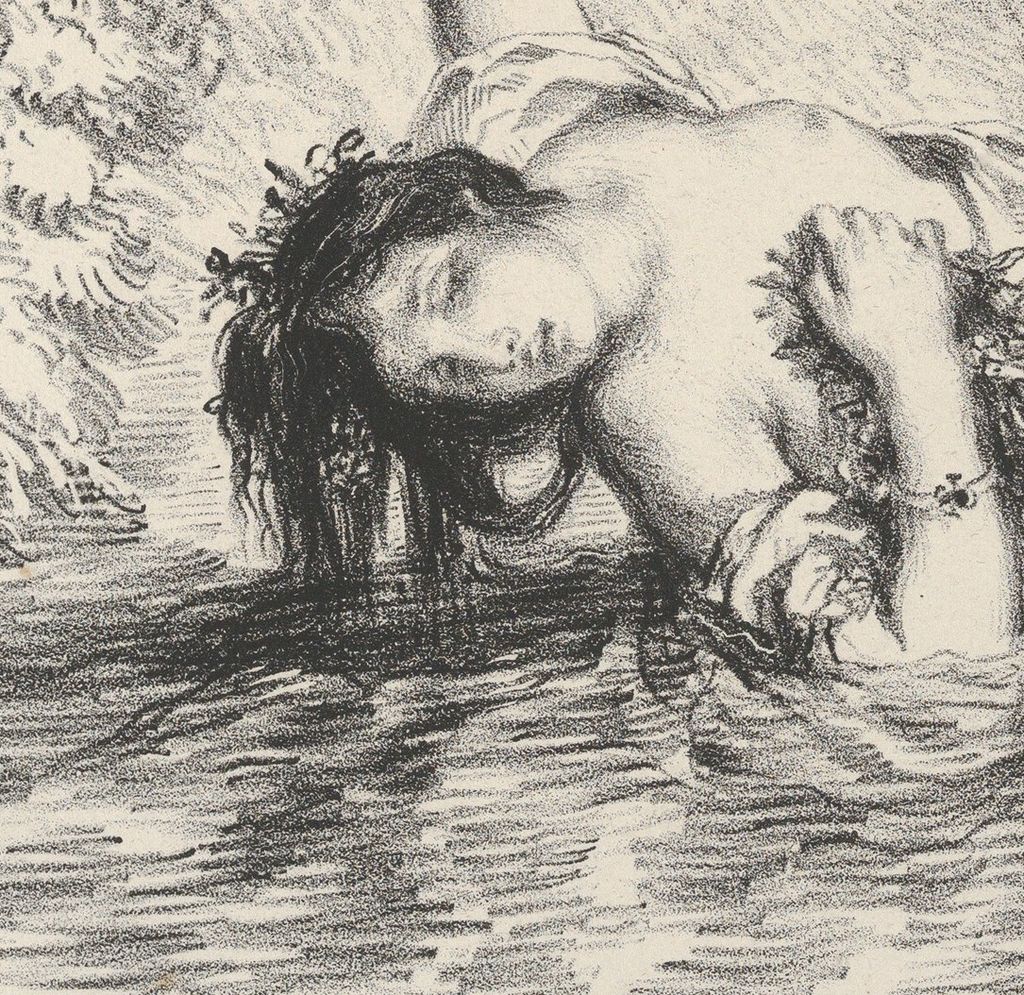
The river is neither an empty backdrop nor a uniform dark surface. Short horizontal marks collect around Ophelia, break into reflections and extend across the foreground. Floating leaves interrupt them. These small repetitions give the water a continuity beyond the body: it moves through the image from the enclosed bank towards the more open distance. The dress interrupts that continuity, and the ripples gather against it. Looking closely means following the changing boundary between a recognisable fold and a mark belonging to the river.
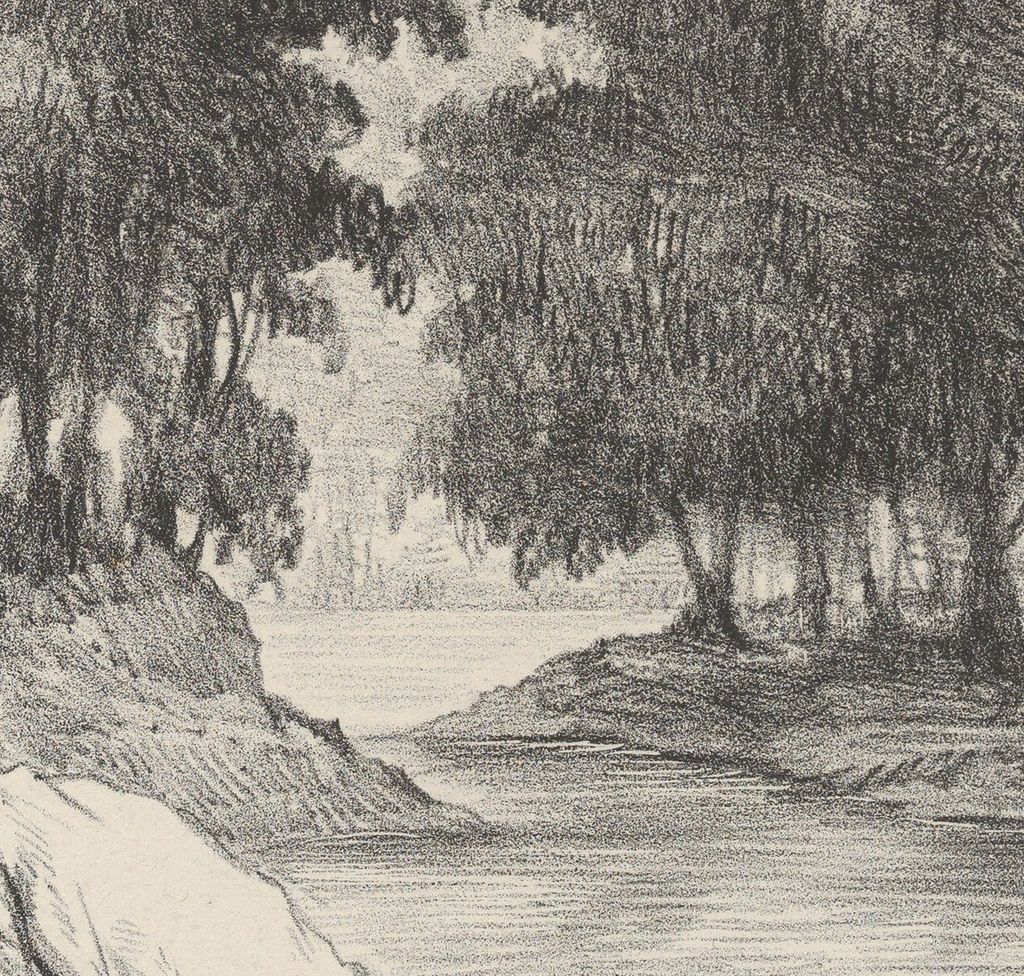
Above, trees crowd the scene. Branches and foliage fill much of the upper field, with dark hanging masses enclosing the water. A small bright opening right of centre leads the eye towards a more distant stretch of river. That gap creates depth, yet it offers no easy visual release from the figure in front. To reach it, our attention has to travel past the pale fabric and the enclosing bank. The landscape continues while the immediate danger remains near the lower edge.
The print’s patterned foliage and luminous dress can hold the eye, but their attraction does not make the subject benign. Ophelia’s face is perilously low, and the contrast between the reaching arm and the body’s descent prevents a settled repose. Her gesture cannot tell us exactly what she thinks or how much strength remains to her. Its visible function is enough: it joins her to the branch above while emphasising the downward pull of the rest of the figure.
Set beside the ghost scene, the change is striking. There, two upright figures have room between them, and pale architecture separates them from an immense sky. Here, a single figure lies across the water, enclosed by vegetation. The ghost’s armour preserves a sharply bounded body; Ophelia’s dress begins to share the river’s broken contours. The contrast gives each encounter with death a distinct pose and setting.
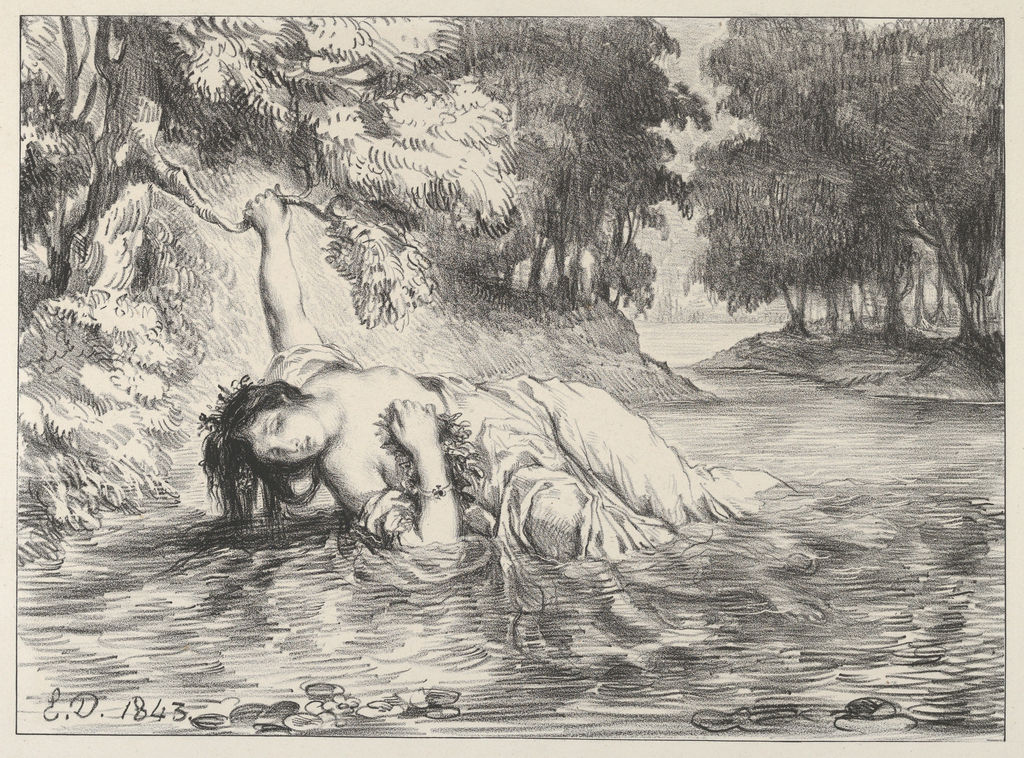
Death of Ophelia, 1843, lithograph, first state of three. The Metropolitan Museum of Art; 28.92.8. The horizontal scene gives visible form to an event narrated offstage. The Metropolitan Museum of Art, Open Access. Image source. CC0 / Public domain. Resized only; native appearance preserved.
Explore Delacroix on video
An artist overview and a closer look at Liberty Leading the People.
Eugene Delacroix Paintings
An overview of Delacroix’s paintings from TheHistoryOfArt.
Watch on YouTubeThe gravediggers: a skull held out for recognition
In Hamlet and Horatio before the Gravediggers, the Met’s 1843 impression is the second of four states, printed by Villain and published by Gihaut Frères.[7] Hamlet stands on the left, tall and elaborately dressed, with a puffed sleeve, cape and plumed hat. One leg advances towards the open ground. Horatio appears behind and to his right. Opposite them, a gravedigger lifts a skull on his outstretched hand. A second worker, seen from behind near the lower centre, brings the activity of the graveyard close to the viewer.
The identity of the skull is essential. In Act 5, Scene 1, the gravedigger identifies Yorick, the king’s jester. Hamlet then takes the skull and recalls the man who carried him as a child and made him laugh.[8] The skull is therefore linked to a remembered person and a shared past. In Delacroix’s image it is still held by the gravedigger. Hamlet’s own hands have not yet closed around it. The composition concentrates attention on the interval between the worker’s presentation and the prince’s physical possession of the object.
The raised arm gives this exchange a clear direction. It reaches diagonally from the gravedigger’s lower body towards the space in front of Hamlet and Horatio. The skull is small beside the living heads, hats and sleeves, yet its placement makes it the point around which the figures gather. Hamlet’s lowered gaze brings his height into relation with it. Horatio’s face, appearing beside him, adds another human presence close to the encounter rather than forming a distant audience.
The foreground worker changes our position. His back occupies space that might otherwise provide an unobstructed approach to Hamlet. We look past a body engaged in the graveyard’s work, over disturbed earth, towards the raised skull. A large pickaxe lies at the lower right. In the distance, a cross rises on the right and a castle appears on the left. These details connect the exchange to a place of labour and burial while keeping the architecture of power farther away.
Unlike the terrace scene, this print opens into a broad, pale sky. The upper space gives the clustered figures room to stand out. Within the group, dark hatching alternates with bright passages in sleeves, faces and clothing. Hamlet’s costume is especially intricate, its divided surfaces contrasting with the exposed skull. The image makes social and bodily differences visible at once: elaborate dress surrounds living flesh, while the object held before it has neither costume nor expression.
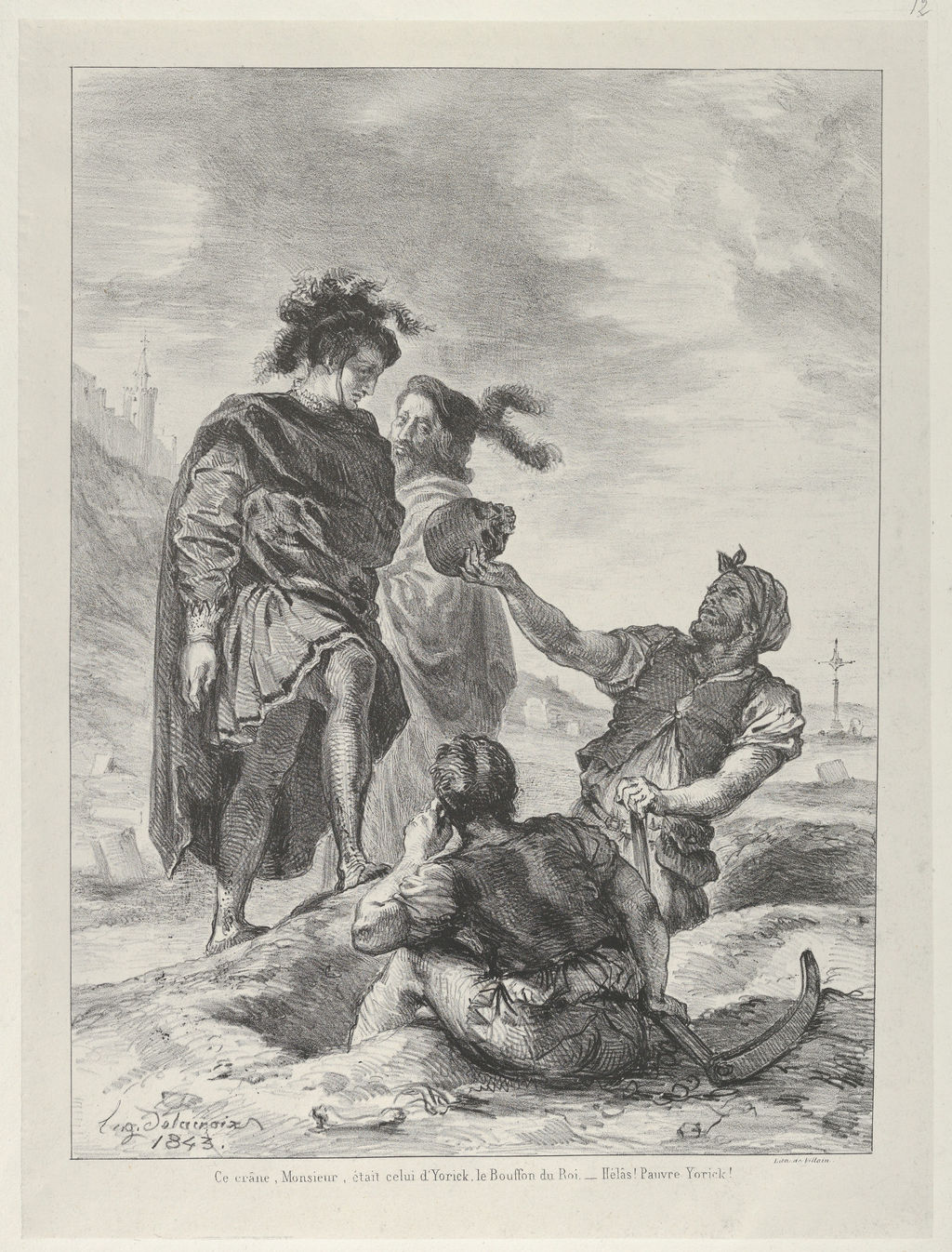
Hamlet and Horatio before the Gravediggers, 1843, lithograph, second state of four. The Metropolitan Museum of Art; 22.56.16. The skull remains in the gravedigger’s hand. The Metropolitan Museum of Art, Open Access. Image source. CC0 / Public domain. Resized only; native appearance preserved.
Returning to the cemetery painting
Delacroix had already treated the encounter in the Louvre’s Hamlet et Horatio au cimetière, an oil on canvas dated 1839, measuring 82 × 65 cm and exhibited at the Salon that year.[4] Comparing the two works reveals a substantial reorganisation. In the painting, Hamlet stands on the right in a dark cloak. Horatio, dressed in red, leans into view behind him on the left. The gravedigger holding the skull is low on the left, and the second worker’s red vest and white sleeve occupy the foreground.
Colour binds the painted group through recurring reds and sets it against ochre ground and a clouded yellow and pink sky. Hamlet’s dark cloak forms a large, comparatively continuous shape. One hand, bearing a ring, lies across his body; the other hangs lower at his side. The raised skull approaches this contained figure from below. Behind Hamlet, the rising bank helps close the space around him, while the overlapping bodies restrict the passage into the distance.
The lithograph reverses the principal arrangement, but reversal alone does not account for its effect. Hamlet’s advanced leg and more exposed costume create a more articulated stance. The gravedigger’s extended arm reaches across a clearer interval. Pale sky opens above and between the heads, and the ground around the figures becomes easier to follow. These changes give the printed encounter a different rhythm: its diagonals, patterned sleeves and gaps invite the eye to travel through the group.
The print can therefore be approached as another sustained treatment of the same dramatic meeting. Comparison with the cemetery painting makes the changes in stance and space especially clear. The subject survives translation between media because Delacroix adjusts the means by which it holds attention. In the painting, large colour masses draw the figures together; in the lithograph, the relations between dark marks, pale intervals and sharply directed limbs do more of that work.
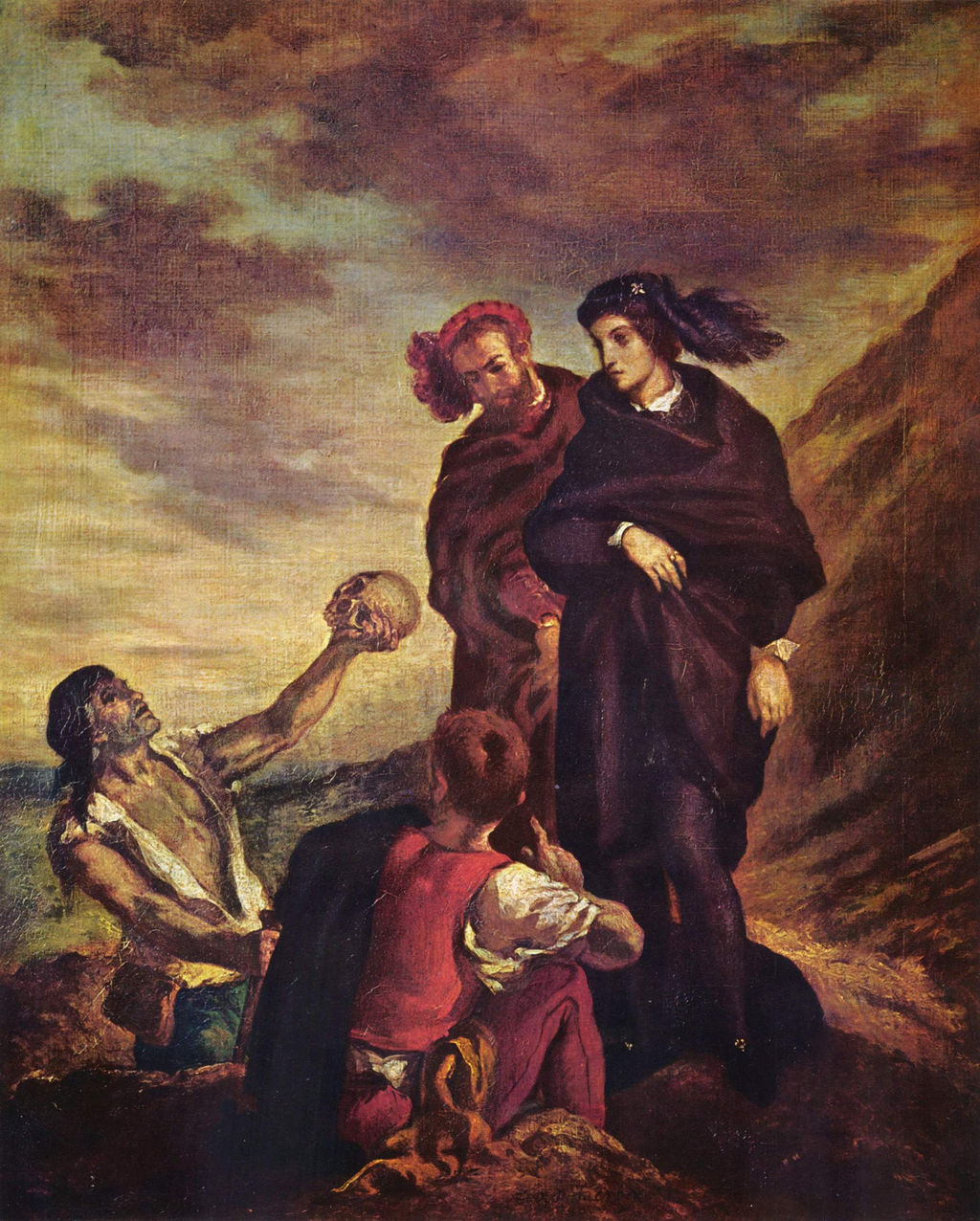
Hamlet and Horatio in the Cemetery, 1839, oil on canvas. Musée du Louvre; RF 1942. Hamlet stands at the right, in contrast with the later lithograph. The Yorck Project / Directmedia, via Wikimedia Commons. Image source. Public domain. Resized only; native appearance preserved.
Reading across the sheets
These three scenes demonstrate the range available within Delacroix’s lithographs. The broad grain of the ghost’s sky gives way to the broken horizontal ripples around Ophelia, then to the alternation of hatched clothing and open sky in the graveyard. Darkness can supply an atmosphere, define a rigid surface or separate one fold from another. Pale passages can make armour gleam, spread a dress across water or isolate a skull. Each scene arranges its tonal resources around a different encounter.
The publication history also connects Hamlet with the wider study of Delacroix’s prints: composition, state, impression and edition describe different aspects of a work’s life. His Faust lithographs offer another route into his engagement with literature through a sequence of images. With Hamlet, looking across the sheets brings particular gestures into relation. The ghost’s hand interrupts our view of his face; Ophelia’s arm reaches above her lowering body; the gravedigger’s hand makes a human remnant available for recognition.
A viewer can pause over these gestures and return to them in another order. The graveyard skull can sharpen the contrast with the ghost’s complete armoured form; Ophelia’s surrounding water can make the terrace’s firm ground newly conspicuous. Such cross-reading gives the series a life beyond the task of following the plot. Delacroix’s Hamlet holds attention through distinct encounters with what can be seen, remembered and physically grasped, each given its own space on the sheet.
Annotated Details from Hamlet Lithographs
The numbered points identify visible features discussed in this article. Return from each detail to the whole composition. Each caption identifies the work shown.
Hamlet and the Ghost on the Terrace
Hamlet Sees the Ghost of His Father on the Terrace, 1843, lithograph, first state of five. The Metropolitan Museum of Art; 22.56.7. The Metropolitan Museum of Art, Open Access. Image source. CC0 / Public domain. Numbers added to a separate resized overview; detail images are crops of the complete source reproduction. No colour or perspective changes.
Death of Ophelia
Death of Ophelia, 1843, lithograph, first state of three. The Metropolitan Museum of Art; 28.92.8. The Metropolitan Museum of Art, Open Access. Image source. CC0 / Public domain. Numbers added to a separate resized overview; detail images are crops of the complete source reproduction. No colour or perspective changes.
Details from HAMLET LITHOGRAPHS
Compare these details with their positions in the complete reproductions.
Hamlet and the Ghost on the Terrace
Armour gives the ghost a solid presence
The ghost’s fitted armour and firm vertical stance give weight to the apparition. A raised hand crosses the helmet and brow.
Hamlet’s cloak crosses the intervening space
The cloak spreads left from Hamlet’s shoulder. Its broad dark folds reach towards the ghost while the two bodies remain apart.
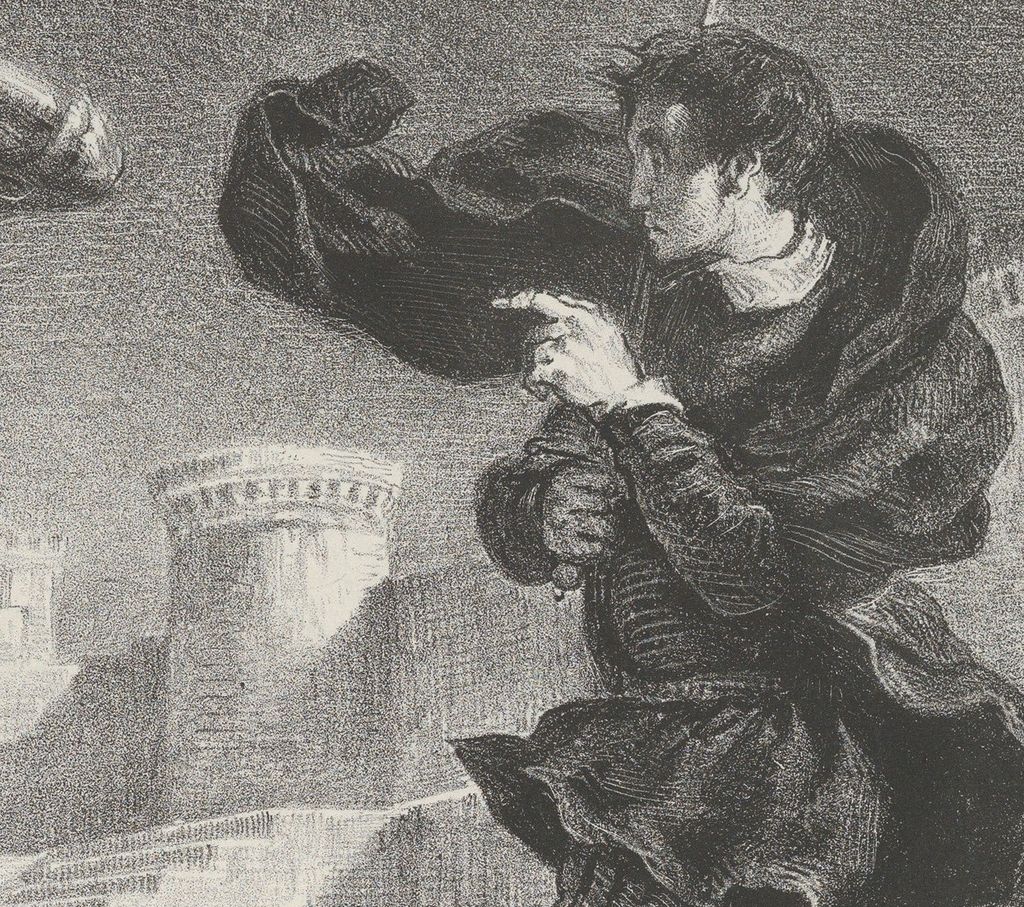
Hands and face concentrate the response
Hamlet’s hands gather in front of his chest as his face turns left. Light catches small parts of the gesture against the dark clothing.
Pale ramparts recede between the figures
Walls and rounded towers recede between the figures. Their lighter tone gives the terrace depth beneath the broad grainy sky.
Death of Ophelia
An extended arm reaches the branch
The pale arm rises towards the overhanging branch while the head lies low beside the water. The two directions divide the body’s movement.
Dark hair meets the moving water
Hair spreads beside the lowered face. Short ripples pass beneath it and replace the more tangled marks of the bank.
The pale dress extends across the stream
Broken folds and reflections carry the dress towards the right. The edge of the clothing becomes less distinct where it meets the water.
A bright gap opens beyond the trees
Dark trunks and hanging foliage frame a small light opening along the stream. This distant gap contrasts with the enclosed foreground.
Artworks directory
Selected documented works by or associated with Eugène Delacroix, with dates, media and collection records distinguished. This is a growing research directory, not a complete catalogue. An unspecified medium appears under All media.
| Name | Date | Medium |
|---|---|---|
| Male Academy Figure: Half‑Length, Side View | c. 1818–20 | Oil painting Catalogue. |
| Female Academy Figure: Seated, Front View (Mademoiselle Rose) | c. 1820–23 | Oil painting Catalogue. |
| Two Bearded Heads, after Veronese (detail from “The Marriage at Cana”) | 1820 | Oil painting Catalogue. |
| Self‑Portrait as Ravenswood | c.1821 | Oil painting Catalogue. |
| Nereid, after Rubens, detail from “The Landing of Maria de Medici at Marseilles” | c. 1822 | Oil painting Catalogue. |
| Studies of a Damned Man, for “The Barque of Dante” | 1822 | Drawing Catalogue. |
| Head of an Old Greek Woman | 1824 | Oil painting Catalogue. |
| Tasso in the Hospital of St. Anna, Ferrara | 1824 | Oil painting Catalogue. |
| Turk Mounting His Horse | 1824 | Aquatint Catalogue. |
| Portrait of Aspasie | About 1824 | Oil painting Catalogue. |
| Sketch after Goya’s “Caprichos” | c. 1822–24 | Drawing Catalogue. |
| Study of Babouches | c. 1823–24 | Oil painting Catalogue. |
| Thales Fielding (1793–1837) | c. 1824–25 | Oil painting Catalogue. |
| Studies of Bindings, an Oriental Jacket, and Figures after Goya | c. 1822–26 | Oil painting Catalogue. |
| Study of an Oriental Vest | c. 1822–26 | Drawing Catalogue. |
| Study of Greek Costumes | c. 1823–26 | Drawing Catalogue. |
| Christ in the Garden of Olives (The Agony in the Garden) | 1824–26 | Oil painting Catalogue. |
| Reclining Female Nude: Back View | c. 1824–26 | Oil painting Catalogue. |
| Macbeth Consulting the Witches | 1825 | Lithograph Catalogue. |
| Studies of Seven Greek Coins | 1825 | Lithograph Catalogue. |
| Studies of Twelve Greek and Roman Coins | 1825 | Lithograph Catalogue. |
| Mortally Wounded Brigand Quenches His Thirst | c.1825 | Oil painting Catalogue. |
| Charles VI and Odette de Champdivers | About 1825 | Oil painting Catalogue. |
| The Duke of Orléans Showing His Lover | About 1825–26 | Oil painting Catalogue. |
| Count Demetrius de Palatiano (1794–1849) in Suliot Costume | c. 1825–26 | Oil painting Catalogue. |
| Greece on the Ruins of Missolonghi | 1826 | Oil painting Catalogue. |
| Combat of the Giaour and Hassan | 1826 | Oil painting Catalogue. |
| Justinian Drafting His Laws, sketch | 1826 | Oil painting Catalogue. |
| Baron Schwiter (Louis Auguste Schwiter, 1805–1889) | 1826 | Lithograph Catalogue. |
| Louis Auguste Schwiter (1805–1889) | 1826–30 | Oil painting Catalogue. |
| Death of Sardanapalus, sketch | 1826–27 | Oil painting Catalogue. |
| A Lady and Her Valet | c. 1826–29 | Oil painting Catalogue. |
| Woman with a Parrot | 1827 | Oil painting Catalogue. |
| Seated Turk (possibly Paul Barroilhet, 1805–1871) | c. 1827–30 | Oil painting Catalogue. |
| A Greek and a Turk in an Interior | late 1820s | Watercolour Catalogue. |
| Faust (illustrated book) | 1828 | Illustrated book Catalogue. |
| Mephistopheles Flying over the City (Study for “Faust,” plate 1) | c. 1825–27 | Drawing Catalogue. |
| Faust, plate 1: Mephistopheles Aloft | 1826/27 | Lithograph Catalogue. |
| Faust, plate 2: Faust in His Study | 1826/27 | Lithograph Catalogue. |
| Faust, plate 3: Faust and Wagner | 1826/27 | Lithograph Catalogue. |
| Faust, plate 4: Faust, Wagner, and the Poodle | 1826/27 | Lithograph Catalogue. |
| Faust, plate 5: Mephistopheles Appearing to Faust | 1826/27 | Lithograph Catalogue. |
| Faust, plate 6: Mephistopheles Receiving the Student | 1826/27 | Lithograph Catalogue. |
| Faust and Mephistopheles in the Tavern (Study for “Faust,” plate 7) | 1825/26 | Drawing Catalogue. |
| Faust, plate 7: Mephistopheles in Auerbach’s Tavern | 1826 | Lithograph Catalogue. |
| Faust, Marguerite, and Mephistopheles in the Street (Study for “Faust,” plate 8) | c. 1825–27 | Drawing Catalogue. |
| Faust, plate 8: Faust Trying to Seduce Marguerite | 1826/27 | Lithograph Catalogue. |
| Faust, plate 9: Mephistopheles Introduces Himself at Martha’s House | 1827 | Lithograph Catalogue. |
| Faust, plate 10: Marguerite at the Spinning Wheel | 1826/27 | Lithograph Catalogue. |
| Faust, plate 11: Duel between Faust and Valentin | 1826/27 | Lithograph Catalogue. |
| Faust, plate 12: Mephistopheles and Faust Fleeing after the Duel | 1826/27 | Lithograph Catalogue. |
| Faust, plate 13: Marguerite in Church | 1826/27 | Lithograph Catalogue. |
| Faust, plate 14: Faust and Mephistopheles in the Harz Mountains | 1826/27 | Lithograph Catalogue. |
| Faust, plate 15: Marguerite’s Ghost Appearing to Faust | 1826/27 | Lithograph Catalogue. |
| Faust, plate 16: Faust and Mephistopheles Galloping on Walpurgis Night | 1826 | Lithograph Catalogue. |
| Faust, plate 17: Faust with Marguerite in Prison | 1826/27 | Lithograph Catalogue. |
| Wild Horse Felled by a Tiger | 1828 | Lithograph Catalogue. |
| Wild Horse Felled by a Tiger | 1828 | Watercolour Catalogue. |
| Wild Horse | 1828 | Lithograph Catalogue. |
| Studies of a Lion (Tours sketchbook) | 12 February 1824 or 1829 | Drawing Catalogue. |
| Sketches of Tigers and Men in Sixteenth‑Century Costume | c. 1828–29 | Watercolour Catalogue. |
| Nineteen Studies of Heads and Skulls of Lions | c. 1828–30 | Drawing Catalogue. |
| Tiger Lying at the Entrance of Its Lair | c. 1828–30 | Etching Catalogue. |
| The Murder of the Bishop of Liège | 1829 | Oil painting Catalogue. |
| Royal Tiger | 1829 | Lithograph Catalogue. |
| Lion of the Atlas Mountains | 1829–30 | Lithograph Catalogue. |
| Young Tiger Playing with Its Mother (Study of Two Tigers) | 1830 | Oil painting Catalogue. |
| The Battle of Poitiers | 1830 | Oil painting Catalogue. |
| The Battle of Nancy and the Death of Charles the Bold, Duke of Burgundy, January 5, 1477 | 1831 | Oil painting Catalogue. |
| Boissy d’Anglas at the Convention, sketch | 1831 | Oil painting Catalogue. |
| Interior of a Dominican Convent in Madrid (L’Amende Honorable) | 1831 | Oil painting Catalogue. |
| Jewish Woman of Tangier | 1832 | Drawing Catalogue. |
| Portrait of Schmareck, Tanner at Tangier | 1832 | Watercolour Catalogue. |
| Standing Moroccan | 1832 | Watercolour Catalogue. |
| A Man of Tangier | 1832 | Watercolour Catalogue. |
| Saada, the Wife of Abraham Ben‑Chimol, and Préciada, One of Their Daughters | 1832 | Watercolour Catalogue. |
| Street in Meknes | 1832 | Oil painting Catalogue. |
| Moroccan Military Exercises | 1832 | Oil painting Catalogue. |
| Arab Cavalry Practicing a Charge (Fantaisie Arabe) | 1833 | Oil painting Catalogue. |
| A Blacksmith | 1833 | Aquatint Catalogue. |
| Collision of Arab Horsemen | 1833/34 | Oil painting Catalogue. |
| Figure Study for “The Women of Algiers” | 1833/34 | Watercolour Catalogue. |
| Women of Algiers in Their Apartment | 1834 | Oil painting Catalogue. |
| The Natchez | 1823–24 and 1835 | Oil painting Catalogue. |
| Christ on the Cross | 1835 | Oil painting Catalogue. |
| Hamlet and Horatio in the Graveyard | 1835 | Oil painting Catalogue. |
| Combat of the Giaour and Hassan | 1835 | Oil painting Catalogue. |
| Léon Riesener (1808–1878) | 1835 | Oil painting Catalogue. |
| Madame Henri François Riesener (Félicité Longrois, 1786–1847) | 1835 | Oil painting Catalogue. |
| Saint Sebastian Tended by the Holy Women | 1836 | Oil painting Catalogue. |
| Medea About to Kill Her Children, sketch | c. 1836 | Oil painting Catalogue. |
| Moroccan Chieftain Receiving Tribute | 1837 | Oil painting Catalogue. |
| Self‑Portrait in a Green Vest | c. 1837 | Oil painting Catalogue. |
| Medea About to Kill Her Children (Medée furieuse) | 1838 | Oil painting Catalogue. |
| Cleopatra and the Peasant | 1838 | Oil painting Catalogue. |
| Hamlet and Horatio in the Graveyard | 1839 | Oil painting Catalogue. |
| Startled Arabian Horse in a Landscape | c. 1835–40 | Watercolour Catalogue. |
| The Shipwreck of Don Juan | 1840 | Oil painting Catalogue. |
| Christ on the Lake of Genesareth (Portland version) | c. 1853 | Oil painting Catalogue. |
| Pietà, first sketch | by 1843 | Oil painting Catalogue. |
| Pietà, second sketch | by 1843 | Oil painting Catalogue. |
| Christ on the Cross, sketch | 1845 | Oil painting Catalogue. |
| Christ on the Cross | 1846 | Oil painting Catalogue. |
| Death of Sardanapalus (Philadelphia replica) | 1844 / 1845–46 | Oil painting Catalogue. |
| The Abduction of Rebecca | 1846 | Oil painting Catalogue. |
| The Lamentation (Christ at the Tomb) | 1847–48 | Oil painting Catalogue. |
| Arab Players | 1848 | Oil painting Catalogue. |
| Arch of Morning Glories, study for “Basket of Flowers” | 1848/49 | Pastel Catalogue. |
| Basket of Flowers | 1848–49 | Oil painting Catalogue. |
| Basket of Flowers and Fruit | 1849 | Oil painting Catalogue. |
| Basket of Flowers | c. 1848–50 | Oil painting Catalogue. |
| Christ at the Column | probably 1849 | Oil painting Catalogue. |
| Landscape at Champrosay | possibly 1849 | Oil painting Catalogue. |
| Michelangelo in His Studio | About1849–50 | Oil painting Catalogue. |
| View in the Forest of Sénart | c. 1849–50 | Oil painting Catalogue. |
| Forest View with an Oak Tree | c. 1849–50 | Watercolour Catalogue. |
| The Triumph of Genius over Envy | c. 1849–51 | Drawing Catalogue. |
| Jacob Struggling with the Angel | 1850 | Drawing Catalogue. |
| Jacob Wrestling with the Angel | 1850 | Drawing Catalogue. |
| Jacob Wrestling with the Angel | 1850 | Oil painting Catalogue. |
| Sunset | c. 1850 | Pastel Catalogue. |
| Apollo Slays the Python, sketch | c. 1850 | Oil painting Catalogue. |
| Apollo Victorious over the Serpent Python, sketch | c. 1850 | Oil painting Catalogue. |
| Pietà | About1850 | Oil painting Catalogue. |
| The Agony in the Garden | 1851 | Oil painting Catalogue. |
| Study of the Sea | 1851(?) | Watercolour Catalogue. |
| Marphise | 1852 | Oil painting Catalogue. |
| The Sea at Dieppe | 1852 | Oil painting Catalogue. |
| Christ Asleep during the Tempest | c. 1853 | Oil painting Catalogue. |
| Saint Stephen Borne Away by His Disciples | 1853 | Oil painting Catalogue. |
| Christ on the Sea of Galilee | 1854 | Oil painting Catalogue. |
| The Sea at Dieppe | probably 1854 | Watercolour Catalogue. |
| A Lion and a Tiger, Fighting | c. 1854 | Drawing Catalogue. |
| Lion Hunt, sketch | 1854 | Oil painting Catalogue. |
| Lion Hunt (fragment) | 1855 | Oil painting Catalogue. |
| Lion Hunt | 1855–56 | Oil painting Catalogue. |
| Hilly Landscape | c. 1855 | Oil painting Catalogue. |
| The Sultan of Morocco and His Entourage | 1856 | Oil painting Catalogue. |
| The Bride of Abydos (Selim and Zuleika) | 1857 | Oil painting Catalogue. |
| Lamentation over the Body of Christ | 1857 | Oil painting Catalogue. |
| Abduction of Rebecca | 1858 | Oil painting Catalogue. |
| Ovid among the Scythians | 1859 | Oil painting Catalogue. |
| Amadis de Gaule Delivers a Damsel from Galpan’s Castle | 1859–60 | Oil painting Catalogue. |
| Arab Horses Fighting in a Stable | 1860 | Oil painting Catalogue. |
| Shipwreck on the Coast | 1862 | Oil painting Catalogue. |
| The Battle of Taillebourg won by Saint Louis (Château de Versailles) | 1837 | Oil on canvas Catalogue. |
| Christ on the Lake of Gennezaret (Christ Asleep during the Tempest) (The Metropolitan Museum of Art) | About 1853 | Oil on canvas Catalogue. |
| The Coast of Spain at Salabrena (Christie’s 1998 sale 6059, lot 123) | 19 January 1832 | Pen and ink Catalogue. |
| Crouching Tiger (The Metropolitan Museum of Art) | 1839 | Pen and ink Catalogue. |
| The Education of Achilles (J. Paul Getty Museum) | 1862 | Pastel Catalogue. |
| Fallen Warriors and a Runaway Horse (The Metropolitan Museum of Art) | 1862 | Pen and ink Catalogue. |
| George Sand's Garden at Nohant (The Metropolitan Museum of Art) | About 1842–43 | Oil on canvas Catalogue. |
| The Giaour on Horseback (The Metropolitan Museum of Art) | 1824–26 | Pen and ink Catalogue. |
| Lion Hunt (Art Institute of Chicago) | 1860–61; signed 1861 | Oil on canvas Catalogue. |
| Figure Studies related to Liberty Leading the People | 1830 | Pen and brown ink, brush and brown wash Catalogue. |
| Chios: Head, Shoulder and Foot Studies | 1823 | Graphite Catalogue. |
| Figure Studies for the Salon du Roi, Palais Bourbon | 1833–35 | Pen and iron gall ink Catalogue. |
| Four Studies of Horses | 1824–25 | Pen, ink, black wash and graphite (recto); graphite (verso) Catalogue. |
| Studies of a Horse and Rider for Heliodorus Driven from the Temple | 1849–50 | Pen and iron gall ink, graphite Catalogue. |
| Liberty Leading the People | 1830 | Oil on canvas Catalogue. |
| Massacre at Chios | 1824 | Oil on canvas Catalogue. |
| Death of Sardanapalus (Louvre original) | 1827 | Oil on canvas Catalogue. |
| Barque of Dante | 1822 | Oil painting Catalogue. |
| Orphan Girl at the Cemetery | 1824 | Oil painting Catalogue. |
| Jacob Wrestling with the Angel (Saint-Sulpice wall painting) | Completed 1861 | Wall painting Catalogue. |
| Heliodorus Driven from the Temple (Saint-Sulpice wall painting) | Completed 1861 | Wall painting Catalogue. |
| African Pirates Abducting a Young Woman | 1852 | Oil painting Catalogue. |
| An Arab Horseman at the Gallop | 1849 | Oil painting Catalogue. |
| Arabs Skirmishing in the Mountains | 1863 | Oil painting Catalogue. |
| Moroccan Horseman Crossing a Ford | About 1850 | Oil painting Catalogue. |
| A Moroccan (Arab) Saddling a Horse | 1855 | Oil painting Catalogue. |
| The Execution of the Doge Marino Faliero | 1825–26 | Oil painting Catalogue. |
| Christopher Columbus and his Son at La Rábida | 1838 | Oil painting Catalogue. |
| Horse Frightened by Lightning | 1825–29 | Watercolour Catalogue. |
| Horses Leaving the Sea | 1860 | Oil painting Catalogue. |
| Tiger with a Tortoise | 1862 | Oil painting Catalogue. |
| Tiger | About1830 | Watercolour Catalogue. |
| Tiger and Snake | 1862 | Oil painting Catalogue. |
| Tiger Hunt | 1854 | Oil painting Catalogue. |
| Lion Hunt in Morocco | 1854 | Oil painting Catalogue. |
| Lion Rending Apart a Corpse | About1848;historical catalogue placement | Watercolour Catalogue. |
| Frederic Chopin | 1838 | Oil painting Catalogue. |
| Portrait of George Sand | 1838 | Oil painting Catalogue. |
| Portrait of Frédéric Chopin and George Sand | 1838 | Oil painting Catalogue. |
| Mademoiselle Rose | About 1820 | Oil painting Catalogue. |
| Head of a Woman in a Red Turban | 1831; archive date | Oil painting Catalogue. |
| Two Views of a Standing Indian from Calcutta | About 1823–24 | Oil painting Catalogue. |
| Last Words of the Emperor Marcus Aurelius | 1844 | Oil painting Catalogue. |
| Entry of the Crusaders in Constantinople | 1840 | Oil painting Catalogue. |
| Medea | 1862 | Oil painting Catalogue. |
| The Death of Laras | 1858 | Oil painting Catalogue. |
| The Bride of Abydos | About 1852–53; dating disputed | Oil painting Catalogue. |
| The Bride of Lammermoor | About1826 | Watercolour Catalogue. |
| Cromwell at Windsor Castle | 1828 | Oil painting Catalogue. |
| Milton Dictated to his Daughters the Paradise Lost | 1827–28 | Oil painting Catalogue. |
| Tasso in the Madhouse | 1839 | Oil painting Catalogue. |
| Christ on the Cross | 1853 | Oil painting Catalogue. |
| The Disciples at Emmaus | 1853 | Oil painting Catalogue. |
| The Entombment of Christ | Nineteenth century; precise date unestablished | Oil painting Catalogue. |
| Fanatics of Tangier | 1837–38 | Oil painting Catalogue. |
| Jewish Bride | Undated; Moroccan subject associated with the1832journey | Watercolour Catalogue. |
| Jewish Wedding in Morocco | 1839; Salon1841 | Oil painting Catalogue. |
| Moroccan Fantasia | 1847 | Oil painting Catalogue. |
| The Sultan of Morocco | 1845 | Oil painting Catalogue. |
| Bouquet of Flowers 1843 | 1843 | Watercolour Catalogue. |
| Bouquet of Flowers, 1849 | 1849 | Watercolour Catalogue. |
| Cliffs Near Dieppe | 1852–55 | Watercolour Catalogue. |
| The Edge of a Wood at Nohant | c.1842/1843 | Watercolour Catalogue. |
| Still Life with Lobsters | 1826–27 | Oil on canvas Catalogue. |
| A Corner of the Studio (attribution disputed) | 1825–1850; attribution disputed | Oil on canvas Catalogue. |
| Study of the Sky at Sunset | c.1849 | Pastel Catalogue. |
| Self-Portrait, about 1840 | c.1840 | Oil on canvas Catalogue. |
| Women of Algiers in Their Apartment (1849) | 1849 | Oil on canvas Catalogue. |
| Susanna and the Elders | 1841 | Oil on canvas Catalogue. |
| The Education of Achilles (Drawing) | c.1844 | Graphite Catalogue. |
| Attila the Hun | Completed 1847 | Mural detail Catalogue. |
| The Italian Theatre | 1821 | Lithograph Catalogue. |
| A Turkish Man on a Grey Horse | Undated | Not specified Catalogue. |
| Study for The Massacre at Chios | About 1823–24 | Graphite, watercolour and gouache on paper Catalogue. |
| The Prisoner of Chillon | 1834; Salon of 1835 | Oil on canvas Catalogue. |
| Two Knights Fighting in a Landscape | Second quarter of the nineteenth century; precise date uncertain | Oil on canvas; possible later completion Catalogue. |
Discussion
Look again at the images and ideas explored in Hamlet Lithographs. These editorial prompts invite your observations.
Reader Insights
Compare the ghost’s armour with Hamlet’s billowing cloak. How does each figure occupy the terrace?
Follow the water around Ophelia. How does the horizontal composition differ from the upright ghost scene?
Join the Conversation
Share a detail, comparison or question about Hamlet Lithographs below.
References
- The Metropolitan Museum of Art. The Death of Ophelia, Eugène Delacroix, 1843, lithograph, first state of three, accession 28.92.8; object record and series commentary. Collection record. English. Accessed 28 October 2026. View source.
- National Gallery of Art, Washington. Hamlet, Eugène Delacroix, 1864 portfolio, sixteen lithographs with text and cover, Rosenwald Collection, accession 1980.45.400–415; portfolio record and linked work list. Collection record. English. Accessed 28 October 2026. View source.
- The Metropolitan Museum of Art. Hamlet Sees the Ghost of his Father on the Terrace, Eugène Delacroix, 1843, lithograph, first state of five, printed by Villain, accession 22.56.7; object record and commentary. Collection record. English. Accessed 28 October 2026. View source.
- Musée du Louvre. Hamlet et Horatio au cimetière, Eugène Delacroix, 1839, oil on canvas, 82 × 65 cm, RF 1942; object identity and exhibition history. Collection record. French. Accessed 28 October 2026. View source.
- Sébastien Allard and Côme Fabre. Delacroix. New York: The Metropolitan Museum of Art, 2018, pp. 158–163, discussion of Hamlet and catalogue entry 96. Exhibition catalogue. English. Accessed 28 October 2026. View source.
- Julie Mellby. “Delacroix’s Hamlet.” Graphic Arts Collection, Princeton University Library, 31 May 2015; description of Princeton’s 1864 set. Article. English. Accessed 28 October 2026. View source.
- The Metropolitan Museum of Art. Hamlet and Horatio before the Gravediggers, Eugène Delacroix, 1843, lithograph, second state of four, printed by Villain and published by Gihaut Frères, accession 22.56.16; object record. Collection record. English. Accessed 28 October 2026. View source.
- William Shakespeare. Hamlet, Act 5, Scene 1, lines 184–203, Folger Shakespeare Library online text. Scene text. English. Accessed 28 October 2026. View source.
- Asher Miller, compiler, “Checklist,” entries 1–145, in Sébastien Allard and Côme Fabre, Delacroix. New York: The Metropolitan Museum of Art, 2018, pp. 275–297. Basic title, date and medium metadata consulted; not a complete catalogue of the artist’s works. Source language: English. Accessed 28 October 2026. View source.
- Asher Ethan Miller, “Eugène Delacroix, Christ on the Sea of Galilee, 1853 or earlier,” French Paintings and Pastels, 1600–1945, Nelson-Atkins Museum of Art, 2021. Narrative and notes, including the revised Portland chronology; Glynnis Napier Stevenson documentation note 1 also consulted. Source language: English. Accessed 28 October 2026. View source.
- Ministère de la Culture, base Joconde, Bataille de Taillebourg. 21 juillet 1242, notice 000PE005883; collection du château de Versailles, MV 2676 / INV 3822 / LP 2780. French. Accessed 27 October 2026. View source.
- The Metropolitan Museum of Art, “Eugène Delacroix: Christ Asleep during the Tempest,” collection record, accession 29.100.131, object details and introductory commentary. Source language: English. Accessed 28 October 2026. View source.
- Christie’s, “The Coast of Spain at Salabrena”, Ferdinand-Victor-Eugène Delacroix, Impressionist & 19th Century Art, Pt. II, sale 6059, lot 123, 1998. Object details, sale-room notice and lot essay; unpaginated. Source language: English; artist’s inscription in French. Accessed 27 October 2026. View source.
- The Metropolitan Museum of Art, “Eugène Delacroix: Crouching Tiger”, collection record for accession 2013.1135.5, 1839; object details and curatorial commentary, unpaginated. Source language: English. Accessed 28 October 2026. View source.
- George R. Goldner and Lee Hendrix, with Kelly Pask, European Drawings 2: Catalogue of the Collections. Malibu: J. Paul Getty Museum, 1992, entry 56, p. 140; colour plate 8. Source language: English. Accessed 27 October 2026. View source.
- The Metropolitan Museum of Art, “Fallen Warriors and a Runaway Horse”, collection record, object details, curatorial commentary and collection image; unpaginated. Source language: English. Accessed 28 October 2026. View source.
- The Metropolitan Museum of Art, “George Sand’s Garden at Nohant,” Eugène Delacroix, collection record, accession 22.27.4; object details and curatorial overview. Source language: English. Accessed 27 October 2026. View source.
- The Metropolitan Museum of Art, “The Giaour on Horseback”, Eugène Delacroix, 1824–26, accession 2015.713.2, collection record and recto image. Source language: English. Accessed 27 October 2026. View source.
- Art Institute of Chicago, “Lion Hunt”, collection record, especially “About this artwork”, object information, inscriptions and provenance; unpaginated. Source language: English. Accessed 28 October 2026. View source.
- The Metropolitan Museum of Art, Figure Studies related to Liberty Leading the People, 1830, 2013.1135.12. Visible object metadata and short commentary. English. Accessed 28 October 2026. View source.
- The Metropolitan Museum of Art, Head, Shoulder, and Foot, Studies for Scenes from the Chios Massacres, 1823, 2013.1135.22. Visible object metadata and commentary. English. Accessed 28 October 2026. View source.
- The Metropolitan Museum of Art, Figure Studies for the Salon du Roi, Palais Bourbon, 1833–35, 2013.1135.24. Visible metadata and commentary. English. Accessed 28 October 2026. View source.
- The Metropolitan Museum of Art, Four Studies of Horses, 1824–25, 2024.591.65. Recto and verso metadata and commentary. English. Accessed 28 October 2026. View source.
- The Metropolitan Museum of Art, Studies of a Horse and Rider for Heliodorus Driven from the Temple, 1849–50, 2024.591.78. Visible metadata and commentary. English. Accessed 28 October 2026. View source.
- Musée du Louvre, Le 28 juillet 1830. La Liberté guidant le peuple, RF 129, 1830. Object details and historical record. French. Accessed 28 October 2026. View source.
- Musée du Louvre, Scènes des massacres de Scio, INV 3823, 1824. Object details and historical record. French. Accessed 28 October 2026. View source.
- Musée du Louvre, Mort de Sardanapale, RF 2346, 1827. Object details and historical record. French. Accessed 28 October 2026. View source.
- Philadelphia Museum of Art, The Death of Sardanapalus, object 82626, 1986-26-17, dated 1844. Heading and short commentary; dating differs from the 2018 catalogue. English. Accessed 28 October 2026. View source.
- Musée du Louvre, Dante et Virgile, dit aussi La barque de Dante, INV 3820, 1822; object metadata and history. French. Accessed 28 October 2026. View source.
- Musée du Louvre, Jeune orpheline au cimetière, RF 1652, 1824; object metadata and history. French. Accessed 28 October 2026. View source.
- Musée des Beaux-Arts de Bordeaux, La Grèce sur les ruines de Missolonghi, Bx E 439, 1826; collection record and audio transcript. French. Accessed 28 October 2026. View source.
- Ville de Paris, Retrouvez les chefs d’œuvres de Delacroix à la chapelle des Saints-Anges de Saint-Sulpice, updated 30 November 2016; chapel commission/completion and material history. French. Accessed 28 October 2026. View source.
- Musée du Louvre, Pirates africains enlevant une jeune femme, RF 1965 9, 1852; object record, interpretation and provenance. French. Accessed 28 October 2026. View source.
- Qatar Museums, Tales of a Connected World: About the Galleries; Arab Horseman at the Gallop, 1849, Lusail Museum Collection, and Delacroix’s Gaze. English. Accessed 28 October 2026. View source.
- National Gallery of Art, Arabs Skirmishing in the Mountains, 1863, 1966.12.1; object metadata, interpretation and provenance. English. Accessed 28 October 2026. View source.
- J. Paul Getty Museum, Moroccan Horseman Crossing a Ford, about 1850, 2001.42; Getty-authored commentary and metadata on Google Arts & Culture. English. Accessed 28 October 2026. View source.
- State Hermitage Museum, Moroccan Saddling a Horse, 1855, ГЭ-3852; complete indexed Russian owner text and object fields. Russian. Accessed 28 October 2026. View source.
- Paris Musées / Petit Palais, Le Combat du Giaour et du Pacha,1835,PDUT1162; object record and interpretation. French. Accessed 28 October 2026. View source.
- Art Institute of Chicago, The Combat of the Giaour and Hassan,1826; owner-authored Google Arts & Culture object record. English. Accessed 28 October 2026. View source.
- Ackland Art Museum, Cleopatra and the Peasant,1838,59.15.1; indexed owner object fields. English. Accessed 28 October 2026. View source.
- The Wallace Collection, The Execution of the Doge Marino Faliero,1825–26,P282; object record and description. English. Accessed 28 October 2026. View source.
- National Gallery of Art, Christopher Columbus and His Son at La Rábida,1838,1963.10.127; object record and provenance. English. Accessed 28 October 2026. View source.
- Musée d’Orsay, Chevaux arabes se battant dans une écurie,1860,RF1988; indexed owner object fields. French. Accessed 28 October 2026. View source.
- Museum of Fine Arts, Budapest / Zsuzsa Gonda, Horse Frightened by Lightning,1825–29,D_1935-2698; owner-authored Google Arts & Culture record and essay. English. Accessed 28 October 2026. View source.
- The Phillips Collection, Horses Coming Out of the Sea,1860,0486; collection record and commentary. English. Accessed 28 October 2026. View source.
- Musée du Louvre, Jeune Tigre jouant avec sa mère,1830,RF1943; full object record and history. French. Accessed 28 October 2026. View source.
- Christie’s, Tigre jouant avec une tortue,1862; Rockefeller2018 sale16718 lot3, record and essay. English. Accessed 28 October 2026. View source.
- National Gallery of Art, Tiger, about1830,1943.3.3375; indexed owner record, inscription and visual description. English. Accessed 28 October 2026. View source.
- National Gallery of Art, Tiger and Snake,1862,2014.136.30; indexed owner record, provenance and visual description. English. Accessed 28 October 2026. View source.
- Musée d’Orsay, Chasse au tigre,1854,RF1814; indexed owner record and commentary. French/English. Accessed 28 October 2026. View source.
- State Hermitage Museum, Lion Hunt in Morocco,1854,3853; official guide2014,entry195,pp248–249. English. Accessed 28 October 2026. View source.
- Alfred Robaut / Ernest Chesneau, L’Œuvre complet de Eugène Delacroix,1885,p279,entry1054,watercolour Lion déchirant un cadavre. French. Accessed 28 October 2026. View source.
- Musée du Louvre, Frédéric Chopin, 1838, RF 1717; current owner record of the surviving fragment. French. Accessed 28 October 2026. View source.
- Museum Ordrupgaard, George Sand, 1838, 280WH; current owner dimensions/materials/signature record. Danish. Accessed 28 October 2026. View source.
- Musée du Louvre, Preparatory study for Chopin and George Sand, circa 1838, RF 9357; owner record and commentary. French/English. Accessed 28 October 2026. View source.
- Musée du Louvre, Portrait de Léon Riesener, 1835, RF 1960 58; current owner metadata, label transcription and commentary. French. Accessed 28 October 2026. View source.
- The National Gallery, London, Louis-Auguste Schwiter, 1826–30, NG 3286; current owner record and in-depth commentary. English. Accessed 28 October 2026. View source.
- Musée du Louvre, Nu assis, dit Mademoiselle Rose, about 1820, RF 1942 14; complete owner object record. French. Accessed 28 October 2026. View source.
- Musée Fabre, Étude d’après le modèle Aspasie, about 1824, 868.1.36; current owner fields and short commentary. French. Accessed 28 October 2026. View source.
- Musées d’Orléans, Head of an Old Greek Woman, study for Chios,1824,96.2.1; full owner record and commentary. French. Accessed 28 October 2026. View source.
- Art Fund, Head of a Woman in Red Turban By Lamplight; archive date1831, rounded dimensions and1962acquisition support; archive cautions record notupdated. English. Accessed 28 October 2026. View source.
- National Gallery of Art, Two Studies of a Standing Indian from Calcutta,c1823/1824,2006.128.18; current owner record and visual description. English. Accessed 28 October 2026. View source.
- National Gallery of Art, Two Studies of an Indian from Calcutta,Seated and Standing,c1823/1824,2006.128.19; separate comparative canvas,current owner record. English. Accessed 28 October 2026. View source.
- Musée du Louvre, The Assassination of the Bishop of Liège,1829,RF1961 13; complete owner fields and selected provenance. French. Accessed 28 October 2026. View source.
- Musée des Beaux-Arts de Nancy, The Battle of Nancy, signed1831,177; current object fields, narrative and acquisition history. French. Accessed 28 October 2026. View source.
- Musée des Beaux-Arts de Lyon, Last Words of the Emperor Marcus Aurelius,1844,A2928; complete owner record and interpretation. French. Accessed 28 October 2026. View source.
- Mar Borobia, Museo Nacional Thyssen-Bornemisza, The Duke of Orléans Showing His Lover,about1825–26,127(1977.19); complete object record and essay. English. Accessed 28 October 2026. View source.
- Musée du Louvre, Entry of the Crusaders in Constantinople,1840,INV3821/LP4674; current owner description, commission and provenance. French. Accessed 28 October 2026. View source.
- Musée du Louvre, Medea,1862,RF1402; later variant of the1838Lilleoriginal,current object record. French. Accessed 28 October 2026. View source.
- Musée du Louvre, The Shipwreck of Don Juan,1840,RF359; current owner fields and1883gift record. French. Accessed 28 October 2026. View source.
- Musée du Louvre, The Bride of Abydos,RF1398; current dimensions/bequest and broad date differing from the2018catalogue. French. Accessed 28 October 2026. View source.
- Palais des Beaux-Arts de Lille, Medea About to Kill Her Children,1838,P542; the earlier large original,current owner record. French. Accessed 28 October 2026. View source.
- Kimbell Art Museum, Selim and Zuleika,1857,AP1986.04; separate final version, complete indexed owner narrative/provenance. English. Accessed 28 October 2026. View source.
- Art Gallery of Ontario, The Bride of Lammermoor,about1826,80/83; graphite,watercolour andgouache,collection/provenance record. English. Accessed 28 October 2026. View source.
- Christie’s, Cromwell at Windsor Castle,1828,Johnson129;2002auction record/lotessay and1831Salon listing. English. Accessed 28 October 2026. View source.
- Musée Fabre, Michelangelo in His Studio,1850,868.1.40;current object fields andinterpretive notice. French. Accessed 28 October 2026. View source.
- Kunsthaus Zürich, Milton Dictating Paradise Lost to His Daughters,1827–28,1988/0028;current ownerPDF. English. Accessed 28 October 2026. View source.
- Sammlung Oskar Reinhart Am Römerholz, Tasso in the Madhouse,1839,oil60×50cm;owner object record. English. Accessed 28 October 2026. View source.
- The National Gallery, London, Christ on the Cross,1853,NG6433;oil73.5×59.7cm,currentobjectrecord. English. Accessed 28 October 2026. View source.
- The Walters Art Museum, Christ on the Sea of Galilee,1854,37.186;oil59.8×73.3cm,currentobjectrecord. English. Accessed 28 October 2026. View source.
- Brooklyn Museum, The Disciples at Emmaus,1853,50.106;oil55.2×47cm,currentobjectrecord. English. Accessed 28 October 2026. View source.
- INHA / Joconde, La Mise au tombeau,copyafterTitian,LyonB286;oil40×55.5cm,nineteenthcentury,currentobjectfields. French. Accessed 28 October 2026. View source.
- Nasjonalmuseet, Oslo, Pietà,about1850,NG.M.01179;oil35.6×27cm,currentobjectrecord. English. Accessed 28 October 2026. View source.
- Minneapolis Institute of Art, Convulsionists of Tangier,1837–38,73.42.3;oil95.57×128.59cm,owner-published collection data. English. Accessed 28 October 2026. View source.
- Musée du Louvre, Mariée juive à Tanger,undated,RF4614Recto;watercolour/graphite28.5×23.2cm,currentobjectrecord. French. Accessed 28 October 2026. View source.
- Musée du Louvre, Noce juive dans le Maroc,1839,INV3825/LP4737;oil105×140.5cm,Salon1841,currentobjectrecord. French. Accessed 28 October 2026. View source.
- Swiss Federal Office of Culture, Marokkanische Soldaten bei einer Gefechtsübung,1847,SOR1936.3;oil66×82cm,Römerholz,currentobjectrecord. German. Accessed 28 October 2026. View source.
- Musée des Augustins, Toulouse, Moulay Abd-er-Rahman,sultan du Maroc,1845,2004 1 99;oil384×344cm,currentobjectrecord. French. Accessed 28 October 2026. View source.
- French Ministry of Culture / Musée Fabre, Bouquet de fleurs, 1843, inventory 876.3.101; black pencil and watercolour, 20.5 × 26.4 cm. Current Joconde collection record. French. Accessed 28 October 2026. View source.
- Musée du Louvre, Bouquet de fleurs, 1849, RF 31719, Recto; watercolour, gouache and pastel over black pencil on two joined sheets of grey paper, 65 × 65.4 cm. Current collection record. French. Accessed 28 October 2026. View source.
- Musée Marmottan Monet, Monet collectionneur – Chefs-d’œuvre de sa collection privée, 2017 press dossier, printed p.24 (PDF p.23). Cliffs near Dieppe, 1852–55, watercolour, 20 × 30.7 cm; reproduction and collection history. French. Accessed 28 October 2026. View source.
- National Gallery of Art, Washington, The Edge of a Wood at Nohant, c.1842/1843, accession 1985.16.2; watercolour, 15.5 × 20.5 cm. Current collection record. English. Accessed 28 October 2026. View source.
- Musée du Louvre, La mer vue des hauteurs de Dieppe, RF 1979-46; oil on cardboard glued to wood, 36 × 52 cm. Current collection record; 1852 dating follows the 2018 Delacroix catalogue, no.128. French. Accessed 28 October 2026. View source.
- Musée du Louvre, Nature morte au homard, RF1661,1826–27, oil on canvas80.5×106.5cm. French. Accessed 28 October 2026. View source.
- Musée du Louvre, Coin d’atelier. Le poêle, RF2058,1825–1850,oil51×43.4cm; doubtful signature and disputed attribution. French. Accessed 28 October 2026. View source.
- Musée du Louvre, Etude de ciel au soleil couchant, RF3706 Recto,c1849,pastel on grey paper19.2×23.8cm. French. Accessed 28 October 2026. View source.
- Ministero della Cultura / Gallerie degli Uffizi, Autoritratto di Delacroix,0900099717,Inv1890no3914,c1840,oil66×54cm; complete six-page SIGEC record. Italian. Accessed 28 October 2026. View source.
- Musée du Louvre / Musée national Eugène-Delacroix, Portrait de Delacroix en Hamlet, formerly Ravenswood,MD2021-2/RF1953-38,c1821,oil41×33cm. French. Accessed 28 October 2026. View source.
- Musée Fabre, Femmes d’Alger dans leur intérieur, 1849, 868.1.38, oil on canvas, 85 × 112 cm. French. Accessed 28 October 2026. View source.
- Musée des Beaux-Arts de Lyon, Femme caressant un perroquet, 1827, B 566, oil on canvas, 24.8 × 33 cm. French. Accessed 28 October 2026. View source.
- Palais des Beaux-Arts de Lille, Suzanne et les vieillards, 1841, P 986, oil on canvas, 27 × 35.5 cm. French. Accessed 28 October 2026. View source.
- Kunstmuseum Basel, Ein sterbender Brigant trinkt an einer Quelle, c.1825, 1726, oil on canvas, 32.7 × 40.8 cm. German. Accessed 28 October 2026. View source.
- The Metropolitan Museum of Art, The Education of Achilles, c.1844, 2014.732.3, graphite, 23.6 × 29.7 cm. English. Accessed 28 October 2026. View source.
- Assemblée nationale, Attila and His Hordes Overrun Italy and the Arts, War hemicycle detail, library of the Palais Bourbon, completed 1847, oil and wax on plaster. French. Accessed 28 October 2026. View source.
- The Metropolitan Museum of Art, Théâtre Italien, 13 August 1821, 2004.198, lithograph, sheet 25.6 × 18.6 cm. English. Accessed 28 October 2026. View source.
- The Metropolitan Museum of Art, Macbeth Consulting the Witches, 1825, 22.63.19, lithograph, third state of five. English. Accessed 28 October 2026. View source.
- Musée du Louvre, Hamlet et Horatio au cimetière, 1839, RF 1942, oil on canvas, 82 × 65 cm. French. Accessed 28 October 2026. View source.
- National Gallery, London, Ovid among the Scythians, 1859, NG6262, oil on canvas, 87.6 × 130.2 cm. English. Accessed 28 October 2026. View source.
- Museum of Fine Arts, Houston, The Abduction of Rebecca, Eugène Louis Lami, 1873, 88.341. Comparative attribution correction; not a Delacroix work. English. Accessed 28 October 2026. View source.
- The Metropolitan Museum of Art, Devotion to Drawing: The Karen B. Cohen Collection of Eugène Delacroix, 2018 exhibition overview. English. Accessed 28 October 2026. View source.
- New York Public Library, Print Collection: Print Glossary, definitions of impression, state, edition and processes. English. Accessed 28 October 2026. View source.
- Museum of Fine Arts, Boston, CAMEO, Lithograph, planographic printing glossary. English. Accessed 28 October 2026. View source.
- Musée Eugène-Delacroix, Delacroix and colour, 5 July 2022, collection article. English. Accessed 28 October 2026. View source.
- Musée du Louvre, Eugène Delacroix: artist biography. French. Accessed 28 October 2026. View source.
- Eugène Delacroix / Philippe Burty, editor, Lettres (1815–1863), Paris: A. Quantin, 1878, pp. 120–121; the published extract of 25 January 1832 and opening of 8 February. French. Accessed 28 October 2026. View source.
- The Metropolitan Museum of Art, A Wall Decorated in Spanish Tiles, 1832, 2013.1135.16; collection record. English. Accessed 28 October 2026. View source.
- National Gallery of Art, Washington, Mephistopheles in the Air, 1828, 1994.60.13; first state of five. English. Accessed 28 October 2026. View source.
- The Metropolitan Museum of Art, Hamlet Sees the Ghost of His Father on the Terrace, 1843, 22.56.7; first state of five. English. Accessed 28 October 2026. View source.
- Eugène Delacroix / Paul Flat and René Piot, editors, Journal, 22 June 1863; Paris: Plon, 1893, volume III, page 438. French. Accessed 28 October 2026. View source.
- Musée du Louvre, Apollo Slays Python, 1850–51; INV 3818. Collection record. French. Accessed 28 October 2026. View source.
- Sotheby’s, A Turkish Man on a Grey Horse, catalogued under Eugène Delacroix; sale N07716, 2001, lot 20. English. Accessed 28 October 2026. View source.
- Splash image, Hamlet Sees the Ghost of His Father on the Terrace, 1843, lithograph, first state of five; printed by Villain. The Metropolitan Museum of Art; 22.56.7. The Metropolitan Museum of Art, Open Access. Image source. CC0 / Public domain. Resized only; whole supplied image and its appearance retained.


