 by Tom Gurney
Tom Gurney BSc (Hons) is an art history expert with over 20 years experience
Published on June 19, 2020 / Updated on October 30, 2026
Email: tomgurney1@gmail.com / Phone: +44 7429 011000
Study for The Massacre at Chios: Introduction
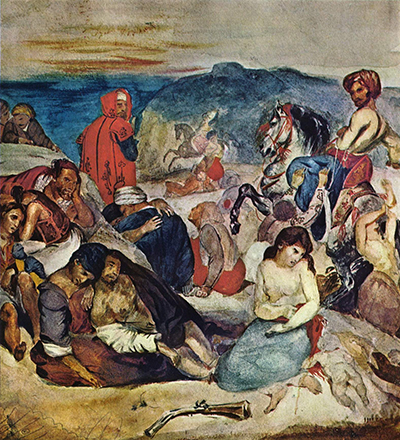
A horse rises above a crowd whose bodies are already sinking towards the ground. A woman in red stands almost motionless behind them; further back, small figures occupy a broken landscape. Eugène Delacroix’s watercolour study for The Massacre at Chios holds these different kinds of movement together within a small, upright sheet. Its interest lies in the relationship between the crowded foreground and the mounted figure at the right. Colour separates the groups while overlapping limbs and clothing bring them into an uncomfortable proximity.
The sheet belongs to the Musée du Louvre, inventory RF 3717, recto. The museum dates it to about 1823–24 and identifies graphite, watercolour and gouache on paper, measuring 34 × 30 cm.[1] It is therefore better understood as a study connected with the preparation of Delacroix’s great 1824 painting than as a work securely dated 1820. The watercolour offers a distinct view of a composition still being explored, before the scene acquired the imposing scale of the finished canvas.
At a Glance
- DateAbout 1823–24 [1]
- MediumGraphite, watercolour and gouache on paper [1]
- Dimensions34 × 30 cm [1]
- Collection / recordMusée du Louvre; RF 3717, recto [1]
This work across Eugène Delacroix’s career
Study for The Massacre at Chios (current article)
About 1823–24 [1]Giaour on Horseback
1824–26 [2]Christ Asleep
About 1853 [5]Contents
- A study with its own identity
- A crowd divided by colour
- Watercolour, graphite and opaque accents
- The landscape beyond the captives
- From working sheet to public painting
- A small sheet within a long history
A study with its own identity
The Louvre calls the work Étude pour Les Massacres de Scio. Scio is the French historical name for Chios, the Greek island whose inhabitants suffered a massacre in 1822. Delacroix’s response to that event became one of the central paintings of his early career. The large canvas was painted in 1824 and shown at that year’s Salon; the watercolour belongs to the preceding period of preparation.[1][7] Keeping the two objects separate helps explain why their differences matter.
In the 2018 Delacroix exhibition catalogue, this particular study is reproduced as figure 6 with its Louvre inventory number and a date of 1823–24.[8] That identification is more precise than a broad label such as “1820s”. It also prevents confusion with the many individual figure drawings connected with the same project. This sheet assembles a scene: it tests a relationship between groups, landscape, mounted power and figures close to the viewer.
At little more than a third of a metre high, it invites close inspection. The monumental painting confronts a viewer with near life-size bodies; the sheet can be taken in almost at once. That smaller scale makes the distribution of red, blue, pale flesh and dark clothing especially evident. Before the eye follows the separate people, it can register the composition as a set of unequal coloured masses.
A crowd divided by colour
The foreground is dense, but it is not an undifferentiated collection of bodies. At the left, pale clothing surrounds darker heads and faces. Near the centre, a low figure in dark clothing draws the eye down into the group. A woman at the right, dressed in pale fabric and a blue-green skirt, creates a lighter interval beside the horse. Her exposed upper body forms a striking contrast with the enclosing folds around her.
Above these seated and reclining figures stands the person in a long red garment. The red is strong enough to be seen immediately, yet the upright figure does not simply become the scene’s heroic centre. The body is narrow and enclosed; the surrounding people occupy more complicated, less stable positions. The contrast turns standing into a precarious exception within a group defined largely by exhaustion and displacement.
The horse and rider create a different kind of height. They rise through force and movement, rather than through a quiet vertical pose. The animal’s lifted forelegs interrupt the human gathering, and its head presses towards the middle of the scene. Looking from the standing figure to the rider therefore means passing between two very different uses of an upright silhouette: vulnerability on one side and a conspicuous capacity for action on the other.
Watercolour, graphite and opaque accents
The combination of graphite, watercolour and gouache matters because the image is neither simply a line drawing nor a miniature oil painting.[1] Coloured passages do much of the work of separating bodies and garments. Some edges remain firm, while others dissolve into neighbouring washes. The paper contributes to the general lightness of the scene, especially in the open sky and the pale spaces between the darker foreground forms.
The looseness is selective. A turban, a horse’s head or a turn of exposed flesh can remain legible without every surrounding fold receiving equal attention. Such differences encourage the viewer to move between recognising particular things and following the larger arrangement. The picture can feel crowded at close range while still retaining a clear opposition between the low group and the mounted figure.
Gouache is included in the museum’s technical description, but that does not mean every bright passage can confidently be assigned to it from a reproduction. Nor can the precise order of pencil and paint be reconstructed merely by looking at the finished sheet. What is visible is the interaction between linear definition and areas of colour. It lets Delacroix explore the scene without giving every element the same degree of finish.
Explore Delacroix on video
An artist overview and a closer look at Liberty Leading the People.
Eugene Delacroix Paintings
An overview of Delacroix’s paintings from TheHistoryOfArt.
Watch on YouTubeThe landscape beyond the captives
Behind the foreground, the ground rises and opens towards distant blue hills. Small figures and patches of warm colour occupy this intermediate space. They extend the scene beyond the people nearest to us, while remaining too reduced to offer the intimacy available in the foreground. The contrast in scale makes the immediate group feel close and exposed against a much larger setting.
The sky occupies a broad, relatively quiet area at the top. Thin horizontal bands of warm colour repeat the long reach of the hills below. These horizontal movements check the thrust of the horse and the standing figure. They also prevent the crowded lower half from becoming the picture’s only rhythm. The eye can move out towards the distance, then return to the compressed bodies along the lower edge.
A discarded weapon near the bottom adds another interruption. Separated from an active hand, it belongs to the foreground without offering an effective means of resistance. Its oblique position carries the eye across the bare ground towards the gathered people. Together with the large animal above it, this small object sharpens the unequal relationship between the ability to act and the condition of those who remain seated or fallen.
From working sheet to public painting
The watercolour should not be treated as a reduced copy of the finished canvas. Its value lies partly in the differences that emerge when the two are compared. The red standing figure is particularly conspicuous here. The handling of the mounted group, the spacing of the captives and the balance between land and sky also give the sheet its own visual character. A preparatory composition can preserve possibilities that do not survive in the same form in a larger painting.
The exhibition catalogue’s account of the 1824 canvas places its production in the working life of the studio. Delacroix’s journal records repeated sessions with models as individual heads and bodies were developed.[8] The watercolour’s gathering of figures should therefore be understood alongside a continuing process of observation, drawing and revision. A convincing appearance of collective suffering was constructed through separate decisions about bodies, clothing and position.
That distinction also matters historically. Delacroix was responding to events in Greece through an invented composition; this is not an eyewitness drawing of the massacre. Its authority as an image comes from the arrangement of the scene and its contemporary subject, rather than from a claim to have recorded a particular group on the island. The study shows how an artist could begin to make distant events emotionally immediate.
A small sheet within a long history
The Louvre records the sheet’s passage through the Coutan-Hauguet sale in 1889 and the Paul-Arthur Chéramy sale in 1908, when it was acquired by the Société des Amis du Louvre and given to the museum.[1] These later stages are distinct from its original work in Delacroix’s studio. They show how a preparatory sheet became an independently collected object, valued for what it reveals about the development of a major painting.
Today it rewards a comparison that moves in both directions. The finished Massacre at Chios clarifies the larger public project behind the drawing, while the drawing makes the painting’s apparent inevitability less secure. The arrangement was worked towards. Standing figures, fallen bodies, colour intervals and distant space could be adjusted before the final canvas fixed their relationships.
The most revealing way to look is to follow one of those relationships across the whole sheet. Begin with the horse’s lifted forelegs, descend through the pale figure at the right and move across the low gathering towards the red standing person. The route passes from movement to stillness without ever leaving the same small space. That compressed circuit is what gives the study an independent force within Delacroix’s account of Chios.
Artworks directory
Selected documented works by or associated with Eugène Delacroix, with dates, media and collection records distinguished. This is a growing research directory, not a complete catalogue. An unspecified medium appears under All media.
| Name | Date | Medium |
|---|---|---|
| Male Academy Figure: Half‑Length, Side View | c. 1818–20 | Oil painting Catalogue. |
| Female Academy Figure: Seated, Front View (Mademoiselle Rose) | c. 1820–23 | Oil painting Catalogue. |
| Two Bearded Heads, after Veronese (detail from “The Marriage at Cana”) | 1820 | Oil painting Catalogue. |
| Self‑Portrait as Ravenswood | c.1821 | Oil painting Catalogue. |
| Nereid, after Rubens, detail from “The Landing of Maria de Medici at Marseilles” | c. 1822 | Oil painting Catalogue. |
| Studies of a Damned Man, for “The Barque of Dante” | 1822 | Drawing Catalogue. |
| Head of an Old Greek Woman | 1824 | Oil painting Catalogue. |
| Tasso in the Hospital of St. Anna, Ferrara | 1824 | Oil painting Catalogue. |
| Turk Mounting His Horse | 1824 | Aquatint Catalogue. |
| Portrait of Aspasie | About 1824 | Oil painting Catalogue. |
| Sketch after Goya’s “Caprichos” | c. 1822–24 | Drawing Catalogue. |
| Study of Babouches | c. 1823–24 | Oil painting Catalogue. |
| Thales Fielding (1793–1837) | c. 1824–25 | Oil painting Catalogue. |
| Studies of Bindings, an Oriental Jacket, and Figures after Goya | c. 1822–26 | Oil painting Catalogue. |
| Study of an Oriental Vest | c. 1822–26 | Drawing Catalogue. |
| Study of Greek Costumes | c. 1823–26 | Drawing Catalogue. |
| Christ in the Garden of Olives (The Agony in the Garden) | 1824–26 | Oil painting Catalogue. |
| Reclining Female Nude: Back View | c. 1824–26 | Oil painting Catalogue. |
| Macbeth Consulting the Witches | 1825 | Lithograph Catalogue. |
| Studies of Seven Greek Coins | 1825 | Lithograph Catalogue. |
| Studies of Twelve Greek and Roman Coins | 1825 | Lithograph Catalogue. |
| Mortally Wounded Brigand Quenches His Thirst | c.1825 | Oil painting Catalogue. |
| Charles VI and Odette de Champdivers | About 1825 | Oil painting Catalogue. |
| The Duke of Orléans Showing His Lover | About 1825–26 | Oil painting Catalogue. |
| Count Demetrius de Palatiano (1794–1849) in Suliot Costume | c. 1825–26 | Oil painting Catalogue. |
| Greece on the Ruins of Missolonghi | 1826 | Oil painting Catalogue. |
| Combat of the Giaour and Hassan | 1826 | Oil painting Catalogue. |
| Justinian Drafting His Laws, sketch | 1826 | Oil painting Catalogue. |
| Baron Schwiter (Louis Auguste Schwiter, 1805–1889) | 1826 | Lithograph Catalogue. |
| Louis Auguste Schwiter (1805–1889) | 1826–30 | Oil painting Catalogue. |
| Death of Sardanapalus, sketch | 1826–27 | Oil painting Catalogue. |
| A Lady and Her Valet | c. 1826–29 | Oil painting Catalogue. |
| Woman with a Parrot | 1827 | Oil painting Catalogue. |
| Seated Turk (possibly Paul Barroilhet, 1805–1871) | c. 1827–30 | Oil painting Catalogue. |
| A Greek and a Turk in an Interior | late 1820s | Watercolour Catalogue. |
| Faust (illustrated book) | 1828 | Illustrated book Catalogue. |
| Mephistopheles Flying over the City (Study for “Faust,” plate 1) | c. 1825–27 | Drawing Catalogue. |
| Faust, plate 1: Mephistopheles Aloft | 1826/27 | Lithograph Catalogue. |
| Faust, plate 2: Faust in His Study | 1826/27 | Lithograph Catalogue. |
| Faust, plate 3: Faust and Wagner | 1826/27 | Lithograph Catalogue. |
| Faust, plate 4: Faust, Wagner, and the Poodle | 1826/27 | Lithograph Catalogue. |
| Faust, plate 5: Mephistopheles Appearing to Faust | 1826/27 | Lithograph Catalogue. |
| Faust, plate 6: Mephistopheles Receiving the Student | 1826/27 | Lithograph Catalogue. |
| Faust and Mephistopheles in the Tavern (Study for “Faust,” plate 7) | 1825/26 | Drawing Catalogue. |
| Faust, plate 7: Mephistopheles in Auerbach’s Tavern | 1826 | Lithograph Catalogue. |
| Faust, Marguerite, and Mephistopheles in the Street (Study for “Faust,” plate 8) | c. 1825–27 | Drawing Catalogue. |
| Faust, plate 8: Faust Trying to Seduce Marguerite | 1826/27 | Lithograph Catalogue. |
| Faust, plate 9: Mephistopheles Introduces Himself at Martha’s House | 1827 | Lithograph Catalogue. |
| Faust, plate 10: Marguerite at the Spinning Wheel | 1826/27 | Lithograph Catalogue. |
| Faust, plate 11: Duel between Faust and Valentin | 1826/27 | Lithograph Catalogue. |
| Faust, plate 12: Mephistopheles and Faust Fleeing after the Duel | 1826/27 | Lithograph Catalogue. |
| Faust, plate 13: Marguerite in Church | 1826/27 | Lithograph Catalogue. |
| Faust, plate 14: Faust and Mephistopheles in the Harz Mountains | 1826/27 | Lithograph Catalogue. |
| Faust, plate 15: Marguerite’s Ghost Appearing to Faust | 1826/27 | Lithograph Catalogue. |
| Faust, plate 16: Faust and Mephistopheles Galloping on Walpurgis Night | 1826 | Lithograph Catalogue. |
| Faust, plate 17: Faust with Marguerite in Prison | 1826/27 | Lithograph Catalogue. |
| Wild Horse Felled by a Tiger | 1828 | Lithograph Catalogue. |
| Wild Horse Felled by a Tiger | 1828 | Watercolour Catalogue. |
| Wild Horse | 1828 | Lithograph Catalogue. |
| Studies of a Lion (Tours sketchbook) | 12 February 1824 or 1829 | Drawing Catalogue. |
| Sketches of Tigers and Men in Sixteenth‑Century Costume | c. 1828–29 | Watercolour Catalogue. |
| Nineteen Studies of Heads and Skulls of Lions | c. 1828–30 | Drawing Catalogue. |
| Tiger Lying at the Entrance of Its Lair | c. 1828–30 | Etching Catalogue. |
| The Murder of the Bishop of Liège | 1829 | Oil painting Catalogue. |
| Royal Tiger | 1829 | Lithograph Catalogue. |
| Lion of the Atlas Mountains | 1829–30 | Lithograph Catalogue. |
| Young Tiger Playing with Its Mother (Study of Two Tigers) | 1830 | Oil painting Catalogue. |
| The Battle of Poitiers | 1830 | Oil painting Catalogue. |
| The Battle of Nancy and the Death of Charles the Bold, Duke of Burgundy, January 5, 1477 | 1831 | Oil painting Catalogue. |
| Boissy d’Anglas at the Convention, sketch | 1831 | Oil painting Catalogue. |
| Interior of a Dominican Convent in Madrid (L’Amende Honorable) | 1831 | Oil painting Catalogue. |
| Jewish Woman of Tangier | 1832 | Drawing Catalogue. |
| Portrait of Schmareck, Tanner at Tangier | 1832 | Watercolour Catalogue. |
| Standing Moroccan | 1832 | Watercolour Catalogue. |
| A Man of Tangier | 1832 | Watercolour Catalogue. |
| Saada, the Wife of Abraham Ben‑Chimol, and Préciada, One of Their Daughters | 1832 | Watercolour Catalogue. |
| Street in Meknes | 1832 | Oil painting Catalogue. |
| Moroccan Military Exercises | 1832 | Oil painting Catalogue. |
| Arab Cavalry Practicing a Charge (Fantaisie Arabe) | 1833 | Oil painting Catalogue. |
| A Blacksmith | 1833 | Aquatint Catalogue. |
| Collision of Arab Horsemen | 1833/34 | Oil painting Catalogue. |
| Figure Study for “The Women of Algiers” | 1833/34 | Watercolour Catalogue. |
| Women of Algiers in Their Apartment | 1834 | Oil painting Catalogue. |
| The Natchez | 1823–24 and 1835 | Oil painting Catalogue. |
| Christ on the Cross | 1835 | Oil painting Catalogue. |
| Hamlet and Horatio in the Graveyard | 1835 | Oil painting Catalogue. |
| Combat of the Giaour and Hassan | 1835 | Oil painting Catalogue. |
| Léon Riesener (1808–1878) | 1835 | Oil painting Catalogue. |
| Madame Henri François Riesener (Félicité Longrois, 1786–1847) | 1835 | Oil painting Catalogue. |
| Saint Sebastian Tended by the Holy Women | 1836 | Oil painting Catalogue. |
| Medea About to Kill Her Children, sketch | c. 1836 | Oil painting Catalogue. |
| Moroccan Chieftain Receiving Tribute | 1837 | Oil painting Catalogue. |
| Self‑Portrait in a Green Vest | c. 1837 | Oil painting Catalogue. |
| Medea About to Kill Her Children (Medée furieuse) | 1838 | Oil painting Catalogue. |
| Cleopatra and the Peasant | 1838 | Oil painting Catalogue. |
| Hamlet and Horatio in the Graveyard | 1839 | Oil painting Catalogue. |
| Startled Arabian Horse in a Landscape | c. 1835–40 | Watercolour Catalogue. |
| The Shipwreck of Don Juan | 1840 | Oil painting Catalogue. |
| Christ on the Lake of Genesareth (Portland version) | c. 1853 | Oil painting Catalogue. |
| Pietà, first sketch | by 1843 | Oil painting Catalogue. |
| Pietà, second sketch | by 1843 | Oil painting Catalogue. |
| Christ on the Cross, sketch | 1845 | Oil painting Catalogue. |
| Christ on the Cross | 1846 | Oil painting Catalogue. |
| Death of Sardanapalus (Philadelphia replica) | 1844 / 1845–46 | Oil painting Catalogue. |
| The Abduction of Rebecca | 1846 | Oil painting Catalogue. |
| The Lamentation (Christ at the Tomb) | 1847–48 | Oil painting Catalogue. |
| Arab Players | 1848 | Oil painting Catalogue. |
| Arch of Morning Glories, study for “Basket of Flowers” | 1848/49 | Pastel Catalogue. |
| Basket of Flowers | 1848–49 | Oil painting Catalogue. |
| Basket of Flowers and Fruit | 1849 | Oil painting Catalogue. |
| Basket of Flowers | c. 1848–50 | Oil painting Catalogue. |
| Christ at the Column | probably 1849 | Oil painting Catalogue. |
| Landscape at Champrosay | possibly 1849 | Oil painting Catalogue. |
| Michelangelo in His Studio | About1849–50 | Oil painting Catalogue. |
| View in the Forest of Sénart | c. 1849–50 | Oil painting Catalogue. |
| Forest View with an Oak Tree | c. 1849–50 | Watercolour Catalogue. |
| The Triumph of Genius over Envy | c. 1849–51 | Drawing Catalogue. |
| Jacob Struggling with the Angel | 1850 | Drawing Catalogue. |
| Jacob Wrestling with the Angel | 1850 | Drawing Catalogue. |
| Jacob Wrestling with the Angel | 1850 | Oil painting Catalogue. |
| Sunset | c. 1850 | Pastel Catalogue. |
| Apollo Slays the Python, sketch | c. 1850 | Oil painting Catalogue. |
| Apollo Victorious over the Serpent Python, sketch | c. 1850 | Oil painting Catalogue. |
| Pietà | About1850 | Oil painting Catalogue. |
| The Agony in the Garden | 1851 | Oil painting Catalogue. |
| Study of the Sea | 1851(?) | Watercolour Catalogue. |
| Marphise | 1852 | Oil painting Catalogue. |
| The Sea at Dieppe | 1852 | Oil painting Catalogue. |
| Christ Asleep during the Tempest | c. 1853 | Oil painting Catalogue. |
| Saint Stephen Borne Away by His Disciples | 1853 | Oil painting Catalogue. |
| Christ on the Sea of Galilee | 1854 | Oil painting Catalogue. |
| The Sea at Dieppe | probably 1854 | Watercolour Catalogue. |
| A Lion and a Tiger, Fighting | c. 1854 | Drawing Catalogue. |
| Lion Hunt, sketch | 1854 | Oil painting Catalogue. |
| Lion Hunt (fragment) | 1855 | Oil painting Catalogue. |
| Lion Hunt | 1855–56 | Oil painting Catalogue. |
| Hilly Landscape | c. 1855 | Oil painting Catalogue. |
| The Sultan of Morocco and His Entourage | 1856 | Oil painting Catalogue. |
| The Bride of Abydos (Selim and Zuleika) | 1857 | Oil painting Catalogue. |
| Lamentation over the Body of Christ | 1857 | Oil painting Catalogue. |
| Abduction of Rebecca | 1858 | Oil painting Catalogue. |
| Ovid among the Scythians | 1859 | Oil painting Catalogue. |
| Amadis de Gaule Delivers a Damsel from Galpan’s Castle | 1859–60 | Oil painting Catalogue. |
| Arab Horses Fighting in a Stable | 1860 | Oil painting Catalogue. |
| Shipwreck on the Coast | 1862 | Oil painting Catalogue. |
| The Battle of Taillebourg won by Saint Louis (Château de Versailles) | 1837 | Oil on canvas Catalogue. |
| Christ on the Lake of Gennezaret (Christ Asleep during the Tempest) (The Metropolitan Museum of Art) | About 1853 | Oil on canvas Catalogue. |
| The Coast of Spain at Salabrena (Christie’s 1998 sale 6059, lot 123) | 19 January 1832 | Pen and ink Catalogue. |
| Crouching Tiger (The Metropolitan Museum of Art) | 1839 | Pen and ink Catalogue. |
| The Education of Achilles (J. Paul Getty Museum) | 1862 | Pastel Catalogue. |
| Fallen Warriors and a Runaway Horse (The Metropolitan Museum of Art) | 1862 | Pen and ink Catalogue. |
| George Sand's Garden at Nohant (The Metropolitan Museum of Art) | About 1842–43 | Oil on canvas Catalogue. |
| The Giaour on Horseback (The Metropolitan Museum of Art) | 1824–26 | Pen and ink Catalogue. |
| Lion Hunt (Art Institute of Chicago) | 1860–61; signed 1861 | Oil on canvas Catalogue. |
| Figure Studies related to Liberty Leading the People | 1830 | Pen and brown ink, brush and brown wash Catalogue. |
| Chios: Head, Shoulder and Foot Studies | 1823 | Graphite Catalogue. |
| Figure Studies for the Salon du Roi, Palais Bourbon | 1833–35 | Pen and iron gall ink Catalogue. |
| Four Studies of Horses | 1824–25 | Pen, ink, black wash and graphite (recto); graphite (verso) Catalogue. |
| Studies of a Horse and Rider for Heliodorus Driven from the Temple | 1849–50 | Pen and iron gall ink, graphite Catalogue. |
| Liberty Leading the People | 1830 | Oil on canvas Catalogue. |
| Massacre at Chios | 1824 | Oil on canvas Catalogue. |
| Death of Sardanapalus (Louvre original) | 1827 | Oil on canvas Catalogue. |
| Barque of Dante | 1822 | Oil painting Catalogue. |
| Orphan Girl at the Cemetery | 1824 | Oil painting Catalogue. |
| Jacob Wrestling with the Angel (Saint-Sulpice wall painting) | Completed 1861 | Wall painting Catalogue. |
| Heliodorus Driven from the Temple (Saint-Sulpice wall painting) | Completed 1861 | Wall painting Catalogue. |
| African Pirates Abducting a Young Woman | 1852 | Oil painting Catalogue. |
| An Arab Horseman at the Gallop | 1849 | Oil painting Catalogue. |
| Arabs Skirmishing in the Mountains | 1863 | Oil painting Catalogue. |
| Moroccan Horseman Crossing a Ford | About 1850 | Oil painting Catalogue. |
| A Moroccan (Arab) Saddling a Horse | 1855 | Oil painting Catalogue. |
| The Execution of the Doge Marino Faliero | 1825–26 | Oil painting Catalogue. |
| Christopher Columbus and his Son at La Rábida | 1838 | Oil painting Catalogue. |
| Horse Frightened by Lightning | 1825–29 | Watercolour Catalogue. |
| Horses Leaving the Sea | 1860 | Oil painting Catalogue. |
| Tiger with a Tortoise | 1862 | Oil painting Catalogue. |
| Tiger | About1830 | Watercolour Catalogue. |
| Tiger and Snake | 1862 | Oil painting Catalogue. |
| Tiger Hunt | 1854 | Oil painting Catalogue. |
| Lion Hunt in Morocco | 1854 | Oil painting Catalogue. |
| Lion Rending Apart a Corpse | About1848;historical catalogue placement | Watercolour Catalogue. |
| Frederic Chopin | 1838 | Oil painting Catalogue. |
| Portrait of George Sand | 1838 | Oil painting Catalogue. |
| Portrait of Frédéric Chopin and George Sand | 1838 | Oil painting Catalogue. |
| Mademoiselle Rose | About 1820 | Oil painting Catalogue. |
| Head of a Woman in a Red Turban | 1831; archive date | Oil painting Catalogue. |
| Two Views of a Standing Indian from Calcutta | About 1823–24 | Oil painting Catalogue. |
| Last Words of the Emperor Marcus Aurelius | 1844 | Oil painting Catalogue. |
| Entry of the Crusaders in Constantinople | 1840 | Oil painting Catalogue. |
| Medea | 1862 | Oil painting Catalogue. |
| The Death of Laras | 1858 | Oil painting Catalogue. |
| The Bride of Abydos | About 1852–53; dating disputed | Oil painting Catalogue. |
| The Bride of Lammermoor | About1826 | Watercolour Catalogue. |
| Cromwell at Windsor Castle | 1828 | Oil painting Catalogue. |
| Milton Dictated to his Daughters the Paradise Lost | 1827–28 | Oil painting Catalogue. |
| Tasso in the Madhouse | 1839 | Oil painting Catalogue. |
| Christ on the Cross | 1853 | Oil painting Catalogue. |
| The Disciples at Emmaus | 1853 | Oil painting Catalogue. |
| The Entombment of Christ | Nineteenth century; precise date unestablished | Oil painting Catalogue. |
| Fanatics of Tangier | 1837–38 | Oil painting Catalogue. |
| Jewish Bride | Undated; Moroccan subject associated with the1832journey | Watercolour Catalogue. |
| Jewish Wedding in Morocco | 1839; Salon1841 | Oil painting Catalogue. |
| Moroccan Fantasia | 1847 | Oil painting Catalogue. |
| The Sultan of Morocco | 1845 | Oil painting Catalogue. |
| Bouquet of Flowers 1843 | 1843 | Watercolour Catalogue. |
| Bouquet of Flowers, 1849 | 1849 | Watercolour Catalogue. |
| Cliffs Near Dieppe | 1852–55 | Watercolour Catalogue. |
| The Edge of a Wood at Nohant | c.1842/1843 | Watercolour Catalogue. |
| Still Life with Lobsters | 1826–27 | Oil on canvas Catalogue. |
| A Corner of the Studio (attribution disputed) | 1825–1850; attribution disputed | Oil on canvas Catalogue. |
| Study of the Sky at Sunset | c.1849 | Pastel Catalogue. |
| Self-Portrait, about 1840 | c.1840 | Oil on canvas Catalogue. |
| Women of Algiers in Their Apartment (1849) | 1849 | Oil on canvas Catalogue. |
| Susanna and the Elders | 1841 | Oil on canvas Catalogue. |
| The Education of Achilles (Drawing) | c.1844 | Graphite Catalogue. |
| Attila the Hun | Completed 1847 | Mural detail Catalogue. |
| The Italian Theatre | 1821 | Lithograph Catalogue. |
| A Turkish Man on a Grey Horse | Undated | Not specified Catalogue. |
| Study for The Massacre at Chios | About 1823–24 | Graphite, watercolour and gouache on paper Catalogue. |
| The Prisoner of Chillon | 1834; Salon of 1835 | Oil on canvas Catalogue. |
| Two Knights Fighting in a Landscape | Second quarter of the nineteenth century; precise date uncertain | Oil on canvas; possible later completion Catalogue. |
Discussion
Look again at the images and ideas explored in Study for The Massacre at Chios. These editorial prompts invite your observations.
Reader Insights
Follow the largest light and dark shapes. How do they direct your attention towards the central encounter?
Compare the foreground with the space behind it. Where does the composition allow movement, and where does it restrict it?
Join the Conversation
Share a detail, comparison or question about Study for The Massacre at Chios below.
References
- Musée du Louvre, Département des Arts graphiques. “Étude pour Les Massacres de Scio”, RF 3717, recto. Louvre collection record. French. Accessed 30 October 2026. View source.
- The Metropolitan Museum of Art, “The Giaour on Horseback”, Eugène Delacroix, 1824–26, accession 2015.713.2, collection record and recto image. Source language: English. Accessed 27 October 2026. View source.
- Ministère de la Culture, base Joconde, Bataille de Taillebourg. 21 juillet 1242, notice 000PE005883; collection du château de Versailles, MV 2676 / INV 3822 / LP 2780. French. Accessed 27 October 2026. View source.
- Asher Miller, compiler, “Checklist,” entries 1–145, in Sébastien Allard and Côme Fabre, Delacroix. New York: The Metropolitan Museum of Art, 2018, pp. 275–297. Basic title, date and medium metadata consulted; not a complete catalogue of the artist’s works. Source language: English. Accessed 28 October 2026. View source.
- The Metropolitan Museum of Art, “Eugène Delacroix: Christ Asleep during the Tempest,” collection record, accession 29.100.131, object details and introductory commentary. Source language: English. Accessed 28 October 2026. View source.
- George R. Goldner and Lee Hendrix, with Kelly Pask, European Drawings 2: Catalogue of the Collections. Malibu: J. Paul Getty Museum, 1992, entry 56, p. 140; colour plate 8. Source language: English. Accessed 27 October 2026. View source.
- Musée du Louvre, Département des Peintures. “Scènes des massacres de Scio. Familles grecques attendant la mort ou l’esclavage”, INV 3823. Louvre collection record. French. Accessed 30 October 2026. View source.
- Sébastien Allard and Côme Fabre. Delacroix. New York: The Metropolitan Museum of Art, 2018, pp. 20–23, especially fig. 6, p. 22. Exhibition catalogue. English. Selected passage reread 30 October 2026. View source.