 by Tom Gurney
Tom Gurney BSc (Hons) is an art history expert with over 20 years experience
Published on June 19, 2020 / Updated on October 30, 2026
Email: tomgurney1@gmail.com / Phone: +44 7429 011000
Two Knights Fighting in a Landscape: Introduction
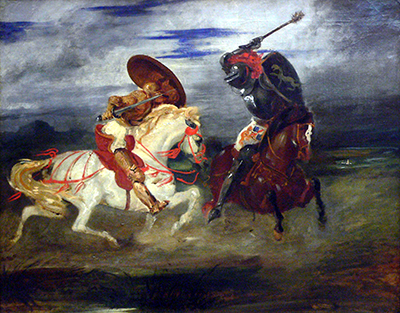
Two mounted figures meet in a landscape that offers almost nothing to soften their encounter. A white horse occupies the left of the scene; a darker horse and armoured rider rise against the stormy sky at the right. Weapons, lifted arms and the animals’ heads crowd the interval between them. Known in English as Two Knights Fighting in a Landscape, the picture turns an open stretch of countryside into a tightly compressed space of confrontation.
The Musée du Louvre records the painting as Combat de chevaliers dans la campagne, inventory RF 1655: oil on canvas, 81 × 105 cm, dated broadly to the second quarter of the nineteenth century. Its catalogue also preserves important doubts about the signature and about whether the picture was completed after Delacroix’s death.[1] Those qualifications belong to the work’s history. They make a secure date of “1824” or a simple claim that every visible passage is certainly by Delacroix too definite.
At a Glance
- DateSecond quarter of the nineteenth century; precise date uncertain [1]
- MediumOil on canvas; possible later completion [1]
- Dimensions81 × 105 cm [1]
- Collection / recordMusée du Louvre; RF 1655 [1]
This work across Eugène Delacroix’s career
Giaour on Horseback
1824–26 [2]Two Knights Fighting in a Landscape (current article)
Second quarter of the nineteenth century; precise date uncertain [1]Christ Asleep
About 1853 [5]Contents
- What the Louvre record establishes
- The collision of two unequal silhouettes
- Horses, armour and the possibility of impact
- A landscape that carries the tension
- Combat without a securely named story
- A disputed finish and an enduring composition
What the Louvre record establishes
The painting’s identity is anchored by an identifiable museum object rather than by its English title alone. The Louvre assigns it to Eugène Delacroix and records its entry through Étienne Moreau-Nélaton’s donation in 1906.[1] The French Ministry of Culture’s Joconde record supplies the same inventory number and dimensions, but gives an approximate date of 1830.[7] Both records concern the same canvas, even though their dating conventions differ.
The Louvre’s note is unusually revealing. It reports Lee Johnson’s suggestion that the picture may have been completed after the artist’s death and raises a possible connection with a fireplace screen Delacroix painted for himself in 1824, otherwise considered lost. It also records Alfred Robaut’s objection to the signature.[1] These are possibilities and scholarly reservations, rather than a settled reconstruction of exactly how the canvas was made.
The most responsible way to look is to keep the painting’s visible qualities and its uncertain history together. The museum identification allows a sustained discussion of the composition. It does not license inventing a precise commission, a named literary episode or an uninterrupted account of the artist’s work on the canvas. The uncertainty is specific: it concerns dating, signature and completion, rather than the existence of the object itself.
The collision of two unequal silhouettes
The two riders do not form a balanced pair. At the left, pale horseflesh expands across the middle of the canvas, making that animal immediately conspicuous. The rider’s warm colours and raised shield cluster above it. At the right, a darker, taller silhouette stretches upwards towards a weapon held against the sky. The encounter is therefore built from contrasting shapes before individual actions become clear.
The horses bring those shapes together. Their lifted heads face into the central interval, where the riders’ gestures also converge. Yet the animals do not simply repeat the people above them. Their bodies occupy different levels and directions; their legs complicate the ground with abrupt changes of angle. The movement looks unstable because a rider’s effort must be supported by an animal whose own balance is visibly changing.
The shield at the left creates a broad curved interruption among the narrower lines of weapons and limbs. It can be recognised quickly even where its exact orientation is difficult to resolve. Its shape supplies a defensive counterpart to the elevated striking gesture at the right. The picture makes opposition legible without arranging the figures in a symmetrical display of equal actions.
Horses, armour and the possibility of impact
Armour changes the way the human bodies can be read. Instead of exposed torsos displaying every turn, the riders are enclosed in surfaces that catch light unevenly. Bright accents describe selected edges and joints; darker passages allow parts of a figure to merge with horse or sky. This alternation makes the combat feel sudden. Recognition arrives in flashes rather than through a continuous, calmly outlined anatomy.
The white horse provides the clearest field against which those accents can be judged. Red straps and warm shadows cross its pale body, while its head and neck turn towards the opposition. The animal is decorative in colour but forceful in structure. Its prominence prevents the scene from being read as an exchange between human wills alone: a great part of the encounter’s energy belongs to the horses.
At the right, dark armour and a dark mount create a more compressed mass. The raised arm extends that mass into the sky, keeping the silhouette visible above the meeting point. The lower body is less immediately separate from its surroundings. As the eye moves downwards, it must distinguish leg, saddle and animal within a narrower range of tones. That difficulty intensifies the sensation of entanglement.
Explore Delacroix on video
An artist overview and a closer look at Liberty Leading the People.
Eugene Delacroix Paintings
An overview of Delacroix’s paintings from TheHistoryOfArt.
Watch on YouTubeA landscape that carries the tension
The countryside is more than a neutral backdrop. Darker ground extends beneath the horses, while the distant horizon remains comparatively low. Most of the upper picture is occupied by a broken sky. Broad grey and blue passages make the space appear unsettled, and their horizontal movement runs behind the sharply angled gestures of the riders. The weather has a visual force even without assigning the scene a particular storm or hour.
The open setting creates a useful contradiction. There seems to be room in which to move, yet the principal forms are driven towards one another. No large architectural enclosure explains their compression. It results from the way the two groups have been brought together within the frame. Countryside can imply freedom of movement, but here that freedom concentrates into the narrow space where the weapons and horses meet.
Small variations in the ground carry the eye away from the encounter before the contrasting animals bring it back. The scene is not crowded with secondary combatants demanding equal attention. Its economy makes the central collision more insistent. Even when looking into the distance, the viewer remains aware of the two large silhouettes that interrupt the passage across the canvas.
Combat without a securely named story
The museum title describes knights fighting in the countryside. It does not identify the combatants or name a passage from a poem or novel.[1] Armour and mounted conflict can invite associations with medieval romance, but an association is not an identification. Attaching a specific tale to the canvas would change what the gestures mean, turning one rider into a known hero and the other into a particular enemy without sufficient evidence.
A comparison with Delacroix’s Battle of the Giaour and Hassan is useful precisely because that painting has a documented literary source. The Petit Palais identifies its subject with Byron’s The Giaour and dates the canvas to 1835.[8] Both pictures concentrate violent movement into mounted figures. In the Giaour scene, the named story supplies a motive and an outcome; the knights’ canvas leaves those narrative coordinates less secure.
The absence of established names need not make the picture empty. It shifts attention towards the mechanisms of the encounter: dark against light, raised weapon against shield, human movement against animal balance. These relationships remain available to the eye even when the reason for the fight is unknown. The result can be read as a study in the physical structure of conflict without claiming that this was the painter’s stated intention.
A disputed finish and an enduring composition
The possible fireplace-screen connection raises an interesting question about function, but it should remain a question. If the connection were established, it would place the image within a domestic decorative setting. The Louvre presents it tentatively, so the current canvas cannot simply be described as a proven surviving screen.[1] Its dimensions and format are documented; the exact original purpose remains less certain.
Likewise, a disputed signature cannot by itself tell us which passages were painted by whom. That requires evidence beyond the appearance of a reproduction. Broad handling in the sky or an abrupt transition in an animal’s body may be visually striking, but those observations do not establish later intervention. The catalogue reservation should guide the wording of an attribution rather than become a licence for assigning individual brushstrokes to an unknown finisher.
What can be followed with confidence is the composition’s sequence of pressures. The pale horse draws the eye in; the shield turns it upwards; the darker rider carries it higher still; the lifted weapon sends attention back towards the centre. The landscape opens behind this circuit while the combat repeatedly closes it. Whatever remains unresolved in the canvas’s making, that visible arrangement gives the two knights a forceful and distinctive presence.
Artworks directory
Selected documented works by or associated with Eugène Delacroix, with dates, media and collection records distinguished. This is a growing research directory, not a complete catalogue. An unspecified medium appears under All media.
| Name | Date | Medium |
|---|---|---|
| Male Academy Figure: Half‑Length, Side View | c. 1818–20 | Oil painting Catalogue. |
| Female Academy Figure: Seated, Front View (Mademoiselle Rose) | c. 1820–23 | Oil painting Catalogue. |
| Two Bearded Heads, after Veronese (detail from “The Marriage at Cana”) | 1820 | Oil painting Catalogue. |
| Self‑Portrait as Ravenswood | c.1821 | Oil painting Catalogue. |
| Nereid, after Rubens, detail from “The Landing of Maria de Medici at Marseilles” | c. 1822 | Oil painting Catalogue. |
| Studies of a Damned Man, for “The Barque of Dante” | 1822 | Drawing Catalogue. |
| Head of an Old Greek Woman | 1824 | Oil painting Catalogue. |
| Tasso in the Hospital of St. Anna, Ferrara | 1824 | Oil painting Catalogue. |
| Turk Mounting His Horse | 1824 | Aquatint Catalogue. |
| Portrait of Aspasie | About 1824 | Oil painting Catalogue. |
| Sketch after Goya’s “Caprichos” | c. 1822–24 | Drawing Catalogue. |
| Study of Babouches | c. 1823–24 | Oil painting Catalogue. |
| Thales Fielding (1793–1837) | c. 1824–25 | Oil painting Catalogue. |
| Studies of Bindings, an Oriental Jacket, and Figures after Goya | c. 1822–26 | Oil painting Catalogue. |
| Study of an Oriental Vest | c. 1822–26 | Drawing Catalogue. |
| Study of Greek Costumes | c. 1823–26 | Drawing Catalogue. |
| Christ in the Garden of Olives (The Agony in the Garden) | 1824–26 | Oil painting Catalogue. |
| Reclining Female Nude: Back View | c. 1824–26 | Oil painting Catalogue. |
| Macbeth Consulting the Witches | 1825 | Lithograph Catalogue. |
| Studies of Seven Greek Coins | 1825 | Lithograph Catalogue. |
| Studies of Twelve Greek and Roman Coins | 1825 | Lithograph Catalogue. |
| Mortally Wounded Brigand Quenches His Thirst | c.1825 | Oil painting Catalogue. |
| Charles VI and Odette de Champdivers | About 1825 | Oil painting Catalogue. |
| The Duke of Orléans Showing His Lover | About 1825–26 | Oil painting Catalogue. |
| Count Demetrius de Palatiano (1794–1849) in Suliot Costume | c. 1825–26 | Oil painting Catalogue. |
| Greece on the Ruins of Missolonghi | 1826 | Oil painting Catalogue. |
| Combat of the Giaour and Hassan | 1826 | Oil painting Catalogue. |
| Justinian Drafting His Laws, sketch | 1826 | Oil painting Catalogue. |
| Baron Schwiter (Louis Auguste Schwiter, 1805–1889) | 1826 | Lithograph Catalogue. |
| Louis Auguste Schwiter (1805–1889) | 1826–30 | Oil painting Catalogue. |
| Death of Sardanapalus, sketch | 1826–27 | Oil painting Catalogue. |
| A Lady and Her Valet | c. 1826–29 | Oil painting Catalogue. |
| Woman with a Parrot | 1827 | Oil painting Catalogue. |
| Seated Turk (possibly Paul Barroilhet, 1805–1871) | c. 1827–30 | Oil painting Catalogue. |
| A Greek and a Turk in an Interior | late 1820s | Watercolour Catalogue. |
| Faust (illustrated book) | 1828 | Illustrated book Catalogue. |
| Mephistopheles Flying over the City (Study for “Faust,” plate 1) | c. 1825–27 | Drawing Catalogue. |
| Faust, plate 1: Mephistopheles Aloft | 1826/27 | Lithograph Catalogue. |
| Faust, plate 2: Faust in His Study | 1826/27 | Lithograph Catalogue. |
| Faust, plate 3: Faust and Wagner | 1826/27 | Lithograph Catalogue. |
| Faust, plate 4: Faust, Wagner, and the Poodle | 1826/27 | Lithograph Catalogue. |
| Faust, plate 5: Mephistopheles Appearing to Faust | 1826/27 | Lithograph Catalogue. |
| Faust, plate 6: Mephistopheles Receiving the Student | 1826/27 | Lithograph Catalogue. |
| Faust and Mephistopheles in the Tavern (Study for “Faust,” plate 7) | 1825/26 | Drawing Catalogue. |
| Faust, plate 7: Mephistopheles in Auerbach’s Tavern | 1826 | Lithograph Catalogue. |
| Faust, Marguerite, and Mephistopheles in the Street (Study for “Faust,” plate 8) | c. 1825–27 | Drawing Catalogue. |
| Faust, plate 8: Faust Trying to Seduce Marguerite | 1826/27 | Lithograph Catalogue. |
| Faust, plate 9: Mephistopheles Introduces Himself at Martha’s House | 1827 | Lithograph Catalogue. |
| Faust, plate 10: Marguerite at the Spinning Wheel | 1826/27 | Lithograph Catalogue. |
| Faust, plate 11: Duel between Faust and Valentin | 1826/27 | Lithograph Catalogue. |
| Faust, plate 12: Mephistopheles and Faust Fleeing after the Duel | 1826/27 | Lithograph Catalogue. |
| Faust, plate 13: Marguerite in Church | 1826/27 | Lithograph Catalogue. |
| Faust, plate 14: Faust and Mephistopheles in the Harz Mountains | 1826/27 | Lithograph Catalogue. |
| Faust, plate 15: Marguerite’s Ghost Appearing to Faust | 1826/27 | Lithograph Catalogue. |
| Faust, plate 16: Faust and Mephistopheles Galloping on Walpurgis Night | 1826 | Lithograph Catalogue. |
| Faust, plate 17: Faust with Marguerite in Prison | 1826/27 | Lithograph Catalogue. |
| Wild Horse Felled by a Tiger | 1828 | Lithograph Catalogue. |
| Wild Horse Felled by a Tiger | 1828 | Watercolour Catalogue. |
| Wild Horse | 1828 | Lithograph Catalogue. |
| Studies of a Lion (Tours sketchbook) | 12 February 1824 or 1829 | Drawing Catalogue. |
| Sketches of Tigers and Men in Sixteenth‑Century Costume | c. 1828–29 | Watercolour Catalogue. |
| Nineteen Studies of Heads and Skulls of Lions | c. 1828–30 | Drawing Catalogue. |
| Tiger Lying at the Entrance of Its Lair | c. 1828–30 | Etching Catalogue. |
| The Murder of the Bishop of Liège | 1829 | Oil painting Catalogue. |
| Royal Tiger | 1829 | Lithograph Catalogue. |
| Lion of the Atlas Mountains | 1829–30 | Lithograph Catalogue. |
| Young Tiger Playing with Its Mother (Study of Two Tigers) | 1830 | Oil painting Catalogue. |
| The Battle of Poitiers | 1830 | Oil painting Catalogue. |
| The Battle of Nancy and the Death of Charles the Bold, Duke of Burgundy, January 5, 1477 | 1831 | Oil painting Catalogue. |
| Boissy d’Anglas at the Convention, sketch | 1831 | Oil painting Catalogue. |
| Interior of a Dominican Convent in Madrid (L’Amende Honorable) | 1831 | Oil painting Catalogue. |
| Jewish Woman of Tangier | 1832 | Drawing Catalogue. |
| Portrait of Schmareck, Tanner at Tangier | 1832 | Watercolour Catalogue. |
| Standing Moroccan | 1832 | Watercolour Catalogue. |
| A Man of Tangier | 1832 | Watercolour Catalogue. |
| Saada, the Wife of Abraham Ben‑Chimol, and Préciada, One of Their Daughters | 1832 | Watercolour Catalogue. |
| Street in Meknes | 1832 | Oil painting Catalogue. |
| Moroccan Military Exercises | 1832 | Oil painting Catalogue. |
| Arab Cavalry Practicing a Charge (Fantaisie Arabe) | 1833 | Oil painting Catalogue. |
| A Blacksmith | 1833 | Aquatint Catalogue. |
| Collision of Arab Horsemen | 1833/34 | Oil painting Catalogue. |
| Figure Study for “The Women of Algiers” | 1833/34 | Watercolour Catalogue. |
| Women of Algiers in Their Apartment | 1834 | Oil painting Catalogue. |
| The Natchez | 1823–24 and 1835 | Oil painting Catalogue. |
| Christ on the Cross | 1835 | Oil painting Catalogue. |
| Hamlet and Horatio in the Graveyard | 1835 | Oil painting Catalogue. |
| Combat of the Giaour and Hassan | 1835 | Oil painting Catalogue. |
| Léon Riesener (1808–1878) | 1835 | Oil painting Catalogue. |
| Madame Henri François Riesener (Félicité Longrois, 1786–1847) | 1835 | Oil painting Catalogue. |
| Saint Sebastian Tended by the Holy Women | 1836 | Oil painting Catalogue. |
| Medea About to Kill Her Children, sketch | c. 1836 | Oil painting Catalogue. |
| Moroccan Chieftain Receiving Tribute | 1837 | Oil painting Catalogue. |
| Self‑Portrait in a Green Vest | c. 1837 | Oil painting Catalogue. |
| Medea About to Kill Her Children (Medée furieuse) | 1838 | Oil painting Catalogue. |
| Cleopatra and the Peasant | 1838 | Oil painting Catalogue. |
| Hamlet and Horatio in the Graveyard | 1839 | Oil painting Catalogue. |
| Startled Arabian Horse in a Landscape | c. 1835–40 | Watercolour Catalogue. |
| The Shipwreck of Don Juan | 1840 | Oil painting Catalogue. |
| Christ on the Lake of Genesareth (Portland version) | c. 1853 | Oil painting Catalogue. |
| Pietà, first sketch | by 1843 | Oil painting Catalogue. |
| Pietà, second sketch | by 1843 | Oil painting Catalogue. |
| Christ on the Cross, sketch | 1845 | Oil painting Catalogue. |
| Christ on the Cross | 1846 | Oil painting Catalogue. |
| Death of Sardanapalus (Philadelphia replica) | 1844 / 1845–46 | Oil painting Catalogue. |
| The Abduction of Rebecca | 1846 | Oil painting Catalogue. |
| The Lamentation (Christ at the Tomb) | 1847–48 | Oil painting Catalogue. |
| Arab Players | 1848 | Oil painting Catalogue. |
| Arch of Morning Glories, study for “Basket of Flowers” | 1848/49 | Pastel Catalogue. |
| Basket of Flowers | 1848–49 | Oil painting Catalogue. |
| Basket of Flowers and Fruit | 1849 | Oil painting Catalogue. |
| Basket of Flowers | c. 1848–50 | Oil painting Catalogue. |
| Christ at the Column | probably 1849 | Oil painting Catalogue. |
| Landscape at Champrosay | possibly 1849 | Oil painting Catalogue. |
| Michelangelo in His Studio | About1849–50 | Oil painting Catalogue. |
| View in the Forest of Sénart | c. 1849–50 | Oil painting Catalogue. |
| Forest View with an Oak Tree | c. 1849–50 | Watercolour Catalogue. |
| The Triumph of Genius over Envy | c. 1849–51 | Drawing Catalogue. |
| Jacob Struggling with the Angel | 1850 | Drawing Catalogue. |
| Jacob Wrestling with the Angel | 1850 | Drawing Catalogue. |
| Jacob Wrestling with the Angel | 1850 | Oil painting Catalogue. |
| Sunset | c. 1850 | Pastel Catalogue. |
| Apollo Slays the Python, sketch | c. 1850 | Oil painting Catalogue. |
| Apollo Victorious over the Serpent Python, sketch | c. 1850 | Oil painting Catalogue. |
| Pietà | About1850 | Oil painting Catalogue. |
| The Agony in the Garden | 1851 | Oil painting Catalogue. |
| Study of the Sea | 1851(?) | Watercolour Catalogue. |
| Marphise | 1852 | Oil painting Catalogue. |
| The Sea at Dieppe | 1852 | Oil painting Catalogue. |
| Christ Asleep during the Tempest | c. 1853 | Oil painting Catalogue. |
| Saint Stephen Borne Away by His Disciples | 1853 | Oil painting Catalogue. |
| Christ on the Sea of Galilee | 1854 | Oil painting Catalogue. |
| The Sea at Dieppe | probably 1854 | Watercolour Catalogue. |
| A Lion and a Tiger, Fighting | c. 1854 | Drawing Catalogue. |
| Lion Hunt, sketch | 1854 | Oil painting Catalogue. |
| Lion Hunt (fragment) | 1855 | Oil painting Catalogue. |
| Lion Hunt | 1855–56 | Oil painting Catalogue. |
| Hilly Landscape | c. 1855 | Oil painting Catalogue. |
| The Sultan of Morocco and His Entourage | 1856 | Oil painting Catalogue. |
| The Bride of Abydos (Selim and Zuleika) | 1857 | Oil painting Catalogue. |
| Lamentation over the Body of Christ | 1857 | Oil painting Catalogue. |
| Abduction of Rebecca | 1858 | Oil painting Catalogue. |
| Ovid among the Scythians | 1859 | Oil painting Catalogue. |
| Amadis de Gaule Delivers a Damsel from Galpan’s Castle | 1859–60 | Oil painting Catalogue. |
| Arab Horses Fighting in a Stable | 1860 | Oil painting Catalogue. |
| Shipwreck on the Coast | 1862 | Oil painting Catalogue. |
| The Battle of Taillebourg won by Saint Louis (Château de Versailles) | 1837 | Oil on canvas Catalogue. |
| Christ on the Lake of Gennezaret (Christ Asleep during the Tempest) (The Metropolitan Museum of Art) | About 1853 | Oil on canvas Catalogue. |
| The Coast of Spain at Salabrena (Christie’s 1998 sale 6059, lot 123) | 19 January 1832 | Pen and ink Catalogue. |
| Crouching Tiger (The Metropolitan Museum of Art) | 1839 | Pen and ink Catalogue. |
| The Education of Achilles (J. Paul Getty Museum) | 1862 | Pastel Catalogue. |
| Fallen Warriors and a Runaway Horse (The Metropolitan Museum of Art) | 1862 | Pen and ink Catalogue. |
| George Sand's Garden at Nohant (The Metropolitan Museum of Art) | About 1842–43 | Oil on canvas Catalogue. |
| The Giaour on Horseback (The Metropolitan Museum of Art) | 1824–26 | Pen and ink Catalogue. |
| Lion Hunt (Art Institute of Chicago) | 1860–61; signed 1861 | Oil on canvas Catalogue. |
| Figure Studies related to Liberty Leading the People | 1830 | Pen and brown ink, brush and brown wash Catalogue. |
| Chios: Head, Shoulder and Foot Studies | 1823 | Graphite Catalogue. |
| Figure Studies for the Salon du Roi, Palais Bourbon | 1833–35 | Pen and iron gall ink Catalogue. |
| Four Studies of Horses | 1824–25 | Pen, ink, black wash and graphite (recto); graphite (verso) Catalogue. |
| Studies of a Horse and Rider for Heliodorus Driven from the Temple | 1849–50 | Pen and iron gall ink, graphite Catalogue. |
| Liberty Leading the People | 1830 | Oil on canvas Catalogue. |
| Massacre at Chios | 1824 | Oil on canvas Catalogue. |
| Death of Sardanapalus (Louvre original) | 1827 | Oil on canvas Catalogue. |
| Barque of Dante | 1822 | Oil painting Catalogue. |
| Orphan Girl at the Cemetery | 1824 | Oil painting Catalogue. |
| Jacob Wrestling with the Angel (Saint-Sulpice wall painting) | Completed 1861 | Wall painting Catalogue. |
| Heliodorus Driven from the Temple (Saint-Sulpice wall painting) | Completed 1861 | Wall painting Catalogue. |
| African Pirates Abducting a Young Woman | 1852 | Oil painting Catalogue. |
| An Arab Horseman at the Gallop | 1849 | Oil painting Catalogue. |
| Arabs Skirmishing in the Mountains | 1863 | Oil painting Catalogue. |
| Moroccan Horseman Crossing a Ford | About 1850 | Oil painting Catalogue. |
| A Moroccan (Arab) Saddling a Horse | 1855 | Oil painting Catalogue. |
| The Execution of the Doge Marino Faliero | 1825–26 | Oil painting Catalogue. |
| Christopher Columbus and his Son at La Rábida | 1838 | Oil painting Catalogue. |
| Horse Frightened by Lightning | 1825–29 | Watercolour Catalogue. |
| Horses Leaving the Sea | 1860 | Oil painting Catalogue. |
| Tiger with a Tortoise | 1862 | Oil painting Catalogue. |
| Tiger | About1830 | Watercolour Catalogue. |
| Tiger and Snake | 1862 | Oil painting Catalogue. |
| Tiger Hunt | 1854 | Oil painting Catalogue. |
| Lion Hunt in Morocco | 1854 | Oil painting Catalogue. |
| Lion Rending Apart a Corpse | About1848;historical catalogue placement | Watercolour Catalogue. |
| Frederic Chopin | 1838 | Oil painting Catalogue. |
| Portrait of George Sand | 1838 | Oil painting Catalogue. |
| Portrait of Frédéric Chopin and George Sand | 1838 | Oil painting Catalogue. |
| Mademoiselle Rose | About 1820 | Oil painting Catalogue. |
| Head of a Woman in a Red Turban | 1831; archive date | Oil painting Catalogue. |
| Two Views of a Standing Indian from Calcutta | About 1823–24 | Oil painting Catalogue. |
| Last Words of the Emperor Marcus Aurelius | 1844 | Oil painting Catalogue. |
| Entry of the Crusaders in Constantinople | 1840 | Oil painting Catalogue. |
| Medea | 1862 | Oil painting Catalogue. |
| The Death of Laras | 1858 | Oil painting Catalogue. |
| The Bride of Abydos | About 1852–53; dating disputed | Oil painting Catalogue. |
| The Bride of Lammermoor | About1826 | Watercolour Catalogue. |
| Cromwell at Windsor Castle | 1828 | Oil painting Catalogue. |
| Milton Dictated to his Daughters the Paradise Lost | 1827–28 | Oil painting Catalogue. |
| Tasso in the Madhouse | 1839 | Oil painting Catalogue. |
| Christ on the Cross | 1853 | Oil painting Catalogue. |
| The Disciples at Emmaus | 1853 | Oil painting Catalogue. |
| The Entombment of Christ | Nineteenth century; precise date unestablished | Oil painting Catalogue. |
| Fanatics of Tangier | 1837–38 | Oil painting Catalogue. |
| Jewish Bride | Undated; Moroccan subject associated with the1832journey | Watercolour Catalogue. |
| Jewish Wedding in Morocco | 1839; Salon1841 | Oil painting Catalogue. |
| Moroccan Fantasia | 1847 | Oil painting Catalogue. |
| The Sultan of Morocco | 1845 | Oil painting Catalogue. |
| Bouquet of Flowers 1843 | 1843 | Watercolour Catalogue. |
| Bouquet of Flowers, 1849 | 1849 | Watercolour Catalogue. |
| Cliffs Near Dieppe | 1852–55 | Watercolour Catalogue. |
| The Edge of a Wood at Nohant | c.1842/1843 | Watercolour Catalogue. |
| Still Life with Lobsters | 1826–27 | Oil on canvas Catalogue. |
| A Corner of the Studio (attribution disputed) | 1825–1850; attribution disputed | Oil on canvas Catalogue. |
| Study of the Sky at Sunset | c.1849 | Pastel Catalogue. |
| Self-Portrait, about 1840 | c.1840 | Oil on canvas Catalogue. |
| Women of Algiers in Their Apartment (1849) | 1849 | Oil on canvas Catalogue. |
| Susanna and the Elders | 1841 | Oil on canvas Catalogue. |
| The Education of Achilles (Drawing) | c.1844 | Graphite Catalogue. |
| Attila the Hun | Completed 1847 | Mural detail Catalogue. |
| The Italian Theatre | 1821 | Lithograph Catalogue. |
| A Turkish Man on a Grey Horse | Undated | Not specified Catalogue. |
| Study for The Massacre at Chios | About 1823–24 | Graphite, watercolour and gouache on paper Catalogue. |
| The Prisoner of Chillon | 1834; Salon of 1835 | Oil on canvas Catalogue. |
| Two Knights Fighting in a Landscape | Second quarter of the nineteenth century; precise date uncertain | Oil on canvas; possible later completion Catalogue. |
Discussion
Look again at the images and ideas explored in Two Knights Fighting in a Landscape. These editorial prompts invite your observations.
Reader Insights
Follow the largest light and dark shapes. How do they direct your attention towards the central encounter?
Compare the foreground with the space behind it. Where does the composition allow movement, and where does it restrict it?
Join the Conversation
Share a detail, comparison or question about Two Knights Fighting in a Landscape below.
References
- Musée du Louvre, Département des Peintures. “Combat de chevaliers dans la campagne”, RF 1655, including the notes referring to Lee Johnson and Alfred Robaut. Louvre collection record. French. Accessed 30 October 2026. The cited historical catalogues were not independently consulted for this article. View source.
- The Metropolitan Museum of Art, “The Giaour on Horseback”, Eugène Delacroix, 1824–26, accession 2015.713.2, collection record and recto image. Source language: English. Accessed 27 October 2026. View source.
- Ministère de la Culture, base Joconde, Bataille de Taillebourg. 21 juillet 1242, notice 000PE005883; collection du château de Versailles, MV 2676 / INV 3822 / LP 2780. French. Accessed 27 October 2026. View source.
- Asher Miller, compiler, “Checklist,” entries 1–145, in Sébastien Allard and Côme Fabre, Delacroix. New York: The Metropolitan Museum of Art, 2018, pp. 275–297. Basic title, date and medium metadata consulted; not a complete catalogue of the artist’s works. Source language: English. Accessed 28 October 2026. View source.
- The Metropolitan Museum of Art, “Eugène Delacroix: Christ Asleep during the Tempest,” collection record, accession 29.100.131, object details and introductory commentary. Source language: English. Accessed 28 October 2026. View source.
- George R. Goldner and Lee Hendrix, with Kelly Pask, European Drawings 2: Catalogue of the Collections. Malibu: J. Paul Getty Museum, 1992, entry 56, p. 140; colour plate 8. Source language: English. Accessed 27 October 2026. View source.
- Ministère de la Culture, Collections des musées de France, base Joconde. “Combat de chevaliers dans la campagne”, notice 000PE000946. French national collection record. French. Accessed 30 October 2026. View source.
- Petit Palais, Paris Musées. “Le Combat du Giaour et du Pacha”, PDUT1162. Petit Palais collection record. French. Accessed 30 October 2026. View source.