 by Tom Gurney
Tom Gurney BSc (Hons) is an art history expert with over 20 years experience
Published on June 19, 2020 / Updated on October 2, 2026
Email: tomgurney1@gmail.com / Phone: +44 7429 011000
Holy Family with Saint John the Baptist and Saint Margaret by Filippino Lippi
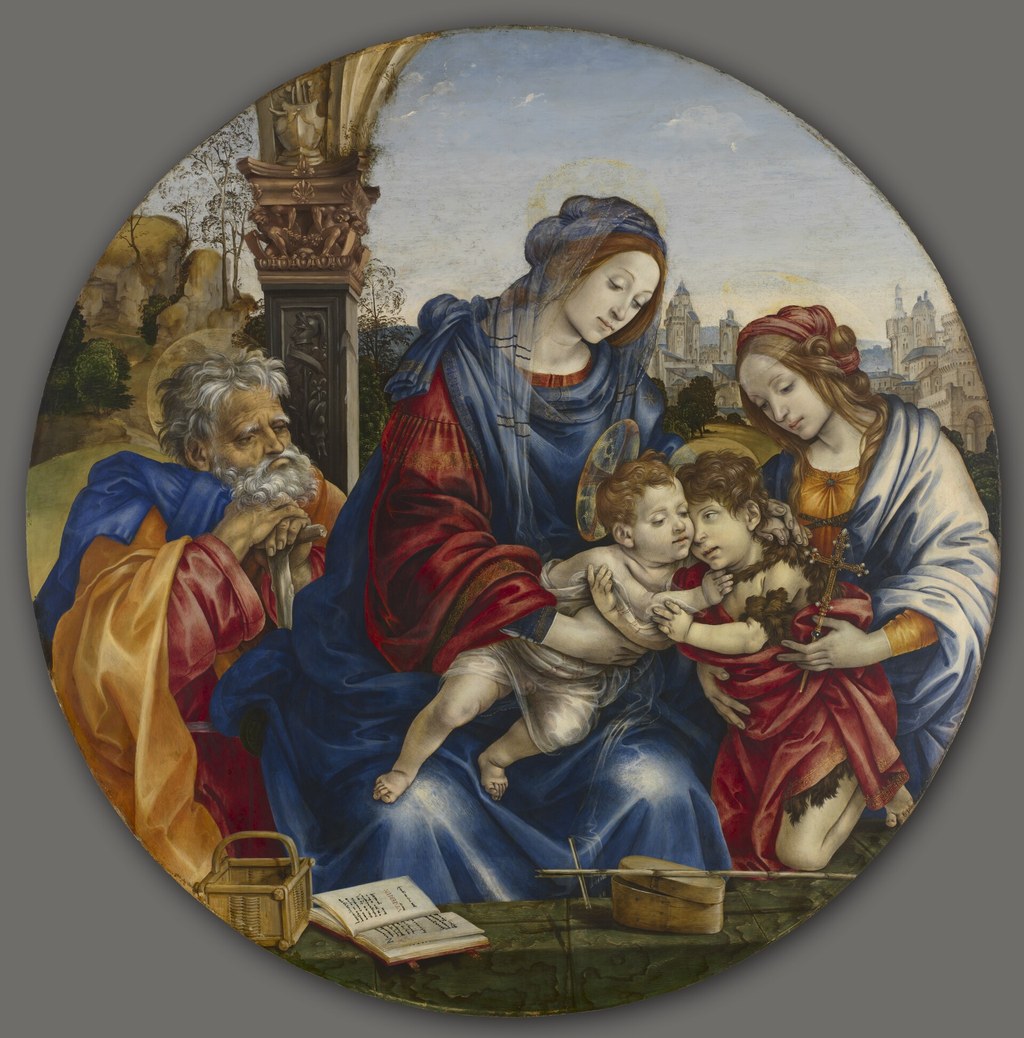
Filippino Lippi’s Holy Family with Saint John the Baptist and Saint Margaret, painted in Rome around 1488–93 and now in the Cleveland Museum of Art, is one of the most important surviving paintings of his mature career. Cleveland describes it as one of Filippino’s most significant works and identifies it as the only known independent painting he produced during his Roman years.[1]
That distinction immediately gives the panel unusual value. Filippino’s Roman period is normally associated above all with the monumental Carafa Chapel frescoes in Santa Maria sopra Minerva. The Cleveland tondo shows how the same encounter with antiquity affected a portable devotional painting.[1] Cardinal Oliviero Carafa commissioned the work while Filippino was frescoing his chapel. The painting therefore belongs to the same patronal and intellectual environment as the Carafa cycle, yet its circular format, domestic sacred subject and close grouping of figures demand a very different solution.
The composition contains five principal figures: Joseph, the Virgin Mary, the Christ Child, the young Saint John the Baptist and Saint Margaret. Mary holds Christ as he embraces John, who is supported by Margaret. Joseph watches from behind a low wall. The circular support makes the grouping particularly challenging. Filippino overlaps bodies and gestures tightly, creating a composition that feels intimate without becoming confused.
Recent technical study has made the painting even more important. A comprehensive conservation treatment completed in October 2025 removed discoloured varnish residues and remnants of earlier overpainting, while X-radiography, infrared reflectography and scientific pigment analysis revealed the structure beneath the visible surface. The results show Filippino repeatedly revising the painting. Infrared imaging reveals alternative compositional ideas, including a bundle of drapery in the place eventually occupied by Joseph and a rough grid that may have helped organise the design.
The technical evidence therefore confirms something already suggested by Filippino’s many surviving drawings: he was an iterative artist. He developed compositions through trial, correction and transformation rather than simply transferring a fully resolved idea to the panel. The painting also contains one of the clearest examples of Filippino’s creative response to antiquity. A preparatory drawing based on an antique Venus was transformed into the Christian figure of Saint Margaret. That process — antique body becoming Christian saint — captures the character of Filippino’s Roman imagination almost perfectly.
At a Glance
- ArtistFilippino Lippi
- TitleHoly Family with Saint John the Baptist and Saint Margaret
- Datec. 1488–93
- MediumTempera and oil on wood
- FormatMonumental tondo
- Diameter153 cm
- Framed dimensionsapproximately 184 × 186 × 9.5 cm
- Current locationCleveland Museum of Art
- PatronCardinal Oliviero Carafa
- Place of productionRome
- Distinctive statusonly known independent painting Filippino produced during his Roman years
- Principal figuresJoseph, Mary, Christ, Saint John the Baptist, Saint Margaret
- Major antique sourcestudy after a Venus transformed into Saint Margaret
- Key pigmentextensive ultramarine
- Major technical researchX-radiography, infrared reflectography, FORS, XRF, cross-sections and SEM-EDS
- Conservationcomprehensive treatment completed October 2025
Contents
- What Does the Painting Show?
- Mary
- Why Saint Margaret?
- Cardinal Oliviero Carafa
- The Antique Venus
- Remarkable Condition
- Infrared Reflectography
- Ultramarine
- Sacred and Domestic Objects
- Looking
- Comparison with the Strozzi Chapel
- Cleveland Acquisition
- Open Access
- Why the Holy Family Matters
- Frequently Asked Questions
- References
What Does the Painting Show?
The Virgin Mary occupies the emotional centre. She supports the Christ Child, who turns towards and embraces the young Saint John the Baptist. John is supported by Saint Margaret.
Joseph stands behind a low wall at the left. The figures overlap closely. This creates a chain of physical contact.
Margaret supports John. John reaches Christ. Mary holds Christ.
Joseph watches. The painting therefore turns sacred relationship into bodily connection. The figures are not arranged as isolated icons around a throne. They form one intertwined group.
The Holy Family Expanded. The title “Holy Family” normally suggests Mary, Joseph and Christ. Filippino enlarges that core. John the Baptist enters as Christ’s cousin and future forerunner.
Saint Margaret introduces a further devotional presence. This expansion gives the composition more than family intimacy. It creates a miniature sacred community.
Each figure has a different relationship with Christ. Mary is mother. Joseph is guardian.
John is prophetic forerunner. Margaret is saintly supporter and witness. The painting therefore combines domestic affection with theological identity.
Christ and Saint John. The embrace between Christ and John is the most immediate emotional action. Both are children. Their physical affection makes the relationship appear natural.
Yet Christian viewers know the future contained within the gesture. John will announce Christ. Christ will undergo the Passion.
The apparent childhood intimacy therefore carries prophetic weight. Renaissance artists frequently used encounters between the infant Christ and young John to compress future sacred history into domestic scenes. Filippino makes that compression especially tender. The embrace is human first and symbolic second. That sequence helps explain the painting’s emotional accessibility.
Mary
Mary’s role is both physical and devotional. She holds Christ securely while allowing his body to move towards John. Her pose must therefore solve a difficult compositional problem.
She has to anchor the centre while participating in movement. Filippino achieves this through overlap. Her body becomes the structural core around which the two children turn. The Virgin is not monumental through isolation. She is monumental because the entire composition depends upon her.
Joseph. Joseph stands behind the low wall. His relative distance from the central group is traditional in many Renaissance Holy Family compositions. Yet the technical study reveals something especially interesting about his presence.
Infrared reflectography shows that Filippino considered a different element in this area: a bundle of drapery appears in the underdrawing where Joseph now stands. This means Joseph’s final position emerged through revision. He was not simply present from the first conception. The visible figure records a decision made during the painting process.
Saint Margaret. Saint Margaret is one of the painting’s most intellectually interesting figures because of her relationship with ancient sculpture. Cleveland’s research connects a preparatory study after an antique Venus with Margaret’s final pose.[1] Filippino did not reproduce the classical statue as Venus.
He converted its bodily form into a Christian saint. This is a perfect example of Renaissance reuse. The ancient body survives.
Its religious identity changes completely. For Filippino, antiquity was therefore not an archaeological world to reconstruct faithfully. It was a vocabulary. Forms could be detached from their original meanings and made to serve new ones.
Why Saint Margaret?
Saint Margaret of Antioch was a popular Christian martyr associated with miraculous deliverance and, in later devotion, childbirth. Her inclusion in a Holy Family image could therefore have domestic resonance. She also gives Filippino another adult female figure with which to balance Mary.
Composition and devotion work together. Margaret supports John physically. She also extends the sacred community beyond Christ’s immediate family. Her antique-derived pose makes the figure one of the clearest points at which Roman visual study becomes Christian invention.
The Tondo Format. A tondo is a circular painting or relief. The format became particularly important in Renaissance Florence, especially in domestic devotional art. The circle creates compositional challenges.
There are no stable corners. Vertical figures can easily feel awkward. Groups must respond to a continuous curved boundary.
Filippino solves this by overlapping bodies and creating internal arcs. Heads and shoulders move around the circle. Arms and children connect the centre. The figures feel compressed, but the compression is deliberate. The circle encourages unity.
Monumental Domesticity. At 153 centimetres in diameter, the Cleveland painting is a large tondo.[1] This is important. The work has the intimacy of domestic devotion but the scale of an imposing prestige object.
The size would have made it visually dominant within an interior. It therefore joins private spirituality with display. A powerful cardinal could commission a devotional image that was also materially magnificent. The circular format softened the monumentality. The viewer encounters a family-like cluster rather than a formal altarpiece hierarchy.
Cardinal Oliviero Carafa
Carafa commissioned the painting during the same Roman years in which Filippino decorated the chapel dedicated to Saint Thomas Aquinas. The cardinal was a major political and ecclesiastical figure. His patronage of both fresco and panel demonstrates sustained confidence in Filippino.
The two commissions also show different dimensions of his devotional identity. The Carafa Chapel is public, intellectual and monumental. The tondo is more intimate.
One celebrates Dominican theology and institutional prestige. The other centres on sacred family relationships. Carafa therefore did not ask Filippino simply to repeat one successful Roman style. He commissioned different objects for different forms of devotion.
The Only Known Independent Roman Painting. Cleveland’s 2025–26 exhibition identifies the tondo as the only known independent painting Filippino produced in Rome.[1] That makes the object exceptionally important. Without it, Filippino’s Roman development would be understood mainly through frescoes and drawings.
The Cleveland painting lets us ask how the same interests operated on wood.[1] Antique sources appear. Architectural fragments appear.
Technical revision appears. But the scale and emotional focus differ from the Carafa Chapel. The Roman transformation therefore crosses media. It is not merely a fresco style.
Rome in the Background. A weathered architectural pier stands behind the sacred group. Cleveland interprets it in relation to the remnants of ancient architecture and decoration Filippino encountered across Rome.[1] The pier is not a reconstructed classical monument.
It looks fragmentary. This is significant. Filippino’s Rome was a city of remains. Broken structures could stimulate imagination precisely because they were incomplete. The background therefore reflects the archaeology of experience rather than a fantasy of pristine antiquity.
The Antique Venus
The preparatory drawing after Venus is perhaps the single most revealing piece of evidence associated with the work. An ancient female body becomes Saint Margaret. The transformation shows that Filippino studied pose separately from identity.
He could admire how an ancient sculptor organised weight, hips, torso and limbs. He could then reuse that bodily logic without retaining pagan subject matter. This is not simple Christian censorship of Venus.
It is artistic appropriation in the literal sense of taking a useful form and making it function differently. The process demonstrates why drawing was so important to Filippino. Paper provided the space in which ancient observation could be translated before entering a finished sacred painting.
Filippino’s Drawings. The Met’s large corpus of surviving Filippino drawings makes this technical process unusually visible.[6] Some drawings study individual figures carefully. Others experiment with costumes, gestures or architectural details.
The Cleveland tondo gives us a rare opportunity to connect such paper studies with scientific examination beneath the paint.[1] Drawing history and conservation science meet. A preparatory sheet tells us what Filippino observed.
Infrared reflectography tells us how the design changed on the panel. The finished image shows what he ultimately chose. Three stages of invention survive.
The 2025 Conservation Treatment. Cleveland completed a comprehensive conservation treatment in October 2025.[1] The work addressed discoloured varnish residues and remnants of earlier overpainting, particularly in the sky. This is important because old restoration layers can alter colour and form dramatically.
A yellowed varnish can suppress cool tones. Overpaint can conceal original edges or damage. Removing or reducing those later layers can recover relationships closer to Filippino’s surviving original surface. The treatment therefore improved both preservation and interpretation.
Remarkable Condition
Cleveland describes the painting as being in remarkable condition for its age.[1] That survival is especially valuable because technical examination can study substantial original material rather than a surface dominated by later reconstruction. Good condition does not mean untouched.
The 2025 treatment itself confirms a history of varnish and overpainting. But it means enough of Filippino’s original work survives to support detailed material analysis. This makes the tondo unusually important for understanding his technique.
The Wooden Panel. X-radiography revealed that the support consists of four large vertically flat-sawn boards. They are joined and reinforced with two original horizontal battens. The battens fit within mortise-and-tenon joints.
This structural evidence reminds us that a Renaissance painting began as carpentry. Before Filippino painted Mary or Christ, artisans had to create a stable circular support. At 153 centimetres across, the construction problem was substantial.
Wood moves with environmental conditions. The support had to resist warping and separation. The surviving original battens are therefore part of the object’s technological history.
Hidden Inlay in the Battens. The X-ray also revealed a repeating inlay design of diamonds and elongated lozenges within the battens. This is a fascinating hidden detail. Modern viewers do not normally see the rear structural system as decoration.
Yet the support itself received aesthetic attention. The finding complicates the division between “painting” and “frame” or “support”. A Renaissance object could be crafted beautifully even in areas not central to the painted image. Scientific imaging therefore recovers evidence invisible in ordinary gallery viewing.
Infrared Reflectography
Infrared reflectography reveals underdrawing beneath many paint layers. In the Cleveland tondo, IRR shows an elaborate and varied drawing process.[1] Filippino used different materials to draft, refine and revise.
The underdrawing is therefore not one clean outline. It records stages. This matters because it contradicts the idea that a Renaissance master always arrived at the panel with the composition fully solved. Filippino continued thinking while working. The panel was part of design, not merely execution.
The Missing Bundle of Drapery. One of the most striking revisions involves Joseph’s area. The infrared image shows an alternative bundle of drapery where Joseph eventually appears. This change provides direct evidence of compositional reconsideration.
The final Joseph was not inevitable. Filippino weighed alternatives. Changing one area would affect neighbouring shapes and balances. The technical image therefore allows us to witness decision-making that the finished surface hides. It is almost like seeing a discarded draft beneath a published text.
The Grid. Infrared imaging also reveals a rough grid. Cleveland suggests it may have been used to plan the composition.[1] A grid could help organise scale, transfer designs or maintain proportions across a large support.
Its presence is especially interesting in a circular picture. The tondo offers fewer stable architectural reference points than a rectangle. A planning structure could help control the complicated overlap of five figures. Yet the grid did not prevent revision. Geometry and improvisation coexist.
Pigment Analysis. The technical study used several scientific methods, including fiber optic reflectance spectroscopy, X-ray fluorescence, cross-section analysis and scanning electron microscopy with energy-dispersive spectroscopy. Together these techniques identified pigments used by Filippino. They include ultramarine, copper-based greens, lead-tin yellow, vermilion, insect-derived red lakes, lead white, earth pigments and gilding.
This palette confirms the painting’s material richness. Colour was not an incidental final layer. It depended on expensive substances, workshop knowledge and careful preparation.
Ultramarine
Cleveland draws special attention to ultramarine.[1] The pigment was derived from lapis lazuli and was extraordinarily expensive. The museum notes that it could cost many times more than gold.
Filippino uses it lavishly. Remarkably, ultramarine appears even in tiny rooftops along the distant horizon. This tells us something about patronage as well as colour.
Such use required money. A powerful cardinal could demand or support a level of material luxury inappropriate to an ordinary workshop product. The blue therefore becomes evidence of Carafa’s investment in the object.
Colour and Prestige. Expensive pigments had devotional and social value simultaneously. Blue carried strong Marian associations. Ultramarine could honour the Virgin through precious material.
It also signalled the resources behind the commission. Renaissance patrons understood that colour had cost. A brilliantly blue garment could therefore communicate piety and magnificence at once. Filippino’s extensive use across the tondo demonstrates how patron, theology and material technology intersect.
Tempera and Oil. Cleveland identifies the medium as tempera and oil on wood.[1] This mixed description reflects the increasingly flexible painting techniques of late-fifteenth-century Italy. Artists did not always choose between “tempera” and “oil” as mutually exclusive systems.
Different binders could be used for different effects. Oil-rich passages allowed blending, saturation and certain transparent effects. Tempera supported crisp detail and rapid layering. Filippino’s technical complexity suits the visual complexity of the painting.
Gilding. Scientific analysis also confirms gilding. Gold remained important even as Renaissance painters increasingly created naturalistic space without traditional gold grounds. It could be used selectively.
Small highlights, halos or ornamental details retained the material splendour of older devotional painting. This selective survival of gold is important. The Renaissance did not simply abandon medieval materials when perspective arrived. Old and new techniques coexisted.
Sacred and Domestic Objects
The low wall behind the figures carries sacred and domestic objects. These details help create a believable lived environment. They also provide another arena for symbolic interpretation.
Care is needed. Not every cup, cloth or object must possess one fixed theological meaning. Their collective effect is more secure.
They bring divine figures into the material world. The Incarnation becomes tangible through things. This was one of the central strengths of Renaissance devotional painting.
Landscape and Distant City. Beyond the sacred group appears a distant urban and landscape setting. The small scale of the horizon contrasts sharply with the monumental foreground figures. This creates depth.
It also opens the intimate family scene towards a wider world. Cleveland’s recent scholarship on Filippino’s “distant views and other fantasies” places such backgrounds within his broader imaginative practice.[1] Distance gives the painting atmosphere. The figures are close enough to feel immediate. The city is far enough to suggest a world continuing beyond them.
Five Figures in a Circle. Cleveland calls attention to the ingenuity with which Filippino overlaps five brightly coloured divine figures within the circular support.[1] The challenge should not be underestimated. Five heads can easily become repetitive.
Five bodies can clutter a circle. Filippino uses hierarchy and overlap. Mary and Christ dominate.
John and Margaret create a counter-group. Joseph recedes. The wall separates foreground from background. The circle contains everything. The result feels dense but not accidental.
Touch. Physical touch unites the composition. Mary touches Christ. Christ embraces John.
Margaret supports John. The network gives devotional meaning a bodily form. The sacred relationships are not described only through attributes.
They are enacted through contact. This gives the painting unusual warmth. It also distinguishes the work from more formal Holy Family compositions in which figures are assembled side by side. Filippino’s family is relational.
Looking
Gaze adds another network. Joseph watches. Mary attends to Christ.
John and Christ respond to one another. Margaret’s attention supports the central exchange. These directions of looking reinforce the physical links.
The viewer is led towards the children. The emotional centre is not an isolated face. It is an interaction. This makes the painting especially suitable for domestic devotion. The sacred lesson is communicated through relationship.
Roman Antiquity without Coldness. The antique source for Margaret might suggest that Roman influence made Filippino more formal. The painting shows the opposite. Classical study enriches a highly affectionate image.
The Venus-derived pose becomes part of a chain of touch between children and adults. Antiquity does not distance the sacred figures. It helps organise their bodies. This is one reason Filippino’s classicism is distinctive. Ancient sources are absorbed into emotional narrative.
Comparison with the Carafa Chapel. The Carafa Chapel and Cleveland tondo share patron, city and chronology.[1] Yet their functions differ radically. The chapel is monumental and public-facing.
It celebrates theology, Dominican learning and Carafa’s ecclesiastical identity. The tondo is intimate and family-centred. The chapel fills architecture.
The tondo is a portable object. The comparison demonstrates Filippino’s adaptability during the same period. Roman influence was not a fixed decorative style. It could be reshaped according to function.
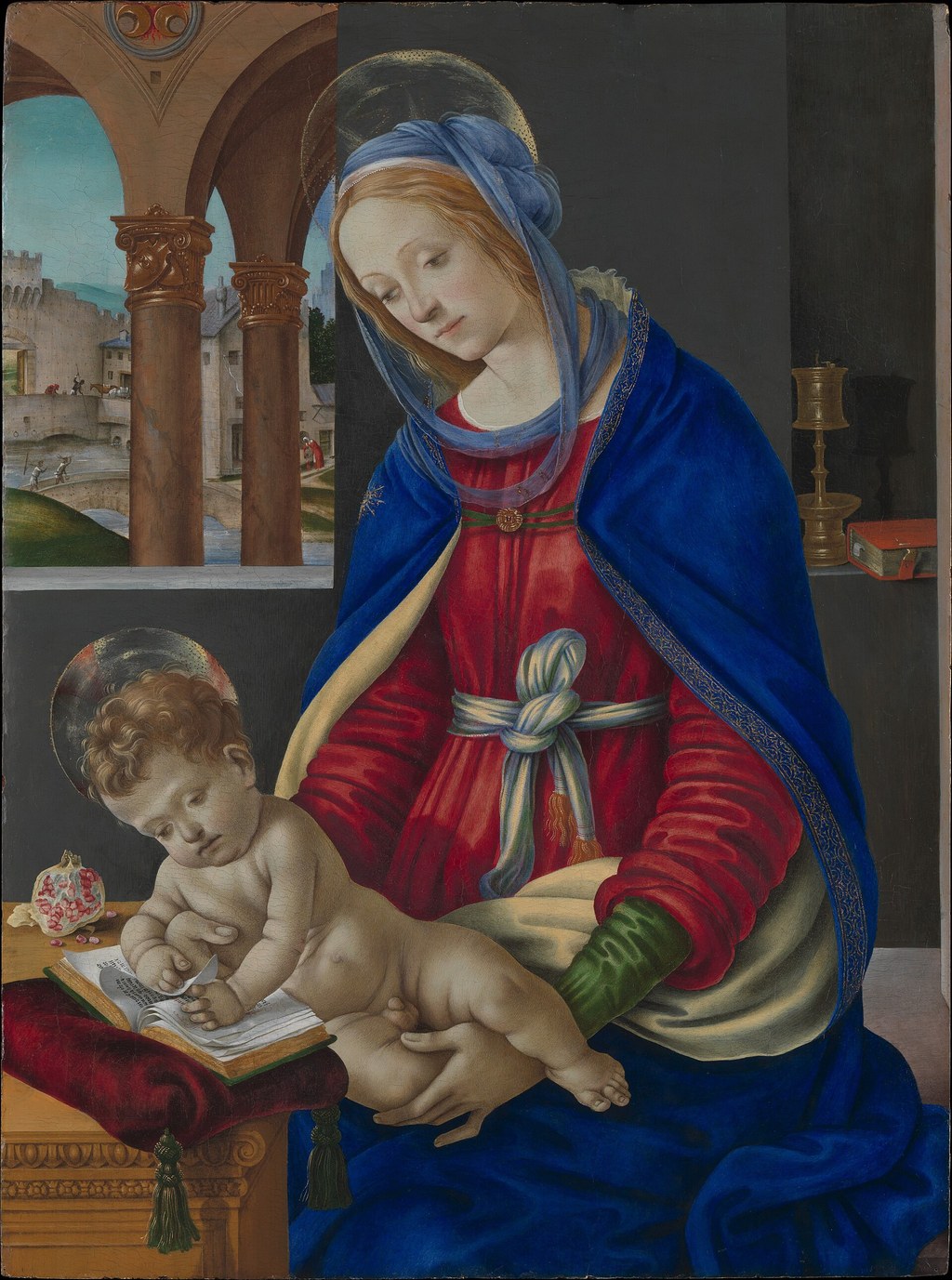
Comparison with the Met Madonna and Child. The Met’s Strozzi Madonna and Child predates Rome.[6] Comparing it with Cleveland reveals development.[1] Both paintings place Mary and Christ within richly observed environments.
Both reflect elite patronage. But the Cleveland tondo is more tightly interwoven and more explicitly indebted to antique form.[1] The contrast helps isolate what Rome changed. The early Strozzi panel is sophisticated and cosmopolitan. The Cleveland work is more archaeologically imaginative and compositionally compressed.[1]
Comparison with the Strozzi Chapel
The later Strozzi Chapel carries Filippino’s Roman vocabulary back to Florence. The Cleveland tondo therefore sits between Carafa and Strozzi as a portable record of the same transformation.[1] Its technical evidence makes it especially useful.
The Strozzi frescoes show the mature visible outcome. Cleveland shows how that kind of invention was built and revised.[1] Together they make the Roman period more than a stylistic label. They reveal process.
Provenance after Carafa. Cleveland traces the painting through Carafa-related collections in Rome and Naples.[1] By the early nineteenth century it was associated with Palazzo Santangelo, formerly Palazzo Diomede Carafa, in Naples. This continuity strengthens the connection with the patronal family.
The painting later entered international collecting networks. Around 1898–1901 it was acquired through Bernard Berenson and Edward Perry Warren for Susan Cornelia Clarke Warren in Boston. It then passed through the Warren family. Eventually it entered the Cleveland Museum of Art.[1] The provenance therefore traces a familiar transformation from Renaissance devotional object to transatlantic Old Master masterpiece.
Bernard Berenson. Berenson’s role in the painting’s modern history is notable. He was one of the most influential connoisseurs of Italian Renaissance painting around 1900. His involvement in acquiring the tondo and publishing it helped establish the work within modern scholarship.
This demonstrates how reputations are constructed. The painting existed for centuries before Cleveland acquired it.[1] But dealers, scholars, collectors and museums changed the way it was classified and valued. Modern Filippino scholarship therefore has its own history layered onto the Renaissance object.
Cleveland Acquisition
The painting was sold to the Cleveland Museum of Art in 1929 and formally entered the collection in 1932.[1] It became one of the museum’s major Renaissance paintings. Its prominence has increased further because of the 2025–26 exhibition.
The museum did not simply display an existing masterpiece. It made the object the centre of new research. Paintings can therefore have active scholarly lives long after acquisition. The Cleveland tondo is a particularly strong example.[1]
The 2025–26 Exhibition. Filippino Lippi and Rome brought twenty-five paintings, drawings and antiquities together. The Cleveland tondo stood at the centre.[1] This curatorial choice reflects its unique ability to connect several forms of evidence.
It is a finished Roman painting. It has preparatory drawings. It incorporates antique sources.
It retains technical evidence beneath the paint. Its patron connects directly to the Carafa Chapel. Few single objects can represent an artist’s transformation so comprehensively.
Iteration and Execution. The 2025 catalogue includes a dedicated technical chapter titled Iteration and Execution: Visualizing Filippino Lippi’s Technique. That title captures the central lesson of the scientific work. Execution was iterative.
Filippino revised as he proceeded. This challenges a romantic model in which inspiration produces one perfect design that assistants merely copy. The evidence instead shows repeated thought. Underdrawing, underpainting and visible surface belong to different stages. The finished painting contains a hidden history of abandoned possibilities.
Why Technical Imaging Matters. Technical imaging does not merely satisfy curiosity about process. It can change interpretation. If Joseph was added after another idea had been considered, his compositional role needs to be understood as a revision.
If a grid organised the figures, apparent spontaneity coexists with planning. If expensive ultramarine extends into tiny distant details, patronal magnificence reaches far beyond Mary’s mantle. Material evidence therefore affects art history. It tells us not only how Filippino painted but what kinds of choices mattered to him and his patron.
Open Access
Cleveland makes the painting’s image available through its Open Access initiative.[1] That is especially valuable for education and digital scholarship. High-quality details can be studied closely without relying on degraded reproductions. For a work whose importance depends on objects, underdrawing, pigment and landscape detail, image accessibility materially improves interpretation. It also makes future annotated comparison possible between visible painting, technical images and preparatory drawings.
A Rare Convergence of Evidence. What makes the Cleveland tondo exceptional is not simply the quality of the painting but the survival of several independent kinds of evidence around it. Patronage history identifies Carafa; drawings preserve antique-source study; scientific imaging records revisions; pigment analysis identifies materials; provenance traces ownership; and recent conservation clarifies the visible surface. Few Renaissance panels permit such a layered reconstruction of conception, execution and later life.[1]
Why the Holy Family Matters
The Cleveland Holy Family with Saint John the Baptist and Saint Margaret matters because it compresses the entire Roman Filippino into one object.[1] The patron is Carafa. The city is Rome.
The classical source is visible through the Venus study. The weathered architecture recalls ancient fragments. The circular composition demonstrates design ingenuity.
The ultramarine reveals patronal expense. Infrared imaging exposes revision. X-rays reveal the carpenter’s structure beneath the paint.
Conservation reveals the painting’s later material history. No other independent panel gives such concentrated evidence for this phase of Filippino’s career. The work is also emotionally compelling.
Technical complexity does not overwhelm the sacred subject. At its centre, two children embrace. Adults support and watch them.
Roman antiquity, expensive pigment and sophisticated geometry all serve an image of intimacy. That balance between learned invention and human feeling is one of Filippino Lippi’s greatest strengths. For that reason, the Cleveland tondo deserves to stand among the principal masterpieces of his career rather than as a secondary Holy Family painting attached to the Carafa story.[1]
Frequently Asked Questions
Discussion
What stands out to you most about Holy Family Cleveland in relation to Filippino Lippi's wider career?
Reader Insights
Notice how the page connects close visual detail with patronage, workshop practice and the wider Renaissance setting.
Which comparison elsewhere in the cluster helps clarify this work or theme most strongly?
Join the Conversation
Have a thought or observation about Holy Family Cleveland? Share it below. Thoughtful responses may be added to this section.
References
- Cleveland Museum of Art, The Holy Family with Saint John the Baptist and Saint Margaret, collection record and full conservation statement. View Source
- Cleveland Museum of Art, Filippino Lippi and Rome, exhibition, 2025–26. View Source
- Alexander J. Noelle, “Filippino Lippi, Cardinal Carafa, and the Cleveland Holy Family Tondo,” in Filippino Lippi and Rome, 2025. View Source
- Juliana Ly, Kathryn Dooley, John Delaney and Dean Yoder, “Iteration and Execution: Visualizing Filippino Lippi’s Technique,” in Filippino Lippi and Rome, 2025. View Source
- Jonathan K. Nelson, “Searching for Hybridity: Filippino Lippi’s Distant Views and Other Fantasies,” in Filippino Lippi and Rome, 2025. View Source
- Metropolitan Museum of Art, The Drawings of Filippino Lippi and His Circle, 1997. View Source
- Cleveland Museum of Art, historical bibliography and provenance for accession 1932.227. View Source