 by Tom Gurney
Tom Gurney BSc (Hons) is an art history expert with over 20 years experience
Published on June 19, 2020 / Updated on October 2, 2026
Email: tomgurney1@gmail.com / Phone: +44 7429 011000
The Annunciation (Murate Altarpiece) by Fra Filippo Lippi
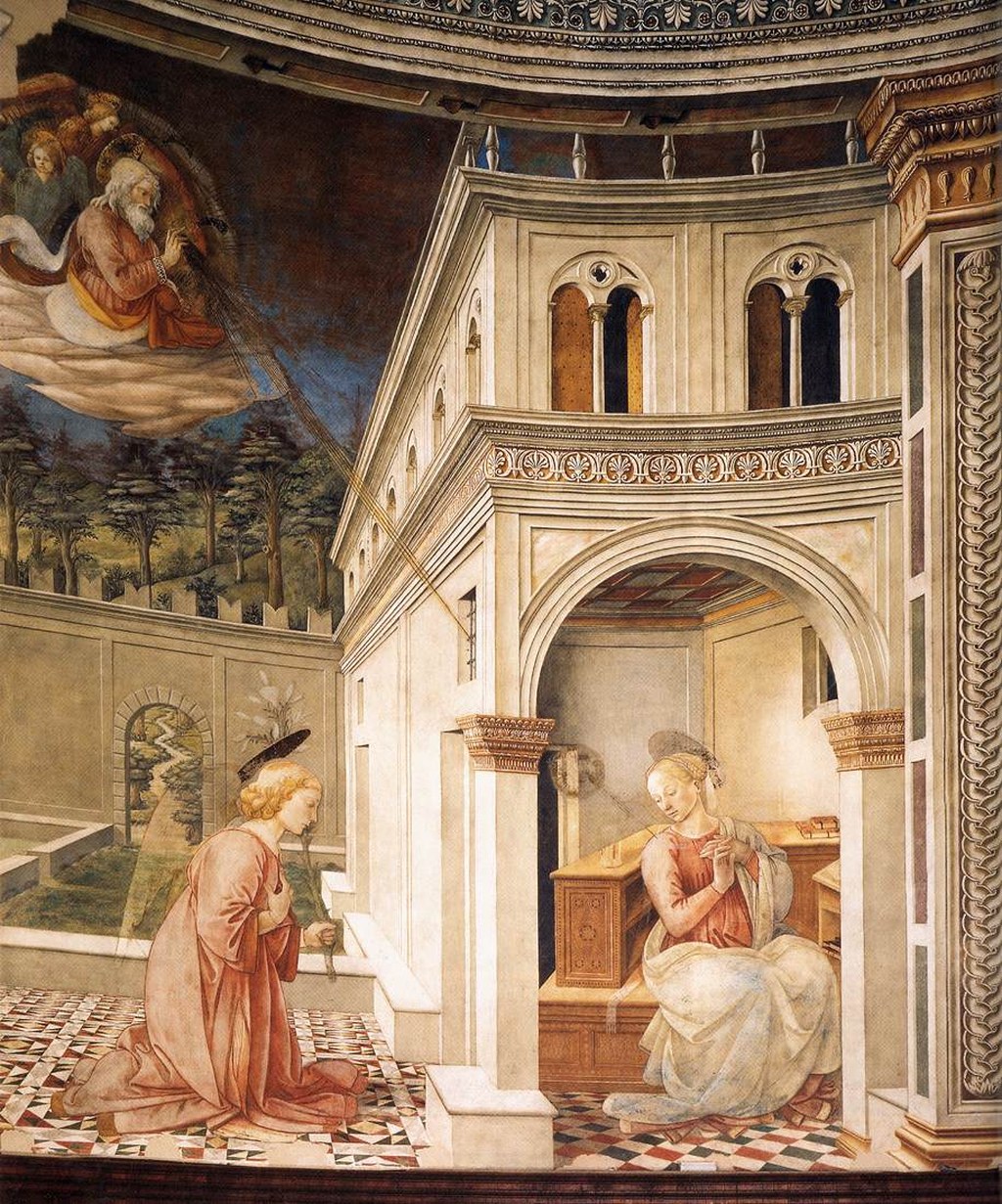
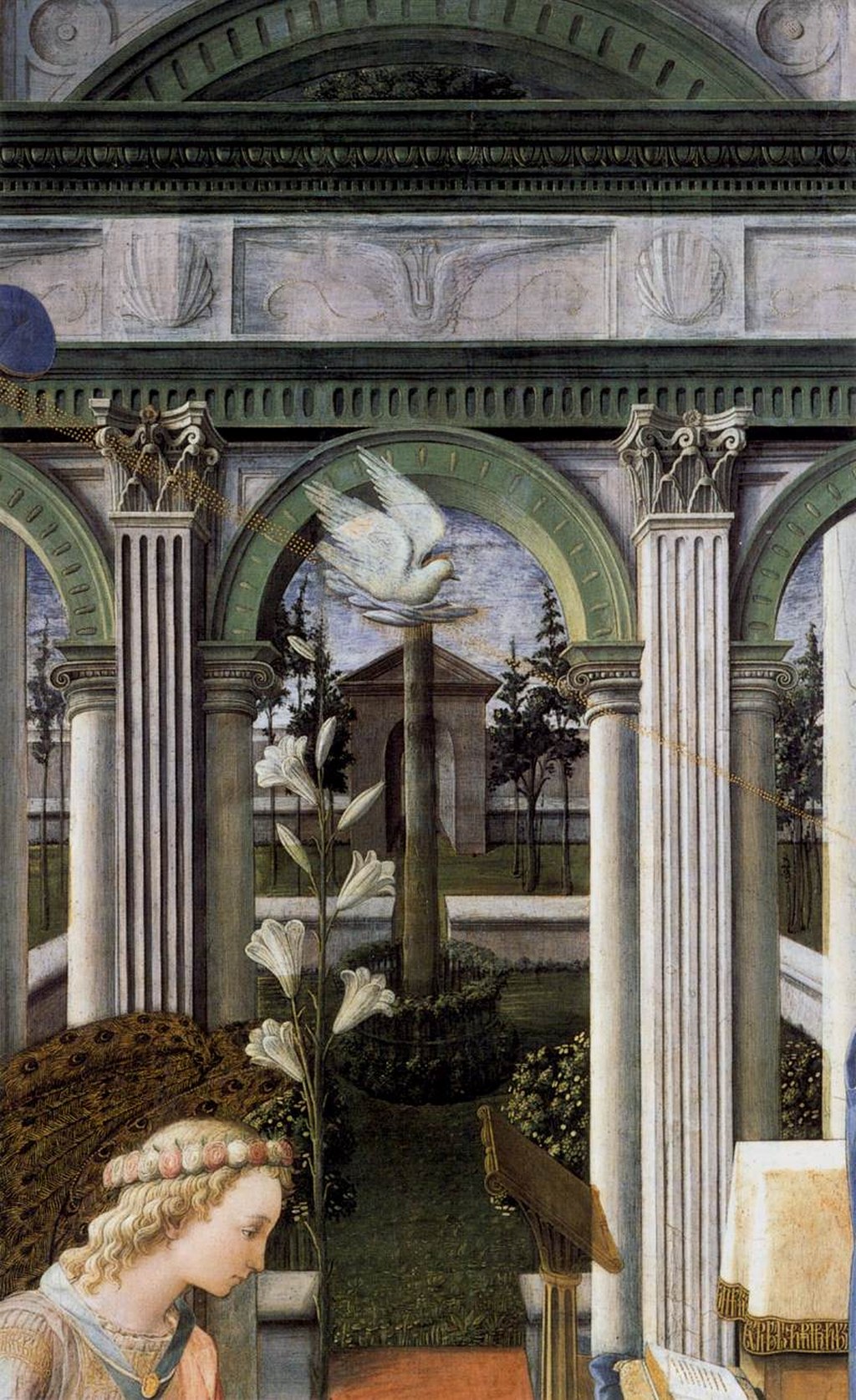
Fra Filippo Lippi's Annunciation in the Alte Pinakothek in Munich, painted about 1443-45, is one of his largest and most revealing treatments of the subject. The monumental panel once stood on the high altar of the Benedictine community known as the Suore Murate in Florence and was commissioned by Giovanni de' Benci, a banker whose wealth and status were closely tied to the Medici financial network.[1]
The painting is especially valuable because it brings together two stylistic languages that might seem contradictory. The Alte Pinakothek notes that Lippi chose an unusually elegant figure style reminiscent of International Gothic, while the deep architectural setting employs central perspective associated with the most forward-looking Florentine innovations of the period.[1] That tension is not a weakness. It demonstrates Lippi's ability to combine grace with spatial modernity and to tailor his style to a patron and female monastic audience.
At more than two metres high, the painting is very different from the quieter Medici Annunciation now in the National Gallery. Comparing the two shows how the same biblical event could be transformed by scale, setting and patronage.[4]
At a Glance
- ArtistFra Filippo Lippi
- TitleThe Annunciation
- Alternative nameMurate Annunciation / Murate Altarpiece
- Datec. 1443-45
- SupportPoplar panel
- Dimensions205.8 × 187.9 cm
- Current locationAlte Pinakothek, Munich
- Inventory number1072
- Original locationHigh altar of the Benedictine Suore Murate in Florence
- PatronGiovanni de' Benci
- Patronage contextWealth gained through career in the Medici bank
- Key stylistic contrastInternational Gothic elegance in the figures combined with innovative central perspective
Contents
- The Biblical Event
- International Gothic Elegance
- Architecture and Enclosure
- Comparison with the National Gallery Annunciation
- The Frame
- The High Altar as the Centre of Community
- Perspective as Devotional Persuasion
- Two Annunciations, Two Florences
- A Useful Chronological Marker
- FAQs
- References
The Biblical Event
The Annunciation represents Gabriel's message to Mary that she will conceive Christ through the Holy Spirit. The narrative is visually quiet but theologically immense. An artist must show a transformation that cannot be seen physically.
Lippi solves the problem through gesture, architecture, light and symbolic objects. Gabriel and Mary occupy a structured space that makes their encounter tangible. The miraculous enters a world governed by perspective.
The Suore Murate. The painting was made for a Benedictine female monastic community in Florence known as the Suore Murate. The name evokes enclosure, an important aspect of female religious life. For nuns, the Annunciation carried particular force because Mary's obedience and virginity could serve as spiritual ideals. The high-altarpiece location meant the work was encountered repeatedly within liturgy rather than as occasional decoration. Its scale therefore had to communicate across a church interior.
Giovanni de' Benci. The Alte Pinakothek identifies Giovanni de' Benci as the commissioner.[1] He had accumulated considerable wealth and status through his career in the Medici banking house. This gives the painting a useful patronage connection without making it a direct Medici family commission. The work shows how Medici economic networks supported a broader culture of patronage around Florence. Bankers, associates and clients could use wealth generated within that system to fund major religious art.
High Altar Function. A high-altarpiece operates differently from a domestic panel. It becomes part of the liturgical centre of a church. Priests, nuns and worshippers encounter it across distance and during ritual.
Large figures and architectural clarity are therefore practical as well as aesthetic choices. Lippi's panel is almost square and monumental. Its proportions support a stable, frontal sacred encounter.
International Gothic Elegance
The Munich museum stresses that Mary's figure is unusually elegant for Lippi and recalls International Gothic style. That observation is important because it complicates a simplistic story in which Renaissance naturalism simply replaced Gothic art. Florentine patrons and artists could still value elongated grace, decorative drapery and refined gesture. Lippi combines those qualities with newer spatial systems. Tradition and innovation coexist.
Central Perspective. The architectural depth is among the painting's most forward-looking features. Central perspective gives the interior measurable coherence. Receding lines direct the eye through the space and establish a believable setting for Gabriel and Mary.
Perspective therefore performs more than technical display. It makes the Incarnation feel as though it occurs inside a world the viewer could enter. This is one of the great conceptual achievements of Renaissance religious painting. The miraculous becomes spatially plausible without becoming ordinary.
Mary. Mary is represented with a refined elegance suited to the painting's devotional and institutional context. Her response is controlled rather than theatrical. That restraint supports the Benedictine setting.
The ideal is obedience, not spectacle. Lippi's figure communicates dignity through line and posture. The painting thus demonstrates how bodily grace can carry theological meaning.
Gabriel. Gabriel approaches as messenger and servant. His presence initiates the event but does not overwhelm Mary. Annunciation paintings depend on a delicate balance between angelic splendour and humility. Lippi uses gesture to establish reverence. The encounter is asymmetrical in role but balanced compositionally.
Architecture and Enclosure
The architectural setting has special relevance in a female monastic context. Enclosure was both physical and spiritual. The convent separated its members from ordinary urban life while creating an interior community ordered towards devotion. An Annunciation occurring in a controlled architectural space could resonate strongly with that experience. Mary's chamber becomes an idealised sacred enclosure.
Perspective Versus Ornament. The panel's greatest stylistic interest lies in the coexistence of rational depth and decorative elegance. Modern histories often divide these tendencies into “Gothic” and “Renaissance”. Lippi did not have to choose.
He could use perspective to construct the room and elegant line to define the figures. The result suggests that Renaissance change was additive as much as revolutionary. New spatial ideas could be absorbed without abandoning older ideals of beauty.
Comparison with Masaccio. Lippi had grown up in the Carmelite environment of Santa Maria del Carmine, where Masaccio's Brancacci Chapel transformed Florentine painting. Masaccio's influence encouraged attention to bodily weight, light and coherent space. The Munich Annunciation shows Lippi retaining that spatial seriousness while developing a more ornate and graceful figure style.
The comparison clarifies Lippi's independence. He is neither a conservative Gothic painter nor a simple follower of Masaccio. He synthesises.
Comparison with Fra Angelico. Fra Angelico repeatedly painted the Annunciation for monastic settings. His versions often combine lucid architecture with intense quiet. Lippi shares that interest but his figures tend towards a more worldly elegance. The comparison is useful because both artists demonstrate that perspective and devotion were not opposites. Measured space could enhance contemplation.
Comparison with the National Gallery Annunciation
The London Medici panel dates only a few years later but serves a different function. Munich is monumental, vertical and ecclesiastical. London is long, horizontal and probably architectural decoration within a palace.
Munich addresses a Benedictine community at the high altar. London addresses Medici domestic space and operates as a pendant to Seven Saints. The comparison proves that Lippi did not repeat one successful Annunciation formula. He redesigned the subject according to site.
Female Monastic Audience. The identity of the Suore Murate is central to understanding the commission. The Annunciation was one of the most important Marian events for women living under religious vows. Mary's virginity, humility and consent could be understood as models of obedience to divine vocation. This does not mean every nun read the image identically. But the institutional audience gives the subject a depth lost if the painting is treated only as a perspective exercise.
Patronage and the Medici Bank. Giovanni de' Benci's career illustrates how economic history and art history overlap. Banking created wealth, mobility and networks of trust. That wealth could be redirected towards religious commissions.
The Medici bank therefore influenced Florentine art beyond works directly ordered by Cosimo or Piero. Associates such as Benci formed a wider patronage ecosystem. The Munich panel gives that ecosystem a surviving visual form.
Monumental Scale. The panel's 205.8-centimetre height matters. Online reproduction can make it seem comparable with a small devotional picture. In person, it is architectural.
Mary and Gabriel approach life scale. The interior becomes something the viewer can imagine extending into real space. That physical scale makes the perspective more persuasive and the encounter more public.
The Frame
The Pinakothek records a frame dating to the fifteenth or sixteenth century. Even where the precise relationship between surviving frame and original installation requires specialist caution, the presence of an early frame is valuable. Frames mediate between painted architecture and real architecture. A high-altarpiece was never simply an image floating on a wall. Carpentry, gilding and altar furnishings contributed to its effect.
From Florence to Munich. The panel eventually entered the Bavarian royal collection and was transferred into state ownership in 1850. Its movement transformed function. The high-altarpiece of a Florentine female monastery became an Old Master painting in a public museum. Modern viewers can examine it closely but no longer encounter it through the liturgy or architecture of the Suore Murate. Reconstructing that context is therefore essential to interpretation.
The Suore Murate and Florentine Enclosure. The name “Murate” carries more than local colour. It refers to women who lived within a religious culture of enclosure, a system that organised movement, access and visibility as part of spiritual discipline. An image of Mary receiving Gabriel inside a controlled architectural space would therefore have had special resonance. The Annunciation is itself a story about a woman encountered in privacy and called to an extraordinary vocation.
The relationship should not be made crudely autobiographical: the nuns were not simply being told that they were Mary. But the scene offered a powerful model of listening, obedience and sacred interiority. That helps explain why the subject was so common in female monastic institutions.
The High Altar as the Centre of Community
The high altar was not just a prominent wall position. It was a focal point around which worship, feast days and the rhythm of religious life were organised. Lippi's painting therefore participated in repeated action. It stood behind or above liturgical performance and became visually associated with prayer over years rather than one-time viewing. This sustained use helps explain the importance of clarity. The picture did not need to surprise its audience every morning; it needed to continue supporting attention. Its balanced architecture and restrained figures suit that purpose.
Giovanni de' Benci and the Wider Medici World. Giovanni de' Benci is a useful figure because he widens the story of Medici patronage beyond the family itself. The Medici bank created careers, alliances and fortunes. People whose status grew inside that economic system could become major patrons in their own right. Benci's commission therefore shows an indirect cultural effect of Medici finance. The bank did not have to pay for every object personally for its network to shape Florentine artistic demand. The commission consequently belongs to the wider Medici economic network while remaining distinct from direct Medici family patronage.
Why International Gothic Still Mattered. The Pinakothek's description of the figures as recalling International Gothic is particularly important because older textbook narratives sometimes make Gothic elegance sound obsolete by the 1440s. It was not. Graceful line, refined costume and courtly posture remained meaningful visual choices. A patron could value those qualities while also admiring the new ability to construct deep space. Lippi's painting therefore demonstrates coexistence rather than replacement. The Renaissance did not arrive as a switch suddenly turning medieval taste off.
Perspective as Devotional Persuasion
Central perspective is sometimes presented as a secular or scientific achievement imposed upon religious art. In this panel it serves devotion. A coherent room makes Gabriel's arrival feel more immediate. The viewer can imagine where bodies stand and how the architecture recedes.
The miracle happens in a space that appears lawful and intelligible. That makes the supernatural intervention more, not less, striking. The divine enters the measurable world. This is one reason perspective became so powerful in Christian imagery.
The Scale of Mary and Gabriel. At more than two metres high, the panel gives the principal figures a bodily presence impossible to appreciate in thumbnails. The scale helps bridge painted and real architecture. A nun or worshipper could experience Gabriel and Mary as presences occupying a comparable physical world rather than as tiny figures inside a precious object. This is a useful contrast with Lippi's household Madonnas, where intimacy comes from small distance. In Munich, intimacy must be created within monumentality.
A Painting Tailored to Audience. The work is one of the clearest demonstrations that Lippi could alter his visual language for a specific audience. The female Benedictine setting encouraged a contemplative Marian subject. The patron's wealth supported monumental scale.
The high altar demanded public legibility. Contemporary taste permitted decorative elegance. Florentine innovation encouraged perspective. The painting is the negotiated result of all these conditions. Seeing those conditions together is more historically useful than trying to decide whether the picture is “Gothic” or “Renaissance”.
Two Annunciations, Two Florences
The Munich and London panels also reveal two different social Florences. The Murate altarpiece belongs to a female religious institution supported by a wealthy banker. The London pair belongs directly to Medici household culture.
One presents the Annunciation as the centre of monastic worship. The other inserts it into dynastic palace decoration. Lippi's ability to serve both worlds helps explain his demand among elite patrons.
Original Context and Modern Museum Experience. The Alte Pinakothek gives modern viewers conditions the nuns never had: consistent lighting, close approach and the ability to compare the panel with works from other schools.[1] But the museum also removes the liturgical frame. Both forms of looking are necessary: the altarpiece rewards close scrutiny while its scale and perspective were designed for a monumental setting. We can examine details as museum visitors while reconstructing the fact that the picture once stood above the central altar of an enclosed religious community. Neither perspective should cancel the other.
Reading the Painting as a Negotiation. The strongest interpretation of the Murate Annunciation is not that one style defeated another, but that Lippi negotiated among several demands. The nuns required an image suitable for devotion. The patron required a prestigious commission.
The high altar required monumentality. Florentine artistic culture rewarded convincing perspective. Contemporary taste still valued refined, courtly beauty. Lippi's solution satisfies all of them. This helps explain why the painting feels simultaneously traditional and innovative. The mixture is purposeful.
A Useful Chronological Marker
The c. 1443-45 date places the panel between the early works of 1437 and the major late-1440s commissions such as the Maringhi Coronation. That position makes it useful for charting Lippi's development. The bodies remain substantial, but line and ornamental grace are becoming more prominent. Architectural perspective is increasingly assured. The painting therefore helps bridge the Madonna of Tarquinia and the mature elegance of later works.
Comparison with the London Annunciation. Treating Lippi’s Annunciations as interchangeable versions of one subject would lose important historical meaning. The Munich work belongs to a female Benedictine high altar and a banker patron. The London work belongs to Medici palace decoration and a paired dynastic programme.
Their shared subject is precisely what makes comparison useful: the viewer can see how function changes composition. The two paintings are therefore most useful when compared directly rather than collapsed into one generic treatment of the Annunciation.
Why the Murate Annunciation Matters. The Munich Annunciation matters because it captures Fra Filippo Lippi at a moment when Florentine painting could combine apparently competing visual traditions. Its figures retain International Gothic grace. Its architecture embraces central perspective.
Its patron connects the work to the Medici banking network. Its high-altarpiece function connects it to female Benedictine devotion. And comparison with the National Gallery panel reveals Lippi's remarkable adaptability.[4]
The Munich painting adds institutional and stylistic evidence that the smaller London Annunciation cannot provide on its own. It should therefore be understood as an independent commission rather than merely as one example of a generic Lippi Annunciation type.
FAQs
Discussion
What stands out to you most about The Annunciation Murate Munich in relation to Filippo Lippi's wider career?
Reader Insights
Notice how the page connects close visual detail with patronage, workshop practice and the wider Renaissance setting.
Which comparison elsewhere in the cluster helps clarify this work or theme most strongly?
Join the Conversation
Have a thought or observation about The Annunciation Murate Munich? Share it below. Thoughtful responses may be added to this section.
References
- Bayerische Staatsgemäldesammlungen – Alte Pinakothek, Fra Filippo Lippi, The Annunciation, inventory 1072, collection entry. View Source.
- Jeffrey Ruda, Fra Filippo Lippi: Life and Work with a Complete Catalogue, 1993.
- Megan Holmes, Fra Filippo Lippi: The Carmelite Painter, Yale University Press, 1999.
- Comparative National Gallery documentation for Lippi's Annunciation, NG666.