 by Tom Gurney
Tom Gurney BSc (Hons) is an art history expert with over 20 years experience
Published on June 29, 2026 / Updated on June 29, 2026
Email: tomgurney1@gmail.com / Phone: +44 7429 011000
The Merry Drinker: Frans Hals and the Art of Capturing a Moment
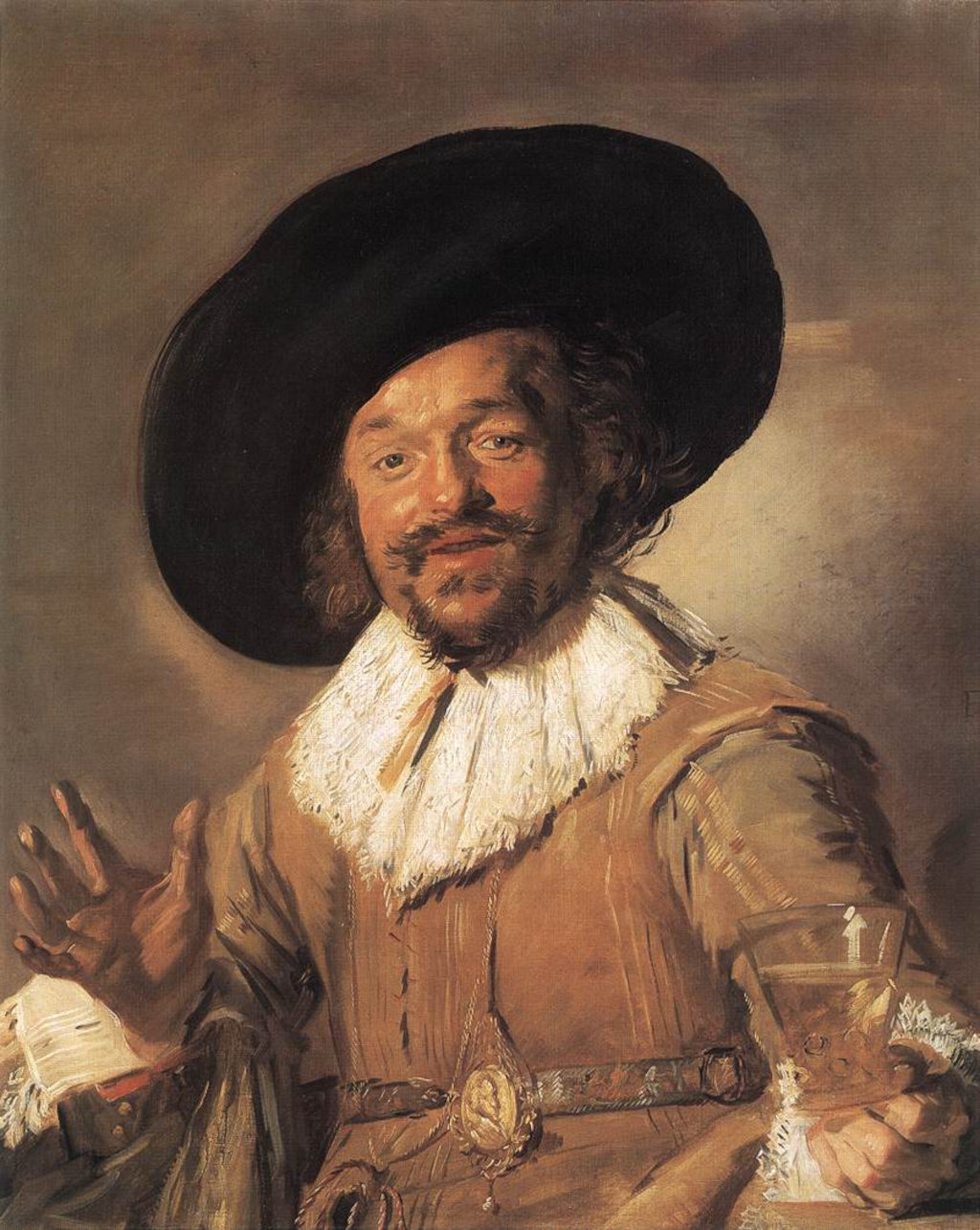
Few paintings convey such immediate warmth and vitality as The Merry Drinker. A smiling gentleman turns towards us, raising a freshly filled glass as though inviting us to join his company. His expression is open, his posture relaxed and his eyes sparkle with amusement. Although painted nearly four centuries ago, the encounter feels astonishingly modern. We do not simply observe the sitter; we feel as though we have interrupted a conversation already in progress.
This remarkable illusion lies at the heart of Frans Hals' achievement. Rather than presenting a rigid formal portrait, Hals captures what appears to be a fleeting instant. The sitter has not frozen into a ceremonial pose. Instead, he seems caught midway through a toast, responding to someone just beyond the picture's edge. The resulting sense of spontaneity would become one of Hals' defining contributions to European portraiture.
The title is also slightly misleading. There is little evidence that the sitter is genuinely drunk. His expression suggests enjoyment rather than intoxication, and the raised glass may represent sociability, hospitality or celebration rather than excess. Like many Dutch paintings of the seventeenth century, the image balances humour with restraint.
Although the identity of the sitter remains uncertain, his personality dominates the composition. Fine clothing, a broad-brimmed hat and an elegant lace collar establish his social standing, yet these signs of status never overshadow the qualities that distinguish the painting: confidence, warmth and humanity. Hals persuades us that we are meeting an individual rather than simply examining a historical costume.
Today, The Merry Drinker ranks among Frans Hals' most celebrated works. It demonstrates his ability to combine expressive brushwork with psychological presence, creating a portrait that appears to breathe, smile and move before our eyes. More than a study of conviviality, it is an exploration of human connection itself.
- ArtistFrans Hals (c.1582/3–1666)
- TitleThe Merry Drinker
- Datec.1628–1630
- MediumOil on canvas
- Current LocationRijksmuseum, Amsterdam
- MovementDutch Golden Age
- SubjectUnknown gentleman raising a glass
- Known ForSpontaneous expression, visible brushwork and lively characterisation
- Main ThemesHospitality, sociability, individuality and movement
- Why It MattersOne of the finest examples of Frans Hals' ability to transform a fleeting gesture into a timeless portrait.
Contents
- Historical Background
- Looking at The Merry Drinker
- Who is the Merry Drinker?
- How Frans Hals Created the Illusion of Life
- The Meaning of the Raised Glass
- Legacy and Influence
- The Journey of the Painting
- Where is The Merry Drinker Today?
- Timeline
- Interesting Facts
- FAQs
- Further Reading
- References
Historical Background
By the late 1620s, Frans Hals had become one of the most admired painters in Haarlem. His portraits of civic guards, prosperous merchants and local families had established a reputation founded not simply upon accurate likenesses but upon an extraordinary ability to capture personality. At a time when many portrait painters favoured formal poses and polished surfaces, Hals introduced movement, animation and psychological immediacy into his work. The Merry Drinker belongs to this mature phase of his career.
The Dutch Republic was enjoying unprecedented commercial success during these years. Expanding trade networks, thriving cities and a prosperous middle class created an energetic urban culture in which sociability played an important role. Taverns, guild halls and civic banquets were central to everyday life, providing spaces where business, friendship and celebration intersected. Artists frequently explored these settings, although Hals approached them with a distinctive emphasis on individual character rather than moral instruction.
The figure in The Merry Drinker reflects this confident society. His fashionable clothing, elaborate lace collar and broad-brimmed hat identify him as a man of comfortable means, yet Hals avoids rigid displays of wealth or authority. Instead, the raised glass transforms the portrait into an encounter. Rather than merely recording status, the painting celebrates conversation, hospitality and the pleasures of shared company.
Looking at The Merry Drinker
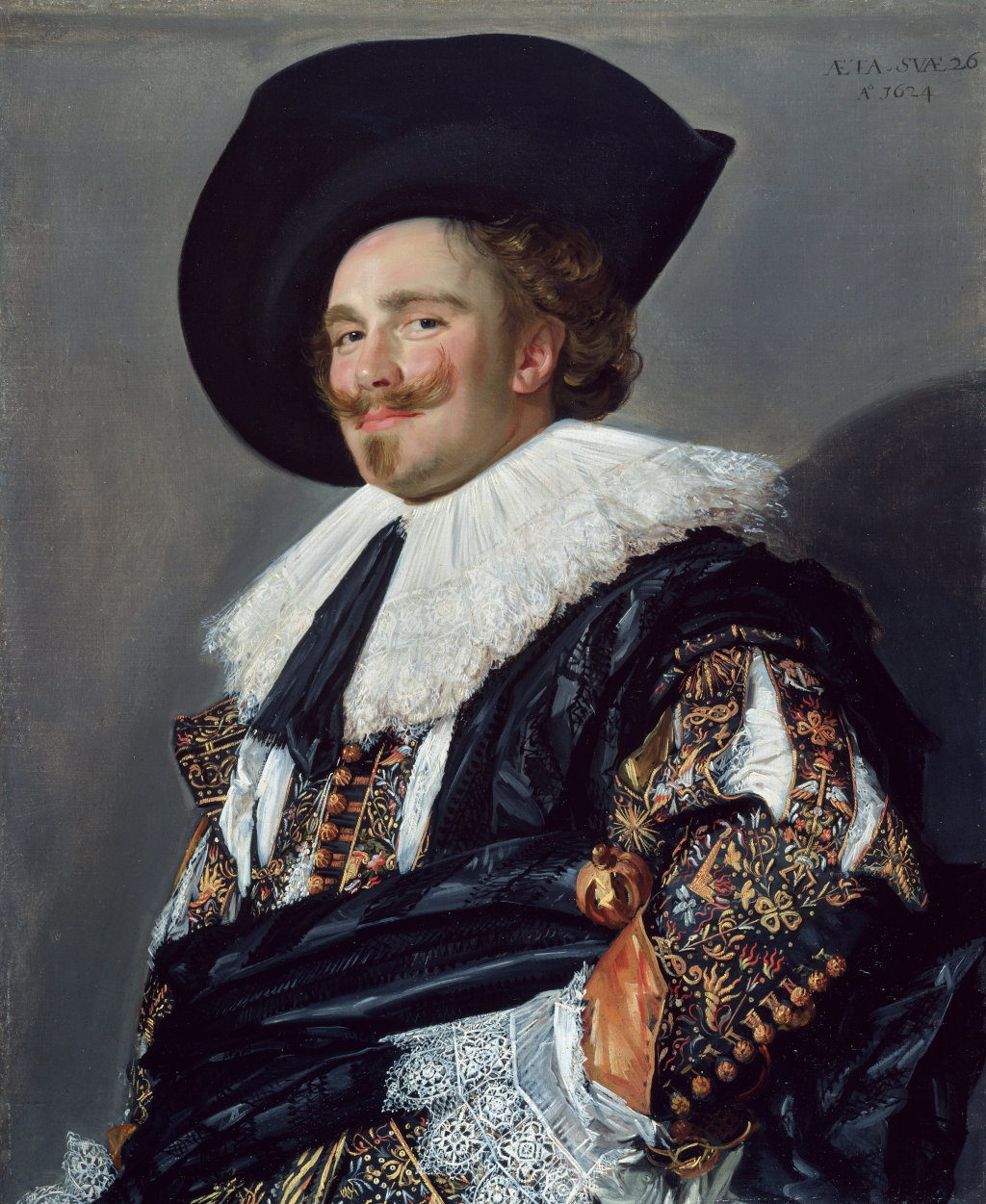
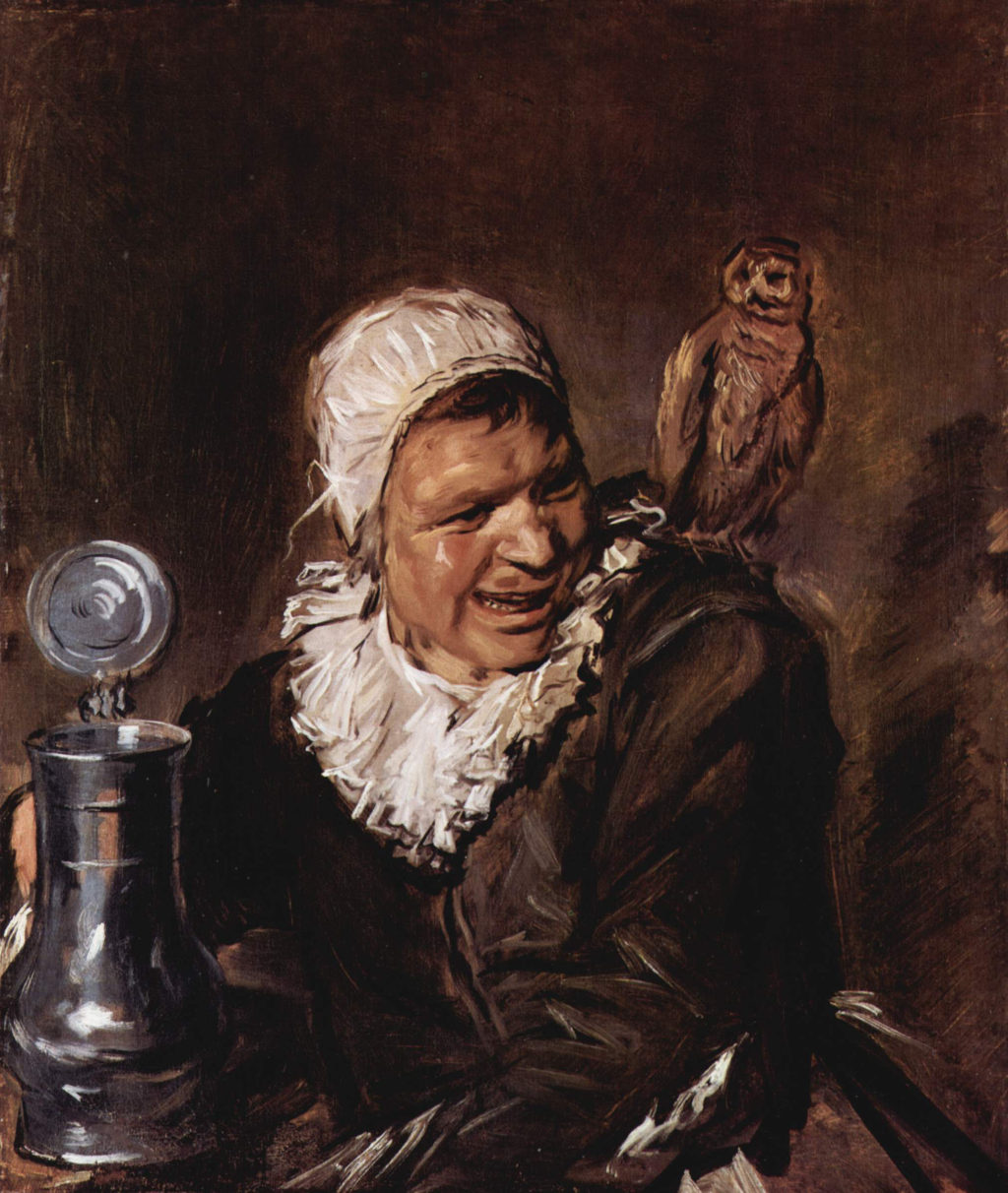
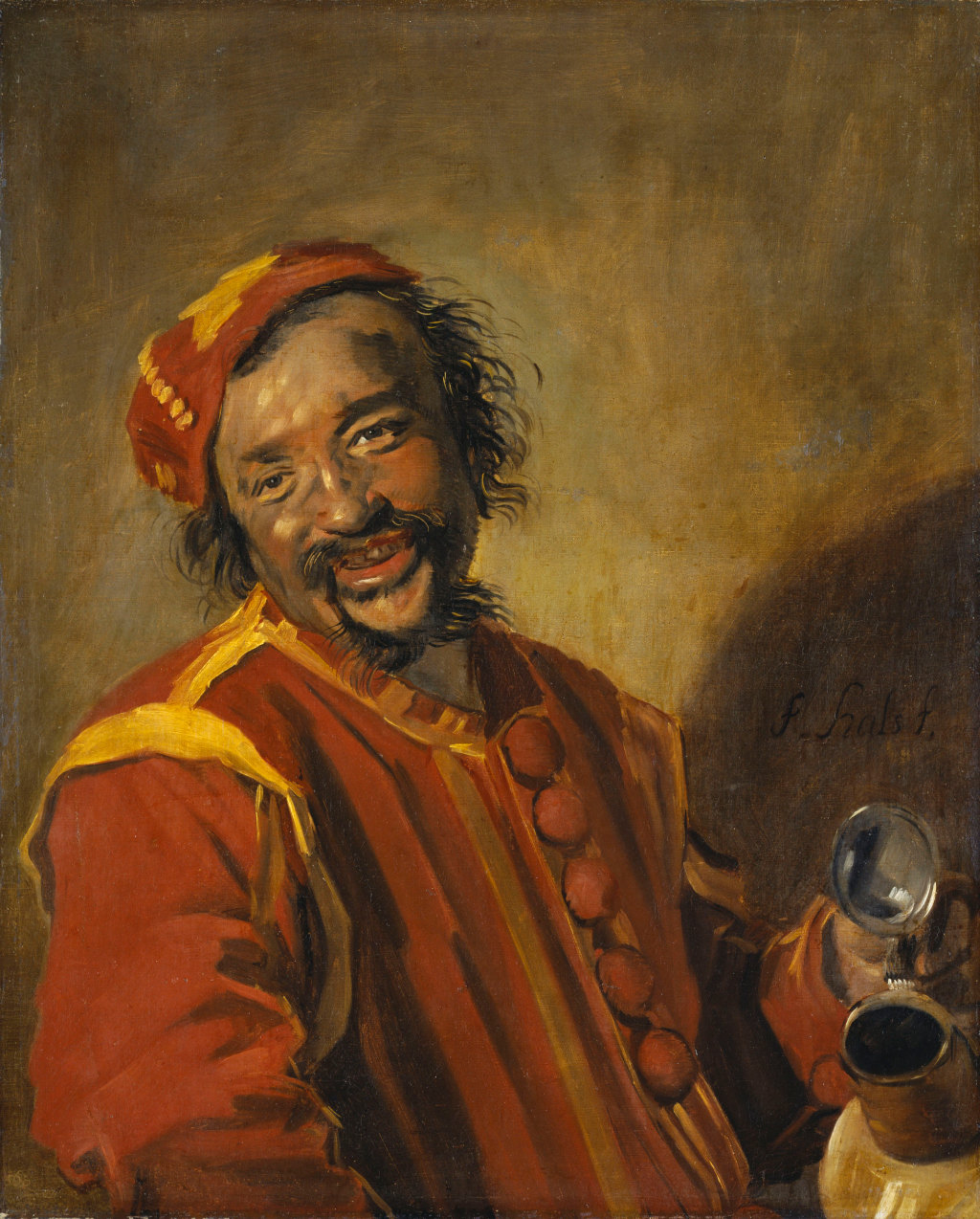
Unlike The Laughing Cavalier, which establishes authority through calm self-confidence, or Malle Babbe, which overwhelms us with uninhibited laughter, The Merry Drinker occupies an engaging middle ground. The sitter appears relaxed, approachable and entirely comfortable in his surroundings. His raised glass immediately creates a social connection with the viewer, transforming the portrait from a static likeness into an unfolding human interaction.
The composition is remarkably economical. Hals eliminates almost every unnecessary detail, allowing the figure to dominate the canvas. The dark background contains no architecture, landscape or symbolic objects beyond those held or worn by the sitter himself. Instead, attention is drawn towards three principal features: the animated face, the raised glass and the elegantly dressed figure.
The sitter leans slightly towards us while lifting his right arm in greeting. This simple gesture introduces movement into the painting without disturbing its stability. Rather than appearing carefully posed, he seems to have paused naturally during conversation. Hals was exceptionally skilled at identifying such fleeting moments of everyday behaviour and transforming them into convincing portraiture.
The costume deserves equal attention. A broad-brimmed black hat frames the sitter's head, while the magnificent lace collar catches the light and directs our gaze towards the face. The richly decorated doublet demonstrates prosperity without overwhelming the portrait. Hals consistently ensures that clothing supports character rather than replacing it.
Perhaps most remarkable is the expression itself. The smile appears genuine but restrained, suggesting pleasure rather than theatrical laughter. The slightly raised eyebrows, relaxed cheeks and attentive eyes combine to create an impression of easy confidence. We feel not that the sitter is performing for the artist, but that we have unexpectedly joined him at precisely the right moment.
Looking Closely: The Raised Glass
Before examining the sitter's face, spend a few moments looking only at the raised glass. Ask yourself who the gesture is directed towards. Is it intended for another person within the painted world, or for us as viewers? Hals deliberately leaves the answer uncertain, allowing every generation to become part of the conversation.
Who is the Merry Drinker?
Unlike many of Frans Hals' commissioned portraits, the identity of the sitter remains unknown. No inscription records his name, and no contemporary document links the painting with a particular Haarlem family. As a result, generations of scholars have attempted to determine whether the figure represents a specific individual, an idealised type or something between the two.
His clothing immediately indicates comfortable social status. The fashionable broad-brimmed hat, elaborate lace collar and finely tailored costume would have been expensive possessions during the early seventeenth century. These details suggest that the sitter belonged to Haarlem's prosperous middle classes or merchant elite rather than the world of labourers or tavern entertainers.
Yet Hals avoids presenting him as a formal gentleman portrait. Instead of standing solemnly before a column or velvet curtain, the sitter smiles warmly while raising his glass. This relaxed informality has encouraged some historians to interpret the painting as a tronie, a character study designed to explore expression and personality rather than commemorate a particular individual. Others argue that it remains a genuine portrait whose identity has simply been lost through time.
Perhaps the most revealing aspect of the painting is that modern viewers rarely ask first about the sitter's name. Instead, they respond instinctively to his personality. Hals succeeds so completely in creating the illusion of a living encounter that biography becomes temporarily secondary.
Looking Closely: Expression
Cover the raised glass with your hand while studying the painting. The portrait still feels cheerful. Now cover the face instead. Suddenly much of that warmth disappears. Hals reminds us that personality comes primarily from expression rather than gesture, while allowing each element to strengthen the other.
How Frans Hals Created the Illusion of Life
The enduring appeal of The Merry Drinker lies not simply in its cheerful subject but in Frans Hals' ability to transform paint into convincing human presence. Like the finest actors, the sitter appears entirely natural despite the careful artistic decisions underlying every aspect of the composition. Hals achieves this effect through a sophisticated combination of gesture, composition, brushwork and observation.
Composition: Capturing a Fleeting Moment
The raised arm provides the painting with its central movement. Instead of presenting the sitter frontally, Hals interrupts the stillness of portraiture by recording a gesture that exists only briefly. Toasts last seconds rather than minutes, making the viewer feel as though the image preserves a passing instant rather than a carefully arranged pose.
The body turns gently while the head returns towards the viewer, creating subtle rotational movement similar to that seen in The Laughing Cavalier. This slight twist prevents the composition from appearing rigid and encourages our eyes to move naturally between face, hand and costume before returning once again to the sitter's expression.
The Psychology of Hospitality
Human beings instinctively recognise invitations. A raised glass accompanied by direct eye contact immediately suggests welcome, celebration or shared experience. Hals exploits this psychological response with intelligence. Rather than merely depicting a man holding a drink, he allows the gesture to establish a relationship between sitter and viewer.
Equally important is the sitter's smile. It is controlled rather than exaggerated, conveying confidence without arrogance and warmth without sentimentality. Hals understood that genuine expressions are rarely symmetrical or perfectly composed. Tiny irregularities around the eyes and mouth make the smile feel spontaneous.
Brushwork: Painting the Experience Rather Than the Detail
Perhaps no aspect of The Merry Drinker has attracted greater admiration than Frans Hals' brushwork. At first sight the painting appears richly detailed. Lace seems delicately woven, velvet appears soft to the touch and polished glass catches the light with clarity. Yet as the viewer approaches the canvas, this apparent precision dissolves into bold, confident strokes of paint.
This economy of means distinguishes Hals from many contemporaries. Artists such as Gerrit Dou or Frans van Mieris delighted in meticulous finish, encouraging viewers to admire the painstaking labour invested in minute detail. Hals pursued almost the opposite objective. His brushwork remains visible, energetic and direct.
The lace collar provides one of the clearest demonstrations of this approach. From across the gallery it appears crisp, delicate and intricately patterned. Close inspection reveals an economical arrangement of white, grey and cream strokes laid confidently across the darker costume beneath. Hals understood that the human eye recognises overall patterns of light, shadow and texture more readily than individual fibres.
The face is handled with equal confidence. Warm flesh tones emerge from subtle mixtures of ochres, reds, greys and soft browns, while small accents of brighter pigment suggest reflected light around the cheeks, nose and forehead. Individual hairs in the moustache and beard are not painstakingly described; instead, they appear through quick, carefully judged touches that merge naturally when viewed from ordinary distance.
Even the raised glass demonstrates restraint. Rather than outlining the vessel with hard contours, Hals relies upon delicate highlights, transparent shadows and carefully placed reflections. The eye effortlessly recognises polished glass despite the limited number of visible brushstrokes.
Looking Closely: Viewing Distance
If you ever stand before the original painting, begin several metres away. Notice how convincing every surface appears. Then slowly approach the canvas until individual brushstrokes become visible. Hals painted for normal human vision, allowing broad strokes to resolve into convincing textures only when viewed from an appropriate distance.
Colour and Light
The colour scheme of The Merry Drinker is restrained, relying upon carefully balanced contrasts rather than brilliant display. Deep blacks dominate the costume and hat, while the luminous white collar immediately attracts attention towards the sitter's face. Small passages of warm ochre, soft pink and muted brown enliven the flesh, creating the impression of animated skin without disturbing the harmony of the composition.
Because much of the painting remains subdued, every highlight becomes significant. The gleaming rim of the raised glass, the delicate folds of the lace collar and the warm reflections across the sitter's cheeks all stand out with clarity. Hals guides attention through controlled relationships between light and dark.
The dark background performs another important function. By removing architectural settings and decorative distractions, Hals ensures that nothing competes with the sitter's personality. Every visual decision directs the viewer back towards the face and the raised toast.
The Gesture That Defines the Painting
The raised glass is far more than an attractive accessory. It provides the emotional centre of the composition. Portraits normally invite viewers to observe. The Merry Drinker, by contrast, appears to acknowledge our presence. The gesture establishes a relationship between sitter and spectator, transforming passive observation into active participation.
Hals never exaggerates the movement. The arm rises naturally, neither stiff nor theatrical, while the wrist remains relaxed. A less experienced artist might have transformed the toast into an overly dramatic flourish. Hals instead captures precisely the degree of movement required to suggest spontaneity while preserving elegance.
The Meaning of the Raised Glass
At first sight the raised glass appears wonderfully straightforward. A cheerful gentleman offers a toast, smiles warmly and invites us to share his company. Yet seventeenth-century Dutch audiences rarely viewed such gestures as entirely innocent. Everyday objects often carried layers of cultural meaning, and artists delighted in exploiting familiar customs, proverbs and social rituals.
Drinking occupied an important place within Dutch urban society. Taverns served as centres of business, hospitality and conversation as much as places of recreation. Toasts celebrated friendships, successful negotiations, marriages, guild events and civic occasions. A raised glass therefore suggested sociability, trust and shared experience before it implied drunkenness.
At the same time, Dutch moral literature frequently warned against overindulgence. Prints and emblem books contrasted moderate enjoyment with destructive intoxication, encouraging viewers to distinguish between responsible celebration and reckless behaviour. Hals avoids obvious moralising. Instead of condemning pleasure, the painting acknowledges the importance of hospitality while leaving ethical judgement largely to the viewer.
The gesture also carries significance within portraiture itself. By raising his glass towards us, the sitter breaks down the conventional distance separating subject and spectator. We become participants rather than detached observers. This simple act explains much of the painting's enduring popularity.
Looking Closely: The Invitation
Imagine that the sitter's arm rested quietly by his side. The portrait would immediately become more formal and less memorable. The raised glass transforms the emotional atmosphere, inviting us into the painting rather than keeping us at a respectful distance.
Legacy and Influence
Today, The Merry Drinker is recognised as one of Frans Hals' defining masterpieces, but its reputation developed gradually. During the seventeenth century it would have been admired primarily as an exceptionally lively portrait, demonstrating Hals' ability to capture human expression. Later generations increasingly recognised that the painting represented something more significant. Hals had redefined what portraiture could achieve.
Throughout much of the eighteenth century artistic taste favoured smoother finishes and greater classical restraint. Hals' visible brushwork, which modern audiences admire as one of his strengths, was sometimes criticised as rough or unfinished. The nineteenth century witnessed a dramatic reversal. Artists searching for greater immediacy in painting rediscovered Hals, recognising that his apparently effortless technique concealed extraordinary observation.
Among the admirers was Gustave Courbet, whose commitment to direct observation owed much to seventeenth-century Dutch painting. Édouard Manet likewise studied Hals, appreciating his ability to preserve freshness while avoiding unnecessary detail. Manet's own portraits often display a similar confidence, allowing visible brushstrokes to remain part of the finished image rather than disguising them beneath polished surfaces.
John Singer Sargent admired Hals for his economy of means. Sargent recognised that convincing likeness depends upon understanding human perception rather than merely describing anatomy. Like Hals, he discovered that carefully selected brushstrokes could communicate character more effectively than exhaustive detail.
Vincent van Gogh repeatedly praised Hals' handling of flesh, black costume and expressive brushwork in his letters. He marvelled that Hals could suggest living skin through seemingly simple touches of paint, regarding the older painter as startlingly modern.
The influence of The Merry Drinker extends beyond technique. The painting demonstrated that portraiture could capture warmth, humour and sociability without sacrificing dignity. Later artists increasingly abandoned rigid ceremonial poses in favour of more relaxed, conversational encounters.
The Journey of the Painting
Like many masterpieces of Dutch Golden Age painting, The Merry Drinker has travelled a long path from Frans Hals' studio to its present home. Although its earliest ownership remains uncertain, the painting was clearly valued for its exceptional quality. As appreciation of Hals increased during the nineteenth century, works such as The Merry Drinker became increasingly sought after by collectors and museums eager to represent the finest achievements of Dutch art.
The painting eventually entered the Rijksmuseum in Amsterdam, where it occupies an important position within one of the world's greatest holdings of Dutch Golden Age painting. Displayed alongside works by Rembrandt, Vermeer, Jan Steen and many of Hals' contemporaries, it illustrates the diversity of artistic responses to Dutch urban life during the seventeenth century.
Scientific examination has deepened appreciation of Hals' working methods. Technical study demonstrates how confidently the artist constructed the composition, relying upon decisive brushwork rather than laborious revision. Such findings reinforce what viewers instinctively sense before the painting itself: spontaneity in Hals is never accidental but the product of artistic control.
Where is The Merry Drinker Today?
The Merry Drinker is housed in the Rijksmuseum, Amsterdam, where it forms part of one of the finest collections of Dutch Golden Age painting anywhere in the world. Within this context the painting can be appreciated alongside masterpieces by Rembrandt, Johannes Vermeer, Pieter de Hooch, Jan Steen and many other artists who helped define seventeenth-century Dutch art.
Seeing the original painting reveals qualities that reproductions struggle to communicate. The relationship between energetic brushwork and convincing illusion becomes especially clear. From several metres away the sitter appears immediate and lifelike. As the viewer approaches, the illusion dissolves into bold strokes of cream, ochre, black and grey. Hals trusted the human eye to unite these marks into a coherent living figure.
Looking Closely: The Lace Collar
Spend a few moments studying only the lace collar. From across the gallery it appears intricately woven. Close inspection reveals that much of this complexity is created through economical strokes of white and grey paint. Hals relied upon your eye to complete the pattern.
Timeline
- c.1582/3 — Frans Hals is born in Antwerp before moving to Haarlem with his family.
- 1610 — Hals joins the Haarlem Guild of Saint Luke as an independent master.
- c.1628–1630 — Hals paints The Merry Drinker during the mature phase of his career.
- 1630s — Hals continues producing many of his greatest portraits, including works characterised by increasingly confident brushwork.
- 1666 — Frans Hals dies in Haarlem.
- Nineteenth century — Artists including Courbet, Manet and Van Gogh help revive international appreciation of Hals' work.
- Twentieth century — The Merry Drinker becomes recognised as one of Hals' greatest masterpieces.
- Today — The painting remains a highlight of the Rijksmuseum's Dutch Golden Age collection.
Interesting Facts
- The sitter's identity remains unknown. Despite centuries of research, no documentary evidence securely identifies the cheerful gentleman.
- The title may be misleading. There is little evidence that the sitter is actually drunk. His raised glass more likely celebrates hospitality and sociability than intoxication.
- The gesture transforms the portrait. Without the raised toast the painting would appear far more conventional.
- Visible brushwork is essential to the illusion. Hals allowed energetic strokes to remain visible, trusting the eye to complete the image.
- Van Gogh admired Hals. His letters praise Hals' ability to paint living flesh through economical means.
- The painting influenced modern portraiture. Manet and Sargent both learned from Hals' combination of spontaneity and psychological realism.
- The smile remains timeless. More than four hundred years after it was painted, viewers continue to respond to the sitter's warmth.
Frequently Asked Questions
Further Reading
- Seymour Slive, Frans Hals, 3 vols. London: Phaidon, 1970–1974.
- Christopher D. M. Atkins, Frans Hals. London: Reaktion Books, 2012.
- Claus Grimm, Frans Hals: The Complete Work. New York: Harry N. Abrams, 1990.
- Lelia Packer & Ashok Roy (eds.), Frans Hals: The Male Portrait. London: Wallace Collection, 2021.
- Norbert Middelkoop & Antoon Erftemeijer (eds.), Frans Hals: Eye to Eye with Rembrandt, Rubens and Titian. Rotterdam: nai010, 2024.
- Mariët Westermann, A Worldly Art: The Dutch Republic 1585–1718. Yale University Press, 1996.
- Walter Liedtke, Dutch Paintings in The Metropolitan Museum of Art. Metropolitan Museum of Art, 2007.
- Friso Lammertse et al., Frans Hals. National Gallery Global / Rijksmuseum, 2023.
References
- Rijksmuseum. Collection catalogue entry for The Merry Drinker.
- RKD – Netherlands Institute for Art History. Frans Hals catalogue entries and technical records.
- Seymour Slive. Frans Hals. 3 vols. London: Phaidon, 1970–1974.
- Christopher D. M. Atkins. Frans Hals. London: Reaktion Books, 2012.
- Claus Grimm. Frans Hals: The Complete Work. New York: Harry N. Abrams, 1990.
- Lelia Packer & Ashok Roy (eds.). Frans Hals: The Male Portrait. Wallace Collection, 2021.
- Friso Lammertse et al. Frans Hals. National Gallery Global / Rijksmuseum, 2023.
- Vincent van Gogh. The Letters. Van Gogh Museum / Huygens ING.
- Mariët Westermann. A Worldly Art: The Dutch Republic 1585–1718. Yale University Press.
- Walter Liedtke. Dutch Paintings in The Metropolitan Museum of Art. Metropolitan Museum of Art.