 by Tom Gurney
Tom Gurney BSc (Hons) is an art history expert with over 20 years experience
Published on June 29, 2026 / Updated on June 29, 2026
Email: tomgurney1@gmail.com / Phone: +44 7429 011000
Frans Hals and the Reinvention of the Group Portrait
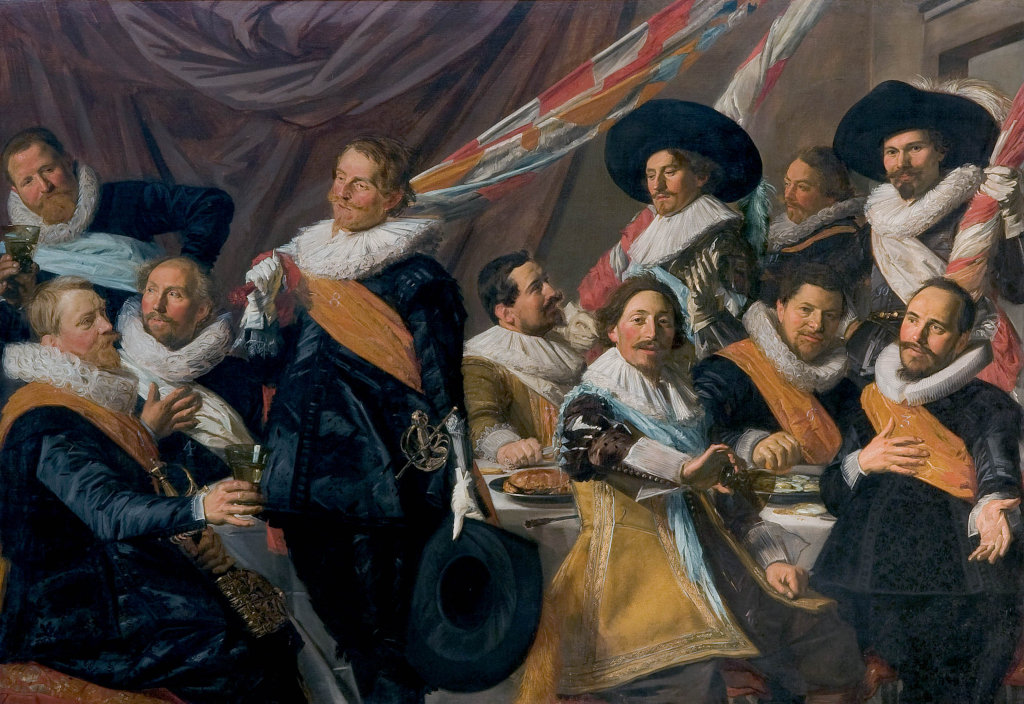
At first glance, The Banquet of the Officers of the St George Militia Company in 1627 appears to be a straightforward record of prosperous Dutch gentlemen enjoying a formal meal. Richly dressed officers gather around a long table, raise elegant glasses and engage in relaxed conversation beneath brightly coloured banners. Yet this remarkable painting represents far more than a social occasion. It transformed one of the most conventional forms of seventeenth-century portraiture into one of the liveliest and most psychologically convincing images of civic life ever produced.
Painted in 1627, the work belongs to a long tradition of Dutch civic guard portraits, in which members of local militia companies commissioned large paintings to commemorate their service and strengthen civic identity. Such commissions were prestigious, expensive and highly competitive. Every officer expected to be recognisable, while the artist faced the formidable challenge of combining numerous individual portraits into a coherent composition. Many painters solved this problem by arranging their sitters in rigid rows, sacrificing vitality in favour of clarity. Frans Hals chose an entirely different solution.
Instead of presenting a static gathering, Hals creates the convincing illusion of an event unfolding before our eyes. Officers turn towards one another in conversation, servants move quietly through the scene, glasses are raised, smiles exchanged and banners catch the light above the company. No single figure dominates the composition for long. Our attention moves naturally from one conversation to another, creating the impression that the banquet continues beyond the limits of the canvas. The painting therefore becomes less a formal record than an experience of participation.
The work also reflects the extraordinary confidence of the Dutch Republic during the early seventeenth century. Haarlem had become one of the Republic's most prosperous cities, enriched by trade, manufacturing and civic organisation. Militia companies no longer played a major military role in defending the town, yet they remained important symbols of urban pride, political stability and communal responsibility. Their annual banquets celebrated fellowship as much as defence, allowing prominent citizens to display both their public office and their prosperity.
For Frans Hals, these civic guard commissions provided the ideal opportunity to demonstrate his greatest artistic strengths. Individual character, natural gesture, expressive faces and astonishingly free brushwork all combine here on a monumental scale. The challenge was no longer to convince viewers that one sitter was alive, but that an entire room full of personalities existed simultaneously. Hals succeeds so completely that modern audiences often forget they are looking at one of the largest and most complex portrait commissions of the Dutch Golden Age.
Today, The Banquet of the Officers of the St George Militia Company in 1627 is recognised as one of the masterpieces of European group portraiture. It marks a decisive stage in Hals' artistic development, paving the way for later achievements by Rembrandt and influencing generations of portrait painters who sought to combine individual likeness with convincing human interaction. More than a record of civic ceremony, it remains a celebration of observation, movement and the extraordinary richness of everyday social life.
This article explores the painting's historical background, the civic guard tradition, the identities of the officers, Hals' revolutionary composition, his brushwork, symbolism, later influence and the reasons why this remarkable banquet continues to define Dutch Golden Age portraiture. Throughout, one question remains central: how did Frans Hals transform a formal civic commission into one of the liveliest paintings of the seventeenth century?
- Artist Frans Hals (c.1582/3–1666)
- Title The Banquet of the Officers of the St George Militia Company in 1627
- Date 1627
- Medium Oil on canvas
- Current Location Frans Hals Museum, Haarlem
- Movement Dutch Golden Age
- Subject Officers of Haarlem's St George Civic Guard
- Known For Revolutionary group portrait composition and extraordinary naturalism
- Main Themes Civic identity, leadership, fellowship, prosperity and public service
- Why It Matters One of the greatest group portraits ever painted and a milestone in the development of European portraiture.
Contents
- Historical Background
- The Civic Guard Tradition
- Looking at the Painting
- Who Are the Officers?
- How Hals Reinvented Group Portraiture
- Colour, Flags and Symbolism
- Legacy and Influence
- The Journey of the Painting
- Where is the Painting Today?
- Timeline
- Interesting Facts
- FAQs
- Further Reading
- References
Historical Background
During the seventeenth century, the Dutch Republic possessed no permanent standing army responsible for the day-to-day defence of every town. Instead, many cities relied upon organised civic militia companies, known in Dutch as the schutterij. Originally established to defend urban communities during periods of conflict, these organisations gradually evolved into prestigious civic institutions whose importance extended far beyond military duties. Membership became a visible expression of wealth, public responsibility and political influence.
Haarlem maintained several militia companies, each identified by its patron saint. The Company of Saint George was among the oldest and most distinguished. Although its officers retained ceremonial military responsibilities, by the early seventeenth century their role increasingly centred upon civic leadership, public order and representation during official ceremonies. Banquets marking the end of an officer's term therefore became significant social occasions, celebrating continuity of leadership as much as military service.
These celebrations also provided an important opportunity for artistic patronage. Officers frequently commissioned large group portraits to commemorate their period of office, displaying the finished paintings within militia headquarters where future generations could admire both the company itself and the artists who immortalised it. Such commissions demanded exceptional skill. Every participant expected an individual likeness worthy of an independent portrait while simultaneously contributing to the harmony of the group as a whole.
Frans Hals was uniquely equipped to meet this challenge. By 1627 he had already established a reputation for lively portraiture that captured movement, expression and personality with unusual immediacy. Rather than treating the banquet as a formal arrangement of separate figures, he approached it as a living social event. The result transformed expectations of what a civic guard portrait could achieve and secured Hals' position as Haarlem's leading painter of public life.
```htmlThe Civic Guard Tradition
To understand The Banquet of the Officers of the St George Militia Company in 1627, it is first necessary to understand the institution that commissioned it. The civic guard companies, or schutterijen, occupied a unique place within the cities of the Dutch Republic. Originally founded to defend towns against attack, they had, by the early seventeenth century, become organisations that combined military preparedness with civic ceremony, political influence and social prestige. Their officers were not professional soldiers but prosperous citizens whose leadership reflected both their wealth and their standing within the community.
Membership of a militia company brought considerable honour. Officers were drawn from Haarlem's leading merchants, brewers, manufacturers and civic officials, men whose commercial success often went hand in hand with public responsibility. Service demonstrated loyalty to the city and provided opportunities to strengthen relationships with other influential families. Banquets, processions and ceremonial gatherings became as important to the companies' identity as military exercises, transforming them into highly visible symbols of civic stability.
This broader role explains why militia portraits became one of the defining artistic commissions of the Dutch Golden Age. Unlike royal portraits or aristocratic dynastic paintings elsewhere in Europe, Dutch civic guard portraits celebrated collective leadership rather than hereditary power. They reflected the values of an urban republic in which prosperity, cooperation and public service were regarded as the foundations of political success. The paintings therefore functioned simultaneously as commemorations, declarations of civic pride and lasting records of the city's governing elite.
How the Commissions Worked
Creating a militia portrait was a collaborative enterprise. The officers themselves commissioned the work, with each participant normally contributing towards the cost. In many cases, the amount paid influenced how prominently an individual appeared within the composition, although artists still faced the challenge of producing a harmonious image in which every contributor felt suitably represented. Balancing equality with hierarchy required considerable diplomatic as well as artistic skill.
The completed paintings were usually displayed in the militia headquarters, where they formed part of a growing visual history of the company. Visitors could trace successive generations of officers through these monumental canvases, comparing styles, fashions and leadership across decades. Each new commission therefore entered into conversation with earlier examples, encouraging artists to innovate while still respecting established traditions.
For Frans Hals, these commissions provided opportunities unavailable within ordinary portraiture. Instead of concentrating upon a single sitter, he could explore the dynamics of conversation, shared celebration and subtle social interaction. The banquet became not merely an occasion to record faces but an opportunity to investigate how groups of individuals occupy the same space and respond naturally to one another.
Looking Closely: A Portrait of a Community
Rather than selecting one officer and following him around the composition, allow your eyes to move naturally from face to face. Notice how conversations overlap, glances intersect and gestures connect figures across the table. Hals is not simply painting individuals; he is painting the social fabric that binds them together.
Hals and the Militia Portrait
Frans Hals returned repeatedly to militia portraiture throughout his career, producing some of the most celebrated group portraits in European art. His first major success came with The Banquet of the Officers of the St George Militia Company of 1616, painted just over a decade before the present work. That earlier canvas immediately distinguished itself through its livelier arrangement and more convincing interaction between the sitters, establishing Hals as Haarlem's leading interpreter of civic portraiture.
The 1627 banquet demonstrates how rapidly his ideas evolved. Instead of merely refining the earlier composition, Hals made the interactions between the officers more fluid and the overall organisation more dynamic. Figures turn naturally towards one another, some engage directly with the viewer while others remain absorbed in private conversation. The painting therefore avoids the impression that each sitter posed independently before being assembled into a single composition. Instead, the company appears genuinely united by the shared experience of the banquet.
This approach represented a quiet revolution in portrait painting. Earlier group portraits often resembled carefully arranged records in which every participant faced the viewer with equal formality. Hals retained the individuality required by his patrons but embedded each portrait within a believable social environment. Every gesture contributes to the life of the whole, allowing personality and collective identity to reinforce one another.
The success of this solution extended far beyond Haarlem. Later Dutch painters recognised that Hals had demonstrated a new way of organising large groups without sacrificing either clarity or vitality. The influence of these militia portraits can ultimately be traced through some of the greatest achievements of Dutch painting, culminating in Rembrandt's revolutionary approach to group portraiture in The Night Watch.
Looking at the Painting
Standing before the enormous canvas, the first impression is not of ceremony but of movement. The officers appear to have paused only briefly in the midst of an animated celebration. Glasses are raised in greeting, conversations continue across the table and richly coloured banners rise behind the figures like theatrical backdrops. Although every participant occupies a carefully considered position, nothing feels rigid or rehearsed. Hals persuades us that the banquet is unfolding naturally before our eyes.
The long white tablecloth immediately establishes the structural centre of the composition. Running diagonally across the foreground, it guides the viewer gently through the gathering while simultaneously creating depth within the shallow interior space. Around it sit the officers, each dressed in elegant black costume relieved by brilliant white lace collars and cuffs. Against this restrained palette, the vivid orange, white and blue sashes identifying the company provide dramatic flashes of colour that unify the entire composition.
Unlike many earlier militia portraits, where each participant competes equally for attention, Hals orchestrates a constantly shifting rhythm of observation. One officer raises his glass towards the viewer, another turns to address a companion, while others listen, smile or prepare to speak. Servants move discreetly through the scene carrying dishes and wine, reinforcing the impression that this is not a formal pose but a living social event. The result is remarkably cinematic. Our attention flows naturally through the painting, discovering new interactions with every glance.
Perhaps most remarkable is Hals' ability to preserve the individuality of every officer despite the complexity of the composition. Each face possesses its own character, expression and emotional presence. Some appear confident and extroverted, others more reserved or thoughtful. Rather than repeating a single portrait type, Hals creates a gathering of recognisably different personalities united by a shared occasion. This psychological richness remains one of the painting's greatest achievements.
Looking Closely: Follow the Toast
Begin with the officer raising his glass towards the viewer, then allow your eye to follow the direction of his gesture across the table. Notice how one raised hand leads naturally to another face, another conversation and another exchange of glances. Hals uses gesture rather than architectural lines to guide the viewer through the composition, making the entire banquet feel connected by human interaction rather than rigid geometry.
Who Are the Officers?
Although The Banquet of the Officers of the St George Militia Company in 1627 appears at first to depict a relaxed social gathering, every figure occupies a carefully considered place within the organisation of Haarlem's civic guard. This is not simply a collection of prosperous gentlemen enjoying dinner together. It is a visual record of a particular body of officers at a specific moment in the history of the Company of Saint George. Every man represented held an official position, and each expected his likeness to be both recognisable and appropriately distinguished.
Unlike a modern military unit, the officers of the schutterij were drawn largely from Haarlem's civic elite rather than from professional soldiers. Many were successful brewers, textile merchants, magistrates or members of influential local families. Their authority rested as much upon commercial success and political standing as upon military experience. Serving as an officer demonstrated commitment to the city while strengthening personal prestige within Haarlem's closely connected social world.
For Hals, the commission presented an unusual artistic challenge. Every participant had contributed financially towards the painting and naturally wished to appear important. At the same time, the finished work needed to function as a harmonious composition rather than a collection of unrelated portraits. Hals therefore developed a remarkably sophisticated balance between hierarchy and equality. Certain officers occupy more commanding positions, yet no individual overwhelms the painting. Instead, leadership is communicated through gesture, placement, costume and interaction rather than sheer size.
The Colonel
The commanding officer naturally occupies one of the most prominent positions within the composition. Hals emphasises his authority not through exaggerated ceremony but through calm assurance. Rather than appearing isolated from his companions, the colonel participates fully in the shared celebration, reinforcing the idea that leadership within the Dutch Republic rested upon cooperation as well as rank. His dignified presence establishes the tone for the entire gathering, providing a visual anchor around which the remaining officers are organised.
Hals avoids turning the colonel into an idealised heroic figure. Unlike aristocratic military portraits elsewhere in Europe, where commanders frequently dominate through theatrical poses or richly decorated armour, the Haarlem officers project confidence through natural behaviour. Their authority derives from civic responsibility rather than dynastic privilege. This distinction reflects one of the defining characteristics of Dutch Golden Age portraiture: status is acknowledged, but humanity remains paramount.
The Captains and Lieutenants
Around the colonel sit the captains and lieutenants responsible for different divisions of the company. Hals distinguishes them subtly through costume, position and gesture rather than through overt visual hierarchy. Some lean forward into conversation, others acknowledge the viewer with direct eye contact, while several appear absorbed in exchanges with neighbouring officers. These variations prevent repetition and create the impression that each individual possesses a distinct personality and role within the group.
The colourful sashes worn across their dark clothing immediately identify their civic office. Orange, white and blue—the colours associated with the House of Orange and the Dutch Republic—introduce brilliant accents into an otherwise restrained palette of black costumes and white lace. They function simultaneously as insignia of rank and as compositional devices, drawing the eye rhythmically across the canvas while reinforcing the officers' shared identity.
Weapons also appear throughout the composition, though with surprisingly little emphasis. Swords, partisans and ceremonial staffs remind viewers of the company's military origins, yet they never dominate the scene. Instead, they operate as symbols of office within what is essentially a civic rather than a martial gathering. Hals makes it clear that these men are celebrating public service as much as military readiness.
The Ensigns and the Flags
Among the most visually striking figures are the ensigns carrying the company's magnificent banners. Their role extended beyond simple decoration. The flag represented the honour and continuity of the militia company itself, serving as a visible emblem of loyalty to Haarlem and to the Dutch Republic. During ceremonies and public processions, these banners proclaimed the identity of the company long before individual officers could be recognised.
Hals exploits their dramatic potential to full effect. The great folds of richly coloured fabric rise behind the banquet like theatrical curtains, introducing movement, colour and vertical rhythm into the composition. Without them, the gathering would feel considerably flatter and more static. The banners therefore serve both symbolic and artistic purposes, binding the upper portion of the painting into a coherent whole while celebrating the collective identity of the officers below.
Looking Closely: The Flags
Spend a few moments looking only at the banners before returning to the faces. Notice how their sweeping curves echo the movement of the officers seated beneath them. Hals uses the flags not merely as military insignia but as powerful compositional devices, lifting the viewer's eye upward before guiding it gently back into the conversations around the table.
The Servants
One of the most innovative aspects of Hals' composition is his inclusion of servants moving naturally through the banquet. Earlier group portraits often concentrated exclusively upon the principal sitters, isolating them within carefully arranged rows. Hals instead allows attendants to carry food, pour wine and participate quietly in the rhythm of the gathering. Their presence expands the social world beyond the officers themselves, transforming the painting into a convincing record of a real event rather than a purely ceremonial display.
These secondary figures also strengthen the composition. Their movement introduces diagonal rhythms that counterbalance the more stable arrangement of the seated officers, while their activities reinforce the atmosphere of hospitality and celebration. Hals demonstrates that every participant, regardless of status, contributes to the life of the scene.
Portraits Within a Narrative
Perhaps Hals' greatest achievement lies in persuading us that these individual portraits belong naturally within a shared narrative. Each officer remains instantly recognisable, fulfilling the expectations of his commission, yet together they create something far richer than a catalogue of faces. Conversations overlap, gestures respond to one another and glances travel across the table with remarkable fluidity. We begin to imagine voices, laughter and the quiet sounds of servants moving between guests.
This narrative quality distinguishes the painting from many earlier militia portraits. Rather than presenting the officers as isolated symbols of rank, Hals depicts them as members of a functioning community. Leadership becomes something performed collectively through interaction rather than simply displayed through status. In doing so, he transforms one of the most formal genres of Dutch portraiture into one of its most human.
How Hals Reinvented Group Portraiture
The true genius of The Banquet of the Officers of the St George Militia Company in 1627 lies not simply in the quality of the individual portraits but in the way Frans Hals persuades us that an entire room full of people exists beyond the limits of the canvas. Earlier group portraits frequently resembled orderly assemblies in which each sitter posed independently before the viewer. Hals retains the clarity required by his patrons while replacing rigidity with movement, conversation and psychological interaction.
Instead of organising the officers into a flat horizontal row, Hals constructs a composition built upon intersecting diagonals. The white tablecloth carries the eye through the foreground, raised glasses introduce rhythmic vertical accents, banners sweep dramatically above the gathering and the directions of individual gazes continually redirect our attention. Every element contributes to a carefully orchestrated visual journey in which the viewer becomes an active participant rather than a passive observer.
The result was revolutionary. Hals demonstrated that a large civic commission could possess the vitality of a spontaneous social encounter without sacrificing the dignity expected by its patrons. This achievement would profoundly influence the future of Dutch portraiture, reaching its fullest expression two decades later in Rembrandt's The Night Watch. While Rembrandt pushed narrative drama even further, the foundations had already been laid by Hals' remarkable ability to transform a formal banquet into a convincing human experience.
``` ```html id="vzqkwm"Colour, Flags and Symbolism
One of the greatest pleasures of studying The Banquet of the Officers of the St George Militia Company in 1627 lies in discovering how Frans Hals transforms ordinary objects into a rich visual language of civic identity. Sashes, banners, drinking glasses, lace collars, silverware and table linen all contribute to the atmosphere of prosperity and celebration, yet none appears unnecessarily decorative. Every object performs both a practical role within the banquet and an artistic role within the composition. Hals therefore achieves a remarkable balance between observation and design, allowing everyday material culture to communicate broader ideas about leadership, public service and civic pride.
Unlike many allegorical paintings of the seventeenth century, however, this banquet should not be interpreted as a puzzle in which every object conceals a hidden meaning. Hals was first and foremost an observer of people. The symbolic value of the surrounding objects emerges naturally from the social world they represent rather than from an elaborate programme of coded messages. This distinction is important because it helps us appreciate the painting as both an accurate document of Haarlem society and a carefully composed work of art.
The Orange, White and Blue Sashes
Among the first details to attract the viewer's attention are the brilliantly coloured sashes crossing the officers' otherwise restrained black costumes. Their vivid orange, white and blue immediately enliven the composition while identifying the men as officers of the civic guard. These colours were closely associated with the Dutch Republic and with the House of Orange, whose leadership during the Eighty Years' War had become central to the emerging identity of the independent Netherlands.
From a painterly perspective, the sashes perform an equally important function. They punctuate the composition with rhythmic flashes of colour, preventing the large areas of black costume from becoming visually monotonous. Rather than concentrating all colour in one area, Hals distributes it across the canvas, encouraging the eye to travel naturally between different groups of figures. The sashes therefore reinforce both civic symbolism and pictorial unity.
Black Clothing and White Lace
To modern eyes, the officers' dark clothing may appear austere, yet in the seventeenth century black textiles of this quality were among the most expensive fabrics available. Producing a rich, even black dye required considerable skill and costly imported materials. Combined with elaborate lace collars and cuffs, these garments projected wealth, refinement and social authority without relying upon the brilliant colours favoured by many European courts.
Hals delights in the challenge of painting these contrasting materials. Broad passages of black are subtly animated by warm reflections, cool shadows and delicate highlights, while the crisp white lace provides brilliant points of visual relief. The interplay between black and white creates a sophisticated harmony that allows the faces and hands to emerge naturally as the emotional focus of the composition.
Looking Closely: Painting Black
Choose one officer's black jacket and look closely for pure black paint. You may be surprised to discover that Hals rarely relies upon a single colour. Browns, blues, greys and warm reflections combine to create surfaces that feel rich and luminous rather than flat. What appears to be a simple black costume is, in reality, one of the most technically sophisticated passages in the painting.
The Banquet Table
The great banquet table occupies both the physical and symbolic centre of the composition. Covered with a brilliant white linen cloth, it unites the officers within a shared space of hospitality and ceremony. Unlike a throne or a battlefield, the table represents cooperation rather than hierarchy. Decisions affecting the city were often discussed during meals of this kind, making the banquet an important expression of civic fellowship as well as celebration.
The carefully arranged glasses, plates and serving vessels further reinforce this atmosphere. They are not extravagant displays of luxury but convincing records of prosperous Dutch domestic life. Hals paints them with remarkable restraint, avoiding unnecessary detail while capturing their reflective surfaces through a handful of decisive highlights. Their quiet presence contributes to the authenticity of the scene without distracting from the people gathered around them.
The Roemer Glasses
Several officers raise distinctive green-tinted roemer glasses, a form of drinking vessel widely used throughout the Dutch Republic during the seventeenth century. Characterised by their rounded bowls and thick stems decorated with applied glass prunts, these elegant vessels appear frequently in Dutch still-life painting as symbols of hospitality, celebration and refined sociability. Hals includes them not as isolated luxury objects but as active participants in the unfolding banquet.
The raised glasses also create an important compositional rhythm. Their repeated vertical forms guide the viewer across the table while reinforcing the atmosphere of shared celebration. Rather than functioning merely as props, they become extensions of the officers' gestures, connecting conversations across the composition and strengthening the sense of communal participation.
The Flags
Towering above the officers, the magnificent banners are among the most dramatic elements in the entire painting. Their practical purpose was to identify the militia company during public ceremonies and military processions, but within Hals' composition they perform far more than a documentary role. Their sweeping curves introduce movement into the upper half of the canvas, balancing the long horizontal line of the banquet table below.
The colours of the banners echo those of the officers' sashes, reinforcing the unity of the company while creating a striking dialogue between foreground and background. Their animated folds also contribute to the painting's remarkable vitality. Rather than hanging motionless, they appear to respond gently to invisible currents of air, suggesting that the entire room remains alive with movement.
Looking Closely: The White Tablecloth
Follow the edge of the tablecloth from one end of the banquet to the other. Notice how this single diagonal line quietly guides your eye through the entire gathering. Although less dramatic than the flags or the raised glasses, it is one of the painting's most important compositional devices, binding the officers together within a single coherent space.
Brushwork, Colour and the Illusion of Reality
Few artists demonstrated greater confidence with a brush than Frans Hals. In a painting of this scale, involving more than a dozen individual portraits together with costumes, lace, silverware, banners and servants, the temptation to overwork every detail would have been considerable. Hals instead achieves unity through extraordinary economy. Close inspection reveals energetic strokes of paint that often appear almost abstract, yet from a natural viewing distance they resolve effortlessly into convincing forms.
Perhaps nowhere is this confidence more evident than in the lace collars. Rather than describing every thread individually, Hals suggests their intricate structure through rapid strokes of white and grey laid confidently across darker passages beneath. The eye instinctively completes what the brush merely implies. This willingness to trust the viewer's perception would later become one of the qualities most admired by nineteenth-century painters, who recognised Hals as an artist remarkably ahead of his time.
The faces receive slightly greater refinement than the costumes, yet even here Hals avoids excessive finish. Flesh is constructed from warm ochres, soft pinks, cool grey shadows and subtle highlights placed with astonishing precision. Individual expressions emerge through remarkably economical means. A slight turn of the mouth, a narrowing of the eyes or the inclination of a head communicates personality more effectively than laborious anatomical description ever could.
The overall palette remains surprisingly restrained. Black, white, warm flesh tones and the vivid colours of the sashes dominate the composition, allowing the officers themselves to remain the undisputed focus. Rather than dazzling the viewer with colour for its own sake, Hals uses restraint to strengthen the psychological unity of the painting. Every decision serves the larger purpose of making the banquet feel both believable and alive.
This combination of bold handling and careful observation explains why later generations regarded Hals as one of the great pioneers of painterly realism. Artists such as Gustave Courbet, Édouard Manet, John Singer Sargent and Vincent van Gogh all recognised that visible brushwork need not diminish realism. On the contrary, when handled with Hals' extraordinary assurance, it could make painted figures appear more alive than meticulously polished surfaces ever could.
``` ```html id="qzvjka"Legacy and Influence
When The Banquet of the Officers of the St George Militia Company in 1627 was unveiled, it immediately demonstrated that a civic guard portrait could be something far more ambitious than a formal record of office. Frans Hals had shown that a large group of independently commissioned portraits could be transformed into a believable social event without sacrificing either individual likeness or collective harmony. This achievement would shape the future of Dutch portraiture for generations.
The painting also marked an important stage in Hals' own artistic development. Comparing it with his earlier militia portrait of 1616 reveals increasing confidence in composition, psychology and movement. Conversations flow more naturally, gestures become more varied and the figures appear increasingly aware of one another rather than simply of the viewer. Hals was steadily replacing the static conventions of sixteenth-century group portraiture with an entirely new conception of collective life.
Preparing the Way for Rembrandt
No discussion of Hals' militia portraits can avoid comparison with Rembrandt's The Night Watch, painted fifteen years later in Amsterdam. Although the two artists developed highly individual approaches, they confronted remarkably similar artistic problems. Both needed to satisfy numerous patrons while creating a unified composition capable of sustaining prolonged attention.
Hals approached this challenge through conversation and natural interaction. His officers remain seated around a banquet table, linked by overlapping gestures, exchanged glances and subtle shifts of posture. Rembrandt, by contrast, transformed the civic guard portrait into a dramatic moment of apparent mobilisation, filling his composition with movement, theatrical lighting and narrative suspense. The differences are considerable, yet Hals' earlier achievement demonstrated that group portraiture could escape rigid formality and become genuinely alive.
Rather than competing directly, the two paintings should be understood as complementary milestones in the evolution of Dutch art. Hals pioneered the language of believable social interaction; Rembrandt expanded that language into something approaching historical drama. Together they established the Dutch Republic as the undisputed centre of European group portraiture during the seventeenth century.
Comparison: Hals and Rembrandt
Hals invites us to join a banquet already in progress, while Rembrandt asks us to witness a company preparing for action. Both painters reject rigid rows of sitters, yet they achieve vitality through different means: Hals through conversation and observation, Rembrandt through movement and theatrical light. Seen together, the two works chart the remarkable evolution of Dutch group portraiture during the first half of the seventeenth century.
The Rediscovery of Frans Hals
Although Hals enjoyed considerable success during his lifetime, changing artistic taste during the eighteenth century favoured smoother surfaces and more idealised forms of portraiture. His energetic handling came to appear unfinished beside the polished elegance admired by later generations. As a result, his reputation declined for many decades, and several of his greatest paintings attracted far less attention than they deserved.
Everything changed during the nineteenth century. A new generation of artists began to value direct observation, visible brushwork and the truthful representation of everyday life. When painters such as Gustave Courbet travelled to study Dutch art, Hals emerged as one of the great revelations. What earlier critics had dismissed as roughness now appeared astonishingly modern.
Édouard Manet admired Hals' ability to describe form through bold, economical strokes rather than painstaking finish. John Singer Sargent likewise studied his portraits closely, recognising how confidently Hals suggested texture, character and movement without unnecessary detail. For both artists, the civic guard portraits demonstrated that technical freedom could coexist with extraordinary psychological precision.
Perhaps the most enthusiastic admirer was Vincent van Gogh. Writing to his brother Theo, Van Gogh repeatedly praised Hals' remarkable handling of black costume, living flesh and visible brushwork, marvelling that apparently simple strokes could create such convincing human presence. His admiration was not confined to individual portraits. Works such as the 1627 banquet convinced him that Hals possessed an unmatched ability to paint life itself.
A Landmark in European Group Portraiture
Today, The Banquet of the Officers of the St George Militia Company in 1627 is recognised as one of the defining masterpieces of European group portraiture. Its importance lies not only in the quality of the individual likenesses but in the way Hals transformed the relationship between those likenesses. Instead of presenting isolated portraits within a shared frame, he created a convincing community whose members appear genuinely aware of one another.
This achievement extends far beyond the history of Dutch art. The painting demonstrates a profound understanding of human behaviour: people rarely sit motionless facing the viewer, but instead converse, listen, gesture, smile and respond to one another in subtle ways. Hals observed these ordinary interactions with exceptional sensitivity, preserving them within a composition of remarkable structural discipline. Four centuries later, the banquet still feels less like a ceremonial document than an invitation to share the company of its participants.
The Journey of the Painting
Unlike many seventeenth-century Dutch paintings that passed through generations of private collectors, the militia portraits commissioned for Haarlem's civic guard remained closely associated with the institutions that created them. After its completion in 1627, the banquet was displayed in the headquarters of the Company of Saint George, where it joined earlier portraits commemorating previous groups of officers. Visitors entering the building encountered not simply works of art but a visual history of the company's leadership stretching across decades.
As the civic guard companies gradually lost their practical importance during the eighteenth and nineteenth centuries, their great portrait commissions assumed a new role as historical monuments. Increasing interest in Dutch cultural heritage encouraged their preservation, while Hals' growing international reputation ensured that the paintings themselves came to be valued as masterpieces rather than merely institutional records.
The establishment of the Frans Hals Museum in Haarlem provided an ideal permanent home for many of these works. Here they could be studied not in isolation but alongside other paintings from Hals' long career, allowing visitors to trace the remarkable development of his portraiture from intimate individual likenesses to ambitious civic commissions. Displayed within the city for which they were originally painted, the militia portraits retain a particularly powerful connection with the community that commissioned them nearly four hundred years ago.
Modern conservation has revealed the extraordinary freshness of Hals' technique. Technical examination confirms the assurance of his brushwork, while careful cleaning has restored much of the brilliance of the orange, white and blue sashes together with the subtle tonal variations of the officers' black costumes. These studies have reinforced rather than diminished admiration for Hals' achievement, demonstrating how confidently he balanced rapid execution with lasting structural coherence.
Where is the Painting Today?
Today, The Banquet of the Officers of the St George Militia Company in 1627 is one of the highlights of the Frans Hals Museum in Haarlem. Few paintings remain so closely connected to the city in which they were created. Seen in its original cultural context, the banquet becomes more than an isolated masterpiece; it forms part of Haarlem's own civic history, preserving the faces of men who helped shape the city's public life during one of the most prosperous periods in Dutch history.
The scale of the painting often surprises first-time visitors. Reproductions cannot fully convey its monumental dimensions or the remarkable effect created by viewing it from different distances. From across the gallery, the officers appear animated and completely convincing. As the viewer approaches, the illusion dissolves into energetic strokes of paint, revealing the extraordinary confidence with which Hals constructed the entire composition.
Looking Closely: Step Back
Begin by standing several metres from the painting before gradually moving closer. Notice how the individual brushstrokes become increasingly visible while the psychological unity of the banquet begins to dissolve. Hals painted not for microscopic inspection but for normal human vision, trusting the eye to transform confident marks of paint into convincing reality.
Timeline
- Late 16th century — Haarlem's civic guard companies become increasingly important symbols of urban government, public order and civic identity within the Dutch Republic.
- 1616 — Frans Hals completes his first major militia commission, The Banquet of the Officers of the St George Militia Company, establishing himself as Haarlem's leading painter of civic portraiture.
- 1627 — Hals paints The Banquet of the Officers of the St George Militia Company in 1627, transforming the conventions of Dutch group portraiture through greater movement, interaction and psychological realism.
- 1642 — Rembrandt completes The Night Watch, expanding many of the compositional innovations pioneered by Hals into an even more dramatic vision of civic portraiture.
- 18th century — Changing artistic taste favours more polished styles of portraiture, and Hals' reputation gradually declines.
- 19th century — Artists including Gustave Courbet, Édouard Manet and Vincent van Gogh rediscover Hals, praising the extraordinary freedom of his brushwork.
- Today — The painting remains one of the masterpieces of the Frans Hals Museum and one of the defining achievements of Dutch Golden Age group portraiture.
Interesting Facts
- The officers helped pay for the painting. Like many Dutch militia portraits, the commission was funded collectively by the officers themselves, making each participant both sitter and patron.
- It was painted for a real civic institution. Unlike imaginary banquets or historical scenes, the painting commemorates an identifiable group of Haarlem citizens serving in the St George Civic Guard.
- Every face is an individual portrait. Although the composition functions as a unified social event, each officer expected an accurate likeness worthy of an independent portrait.
- Black clothing was a luxury. The rich black fabrics worn by the officers reflected wealth rather than austerity, as producing deep, even black dyes was an expensive process during the seventeenth century.
- The banners are both symbolic and practical. They identify the company while simultaneously providing one of the painting's strongest compositional elements.
- Hals avoided rigid symmetry. Instead of arranging his sitters in static rows, he created a network of conversations, gestures and glances that make the gathering appear genuinely alive.
- The painting influenced later masterpieces. Hals' approach to group portraiture helped prepare the way for Rembrandt's revolutionary treatment of civic guards in The Night Watch.
- The painting still lives in Haarlem. Nearly four centuries after its creation, it remains in the city for which it was originally painted, preserving an exceptional connection between artwork and place.
Explore More Frans Hals Paintings
This banquet formed part of a remarkable sequence of portraits and character studies that established Frans Hals as one of the greatest painters of the Dutch Golden Age. To explore his development further, continue with the following pages:
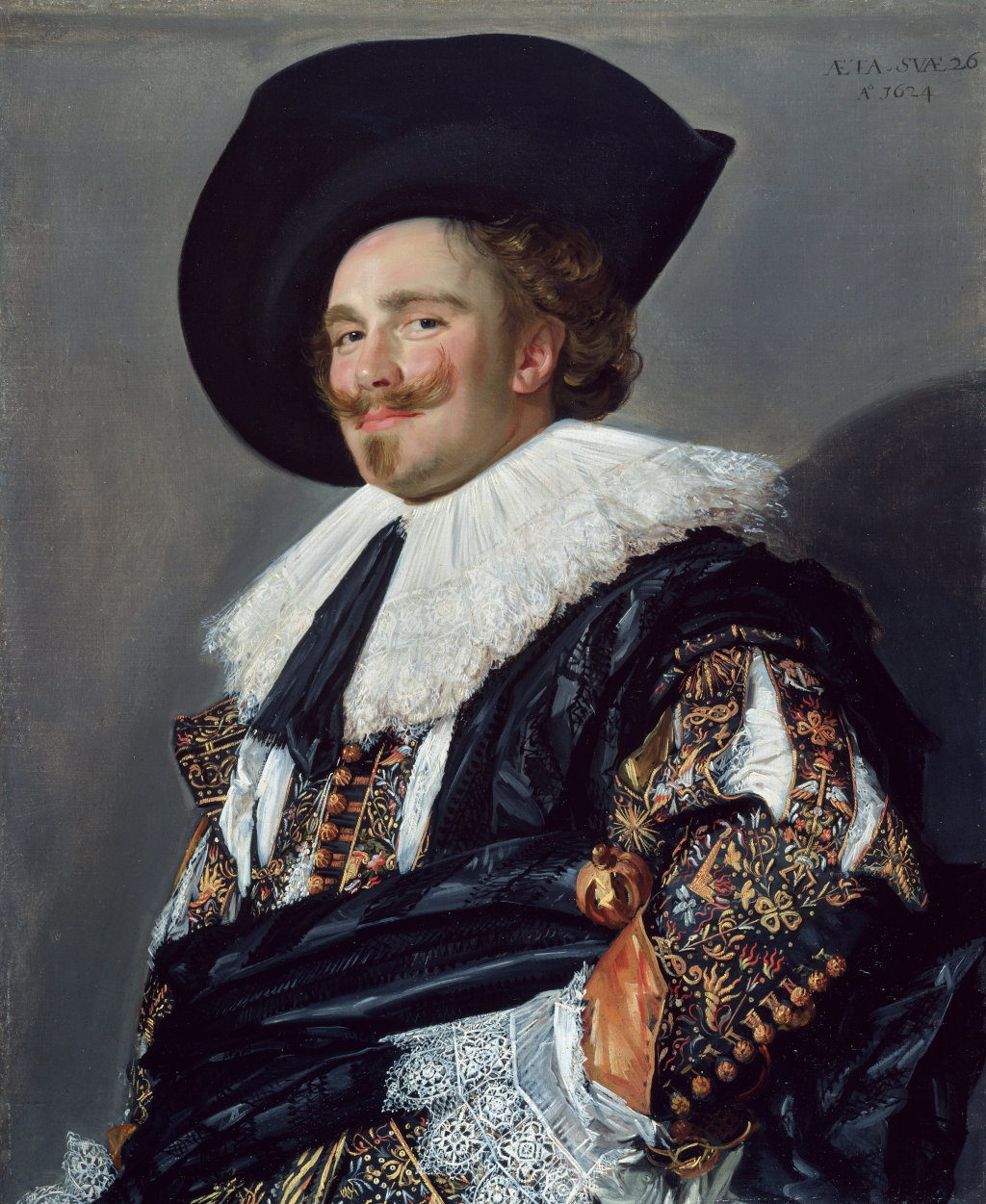
- The Laughing Cavalier — Hals' most famous individual portrait and a masterpiece of psychological confidence.
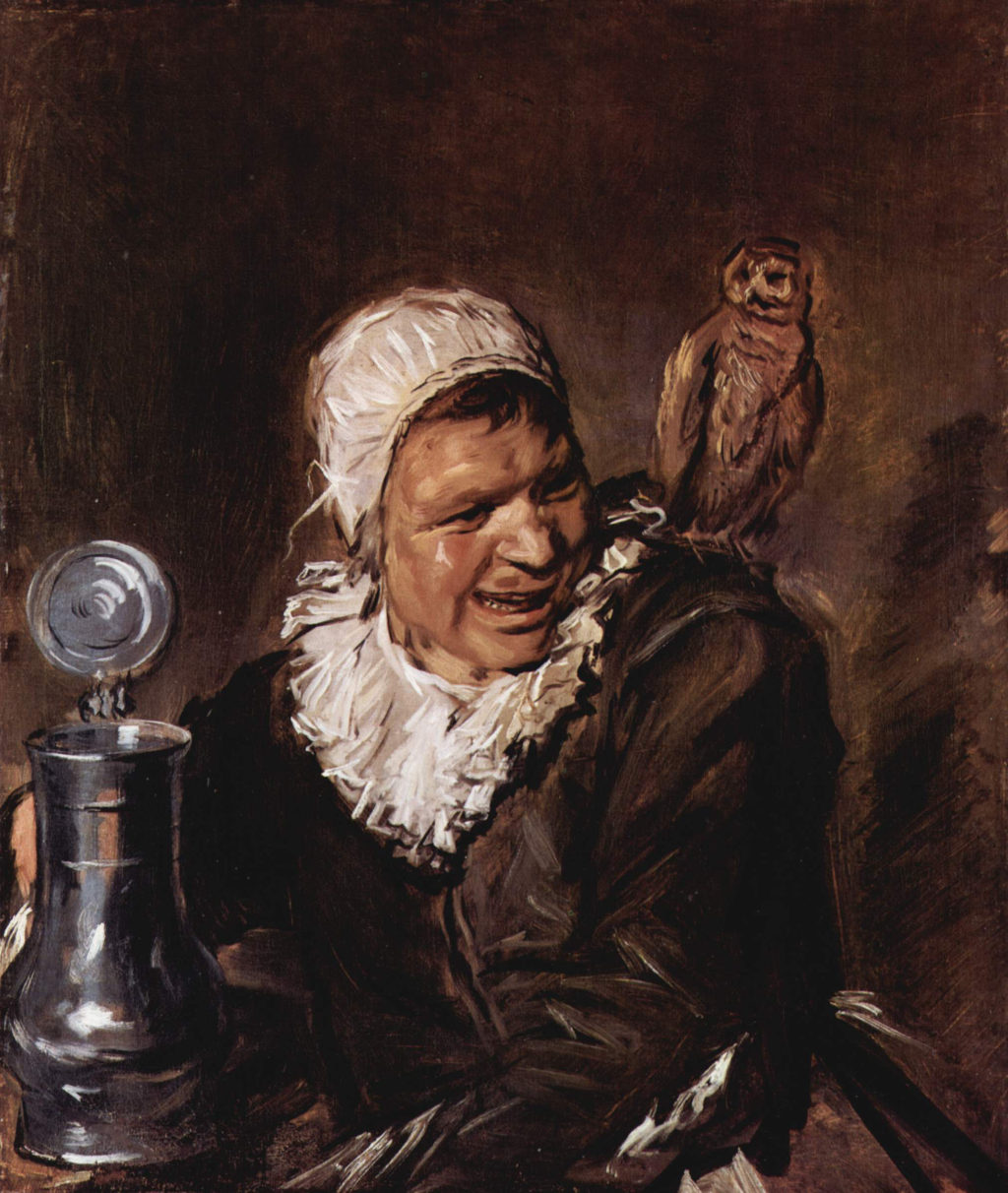
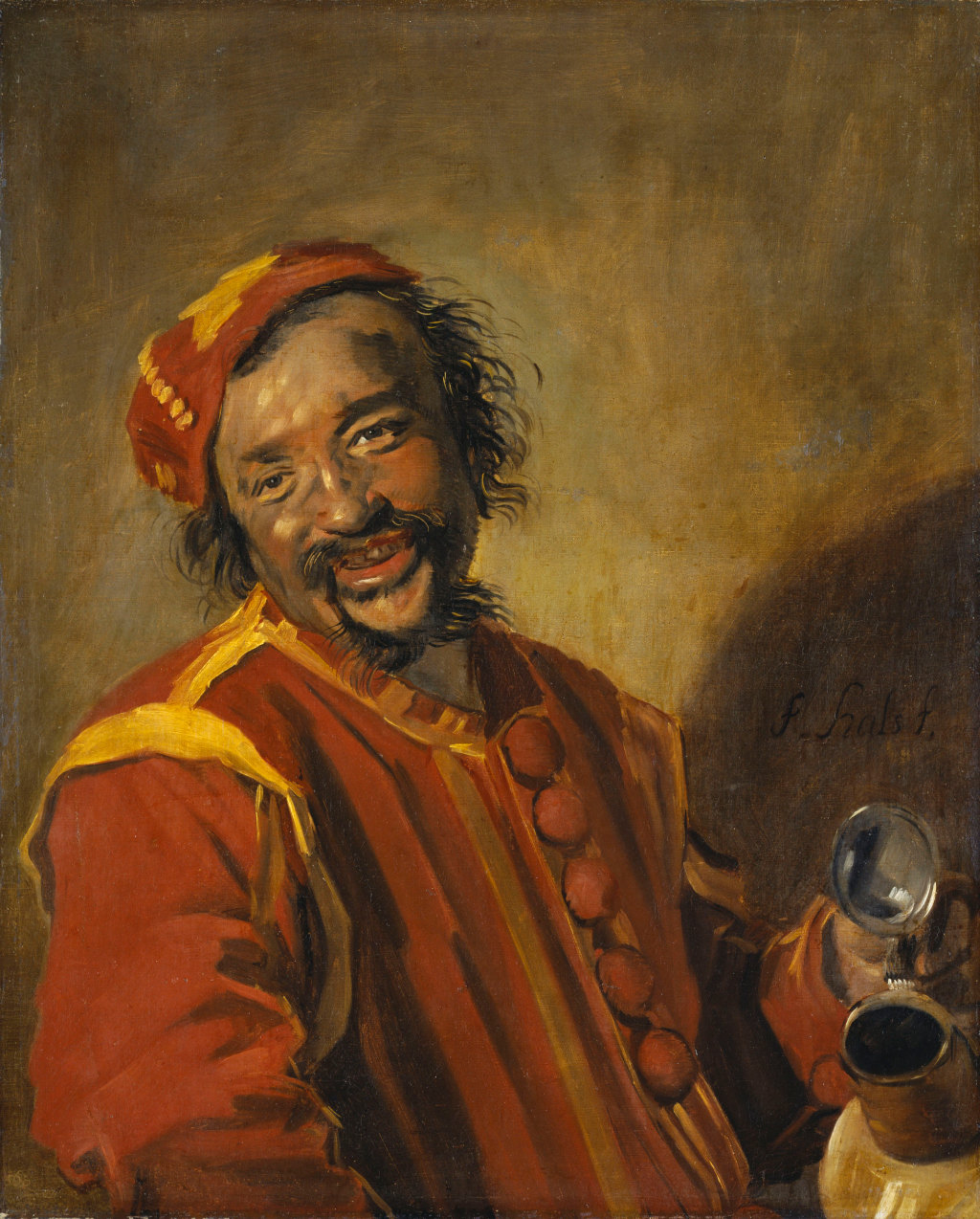
- Malle Babbe — An extraordinary character study exploring expression, individuality and one of the most enigmatic figures in Dutch art.
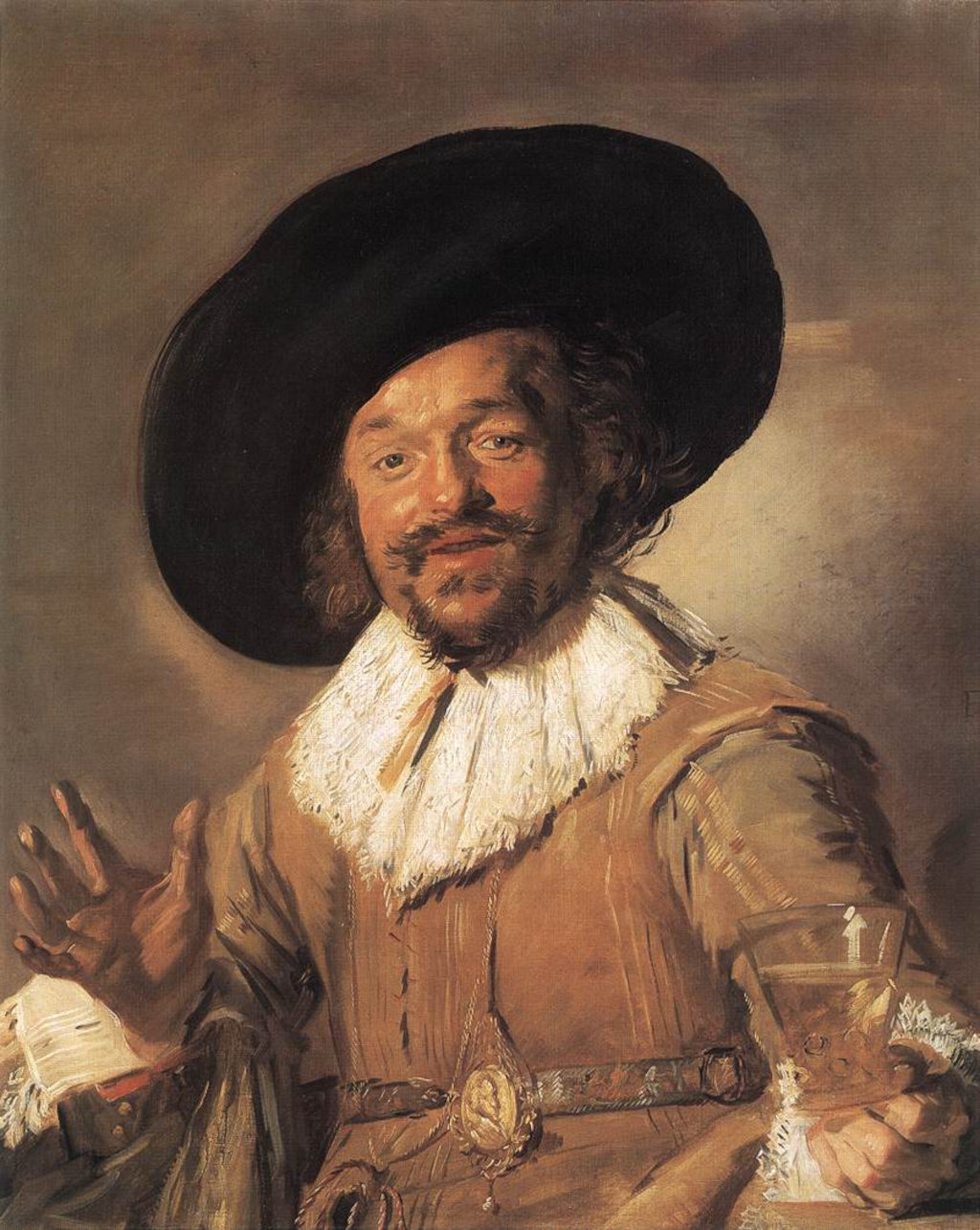
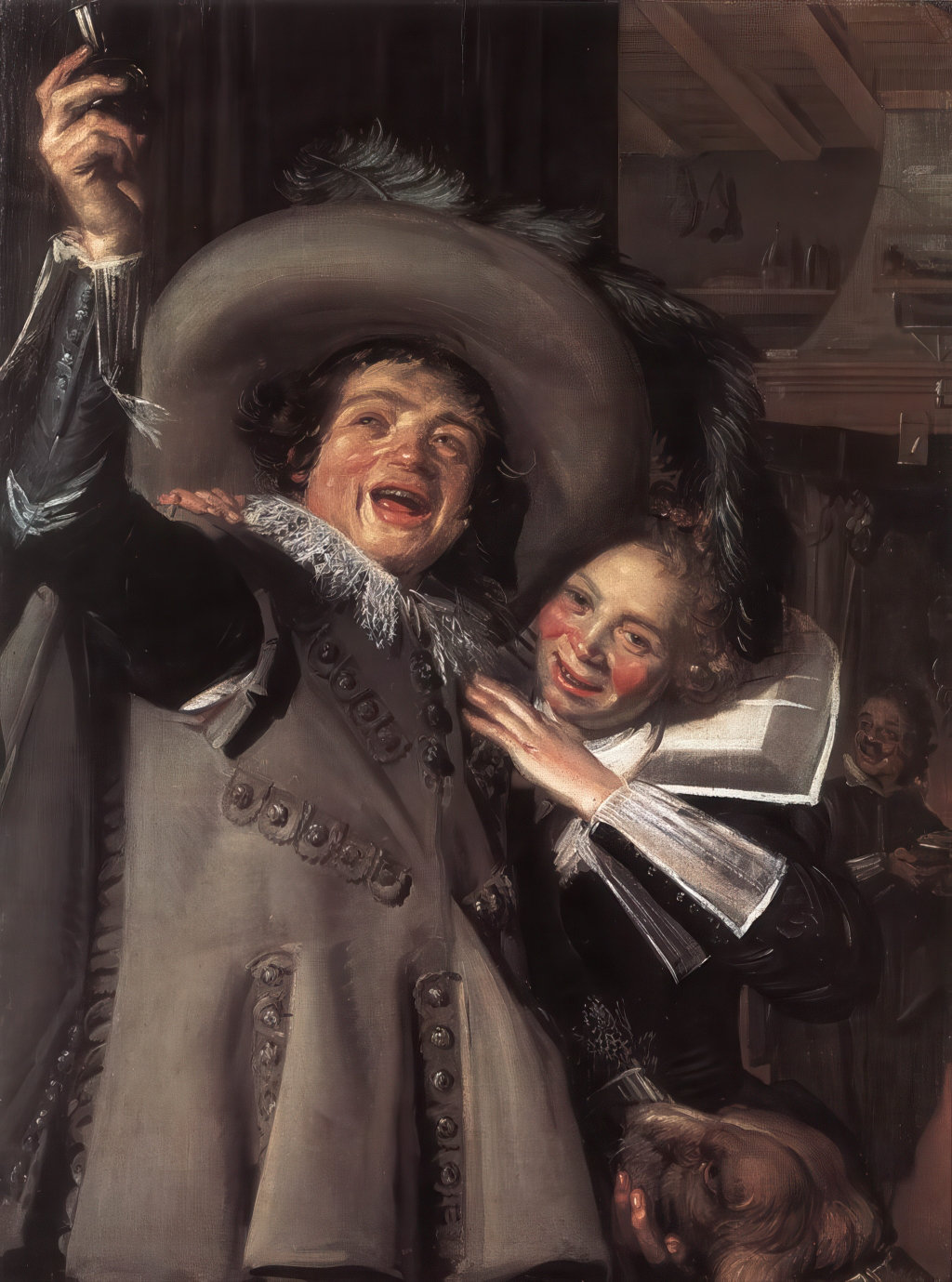
- The Merry Drinker — A lively celebration of sociability, gesture and Hals' extraordinary ability to paint movement.
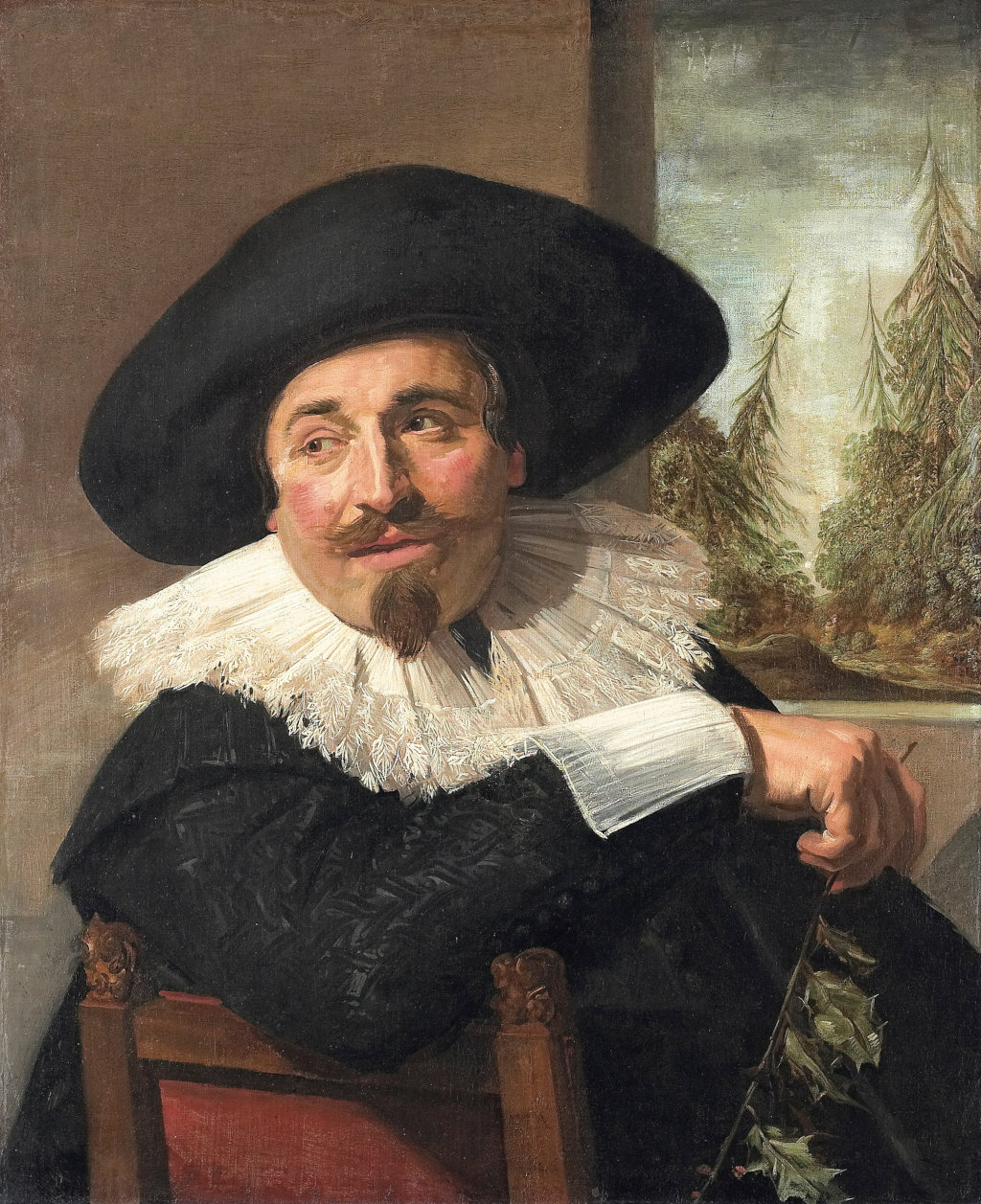
- Isaac Massa and Beatrix van der Laen — One of the earliest and most relaxed double portraits in European painting.
- Portrait of Willem Heythuijsen — A brilliant exploration of elegance, wealth and self-fashioning in the Dutch Republic.
Looking Closely: The Whole Composition
Before leaving the painting, stand back and look at it as a single image rather than as a collection of portraits. Notice how your eye moves naturally from the banners to the officers, across the table, towards the raised glasses and back again. Hals has choreographed your attention with extraordinary subtlety. The painting succeeds not because of any single portrait, but because every individual contributes to the life of the whole.
Conclusion
The Banquet of the Officers of the St George Militia Company in 1627 represents one of the defining moments in the history of European portraiture. What might have remained a formal record of civic office became, in Frans Hals' hands, an astonishing study of conversation, leadership and human interaction. Every officer retains his individual identity, yet the true subject of the painting is neither a single man nor even the company itself. It is the experience of belonging to a civic community united by shared responsibility and mutual respect.
The painting also demonstrates Hals' remarkable confidence as an artist. Through economical brushwork, subtle observation and an intuitive understanding of human behaviour, he created a scene that still feels immediate four centuries later. Modern viewers may know little about Haarlem's militia companies, yet they instantly recognise the universal rhythms of conversation, celebration and companionship that animate the banquet.
Perhaps this explains the painting's enduring significance. Rather than commemorating military power alone, it celebrates the civic ideals upon which the Dutch Republic built much of its success: cooperation, public service and collective responsibility. Hals transforms these abstract principles into recognisable human experience, ensuring that the officers remain far more than historical figures. They become participants in one of the liveliest conversations in the history of European art.
``` ```htmlFAQs
Further Reading
- Seymour Slive, Frans Hals, 3 vols., London: Phaidon, 1970–1974.
- Christopher D. M. Atkins, Frans Hals, London: Reaktion Books, 2012.
- Claus Grimm, Frans Hals: The Complete Work, New York: Harry N. Abrams, 1990.
- Norbert Middelkoop & Antoon Erftemeijer (eds.), Frans Hals: Eye to Eye with Rembrandt, Rubens and Titian, Rotterdam: nai010 publishers, 2013.
- Lelia Packer & Ashok Roy (eds.), Frans Hals: The Male Portrait, London: Wallace Collection, 2021.
- Friso Lammertse, Bart Cornelis, Jaap van der Veen & Justine Rinnooy Kan, Frans Hals, National Gallery Global, 2023.
- Mariët Westermann, A Worldly Art: The Dutch Republic 1585–1718, Yale University Press, 2004.
- Walter Liedtke, Dutch Paintings in The Metropolitan Museum of Art, Metropolitan Museum of Art, 2007.
References
- Frans Hals Museum. Collection catalogue entry: Banquet of the Officers of the St George Civic Guard, 1627.
- RKD – Netherlands Institute for Art History. Research database entries relating to The Banquet of the Officers of the St George Militia Company, Frans Hals and Haarlem civic guard portraiture.
- Seymour Slive. Frans Hals. 3 vols. London: Phaidon, 1970–1974.
- Christopher D. M. Atkins. Frans Hals. London: Reaktion Books, 2012.
- Claus Grimm. Frans Hals: The Complete Work. New York: Harry N. Abrams, 1990.
- Norbert Middelkoop & Antoon Erftemeijer (eds.). Frans Hals: Eye to Eye with Rembrandt, Rubens and Titian. Rotterdam: nai010 publishers, 2013.
- Lelia Packer & Ashok Roy (eds.). Frans Hals: The Male Portrait. London: Wallace Collection, 2021.
- Friso Lammertse et al. Frans Hals. National Gallery Global, 2023.
- Mariët Westermann. A Worldly Art: The Dutch Republic 1585–1718. Yale University Press, 2004.
- Walter Liedtke. Dutch Paintings in The Metropolitan Museum of Art. Metropolitan Museum of Art, 2007.
- Wayne Franits. Looking at Seventeenth-Century Dutch Art. Cambridge University Press, 1997.
- Simon Schama. The Embarrassment of Riches. University of California Press, 1987.
- Van Gogh Museum / Huygens ING. Vincent van Gogh: The Letters. References to Frans Hals' brushwork and portraiture.