 by Tom Gurney
Tom Gurney BSc (Hons) is an art history expert with over 20 years experience
Published on June 29, 2026 / Updated on June 29, 2026
Email: tomgurney1@gmail.com / Phone: +44 7429 011000
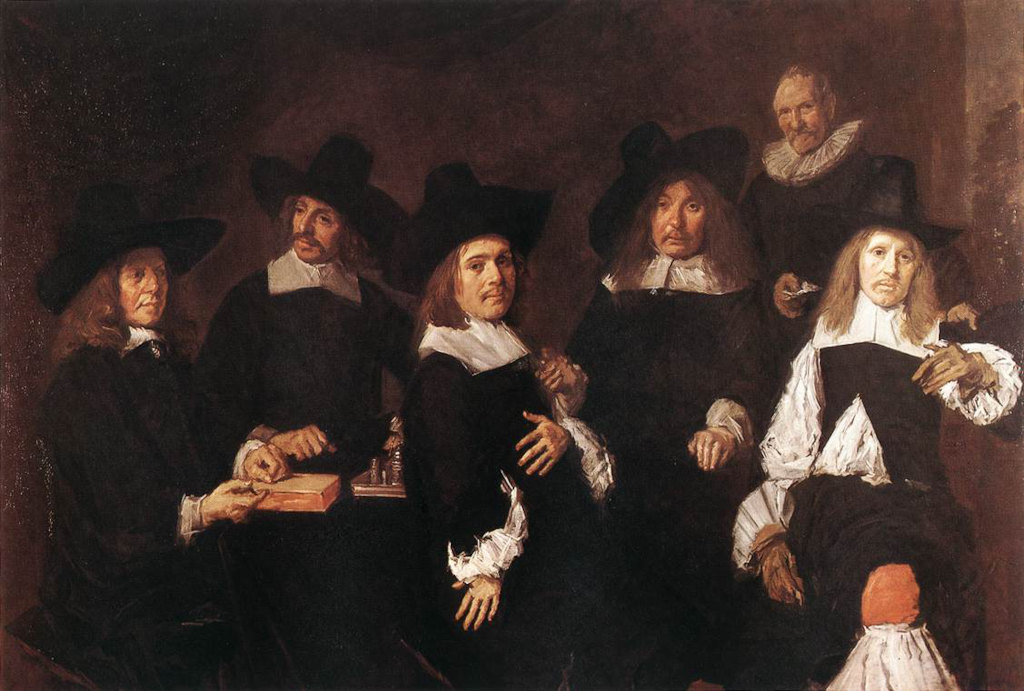
The Final Masterpiece of Frans Hals - The Regents of the Old Men's Almshouse
Few paintings demonstrate the extraordinary longevity of artistic genius more powerfully than The Regents of the Old Men's Almshouse. Painted in 1664, only two years before Frans Hals' death, the work belongs to the final phase of one of the greatest careers in Dutch Golden Age painting. At an age when many artists had long ceased working, Hals produced a portrait of astonishing psychological depth, remarkable technical confidence and enduring emotional power.
The painting depicts the governors of Haarlem's Old Men's Almshouse, a charitable institution responsible for caring for elderly men who could no longer support themselves. Rather than presenting idealised benefactors, Hals portrays a group of individuals whose expressions range from thoughtful and compassionate to reserved and quietly authoritative. Every face appears shaped by experience, while the restrained composition conveys the dignity and seriousness of civic responsibility.
For generations, the painting has also been associated with one of the most persistent legends surrounding Frans Hals. According to a popular story, Hals himself was impoverished and dependent upon charity when he received the commission. Modern scholarship paints a more complicated picture. Although the artist undoubtedly experienced financial difficulties during his later years, historians now question many of the dramatic anecdotes that developed during the nineteenth century. Separating documented evidence from romantic myth has become an essential part of understanding both the painting and the final years of Hals' life.
Technically, the portrait represents one of the supreme achievements of Hals' late style. Broad, economical brushstrokes describe faces, lace collars and black clothing with astonishing confidence. What appears almost abstract at close range resolves into compelling psychological realism when viewed from a normal distance. Later artists, including Vincent van Gogh, regarded these late portraits as among the greatest demonstrations of painterly freedom in European art.
Today, The Regents of the Old Men's Almshouse stands alongside its companion painting, The Regentesses of the Old Men's Almshouse, as one of the defining masterpieces of seventeenth-century portraiture. Together they offer an unparalleled meditation on ageing, civic duty, institutional charity and the enduring power of observation.
This article explores the history of the commission, the role of Haarlem's almshouses, the identities of the regents, Hals' extraordinary late technique, changing interpretations of the painting and its lasting influence on generations of artists.
- Artist Frans Hals (c.1582/3–1666)
- Title The Regents of the Old Men's Almshouse
- Date 1664
- Medium Oil on canvas
- Current Location Frans Hals Museum, Haarlem
- Subject Governors of Haarlem's Old Men's Almshouse
- Main Themes Charity, ageing, civic responsibility and leadership
- Artistic Importance Masterpiece of Hals' late style
- Why It Matters One of the greatest psychological group portraits ever painted.
Contents
- Historical Background
- What Was the Old Men's Almshouse?
- The Commission
- Looking at the Painting
- Who Are the Regents?
- Composition and Psychology
- Brushwork and Hals' Late Style
- Legacy and Influence
- The Journey of the Painting
- Where is the Painting Today?
- Timeline
- Interesting Facts
- Explore More Frans Hals Paintings
- FAQs
- Further Reading
- References
Historical Background
When Frans Hals painted The Regents of the Old Men's Almshouse in 1664, both the artist and the Dutch Republic were entering the closing stages of remarkable eras. Hals was more than eighty years old and had spent over half a century documenting the faces of Haarlem's citizens, while the Dutch Golden Age itself was beginning to experience political, military and economic pressures that contrasted sharply with the optimism of earlier decades. Yet despite these wider changes, Haarlem remained an important cultural and commercial centre whose civic institutions continued to commission works celebrating responsible public service.
By the 1660s Hals had developed one of the most distinctive styles in European painting. Gone were the brilliant orange sashes and animated banquets of his militia portraits. In their place appeared a quieter, more contemplative vision characterised by restrained colour, extraordinary psychological insight and astonishing confidence of execution. Rather than attempting to impress through elaborate display, Hals concentrated almost entirely upon the personalities of his sitters. Every brushstroke served the purpose of revealing character.
The commission for the Old Men's Almshouse therefore arrived at a particularly significant moment in Hals' career. Although he continued to enjoy considerable respect within Haarlem, the artist was no longer the fashionable portrait painter he had once been. Younger generations had emerged, artistic taste had evolved and financial difficulties had affected parts of his later life. Nevertheless, the governors of one of Haarlem's principal charitable institutions entrusted him with one of the city's most important public portrait commissions, demonstrating that his reputation as a portraitist remained formidable.
The resulting painting is remarkable not simply because it represents one of Hals' final masterpieces but because it reveals an artist who had refined his vision to its essentials. There are no unnecessary gestures, no elaborate settings and no theatrical effects. Instead, the work depends almost entirely upon observation: the subtle tilt of a head, the thoughtful meeting of a glance, the quiet authority of a folded hand. Few painters have conveyed so much with such apparent simplicity.
Today, The Regents of the Old Men's Almshouse is recognised as one of the defining achievements of late seventeenth-century portraiture. Together with its companion painting, The Regentesses of the Old Men's Almshouse, it demonstrates that Hals' powers remained astonishingly fresh even during the final years of his life.
Looking Closely: First Impressions
Before examining the individual faces, take a moment to observe the atmosphere of the painting as a whole. Unlike Hals' lively militia banquets, this composition immediately feels quieter and more reflective. Ask yourself how the mood changes before you begin analysing any single figure.
What Was the Old Men's Almshouse?
To understand the painting, it is first necessary to understand the institution it commemorates. The Old Men's Almshouse (Oudemannenhuis) was one of Haarlem's principal charitable foundations, providing accommodation and care for elderly men who could no longer support themselves. In the Dutch Republic, such institutions formed an essential part of urban welfare, combining civic responsibility with religious ideas about charity, discipline and moral duty.
Unlike modern systems of publicly funded social care, seventeenth-century welfare depended largely upon a combination of municipal government, private benefactors and charitable endowments. Almshouses provided food, lodging and basic medical care while also enforcing rules intended to promote orderly behaviour among residents. Their governors therefore carried significant responsibilities extending well beyond financial administration.
The regents shown in Hals' painting were not employees in the modern sense but respected citizens appointed to oversee the institution. They supervised expenditure, maintained the buildings, monitored admissions and ensured that charitable funds were used responsibly. Serving as a regent was both an honour and a civic obligation, reflecting the Dutch Republic's broader culture of shared municipal governance.
Portraits commissioned by charitable institutions differed subtly from those created for militia companies or private patrons. Instead of celebrating military achievement or personal wealth, they emphasised qualities such as prudence, integrity and responsible administration. These values are reflected throughout Hals' composition. The restrained clothing, sober expressions and absence of unnecessary luxury all reinforce the seriousness of the regents' public responsibilities.
Understanding this context transforms the painting. Rather than depicting five elderly men seated around a table, Hals presents the visible leadership of one of Haarlem's most important charitable organisations. Their authority derives not from aristocratic birth or military power but from civic service. This emphasis upon responsible citizenship lies at the heart of the Dutch Republic's political culture and explains why such portraits occupied an honoured place within institutional buildings.
Looking Closely: The Table
Notice the simplicity of the table before the regents. Unlike the lavish banquet tables of Hals' earlier militia portraits, this one contains very little to distract the eye. The absence of luxury reinforces the seriousness of the institution and directs attention towards the men themselves rather than their possessions.
The Commission
The commission formed part of a long Dutch tradition in which civic institutions commemorated their governors through large group portraits. Hospitals, almshouses, orphanages and charitable foundations frequently displayed such paintings within their meeting rooms, creating visual records of successive generations of administrators. These portraits celebrated continuity as much as individuality, reminding future regents of the responsibilities entrusted to them.
By the time Hals received the commission in 1664, he was the obvious choice for a project demanding both artistic distinction and psychological sensitivity. Few painters possessed his unrivalled experience in portraying groups of prominent Haarlem citizens. Although his style had evolved considerably since the exuberant militia portraits of earlier decades, his ability to capture personality remained unsurpassed.
One of the most enduring legends surrounding the commission claims that Hals painted the work while himself dependent upon charity from the very institution whose governors he portrayed. This story became especially popular during the nineteenth century, when biographers often romanticised the lives of great artists, portraying genius as inseparable from poverty and neglect.
Modern scholarship presents a more nuanced picture. Documentary evidence confirms that Hals experienced financial difficulties during his later years and that the Haarlem city authorities granted him modest financial assistance. However, there is no convincing evidence that he lived within the almshouse or painted the regents as a resident dependent upon their charity. The commission should therefore be understood primarily as a prestigious public appointment rather than as an act of institutional benevolence towards an impoverished artist.
Recognising this distinction is important because it changes our interpretation of the painting itself. Instead of imagining Hals pleading for assistance from powerful governors, we see an elderly master entrusted with recording fellow citizens whose public responsibilities demanded exactly the qualities of observation, restraint and psychological understanding that he had spent a lifetime perfecting.
Looking Closely: Myth and Evidence
Many famous paintings acquire dramatic stories that are repeated more often than they are verified. As you study this portrait, remember that the most moving aspects of Hals' achievement require no romantic legend. The painting's emotional power comes from careful observation rather than biographical myth.
Looking at the Painting
At first sight, The Regents of the Old Men's Almshouse appears remarkably restrained. Five men dressed almost entirely in black sit around a simple table, their broad white collars providing the principal visual contrast against the dark interior. There is little decoration, almost no symbolism and none of the theatrical movement found in many Baroque paintings of the same period. Yet the longer one studies the work, the richer it becomes. Hals has replaced outward drama with psychological complexity, inviting the viewer to observe subtle differences in character, authority and human interaction.
Unlike the lively militia banquets that established Hals' reputation earlier in his career, this composition unfolds slowly. No figure dominates the scene through extravagant gesture or elaborate costume. Instead, the regents communicate through restrained posture, carefully directed glances and quiet physical presence. Every movement appears measured, every expression considered. The atmosphere is one of reflection rather than celebration, perfectly suited to an institution devoted to charity and responsible administration.
The painting also demonstrates Hals' extraordinary confidence in allowing empty space to play an active role within the composition. Large passages of subdued wall and dark clothing create an almost architectural calm that focuses attention upon the faces and hands. Rather than filling every part of the canvas with descriptive detail, Hals understands that restraint can intensify observation. Silence becomes one of the painting's most powerful expressive tools.
The Arrangement of the Regents
The five governors are positioned around a table in a composition that appears informal yet is carefully balanced. No single figure occupies the exact centre of the canvas, preventing the eye from settling too quickly. Instead, attention moves naturally from one face to another, following a rhythm established by the alternating directions of heads, shoulders and gazes. Hals creates unity not through rigid symmetry but through subtle visual relationships.
The seated regents each respond differently to the viewer's presence. One turns directly towards us with an expression suggesting thoughtful engagement, while another appears absorbed in quieter reflection. A third seems almost interrupted in conversation, his attention divided between fellow governors and the observer standing before the painting. These varied responses create the impression that we have entered a meeting already in progress rather than interrupting a carefully staged pose.
Behind the table stands a servant, whose presence introduces an additional layer of social hierarchy. Unlike the regents, whose authority derives from civic office, the servant remains attentive and discreet, reinforcing the institutional setting without distracting from the principal sitters. Hals includes him not as decorative background but as an essential participant in the everyday functioning of the almshouse.
Looking Closely: Follow the Eyes
Rather than concentrating on one figure, follow the direction of each man's gaze. Some look directly towards the viewer, others appear to acknowledge fellow regents, while one remains quietly withdrawn. Hals uses these intersecting lines of sight to create a network of relationships that binds the group together without requiring dramatic movement.
Faces Shaped by Experience
Perhaps the painting's greatest achievement lies in the extraordinary individuality of the faces. Although the regents wear broadly similar clothing and occupy comparable positions, Hals ensures that no two personalities appear alike. Differences emerge through the slightest variations of expression: a raised eyebrow, tightened lips, a thoughtful tilt of the head or the weight of a downward glance. These subtle distinctions transform what might otherwise have become a repetitive group portrait into a compelling study of human character.
Age itself becomes an important expressive element. Hals neither idealises nor exaggerates the physical appearance of his sitters. Wrinkles, thinning hair and weathered complexions are recorded with honesty but never cruelty. Instead, the signs of advancing years contribute to an impression of experience, responsibility and accumulated judgement. These are men whose authority has been earned through long participation in civic life.
The directness of Hals' observation prevents the painting from becoming sentimental. There is little attempt to flatter or soften individual features. Instead, each regent appears entirely believable, occupying the delicate balance between public dignity and private humanity. This refusal to idealise would become one of the defining characteristics admired by nineteenth-century artists seeking greater truthfulness in portraiture.
Hands, Gesture and Authority
While the faces naturally attract immediate attention, the hands play an equally important role in communicating character. Hals understood that gesture often reveals personality as clearly as expression. Some hands rest calmly upon the table, suggesting confidence and composure, while others grip documents or the arms of chairs with greater firmness. None of these gestures appears theatrical, yet together they communicate differences in temperament and responsibility.
The restrained movement of the hands also reinforces the institutional purpose of the gathering. These are not military commanders displaying weapons or wealthy merchants exhibiting luxury goods. Instead, the gestures belong to administrators engaged in discussion, judgement and governance. Hals therefore transforms ordinary bodily movement into an eloquent visual language of civic responsibility.
Looking Closely: Notice the Hands
Spend a few moments studying the hands before returning to the faces. Observe how differently each man occupies the table. Hals uses these small variations to suggest confidence, hesitation, authority and reflection without relying upon exaggerated gestures.
Who Are the Regents?
Unlike many anonymous group portraits, the individuals represented in The Regents of the Old Men's Almshouse can largely be identified through surviving institutional records. They were prominent citizens of Haarlem appointed to oversee one of the city's most important charitable foundations. Their responsibilities included supervising finances, managing admissions, maintaining property and ensuring that the institution fulfilled its civic obligations to elderly residents.
Although each regent possessed his own professional background and social connections, Hals avoids presenting them as isolated portraits. Their identities matter less than their collective role. Together they embody an ideal of responsible municipal government that lay at the heart of the Dutch Republic. Rather than celebrating inherited aristocratic privilege, the painting honours citizens entrusted with public service through reputation, experience and civic engagement.
This collective identity distinguishes the work from Hals' earlier militia portraits. In those paintings, colourful costumes, banners and ceremonial objects emphasise rank and individual distinction. Here, uniform black clothing reduces visual hierarchy, encouraging viewers to concentrate upon personality instead of outward display. Authority is communicated through presence rather than spectacle.
The regents also remind us that charitable institutions depended upon the voluntary participation of influential citizens. Their service reflected a broader Dutch belief that prosperous members of society carried responsibilities towards the wider community. By recording these governors with such seriousness, Hals reinforces the moral importance attached to civic administration within seventeenth-century Haarlem.
For modern viewers, the individual biographies of the regents inevitably remain secondary to the extraordinary psychological unity that Hals achieves. We may never remember each name, yet we quickly recognise the different personalities assembled around the table. That ability to preserve individuality while creating collective coherence remains one of the defining achievements of Hals' mature art.
``` ```htmlComposition and Psychology
Although The Regents of the Old Men's Almshouse initially appears quiet and restrained, its composition is remarkably sophisticated. Hals abandons the lively diagonals and animated gestures that characterise his earlier militia portraits in favour of a structure built upon balance, tension and psychological observation. Every figure occupies a carefully judged position, while subtle variations in posture and eye contact create an intricate network of relationships across the canvas.
The composition depends less upon physical movement than upon mental engagement. Rather than depicting dramatic action, Hals invites the viewer into a moment of thoughtful deliberation. The governors appear to have paused during a meeting, turning their attention towards the observer with expressions that suggest curiosity, assessment and quiet authority. The resulting atmosphere is one of controlled concentration, entirely appropriate for men entrusted with administering one of Haarlem's principal charitable institutions.
A Circle of Responsibility
Unlike ceremonial portraits in which hierarchy is immediately obvious, Hals arranges the regents in a manner that emphasises collective responsibility. Although individual personalities emerge clearly, no single governor overwhelms the others. The eye circulates naturally around the group, moving from face to face before returning to the table that symbolically unites them. This circular rhythm reinforces the idea that decisions are reached collectively rather than imposed by a single dominant figure.
The table itself becomes an organising device. It anchors the composition physically while also representing the place where discussion, judgement and administration occur. Hals needs remarkably few objects to establish this setting. A document, a chair, a carefully placed hand and the quiet presence of the servant communicate everything necessary about the institution's daily work.
Psychological Variety
One of Hals' greatest achievements is his refusal to reduce the governors to a single collective personality. Each man appears to think differently, observe differently and respond differently to the viewer's presence. Some meet our gaze directly, while others appear more introspective. One seems quietly sceptical, another quietly attentive. These differences are subtle rather than theatrical, encouraging prolonged observation rather than immediate interpretation.
Importantly, Hals avoids creating heroes or villains. The painting contains no obvious moral judgement. Instead, he presents a group of experienced administrators whose authority derives from accumulated knowledge rather than dramatic charisma. Their expressions suggest lives shaped by responsibility, routine and difficult decisions. This psychological restraint makes the portrait feel unusually modern, inviting viewers to interpret character rather than simply admire status.
Looking Closely: Reading the Room
Imagine entering the meeting just as Hals did. Which governor seems most welcoming? Which appears most cautious? Which seems deep in thought? The painting offers remarkably few obvious clues, yet most viewers quickly develop different impressions of each individual. This ability to encourage psychological interpretation is one of Hals' greatest achievements.
Brushwork and Hals' Late Style
If The Regents of the Old Men's Almshouse demonstrates Frans Hals' psychological maturity, it also represents one of the supreme achievements of his technique. By 1664 he had spent more than fifty years refining his approach to portraiture. Every unnecessary brushstroke had been eliminated. What remained was an astonishing economy of means capable of conveying extraordinary richness through apparently simple marks of paint.
Modern viewers sometimes assume that the painting appears loose because it was created during Hals' old age. Earlier critics occasionally suggested that advancing years or declining eyesight explained its abbreviated handling. Technical examination and close visual analysis tell a very different story. The brushwork is not careless but controlled, not hesitant but decisive. Every stroke contributes to the final effect with remarkable precision.
Confidence Through Simplicity
The collars provide one of the clearest demonstrations of Hals' mastery. Rather than describing every fold of linen in painstaking detail, he constructs their forms through broad passages of white broken by delicate grey shadows and carefully placed highlights. The viewer's eye instinctively completes the illusion. What initially appears effortless is, in reality, the product of exceptional judgement about exactly how much information the eye requires.
The same principle governs the faces. Wrinkles are suggested rather than catalogued. Beards emerge from loosely interwoven strokes of grey, cream and brown. Flesh is built from surprisingly varied mixtures of warm ochres, reds, pinks and cool shadows. Seen from close range these passages verge on abstraction; from normal viewing distance they resolve into some of the most convincing portraits in European art.
The Mastery of Black
The dominance of black clothing might suggest a limited palette, yet Hals transforms these dark garments into remarkably varied surfaces. Warm reflections, cool shadows and subtle changes in texture distinguish one costume from another without disturbing the overall harmony of the composition. The blacks never appear flat or monotonous. Instead, they possess an unexpected luminosity that allows the figures to retain physical presence against the subdued background.
This sophisticated treatment of black profoundly impressed later painters. Vincent van Gogh repeatedly praised Hals' ability to paint dark clothing that remained vibrant and alive, recognising that true black is rarely achieved through black pigment alone. Browns, blues, greys and translucent glazes all contribute to the extraordinary richness of these apparently simple costumes.
Looking Closely: The Colour Hidden Inside Black
Choose one jacket and examine it closely. Instead of searching for black paint, look for warm browns, cool blues and soft greys. Hals creates depth by layering subtle tonal shifts rather than relying upon a single uniform colour.
Painting Time Rather Than Detail
Perhaps the most remarkable quality of Hals' late style is its ability to suggest the passage of time. The governors appear neither frozen nor theatrical. Instead, they seem caught within a brief pause between thoughts or conversations. Tiny adjustments of posture, barely perceptible changes of expression and restrained gestures create the impression that the scene continues beyond the limits of the canvas.
This sensitivity to transient human behaviour links Hals with much later developments in European painting. Although separated from the Impressionists by more than two centuries, he shared with them a fascination for visual immediacy and the incomplete nature of perception. Rather than labouring to eliminate every visible trace of the artist's hand, Hals embraced the expressive potential of paint itself.
Influence on Later Artists
Few seventeenth-century painters exercised such a profound influence upon nineteenth-century artists. Gustave Courbet admired Hals' honesty and directness, while Édouard Manet recognised in his portraits a powerful alternative to academic finish. John Singer Sargent carefully studied Hals' ability to combine apparently effortless brushwork with uncompromising psychological observation.
Vincent van Gogh's admiration was particularly heartfelt. In his letters to Theo, Van Gogh repeatedly praised Hals' extraordinary command of colour and flesh painting, marvelling that such vitality could be achieved through strokes that appeared almost casual. Looking at The Regents of the Old Men's Almshouse, he saw not the work of an ageing painter in decline but the achievement of an artist whose understanding had become so complete that every unnecessary movement of the brush had disappeared.
Legacy and Influence
The Regents of the Old Men's Almshouse occupies a unique place within the history of European portraiture. It is at once the culmination of Frans Hals' lifelong exploration of human character and one of the defining masterpieces of late Dutch Golden Age painting. Unlike many artists whose final works reveal diminishing confidence, Hals' late portraits possess an extraordinary assurance that has continued to inspire admiration for more than three centuries.
The painting also transformed later understanding of portraiture itself. Instead of treating likeness as a matter of physical accuracy alone, Hals demonstrated that psychological truth could be conveyed through gesture, posture and the expressive handling of paint. His achievement influenced not only individual painters but also broader ideas about what portraiture could accomplish. The governors remain recognisable not because every feature is meticulously described, but because each appears unmistakably alive.
``` ```html id="regents04"Legacy and Influence
Although The Regents of the Old Men's Almshouse was admired within Haarlem from the time of its completion, its wider reputation developed gradually. During the later seventeenth and eighteenth centuries, European artistic taste increasingly favoured highly polished surfaces and idealised portraiture. Hals' energetic brushwork, visible paint handling and uncompromising realism appeared old-fashioned beside the elegant refinement of artists such as Anthony van Dyck and the fashionable portrait painters of eighteenth-century Europe.
As a result, many of Hals' greatest works attracted less attention than they deserved. His reputation never disappeared entirely, but it became overshadowed by changing artistic fashions. Ironically, the very qualities that later generations criticised—his visible brushwork, direct observation and willingness to leave traces of the painter's hand—would eventually become the foundation of his modern reputation.
The Nineteenth-Century Rediscovery
The nineteenth century witnessed one of the great rediscoveries in the history of European art. As painters began rejecting rigid academic conventions in favour of direct observation and expressive handling of paint, Frans Hals suddenly appeared remarkably contemporary. Artists travelling through the Netherlands made special journeys to Haarlem in order to study his portraits, recognising qualities that had been overlooked for generations.
Gustave Courbet admired Hals' refusal to idealise his sitters, while Édouard Manet found in his work a convincing demonstration that visible brushwork could enhance realism rather than diminish it. John Singer Sargent likewise studied Hals closely, adapting aspects of his confident handling and psychological immediacy within his own portrait practice. Their admiration helped restore Hals to his rightful place among the greatest portrait painters in European history.
Vincent van Gogh's enthusiasm was perhaps even more personal. Writing to his brother Theo, Van Gogh repeatedly praised Hals' astonishing command of flesh painting, black costume and expressive brushwork. He marvelled that an artist could create such convincing humanity through strokes that appeared almost effortless. To Van Gogh, Hals represented the ideal combination of technical freedom and profound observation.
Looking Closely: Paint or Person?
Stand close enough that individual brushstrokes become obvious. Then gradually step backwards until the regents emerge as convincing individuals once more. Hals continually reminds us that great painting exists simultaneously as coloured pigment and as human presence.
The Myth of the Impoverished Master
Few stories about Frans Hals have proved more enduring than the claim that he painted the regents while himself dependent upon the charity of the institution they governed. The image of an ageing genius rescued by public generosity appealed strongly to nineteenth-century biographers, who often preferred dramatic narratives to careful documentary research. Over time the story became closely associated with the painting itself.
Modern scholarship paints a more measured picture. Surviving municipal records confirm that Hals experienced financial difficulties during his later years and that the Haarlem authorities provided him with modest assistance. These documents reflect genuine hardship, but they do not support the romantic claim that the artist lived in the almshouse or painted its governors as a grateful resident. The commission should instead be understood as a prestigious civic appointment awarded to Haarlem's most experienced portrait painter.
Correcting this misconception does not diminish the painting's emotional impact. On the contrary, it restores Hals' professional dignity while allowing the portrait to be appreciated on its own artistic merits. Rather than illustrating the charity extended towards an impoverished painter, the work records an encounter between respected civic administrators and an elderly artist whose powers remained astonishingly undiminished.
A Masterpiece of Late Style
Today, The Regents of the Old Men's Almshouse is recognised as one of the defining achievements of Hals' final years. Together with its companion painting, The Regentesses of the Old Men's Almshouse, it demonstrates how far his art had evolved from the exuberant confidence of his early portraits towards a quieter, more reflective vision of human character.
Many historians now regard these late works as the culmination of Hals' artistic development. Their restrained colour, economical brushwork and profound psychological insight reveal an artist who no longer needed elaborate display to command attention. Every unnecessary detail has been stripped away, leaving only what matters most: the presence of living human beings.
In this sense, the painting stands not simply as the conclusion of Hals' career but as one of the great final statements in the history of European portraiture. Few artists have ended their working lives with such confidence, originality and emotional depth.
The Journey of the Painting
Unlike many masterpieces that passed through generations of aristocratic collections before entering public museums, The Regents of the Old Men's Almshouse has remained closely connected with the institution and the city for which it was created. Painted specifically for Haarlem's Old Men's Almshouse in 1664, it originally hung within the building itself, where successive governors and visitors encountered it as both a work of art and a permanent record of civic administration.
This original setting is crucial to understanding the painting. The portrait was never intended for a royal palace or private collector. Instead, it formed part of the visual identity of a charitable institution whose governors were expected to uphold standards of honesty, prudence and responsible stewardship. Anyone entering the meeting room would have been reminded not only of previous regents but also of the values associated with their office.
During the nineteenth century, increasing appreciation of Dutch Golden Age painting encouraged renewed efforts to preserve works by Frans Hals within Haarlem. As municipal collections gradually developed into what is now the Frans Hals Museum, the city's most important civic portraits—including the militia paintings, regents' portraits and numerous individual likenesses—were brought together under conditions that ensured their long-term conservation while making them accessible to the public.
The transfer of these paintings into a museum setting inevitably changed the way they were experienced. Originally functional portraits created for specific institutions became masterpieces of European art history. Yet unlike many museum objects separated from their place of origin, Hals' great civic commissions remained in Haarlem, preserving an unusually strong relationship between artwork, city and historical context.
Modern conservation has further deepened understanding of the painting. Careful technical examination has confirmed the extraordinary assurance of Hals' late technique while revealing the subtle complexity of his apparently simple brushwork. Cleaning campaigns have restored the luminosity of the black costumes, the crisp brilliance of the lace collars and the delicate tonal relationships that unite the composition.
Looking Closely: Imagine the Original Setting
Rather than picturing the painting in a modern museum gallery, imagine it hanging inside the meeting room of the almshouse itself. The governors shown before you were not distant historical figures but predecessors whose example continued to shape the institution's daily work.
Where is the Painting Today?
Today, The Regents of the Old Men's Almshouse is one of the treasures of the Frans Hals Museum in Haarlem. Few paintings remain so closely associated with the city that commissioned them. Displayed alongside many of Hals' greatest portraits, it allows visitors to trace the extraordinary development of his style across more than fifty years of artistic activity.
Seeing the painting in person reveals qualities that reproductions cannot fully convey. Its scale gives the regents an imposing physical presence, while the subtle interplay of black costume, white collars and carefully modulated flesh tones creates a visual harmony that is difficult to appreciate in photographs. From a normal viewing distance the figures appear astonishingly real. Only at close range does the illusion dissolve into confident, energetic brushwork.
Perhaps the greatest surprise for many visitors is the painting's quietness. Unlike dramatic Baroque history paintings filled with movement and colour, Hals' masterpiece unfolds gradually. The longer one spends with it, the richer it becomes. Every face seems to reveal new aspects of personality, while the relationships between the governors continue to shift with sustained observation. It is a painting that rewards patience rather than spectacle.
Looking Closely: Give the Painting Time
Spend at least five uninterrupted minutes with the portrait. Notice how your attention gradually shifts from the composition as a whole to individual expressions, then back again. Hals created a painting that reveals itself slowly, encouraging prolonged observation rather than immediate impact.
Timeline
- 1609 — Haarlem's Old Men's Almshouse continues to develop as one of the city's principal charitable institutions, governed by appointed regents.
- 1664 — Frans Hals completes The Regents of the Old Men's Almshouse, together with its companion portrait of the Regentesses.
- 1664–1666 — The portrait hangs in the almshouse meeting room, serving both as a record of the governors and a reminder of civic responsibility.
- 1666 — Frans Hals dies in Haarlem, leaving behind one of the greatest bodies of portrait painting in European art.
- 19th century — Hals is rediscovered by artists including Courbet, Manet, Sargent and Van Gogh, who admire the freedom of his late brushwork.
- Today — The painting remains one of the masterpieces of the Frans Hals Museum, Haarlem.
Interesting Facts
- The painting was created when Hals was in his early eighties. It demonstrates that his powers of observation and technical confidence remained extraordinary late in life.
- It has a companion painting. Hals painted The Regentesses of the Old Men's Almshouse at the same time, creating one of the greatest paired commissions of the Dutch Golden Age.
- The famous poverty story is exaggerated. Documentary evidence confirms financial difficulties but does not support the popular claim that Hals painted the regents while living in the almshouse.
- The black costumes are among Hals' greatest technical achievements. Their apparent simplicity conceals an extraordinarily sophisticated range of colours and tones.
- The servant plays an important compositional role. Although easily overlooked, the standing figure helps balance the composition while reinforcing the institutional setting.
- Van Gogh admired these late portraits deeply. He regarded Hals as one of history's greatest painters of flesh and black costume.
- The painting remains in Haarlem. Unlike many Dutch masterpieces dispersed across Europe and America, it can still be viewed in the city for which it was originally painted.
Explore More Frans Hals Paintings
FAQs
Further Reading
- Seymour Slive, Frans Hals, 3 vols. London: Phaidon, 1970–1974.
- Christopher D. M. Atkins, Frans Hals. Reaktion Books, 2012.
- Claus Grimm, Frans Hals: The Complete Work. Harry N. Abrams, 1990.
- Norbert Middelkoop & Antoon Erftemeijer (eds.), Frans Hals: Eye to Eye with Rembrandt, Rubens and Titian. nai010 publishers, 2013.
- Friso Lammertse et al., Frans Hals. National Gallery Global, 2023.
- Mariët Westermann, A Worldly Art: The Dutch Republic 1585–1718. Yale University Press, 2004.
- Wayne Franits, Looking at Seventeenth-Century Dutch Art. Cambridge University Press, 1997.
- Walter Liedtke, Dutch Paintings in The Metropolitan Museum of Art. Metropolitan Museum of Art, 2007.
References
- Frans Hals Museum. Collection catalogue for The Regents of the Old Men's Almshouse.
- RKD – Netherlands Institute for Art History. Catalogue entry for Frans Hals and the regents' portraits.
- Seymour Slive, Frans Hals, 3 vols., Phaidon.
- Christopher D. M. Atkins, Frans Hals, Reaktion Books.
- Claus Grimm, Frans Hals: The Complete Work.
- Norbert Middelkoop & Antoon Erftemeijer (eds.), Frans Hals: Eye to Eye with Rembrandt, Rubens and Titian.
- Friso Lammertse et al., Frans Hals, National Gallery Global.
- Mariët Westermann, A Worldly Art.
- Wayne Franits, Looking at Seventeenth-Century Dutch Art.
- Walter Liedtke, Dutch Paintings in The Metropolitan Museum of Art.
- Van Gogh Museum / Huygens ING, Vincent van Gogh: The Letters.