 by Tom Gurney
Tom Gurney BSc (Hons) is an art history expert with over 20 years experience
Published on June 29, 2026 / Updated on June 29, 2026
Email: tomgurney1@gmail.com / Phone: +44 7429 011000
The Final Portrait of Female Civic Leadership
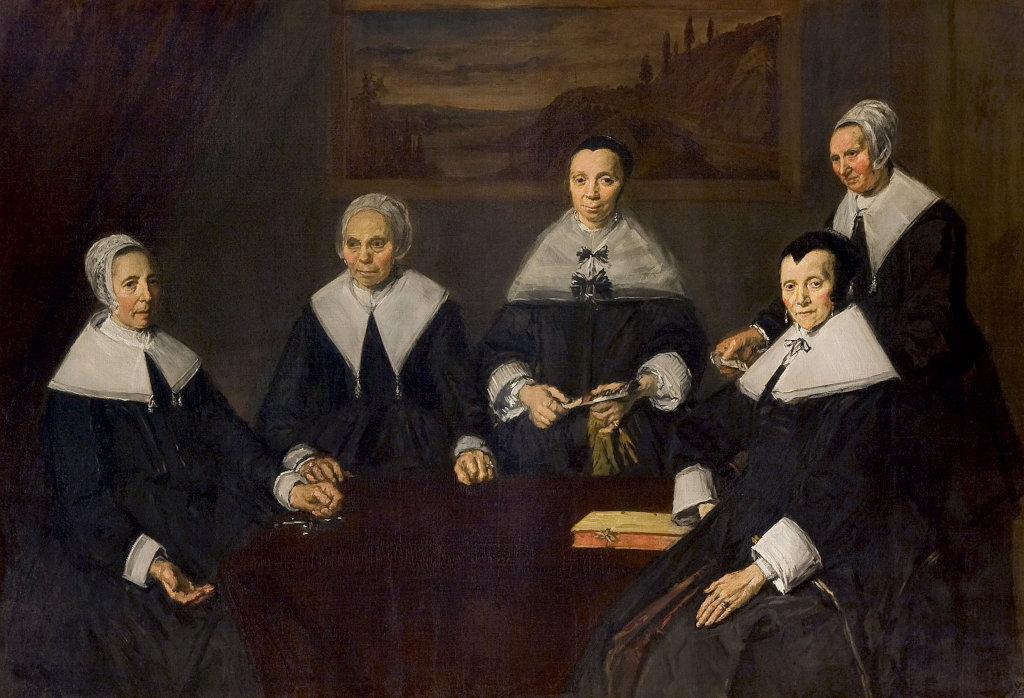
Among the greatest achievements of Frans Hals' final years is The Regentesses of the Old Men's Almshouse, painted in 1664 as the companion to The Regents of the Old Men's Almshouse. Created when the artist was more than eighty years old, the portrait demonstrates an astonishing combination of technical confidence, psychological insight and artistic restraint. Far from showing signs of decline, Hals' late style had reached a remarkable level of refinement in which every brushstroke contributes directly to the character of the sitters.
The painting depicts the women responsible for supervising Haarlem's Old Men's Almshouse, one of the city's principal charitable institutions. Like their male counterparts, the regentesses were entrusted with overseeing welfare, discipline and the day-to-day administration of the institution. Their responsibilities formed part of the wider civic culture of the Dutch Republic, in which prosperous citizens accepted important voluntary roles in governing hospitals, orphanages and charitable foundations.
Unlike many earlier portraits of wealthy women, Hals avoids elaborate displays of jewellery, fashionable luxury or aristocratic grandeur. Instead, the regentesses are presented with striking dignity and quiet authority. Their black clothing, crisp white collars and composed expressions direct attention away from wealth and towards character. Each woman appears thoughtful, self-possessed and entirely individual, creating one of the most psychologically compelling group portraits in European art.
Modern viewers are often struck by the painting's extraordinary stillness. There are no dramatic gestures or theatrical interactions. Instead, Hals achieves emotional depth through subtle differences in posture, expression and eye contact. The resulting atmosphere feels almost timeless, inviting prolonged contemplation rather than immediate narrative interpretation.
Together with its companion portrait of the regents, this masterpiece represents the culmination of Hals' lifelong exploration of portraiture. It also provides invaluable insight into the important role played by women within the charitable institutions of the Dutch Republic, reminding us that civic leadership extended far beyond the formal structures of political office.
This article explores the history of the commission, the responsibilities of the regentesses, the identities of the sitters, Hals' remarkable late brushwork, the painting's symbolism and its lasting influence on the history of portraiture.
- Artist Frans Hals (c.1582/3–1666)
- Title The Regentesses of the Old Men's Almshouse
- Date 1664
- Medium Oil on canvas
- Current Location Frans Hals Museum, Haarlem
- Subject Governors of Haarlem's Old Men's Almshouse
- Main Themes Female civic leadership, charity and responsibility
- Artistic Importance One of Hals' greatest late masterpieces
- Why It Matters A profound study of character, authority and the role of women in Dutch civic life.
Contents
- Historical Background
- The Old Men's Almshouse and Female Civic Leadership
- The Commission
- Looking at the Painting
- Who Were the Regentesses?
- Composition and Psychology
- Brushwork and Hals' Late Style
- Legacy and Influence
- The Journey of the Painting
- Where is the Painting Today?
- Timeline
- Interesting Facts
- Explore More Frans Hals Paintings
- FAQs
- Further Reading
- References
Historical Background
When Frans Hals completed The Regentesses of the Old Men's Almshouse in 1664, he was in the final years of a remarkable career that had transformed Dutch portraiture. More than five decades earlier he had established his reputation through lively militia banquets and animated individual portraits, yet by the 1660s his artistic priorities had changed profoundly. Colour had become more restrained, compositions quieter and brushwork increasingly economical, while psychological observation reached an extraordinary depth. These final portraits reveal not an ageing artist in decline but a master who had refined his art to its essentials.
The commission also belongs to a fascinating period in the history of the Dutch Republic. Haarlem remained one of the country's principal artistic and commercial centres despite the economic and political challenges that gradually affected the later decades of the seventeenth century. Civic institutions continued to play a central role in urban life, relying upon respected citizens to supervise hospitals, orphanages and charitable foundations. Portraits of these governors and regentesses were commissioned not merely to commemorate individuals but to celebrate responsible public service.
Unlike many European societies of the period, the Dutch Republic offered wealthy women opportunities to participate in organised charitable administration. Although excluded from formal political office, women from prominent families frequently served as regentesses responsible for overseeing institutions caring for the poor, the elderly and orphaned children. Their work required practical judgement, financial oversight and considerable organisational ability. Hals' painting therefore records an important aspect of civic life that is sometimes overlooked in broader histories of the Dutch Golden Age.
Painted as the companion to The Regents of the Old Men's Almshouse, this portrait completes Hals' final great statement on civic responsibility. Together the two works present male and female leadership not as opposing forces but as complementary aspects of institutional governance. While each painting possesses its own distinct atmosphere, both are united by the artist's profound respect for individual character and public duty.
Today, The Regentesses of the Old Men's Almshouse is recognised as one of the greatest group portraits ever devoted to female civic leadership. Its quiet dignity, extraordinary psychological insight and remarkable technical assurance continue to inspire admiration from historians, artists and museum visitors alike.
Looking Closely: First Impressions
Before examining individual faces, consider the atmosphere created by the group as a whole. Does the painting feel formal, compassionate, distant or welcoming? Hals encourages us to respond emotionally before we begin analysing the details of costume or composition.
The Old Men's Almshouse and Female Civic Leadership
The Old Men's Almshouse (Oudemannenhuis) formed part of a sophisticated network of charitable institutions that supported vulnerable members of Haarlem's population. Elderly men without sufficient means could receive accommodation, food and care within the institution, while its governors and regentesses supervised daily administration, financial management and the overall welfare of residents. These responsibilities demanded careful judgement and reflected the Dutch Republic's belief that prosperous citizens should contribute actively to the wellbeing of their communities.
The role of the regentesses extended well beyond ceremonial duties. They inspected living conditions, oversaw domestic management, supervised female staff and ensured that standards of cleanliness, discipline and care were maintained. Their work required practical knowledge as well as compassion, balancing charitable concern with the orderly administration expected within seventeenth-century civic institutions.
Membership of such governing bodies was normally drawn from Haarlem's established urban elite. Appointment recognised reputation, family standing and proven commitment to public service. Although the women portrayed by Hals belonged to privileged households, their responsibilities remind us that influence within the Dutch Republic often operated through civic institutions rather than through aristocratic courts. Charity was regarded not simply as personal generosity but as organised public responsibility.
Portraits commissioned for these institutions reinforced that ideal. Hanging within meeting rooms, they recorded successive generations of administrators while also encouraging future office holders to uphold the same standards of integrity and diligence. In this sense, Hals' painting functioned both as portraiture and as a visual expression of institutional identity.
Understanding this context transforms our reading of the painting. Rather than seeing a group of solemnly dressed women, we recognise experienced administrators responsible for one of Haarlem's most important charitable organisations. Their authority derives not from wealth alone but from service, responsibility and the confidence placed in them by the wider community.
Looking Closely: Authority Without Display
Notice how little Hals relies upon luxury to communicate status. There are no elaborate interiors, costly jewellery or theatrical gestures. Authority emerges instead through posture, expression and the quiet confidence with which each woman occupies the composition.
The Commission
The commission formed part of the long Dutch tradition of institutional portraiture, in which hospitals, orphanages, almshouses and charitable foundations recorded their governors through large-scale group paintings. Such works were intended to remain within the buildings they represented, preserving both institutional memory and civic identity. Hals had already demonstrated exceptional mastery of this genre through his celebrated militia portraits, but his late commissions required a markedly different approach.
Rather than celebrating military success or civic ceremony, the regentesses' portrait reflects the quieter responsibilities of charitable administration. Hals responds by abandoning almost every element of visual spectacle. Colour is reduced to a restrained harmony of black, white and muted flesh tones. Movement becomes subtle rather than dramatic. Individual psychology replaces outward display as the principal subject of the painting.
By 1664 Hals was more than eighty years old, yet his reputation within Haarlem remained considerable. Although financial difficulties affected his later years, the decision to entrust him with both the regents' and regentesses' portraits demonstrates the continuing confidence placed in his abilities. Far from being an act of charity towards an ageing artist, the commission recognised a lifetime of achievement and unmatched experience in portraying the city's civic elite.
The companion nature of the two paintings also deserves emphasis. Together they present the complete governing structure of the almshouse, acknowledging the complementary responsibilities carried by male and female administrators. Viewed side by side, they provide one of the most remarkable surviving records of civic leadership anywhere in seventeenth-century Europe.
Looking Closely: Two Halves of One Commission
Imagine the regents' portrait hanging beside this one, as originally intended. The paintings are not rivals but companions. Together they tell the complete story of the institution's leadership, reminding viewers that successful charitable administration depended upon the contributions of both men and women.
Looking at the Painting
At first glance, The Regentesses of the Old Men's Almshouse appears even more restrained than its companion portrait of the regents. Five women, dressed almost entirely in black with crisp white collars and cuffs, are arranged around a simple table within an austere interior. There are no rich fabrics, no elaborate jewellery and almost no decorative objects to distract the viewer. Hals deliberately removes every unnecessary element, allowing expression, posture and human presence to become the true subject of the painting.
The composition possesses an extraordinary stillness. Unlike many Baroque portraits that rely upon sweeping gestures or dramatic movement, Hals creates tension through quiet observation. The women neither pose theatrically nor ignore the viewer entirely. Instead, each appears caught in a moment of thoughtful interruption, as though a meeting has briefly paused to acknowledge our arrival. This impression of suspended time contributes greatly to the painting's psychological power.
The restrained setting also reflects the institutional purpose of the commission. These women are not shown within luxurious domestic interiors but within the working environment of a charitable foundation. Their authority derives from responsibility rather than wealth. Hals communicates this distinction with remarkable economy, relying upon little more than carefully judged posture, expression and the subtle relationships between the figures.
The Arrangement of the Figures
The five regentesses occupy the composition with carefully balanced individuality. Although they form a unified governing body, Hals avoids rigid symmetry or repetitive poses. Each woman turns slightly differently, creating a rhythm that encourages the eye to move naturally around the group. Some meet the viewer directly, while others appear momentarily distracted by conversation or private reflection. These small differences prevent the composition from becoming static despite its remarkable calm.
The table provides the structural centre of the painting much as it does in the companion portrait of the regents. Here too it symbolises the place where decisions were discussed, records examined and responsibilities shared. Hals includes only the minimum number of objects necessary to establish this setting, trusting the personalities of the sitters to sustain the viewer's interest.
Behind the seated women stands a servant dressed in simpler clothing. Her presence quietly reinforces the social hierarchy within the institution while also contributing to the composition's balance. Hals treats her with the same careful observation as the regentesses themselves, avoiding caricature or excessive idealisation. Although her role differs fundamentally from theirs, she remains an essential participant in the daily life of the almshouse.
Looking Closely: The Rhythm of the Composition
Allow your eye to travel slowly from one face to the next. Notice how Hals varies the direction of each head and the angle of every shoulder. These subtle adjustments create movement without requiring dramatic gestures, producing a composition that feels quietly alive.
Authority Through Expression
Perhaps the most remarkable achievement of the painting is Hals' ability to convey authority without resorting to obvious symbols of power. None of the women wears a crown, carries an official staff or occupies an elevated throne. Instead, leadership is communicated almost entirely through expression. Their calm self-possession, attentive gazes and composed bearing suggest individuals accustomed to making considered decisions affecting the lives of others.
Importantly, Hals does not present the regentesses as a single unified personality. Each woman responds differently to the viewer's presence. One appears quietly inquisitive, another reserved, another thoughtful, while a fourth projects a more direct confidence. These distinctions emerge gradually rather than immediately, rewarding sustained observation. Hals demonstrates that genuine individuality often resides in the smallest variations of expression.
This refusal to simplify character distinguishes the portrait from many contemporary institutional commissions. Rather than creating idealised representatives of charity, Hals portrays experienced administrators whose authority has been shaped by judgement, responsibility and daily engagement with the practical realities of civic life. Their humanity remains fully visible alongside their public roles.
Faces Shaped by Experience
As in the companion portrait of the regents, age becomes an expressive resource rather than a limitation. Hals neither disguises nor exaggerates the physical signs of advancing years. Fine wrinkles, changing complexions and the subtle effects of ageing are recorded with remarkable honesty, yet never with cruelty. The faces communicate experience rather than decline, suggesting lives devoted to sustained responsibility rather than fleeting achievement.
The psychological depth of these portraits depends largely upon Hals' extraordinary observational skills. Tiny adjustments around the eyes, slight changes in the corners of the mouth and almost imperceptible tilts of the head create individuals who seem capable of thought beyond the moment represented on the canvas. The viewer senses not merely appearance but interior life.
Looking Closely: Spend Time With One Face
Choose a single regentess and study her expression for a full minute before moving to another. You may find that your interpretation changes over time. Hals avoids obvious emotions, allowing subtle expressions to reveal themselves gradually through prolonged looking.
Who Were the Regentesses?
Unlike many anonymous portraits from the seventeenth century, the women represented in The Regentesses of the Old Men's Almshouse can largely be identified through surviving institutional records. They belonged to Haarlem's civic elite and had been appointed to oversee the female administration of one of the city's most important charitable foundations. Their responsibilities extended well beyond ceremonial attendance, encompassing practical management, financial oversight and the welfare of elderly residents.
Appointment as a regentess reflected both social standing and public trust. Most came from established merchant or governing families whose involvement in Haarlem's civic institutions extended across generations. Their service formed part of a broader culture in which influential women exercised significant authority within charitable organisations, complementing the work undertaken by male governors while maintaining responsibilities that were often distinct in practice.
Although modern visitors naturally wish to know the personal histories of each woman, Hals deliberately emphasises their collective role. The portrait is less concerned with celebrating private achievement than with recording responsible public service. Individual identities remain important, but they are woven into a broader vision of institutional continuity and civic obligation.
Individual Character Within a Collective Portrait
Hals' genius lies in reconciling individuality with unity. Each regentess possesses a distinct personality, yet none dominates the composition. Together they form a governing body rather than a gathering of unrelated portraits. The painting therefore succeeds simultaneously on two levels: as a collection of compelling individual likenesses and as a coherent statement about institutional leadership.
This balance distinguishes the work from many group portraits produced elsewhere in Europe during the same period. Instead of emphasising rank or hierarchy, Hals presents cooperation. Authority is distributed across the composition rather than concentrated in a single commanding figure. Such an arrangement reflects the collegiate nature of Dutch civic administration, in which decisions were commonly reached through discussion and shared responsibility.
The regentesses also remind us that the history of the Dutch Republic cannot be understood solely through the actions of male politicians, merchants or military leaders. Women played essential roles within the charitable and educational institutions that supported urban society. Hals' portrait preserves one of the most eloquent visual records of that contribution.
``` ```html id="regentesses03"Composition and Psychology
Although The Regentesses of the Old Men's Almshouse is outwardly one of Frans Hals' quietest paintings, its emotional complexity rewards prolonged study. Every aspect of the composition has been reduced to its essentials. There are no unnecessary gestures, no theatrical interactions and almost no decorative distractions. Instead, Hals relies upon the subtle relationships between the women—the direction of a glance, the angle of a shoulder, the position of a hand—to create one of the most psychologically sophisticated group portraits of the Dutch Golden Age.
Unlike the exuberant civic banquets that established Hals' early reputation, this composition unfolds gradually. The women do not compete for attention. Their authority is expressed collectively rather than individually, reflecting the collegiate nature of institutional governance within the Dutch Republic. The viewer's eye moves slowly from one figure to another, discovering new nuances of personality with each return to the painting.
A Community of Decision-Makers
The arrangement of the regentesses emphasises cooperation rather than hierarchy. Although one or two figures naturally attract initial attention, no single woman dominates the composition for long. Hals instead creates a visual conversation in which each participant contributes to the overall rhythm of the group. The painting therefore reflects not only individual character but the collaborative nature of charitable administration itself.
The table again functions as the symbolic centre of the composition. It is the place where accounts would have been examined, decisions debated and responsibilities shared. Hals needs remarkably few objects to establish this institutional setting. A ledger, a piece of fabric and the measured placement of hands communicate an entire world of organised civic life without resorting to elaborate symbolism.
The Language of Expression
One of Hals' greatest achievements is his ability to distinguish each woman through the slightest differences of expression. Rather than relying upon exaggerated emotion, he works with almost imperceptible variations around the eyes and mouth. One regentess appears quietly attentive, another more reserved, another seems deep in thought, while another acknowledges the viewer with calm assurance. None of these impressions is fixed. They shift subtly as the viewer spends more time with the painting.
This ambiguity is one of the portrait's greatest strengths. Hals avoids the temptation to assign obvious emotional roles, allowing each viewer to form independent interpretations. The regentesses feel like real individuals precisely because they resist simple categorisation. Their expressions contain the complexity and restraint characteristic of people accustomed to responsibility rather than display.
Looking Closely: Expressions That Change
Return to the same face several times while studying the painting. You may discover that a woman who initially appeared stern gradually seems thoughtful or compassionate instead. Hals paints expressions that evolve through sustained observation rather than revealing themselves instantly.
Hands and Gesture
Although the faces naturally command attention, Hals devotes equal care to the hands. They rest quietly upon the table, hold documents or fold naturally within the composition. None appears posed merely for elegance. Instead, every gesture contributes to the impression of practical administration. These are working hands, accustomed to examining records, signing documents and supervising the daily operation of the institution.
The restrained handling of gesture reinforces the painting's broader themes. Authority is expressed not through theatrical movement but through calm assurance. Hals demonstrates that stillness can possess extraordinary expressive power when supported by acute observation.
Looking Closely: Follow the Hands
Spend a moment tracing the positions of the hands before returning to the faces. Hals uses these subtle gestures to establish rhythm across the composition, quietly reinforcing the individuality of each regentess without disturbing the painting's remarkable calm.
Brushwork and Hals' Late Style
If The Regentesses of the Old Men's Almshouse represents one of Frans Hals' greatest psychological achievements, it is equally remarkable as a demonstration of his mature technique. Painted when the artist was more than eighty years old, the work reveals a painter who had reduced his method to its absolute essentials. Every stroke appears deliberate. Nothing has been added simply for decorative effect, and nothing essential has been omitted.
Earlier generations sometimes interpreted this abbreviated handling as evidence of declining eyesight or failing physical strength. Modern technical study and close visual examination support a very different conclusion. Hals' late brushwork is not the result of diminishing ability but of extraordinary confidence. Decades of experience enabled him to describe flesh, lace, fabric and expression with astonishing economy, relying upon the viewer's eye to complete forms suggested rather than exhaustively defined.
Painting White Against Black
Perhaps nowhere is Hals' mastery more evident than in his handling of the women's white collars and cuffs. Instead of describing every fold of linen with painstaking precision, he constructs them from broad passages of white animated by cool grey shadows and carefully placed highlights. These apparently simple areas reveal remarkable sophistication when viewed closely, yet from a normal distance they possess complete conviction.
Against these brilliant whites, the black dresses acquire extraordinary richness. Hals understood that convincing black depends upon subtle variation rather than uniform darkness. Browns, blues, translucent greys and warm reflections combine to create garments that feel substantial and luminous rather than flat. The restrained palette therefore becomes one of the painting's greatest expressive strengths.
Age Painted with Compassion
The regentesses are elderly women, yet Hals refuses either to flatter or to caricature them. Wrinkles, changing complexions and the physical effects of advancing years are recorded honestly but sympathetically. Nothing appears cruel or sentimental. Instead, age itself becomes a source of dignity, suggesting lives shaped by experience, responsibility and accumulated wisdom.
This compassionate realism distinguishes Hals from many portrait painters of his period. He does not conceal the passage of time, but neither does he transform it into moral commentary. The women are portrayed simply as they are: thoughtful, capable individuals whose authority rests upon judgement rather than youthful appearance.
Looking Closely: The Brushstroke Up Close
Move close enough to distinguish individual strokes of paint, then step back again. Observe how quickly the apparently abstract marks merge into convincing faces and richly textured clothing. Hals trusted normal human vision more than microscopic detail, allowing perception itself to complete the illusion.
Influence on Later Artists
The rediscovery of Frans Hals during the nineteenth century owed much to paintings such as The Regentesses of the Old Men's Almshouse. Gustave Courbet admired their uncompromising realism, while Édouard Manet recognised that visible brushwork could communicate truth more effectively than highly polished surfaces. John Singer Sargent likewise studied Hals' extraordinary ability to suggest personality through apparently effortless handling.
Vincent van Gogh's admiration was especially profound. Writing to his brother Theo, he praised Hals' astonishing treatment of black costume, living flesh and expressive brushwork, describing him as one of the greatest portrait painters in history. Looking at these late portraits, Van Gogh saw not an artist approaching the end of his powers but one whose understanding had become so complete that every unnecessary movement of the brush had disappeared.
Legacy and Influence
Today, The Regentesses of the Old Men's Almshouse is recognised as one of the supreme achievements of seventeenth-century portraiture. Together with its companion painting of the regents, it demonstrates the extraordinary heights that Frans Hals reached during the final years of his career. Few artists have ended their working lives with works of such confidence, restraint and psychological insight.
The painting has also acquired wider historical importance as one of the finest visual records of women's participation in civic administration during the Dutch Golden Age. While political history has traditionally focused upon male officeholders, Hals' portrait reminds us that charitable institutions depended equally upon the judgement, organisation and commitment of influential women. In preserving their likenesses with such dignity and individuality, Hals created not merely a masterpiece of portraiture but an enduring document of civic history.
``` ```html id="regentesses04"The Journey of the Painting
Unlike many masterpieces that entered royal collections or passed through generations of aristocratic ownership, The Regentesses of the Old Men's Almshouse has remained closely connected with the institution and city for which it was created. Painted in 1664 for Haarlem's Old Men's Almshouse, it originally hung within the meeting room used by the regentesses themselves. There it served not simply as decoration but as a permanent record of civic service, preserving the identities of successive administrators while reminding future office holders of the responsibilities entrusted to them.
This original setting is essential to understanding the portrait. The painting functioned within the daily life of the institution, surrounded by records, accounts and the practical business of charitable administration. Visitors would have recognised the women depicted not as distant historical figures but as active governors responsible for the welfare of elderly residents. The portrait therefore combined artistic achievement with institutional memory in a manner characteristic of the Dutch Republic.
As appreciation of Dutch Golden Age painting increased during the nineteenth century, Haarlem took growing pride in the works of its most famous painter. The great civic portraits that had once belonged to separate institutions gradually became central to the city's museum collections. This process ensured both their preservation and their accessibility, while allowing Hals' development as a portrait painter to be appreciated more fully through the survival of so many important works in their original city.
Modern conservation has revealed the extraordinary sophistication of Hals' late technique. Technical examination confirms that the apparently simple brushwork is the product of highly controlled painting rather than rapid improvisation. Cleaning campaigns have restored subtle tonal relationships, particularly within the black garments and white collars, allowing modern viewers to appreciate the remarkable delicacy that underlies the painting's outward restraint.
Looking Closely: Imagine the Original Room
Picture the painting hanging inside the almshouse itself rather than a museum gallery. The women before you were not merely historical subjects but living governors whose portraits formed part of the institution they administered. The work originally belonged to the daily rhythm of civic life.
Where is the Painting Today?
Today, The Regentesses of the Old Men's Almshouse is housed in the Frans Hals Museum in Haarlem alongside many of the artist's greatest achievements. Few museums offer such an exceptional opportunity to trace the complete evolution of a painter's style within the city where he spent almost his entire career. Seeing the regentesses displayed in proximity to Hals' militia portraits, individual likenesses and companion works allows visitors to appreciate the remarkable consistency of his interest in human character across more than fifty years.
Viewed in person, the painting possesses a quiet authority that reproductions struggle to capture. The subtle interplay between luminous white collars, deep black clothing and carefully observed flesh tones creates a harmony that changes with viewing distance. From across the gallery the women appear strikingly alive; from close range their faces dissolve into confident, economical brushstrokes. This shifting experience lies at the heart of Hals' mature technique.
Many visitors are surprised by the emotional warmth of the painting. Although the composition is restrained and the expressions measured, prolonged observation reveals a remarkable sympathy for the sitters. Hals records ageing without sentimentality, authority without severity and individuality without disrupting the unity of the group. These qualities become increasingly apparent the longer one spends before the original canvas.
Looking Closely: Patience Rewards the Viewer
Give yourself time. The painting is deliberately quiet, and its greatest strengths reveal themselves gradually. As your eye moves repeatedly around the group, subtle differences in expression, posture and personality become increasingly apparent.
Timeline
- 17th century — Haarlem's Old Men's Almshouse continues to develop as one of the city's principal charitable institutions, administered by governors and regentesses.
- 1664 — Frans Hals paints The Regentesses of the Old Men's Almshouse together with its companion portrait of the regents.
- 1664–1666 — The portrait hangs within the almshouse, serving as a permanent record of civic leadership.
- 1666 — Frans Hals dies in Haarlem at approximately eighty-two years of age.
- 19th century — Hals' reputation is revived by artists including Courbet, Manet, Sargent and Van Gogh, who admire his extraordinary late style.
- Today — The painting remains one of the masterpieces of the Frans Hals Museum, Haarlem.
Interesting Facts
- The portrait was painted when Hals was over eighty years old. It ranks among the greatest late works by any European painter.
- It forms one half of a remarkable pair. The companion portrait of the regents was completed at the same time for the same institution.
- The painting records female civic leadership. Few surviving masterpieces from the seventeenth century portray women exercising institutional authority with such dignity and realism.
- The restrained palette is highly sophisticated. Hals creates extraordinary richness through subtle variations of black, grey, brown and white rather than brilliant colour.
- The servant plays an essential role. Her presence balances the composition while reinforcing the social organisation of the almshouse.
- Van Gogh admired Hals' late portraits deeply. He praised their expressive brushwork and remarkable treatment of black costume.
- The painting has remained in Haarlem. Its continued association with the city strengthens our understanding of its original civic context.
Explore More Frans Hals Paintings
FAQs
Further Reading
- Seymour Slive, Frans Hals, 3 vols. London: Phaidon Press, 1970–1974.
- Christopher D. M. Atkins, Frans Hals. London: Reaktion Books, 2012.
- Claus Grimm, Frans Hals: The Complete Work. New York: Harry N. Abrams, 1990.
- Norbert Middelkoop & Antoon Erftemeijer (eds.), Frans Hals: Eye to Eye with Rembrandt, Rubens and Titian. Rotterdam: nai010 publishers, 2013.
- Friso Lammertse et al., Frans Hals. National Gallery Global, 2023.
- Mariët Westermann, A Worldly Art: The Dutch Republic 1585–1718. Yale University Press, 2004.
- Wayne Franits, Looking at Seventeenth-Century Dutch Art. Cambridge University Press, 1997.
- Walter Liedtke, Dutch Paintings in The Metropolitan Museum of Art. Metropolitan Museum of Art, 2007.
- Frans Hals Museum. Collection catalogue and curatorial essays relating to The Regentesses of the Old Men's Almshouse.
- RKD – Netherlands Institute for Art History. Catalogue records for Frans Hals and Haarlem civic portraiture.
References
- Frans Hals Museum, collection catalogue for The Regentesses of the Old Men's Almshouse.
- RKD – Netherlands Institute for Art History (Netherlands Institute for Art History), catalogue entry for Frans Hals.
- Seymour Slive, Frans Hals, 3 vols., Phaidon Press.
- Christopher D. M. Atkins, Frans Hals, Reaktion Books.
- Claus Grimm, Frans Hals: The Complete Work.
- Norbert Middelkoop & Antoon Erftemeijer (eds.), Frans Hals: Eye to Eye with Rembrandt, Rubens and Titian.
- Friso Lammertse et al., Frans Hals, National Gallery Global.
- Mariët Westermann, A Worldly Art: The Dutch Republic 1585–1718.
- Wayne Franits, Looking at Seventeenth-Century Dutch Art.
- Walter Liedtke, Dutch Paintings in The Metropolitan Museum of Art.
- Van Gogh Museum / Huygens ING, Vincent van Gogh: The Letters, letters discussing Frans Hals' late portraits and brushwork.
- National Gallery, London, exhibition catalogue essays on Frans Hals and seventeenth-century Dutch portraiture.