 by Tom Gurney
Tom Gurney BSc (Hons) is an art history expert with over 20 years experience
Published on June 19, 2020 / Updated on October 2, 2026
Email: tomgurney1@gmail.com / Phone: +44 7429 011000
Introduction
Kazimir Malevich (1879–1935) changed what a painting could ask its viewer to see. Born in Kyiv, then in the Russian Empire, into a family of Polish origin, he worked across the artistic communities of Ukraine, Russia and Belarus. His career did not begin with an empty square. It passed through portraits, rural labour, book illustration, theatre, Cubo-Futurist movement and apparently irrational combinations of objects. In 1915, he made paintings of free-standing geometric forms and named the approach Suprematism. The first Black Square became its best-known image, but the range of work around it is the fuller story. Later he returned to figures and peasants, often carrying the formal decisions of his abstract years into bodies and landscapes. [1], [2], [3]
This artist guide follows those changes through particular works. It distinguishes the 1915 Black Square in the Tretyakov Gallery from later paintings of the motif; a 1916 Suprematist Composition from similarly titled works; and the Russian Museum's circa-1923 Black Circle from a different circle associated with 1915. Such distinctions matter because an image search can flatten several physical paintings into one familiar icon. The links below lead to focused pages for individual objects, a longer biography, a paintings guide, style and technique, and theory and writings. [4], [5], [6], [7]
At a Glance
- ArtistKazimir Severinovich Malevich
- Life1879–1935; older catalogues sometimes give 1878
- BirthKyiv, then part of the Russian Empire; family of Polish origin
- Artistic centresKursk, Moscow, Petrograd/Leningrad, Vitebsk and Kyiv, among other places
- Best-known workFirst Black Square, painted and exhibited in 1915; State Tretyakov Gallery, Moscow, inv. 11925
- Approach he namedSuprematism: nonobjective paintings built from colour, plane, line and a surrounding field
- Beyond paintingDrawings, prints and books, theatre designs, teaching, porcelain, architectural models and writing
- Key turning points1913 theatre collaboration; 1915 exhibition at 0.10; 1919–22 Vitebsk and UNOVIS; 1927 Warsaw and Berlin exhibitions; late figurative work
Malevich in context
The bands show approximate periods and documented moments, not exclusive styles. Select a work or source to follow its evidence.
Early experiments [1]
c. 1908–11Neo-Primitivist peasant pictures [1]
c. 1911–13Cubo-Futurist movement [15]
c. 1912–14Alogical painting [18]
c. 1914–15White phase and collective design [1]
c. 1918–22Later figurative work [1]
c. 1928–35Goncharova and Larionov [1]
Moscow exchanges, c. 1907–13Kruchenykh and Matyushin [1]
Opera collaboration, 1913Kliun and Suprematist circle [22]
1915 onwardChagall and Vitebsk school [1]
1919–20Ermolaeva and Lissitzky [1]
UNOVIS, c. 1920–22Suetin and Chashnik [1]
Vitebsk to Petrograd, c. 1920–24Malevich in Kyiv [1]
Teaching, c. 1928–30The Woodcutter [13]
1912The Knife Grinder [15]
1912–13Black Square [4]
1915White on White [5]
1918Red Cavalry [30]
c. 1932Contents
- Why Malevich matters
- Beginnings: Kyiv, Kursk and Moscow
- Peasants and motion before the square
- The 1915 turn: 0.10 and Suprematism
- Colour, construction and the white phase
- Teaching, books and objects
- The 1927 journey and the artworks left abroad
- Figures return without erasing abstraction
- Looking at the paintings as paintings
- Where to go next
Watch: Kazimir Malevich
Three short films place Black Square, the 1915 exhibition and Malevich’s later work in context.
Kazimir Malevich | TateShots
A curator introduces Black Square, the 0.10 exhibition and Malevich’s later work.
Watch on YouTubeWhy Malevich matters
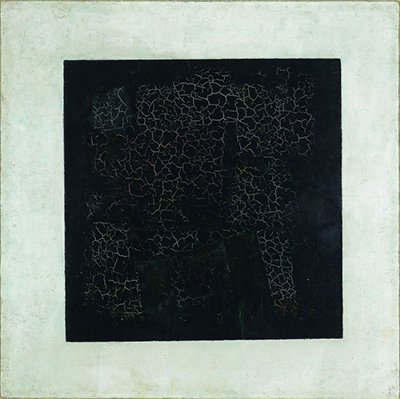
Black Square is often reproduced as if it were a logo for abstract art. Its historical importance lies partly in Malevich's decision to exhibit an oil painting that had no depicted subject and then argue that colour and painted form could be a work's subject in themselves. He placed the first surviving canvas high across the corner of his room at the 0.10 exhibition in Petrograd in December 1915. A period photograph records the arrangement: the square above and many other geometric pictures around it. The position evoked the high domestic corner where an icon might hang, yet the work offered no recognisable saint, person or scene. It announced a different relation between an image and its viewer. [4], [8]
The painting was a physical experiment, too. Its quadrilateral is not perfectly regular, its pale surround is not an untouched blank and its present dark surface is crossed by craquelure. Technical examination has shown earlier compositions underneath. The original therefore asks two questions at once: what happens when a painting removes the depicted object, and what remains visible of the painter's making and the canvas's later life? Neither question is answered by drawing a black square in software. Malevich's own subsequent works changed the colours, scale and relations of forms; the single famous canvas is an opening into the sequence rather than a substitute for it. [4], [9]
His achievement also belongs to a network rather than an isolated burst of inspiration. He worked with poets and musicians, shared exhibitions with other avant-garde artists, wrote polemics and taught students. His experiments moved from painted canvases into printed pages, public graphics, porcelain and proposed architecture. In Vitebsk, the UNOVIS group formed around collective work and training. The later histories of Suprematism depend as much on those exchanges and on the movement of artworks across borders as on any one object. This is why the guide keeps the artist's works, writings and relationships in view together. [1], [10], [11]
Beginnings: Kyiv, Kursk and Moscow
Malevich's birth is frequently given as 1878 in older museum and exhibition catalogues. A reproduced Kyiv parish register and a scholarly Ukrainian historical entry support 11 February 1879 in the calendar then used locally, or 23 February 1879 in the Gregorian calendar. A single modern national label cannot describe every part of his career without losing the historical geography. Kyiv was then in the Russian Empire; his parents were of Polish origin; he later worked and taught in cities now in several different states. The wording here names places and circumstances rather than retrofitting a present-day border to every year of his life. [2], [3]
His father worked in the sugar industry, and the family moved among industrial and rural settings during Malevich's childhood. In the 1890s he lived in Kursk and worked for the railway, while making art with local companions. Trips to Moscow and eventual study in Ivan Rerberg's private studio brought him into contact with the city's collections and exhibition circles. The story matters to his paintings because the peasant labour and provincial scenes of the early 1910s were not simply imported themes from a Parisian school. At the same time, he saw modern European painting in Moscow collections and encountered artists who were actively testing new approaches to colour, form and popular visual culture. [1]
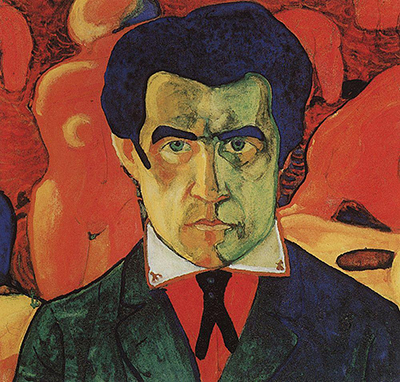
Early works resist a tidy label. The Malevich Society documents experiments with Impressionism, Symbolism, Fauvism and other approaches before the canvases usually called Neo-Primitivist or Cubo-Futurist. An early Self-Portrait uses strong contrasting colour to construct a face rather than a neutral likeness. It should be read as one of several portraits and self-images, not confused with the formally different 1933 portrait in Renaissance-like dress. A Tretyakov account dates a closely matching early self-portrait to 1911, although another reproduction has circulated under a 1912 label. This guide therefore leaves the pictured version undated pending a secure object match. [1], [12]
In Moscow, Malevich knew Natalia Goncharova and Mikhail Larionov. Their work and exhibitions gave him a setting in which vernacular images, icons and the lubok print could be reconsidered alongside modern European painting. That connection can be seen in thick contours, frontal figures and emphatic colour, but it should not be reduced to a claim that he merely copied their style. The works change markedly from one year to the next. The comparison is useful because it makes his geometric paintings appear as part of an extended inquiry into what forms and colours can do, rather than a miraculous break with a featureless past. [1]
Peasants and motion before the square
The Woodcutter and Taking in the Rye show why Malevich's early rural subjects deserve close attention. Bodies, tools and crops are recognisable, yet large planar areas of colour and forceful outlines dominate how the scene is read. Taking in the Rye is particularly useful for seeing the overlap of subject and construction: the Stedelijk's painting is a specific second version dated 1912, not a generic image of harvesting. A peasant theme could serve as a testing ground for colour, frontal composition and the breakup of naturalistic space. [1], [13], [14]
His 1912–13 Knife Grinder makes a different experiment. Yale's canvas repeats the worker's limbs and the wheel's forms across small facets; the grinding action appears as a sequence rather than one still pose. The picture has a person and a task, but it also asks how a canvas might show movement and duration. The overlapping shapes connect to Cubism and Futurism without becoming a simple translation of either movement. Malevich's Woman with Pails: Dynamic Arrangement at MoMA, dated 1912–13 by that museum, likewise keeps a carrying figure in view while the structure of colours and planes takes on growing force. The date painted on its reverse reads 1912 and should not be silently treated as a complete catalogue chronology. [15], [16]
The 1913 futurist opera Victory over the Sun brought Malevich into a collaboration with Aleksei Kruchenykh and Mikhail Matyushin. Costumes and stage designs used strong divisions of form and an unsettling theatrical space. Malevich later connected the black-square idea to this project. A surviving design relevant to the opera contains a divided dark and light square; it is not the Tretyakov's painted Black Square, which was first exhibited in 1915. The distinction gives the 1913 work its proper importance without inventing a two-year earlier display of the canvas. [1], [4], [17]
By 1914, the conventional logic of objects could be made to fail while fragments remained recognisable. In An Englishman in Moscow, a face, fish, church, tools and letters occupy an unstable arrangement. A viewer can name many parts but cannot turn them into a consistent event in one room. The Stedelijk's object record and its research on a newly identified drawing make this a particularly good comparison with the later square. A year before the most severe nonobjective gesture, Malevich was already asking what a painting could do once familiar relations of size and space were suspended. [18]
Follow Malevich’s career through four stages
The 1915 turn: 0.10 and Suprematism
Malevich's Suprematist works were not all black on white. His 1915 paintings place red, blue, yellow and dark planes against open light grounds, testing orientation, balance and a sense of movement without illustrating a scene. Suprematist Composition: Airplane Flying is held by MoMA; its title suggests flight, but the canvas does not provide a literal airplane. The distinction between an evocative title and depicted content is central to reading these works. The painting's coloured masses and their surrounding field create their own spatial relationships. [1], [19]
At the December 1915 0.10 exhibition, the first Black Square was prominent but it was not alone. The period photograph shows a densely hung ensemble. Black Cross is an unusually useful companion because Centre Pompidou has identified its 1915 canvas, AM 1980-1, through distinctive irregularities visible in installation photographs. A later cross in the Russian Museum is a separate physical work. This matters whenever a current image is chosen for a page about 1915: the similar motif cannot establish that the photograph shows the same canvas. [4], [8], [20]
Red Square gives another route into the moment. The Russian Museum's 1915 painting carries the extended title Painterly Realism of a Peasant Woman in Two Dimensions. The words can surprise a viewer who sees only a red quadrilateral. They point toward Malevich's revision of what counted as painterly reality: the colour and plane are the work's reality, rather than an outline disguising a peasant portrait. The title should be handled as his historical formulation, not used to claim that an invisible woman can be located within the pigment. The painting also differs from a smaller private rectangular-field red-square version catalogued in the 2003 Guggenheim publication. [6], [21]
The word Suprematism enters Malevich's correspondence during 1915, while paintings and explanations were still taking shape. That order matters. The exhibition, the text and the canvases did not fall out of a complete system in one instant. Malevich issued writing around the first presentation and revised his account as the work developed. His language about objectlessness, form, feeling and a new painterly realism invites interpretation; a short English slogan can never replace a full edition with date and translation. The theory and writings guide follows those documents, while the broader Suprematism movement page places the movement among other makers. [1], [4], [22]
Colour, construction and the white phase
By 1916, Suprematism had produced complex arrangements far beyond one dark shape. The 1916 Suprematist Composition with a tilted blue plane, long green form, dark horizontal bar and smaller coloured elements is a specific canvas catalogued as Nakov S-97. Christie’s records its size as 88.7 by 71.1 centimetres and its subsequent exhibition and ownership history. The title has been used for many Malevich works; collection, catalogue number and appearance are required to keep this one distinct. Its overlapping forms make the light field active: small elements disperse across it while large forms suggest weight and motion. [7]
Tate's 1916 Dynamic Suprematism offers another kind of movement. The museum's painting T02319 is not the same object as a similarly named drawing at SFMOMA or another canvas at Museum Ludwig. Its diagonal arrangement makes the picture feel different from the more frontal 1915 squares. Suprematism, 18th Construction is associated with the November 1915 Moscow exhibition of decorative art; its possible inclusion at 0.10 requires a different level of evidence. The current painting's 2008 transfer from the Stedelijk to Malevich's heirs belongs to its own history. Such cases show how seemingly abstract shapes can have sharply individual object biographies. [23], [24]
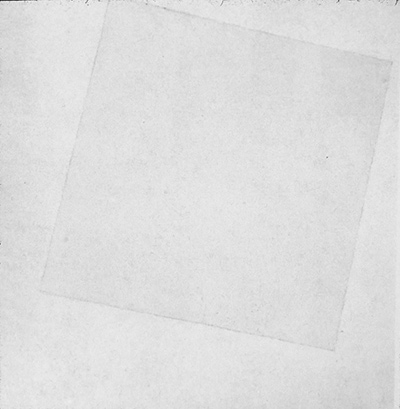
Malevich explored how little visible difference a painting could contain while still making relationships legible. In the 1918 Suprematist Composition: White on White at MoMA, an angled pale quadrilateral lies within a differently toned white square field. The work is not a blank canvas. Looking longer reveals shifts of hue, edge and orientation; reading its dimensions and material history prevents an interpretation based only on a low-contrast thumbnail. The later white phase did not cancel the colour works. It pursued the relation between form and an apparently open, unbounded space by other means. [5]
Black, colour and white are sometimes presented as neat successive boxes. The objects warn against that diagram being too rigid. Malevich returned to earlier motifs, dated some works retrospectively, and made different versions of a form years later. The Russian Museum's Black Circle is dated circa 1923 by its owner; it should not be transported back to the 1915 0.10 room merely because a circle is associated with the early Suprematist vocabulary. Its large dark disc leaves an especially broad pale zone below. This physical painting is part of the story of the form's continuation, not evidence that all black-form canvases were made together. [25]
Teaching, books and objects
In 1919 Malevich moved to Vitebsk, where Marc Chagall had established an art school. Malevich's teaching attracted students and colleagues, including Vera Ermolaeva and El Lissitzky, and the group called UNOVIS formed in early 1920. It promoted collective artistic work and applied Suprematist ideas to printed matter, public decoration and everyday design. The group is often represented only by a black-square sign, but its significance lies also in a social experiment about how artists learn and work together. The relationships were historically specific: Chagall's role in founding the school, Malevich's arrival and the subsequent conflict should not be blurred into an easy story of one master passing a style to another. [1], [10]
Malevich wrote during this period, including On New Systems in Art and Suprematism: 34 Drawings. He treated drawing as a way of constructing and explaining new relations, not merely as a private outline to be discarded after a painting was finished. The Stedelijk's Khardzhiev research shows why work on paper matters to this corpus: its collection includes a large group of Malevich works, and its research has identified a preparatory drawing connected with An Englishman in Moscow. The site's drawings and prints guides distinguish original sheets, printed illustrations and later reproductions. Those categories can look alike in a browser image while having different makers, dates and media. [10], [18], [26]
The ideas also became things to hold and spaces to imagine. In Petrograd/Leningrad, Malevich worked with porcelain designs and with white architectural models he called architectons. A teapot, a drawing of a structure and an architecton are not simply oil paintings turned three-dimensional: they require different materials and users. The change of medium did not make geometry ornamental by default. It let Malevich test whether relations that had been made on a canvas could shape a cup, a page or a proposed built environment. Any claim about a specific object's author, workshop or date belongs with its owner record, especially when production involved students or factories. [1]
The 1927 journey and the artworks left abroad
Malevich travelled west in 1927, showing work in Warsaw and then Berlin. He visited the Bauhaus, and his German-language book Die gegenstandslose Welt appeared in the Bauhaus series. He returned to the Soviet Union and left a substantial group of paintings and documents in Germany. Their survival and later movement are an important part of how European and American audiences encountered his work. Some of the paintings passed into the Stedelijk Museum's collection; others have histories involving MoMA exhibitions and, much later, restitution. A single statement about “the Malevich collection” cannot stand in for the object history of every canvas. [1], [7], [27]
The 1916 Suprematist Composition provides a specific example. Christie’s account traces its exhibitions and its later passage through the Stedelijk context before a 2008 settlement with Malevich's heirs; it was sold in 2018. The facts explain why this painting appears in multiple museum, legal and market narratives. Its price is not the reason the 1916 composition mattered to Malevich's development. Similarly, MoMA's record of White on White shows an individual route from the 1927 European presentation into a New York collection. The objects have shared historical turning points but not interchangeable provenance. [5], [7]
The journey also complicates a simple national account of the artist. Malevich was born in Kyiv, formed a career in Russian Empire avant-garde circles, taught in Vitebsk and Kyiv, and displayed works in Poland and Germany. His paintings then circulated through museums and collectors far from those places. Recognising each context is more informative than choosing a single label that would be expected to explain all of them. The biography traces the chronology in greater detail. [1], [2], [3]
Figures return without erasing abstraction
Malevich painted figures again in the late 1920s and early 1930s. Some works revisit peasants, a theme present before Suprematism, but their bodies can be simplified into colour fields and repeated planes. The Russian Museum's Sportsmen (1928–32) places four faceless figures in divided colour; Head of a Peasant uses a different, more isolated encounter with the face. Head of a Peasant is especially easy to misidentify because the same museum has another painting with that title, similar reported dimensions and date but a different composition and support. Exact inventory numbers and images are essential. [28], [29]
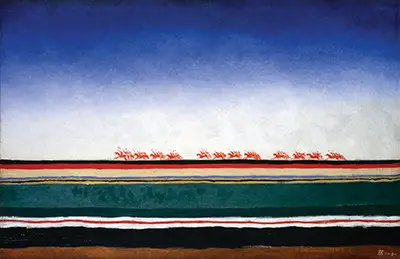
Red Cavalry shows tiny red riders on a distant horizon, with extensive bands of earth and sky occupying the canvas. The Russian Museum dates the physical work circa 1932. The inscription “1918” on it is not a secure creation date, although it is evidence that needs interpretation. National Gallery of Art conservation research describes carefully varied surface effects in the bands; a digital image can show their arrangement but not reproduce the full gloss and texture. The scene may invite political readings, yet its construction also links late subject matter to long-standing questions about flat planes, distance and rhythm. [30], [31]
The later work unfolded under increasing political pressure. Malevich's institute was closed in 1926; he was arrested and imprisoned in 1930. It would nevertheless be too simple to describe every figurative painting as a forced abandonment of Suprematism. Works such as Girl with a Comb in Her Hair (1932–33) show sustained attention to paint, figure and surface, while some late images retain severe geometric organisation. Conversely, treating the political context as irrelevant would erase an important condition of his later life. The paintings and the documents should be read together rather than made to illustrate one all-purpose motive. [1], [32]
Malevich died in Leningrad in 1935. His black-square emblem remained part of the visual account of his career, including the late self-presentation described by specialist and museum histories. The persistence of that form does not mean that the late paintings were simply disguised versions of the 1915 canvas. It shows that he continued to think through earlier inventions while changing subject and medium. The early and late self-portraits are a concise example: both represent the artist, but their colour, pose and public claims about what an artist is could hardly be the same. [1], [12]
Looking at the paintings as paintings
Digital reproductions encourage a quick sweep from one recognisable design to another. Malevich's paintings deserve slower looking at scale. In Black Square, the off-white frame and cracked dark field interrupt the idea of a flawless symbol. In Red Square, the tilted red edge makes a simple shape feel made rather than mechanically generated. In White on White, small differences between light tones do almost all the compositional work. In the 1916 Suprematist Composition, crowded small elements set up a different tempo from the dominant blue and green planes. These are visual observations tied to specific images and objects, not a formula for every Suprematist picture. [4], [5], [6], [7]
The conservator Ann Hoenigswald examined Malevich paintings and found a varied, considered handling of support, ground, paint and coatings. Her study is particularly useful because it keeps the painter's material decisions visible in works frequently described only as ideas. It does not licence an unsupported claim that every canvas used the same pigments or surface treatment. The technique of Red Cavalry, for example, must be discussed as that work's treatment; the cracked 1915 Black Square has its own material history. The style and technique guide follows those object-specific studies. [9], [31]
The white ground, too, should not be treated as an empty backdrop in every picture. A colour plane's tilt, spacing and proximity to another form can make the surrounding light field seem to open, press or divide. A cross made from two painted bands differs from the square even when both are black; a circle's placement leaves changing amounts of light around it. These differences invite a viewer to attend to relations rather than search for a hidden pictured object. The claim is modest but powerful: looking carefully at shape, colour, edge and surface is already a way of reading the work. [5], [20], [25]
Essential works
Eight starting points across the transition to Suprematism. Each image opens at a larger size; each title leads to its researched artwork page.
Black Square
1915 · The cracked original made a severe new claim for painting without a depicted object.
White on White
1918 · Two differently toned whites create a quiet but active relation.
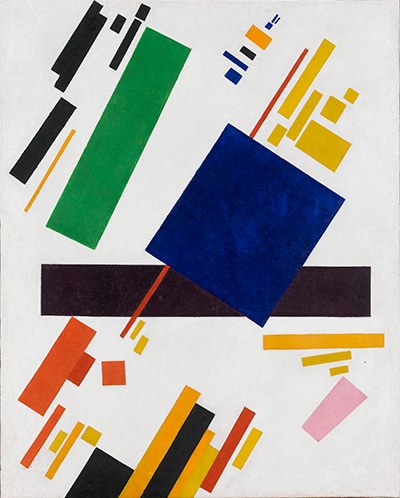
Suprematist Composition
1916 · Large blue and green planes gather smaller moving colour forms.
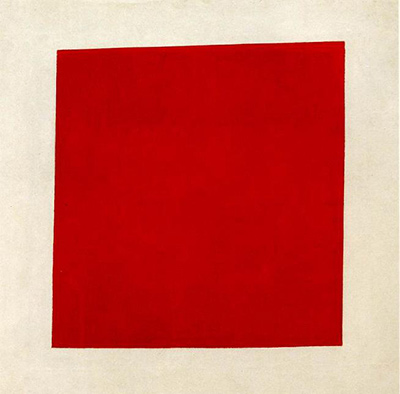
Red Square
1915 · A painted red quadrilateral carries Malevich’s provocative “painterly realism” title.
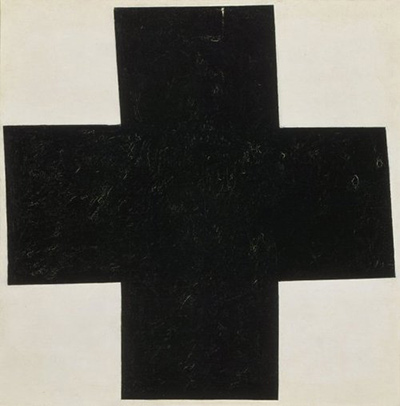
Black Cross
1915 · The Pompidou canvas is a distinct early black form identified in 0.10 photographs.
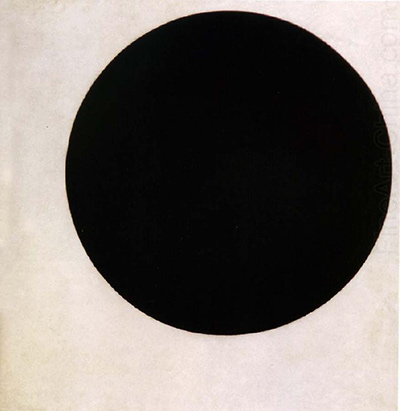
Black Circle
c. 1923 · The Russian Museum canvas continues the form in a later physical work.
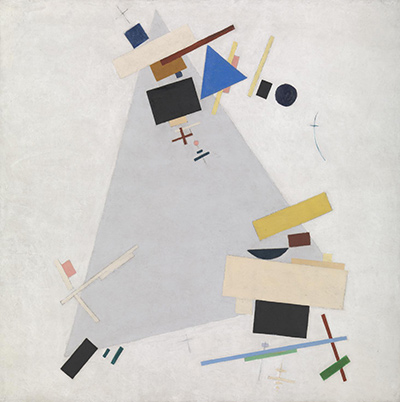
Dynamic Suprematism
1916 · Diagonal forms test movement and balance beyond the square.
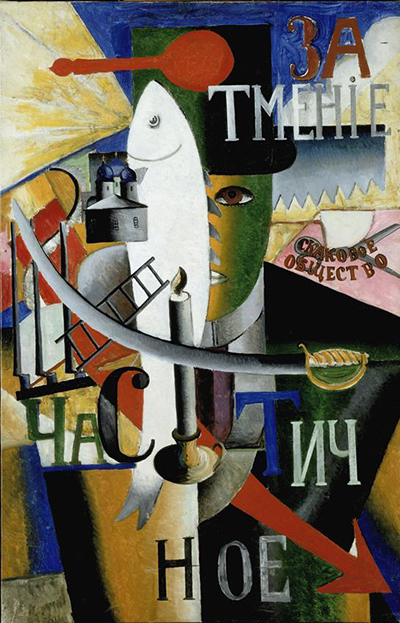
An Englishman in Moscow
1914 · Illogical relations among objects precede the nonobjective turn.
Where to go next
Begin with Black Square for the 1915 room, its later versions and the evidence beneath its cracked surface. Read Red Square and Black Cross beside it to see how different a primary form can feel. Black Circle extends that comparison but belongs to a later physical canvas. Suprematist Composition, Dynamic Suprematism and White on White show the range of colour, movement and reduction. Return to An Englishman in Moscow and the early rural paintings when the abruptness of 1915 begins to seem too tidy. [4], [5], [6], [7], [18], [23], [25]
For a life chronology, use the biography. For a browsable set of individual canvases, use the paintings guide. The drawings, prints and theory and writings pages make it possible to follow an idea across media. Malevich did not leave a single square and a single interpretation. He left works and documents that often disagree with an easy timeline, and that is part of what makes the artist worth studying closely. [1], [10], [26]
Documented Malevich collection records
Explore 665 catalogued source objects from museums and archives, including 87 exact links to local artwork pages. Records include works, print impressions, book components and archival items; they are not a deduplicated or complete oeuvre. Medium labels are grouped into broad English categories. Titles link to local artwork pages where available.
| Artwork title | Date | Medium |
|---|---|---|
| "Front line soldier" (Ratnik 1-go razriada) | Δεκαετία 1920 | Photograph |
| [Le Cheval blanc] | [circa 1930 - 1931] | Painting |
| [Sensation du danger] | [1930 - 1931] | Painting |
| A Game in Hell, Petrograd, 1913 (2nd expanded edition) | 1913 | Book |
| A Game in Hell: A Poem (Igra v adu: Poema) | 1914 | Book |
| A Peasant Woman Goes for Water | 1913 | |
| A pork-butcher came around to Lodz and we said "Good day." From Lodz to neighboring Radom he passed, and left behind one sorry ass. (Podoshel kolbasnik k Lodzi / my skazali : 'Pan dobrodzi!' Nu, a s Lodz'iu riadom Radom / i ushel s podbitym zadom.) | c. 1914 | |
| Alogisme 1. Portret Moskovskoy Damy (Alogisme 1. Portret van een Moskouse dame) | 1914 | Drawing |
| Alogisme 2. Vis, zaag, lepel, telegraafpaal | 1914 | Drawing |
| Alogisme 22. Malorossiyanin (Alogisme 22. Een kleine Rus) | 1915 | Drawing |
| Alogisme 23. Sobol, koshka (Alogisme 23. Sabel, kat) | 1915 | Drawing |
| Alogisme 29. Derevnya | 1915 | Drawing |
| Alogisme 3. Chastichnoe zatmenie (Alogisme 3. Gedeeltelijke eclips) | 1914 | Drawing |
| Alogisme 4. Apteka (Alogisme 4. Apotheek) | 1914 | Drawing |
| Alpha | 1923 / 1978 | Sculpture or object |
| An Austrian was going to Radzivily | 1914 | |
| An Austrian was going to Radzivily | 1914 | |
| Analytical Chart | 1924–27 | Drawing |
| Analytical Chart | 1924–27 | Drawing |
| Analytical Chart | 1924–27 | Drawing |
| Analytical Chart | 1924–27 | Drawing |
| Analytical Chart | 1924–27 | Drawing |
| Announcement for Malevich's lecture in Orenburg | 1917-1920 | |
| Apple Tree in Blossom | c. 1930 | Painting |
| Architecton Alpha | 1920 | Sculpture or object |
| Architecton Gota | 1923 (?) | Sculpture or object |
| Architectonische constructie | 1917 (versie ca. 1925) | Drawing |
| Architectons and Figurines | Späte 1920er Jahre | Sculpture or object |
| Architecturaal-kosmische compositie | 1920 (latere versie (1927?)) | Drawing |
| Architectural construction | ca. 1917 | Drawing |
| Aritmetica | 1913 | Drawing |
| Aritmetica | 1913 | Drawing |
| Arkhitekton Zeta | 1926 | Photograph |
| At Harvesting (Marfa and Vanka) | 1928-1929 | Painting |
| Aveniriens | vers 1931 - 1932 | Drawing |
| Aviator | 1914 | Painting |
| Aviator v Pobede nad solntsem (Vliegenier in Overwinning op de zon) | 1913 (versie ca. 1929) | Drawing |
| Baadsters op de rug gezien | 1910 | Painting |
| Back cover from Igra v adu (A Game in Hell) | 1913–14, published 1914 | Book |
| Back cover from Vzorval' (Explodity) | 1913 | Book |
| Bader | 1911 | Drawing |
| Betende Bäuerin | 1933 | Drawing |
| Biddende figuur | motief ca 1922, versie voor 1927 | Drawing |
| Birkenhain | um 1905 - 06 | Painting |
| Black Circle | c. 1923 | Painting |
| Black Cross | c. 1923 | Painting |
| Black quadrilateral | 1915 | Painting |
| Black Square | c. 1923 | Painting |
| Black Square and Circle | 1920-1921 | Drawing |
| Black Square and White Cylindrical Form | 1915 | Drawing |
| Black Square, Second State | 1915/20 | Drawing |
| Blacksmith | Study. 1933 | Painting |
| Blestifze (Pencils) | 1917–1918 | Drawing |
| Boer met baard | ca 1930 | Drawing |
| Boerenvrouw in het veld | ca. 1929-1930 | Drawing |
| Boerenvrouw met emmers | 1912 | Painting |
| Book of Selected Poems (Kniga izbrannykh Stikhotvorenii) | 1930 | Book |
| Boy (Vanka) | 1928–1929 | Painting |
| Boy wuth knapsack / Mal'chyk s rantsem | 1915 | |
| Brooch | 1920 | Sculpture or object |
| Brooch | 1920 | Sculpture or object |
| Bubnovy Valet 21. Boerenvrouw met kind | 1911-1912 (latere versie) | Drawing |
| Bubnovy Valet 40. Portret (van M.F. Larionov?) | 1910 | Drawing |
| Bubnovy Valet 41. Na uglu stoit apteka, lyubov sushit tseloveka (De drogist is op de hoek, van liefde droogt een man uit) | 1910-1911 (versie ca. 1930) | Drawing |
| Bubnovy Valet 42. Portret moei rodstvennitsy (Bubnovy Valet 42. Portret van mijn familielid) | 1911 | Drawing |
| Bubnovy Valet 43. Kop van een boer | 1912 (latere versie) | Drawing |
| Bubnovy Valet 44. Dansend paar | 1912 | Drawing |
| Bubnovy Valet 57. Lopende man | 1911 | Drawing |
| Bubnovy valet 8. Kop van een boer | 1912 | Drawing |
| Budetliyansky silach (Futuristische sterke man) | 1913 (versie 1915) | Drawing |
| Bêta | avant 1926 / 1978 | Sculpture or object |
| Car and Lady | Photograph | |
| Carpenter | 1928–1929 | Painting |
| Carré noir | [1923 - 1930] | Sculpture or object |
| Chelovek v ochkakh (Man met bril) | ca 1929 | Drawing |
| Compositie 1 z (Supremus nr. 67) | 1916 (versie jaren 1920) | Drawing |
| Compositie 10 t (Suprematisme: constructief moment) | 1917 | Drawing |
| Compositie 11 t (Supremus nr.18: constructievorming afhankelijk van de beweging naar een bol ) | 1916 | Drawing |
| Compositie 13 t (Supremus nr 38) | 1915-1916 | Drawing |
| Compositie 13 t (Supremus nr 38) | 1915-1916 (gedrukt 1920, annotaties jaren 1920) | |
| Compositie 14 t Oshchushchenie elektrichestva (Compositie 14 t Gevoel van electriciteit) | 1915 | Drawing |
| Compositie 15 k (Suprematisme) | 1916 (versie begin jaren 1920) | Drawing |
| Compositie 15 q (Supremus nr. 118) | 1918 | Drawing |
| Compositie 16 t (Suprematisme: groot zwart trapezium en vierkant tussen rechthoeken en lijnen) | 1915 | Drawing |
| Compositie 2 i (Suprematisme: gecombineerd gevoel: cirkel en vierkant) | 1916 (latere versie) | Drawing |
| Compositie 2 t (Verlengd vierkant met elementen overdwars) | 1915 (versie ca. 1920) | Drawing |
| Compositie 2 z Obshchushchenie magnita (Compositie 2 z Gevoel van een magneet) | 1916 (hernomen in 1919, versie jaren 1920) | Drawing |
| Compositie 3 t | 1916 | Drawing |
| Compositie 4 l Suprematisme van de geest | 1919 | Drawing |
| Compositie 4 t (Suprematisme: cirkel tussen rechthoeken en driehoeken) | 1916 | Drawing |
| Compositie 4 z (Supremus nr. 84) | 1916 (latere versie) | Drawing |
| Compositie 5 l Suprematisme van de geest | 1919 | Drawing |
| Compositie 6 d (Tekening verwant aan ‘Huis in aanbouw’) | 1915 | Drawing |
| Compositie 6 t Obshchushchenie vremeni (Compositie 6 t Gevoel van tijd) | 1916 | Drawing |
| Compositie 9 b. Fevralizm kak emotionizm (Compositie 9 b. Februarisme als emotionisme) | 1915 | Drawing |
| Compositie 9 h (Suprematisme: kruis en drie rechthoeken) | 1916 (versie 1920) | Drawing |
| Compositie 9 k (Suprematisme: zeven rechthoeken) | 1915 | Drawing |
| Compositie 9 t (Suprematisme: vier ruimtelijke elementen tegen een zwart trapezium) | 1915 | Drawing |
| Composition 1 e (Suprematisme: vierkant op diagonaal vlak) | 1915 | Drawing |
| Composition 1 t | [1916 / vers 1920] | Drawing |
| Composition 14 f | [1918] | Drawing |
| Composition 15 t | 1916 | Drawing |
| Composition 2 a | [1917 - 1918] | Drawing |
| Composition 3 z | [1919 / avant 1930] | Drawing |
| Composition 5 x | [été 1915] | Drawing |
| Composition 5 x | [été 1915] | Drawing |
| Composition alogique | [1915] | Drawing |
| Composition with La Gioconda (Partial Eclipse) | 1914 | Painting |
| Compositions 11 R | circa 1915–16 | Drawing |
| Construction 5 h | 1916 | Drawing |
| Costume study for the Budetlyan Athlete in Victory over the Sun | 1913 | Drawing |
| Cow and Violin | 1913 | Painting |
| Cow and Violin from On New Systems in Art (O Novykh Sistemakh Visk Usstve) | 1911–19 | |
| Croix [noire] | [1915] | Painting |
| Croix noire | [vers 1923 - 1926] | Sculpture or object |
| Dame | 1915 | Drawing |
| Dame an der Straßenbahnhaltestelle | 1913 | Drawing |
| Dame bij reclamezuil | 1914 | Painting |
| De gardist | 1913-1914 | Other |
| De houthakker (recto) / Boerenvrouwen in kerk (verso) | 1912 | Painting |
| De likdoornsnijder | 1911 | Drawing |
| De likdoornsnijder | 1911 | Drawing |
| De provincie | 1910 | Painting |
| De tuinman | 1911 | Painting |
| De vloerboeners | 1911 | Drawing |
| Der Häftling | 1930 | Drawing |
| Der Tod eines Menschen, gleichzeitig im Flugzeug und der Eisenbahn | um 1913 | |
| Desk and Room (legacy site: Bureau and Room) | 1913 | Painting |
| Dessin de Lissitzky d'après "Supremus n° 58, composition dynamique jaune et noire", 1916, de Malevitch | [1924] | Drawing |
| Deux plans de villes | [1916 / avant 1930] | Drawing |
| Deux plans en extension | [1916 - 1919] | Drawing |
| Diagramm | around 1917/1918 | Drawing |
| Die Hochzeit | 1903 | Other |
| Die Waschfrau | 1911 | Painting |
| Dorp | ca. 1906 | Other |
| Dorpje | 1908 | Drawing |
| Drei Köpfe | after 1930 | Drawing |
| Drie boerenvrouwen | 1917-1919 of eind jaren 1920 | Drawing |
| Drie figuren in een landschap | ca. 1928-1930 | Drawing |
| Drie naakte vrouwen en een kind, peren plukkend | 1909 | Drawing |
| Drie staande vrouwen | 1930 | Drawing |
| Drie vrouwenfiguren | ca 1905-1906 | Drawing |
| Druckstock für Holzschnitt | 1920 | |
| Dynamic Construction | 1923 | Photograph |
| Dynamic Figure from On New Systems in Art (O Novykh Sistemakh V Iskusstve) | 1911 | |
| Dynamic Suprematism | 1915/16 | Painting |
| Dynamisch suprematisme | 1917-1918 | Drawing |
| Een Engelsman in Moskou | 1914 | Painting |
| Een paar onder bomen | ca 1929 | Drawing |
| Elegant gezelschap in een park | ca 1908 | Drawing |
| Elementarer Suprematismus | 1917 | Drawing |
| Eléments d'architectone | [après 1924] | Drawing |
| Eléments non identifiés | [1923 - 1935] | Sculpture or object |
| Engelsman in Moskou | 1913-1914 | Drawing |
| Entwurf für das Gemälde 'Die roten Häuser' | 1910 | Drawing |
| Entwurf für die Bemalung der Pfeiler aus der Serie von Entwürfen für die Ausgestaltung des Roten Theaters in Leningrad | 1931 | Drawing |
| Entwurf für eine Deckenmalerei im Roten Theater in Leningrad | 1931 | Drawing |
| Eskiz k portretu Roslavtsa. Pesn golubym oblakam (Schets voor portret van de componist Roslavets. Lied van de blauwe wolken) | 1907-1908 | Drawing |
| Etude de paysan | fin 1911 | Drawing |
| Etyud suprematis 52 sistema A 4 | 1916-1917 (versie 1920-1927) | Drawing |
| Explodity (Vzorval') | 1913 | Book |
| Explodity (Vzorval') | 1913 | Book |
| Explodity (Vzorval) | 1913 | Book |
| Female Figure | 1928–1929 | Painting |
| Female portrait | ca. 1910-1911 | Painting |
| Female Torso | 1928–1929 | Painting |
| Female Torso | 1928-1929 | Painting |
| Figur mit ausgebreiteten Armen, ein Kreuz bildend | 1933 | Drawing |
| Figuren in Schwarz und Weiß | 1928/1930 | Drawing |
| Flower Seller | 1930 | Painting |
| Folio 1 from Igra v adu (A Game in Hell) | 1913–14, published 1914 | Book |
| Folio 15 from Igra v adu (A Game in Hell) | 1913–14, published 1914 | Book |
| Folio 17 verso from Igra v adu (A Game in Hell) | 1913–14, published 1914 | Book |
| Folio 18 from Igra v adu (A Game in Hell) | 1913–14, published 1914 | Book |
| Folio 19 from Igra v adu (A Game in Hell) | 1913–14, published 1914 | Book |
| Folio 19 from Vzorval' (Explodity) | 1913 | Book |
| Folio 20 from Igra v adu (A Game in Hell) | 1913–14, published 1914 | Book |
| Folio 23 from Vzorval' (Explodity) | 1913 | Book |
| Folio 25 from Igra v adu (A Game in Hell) | 1913–14, published 1914 | Book |
| Folio 27 from Igra v adu (A Game in Hell) | 1913–14, published 1914 | Book |
| Folio 27 from Vzorval' (Explodity) | 1913 | Book |
| Folio 29 from Igra v adu (A Game in Hell) | 1913–14, published 1914 | Book |
| Folio 31 from Vzorval' (Explodity) | 1913 | Book |
| Folio 32 verso from Igra v adu (A Game in Hell) | 1913–14, published 1914 | Book |
| Folio 34 verso from Igra v adu (A Game in Hell) | 1913–14, published 1914 | Book |
| Folio 37 from Igra v adu (A Game in Hell) | 1913–14, published 1914 | Book |
| Folio 4 verso from Igra v adu (A Game in Hell) | 1913–14, published 1914 | Book |
| Folio 7 from Igra v adu (A Game in Hell) | 1913–14, published 1914 | Book |
| Folio 9 from Igra v adu (A Game in Hell) | 1913–14, published 1914 | Book |
| Footballer / Futbolist | 1915 | |
| Four Squares | 1915 | Painting |
| Fragmenten van een tekst over het suprematisme | 1927 | Other |
| From Cubism and Futurism to Suprematism (Ot kubizma i futurizma k suprematizmu) | 1916 | Book |
| Front cover from Igra v adu (A Game in Hell) | 1913–14, published 1914 | Book |
| Fruit plukken / Overvloed | 1909 | Painting |
| Fuhrleute | 1909-1910 | Drawing |
| Full portrait of Malevich | 1931 | Photograph |
| Futuristische draak | 1913 | |
| Futurizm: dvizhenie cheloveka po lestnitse (Futurisme: beweging van een man op een trap) | 1919 | Drawing |
| Gebet II | um 1913 | |
| Gesellschaft in Zylindern | 1907 | Drawing |
| Girl in the Countryside | 1928–1929 | Painting |
| Girls in a Field | 1928-1929 | Painting |
| Gliad', pogliad' uzh blizko Visly. Nemtsev puchit, znachit kislo. | 1914/1918? | |
| Glyad, poglyad, uzh blizko Visly | 1914 | |
| Golgatha | around 1911 | Drawing |
| Gota | 1923 / 1978 | Sculpture or object |
| Gota 2-a | 1923 / 1978 | Sculpture or object |
| Grafik ... | ca. 1923 | Other |
| Grafik dvizheniya tvorcheskikh edinits v beskonechnosti | ca. 1923 | Other |
| Grammatica | 1913 | Drawing |
| Harvesting | Study for a painting. 1928–1929 | Painting |
| Head of a Peasant | Early 1930s | Painting |
| Head of a Peasant | 1928-1929 | Painting |
| Head of a Peasant | 1928–1929 | Painting |
| Hiëratisch suprematistisch kruis (groot kruis in zwart over rood op wit) | 1920-1921 | Painting |
| Houses of the Future Leningrad: Pilot's House | 1924 | Drawing |
| Huis, man, ladder | 1930-1931 | Drawing |
| Huit dessins suprématistes | [1917 / avant 1930] | Drawing |
| Huizen op het platteland | ca. 1906 | Other |
| Häuser und Kreuze (Golgatha) | 1930 | Drawing |
| I yu mane tor | ca. 1915 | Drawing |
| Igra v adu | 1914 | Other |
| Igra v adu (A Game in Hell) | 1914 | Book |
| Igra v adu (A Game in Hell) | 1914 | Book |
| Igra v adu (A Game in Hell) | 1914 | Book |
| Igra v adu (A Game in Hell) | 1913–14, published 1914 | Book |
| II | 1913 | Drawing |
| Illustration for the book by Aleksei Kruchenykh and Velimir Khlebnikov "Igra v Adu»" (2nd edition, Moscow 1914) | 1914 | |
| Ils vont à l'église | 1928 - 1932 | Drawing |
| Into Wagons of the French, German Corpses Were Tightly Wrenched; Their English Brothers Carried Kegs Stuffed with Germans Who Lost Their Legs | c. 1914 | |
| Izbornik stikhov s poslesloviem rechiaria. 1907–1914 gg. (A Selection of Poems with an Afterword by the Wordsmith: 1907–1914) | 1914 | Book |
| Jnitsa | 1913 | Drawing |
| K.Malevich, M.Matiushin, A.Kruchenykh, St.Petersburg, December 1913 | 1913 | Photograph |
| K.Malevich, M.Matiushin, A.Kruchenykh, St.Petersburg, December 1913 | 1913 | Photograph |
| K.Malevich, M.Matiushin, A.Kruchenykh, St.Petersburg, December 1913 | 1913 | Photograph |
| Kabarett | 1930 | Drawing |
| Kazimir Malevich lying seriously ill in his bed, shortly before he died | 1935 | Photograph |
| Kettle with lid | 1923 | Sculpture or object |
| Komposition mit einer Figur | after 1930 | Drawing |
| Konstruktion | around 1915 | Drawing |
| Kop van een boer, kruis, en landschap | 1928-1929 | Drawing |
| Kop van een boerenmeisje | 1912 | Painting |
| Kop van een boerenvrouw | 1913 | Drawing |
| Kopf | 1930 | Drawing |
| Kopf | around 1930 | Drawing |
| Kostüm für das Stück 'Maskenball' | 1913 | Drawing |
| Krestyanka (Boerenvrouw) | 1913 | |
| Krestyanka idet po vodu (Boerin haalt water) | 1913 | |
| Kubisme 25. Avtoportret (Kubisme 25. Zelfportret) | 1913 | Drawing |
| Kubisme 6. Wandklok | 1913 | Drawing |
| Kubisme 9. Molitva (Kubisme 9. Gebed) | 1913 | Drawing |
| Kubistische compositie | ca 1925 | Drawing |
| Kubistische figuur staand op de rug gezien | 1912-1913 (versie ca. 1925) | Drawing |
| Kubofuturistische compositie met piano | 1913-1914 | Painting |
| Kubosuprematismus | 1916/1920 | Drawing |
| Kuppel des Volkshauses in Leningrad | 1931 | Drawing |
| Lamp - Musical Instruments | Δεκαετία 1920 | Photograph |
| Lamp / Muziekinstrumenten | 1913 | Painting |
| Landscape | 1911 | Painting |
| Landscape | c. 1906 | Painting |
| Landscape with a White House | 1928–1929 in Gasper-Hulvat 2012; Christie’s groups work with early-1930s landscapes | Painting |
| Landscape with a Yellow House (Winter Landscape) | c. 1906 | Painting |
| Landscape with Five Houses | 1928–1929 | Painting |
| Landscape with house | c. 1905-1906 | Painting |
| Landschaft | around 1933/34 | Other |
| Landschaft (Der Winter) (Landscape (Winter)) | after 1927 | Painting |
| Lauf | 1917 | Drawing |
| Let's Grumble (Vozropshchem) | 1913 | Book |
| Liggende naakte vrouw met twee spelende kinderen | 1908 | Drawing |
| Lopende man met zaag onder de arm | ca. 1928-1929 | Drawing |
| Maaiende vrouw | 1913 | Drawing |
| Maaiende vrouw | 1913 | Drawing |
| Maaiende vrouw | 1913 | Drawing |
| Maaiende vrouw | 1912-1913 | Drawing |
| Magnetic construction | Drawing | |
| Magnetisch architectonische compositie | ca. 1920 (versie 1925-1926) | Drawing |
| Magnetischer Suprematismus | 1916 | Drawing |
| Male Portrait | 1933–1934 | Painting |
| Malevich archief | 1913-1927 | Other |
| Malevich with his students (UNOVIS) | Μάιος 1922 | Photograph |
| Man met zak | 1910-1911 | Painting |
| Manifesto handbill for the 0.10 exhibition | 1915 | Book |
| Mann in suprematistischer Landschaft | um 1930 - 31 | Painting |
| Mann mit Pferd | 1933 | Drawing |
| Manuscript with drawings, Page 27, 1 July 1916 | 1916 | Other |
| Maternity. Woman in Birth | 1908 | Drawing |
| Moederschap / Overvloed | 1910 | Painting |
| Morning in the Village after Snowstorm | 1912 | Painting |
| Muziekinstrument | 1913 | Drawing |
| Muziekinstrumenten | 1913-1914 | Drawing |
| Mystic Suprematism (Black Cross on Red Oval) | 1920–22 | Painting |
| Mysticus | 1930 | Drawing |
| Mystiek suprematisme (rood kruis op zwarte cirkel) | 1920-1922 | Other |
| Naakt met geheven handen | 1908 | Drawing |
| Nachtwandeling | 1909-1910 | Drawing |
| Nu i tresk-zhe, nu i grom-zhe byl ot niemtsev podlie Lomzhi. | 1914/1918? | |
| O Novykh Sistemakh V Iskusstve (On New Systems in Art) | 1919. (Prints executed 1910-1919). | Book |
| O novykh sistemakh v iskusstve. Statika i skorost' | 1919 | Other |
| O novykh systemakh v iskusstve. Statika i skorost' ( On New Systems in Art: Statics and Speed ) | 1919 | Book |
| O novykh systemakh v iskusstve: Statika i skorost’ (On New Systems in Art: Statics and Speed), Vitebsk | 1919 | Book |
| Ohne Titel | around 1904-1908 | Drawing |
| Ohne Titel | 1916 | Drawing |
| Ohne Titel | around 1931 | Drawing |
| Ohne Titel | 1916 | Drawing |
| Ohne Titel | around 1916 | Drawing |
| Ohne Titel (Untitled) | 1917–1930 | Drawing |
| Omslag van A. Kruchenykh en V. Khlebnikov, Igra v adu (Een spel in de hel) | 1913-1914 | |
| Omslag van Sezd Komitetov Derevenskoi Bednoty (Congres van Comités van Armoede op het Platteland) | 1918 | |
| Omslag van Troe (Het drietal) | 1913 | |
| Omslagontwerp voor Internatsional iskusstva (Internationale van de kunst) | 1918 | |
| Omslagontwerp voor N.N. Punin, Pervy tsikl lektsii (Eerste cyclus van lezingen) | 1920 | Drawing |
| Omslagontwerp voor Troe (Het drietal) | 1913 | Drawing |
| Ontwerp voor een architecton type 'Alfa' | ca 1925-1926 | Drawing |
| Ontwerp voor een architecton type Alfa | 1925-1929 | Drawing |
| Ontwerp voor een monument | ca. 1932-1933 | Drawing |
| Ontwerp voor een monument | ca. 1932-1933 | Drawing |
| Ontwerp voor een monument | ca. 1932-1933 | Drawing |
| Oogstende vrouwen/Het binnenhalen van de rogge II | 1912 | Other |
| Op de boulevard | 1910 | Painting |
| Opdoemende kruisvorm | 1917-1918 | Drawing |
| Ornements suprématistes | 1927 / 1978 | Sculpture or object |
| Ot kubizma i futurizma k suprematizmu. Novyi zhivopisnyi realizm (From Cubism and Futurism to Suprematism: New Painterly Realism) | 1916 | Book |
| Ot kubizma k suprematizmu. Novy zhivopisny realizm | 1916 | Other |
| Ot Sezanna do Suprematizma. Kritichesky ocherk | 1920 | Book |
| Ot Sezanna do Suprematizma. Kritichesky ocherk. | 1920 | Other |
| Paard en koets in beweging | 1913 | Drawing |
| Painterly Realism of a Boy with a Knapsack - Color Masses in the Fourth Dimension | 1915 | Painting |
| Painterly Realism of a Football Player—Color Masses in the 4th Dimension | Summer/fall 1915 | Painting |
| Patriotic poster against the Germans | 1914 | |
| Patriotic Poster Against the Germans | 1914 | |
| Patriotic Poster Against the Germans | 1914 | |
| Patriotic Poster Against the Germans | ||
| Patriotic propaganda postcard with verse by Vladimir Mayakovsky | 1914 | Book |
| Patriotic propaganda postcard with verse by Vladimir Mayakovsky | 1914 | Book |
| Patriotic propaganda postcard with verse by Vladimir Mayakovsky | 1914 | Book |
| Patriotic propaganda postcard with verse by Vladimir Mayakovsky | 1914 | Book |
| Patriotic propaganda postcard with verse by Vladimir Mayakovsky | 1914 | Book |
| Patriotic propaganda postcard with verse by Vladimir Mayakovsky | 1914 | Book |
| Patriotic propaganda postcard with verse by Vladimir Mayakovsky | 1914 | Book |
| Patriotic propaganda postcard with verse by Vladimir Mayakovsky | 1914 | Book |
| Patriotic propaganda postcard with verse by Vladimir Mayakovsky | 1914 | Book |
| Patriotic propaganda postcard with verse by Vladimir Mayakovsky | 1914 | Book |
| Patriotic propaganda postcard with verse by Vladimir Mayakovsky | 1914 | Book |
| Patriotic propaganda postcards with verse by Vladimir Mayakovsky | 1914 | Book |
| Paysanne | [1912 / 1932] | Drawing |
| Paysanne et deux enfants | [1911 / avant 1930] | Drawing |
| Peasant | Between 1930–1932 | Painting |
| Peasant bringing Water | 1912 (Thema), 1920er Jahre (Ausführung) | Drawing |
| Peasant in a Field | 1928–1929 | Painting |
| Peasant Woman | Early 1930s | Painting |
| Peasants | c. 1930 | Painting |
| Peasants | circa 1928 (NGA); 1928–1929 (Gasper-Hulvat) | Painting |
| Perfected Portrait of Ivan Kliun | 1913 | Painting |
| Peruyi Tsikl Lektsii | 1920 | Book |
| Pervyi tsikl lektsii chitannykh na kratkosrochnykh kursakh dlia uchitelei risovaniia (First Series of Lectures, Given at a Short-Term Course for Teachers of Drawing) | 1920 | Book |
| Plan d'éléments d'architectone | [après 1924] | Drawing |
| Planetaire constructie (magnetische kruisvorm) | 1916-1917 (ontwikkeld 1920-1922, latere versie (voor 1927)) | Drawing |
| Planetary-Architectural Suprematism | 1919-1920 | Drawing |
| Plate (folio 17) from Vzorval' (Explodity) | 1913 | Book |
| Plate (folio 21) from Igra v adu (A Game in Hell) | 1913–14, published 1914 | Book |
| Plate (folio 22) from Vzorval' (Explodity) | 1913 | Book |
| Po utru iz Lvova vyshli | 1914 | |
| Pobeda nad solntsem. Opera (Victory over the Sun: An Opera) | 1913 | Book |
| Podoshel kolbasnik k Lodzi | 1914 | Drawing |
| Pokhoronnoe byuro (Begrafeniskantoor) | 1914-1915 | Drawing |
| Porosiata | Saint Petersburg: 1913 | Book |
| Porosiata (Piglets) | 1913 | Book |
| Portrait of a Youth | 1933 | Painting |
| Portrait of M. V. Matyushin | 1913 in gallery-magazine object record; 1913–14 in Tretyakov education page | Painting |
| Portrait of the Artist’s Wife | 1933 | Painting |
| Portret M.V. Matyushina (Portret van M.V. Matyushin) | 1913 | Drawing |
| Portret stroitelya usovershenstvovan (Verbeterd portret van een bouwer) | 1913 | Drawing |
| Portret van de vader van de kunstenaar | ca 1902-1903 | Painting |
| Portret van een jonge vrouw (waarschijnlijk Sofia Rafalovitch) | 1908-1909 | Drawing |
| Portret van een man (Aleksei Morgunov?) | 1912 | Other |
| Portret van M.V. Matyushin | 1913 | Drawing |
| Prayer | 1913 | Drawing |
| Prayer | 1913 | |
| Prayer | Study for a fresco painting. 1907 | Painting |
| Prayer (plate, folio 19) from Vzorval' (Explodity) | 1913–14, published 1914 | Book |
| Primitiv (Schuhmacher) | 1910 | Drawing |
| Prografachnik | 1916 | Drawing |
| Projekt einer kosmischen Anlage | around 1917 | Drawing |
| Quadrat und Oval | 1915/1916 | Drawing |
| Quadrat und Viereck | 1914-1915 | Drawing |
| Red Cavalry | c. 1932 | Painting |
| Red House | 1932 | Painting |
| Red Square | Undated | Drawing |
| Red Square. Painterly Realism of a Peasant Woman in Two Dimensions | 1915 | Painting |
| Reicher Mann | around 1910 | Drawing |
| Relaxing (Society in Top Hats) | 1908 | Drawing |
| Reservist of the First Division | fall-winter 1914 | Painting |
| Roar!: Gauntlets of 1908-1914 (Riav!: Perchatki 1908-1914) | 1914 | Book |
| Rotes Quadrat auf Schwarz | around 1922 | Other |
| Samovar | 1913 | Painting |
| Schema I: Construction of Axes of a Model; Schema II: Cubist Structure (Construction); Schema III: Cubist Constructed Drawing from On New Systems in Art (O Novykh Sistemakh Visk Usstve) | 1919 | |
| Schets vooor de opera Voyna (Oorlog): Topor molodets ne brekhal (de jongeman Topor heeft niet gelogen) | 1918 | Drawing |
| Schets voor de opera Voyna (Oorlog): Bas, day stakan (Bas, geef me een glas) | 1918 | Drawing |
| Schets voor de opera Voyna (Oorlog): gekruisigde tegen een lichte achtergrond | 1918 | Drawing |
| Schets voor de opera Voyna (Oorlog): gekruisigde tegen een zwarte achtergrond | 1918 | Drawing |
| Schets voor de opera Voyna (Oorlog): interieur met figuur en hangend kruisbeeld | 1918 | Drawing |
| Schets voor de opera Voyna (Oorlog): Odin tikho (een stille) | 1918 | Drawing |
| Schets voor een architectonische structuur | 1920-1921 (versie 1923-1924) | Drawing |
| Schetsboekomslag | Drawing | |
| Schneider, Allogismus, Aushang | around 1915 | Drawing |
| Schnitter | 1909-1910 | Drawing |
| Schnitterinnen | 1909-1910 | Drawing |
| Schnitterinnen (Reapers) | 1909–1910 | Drawing |
| Schwarzes Viereck | 1914-1915 | Drawing |
| Scène uit Anathema | 1909-1910 | |
| Segodnyashnye sooruzheniya | 1920 (versie 1923-1924) | Drawing |
| Segodnyashnye sooruzheniya | 1923-1924 / 2010 | Other |
| Selected Verse, 1907–1914 (Izbornik stikhov, 1907-1914) | 1915 | Book |
| Self-Portrait | Study for a fresco painting. 1907 | Painting |
| Self-Portrait | 1910–1911 | Drawing |
| Self-Portrait (Artist) | 1933 | Painting |
| Shel avstriec v Radzivily | 1914 | |
| Sieg über die Sonne 1913-1973 | 1973 | |
| Sieg über die Sonne 1913-1973 | 1973 / 2010 | Other |
| Simultaneous Death in an Airplane and at the Railway | (1913) | |
| Simultaneous Death of a Man in an Airplane and on the Railroad (plate, folio 15) from Vzorval' (Explodity) | 1913–14, published 1914 | Book |
| Sketch for "Vertical Suprematist Construction»" | Undated | Drawing |
| Sketch for a Stage Curtain for the Opera Victory over the Sun | 1928 | Drawing |
| Sketch for Agit-Train | περ. 1918 | Drawing |
| Slovo Kak Takavoe (The Word as Such) | 1913 | Book |
| Slovo kak takovoe (The Word as Such) | 1913 | Book |
| Smert cheloveka odnovremmeno na aeroplane i zhel. doroge (De gelijktijdige dood van een man in een vliegtuig en op de spoorlijn) | 1913 | |
| Sportsmen | 1928–1932 | Painting |
| Square and Cone | 1915 | Drawing |
| Staande boer | 1928-1929 | Drawing |
| Staande boer met emmer | 1930-1932 | Drawing |
| Staande boer met zeis bij het hooien | 1928-1929 | Drawing |
| Staande duivel | 1913-1914 | |
| Staande figuur | 1927 | Drawing |
| Staande mannenfiguur | 1930-1931 | Drawing |
| Staande vrouw en man Kop en schouders Vijf figuren met twee suprematistische elementen | 1918 (latere versie) | Drawing |
| Staande vrouw met de armen over elkaar | ca 1930 | Drawing |
| Standing Figure | 1913 | Drawing |
| Standing Woman | circa 1930 | Drawing |
| Stikhi V. Maiakovskogo. Vypyt (The Poetry of V. Mayakovsky. [Vypyt]) | 1914 | Book |
| Still Life | c. 1910 | Drawing |
| Stroyuschiysya dom [House under construction] | 1915–16 (museum); reverse inscription 1914 distinguished from execution date | Painting |
| Studie für das Gemälde 'Die Rote Kavallerie' | 1930 | Drawing |
| Studie nach Picasso. Entwurf für das Bauhausbuch 'Die Gegenstandslose Welt' | 1926/1927 | Drawing |
| Studie nach Picasso. Entwurf für das Bauhausbuch 'Die Gegenstandslose Welt' | 1926/1927 | Drawing |
| Study for the rear curtain for Victory over the Sun | 1913 | Drawing |
| Study for the rear curtain for Victory over the Sun | 1913 | Drawing |
| Summer Landscape (Zomerlandschap) | circa 1929 | Painting |
| Suprematicheskoe postroenie N 118 (Suprematistische constructie nr. 118) | 1917-1918 (versie 1920) | Drawing |
| Suprematisch kruis (klein kruis in zwart over rood op wit) | 1920-1927 | Other |
| Suprematism | 1915 | Drawing |
| Suprematism | 1915 | Painting |
| Suprematism | 1915–1916 | Painting |
| Suprematism (Supremus No. 56) | 1915-16 | Painting |
| Suprematism (Supremus No. 58) | 1916 | Painting |
| Suprematism, 18th Construction | 1915 (artist's reverse inscription reads 1914) | Painting |
| Suprematisme | 1917-1918 | Drawing |
| Suprematisme van de geest | 1919 | Other |
| Suprematisme. Oplossende constructie, vorm 78 | 1918 (latere versie (1927)) | Drawing |
| Suprematisme: Compositie 5 c | 1915-1917 | Drawing |
| Suprematisme: drie overlappende rechthoeken | 1916-1917 (latere versie) | Drawing |
| Suprematisme: drie snijdende vlakken, vervagend | 1917-1918 | Drawing |
| Suprematisme: elementen in wisselwerking, vervagend | 1917-1918 | Drawing |
| Suprematisme: formatie van rechthoeken | 1916 (latere versie) | Drawing |
| Suprematisme: formatie van rechthoeken en vierkanten van verschillende grootte | 1916 (latere versie) | Drawing |
| Suprematisme: formatie van rechthoeken van verschillende grootte | 1916 (latere versie) | Drawing |
| Suprematisme: gevoelens van angst | 1917-1919 | Drawing |
| Suprematisme: in tweeën | 1917-1919 | Drawing |
| Suprematisme: krommingen en bogen | 1917-1918 | Drawing |
| Suprematisme: magnetische rechthoeken in stervorm Vier kaderlijnen | 1917-1919 | Drawing |
| Suprematisme: magnetische staven | 1917 | Drawing |
| Suprematisme: ovaal en rechthoek Twee staande vrouwen in een landschap Man met hoed (zogenaamd portret van Larionov?) Boer Vier figuren | 1916-1917 (latere versie) | Drawing |
| Suprematisme: Ovaal, boog en rechthoeken | 1917 | Drawing |
| Suprematisme: twee snijdende vlakken, vervagend | 1917-1918 | Drawing |
| Suprematisme: twee snijdende vlakken, vervagend Suprematisme: drie snijdende vlakken, vervagend | 1917-1918 | Drawing |
| Suprematisme: zwart vierkant en witte rechthoek met rode strepen | 1917-1919 | Drawing |
| Suprematismus | 1912-1913 | Drawing |
| Suprematist Composition | 1915 | Drawing |
| Suprematist composition | c. 1916 | Drawing |
| Suprematist Composition | 1916 | Photograph |
| Suprematist Composition | 1916 | Painting |
| Suprematist Composition with Plane in Projection | 1915 | Painting |
| Suprematist Composition: Airplane Flying | 1915 (dated on reverse 1914) | Painting |
| Suprematist Composition: White on White | 1918 | Painting |
| Suprematist Diagonal Construction 79 | 1917 | Drawing |
| Suprematist Drawing | (c. 1916-17) | Drawing |
| Suprematist Drawing | (c. 1916-17) | Drawing |
| Suprematist Element: Circle | (1923) | Drawing |
| Suprematist Elements: Squares | 1923 | Drawing |
| Suprematist interior decoration | 1920-1921 | Drawing |
| Suprematist Painting | 1916-17 | Painting |
| Suprematistisch schilderij (met zwart trapezium en rood vierkant) | 1915 | Other |
| Suprematistische compositie | 1915 (versie 1920-1927) | Drawing |
| Suprematistische compositie (met acht rode rechthoeken) | 1915 | Painting |
| Suprematistische compositie (met blauwe driehoek en zwarte rechthoek) | 1915 | Painting |
| Suprematistische compositie (met gele, oranje en groene rechthoek) | 1915-1916 | Other |
| Suprematistische Elemente im Raum | 1914-1915 | Drawing |
| Suprematistische Komposition | 1915-1916 | Drawing |
| Suprematistische Komposition | 1915/1916 | Drawing |
| Suprematistische Komposition (Suprematist Composition) | 1915 | Painting |
| Suprematistische schets | 1915-1920 | Drawing |
| Suprematistische Zeichnung (Plan eines Erdflugplatzes) | 1927 | Drawing |
| Suprematistisches Architekton | around 1926 | Sculpture or object |
| Suprematizm. 34 risunka | 1920 | |
| Suprematizm. 34 risunka (Suprematism: 34 Drawings) | 1920 | Book |
| Supremus No. 18 | 1916–1917 | Drawing |
| Supremus nr 51 | 1916 (versie 1920-1927) | Drawing |
| Supremus Nr. 38 | 1916 | Other |
| Supremus nr. 50 | 1915 | Other |
| Supremus nr. 58 | 1916 (versie begin jaren 1920) | Drawing |
| Sushchestvuet énergiya v sushchestve kot | ca. 1923 | Other |
| Sämann | 1910/1912 | Drawing |
| Tenhemelopneming van een heilige | 1907-1908 | Drawing |
| The Triumph of Heaven | 1907 | Painting |
| The UNOVIS way (Put' Unovisa) | Ιανουάριος 1921 | |
| The Word As Such (Slovo kak takovoe) | 1913 | Book |
| Third State of Being | designed in 1915, made in the 1920s | Drawing |
| Three Female Figures | Early 1930s | Painting |
| Threesome (Troe) | 1913 | Book |
| Thèmes pour des monuments architecturaux dans des parcs et sur des places | 1927 / 1978 | Sculpture or object |
| Tizian | around 1930 | Drawing |
| Tochil’schik Printsip Mel’kaniia (The Knife Grinder or Principle of Glittering) | 1912–13 | Painting |
| Toekomstige planits voor Leningrad. Het huis van de vliegenier | 1924 | Drawing |
| Toekomstige planits, huizen voor aardbewoners | 1920-1921 (versie 1923-1924) | Drawing |
| Toneelontwerp voor akte 1, scène 4 van Overwinning op de zon | 1913 | Drawing |
| Toneelontwerp voor Overwinning op de zon | 1913 (versie 1915) | Drawing |
| Torse féminin | [1908 / avant 1930] | Drawing |
| Torso (Figure with a Pink Face) | 1928–1929 | Painting |
| Torso (Prototype of a New Image) | 1928–1929 | Painting |
| Torso in a Yellow Shirt (Complicated Premonition) | c. 1932 | Painting |
| Transrationele compositie: geluiden | 1913 | Drawing |
| Trees | circa 1904 | Painting |
| Triple Portrait | Study for Socialist City (unexecuted). 1933 | Painting |
| Troe (The Three) | 1913 | Book |
| Troe (The Three) | 1913 | Book |
| Trois croix | vers 1930 - 1932 | Drawing |
| Trois dessins : tête de femme, buste et visage | [1908 / avant 1930] | Drawing |
| Troye | 1913 | Other |
| Tvorchestvo ne mozhet byt' svobodno | ca. 1923 | Other |
| Tvorchestvo ne mozhet byt' svobodno | ca. 1923 | Other |
| Twee duivels die een vrouw doormidden zagen | 1913-1914 | |
| Twee mannen in beweging | 1917-1918 of ca. 1930 | Drawing |
| Twee naakte vrouwen peren plukkend | 1909 | Painting |
| Twee vrouwen en een man tegen een lage horizon | 1930 | Drawing |
| Two figures with a stretcher | ca. 1930-1931 | Drawing |
| Two Male Figures | Early 1930s | Painting |
| Tête noire | vers 1930 | Drawing |
| Universal Landscape | 1913 | |
| UNOVIS Questionnaire | 1920 | |
| Untitled | 1920 | Drawing |
| Untitled | c. 1920 | |
| Untitled | αχρονολόγητο | |
| Untitled | Undated | Drawing |
| Untitled | Undated | Drawing |
| Untitled | 1913? | Drawing |
| Untitled (Suprematist Composition) | circa 1919–1926 | Drawing |
| Untitled (Suprematist Composition) | circa 1919–1926 | Drawing |
| Untitled (Suprematist Cross) | 1920, printed 1973 | |
| Untitled, Illustration for the book by Aleksei Kruchenykh and Velimir Khlebnikov "Igra v Adu»" (2nd edition, Moscow 1914) | 1913 | |
| Verdwijnend geel vlak | 1917-1918 | Painting |
| Verdwijnende constructie (diagonale balk met drie bogen in wit) | ca. 1917 | Other |
| Verdwijnende witte vlakken | 1917-1918 | Other |
| Verklarende kaarten over de theorie van het additionele of toegevoegde element in de schilderkunst | 1927 | Drawing |
| Verticale constructie, suprematisme | 1919-1920 (versie 1920-1925) | Drawing |
| Vier figuren in een landschap | ca. 1928-1930 | Drawing |
| Vijf geketende figuren op de rug gezien, geflankeerd door twee bewakers | 1910-1911 | Drawing |
| Vil'gel'mova Karusel' (Wilhelm's Carousel) | 1914 | |
| Vloerboeners | 1911 | Drawing |
| Voorstudie voor het omslag van het programma van het Congres van Comités van Armoede op het Platteland | 1918 | Drawing |
| Voorstudie voor het omslag van het programma van het Congres van Comités van Armoede op het Platteland | 1918 | Drawing |
| Voorstudie voor het omslag van Sezd Komitetov Derevenskoi Bednoty (Congres van Comités van Armoede op het Platteland) | 1918 | Drawing |
| Voorstudie voor het omslag van Sezd Komitetov Derevenskoi Bednoty (Congres van Comités van Armoede op het Platteland) | 1918 | Drawing |
| Voyna (Oorlog) | 1914 | Drawing |
| Vozropshchem (Let's Grumble) | 1913 | Book |
| Vrouw bij tramhalte | 1913-1914 | Other |
| Vrouw in lange jurk met kind | 1930 | Drawing |
| Vrouw met de armen over elkaar | 1931-1932 | Drawing |
| Vrouw met krant op schoot | 1904 | Other |
| Vrouw omgeven door vruchten | 1909 | Painting |
| Vrouwelijke figuur met uitgespreide armen | 1930? | Drawing |
| Vrouwenfiguur | 1909 | Drawing |
| Vrouwenfiguur met gespreide armen | 1930-1931 | Drawing |
| Vrouwenfiguur, vis, cirkel, kruis | ca. 1928-1930 | Drawing |
| Vsemirny peyzazh (Universeel landschap) | 1913 | Drawing |
| Vzorval | 1913 | Book |
| Vzorval' (Explodity) | 1913 | Book |
| Vzorval' (Explodity) | 1913 | Book |
| Vzorval' (Explodity) | 1913–14, published 1914 | Book |
| Wachthuisje, drie kruisen | ca 1930-1931 | Drawing |
| What a Rattle | 1914 | |
| Wilhelm Carousel | 1914 | |
| Windmills | ca. 1909-1910 | Painting |
| Wit suprematistisch kruis | 1920-1921 | Painting |
| Woman Reaper (front cover) from Slovo Kak Takavoe (The Word as Such) | 1913 | Book |
| Woman with Pails: Dynamic Arrangement | 1912-13 (dated on reverse 1912) | Painting |
| Woman Worker | 1933 | Painting |
| Women Bathers | Circa 1930 | Painting |
| Women Reapers (The Reapers) | 1928–1929; 1905 inscription separately documented by Gasper-Hulvat 2012 | Painting |
| Wraparound cover for the program S'ezd komitetov derevenskoi bednoty (Congress of Committees of Peasant Poverty) | 1918 | Book |
| Wäscherin | 1909-1910 | Drawing |
| Ya apostol novykh ponyaty b iskusstve (Ik, de apostel van nieuwe begrippen in de kunst | 1916 | Drawing |
| Zelfportret in twee dimensies | 1915 | Painting |
| Zeta | 1923 / 1978 | Sculpture or object |
| Zhnitsa (Maaiende vrouw) | 1913 | Drawing |
| Zittend naakt op de rug gezien | 1907-1908 | Drawing |
| Zwei Schwestern | around 1904-1906 | Drawing |
| «Живо заняли мы Галич...». | 1914 | |
| «Ну и треск же, ну и гром же...» | 1914 | |
| «Подошел колбасник к Лодзи...» | 1914 | |
| Весна – цветущий сад | 1928–1929 | Painting |
| Вильгельмова карусель | 1914 | |
| Голова крестьянина | Конец 1920-х | Drawing |
| Девочка под деревом. Этюд | 1932–1933 | Painting |
| Девушка с гребнем в волосах | 1932–1933 | Painting |
| Девушка с красным древком | 1932–1933 | Painting |
| Деревня. Три рисунка | 1928-1929 | Drawing |
| Динамический супрематизм | 1920 | Drawing |
| Динамический супрематизм. Аэроплан летит | 1920 | |
| Доктор Мабузо. Образец киноплаката | 1925–1926 | Painting |
| Ескіз розпису конференц-залу ВУАН в Києві (Sketch for the painting of the conference hall of the All-Ukrainian Academy of Sciences, Kyiv) | 1930 | Drawing |
| Женщина с граблями | 1930-1931 | Painting |
| Композиция с двумя прямоугольниками | 1920 | Drawing |
| Крестьянка | 1928-1929 | Drawing |
| Кубофутуризм. Динамическое ощущение натурщика. Авторская реплика композиций 1911 и 1919 года | Вторая половина 1920-х | Drawing |
| Кубофутуристический пейзаж | 1913 | Drawing |
| Лубок. «Вильгельмова карусель» | 1914 | |
| Лубок. «Глядь, поглядь, уж близко Висла» | 1914 | |
| Лубок. «Подошел колбасник к Лодзи» | 1914 | |
| Лубок. «Шел австриец в Радзивиллы» | 1914 | |
| На сенокосе | 1928-1929 | Painting |
| Пейзаж под Киевом | 1930 | Painting |
| Плащаница | 1908 | Drawing |
| Портрет А.А. Лепорской | Около 1933 | Painting |
| Портрет В.А. Павлова | 1933 | Painting |
| Портрет жены | 1934 | Painting |
| Портрет Н. Н. Пунина | 1933 | Painting |
| Портрет ударника (Краснознаменец Жарновский) | 1932 | Painting |
| Почтовая карточка «По утру из Львова вышли...» | 1914 | |
| Почтовая карточка. «Ах ты, милый город Люблин...» | 1914 | |
| Почтовая карточка. «Выезжали мы за Млаву...» | 1914 | |
| Почтовая карточка. «Выезжали мы из Ковны...» | 1914 | |
| Почтовая карточка. «Глядь, по глядь, уж близко Висла...» | 1914 | |
| Почтовая карточка. «Как заехали за Лык..» | 1914 | |
| Почтовая карточка. «Не ходи австриец плутом...» | 1914 | |
| Почтовая карточка. «Ну и треск, да ну и гром же...» | 1914 | |
| Почтовая карточка. «Скоро, скоро будем в Краков...» | 1914 | |
| Почтовая карточка. «Шел австриец в Радзивилы...» | 1914 | |
| Почтовые карточки | 1914 | |
| Принцип росписи стены | 1919 | Drawing |
| Сестры | 1930 | Painting |
| Смерть конного генерала | 1914 | Drawing |
| Станция без остановки. Кунцево | 1913-1914 | Painting |
| Супрематизм | 1920 | Drawing |
| Супрематизм | 1919 | Drawing |
| Супрематизм. Композиция с кругом | 1917-1918 | Drawing |
| Супрематическая композиция | 1917-1918 | Drawing |
| Три супрематических композиции | Начало 1920-х | Drawing |
| Туалетная шкатулка | 1913-1914 | Painting |
| Чашка (получашка) | 1923 | Sculpture or object |
| Чашка (получашка) «Супрематизм» | 1923 | Sculpture or object |
| Черный квадрат | 1929 | Painting |
| Черный квадрат (Black Square) | 1913 / circa 1932 in formal field; circa 1930–32 in museum essay | Painting |
| Черный супрематический квадрат | 1915 | Painting |
| ‘aF’ forma obema (‘aF’ vorm van volume) | 1915, versie 1924 of 1926 | Drawing |
Frequently asked questions
Was Kazimir Malevich born in Russia or Ukraine?
He was born in Kyiv in 1879, when the city was in the Russian Empire, to a family of Polish origin. He later worked in places now in Ukraine, Russia and Belarus. Naming the birth city, historical state and family background is more precise than treating a modern national label as a complete biography. [1], [2], [3]
Did Malevich invent abstract art?
Abstraction emerged through several artists and places in the early twentieth century. Malevich's distinctive contribution was the nonobjective painting and theory he called Suprematism, publicly presented in 1915. “First abstract artist” is too broad a claim for that more specific achievement. [1], [4]
Was Black Square painted in 1913 or 1915?
Did Malevich stop painting after White on White?
Are the black square, circle and cross one original set?
Discussion
What changed most as you moved from the early figures to the nonobjective works and back to late figures?
Choose a particular painting and point to a visible detail or dated document that supports your interpretation.
Reader Insights
Which edge, painted surface or gap around a shape changes your first impression?
How does an exact museum date or version alter a familiar story about the work?
Which relation among theatre, writing, painting or teaching would you investigate next?
Join the Conversation
Add your observation or question about a specific work, source or moment in Malevich’s career.
References
- The Malevich Society, “About the Artist”: specialist biography, chronology, exhibitions, teaching and later work; day of birth cross-checked below. View source.
- Kyiv Roman Catholic parish birth-register reproduction, archive F.1268, op.1, case 26, leaves 13v–14. View source.
- National Academy of Sciences of Ukraine, Encyclopedia of the History of Ukraine, Malevich entry. View source.
- State Tretyakov Gallery, 1915 Black Suprematist Square, inv. 11925. View source.
- MoMA, Suprematist Composition: White on White, 1918, 817.1935. View source.
- Russian Museum, Red Square, 1915, Жб-1643. View source.
- Christie’s, 2018 catalogue, Suprematist Composition, Nakov S-97. View source.
- Wikimedia Commons, archived 0.10 exhibition photograph, state archive D 3539. View source.
- Factum Foundation, 2018 Tretyakov technical recording of two black-square canvases. View source.
- Malevich Society, writings by Malevich. View source.
- Tretyakov Gallery, history of Malevich's exhibitions. View source.
- Tretyakov Gallery, archival account of the early self-portrait. View source.
- Stedelijk Museum, The Woodcutter, A 7679. View source.
- Stedelijk Museum, Taking in the Rye, A 7678. View source.
- Yale University Art Gallery, The Knife Grinder, 1941.553. View source.
- MoMA, Woman with Pails: Dynamic Arrangement, 815.1935. View source.
- MoMA, Victory over the Sun book/design record. View source.
- Stedelijk Museum, drawing connected with An Englishman in Moscow. View source.
- MoMA, Suprematist Composition: Airplane Flying, 248.1935. View source.
- Centre Pompidou, Angela Lampe, “Focus on Black Cross”. View source.
- Matthew Drutt, ed., Kazimir Malevich: Suprematism (Guggenheim, 2003): comparison of distinct red-square works. View source.
- Aleksandra Shatskikh, Black Square: Malevich and the Origin of Suprematism (Yale, 2012): movement's formation and artist's writings. View source.
- Tate, Dynamic Suprematism, T02319. View source.
- Stedelijk Museum, Suprematism, 18th Construction, restitution account. View source.
- Russian Museum, Black Circle, circa 1923, Ж-9472. View source.
- Stedelijk Museum, Khardzhiev collection research. View source.
- Stedelijk Museum, Malevich and the Stedelijk collection. View source.
- Russian Museum, Sportsmen, Ж-9439. View source.
- Russian Museum, Head of a Peasant, Ж-9488. View source.
- Russian Museum, Red Cavalry, Ж-9435. View source.
- Ann Hoenigswald, “Kazimir Malevich’s Paintings: Surface and Intended Appearance,” National Gallery of Art conservation research, 1996–97. View source.
- State Tretyakov Gallery, Girl with a Comb in Her Hair, Инв. 20843. View source.
- Splash image: Kazimir Malevich, early Self-Portrait. Image supplied by the site owner, who identifies this reproduction as public domain. The pictured version is left undated until its museum object identity is confirmed.