


 by Tom Gurney
Tom Gurney BSc (Hons) is an art history expert with over 20 years experience
Published on June 19, 2020 / Updated on November 6, 2025
Email: tomgurney1@gmail.com / Phone: +44 7429 011000
Michelangelo's Lost Leda and the Swan
Michelangelo's Leda and the Swan was a large, erotic mythological painting made around 1530 for Alfonso I d'Este, Duke of Ferrara. Leda reclined with Jupiter transformed into a swan; the children or eggs born from their union appeared nearby. The painting was never delivered. After an envoy disparaged it, Michelangelo withheld the work and gave it to his assistant Antonio Mini, who carried it to France.
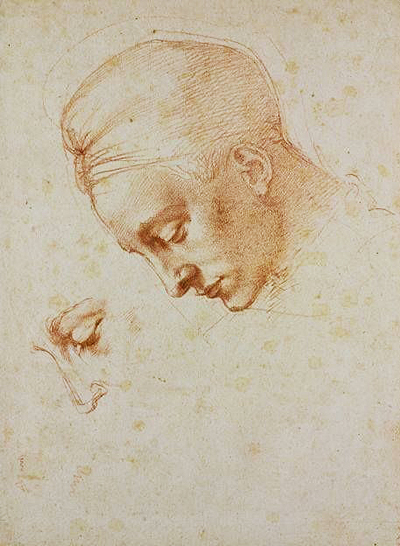
The original disappeared after entering the French royal orbit, but its composition survives through copies, variants, engravings and Michelangelo's drawings for Leda's head. Casa Buonarroti preserves the most secure preparatory evidence: a sheet of delicately turned head studies accepted as Michelangelo and universally connected with the lost painting.[1]
Copies make the picture more visible than many lost works, but they also tempt false certainty. They differ in detail, colour, anatomy and surrounding figures. No single version is the original returned. The responsible reconstruction begins with what they share and keeps translation visible.
At a Glance
- ArtistMichelangelo Buonarroti
- TitleLeda and the Swan
- DateAbout 1529–1530
- MediumTempera, generally described on canvas
- CommissionerAlfonso I d'Este, Duke of Ferrara
- SubjectJupiter in the form of a swan with the reclining Leda; offspring of the myth represented nearby in copies
- Model traditionAntonio Mini is reported to have modelled for Leda's body
- Preparatory workAccepted studies for Leda's head at Casa Buonarroti
- DeliveryRefused after Alfonso's envoy offended Michelangelo
- First transferGiven to Antonio Mini, who took it to France
- French historySought by Francis I and recorded in the Fontainebleau orbit
- StatusLost; exact fate unknown
- SurvivalKnown through drawings, painted copies, variants and prints
Contents
- The Myth of Leda
- Alfonso d'Este and Michelangelo
- A Reclining Body Built by a Sculptor
- Antonio Mini as Model and Recipient
- The Studies for Leda's Head
- Painting in Tempera on Canvas
- Michelangelo as a Painter of Portable Pictures
- The Envoy's Insult
- From Florence to France
- Copies and Variants
- Copying, Censorship and the Survival of an Erotic Image
- The Children, Eggs and Mythic Aftermath
- Michelangelo, Leonardo and the Leda Tradition
- How the Original Was Lost
- Why Leda and the Swan Matters
The Myth of Leda
In Greek mythology, Jupiter or Zeus desired Leda, queen of Sparta, and approached her as a swan. Versions of the story differ over consent, seduction and assault. The union produced eggs from which Helen, Clytemnestra, Castor and Pollux were born in varying genealogies.
Renaissance art often transformed the disturbing myth into an image of beauty, erotic access and poetic metamorphosis. The swan's neck and wings could entwine with a nude female body while mythological distance made explicit sexuality acceptable in elite collections.
Modern viewers should not let aesthetic convention neutralise power. A god changes form to obtain a woman. Copies of Michelangelo's composition show physical intimacy that can be read as embrace, pressure and possession at once.
The offspring place consequence beside desire. Castor and Pollux became heroic twins; Helen's beauty led mythically to the Trojan War. The image can therefore contain future violence within present sensuality.
For Alfonso d'Este, such a subject suited a courtly environment already invested in learned mythology and extraordinary paintings. The commission offered Michelangelo a chance to rival antique sensuality and contemporary masters in colour.
Alfonso d'Este and Michelangelo
Alfonso I d'Este was an ambitious patron whose Ferrara collections included major mythological works. His relations with Pope Julius II had been politically fraught, but his admiration for Michelangelo's art was real.
During Michelangelo's work on Florentine fortifications in 1529, he passed through Ferrara and engaged with the duke. The Leda commission emerged from this relationship, joining art, diplomacy and wartime movement.
Alfonso had earlier sought a work from Michelangelo and understood the prestige of adding one to his celebrated rooms. A painted myth would complement the poetic canvases associated with artists such as Giovanni Bellini and Titian while introducing Michelangelo's bodily power.
The commission is unusual within Michelangelo's surviving career. His accepted independent paintings are few, and much of his colour work is fresco or unfinished. A completed portable tempera canvas would offer essential evidence of how he handled an erotic, secular subject outside a wall programme.
Its loss is therefore more than the loss of one composition. It removes a major part of Michelangelo's identity as a painter of portable pictures.
A Reclining Body Built by a Sculptor
Copies present Leda lying horizontally, her body extended across bedding or ground while the swan presses close. One arm turns behind or above her head, opening the torso; bent and extended limbs create a long, complex silhouette.
The pose converts sculptural thinking into paint. The body seems designed as a chain of volumes that could be modelled in clay or carved in relief. Yet colour and surface permit flesh, feathers, fabric and landscape to differ without physical separation.
Michelangelo's sustained study of the male nude shaped the female figure. Early testimony reports that Antonio Mini, a male assistant, served as model. Using a male body for Leda was consistent with workshop practice and with Michelangelo's preference for developing anatomy through male models.
This does not mean the painted figure simply looked male. The artist could alter chest, hips, face and surface while retaining the model's pose and muscular structure. Copies differ in how strongly they preserve that foundation.
The result challenges neat categories of gender. Leda is erotically female within the myth but built through an anatomical language Michelangelo had developed on male bodies. Her strength and extension are integral to the composition, not mistakes to be softened.
Antonio Mini as Model and Recipient
Antonio Mini was a Florentine assistant close to Michelangelo during the late 1520s and early 1530s. Tradition makes him both bodily model for Leda and eventual recipient of the painting.
This double role is significant. A studio assistant could contribute pose, labour and daily support without appearing in the commission's official title. Michelangelo's gift later converted that participation into ownership.
Mini hoped to establish himself and travelled to France with works and drawings connected with the master. The Leda became his greatest asset, capable of attracting Francis I's attention.
His position was nevertheless precarious. Possessing a masterpiece did not guarantee the power to control its royal acquisition, display or long-term preservation. The painting entered networks much larger than an assistant's household.
Mini's role also cautions against an isolated-genius account. Even when Michelangelo painted the original, bodies, materials, errands, copies and movement depended on assistants.
The Studies for Leda's Head
Casa Buonarroti preserves a sheet with several studies for Leda's head, dated around 1530.[1] Scholars agree on its connection with the lost picture. It is the most direct surviving witness to Michelangelo's preparation.
The head turns and inclines, eyes lowered or closed, hair gathered into complex braids. Repetition on one sheet shows adjustment rather than duplication. Michelangelo tests angle, expression and the relation of face to coiffure.
The elaborate hair has both formal and erotic force. Braids control abundant strands while creating loops of line around the face. In the final painting, hair would contrast with the swan's feathers and the smooth body.
Because the drawing is autograph, it anchors copies that preserve a similar head. But even here caution is needed. A preparatory study may differ from the final state, and copyists can consult intermediary drawings as well as the painting.
The sheet does something no later copy can: it records Michelangelo searching. Its small variations reveal the painting before its public identity was fixed.
Painting in Tempera on Canvas
Sources generally describe the Leda as tempera on canvas. This support distinguishes it from Michelangelo's frescoes and from panel paintings such as the Doni Tondo.
Canvas was portable and suitable for a picture intended to travel from Florence to Ferrara. Tempera could produce clear modelling and controlled colour, though the exact binding medium and surface cannot now be tested.
The copies offer clues to palette—pale flesh, white swan, dark or coloured fabric and a landscape setting—but their colours belong to their own materials, ageing and restorations. The original may have differed substantially.
Michelangelo's reputation as a sculptor often causes the lost painting to be described only through drawing and anatomy. Colour was part of its effect. The whiteness of feathers against flesh, the temperature of bedding and the atmospheric background would mediate the explicit bodily encounter.
Without the original, technical language must remain modest. We can identify the reported medium and portable form; we cannot analyse brushwork or prove exact colour decisions.
Michelangelo as a Painter of Portable Pictures
Michelangelo resisted being reduced to one profession, yet his surviving painted corpus encourages exactly that simplification. The Sistine Ceiling and Last Judgement dominate at architectural scale; the Doni Tondo is the principal completed portable painting accepted without dispute. The loss of Leda makes secular easel painting look less important in his career than it actually was.
A transportable mythological picture required different decisions from fresco. The composition needed to hold within a bounded rectangle, survive movement and enter a room already containing other works. Colour, fabric and landscape could be adjusted for sustained close viewing rather than a chapel's height.
The commission also placed Michelangelo in direct competition with court painters celebrated for sensuous colour. His reputation for disegno and anatomical power would be tested against the painted surface prized in Ferrara and Venice.
Copies cannot show whether he answered that test through brilliant chromatic variety or a more sculptural restraint. They do establish that contemporaries thought the result worth carrying, copying and seeking for a king.
The Envoy's Insult
When Alfonso's representative came to collect the painting, he reportedly judged it harshly or behaved disrespectfully, perhaps saying it was a small or insignificant thing. Michelangelo, acutely sensitive to status and criticism, refused to release it.
The episode appears in early biographical accounts and fits his documented willingness to resist patrons. Yet its dialogue may have been sharpened in retelling. What matters historically is the failed delivery: Alfonso commissioned the picture but did not receive it.
The envoy's mistake transformed provenance. A painting intended for Ferrara remained with the artist and passed to Mini. One encounter redirected a major work from an Este collection to France.
The story also exposes the role of representatives. Patron and artist did not always meet at delivery. An envoy's judgment and manners could affect contracts, payment and cultural history.
Michelangelo's refusal asserted control over his work. Commission did not, in practice, overcome his sense of personal honour. That autonomy carried financial risk but protected the painting from an owner whose representative had diminished it.
From Florence to France
Michelangelo gave the Leda to Antonio Mini, who took it to France around 1531–1532. Mini carried other drawings and sought opportunity in a court increasingly enthusiastic about Italian art.
Francis I became aware of the painting and wanted it for the royal collection. By the mid-1530s it was associated with Fontainebleau, where Italian artists and imported works reshaped French court culture.
The move paralleled the earlier journeys of Michelangelo's Hercules and bronze David. France acquired his art through gifts, agents, purchases and the movements of politically vulnerable Florentines.
At Fontainebleau, the erotic myth belonged to an environment rich in reclining nudes, metamorphosis and courtly display. Its influence could pass into copies, prints and decorative schemes even as the original's ownership became less clear.
Copies and Variants
Several painted versions preserve Michelangelo's composition. A copy at Casa Buonarroti is central to the family museum's presentation, while other versions and fragments have been connected with Rosso Fiorentino, Cornelis Bos or anonymous followers. Attributions among copyists vary.
Shared elements establish the main design: reclining Leda, swan in intimate contact, complex head turn, and children or eggs nearby. Differences appear in landscape, drapery, body proportions, secondary figures and colour.
A copy can be close in contour and still alter expression. Scale may change; damaged areas may be “improved”; nudity may be covered; the swan's action may become more or less forceful. Prints reverse orientation and translate colour into line.
The safest use is comparative. Where independent versions agree, they likely preserve an important feature of the original. Where they diverge, uncertainty must be admitted.
No copy should be titled simply “Michelangelo's Leda” without “after,” “copy” or equivalent language. Authorship of composition and execution are distinct.
Copying, Censorship and the Survival of an Erotic Image
Copies preserved the composition because patrons and artists valued it, but transmission was never neutral. A copyist chose which version to follow, which anatomical force to retain and how explicitly to describe contact between woman and bird. Drapery could be added, secondary figures reduced and expression softened.
Erotic images were especially vulnerable to moral reinterpretation. Ownership might restrict access to a private room; a later keeper could cover or destroy a work judged indecent. The tradition that the French original was deliberately destroyed reflects this vulnerability even though the responsible person and event remain uncertain.
Copying could therefore work against censorship. Once the design existed in multiple paintings and prints, removing one canvas could not erase it. Reproduction decentralised the image while also distancing it from Michelangelo's touch.
This creates a difficult modern balance. The surviving versions are indispensable historical witnesses, not degraded noise around a missing masterpiece. Each is also an independent object with its own maker, patron, changes and condition. Calling all of them “copies” should not make those histories invisible.
Digital reproduction adds a further layer. One version is often selected as the standard image and repeated until its colour and details seem canonical. The most responsible presentation compares several witnesses or states clearly which one is shown.
The erotic subject also demands accurate language. Jupiter's metamorphosis and approach involve unequal divine power; “seduction” is not the only reading. Michelangelo and his copyists made the encounter beautiful, but beauty does not resolve the myth's consent.
The Children, Eggs and Mythic Aftermath
Copies include infant figures and eggs near Leda. These details identify the myth's consequence rather than presenting the union as isolated erotic spectacle.
Traditions differ over which children emerged from which egg and whether Leda's mortal husband Tyndareus fathered some. Renaissance viewers could bring this learned ambiguity to the image.
Castor and Pollux became the Dioscuri, associated with brotherhood, horsemanship and rescue. Helen became the cause or pretext of the Trojan War; Clytemnestra's story led into murder and vengeance.
The quiet secondary figures therefore contain an enormous narrative future. Michelangelo compressed transformation, sexuality, birth and heroic tragedy into one field.
Copyists sometimes reduce or rearrange these elements, which changes the painting's intellectual balance. A version focused only on Leda and the swan can appear more purely erotic than the original composition may have been.
Michelangelo, Leonardo and the Leda Tradition
Leonardo da Vinci also developed a famous Leda and the Swan, now lost and known through copies. His standing or kneeling figure, eggs and children helped make the myth a major Renaissance subject.
Michelangelo's reclining Leda offered a different bodily solution. Instead of a vertical figure curving beside the bird, he stretched the encounter horizontally and intensified physical contact.
Comparison demonstrates artistic rivalry but does not require direct quotation. Both artists used the myth to solve interlocking human, animal and landscape forms. Both originals disappeared, leaving copy traditions that can easily be confused.
Captions must identify which lost composition a copy follows. “Leda after Leonardo” and “Leda after Michelangelo” are separate histories even when both include swan, eggs and children.
How the Original Was Lost
The painting remained recorded in France after Mini's arrival, but its later fate is uncertain. One tradition says it was destroyed on moral grounds under Anne of Austria; another suggests disappearance, damage or dispersal within royal collections.
Erotic mythological paintings were vulnerable to censorship, overpainting and restricted display. Canvas was also physically vulnerable to damp, folding, fire and poor storage.
No surviving candidate has been accepted as Michelangelo's original. A claim would require provenance to the French royal picture, technical compatibility with the reported medium and evidence distinguishing it from known copies.
The multiplicity of replicas makes rediscovery harder, not easier. A close copy can preserve design brilliantly while lacking Michelangelo's paint. Familiarity with composition may disguise differences of hand.
The correct status remains lost, not securely destroyed by one named person. The distinction leaves fate open without promoting wishful candidates.
Why Leda and the Swan Matters
The lost Leda matters because it reveals a Michelangelo corpus larger and more varied than the surviving one. He made an ambitious portable mythological painting whose erotic body was as carefully designed as any sacred or civic figure.
Its commission and refusal reveal the volatility of patronage. Alfonso's desire, an envoy's insult, Michelangelo's pride and Mini's dependence redirected the work across Europe.
The preparatory head studies show invention at first hand. Copies preserve the overall composition and its influence. Together they allow a responsible partial reconstruction while keeping the original's colour, surface and exact detail absent.
The painting also joins gender, model and transformation in unusually concentrated form. A male assistant reportedly posed for a female mythological body embraced by a god in animal form. Michelangelo used artifice to make metamorphosis bodily.
Loss has not silenced the image, but it has multiplied it. There is no single Leda before us—only Michelangelo's drawing, many translators and the space where the original once held them together.
Frequently Asked Questions
Discussion
What details, sources or comparisons stand out to you in Leda and the Swan?
Reader Insights
Which formal detail changes how the work reads?
Which documented source or collection history feels most useful?
Which related Michelangelo work should readers compare next?
Join the Conversation
Add a source-led observation, comparison or question for other readers.
References
- Casa Buonarroti, Studies for the Head of Leda”:, View source.
- Casa Buonarroti, Michelangelo's Drawings”:, View source.
- J. Paul Getty Museum, Titian Remade: Repetition and the Transformation of Early Modern Italian Art, contextual discussion of Michelangelo's lost Leda:, View source.
- Mauritshuis, Leda and the Swan,” discussion of the lost painting and print tradition:, View source.