


 by Tom Gurney
Tom Gurney BSc (Hons) is an art history expert with over 20 years experience
Published on June 19, 2020 / Updated on November 6, 2025
Email: tomgurney1@gmail.com / Phone: +44 7429 011000
The Prophet Isaiah by Michelangelo
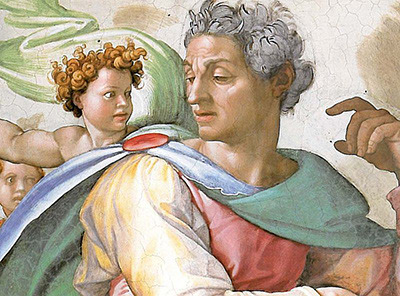
Michelangelo’s Isaiah has turned away from his book at the touch or call of a youthful attendant. One finger remains near the closed or partly closed volume, as if preserving a place, while the other hand rises beside his face. His head looks back over a green mantle and pale-rose robes. Thought has been interrupted but not abandoned.
Isaiah is one of the seven Hebrew prophets installed among five ancient sibyls around the Sistine Chapel ceiling.[1] His biblical book ranges from judgment and historical crisis to consolation, renewal and visions that Christian tradition read in relation to Christ.[7] Michelangelo does not choose one verse for illustration. He makes the prophet’s defining event a change in attention.
Why is this page called Prophet Isaiah? The selected page address is Prophet Isaiah, while a separate shorter Isaiah page remains outside this refreshed article. The public article focuses on Michelangelo's ceiling figure and does not promise a merge, redirect or canonical decision.
At a Glance
- FigureThe Prophet Isaiah, labelled ESAIAS
- Artist and techniqueMichelangelo Buonarroti; fresco
- SettingA monumental prophetic seat on the Sistine Chapel vault
- Campaign rangePainted for Julius II within the 1508–1512 ceiling project[2]
- EnsembleSeven prophets and five sibyls surrounding the central Genesis fields[1][3]
- Primary actionTurning from a book toward an attendant’s message
- Textual objectA substantial closed or partly closed volume held against his side
- CompanionsTwo youthful attendants, one gesturing close to Isaiah’s shoulder
- Visual structureHead and shoulders rotate while knees and feet remain forward
- Name formESAIAS on the tablet reflects a Latin form of Isaiah
- Interpretive cautionThe interruption is visible; the exact words being communicated are not
- Date cautionLocation within the ensemble does not yield an exact completion day
Contents
- Isaiah in Scripture and Christian Tradition
- The Turn Away from the Book
- The Attendant’s Gesture
- A Finger Keeping the Place
- The Book at His Side
- A Closed Book and an Open Message
- Before the Prophet Speaks
- Head, Face and Listening
- The Raised Hand
- Drapery Carrying the Turn
- Knees and Feet Facing Forward
- The Tablet ESAIAS
- Isaiah After Joel
- Isaiah Before Ezekiel
- Prophet and Sibyl Company
- Relation to Genesis
- Campaign and Evidence Limits
- Seeing Isaiah in the Chapel
- Restoration and Reproduction
- Why Isaiah Matters
- Artist Up Close
Isaiah in Scripture and Christian Tradition
The Book of Isaiah addresses Judah across histories of warning, political threat, judgment and promised restoration. Its language includes visions of divine holiness, a child and coming ruler, a suffering servant, consolation and a renewed creation.[7]
Christian readers treated many of these passages as prophecies of Christ. That reception made Isaiah one of the most prominent scriptural witnesses in a papal chapel devoted to salvation history.
Michelangelo’s fresco does not identify which passage occupies the volume. No scene of the seraphim, royal court or suffering servant appears within the throne.
Instead, the artist represents prophetic receptivity itself. Isaiah’s authority lies in his ability to move between preserved text and a message arriving now.
The Turn Away from the Book
Isaiah’s torso faces broadly outward, but head and upper shoulders rotate toward the attendant behind him. The change is not as explosive as Ezekiel’s; it feels suspended and thoughtful.
One hand rises near the face with fingers partly open, perhaps acknowledging, questioning or preparing to respond. The other remains in contact with the book.
This divided action is the figure’s intelligence. Isaiah can attend to interruption without losing his place in reading.
Michelangelo gives the body two temporal directions: the text just consulted and the voice now heard.
The Attendant’s Gesture
A youthful companion leans close behind Isaiah, one hand or arm raised in an emphatic gesture. Another smaller face appears further back.
The attendants create the event without becoming individually named actors. One supplies urgency; the other expands the group’s depth.
Scale is reversed in agency. The colossal prophet turns because a small figure addresses him. Monumentality remains responsive.
The Vatican ensemble record does not provide a transcript or identify the youth as a particular angel.[1] “Attendant” preserves what the fresco securely shows.
A Finger Keeping the Place
Isaiah’s hand rests near the upper edge of the book, and one finger appears to hold or mark a location. This small action links interruption to return.
The book has not been discarded. It remains closed against the body or held at the edge of reopening.
Michelangelo makes memory material. A finger can preserve continuity while head and mind turn elsewhere.
At ceiling height, the detail is difficult to see, but it rewards enlargement by explaining the whole pose’s psychological precision.
The Book at His Side
The volume rises vertically against Isaiah’s body, its pale and blue-toned covers creating a firm geometric block amid softer fabric.
Unlike Joel’s scroll, it does not span the composition. Unlike the Libyan book, it is not being lifted through space. It waits.
That waiting gives the object duration. The prophet will return to study after the exchange, or at least remains bound to its authority.
Textual matter and spoken message are therefore not rivals. The fresco holds them in one prophetic practice.
A Closed Book and an Open Message
The volume’s closed or nearly closed state creates a productive paradox. Isaiah is identified with a great prophetic book, yet Michelangelo defines him when reading pauses.
Closure does not mean ignorance. The prophet’s finger, hand and bodily memory keep the text present even when its leaves no longer face him.
Meanwhile the attendant’s gesture opens another channel of knowledge. Message moves through voice, touch or sign rather than visible writing. Isaiah occupies the crossing point between them.
This matters within a chapel filled with images and spoken liturgy. Sacred understanding is not confined to a single medium. Written text, heard word and embodied response can reinforce one another.
Michelangelo makes the transition reversible. Nothing in the pose suggests permanent abandonment of the book. Interruption becomes part of study rather than its failure.
Before the Prophet Speaks
Isaiah’s mouth and raised hand remain suspended before a clear reply. The fresco therefore withholds the authoritative declaration one might expect from a monumental prophet.
That interval makes listening visible. Prophetic speech acquires ethical weight because it follows attention rather than replacing it.
The attendant’s youthful urgency and Isaiah’s measured turn occupy different tempos. One delivers; the other considers. Michelangelo refuses to make immediate reaction identical with comprehension.
This psychological delay distinguishes Isaiah from Ezekiel’s broader, more public response and deepens the sequence between neighbouring thrones.
Head, Face and Listening
Isaiah’s youthful or middle-aged face turns in three-quarter profile. Eyes angle toward the attendant, and lips remain slightly parted or relaxed.
The expression suggests listening before reply. Michelangelo avoids a theatrical shock that would make subtle communication impossible.
Short curling hair gives the head a distinct silhouette against pale wall and moving green cloth.
No secure portrait model can be named from likeness alone. The face is individual enough to sustain thought without becoming documentary biography.
The Raised Hand
The hand nearest Isaiah’s face bends at the wrist, with fingers loosely separated. It echoes the attendant’s gesture without copying it.
This creates a small conversation of hands. One message reaches forward; one response forms.
The hand also bridges head and book, occupying the empty space between inward thought and external exchange.
Its ambiguity is productive. Isaiah may be pausing, asking, acknowledging or reflecting. No single verb exhausts the pose.
Drapery Carrying the Turn
Isaiah wears layered rose, cream and rust garments beneath a broad dark-green mantle. The mantle sweeps around his back and over the shoulder nearest the attendant.
Fabric records rotation. It gathers where torso turns, opens across the lap and descends beside the throne.
The pale upper sleeve catches light and directs attention toward the hand holding the book. Green creates a deep field behind the moving head.
Modern conservation made these colour relations newly prominent to recent audiences, though digital hues vary.[4][6]
Knees and Feet Facing Forward
The lower body remains largely frontal. Knees project beneath broad garments, and bare feet rest close together at the ledge.
This stability intensifies the upper turn. Isaiah does not spin his whole body; attention moves within a seated base.
Feet create contact with fictive stone and persuade the eye that the large figure bears weight.
The contrast between grounded lower body and responsive upper body is a recurring Michelangelo strategy, here adapted to listening.
The Tablet ESAIAS
The Latin name form below the throne identifies Isaiah. Modern English title and painted inscription therefore differ without referring to different prophets.
The label is essential because book and attendants recur elsewhere. Identity cannot be inferred from generic attributes alone.
Letters also embed scripture within Renaissance Rome’s classical architectural language. Hebrew prophet, Latin name and Christian chapel overlap.
At a distance, pose may register before text. Close study reunites the figure with his explicit name.
Isaiah After Joel
Joel stretches a scroll between both hands and sustains downward concentration. Isaiah turns from a bound book toward interruption.
The change gives the nearby company rhythm. Reading is first continuous, then divided by a voice.
Michelangelo varies object, age and attention together: scroll and older face yield to codex and a more youthful listener.
These relations are visual comparisons, not a narrative in which Joel historically precedes Isaiah within one conversation.
Isaiah Before Ezekiel
Ezekiel’s turn toward an attendant is more urgent and expansive. His open hand reaches outward while a scroll remains in the other.
Isaiah’s exchange is inward and measured. Raised hand stays close to the face, and book remains pressed against the side.
Placed together in the ensemble, the prophets form a progression in the intensity of interruption.
This reveals Michelangelo’s precision. “Turning prophet with attendant” is not a repeated formula; small anatomical changes create distinct minds.
Prophet and Sibyl Company
Isaiah shares monumental scale with pagan prophetesses because Renaissance Christian culture construed both groups as witnesses to Christ.[1]
That visual parity does not erase different historical sources. Isaiah is a biblical authorial identity; the sibyls enter through ancient and later traditions appropriated into Christianity.
Common thrones allow bodies to be compared; names and books preserve difference.
The ensemble’s unity is therefore structured, not homogeneous.
Relation to Genesis
The central nine stories move from cosmic creation through Adam, Eve and Noah.[3] Isaiah stands outside their narrative time within the surrounding architecture.
His interruption can suggest interpretation awakening around the ancient stories, but it should not be tied to one neighbouring Genesis picture without demonstrated sightline.
The larger ceiling juxtaposes origin and prophecy: what happened, and how later figures receive meaning.
Close cropping clarifies Isaiah while hiding that intellectual architecture.
Campaign and Evidence Limits
Michelangelo painted the ceiling under Julius II from 1508 to 1512.[2] Isaiah belongs securely within this documented span.
The public institutional sources do not assign an exact day or simple sequence number to his execution. Fresco work encompasses adjacent figures, painted stone and plaster divisions.
Stylistic comparison with Joel and Ezekiel can illuminate variation without becoming an unsupported calendar.
The evidence supports a fully individual account even when precise microchronology remains open.
Seeing Isaiah in the Chapel
From below, the rose lap, green mantle and backward-turning head dominate. The place-holding finger and second attendant require closer imagery.
Smarthistory emphasises the height and density of Michelangelo’s vault.[5] Isaiah’s broad colour masses answer those conditions.
The figure also changes as an observer walks. A turn painted into the body meets the changing angle of the person beneath.
Whole throne, ensemble map and close detail each reveal part of the design.
Restoration and Reproduction
The Vatican’s conservation record frames the present surface and renewed brightness of the garments.[4][6] Older reproductions often subdued their chromatic differences.
Photography can make the green mantle almost black or intensely saturated, altering how head and attendant emerge.
Cracks visible in enlarged images belong to material history. They should neither be hidden nor mistaken for expressive lines.
Reliable interpretation attends to stable relations across responsible views.
Why Isaiah Matters
Isaiah matters because Michelangelo gives thought a reversible movement. The prophet can leave a book without losing it.
He matters because listening is shown as disciplined responsiveness rather than passive reception. Hand, head and shoulder reorganise while the body remains grounded.
Most importantly, the figure makes interruption part of knowledge. Prophecy is not only what has been written; it is the readiness to turn when another voice arrives.
Artist Up Close
Michelangelo measures the speed of thought through anatomy. Isaiah’s head has turned farther than his torso, his finger still remembers the book and his raised hand has not yet become speech. The entire figure occupies a fraction of a second stretched to monumental scale. That interval—after hearing, before answering—is where the prophet becomes psychologically real.
Frequently Asked Questions
Discussion
What seems most important in Michelangelo's Prophet Isaiah: his role among the seers, the visual authority of the figure, or his relationship to the central Genesis scenes?
Reader Insights
How does Isaiah continue the sequence after Joel?
How much can the visible book suggest without assigning a specific verse?
How does Isaiah frame the central stories without becoming part of them?
Join the Conversation
Compare Isaiah's prophet role, ceiling setting and relationship to the Genesis scenes while keeping the route focused on Michelangelo's painted figure.
References
- Vatican Museums, Sibyls and Prophets”:, View source.
- Vatican Museums, Sistine Chapel Ceiling”:, View source.
- Vatican Museums, Central Stories”:, View source.
- Vatican Museums, Sistine Chapel History”:, View source.
- Smarthistory, Michelangelo, Ceiling of the Sistine Chapel”:, View source.
- Vatican Museums, The Sistine Chapel Twenty Years Later: New Breath, New Light”:, View source.
- United States Conference of Catholic Bishops, Isaiah, Chapter 1”:, View source.