 by Tom Gurney
Tom Gurney BSc (Hons) is an art history expert with over 20 years experience
Email: tomgurney1@gmail.com / Phone: +44 7429 011000
English Jockey (Jockey anglais): Introduction
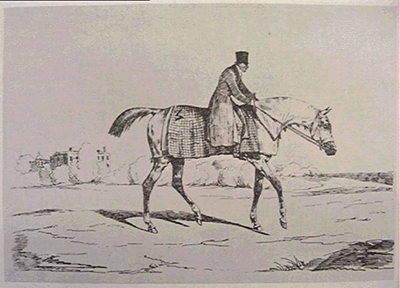
A covered horse walks towards the right, carrying a rider in a tall hat and long coat. The head inclines, the reins stretch back towards the man's hands, and a low landscape leaves most of the surrounding paper open. Théodore Géricault's English Jockey gives sustained attention to an unhurried passage across ordinary ground. The Bibliothèque nationale de France dates this lithograph to 1820 and identifies it as Delteil 22, a work drawn with a pen on lithographic board. [1]
The title can make a viewer expect a race. What appears instead is the quieter business of being mounted on a horse between moments of greater exertion. There are no competitors, spectators or finishing posts. The animal's measured movement, the rider's upright seat and the patterned covering offer three different rhythms within a deliberately sparse setting. Looking at their relationship reveals how much Géricault could make of a single horse without surrounding it with an elaborate story.
At a Glance
- Date1820, as catalogued by the BnF [1]
- MediumPen lithograph made on lithographic board [1]
- CatalogueDelteil 22 [1] [2]
- BnF impressionSheet 22.6 × 37.3 cm; FRBNF45616361 [1]
This work across Théodore Géricault’s career
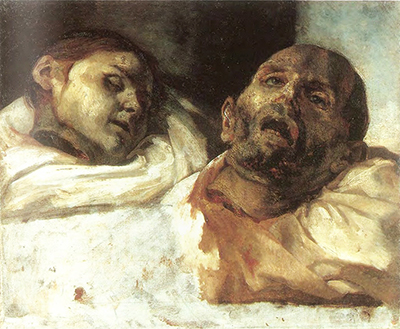
The Severed Heads
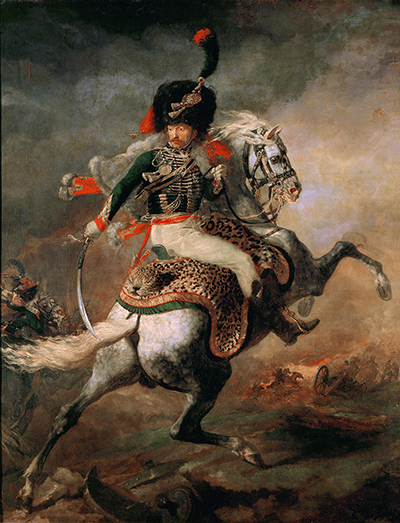
1810s [3]Charging Chasseur
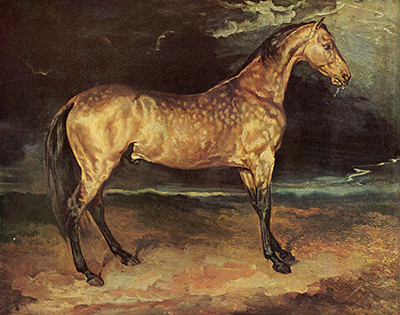
1812 [4]Horse Frightened by Lightning
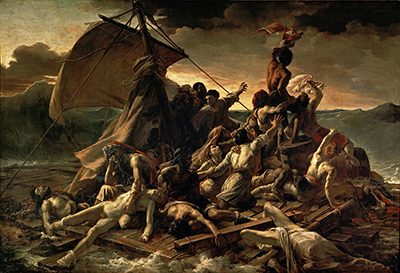
c.1813–14 [5]The Raft of the Medusa
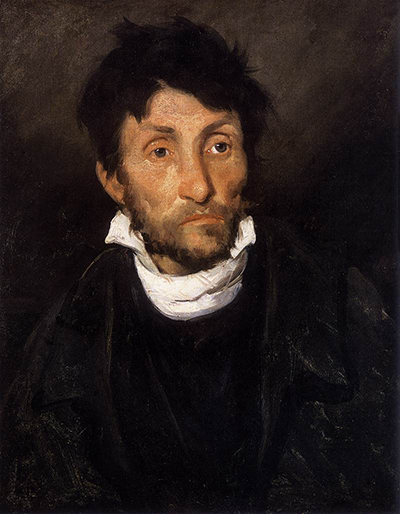
1818–19 [7]Portrait of a Kleptomaniac
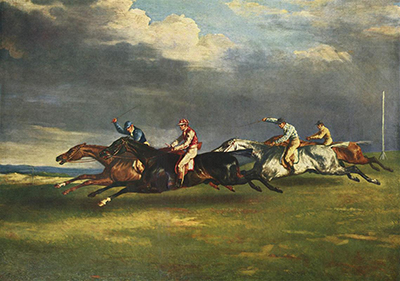
c.1820–24 [9]The Epsom Derby
1821 [10]Contents
- Walking through open space
- A blanket that changes the subject
- A drawing made for printing
- The jockey and the groom
- English prints and different impressions
Walking through open space
The horse occupies a broad horizontal strip, with its lifted tail at the left and its lowered muzzle at the right. Against that long outline, the rider rises as a narrow vertical. His hat makes a small, dark accent above the pale sky. The body below it bends gently towards the hands, so that the seated figure does not look rigid despite its upright position. The rider's long coat also interrupts the horse's contour: its falling edge links the human body to the covering beneath him.
The legs make the forward movement legible. Their separated angles establish a succession of supports and steps, while the shadow below gives them a surface to move across. The front of the animal extends into a relatively empty area. That space matters: the muzzle has somewhere to go, and the viewer can imagine the next step without needing a destination to be represented. The movement feels continuous rather than arrested at a dramatic climax.
Géricault establishes distance with very little. Small upright forms and clustered vegetation at the left contrast with the horizontal band behind the horse. Nearer marks are broader and more broken, especially along the lower edge. These variations keep the background from becoming a flat blank while preserving the prominence of the mounted pair. Nothing in the visible setting securely identifies a particular stable, racecourse or English town.
A blanket that changes the subject
The covering is central to the design. Its dense pattern offers a very different surface from the lightly worked neck and head. Lines run across and down the fabric, making the viewer conscious of a material laid over another body. At the rear, the cloth falls towards the upper legs; around the rider it is partly hidden by his coat. We read the horse through alternating passages of exposure and concealment.
This is an unusual form of equestrian attention. The great mass of the torso is largely withheld, yet the animal remains convincing through its extremities: the neck's downward curve, the shape of the hindquarters, the tail and the articulated legs. The blanket does not merely decorate a fully displayed anatomy. It makes the eye work around a covered centre, giving greater force to the parts that remain visible.
The covering also helps identify the print. Charles Clément's historical catalogue describes a mounted English jockey on a horse with a blanket marked with an M, facing right. In the 1866 lithograph catalogue offprint, this is entry 39. [11] That description is useful evidence for distinguishing the composition; the letter supplies no secure identification of an owner or stable. Its presence should not become a reason to invent a name for either the horse or its rider.
Watch: Géricault and The Raft of the Medusa
Three perspectives on Géricault’s best-known painting, its making and its historical setting.
Gericault, Raft of the Medusa
Smarthistory examines the composition and historical setting of The Raft of the Medusa.
Watch on YouTubeA drawing made for printing
The BnF places English Jockey among seven English lithographs made with a pen on prepared board. Its record, citing the École des beaux-arts exhibition catalogue, explains that the board was lighter, easier to carry and cheaper than stone. [1] The support therefore belongs to the work's history even though the object a viewer encounters is a paper impression. Drawing surface and printed sheet are different things.
Clément relates that Géricault took sheets of prepared board with him when leaving Paris. He also records serious disadvantages in the process and its subsequent abandonment. These are statements from a nineteenth-century account, rather than a technical examination of this particular surviving impression. [11] They give the image a material context without allowing us to reconstruct every stage of its printing.
The visible line rewards attention on its own terms. Short strokes build the covering's texture, while lighter, more widely spaced marks describe the ground and distance. On the horse's head, economical dark accents around the eye, ears and bridle make a small area unusually active. The rider's coat falls in longer passages. Moving between these areas, the eye encounters changes in density rather than a uniformly polished surface. The sparseness of the landscape makes those changes easy to see.
The jockey and the groom
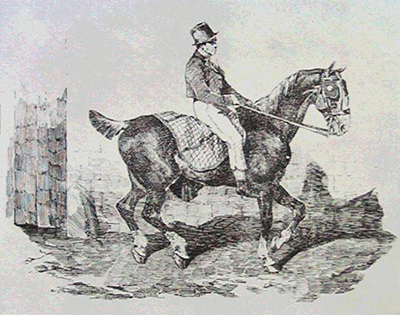
Clément places the mounted jockey immediately before a carriage horse ridden by a groom, recording the same board process for the second work. [11] The comparison is particularly revealing beside Groom Mounted on a Carriage-Horse. Krannert Art Museum dates its impression of that composition to 1820 and describes its medium as pen-and-ink lithography on paper. [12]
Both compositions face right and give a mounted man a prominent place above a covered horse. Their effect nevertheless differs. The groom's horse carries its neck higher and bends its legs into a more compact, animated pattern. Its body is more densely worked, and a dark patch of ground presses close around the hooves. In English Jockey, the longer silhouette, lowered head and more open surroundings spread the movement across the sheet. A shared arrangement becomes a study in different kinds of equine presence.
The rider's occupation should not substitute for looking. A jockey can appear outside a race, just as a carriage horse can be represented without a carriage. Here the hat, coat, seat and reins give the man a particular visible character, but do not disclose his name. The subject is legible as a relationship between a mounted person and a moving animal even where the historical record supplies no individual biography.
Groom Mounted on a Carriage-Horse
English prints and different impressions
This experiment should be distinguished from the larger English publication of 1821. Clément catalogues that group as twelve subject plates and a title page, then begins a separate group of seven works on prepared board with English Jockey. [11] The distinction prevents the shared English setting from collapsing different projects into one series. The broader development can be followed in Géricault's lithographs and prints.
Measurements require similar care. The BnF gives its sheet as 22.6 × 37.3 cm. [1] An Art Valorem catalogue for a different impression, sold in April 2026, lists 18.2 × 34 cm, with margins extending the sheet to 28.5 × 42 cm. It likewise identifies the work as the 1820 pen lithograph on board, Delteil 22. [2] These figures describe different physical examples and different measured areas; they are not interchangeable dimensions for every reproduction of the design.
Nor can the precise state or ownership of a particular impression be established from a cropped image alone. What remains clear is the composition's distinctive economy. The covering concentrates texture, the open sky isolates the rider, and the ground supplies just enough resistance for the horse's steps. English Jockey asks us to look at the intervals within movement: between one footfall and the next, between a rider's hand and an animal's mouth, and between the exposed body and the cloth that conceals it.
Géricault collection records
Seventy collection records include paintings, drawings and individual print impressions. Different impressions remain separate records; this selection is not a complete catalogue raisonné.
Frequently Asked Questions
The horse is walking with a mounted rider. There are no competing horses or visible racecourse markers; the title does not turn the scene into a documented race. [11]
Discussion
Look again at the images and ideas explored in English Jockey (Jockey anglais). These editorial prompts invite your observations.
Reader Insights
How does the lowered head change your sense of the horse’s pace?
Where does the covering make you look more closely at the exposed body?
What changes when you compare this long silhouette with the groom’s more compact horse?
Join the Conversation
Share a detail, comparison or question about English Jockey (Jockey anglais) below.
References
- Bibliothèque nationale de France, Jockey anglais, FRBNF45616361, dated [1820], medium, sheet dimensions and catalogue concordance; French collection record. View source.
- Art Valorem, Théodore Géricault: Jockey anglais, 1820, lot 47, sale of 8 April 2026, Delteil 22; French auction catalogue. View source.
- Nationalmuseum, The Severed Heads, NM 2113; collection metadata and museum interpretation (Swedish). View source.
- Louvre, Charging Chasseur, INV 4885; collection metadata and museum interpretation (French/English interface). View source.
- National Gallery, Horse frightened by Lightning; collection metadata and museum interpretation (English). View source.
- Louvre, Wounded Cuirassier, INV 4886; collection metadata and museum interpretation (French). View source.
- Louvre, The Raft of the Medusa, INV 4884; collection metadata and museum interpretation (French). View source.
- Gary Tinterow / The Metropolitan Museum of Art, Géricault’s Heroic Landscapes: The Times of Day, Met Bulletin 48/3, Winter 1990–91; consulted main essay and relevant object entries (English). View source.
- Vlaamse Kunstcollectie, Portrait of a Kleptomaniac; collection metadata and museum interpretation (Dutch). View source.
- Louvre, Epsom, MI 708; collection metadata and museum interpretation (French/English interface). View source.
- Charles Clément, Catalogue de l'œuvre de Géricault: Lithographies, Paris, extrait de la Gazette des beaux-arts, 1866, pp. 13–16, particularly nos. 39–40; French historical catalogue offprint, distinct from the 1868 book edition. View source. (in French).
- Krannert Art Museum, Carriage Horse Ridden by a Groom (Cheval de carrosse monté par un palefrenier), 1820, object 2014-10-2, collection record. View source.