 by Tom Gurney
Tom Gurney BSc (Hons) is an art history expert with over 20 years experience
Email: tomgurney1@gmail.com / Phone: +44 7429 011000
Pity the Sorrows of a Poor Old Man: Introduction
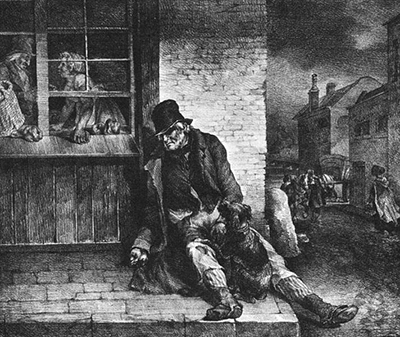
A man sits against a street corner, his legs extending across the pavement and his head bent towards a dog. Directly above him, two people occupy the space behind a shop window. Géricault places these figures close together but gives them different worlds: a sheltered interior, an exposed pavement, a conversation, and a silent encounter between a person and an animal. The lithograph's documented title, Pity the Sorrows of a Poor Old Man, supplies the appeal that the seated figure does not visibly make. The Musée Condé identifies its words with Thomas Moss's poem The Beggar, published in 1769, and records the print's publication inscription of 1 February 1821. [1]
The title matters because this is more than a record of an anonymous person in a street. It asks the spectator to consider what looking entails. The man is easy to see, yet nobody within the composition clearly responds to him. We can examine his clothes, posture and surroundings with an attention that the people behind the glass appear to direct elsewhere. Whether that difference becomes compassion is a question the print leaves with its viewer.
At a Glance
- Documented titlePity the sorrows of a poor old Man! [1] [2]
- Date1821; Condé inscription specifies 1 February [1] [2]
- MediumLithograph on paper [1] [2]
- PublicationLondon; printer Charles Hullmandel, publisher Rodwell & Martin [1] [2]
This work across Théodore Géricault’s career
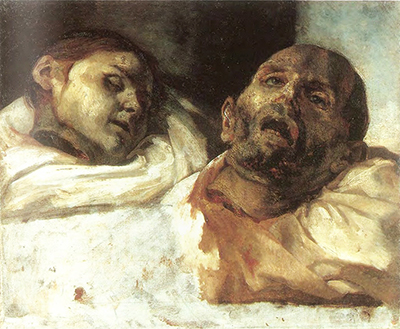
The Severed Heads
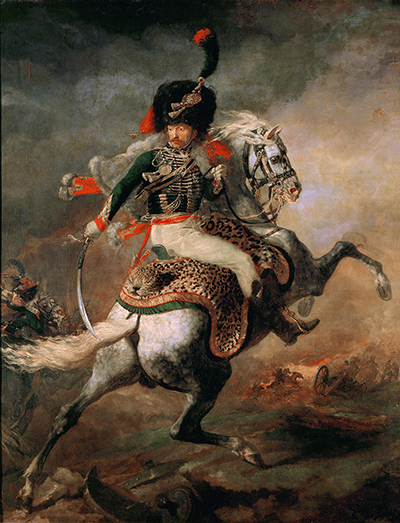
1810s [3]Charging Chasseur
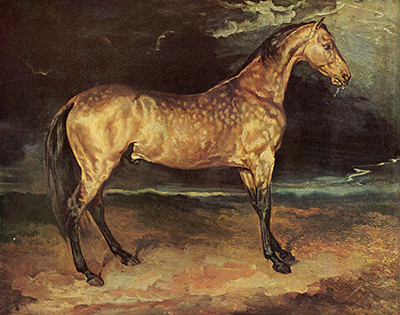
1812 [4]Horse Frightened by Lightning
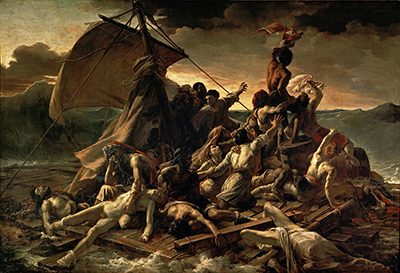
c.1813–14 [5]The Raft of the Medusa
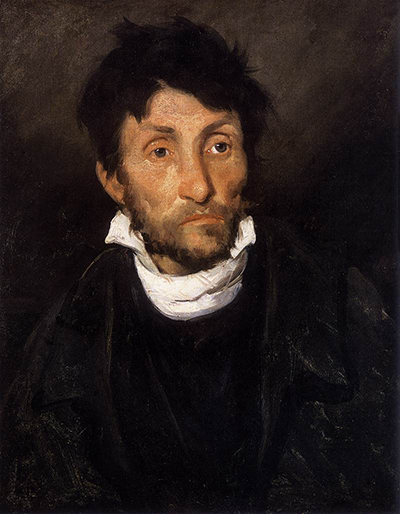
1818–19 [7]Portrait of a Kleptomaniac
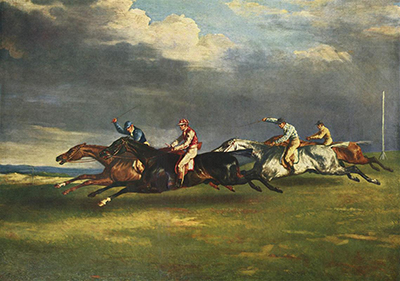
c.1820–24 [9]The Epsom Derby
1821 [10]Contents
- A body at the corner
- The dog and the direction of attention
- Looking through the shop window
- A title that addresses the viewer
- English publication and a companion print
- Light, texture and the limits of an impression
A body at the corner
The man's top hat remains tall and dark above a face largely shaded by its brim. His coat hangs around his shoulders, gathering into heavy folds beside the wall. Below it, lighter trousers spread into two long diagonals. One foot rests towards the middle of the foreground; the other reaches almost to the lower right edge. The irregular arrangement makes his body seem to occupy more pavement than its hunched upper half initially suggests.
His placement is awkward rather than ceremonious. The pale corner behind his shoulder forms a narrow support, while the street recedes sharply at his side. His right hand, on the left as we look at him, hangs low near the paving. His other arm is partly absorbed into the dark meeting of coat and dog. These hands do not deliver a large theatrical gesture. Attention has to travel down from the hat and shaded face to discover them.
The extended legs also interrupt the ordered pattern of the paving. Rectangular stones provide a regular measure beneath a body that cannot be contained within their lines. Looking from left to right, the eye meets the shop front, the man's bent torso, his outstretched leg and finally the passage into the street. The composition repeatedly brings the eye back to the body at the corner instead of allowing an uninterrupted survey of the architecture.
The dog and the direction of attention
The dog's raised head introduces an answering movement. While the man's head inclines downwards, the animal looks up towards him. Its shaggy coat merges with the dark clothing, but its face and muzzle catch enough light to remain legible. Their heads form a small, close circuit within a much larger urban scene.
This exchange can be read as companionship without inventing a history for either figure. We do not know how long they have been together, whether the animal belongs to the man, or what help either might receive. What the drawing gives us is proximity and directed attention. The dog acknowledges the person beside it in a way that no clearly visible human participant does.
There is also a difference between the man and dog as a group and the pair at the window. Above, two human heads face across a counter; below, a human and an animal incline towards one another. The upper encounter is framed by straight bars and edges. The lower one is held together by overlapping bodies and slanting contours. Géricault lets these arrangements coexist without adding a demonstrative passer-by who would tell us how to judge them.
Looking through the shop window
The window is among the brightest and most tightly organised parts of the image. Its rectangular panes divide faces, hands and goods into small compartments. A figure behind the counter leans forward with both hands resting on its surface; another appears at the far left. The Rijksmuseum describes a beggar seated at a street corner beside a shop window, with a man and woman visible behind it. Its record calls the print Bedelaar, or Beggar, alongside the English title, and places it in Various Subjects Drawn from Life. [2]
The glass does not make the interior inaccessible to our gaze. We can look inside while also observing the person below. Yet the window frame creates a strong division between those spaces. The counter stands above the seated man's head, and the dark wooden panels beneath it form a substantial barrier. The people inside need not step outside, or even turn their heads, for the composition to reveal the contrast.
Calling this a contrast does not establish the inner characters of the figures. The picture does not show them refusing a request, and it cannot tell us what they have noticed. Its force lies in the arrangement: everyday activity continues within a few feet of visible need. The viewer must hold both facts in view at once. The window offers neither a separate anecdote nor a simple explanatory key; it makes the man's exposure harder to overlook.
Watch: Géricault and The Raft of the Medusa
Three perspectives on Géricault’s best-known painting, its making and its historical setting.
Gericault, Raft of the Medusa
Smarthistory examines the composition and historical setting of The Raft of the Medusa.
Watch on YouTubeA title that addresses the viewer
The caption turns observation into a direct appeal. Its opening word asks for pity, while its reference to an old man gives the apparently incidental street scene a stated human subject. The next line, transcribed in the Condé record, describes trembling limbs that have carried him to the reader's door. The museum connects the verses to Moss's story of a farmer who loses his livelihood and survives by begging. That literary account supplies context for the caption; it does not identify a documented sitter in Géricault's street. [1]
The shift towards the reader's own doorway is especially pointed. Within the image, the man sits beside somebody else's business. In the verse, the distance between his need and the spectator's space diminishes. A person looking at a purchased sheet becomes the person to whom the appeal is addressed. Image and caption therefore operate at different distances: one lets us inspect an urban corner, while the other makes its demand personal.
The street itself remains active. Beyond the corner, a horse and vehicle occupy the darker middle distance; a small walking figure appears at the right. Buildings rise behind them, their edges reduced by shadow. These details keep the scene from becoming an isolated portrait. The old man occupies a place through which other lives and tasks continue to move.
English publication and a companion print
The Condé impression names Charles Hullmandel as printer and Rodwell & Martin as publisher. Its inscription specifies London and 1 February 1821. The Rijksmuseum independently dates its sheet to 1821 and records the same printer and publisher, with catalogue reference Delteil 31-2. These records anchor the work in Géricault's English printmaking rather than leaving its date to a general impression of nineteenth-century street life. [1] [2]
A useful comparison is The Piper, discussed in Charles Clément's 1866 lithograph catalogue immediately before this composition. Clément describes a blind bagpiper walking through a deserted street with a dog behind him, whereas he describes the old man as seated or half reclining at a baker's doorway. Both entries transcribe a publication date of 1 February 1821. The catalogue situates them in a suite of twelve subject plates with a title page. [11]
The contrast sharpens the seated figure's stillness. The piper's described movement takes him through the street; here the man's spread legs hold the foreground while traffic continues beyond him. A dog accompanies each figure, but companionship does not cancel vulnerability. These are useful points of comparison within Géricault's lithographs, without assuming that the two men share a biography or that the pictures illustrate a single unfolding story.
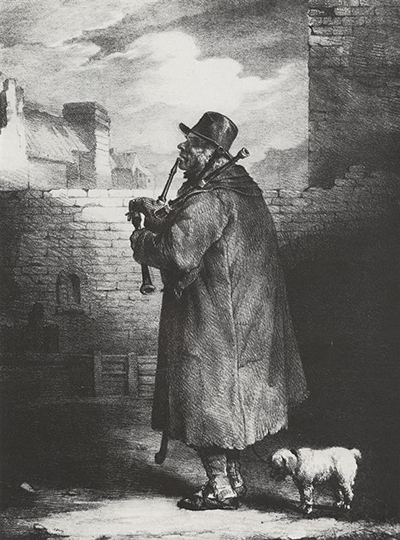
The Piper (The Bagpipe Player)
Light, texture and the limits of an impression
The lithograph's tonal structure joins broad divisions to small irregular marks. Pale masonry behind the hat separates the head from the dark shop front. Bricks, paving and wood grain carry different patterns, while the clothing and animal are drawn in more broken, overlapping passages. The upper right is especially dark, so the street seems to open into shadow rather than distant clarity. Against this surrounding density, the man's trousers become an insistent light shape.
The reproduction shows that composition clearly, but its cropped margins do not identify a particular museum impression or establish its state. Museum sheets preserve further evidence in inscriptions, dimensions and marks. The Condé and Rijksmuseum objects are witnesses to the same design, not interchangeable physical sheets. Their records allow us to recover the title and publication context while the image rewards a different kind of attention: to the downward turn of a head, the answering dog, and the short but consequential distance between a window and the pavement. [1] [2]
Géricault collection records
Seventy collection records include paintings, drawings and individual print impressions. Different impressions remain separate records; this selection is not a complete catalogue raisonné.
Frequently Asked Questions
Its title quotes the opening of Thomas Moss’s The Beggar. The caption addresses the reader directly, adding a verbal appeal to the pictured street scene. [1]
Clément’s 1866 catalogue places both within the English suite and transcribes the same publication date. He describes a blind musician with a dog in The Piper; Poor Old Man places its figure seated beside a shop. [11]
Discussion
Look again at the images and ideas explored in Pity the Sorrows of a Poor Old Man. These editorial prompts invite your observations.
Reader Insights
How does your attention move between the man’s face, the dog and the two people behind the window?
How does the scene change when you read the title as an appeal addressed to you?
Which contributes more to the sense of exposure: the extended legs, the corner, or the surrounding shadows?
Join the Conversation
Share a detail, comparison or question about Pity the Sorrows of a Poor Old Man below.
References
- Musée Condé, Pity the sorrows of a poor old Man!, inventory 2015-0-17, collection record, French; description, publication inscription and Thomas Moss identification. View source.
- Rijksmuseum, Bedelaar / Pity the sorrows of a poor old Man!, RP-P-1975-60, 1821, collection record, Dutch; series, makers and Delteil 31-2. View source.
- Nationalmuseum, The Severed Heads, NM 2113; collection metadata and museum interpretation (Swedish). View source.
- Louvre, Charging Chasseur, INV 4885; collection metadata and museum interpretation (French/English interface). View source.
- National Gallery, Horse frightened by Lightning; collection metadata and museum interpretation (English). View source.
- Louvre, Wounded Cuirassier, INV 4886; collection metadata and museum interpretation (French). View source.
- Louvre, The Raft of the Medusa, INV 4884; collection metadata and museum interpretation (French). View source.
- Gary Tinterow / The Metropolitan Museum of Art, Géricault’s Heroic Landscapes: The Times of Day, Met Bulletin 48/3, Winter 1990–91; consulted main essay and relevant object entries (English). View source.
- Vlaamse Kunstcollectie, Portrait of a Kleptomaniac; collection metadata and museum interpretation (Dutch). View source.
- Louvre, Epsom, MI 708; collection metadata and museum interpretation (French/English interface). View source.
- Charles Clément, Catalogue de l'œuvre de Géricault: Lithographies, 1866 catalogue offprint, printed pp. 13–14, entries 27–28, French; The Piper and Pity the Sorrows. View source. (in French).