


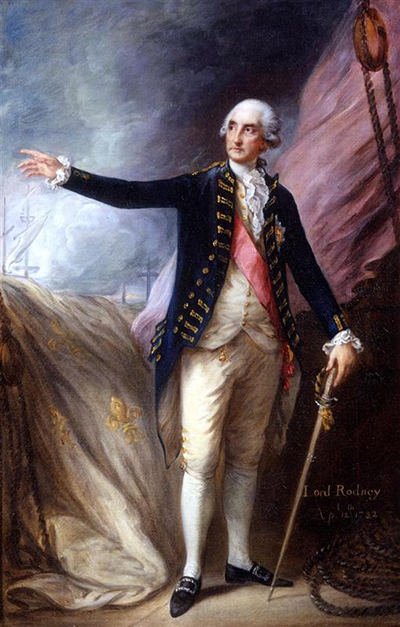
 by Tom Gurney
Tom Gurney BSc (Hons) is an art history expert with over 20 years experience
Published on June 19, 2020 / Page Updated on November 5, 2026
Email: tomgurney1@gmail.com / Phone: +44 7429 011000
Introduction
Thomas Gainsborough's paintings resist a tidy catalogue of types. Portraits, landscapes, family pictures, rustic subjects, conversation pieces, musician portraits, naval sitters and experimental late landscapes all belong to the same restless practice. The division between them is useful, but only up to a point. Gainsborough became famous through portraiture, but he kept returning to landscape. He painted fashionable sitters, but often set them in wooded air. He loved rural imagery, but his country scenes are rarely simple records of country life. He could make a portrait feel like a breeze passing through satin and leaves, and make a landscape feel almost staged for the eye.
This guide introduces the main bodies of Gainsborough's painting, not a catalogue raisonné. It is designed to help readers understand how the individual works relate to one another: why The Blue Boy and Mr and Mrs Andrews need unusually full attention, how the portraits differ from one another, why the landscapes need their own path through the artist, and where family pictures, rustic figures, prints, drawings and technique enter the story.
Gainsborough was born in Sudbury, Suffolk, in 1727, trained in London, worked in Sudbury and Ipswich, moved to Bath in 1759 and settled in London in 1774. Those places matter because his paintings changed with his markets and surroundings. Early East Anglian works often connect portraiture with local landscape. Bath brought a much larger society portrait practice. London intensified his public reputation, Royal Academy exposure and royal patronage. Throughout those changes, landscape remained a deep imaginative resource.[1][2]
The National Gallery describes Gainsborough, with Joshua Reynolds, as a leading portrait painter in later eighteenth-century England, while also emphasising his mature brushwork, colour and distance from Reynolds's more explicit use of Italian Renaissance and antique models.[2] Gainsborough's paintings often feel lighter than that comparison suggests, but lightness should not be confused with slightness. His best works are built from social intelligence, visual speed and a sustained negotiation between likeness and atmosphere.
At a Glance
- ArtistThomas Gainsborough
- Life1727–1788 [1]
- Working centresSudbury, Ipswich, Bath and London [1][2]
- Public enginePortraiture, especially fashionable society likenesses [2]
- Other centreLandscape, from Suffolk observation to late studio invention [14][16]
- Flagship portraitThe Blue Boy [9]
- Flagship hybridMr and Mrs Andrews [11]
- Broader formsConversation pieces, family pictures, rustic subjects and fancy pictures
- SurfaceFeathered brushwork, colour, soft transitions and atmospheric settings [26]
- Modern mapWorks held across British, American and international collections [1][4]
Contents
- Introduction
- The Main Shape of the Paintings
- Portraits: The Career's Public Engine
- The Blue Boy: A Flagship Portrait
- Mr and Mrs Andrews: Portrait, Land and Marriage
- Landscapes: The Other Centre
- Early, Middle and Late Gainsborough
- Rustic Subjects and Fancy Pictures
- Technique, Surface and Viewing
- Browse Thomas Gainsborough Paintings
The Main Shape of the Paintings
There are several ways to map Gainsborough's paintings. Chronology gives one structure: early Suffolk and Ipswich, fashionable Bath, ambitious London, late experiment. Subject gives another: portraits, landscapes, conversation pieces, family pictures, fancy or rustic subjects. Collections give a third: National Gallery, Huntington, National Gallery of Art, National Galleries of Scotland, Dulwich, MASP, National Trust, National Portrait Gallery and many others.
For a reader, the most useful map begins with the tension between portraiture and landscape. Portraits paid the bills, built the reputation and placed Gainsborough before the public. Landscape fed another kind of ambition. The two practices did not stay separate. Many of his most memorable pictures are hybrids: sitters outdoors, couples in land, children in woods, musicians in atmospheric settings, country figures arranged with theatrical care.
Gainsborough's House, the museum based in his Sudbury birthplace, emphasises the breadth of his practice and the spread of his works across major collections.[1][3] The National Gallery of Art's artist record similarly shows the range of paintings associated with his name, from late portraits to landscapes such as Mountain Landscape with Bridge and Seashore with Fishermen.[4] A 2002-03 retrospective presented 63 paintings and 30 drawings, including portraits, landscapes and scenes of the rural poor, which is a useful modern reminder that Gainsborough's achievement cannot be reduced to one famous blue suit or one landowning couple.[5]
The paintings fall roughly into five overlapping groups:
- portraits and society images;
- portraits in landscapes and conversation pieces;
- landscape paintings;
- family, child and rustic or fancy subjects;
- late experimental works where handling, mood and studio invention become especially important.
Those groups are not walls. They are pathways through the same artist.
Portraits: The Career's Public Engine
Portraiture was the public engine of Gainsborough's career. It gave him patrons, income, exhibition visibility and a reputation among the fashionable. In Bath and London especially, portrait commissions put him in contact with sitters who wanted status, likeness, beauty, lineage, accomplishment or social identity made visible. The question is what Gainsborough did with those demands.
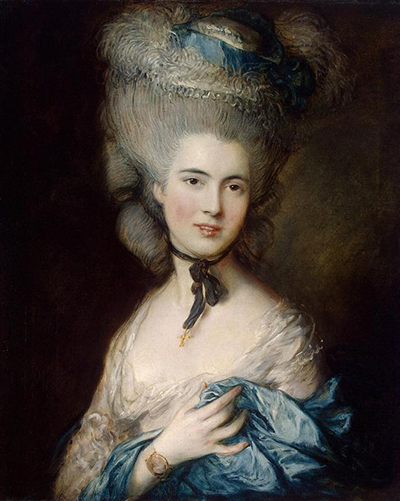
His answer was rarely stiff ceremony. A Gainsborough portrait may include rank, costume and pose, but it often depends on movement: a turn of the body, drifting hair, shimmering fabric, a dog at heel, foliage opening behind the figure, a hand that seems caught between display and ease. The face is important, but so is the weather around the sitter. A portrait becomes an event of light, surface and social performance.
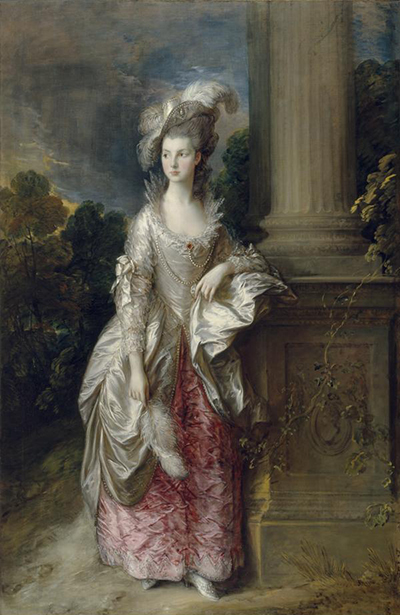
The Honourable Mrs Graham is one of the grandest examples. The National Galleries of Scotland record identifies Mary Cathcart Graham and gives the painting's full-length format, Van Dyck-inflected dress and later collection history.[6] The picture is not merely a beautiful woman in white. It is a carefully constructed society image in which costume, vertical elegance and aristocratic association all matter.
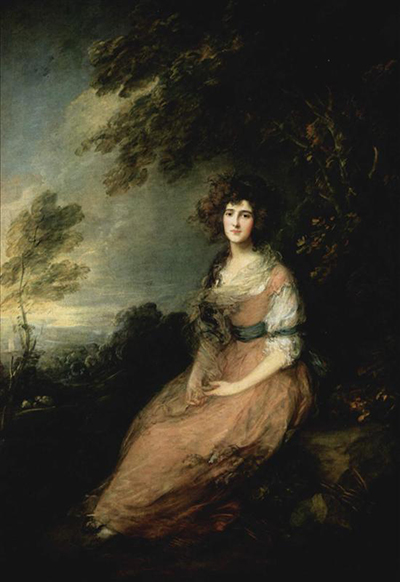
Mrs Richard Brinsley Sheridan offers a different form of portrait presence. The National Gallery of Art record anchors the sitter as Elizabeth Linley Sheridan and places the painting within the collection history of the Andrew W. Mellon Collection.[7] The portrait's landscape setting and quiet turn of the head make the sitter feel poised between public identity and inwardness. It is easy to romanticise Elizabeth Linley Sheridan because her biography is vivid, but the painting asks to be read first as a made object: pose, costume, setting, handling and social context.
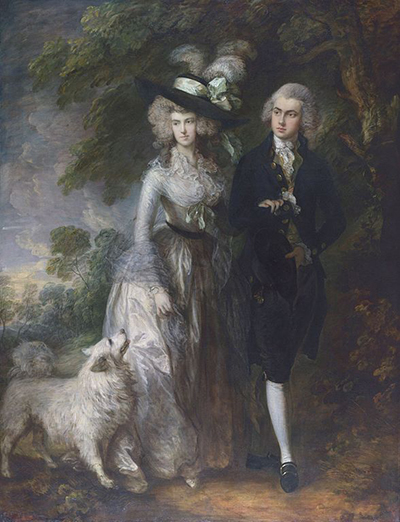
Mr and Mrs William Hallett, The Morning Walk shows how late Gainsborough could make a double portrait look effortless while carefully staging fashion, marriage, movement and landscape. The National Gallery notes that William Hallett and Elizabeth Stephen were painted shortly before their marriage in 1785, walking arm in arm with a dog.[8] The picture looks natural, but its naturalness is a high social style. Clothing, setting and brushwork produce a world of cultivated ease.
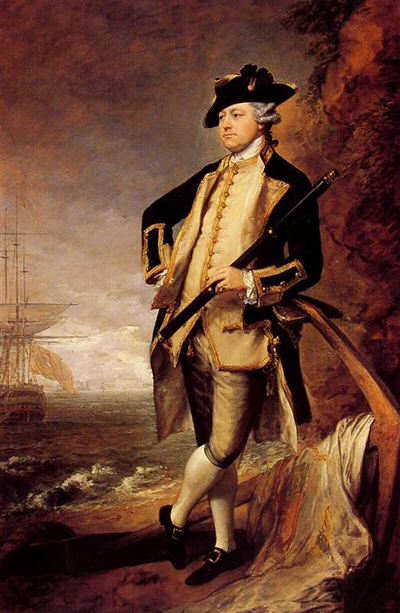
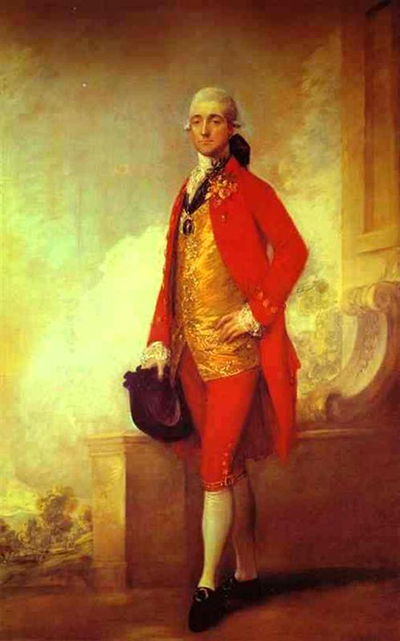
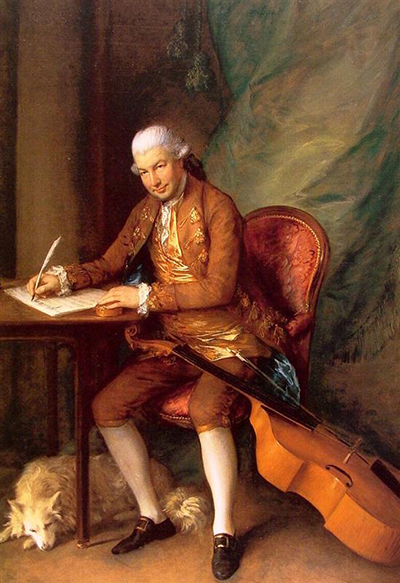
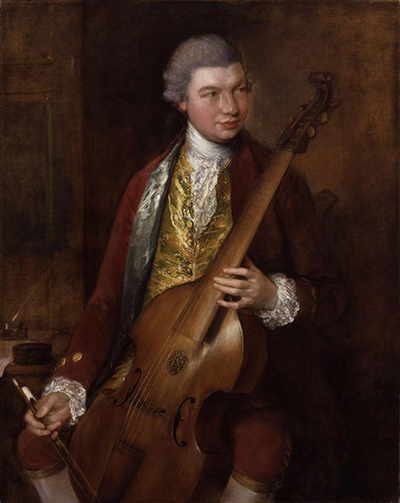
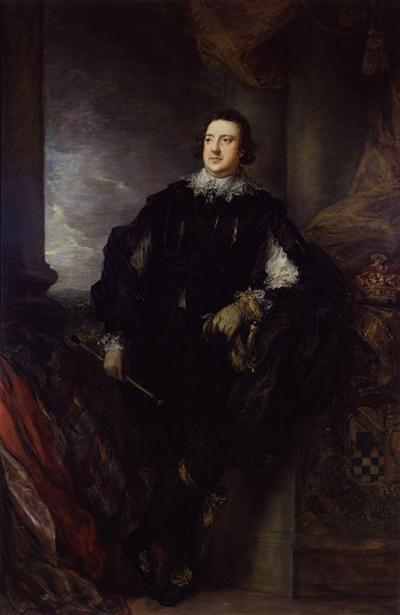
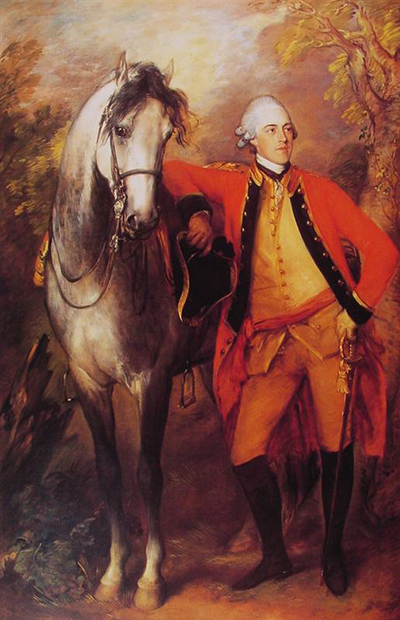
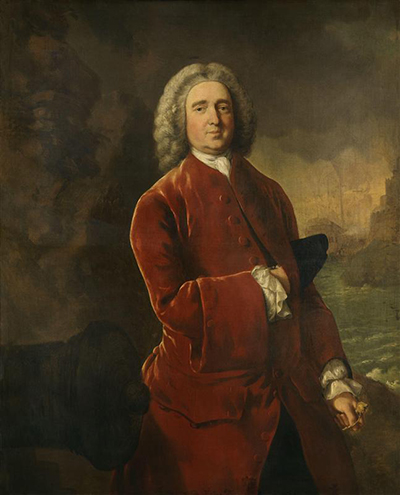
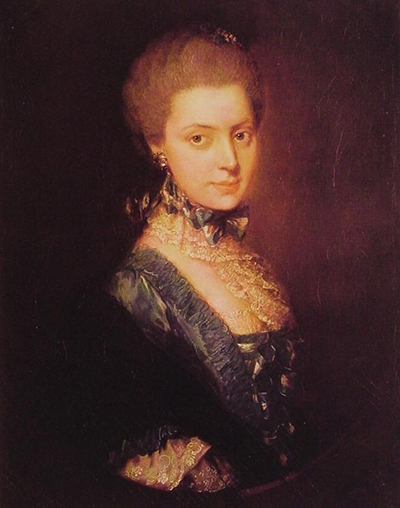
Other portraits complicate the field. Captain William Wade belongs to Bath society and the role of the Master of Ceremonies. Karl Friedrich Abel connects portraiture to music. Charles Howard, 11th Duke of Norfolk brings in late portrait status and unfinished-state questions. Edward Vernon requires attention to attribution and version language in the National Portrait Gallery record. Elizabeth Wrottesley shows how even a narrower portrait account must respect current holder data before general biography.
The portraits support the simple claim that Gainsborough was one of the great British portraitists. They also make that claim more interesting. He did not merely record the elite. He gave elite portraiture a mobile surface, and that surface can be charming, unstable, flattering and revealing at once.
The Blue Boy: A Flagship Portrait
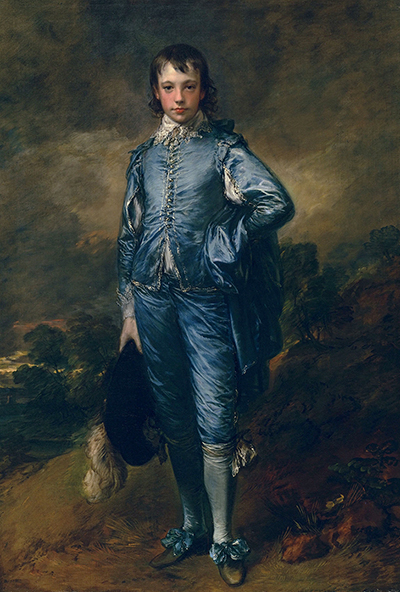
The Blue Boy is the most famous Gainsborough painting for many viewers, and it deserves its own extended account. A broad account of the paintings should only open the door. The Huntington's object record and Project Blue Boy materials make clear why the painting demands careful treatment: title, date, sitter uncertainty, Van Dyck costume, conservation history, acquisition, restoration and modern reception all matter.[9]
The painting's fame rests first on visual force. A young figure stands in a blue satin costume, confident and theatrical against a darker landscape. The colour is memorable, but the picture is not simply about blue. Costume makes the sitter look backward toward seventeenth-century aristocratic portraiture while the handling makes the surface vibrate with eighteenth-century painterly life. The boy is both portrait and performance.
Its afterlife has been unusually public. The painting's movement to the Huntington, its conservation and its return to the National Gallery for exhibition have all changed how modern audiences meet it.[9][10] That afterlife can become so loud that it drowns out the painting. A careful account has to slow the image down again: what is known, what is uncertain, what costume is doing, how restoration changed modern viewing, and why the picture became a cultural icon.
In this broader account, The Blue Boy matters as a compass point. It shows Gainsborough's portraiture at its most theatrical and memorable, and it introduces themes that recur across the paintings: costume, old-master memory, sitter identity, display, surface, colour and public myth.
Mr and Mrs Andrews: Portrait, Land and Marriage
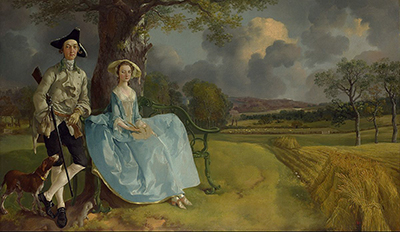
Mr and Mrs Andrews is the second flagship because it asks a different set of questions. It is not a single figure transformed into an icon of colour. It is a young married couple placed in relation to land. The National Gallery describes it as a masterpiece of Gainsborough's early career and notes that it has been read almost as a triple portrait: Robert Andrews, Frances Andrews and their land.[11]
The painting's power comes from its unusual balance. Robert Andrews stands with gun and dog; Frances Andrews sits beside him; behind them stretches a wide view of fields and estate. The picture can be enjoyed for its freshness and delicacy, but it is also a work about property, marriage, social position and the display of land. The unfinished area on Mrs Andrews's lap adds another layer of interest that belongs to fuller interpretation rather than to a quick summary.
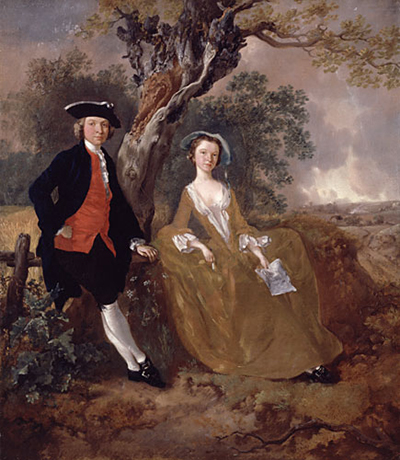
It would be a mistake to make every Gainsborough double portrait into Mr and Mrs Andrews. The painting is exceptional because of its early date, its landscape integration, its social clarity and its modern interpretive history. A later work such as The Morning Walk creates a very different form of outdoor couple portrait. Dulwich Picture Gallery's A Couple in a Landscape belongs to an earlier conversation-piece tradition and should not be forced into the Andrews pattern.[12]
An extended account of Mr and Mrs Andrews can move through land, class, marriage, unfinished paint, composition and catalogue history in detail. Here, its role is to show how Gainsborough could fuse portraiture and landscape so tightly that neither can be treated as a background to the other.
Portraits in Landscape and Conversation Pieces
Gainsborough's portraits often move outdoors. This does not mean the sitter has become more “natural” in any simple way. An outdoor setting can be a form of status, leisure, estate identity, poetic distance or fashionable informality. Landscape can soften a portrait, but it can also make social possession visible.
The conversation piece is especially important for understanding the early and middle parts of his career. These images place figures in social relation, often within interior, garden or landscape settings. Dulwich Picture Gallery's A Couple in a Landscape gives one useful anchor: an early work in which a couple appears within a landscape format, and where the object record also notes the reused canvas evidence revealed by x-ray.[12] That material belongs to a close account of the picture, but a wider view of the paintings can use it to show how early Gainsborough was already exploring the meeting point between likeness and setting.
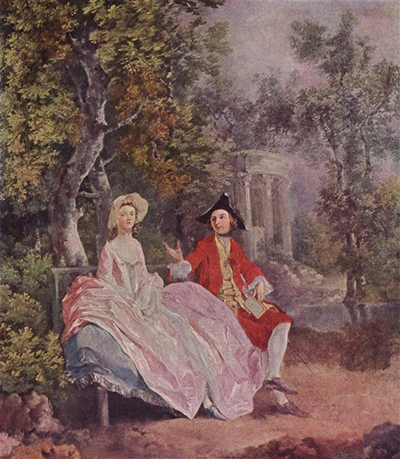
Conversation in a Park, now in the Louvre collection, extends this field with title and dating issues that need careful translation and source control.[13] It should not be treated as a vague decorative scene just because the sitters are not familiar to most readers. Conversation pieces tell us how people, space and social identity were arranged for viewing. They sit between portraiture and genre, between record and invention.
The same hybrid thinking shapes larger works. Mr and Mrs Andrews makes land itself part of the portrait. The Morning Walk makes a couple's fashion and movement part of a wooded social theatre. Even some single portraits depend heavily on landscape backgrounds that imply taste, ease or cultivated sensibility. Gainsborough's outdoor portraits are therefore not portraits plus scenery. They are pictures in which identity is partly made by place.
Landscapes: The Other Centre
Landscape is the other centre of Gainsborough's painting. It appears in early Suffolk works, in later London productions, in rustic scenes, in drawings and in prints. The challenge is to avoid two simplifications. One makes the landscapes merely personal escapes from portrait commissions. The other makes them simple views. Gainsborough's landscapes are more constructed, learned and ambitious than either version allows.
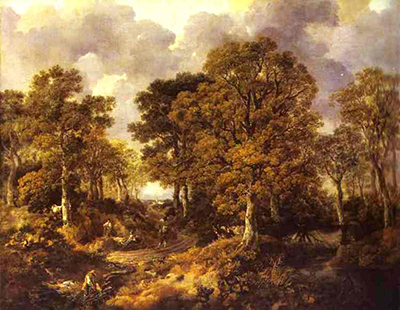
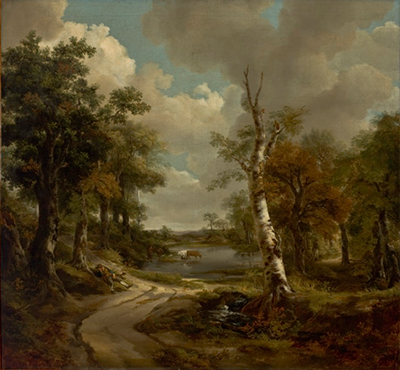
Cornard Wood, near Sudbury, Suffolk is a key early landscape. The National Gallery record anchors the geography near Sudbury and Great Cornard, notes Dutch influence, and even draws attention to the painting's changed present appearance through pigment fading.[14] That combination is exactly why Gainsborough landscape interpretation needs object records. A title, a place, an influence and the material condition of the picture all affect interpretation.
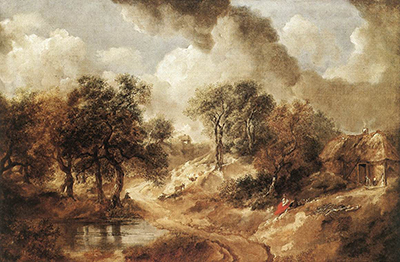
Landscape in Suffolk belongs to the early landscape field as well, though the accessible evidence is weaker because the available record is a Kunsthistorisches Museum-linked Google Arts & Culture entry rather than a full direct catalogue record.[15] The painting still helps readers see Gainsborough learning through Dutch landscape models and Suffolk subjects, but any discussion should stay modest unless stronger evidence is located.
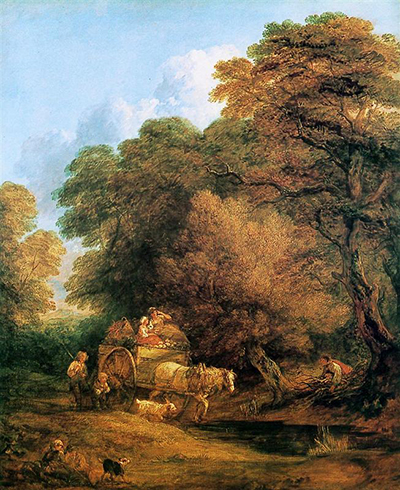
The later landscapes change the mood. The Market Cart shows a horse-drawn cart, children, produce, animals and a wooded road, but the National Gallery's record makes clear that this is not merely a slice of documentary rural life.[16] The scene is arranged for movement and atmosphere. It belongs with Gainsborough's late interest in rural subjects that are observed, remembered, invented and staged.
The Watering Place is especially useful for understanding influence and transformation. The National Gallery explains that Gainsborough's painting echoes Rubens's The Watering Place, which he saw in London, while also becoming a quieter evening image with its own mood. The painting was exhibited at the Royal Academy in 1777 and also translated into an etching.[17] This single work links landscape, old-master looking, exhibition culture and printmaking.
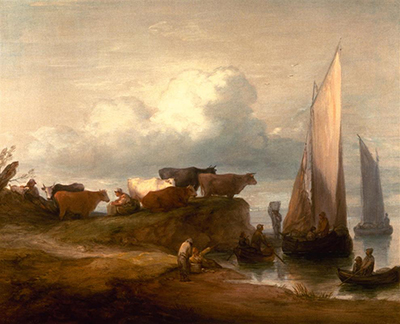
Other landscapes require title caution. MASP's Drinkstone Park (The Woods of Cornard) carries uncertainty in the source title itself, which should remain visible in any public discussion.[18] A Coastal Landscape currently rests on a strong contextual trail through the Taft Museum's discussion of Gainsborough landscapes and the Berger/DAM work, but still needs direct object-record reinforcement before a full account can be confident.[19]
Together, the landscapes show Gainsborough thinking about rural imagery as a painter, not merely as a local observer. Paths, carts, trees, cattle, pools, children and cottages are pictorial actors. They direct attention, organise mood and create a countryside that is never simply raw fact.
Early, Middle and Late Gainsborough
Another useful way to approach Gainsborough's paintings is by career phase. The phases overlap, but they help prevent a common mistake: reading every work through the most famous late portraits.
The early paintings belong to Suffolk, London training and Ipswich practice. They include local portraits, family works, small-scale conversation pieces and landscapes that still show Gainsborough learning from Dutch models and local scenery. Their ambition is not always the grand ambition of later society portraiture. It often lies in experiment: how to place figures outdoors, how to structure a road through trees, how to make a modest sitter or couple occupy a convincing pictorial world.
The Bath years changed the pressure. Gainsborough's portrait practice expanded because Bath supplied clients who wanted fashionable likenesses. These works often ask how elegance can be made lively rather than stiff. The sitter must be recognisable and socially legible, yet the painting must also feel fresh. Costume, hair, hands and landscape setting become tools for turning portraiture into performance.
The London years bring a different public scale. Gainsborough was now working in the orbit of the Royal Academy, royal patronage, rivalry with Reynolds and a larger exhibition audience. The late portraits can be more daring in handling, while the landscapes become increasingly imaginative. The brushwork that viewers now associate with Gainsborough's mature style is not simply a decorative finish; it is a way of making forms appear to hover between precision and suggestion.
This phased view also helps with dating questions. A painting from the Ipswich period should not be expected to behave like a London society portrait. A late landscape should not automatically be read as a memory of Suffolk topography. A Bath portrait and a London portrait may share fashionable ease but answer different social demands. Readers who keep the phases in view will see more than a single graceful manner repeated across decades.
Collections and the Modern Gainsborough
Gainsborough's paintings now live in many different kinds of collections: national museums, regional museums, university collections, private collections, and institutions outside Britain. That dispersal affects how modern readers know him. Some works are familiar because they hang in high-profile galleries. Others are known through catalogues, prints, loans, reproductions or institutional records.
The National Gallery's Gainsborough holdings give one strong path through the artist: Cornard Wood, Mr and Mrs Andrews, The Morning Walk, The Market Cart, The Watering Place and several family or portrait works appear in the same institutional frame.[2] The Huntington gives another path through The Blue Boy, Ligonier and Abel, tying Gainsborough to American collecting and modern conservation history.[9][22] The National Gallery of Art in Washington gives yet another path through late portraits and landscapes, including Mrs Richard Brinsley Sheridan and other Mellon or Corcoran collection works.[4][7]
This matters because a survey of the paintings should not imply that Gainsborough's art has one centre. Sudbury is biographically central, and Gainsborough's House is crucial to his study, but the paintings themselves form an international map. Gainsborough's House lists major holdings across the United Kingdom, the United States and other countries, which is a helpful reminder that the artist's reputation is maintained by a network of collections rather than a single museum.[1]
Modern collection records also discipline interpretation. They tell us title, medium, dimensions, accession, provenance, display, conservation and bibliography. They also preserve uncertainty. A title may be provisional. A sitter may be debated. A work may be “after” Gainsborough rather than by him. A record may show that a popular name is less precise than a collection title. Good Gainsborough writing should welcome those corrections. They make the interpretation stronger, not weaker.
The paintings therefore have two histories at once. One is the eighteenth-century history of making: studio, patron, sitter, exhibition, sale and reception. The other is the modern history of keeping: attribution, restoration, display, cataloguing, digital access and public interpretation. The best close accounts will keep both histories visible.
Rustic Subjects and Fancy Pictures
Gainsborough's rustic and child subjects sit between portrait, landscape and genre. They can be tender, theatrical, sentimental, experimental or unsettling. The danger is to treat them as simple images of rural innocence. The better approach is to ask what kind of picture each one is making.
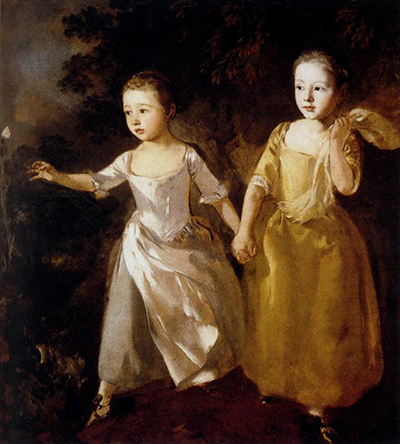
The Painter's Daughters Chasing a Butterfly is central here. The National Gallery identifies the two girls as Mary and Margaret Gainsborough and discusses the likely Ipswich date, unfinished condition and family context.[20] The image is intimate because the children are the artist's daughters, but it is also pictorially strange: a butterfly chase in a dark wood, a thistle, movement, vulnerability and incompletion. It should not be reduced to a charming family anecdote.
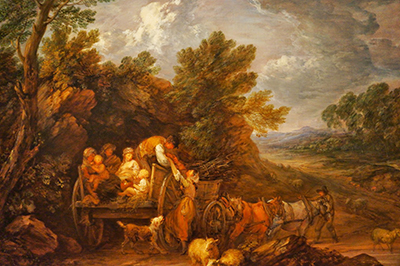
The Harvest Wagon, held by the Barber Institute, creates another bridge between landscape and rustic figure painting.[21] It includes rural movement, children, wagon and social staging. It should be distinguished carefully from The Market Cart, because both involve rural vehicles and figures but belong to different objects, collections and interpretive contexts.
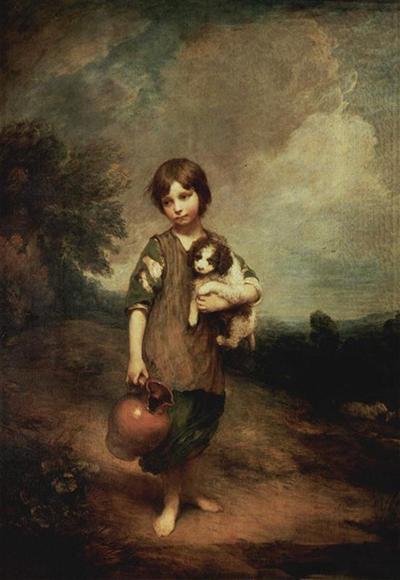
The broader category sometimes called “fancy pictures” must be used carefully. It can help gather images of children, peasants, rustic figures and emotionally suggestive scenes, but it should not become a licence for unsupported symbolism. A Peasant Girl with Dog and Jug is a good warning: the image is familiar, but the available public evidence remains weak. A responsible account should not pretend that loose reproduction facts can carry the subject. It may need to be concise, cautious or absorbed into broader fancy-picture interpretation if no stronger authority appears.
These works matter because they reveal Gainsborough experimenting with feeling outside strict commissioned portraiture. Children and rural figures gave him room to explore motion, vulnerability, sentiment and landscape mood. But sentiment should be earned by looking, not imposed.
Music, Family and Studio Affection
Music runs quietly through Gainsborough's paintings. His own interest in music is part of his biography, and several works make music visible or implied. Karl Friedrich Abel, anchored by the Huntington, connects Gainsborough to one of the important musicians of his London world.[22] The portrait should be read as both likeness and cultural association: a painter representing a musician within a social network where music, performance and artistic friendship mattered.
Family pictures open another path. Gainsborough's daughters appear in several works, and the National Gallery's material on its daughter portraits helps show how family, music and unfinished handling intersect.[23] These pictures can feel unusually private, but they still require art-historical discipline. The fact that a sitter is family does not remove questions of pose, format, condition, display and later interpretation.
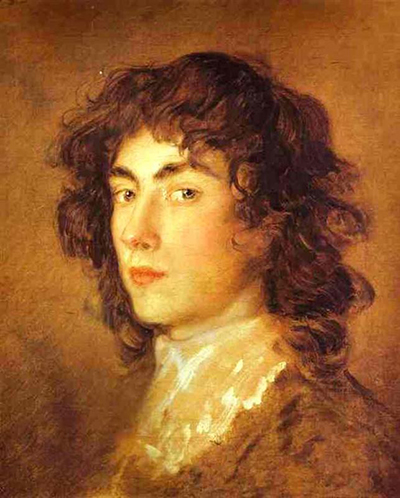
Gainsborough Dupont adds a further studio-family dimension. Dupont was Gainsborough's nephew and assistant, later active as a painter and engraver. The National Portrait Gallery and Government Art Collection records make clear that he belongs to both family history and studio continuity.[24][25] Dupont also matters because modern discussions of The Blue Boy include him among sitter possibilities. That connection should be handled carefully: relevant, but not allowed to turn every account of Dupont into a Blue Boy footnote.
The paintings are therefore not only a public parade of patrons. They include family, musicians, assistants, children, actors, society figures and rural types. That variety gives Gainsborough's art its unusual social range.
Technique, Surface and Viewing
Gainsborough's paintings are famous for their surface: feathered brushwork, rich colour, soft transitions, flickering costume, loose landscape forms and atmospheric settings. These qualities are visible even in reproduction, but they are easy to turn into vague praise. Good technical discussion needs object support.
National Gallery technical and object records are useful here because they connect visual effects to evidence. Cornard Wood reminds readers that pigment change can alter the present appearance of a painting.[14] The Watering Place links painting to drawing and etching.[17] Technical Bulletin material on Dr Ralph Schomberg gives a more specialised path into Gainsborough's studio lighting, palette, brushwork and painting method.[26] Project Blue Boy adds conservation and restoration evidence for a flagship work.[9]
The surface is not decoration added after the real subject. It is one of the ways Gainsborough makes meaning. In a portrait, loose handling can soften status, enliven costume or make a sitter seem present rather than frozen. In a landscape, painterly movement can turn trees and roads into rhythm. In a rustic subject, unfinished or rapid handling can intensify vulnerability.
This is why any broad account of Gainsborough's paintings should prepare readers for close looking. Description should not only identify title, date and sitter. It should ask how the paint behaves: where it tightens, where it loosens, what kind of air it creates, and how much certainty the surface withholds.
How the Paintings Connect
Gainsborough's paintings are best understood through complementary kinds of attention rather than repetition. Biography gives the life; portraits explain sitter status, fashion, Van Dyck influence and social performance; landscapes explain Dutch models, Suffolk memory, rural motifs and studio invention. Drawings and technique carry recurring questions about working method, while fancy pictures bring together child, rustic and genre-like scenes.
That balance matters because Gainsborough's works overlap so easily. Without clear boundaries, every portrait would retell the Bath-and-London career; every landscape would repeat the “preferred landscape” story; every child picture would become sentimental biography; every famous work would swallow the surrounding context.
The best way to read the paintings is therefore by movement:
- from early Suffolk landscape into national collection history;
- from local portrait practice into Bath society;
- from Bath society into London exhibition and royal patronage;
- from single portraits into double portraits and conversation pieces;
- from landscape views into invented rural scenes;
- from family pictures into fancy subjects and late experiment;
- from famous works into quieter but revealing individual works.
This also explains why not every familiar artwork title deserves the same public weight. Strong evidence can support a full treatment. Weak evidence may support only a short, cautious account or a mention within a broader theme. The goal is not to inflate the number of Gainsborough treatments; it is to answer real reader questions with reliable evidence.
Looking at a Gainsborough Painting
When looking at a Gainsborough painting, begin with category, but do not stop there. Is it a portrait, a landscape, a conversation piece, a family picture, a rustic subject or some mixture of these? The category tells you what kind of expectations the picture is working with. A full-length society portrait, a Suffolk landscape and a picture of children in a wood do not ask the same questions.
Next, look at the setting. A landscape background may be named, implied, invented or socially symbolic. In Mr and Mrs Andrews, land is part of the painting's argument. In The Morning Walk, the wooded setting helps create fashionable ease. In The Blue Boy, the landscape supports theatrical presence rather than estate identity. In Cornard Wood, geography and pictorial tradition meet.
Then consider costume and pose. Gainsborough's sitters often perform identity through dress. Van Dyck costume, white satin, military uniform, walking dress, musical association and fashionable hair all carry meaning. Pose matters just as much. A figure may stand, turn, stroll, sit, point, lean or gaze aside. These choices shape how the viewer experiences status and personality.
Finally, examine the edge between finish and looseness. Gainsborough often lets parts of a painting remain airy, brushed or suggestive. That looseness can be beautiful, but it can also be informative. It may indicate speed, late style, unfinished condition, atmospheric intention or the difference between face and setting. The task is not to praise looseness automatically, but to ask what it does in the specific painting.
The Paintings as a Whole
Taken together, Gainsborough's paintings form one of the richest bodies of work in eighteenth-century British art. They are elegant but not merely elegant, rural but not merely rustic, fashionable but not merely flattering. They move between patronage and freedom, likeness and invention, social performance and painterly experiment.
The famous works deserve their fame. The Blue Boy and Mr and Mrs Andrews really do open major doors into Gainsborough's art. But the quieter paintings are often where the larger pattern becomes visible: a child chasing a butterfly, a wagon moving through a wood, a musician held in informal presence, a couple turned into a landscape event, a title that carries uncertainty, a portrait whose surface seems to breathe.
The paintings matter because Gainsborough found ways to make eighteenth-century forms feel alive. He did not abolish the portrait, reject society, abandon landscape tradition or escape the art market. He worked inside those conditions and made them mobile. That mobility is the thread running through this rich body of work. His best paintings look as if they might settle into charm, and then do something more difficult: they ask how identity, place, class, memory, affection and performance can be held in paint without becoming still.
That is why the paintings reward both breadth and patience. They form a recognisable career, but they do not reduce to a single formula. Each major work changes the balance again: a costume becomes historical theatre, a field becomes social evidence, a wooded road becomes memory, a family image becomes a test of tenderness and restraint.
Browse Thomas Gainsborough Paintings
Frequently Asked Questions
Discussion
Which painting most changes your understanding of Gainsborough's range?
Reader Insights
Where does landscape do more than decorate a sitter's identity?
How do costume, pose and loose handling work together or pull against one another?
Which family, rustic or quieter landscape work most complicates the familiar flagships?
Join the Conversation
Share your reading below.
References
- Gainsborough's House, “About Thomas Gainsborough.” View source.
- National Gallery, London, “Thomas Gainsborough.” View source.
- Gainsborough's House, “Collection.” View source.
- National Gallery of Art, Washington, “Thomas Gainsborough.” View source.
- National Gallery of Art, Washington, “Thomas Gainsborough, 1727-1788.” View source.
- National Galleries of Scotland, “The Honourable Mrs Graham.” View source.
- National Gallery of Art, Washington, “Mrs Richard Brinsley Sheridan.” View source.
- National Gallery, London, “Mr and Mrs William Hallett ('The Morning Walk').” View source.
- The Huntington, “The Blue Boy” object and Project Blue Boy material. Object record; Project history.
- National Gallery, London, “Gainsborough's Blue Boy.” View source.
- National Gallery, London, “Mr and Mrs Andrews” object and catalogue entry. Object record; Catalogue entry.
- Dulwich Picture Gallery, “A Couple in a Landscape.” View source.
- Louvre Collections, “Conversation dans un parc.” View source.
- National Gallery, London, “Cornard Wood, near Sudbury, Suffolk.” View source.
- Google Arts & Culture / Kunsthistorisches Museum, “Landscape in Suffolk.” View source.
- National Gallery, London, “The Market Cart.” View source.
- National Gallery, London, “The Watering Place.” View source.
- MASP, “Drinkstone Park (The Woods of Cornard),” with title uncertainty in the source record. View source.
- Taft Museum of Art, “Life in Quietness and Ease: Thomas Gainsborough's Landscapes.” View source.
- National Gallery, London, “The Painter's Daughters Chasing a Butterfly” object and catalogue entry. Object record; Catalogue entry.
- Barber Institute of Fine Arts, “Thomas Gainsborough.” View source.
- The Huntington, “Karl Friedrich Abel.” View source.
- National Gallery, London, “Gainsborough's daughters.” View source.
- National Portrait Gallery, London, “Gainsborough Dupont.” View source.
- Government Art Collection, “Gainsborough Dupont, after.” View source.
- National Gallery Technical Bulletin, “Dr Ralph Schomberg.” View source.