 by Tom Gurney
Tom Gurney BSc (Hons) is an art history expert with over 20 years experience
Published on June 19, 2020 / Updated on October 13, 2026
Email: tomgurney1@gmail.com / Phone: +44 7429 011000
Overview
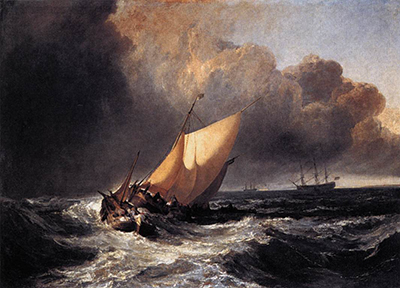
J. M. W. Turner's Dutch Boats in a Gale ('The Bridgewater Sea Piece') is an 1801 oil painting recorded by the National Gallery, London, under inventory L297.[1] The Gallery gives the medium as oil on canvas, the dimensions as 162.5 x 221 cm, and the credit line as on loan from The Capricorn Foundation.[1] Its history joins private patronage with public exhibition and artistic rivalry.[1]
The painting shows boats driven through rough water under a darkening sky. Its drama is not simply bad weather. Turner uses wind, wave, sail, light and threatened collision to make a young painter's argument about marine art. The sea is forceful, the figures are exposed, and the boats are pushed into a visual struggle that is also an artistic competition.
That competition was literal. Francis Egerton, Duke of Bridgewater, commissioned Turner to make a seascape as a pendant to Willem van de Velde the Younger's Ships on a Stormy Sea, a work Bridgewater already owned.[1] Van de Velde was regarded in Britain as a pre-eminent marine painter, so Turner was being asked to work beside an acknowledged Dutch master.[1]
The result helped establish Turner's public reputation. The National Gallery says the painting was first exhibited at the Royal Academy in London, drew crowded attention, and secured his standing as a leading figure in British art.[1] For an ambitious artist in 1801, this was not a minor storm scene. It was a professional test carried out on a large canvas.
At a Glance
- ArtistJoseph Mallord William Turner
- National Gallery titleDutch Boats in a Gale ('The Bridgewater Sea Piece')
- Date1801
- MediumOil on canvas
- Dimensions162.5 x 221 cm
- CollectionNational Gallery, London
- InventoryL297
- CreditOn loan from The Capricorn Foundation
- First exhibitedRoyal Academy, London, 1801
- PatronFrancis Egerton, Duke of Bridgewater
Contents
- Overview
- Object Identity
- The Bridgewater Commission
- Turner and Van de Velde
- Royal Academy Success
- Storm, Wind and Collision
- Sea Power and the Sublime
- Paint Handling and Marine Force
- Related Studies
- Not Other Dutch Boat Paintings
Object Identity
The National Gallery's full title includes the familiar name "The Bridgewater Sea Piece."[1] This name preserves the painting's connection with Bridgewater, his collection and the pendant relationship that shaped the commission. The shorter title Dutch Boats in a Gale describes its subject, while the additional name recalls its origins.
The artist is Joseph Mallord William Turner, 1775-1851, and the date is 1801.[1] The National Gallery identifies this particular canvas with inventory number L297.[1] Its title, date and collection history distinguish it from Turner's other paintings of Dutch boats and fishing craft.
The painting is on loan from The Capricorn Foundation and appears in the National Gallery's Main Collection.[1] The Gallery's Room 36 guide places Turner in dialogue with Claude, another predecessor whose work he admired.[2] That curatorial setting offers a wider context for the older-master comparisons central to his art, without making Claude the source of this particular marine commission.[1][2]
The physical scale also matters. At 162.5 x 221 cm, the painting is large enough for the storm to dominate the viewer's field.[1] The boats are not isolated vignettes in a small cabinet work. They are set within a marine event broad enough to carry public exhibition ambition.
The Capricorn Foundation's loan is distinct from the painting's temporary display location.[1] Exhibition arrangements can change while the work retains its title, date, inventory number and credit line. Visitors can consult the Gallery's current information for viewing details.
The Bridgewater Commission
The National Gallery identifies Francis Egerton, Duke of Bridgewater, as the patron who commissioned the seascape.[1] Bridgewater was a coal and canal magnate, and he wanted Turner's painting to hang as a pendant to a work already in his possession by Willem van de Velde the Younger.[1] That origin explains why the painting is often known through the Bridgewater title.
This was a significant commission for Turner. The National Gallery records that Bridgewater paid him 250 pounds, the highest sum Turner had received for an oil painting up to that point.[1] Money is not the whole measure of artistic importance, but in this case it reveals the scale of trust and ambition attached to the work.
The patronage also clarifies the painting's competitive structure. Turner was not merely painting Dutch boats because he liked Dutch marine subjects. He was making a work designed to converse with, answer and challenge a known Dutch painting in a major British collection. The commission put imitation, admiration and rivalry into the same assignment.
Bridgewater House shaped how the two paintings were seen together. The National Gallery notes that the paired display was initially available only to guests there.[1] Both works were later lent to the British Institution in 1837, allowing a wider audience to compare them.[1] The painting therefore had both a private collection life and a public comparison history.
The commission also helps explain the painting's boldness. Turner needed to satisfy a powerful patron, respond to an older master and assert himself as a modern British seapainter. The canvas is stormy because the subject demands it, but it is also stormy because Turner was testing how much energy a commissioned pendant could bear.
Bridgewater's own identity gives the commission another edge. He was not simply a passive owner of fine art; the National Gallery describes him through coal and canals, a form of wealth tied to engineering, transport and commercial infrastructure.[1] A storm seascape for such a patron therefore sat within a world where water, movement and economic power mattered beyond art history. Turner did not paint a canal or colliery here, but the commission came from a man whose status was deeply connected with systems of movement.
Bridgewater's industrial wealth is part of the commission's context, rather than proof that the painting is an industrial allegory. Its immediate subject remains boats in a gale. Force, risk and control belong to that marine subject, while the commission looks backward to Dutch mastery and forward to Turner's own public ambition.
Turner and Van de Velde
Willem van de Velde the Younger was central to the painting's meaning. The National Gallery describes him as a seventeenth-century Dutch marine painter who worked for much of his life in England and was regarded in Britain as the leading painter of the sea.[1] Turner was therefore entering a respected Anglo-Dutch tradition rather than inventing the contest from nothing.
The pendant design was specific. The National Gallery states that Turner's composition resembles the older marine painting but reverses it: in the Dutch canvas, the sails lean left; in Turner's, they lean right.[1] The storm clouds also answer each other from opposite directions.[1] The two canvases were designed to create a strong visual link while inviting comparison.
This reversal is more than a clever device. It lets Turner mirror the older work while refusing subordination to it. He acknowledges the model, then makes his own image more aggressive in scale, motion and storm force. The viewer is asked to see both kinship and difference.
The National Gallery interprets Turner's larger canvas as an assertion of superiority.[1] The increase in size gives the comparison a competitive edge. He produced a painting that could stand beside Van de Velde, acknowledge its model and challenge the older work's authority.
Dutch influence here takes a precise form: a pendant commission, a named master, a compositional reversal and a shared storm theme. Turner was establishing himself within a revered marine lineage through a direct comparison, not simply borrowing a general Dutch manner.
The reversal also affects how the viewer reads movement. If the two works were hung together, the opposing diagonals would have made the eye move between them rather than treating each one as sealed off. Turner seems to have understood that a pendant could be more than a matching subject. It could create a visible argument across a wall.
The older marine tradition offered authority, refinement and precedent. Turner's canvas answers with size, urgency and a more violent sea. Neither painting cancels the other: their differences make rivalry visible through composition.
Royal Academy Success
The painting was first exhibited at the Royal Academy in London in 1801.[1] The National Gallery describes the response as a huge success, with viewers gathering around the work.[1] That reception made the painting a public event as well as a commissioned object.
Turner was still a young artist. The National Gallery describes him in 1801 as ambitious and alert to the competitive British art world.[1] Dutch Boats in a Gale gave him a way to show technical command, artistic courage and professional calculation at once.
The Academy context is essential. A pendant in Bridgewater House could prove Turner to a patron and private circle. A Royal Academy exhibition could prove him before artists, critics, collectors and a broader public. The same painting could therefore operate in two overlapping arenas: elite collection and public display.
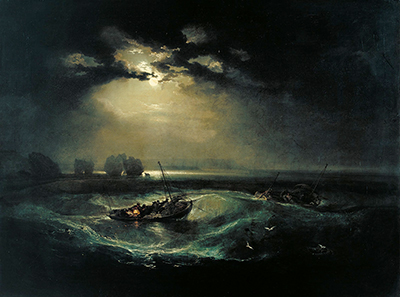
The work's success also helps explain why it secured such a strong place in Turner's early career. He had already exhibited significant marine subjects, including Fishermen at Sea, but the Bridgewater commission placed him in direct contest with a Dutch master and under the eyes of an influential patron. The stakes were unusually high.
The painting's energy is partly professional energy. The rough water, forced diagonal movement and charged light all belong to the subject, but they also serve Turner's career. He is showing that he can command a large marine canvas, answer tradition and attract attention in the most important exhibition setting available to him.
The Academy success reveals Turner's confidence in accepting comparison with Van de Velde. Weather, danger and scale made his response conspicuous, but they also exposed it to judgment. The National Gallery presents the outcome as a decisive step in his reputation.[1]
This confidence is an important part of early Turner. Before the mature colour, late looseness and modern subjects for which he became famous, he was already taking on demanding public comparisons. The high-value commission, enlarged subject and Academy exhibition combined patronage with an unusually visible artistic challenge.
Storm, Wind and Collision
The National Gallery's interpretation emphasizes the painting's dynamism: rolling, white-spumed sea, stronger weather than in Van de Velde's picture, and two boats apparently close to collision.[1] The storm has a concrete human focus. Wind and water threaten the sailors' ability to steer their craft past each other.
Wind is visible through the tilt of sails and the bodies of the boats. The vessels do not sit in water; they are driven through it. Their angles make the viewer feel resistance. Turner turns direction into drama, using sail and hull to show how weather acts on human craft.
The possible collision is central. The National Gallery notes sailors trying desperately to avoid each other under strong wind.[1] That moment gives the painting human urgency without requiring a complicated narrative. The viewer can understand the danger immediately: wind has overpowered easy control, and proximity has become peril.
The sea's surface intensifies the problem. Foam, broken water and sharp tonal contrasts make the boats' movement unstable. The waves are not decorative setting. They are the medium through which the danger is felt.
Light and shade heighten the sense of movement.[1] Turner does not light the scene evenly. He makes brightness flash against darkness, so that forms emerge under pressure. The eye has to move quickly between sail, water, cloud and threatened impact.
The storm also makes the boats interdependent. Each vessel matters because of its relation to another: angle to angle, sail to sail, hull to wave, human effort to force. Turner avoids a simple single-boat drama. The danger is relational. One boat's movement becomes another's risk.
This relational danger is what makes the possible collision so effective. It is not necessary to know the full story of the sailors to grasp the stakes. The arrangement itself tells the viewer that wind has narrowed the margin for control. The drama is readable through form.
Sea Power and the Sublime
The National Gallery connects the painting with the Sublime, describing nature here as greater than human effort.[1] The boats, sailors and weather give that idea visible form: human action is constrained by the force of sea and wind.
The sailors are active, not passive. They work to keep control, avoid impact and keep the boats alive in the weather. Yet their activity is visibly limited. The force around them is larger than their skill. Turner makes human effort important while refusing to make it sovereign.
This differs from a heroic naval battle. There is no triumphant commander, no clear victory and no national banner dominating the meaning. The subject is maritime struggle under weather pressure. The boats matter because they reveal the scale of the forces acting on them.
In Dutch Boats in a Gale, sublime power emerges from dark cloud, breaking sea, hard wind, leaning sail, threatened collision and sailors struggling for control. The arrangement of these visible elements makes the force of nature tangible rather than merely naming it.
Riding and Johns's Turner & the Sea situates these struggles within Turner's wider maritime art.[3] His marine art repeatedly tests human beings against water, weather, naval memory, travel and modernity. This 1801 painting belongs near the beginning of that sustained investigation.
The painting's sublime effect is therefore disciplined by circumstance. It is not a general claim that the sea is large and people are small. It is a more exact image of working craft in a particular storm pressure, shaped by a commission that required comparison with an earlier sea painter. Sublime force and artistic rivalry reinforce each other.
The human scale is crucial. Without sailors struggling in the boats, the sea would become impressive but less urgent. Without the sea's power, the figures would become mere detail. Turner makes each depend on the other, so that the viewer senses both labour and helplessness.
Paint Handling and Marine Force
Turner makes the sea forceful through paint as well as design. White foam, dark cloud and hard tonal contrast give the scene its physical charge. The surface carries the storm's energy alongside the diagonals of sails and hulls.
Townsend's study of Turner's materials and techniques explains the relationship between physical handling and pictorial effect.[4] In this canvas, the storm depends on the distribution of light and the sharpening or obscuring of forms, not on its subject alone.
In this painting, the handling serves urgency. The water must feel mobile, the boats must feel unstable, and the sky must feel capable of driving the whole scene. Turner is not yet the late painter of near-dissolving light, but he is already using paint to make weather into structure.
The scale of the canvas increases the burden on handling. A small marine sketch can rely on suggestion; a large oil shown at the Royal Academy must sustain its effect across distance and close inspection. Turner answers that demand by building strong diagonals, contrasts and areas of active surface.
The painting therefore shows early technical confidence. Turner can organize a large scene around weather, but he can also make the paint participate in that weather. The sea is not only represented. It is made to behave visually as a force that breaks, pushes and destabilizes.
The pendant relation takes visible form through these effects. White sea, dark cloud, warm and cool contrasts, and rough edges of movement give Turner's response to Van de Velde its force. Patronage and artistic rivalry are embodied in the painted surface rather than existing only outside the image.
Turner's handling also gives the painting a different energy from a calmer Dutch river subject such as Dort. In Dort, light expands and steadies the water. In Dutch Boats in a Gale, light strikes across a field of instability. The two works both engage Dutch precedent, but they do so through very different weather and pictorial pressure.
Related Studies
Tate's research publication records studies connected with Dutch Boats in a Gale, including a c.1799-1801 study titled Study for 'Dutch Boats in a Gale: Fishermen Endeavouring to Put their Fish on Board ("The Bridgewater Seapiece")'.[5] These works-on-paper materials help confirm that the finished oil was prepared through study rather than improvised as a single burst of storm imagery.
The studies also preserve the longer descriptive wording associated with the subject: fishermen trying to put fish on board. That detail reinforces the work's labour dimension. The boats are not anonymous shapes in bad weather. They belong to fishing work, exchange and survival under difficult conditions.
The related studies record stages of preparation for the finished canvas. They remain distinct objects from the 1801 oil held at the National Gallery as inventory L297, on loan from The Capricorn Foundation.[1]
The existence of preparatory material also helps refine the idea of drama. Turner may present the storm as urgent, but the painting's making involved planning. The final image balances immediacy with preparation. Its weather feels sudden; its composition is deliberate.
This matters for early Turner. He was not relying on subject matter alone to impress viewers. He was developing a complex marine composition through study, then using exhibition scale to make that planning look alive.
The Tate material also keeps the subject connected to fishing labour.[5] The National Gallery account emphasizes storm, competition and reputation, while the study title preserves fishermen working with their catch. Taken together, those strands keep the painting from becoming only a storm effect. It is a marine work about labour under stress, made within a culture of artistic rivalry.
The studies are useful for another reason: they reveal how a successful Academy work can emerge from repeated decisions. A viewer may experience the finished canvas as a sudden gale, but Turner's process required selecting, reversing, enlarging and intensifying forms. The public impact depended on private preparation.
Not Other Dutch Boat Paintings
Turner's later Fishing Boats with Hucksters Bargaining for Fish, held by the Art Institute of Chicago, is a different work, although its historical titles also connect it with Dutch fishing subjects. Its date, collection and pictorial problems distinguish it from the 1801 Bridgewater seascape.
The Yale Dordrecht painting, Dort, offers another contrast. That 1818 work is a river scene built around Cuyp, a calm vessel and postwar travel. Dutch Boats in a Gale is an 1801 storm seascape tied to Bridgewater, Van de Velde and Royal Academy success.
The National Gallery record for the Bridgewater painting gives L297.[1] That inventory number identifies the large 1801 oil discussed here, rather than a related study or another Turner marine painting with a similar title.
The name "The Bridgewater Sea Piece" points to the commission, patron, collection setting and Van de Velde comparison. It carries a history that the more descriptive title Dutch Boats in a Gale does not supply on its own.
Turner's marine subjects often share boats, storms, fishing and rough water. Their differences emerge through particular commissions, dates, settings and arrangements of human activity. In this canvas, the Bridgewater pendant relationship gives the storm a distinctive place in his career.
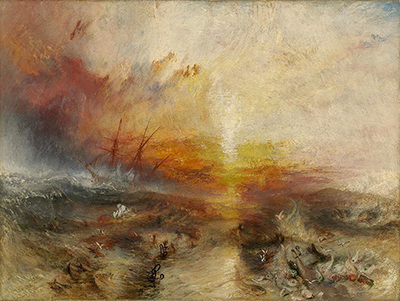
The Shipwreck presents a different kind of marine danger. Here the sailors struggle to prevent a collision under storm pressure; in The Shipwreck, disaster has already overwhelmed the vessel. Dutch Boats in a Gale joins the immediate risk to fishing craft with the specific history of the Bridgewater commission.
How to Look at the Painting
The large 1801 oil brings a storm into the viewer's field through opposed forces: the wind drives the boats, while sailors struggle to steer them through the waves.[1] Following these pressures reveals how Turner gives the scene both movement and human urgency.
Next, look for the pendant design. Imagine the painting in relation to Van de Velde's Ships on a Stormy Sea. Turner's boats lean in the opposite direction from Van de Velde's, and the storm movement answers the older painting in reverse.[1]
Then watch the diagonals. Sails, hulls, waves and clouds all push the eye across the canvas. Turner does not organize the scene as a calm horizontal view. He builds it around strain.
After that, focus on the threatened collision. The boats are close enough to make weather a human problem. The danger is not distant or abstract; it is happening between vessels handled by sailors.
Finally, consider scale and ambition. Turner made the painting large, successful and competitive. It is a storm scene, but it is also an argument: a young British artist claiming that he could meet and surpass the Dutch marine tradition.
It is also worth looking for what the painting withholds. There is no calm safe position inside the image. The viewer is placed before weather already in motion, with boats under strain and sailors forced to respond. That lack of settled viewpoint strengthens the sensation of danger.
Then return to the Bridgewater context. The painting is easiest to understand when seen as both image and challenge: a storm at sea, a pendant to Van de Velde, a public Royal Academy success and an early sign of Turner's appetite for artistic competition.
Why the Painting Matters
This painting matters because it shows Turner turning a patron's commission into a public career breakthrough. Bridgewater asked for a pendant to Van de Velde; Turner made a painting that could compete with the older master and attract Royal Academy attention.
It also matters because it keeps Dutch marine inheritance specific. The painting is not vaguely Dutch in flavour. It is tied to a named patron, a named Dutch painter, a specific pendant relationship, and a composition deliberately set in reverse dialogue with Van de Velde.
The work is important for Turner's treatment of the sea. The National Gallery's discussion of wind, collision risk, rolling water and human powerlessness gives the storm concrete force.[1] Turner makes the sea an active power rather than a scenic backdrop.
It matters for Turner's professional development as well. The painting brought public attention, helped secure his reputation, and showed that a young painter could use marine art as a field of ambition.[1] This is early Turner, but it is already Turner thinking competitively at scale.
Finally, the painting matters because it joins technical force with historical argument. Paint handling, composition, patronage, Dutch precedent and exhibition success all work together. The canvas is not only a dramatic marine scene; it is a statement about what British painting could do with the sea.
It also matters because it shows that Turner's relationship to older art could be aggressive as well as admiring. He did not reject Van de Velde. He accepted the comparison and intensified it. That habit of working through rivalry would remain important throughout his career.
Frequently Asked Questions
J. M. W. Turner painted it. The National Gallery identifies the artist as Joseph Mallord William Turner, 1775-1851.[1]
The National Gallery gives the full title as Dutch Boats in a Gale ('The Bridgewater Sea Piece').[1]
The National Gallery dates the painting to 1801.[1]
It is oil on canvas and measures 162.5 x 221 cm.[1]
The National Gallery inventory number is L297.[1]
It is recorded at the National Gallery, London, on loan from The Capricorn Foundation.[1] Consult the Gallery's current display information before visiting.
Bridgewater wanted Turner's canvas to accompany Van de Velde's storm painting, and the National Gallery explains that Turner reversed key compositional forces in response.[1]
Discussion
How does Turner turn a commissioned pendant into a visible contest with Van de Velde?
Reader Insights
How do sails, hulls and clouds drive the eye through the gale?
Where does the threatened collision become most immediate?
How does scale make Turner's response to Van de Velde competitive?
Join the Conversation
Share a close observation or a source-based question for other readers.
References
- National Gallery, London, "Dutch Boats in a Gale ('The Bridgewater Sea Piece')." https://www.nationalgallery.org.uk/paintings/joseph-mallord-william-turner-dutch-boats-in-a-gale-the-bridgewater-sea-piece
- National Gallery, London, "Room 36." https://www.nationalgallery.org.uk/visiting/floorplans/level-2/room-36
- Christine Riding and Richard Johns, eds., Turner & the Sea, Thames & Hudson / National Maritime Museum, 2013.
- Joyce H. Townsend, How Turner Painted: Materials & Techniques, Thames & Hudson, 2019.
- Tate Research Publication, "Study for 'Dutch Boats in a Gale: Fishermen Endeavouring to Put their Fish on Board (\"The Bridgewater Seapiece\")'." https://www.tate.org.uk/art/research-publications/jmw-turner/joseph-mallord-william-turner-study-for-dutch-boats-in-a-gale-fishermen-endeavouring-to-r1178224