 View the object record
at MFA Boston
Museum of Fine Arts, Boston, accession 13.2723. Public-domain image via Wikimedia Commons.
 by Tom Gurney
Tom Gurney BSc (Hons) is an art history expert with over 20 years experience
Published on June 19, 2020 / Updated on August 29, 2026
Email: tomgurney1@gmail.com / Phone: +44 7429 011000
Fall of the Rhine at Schaffhausen in Boston
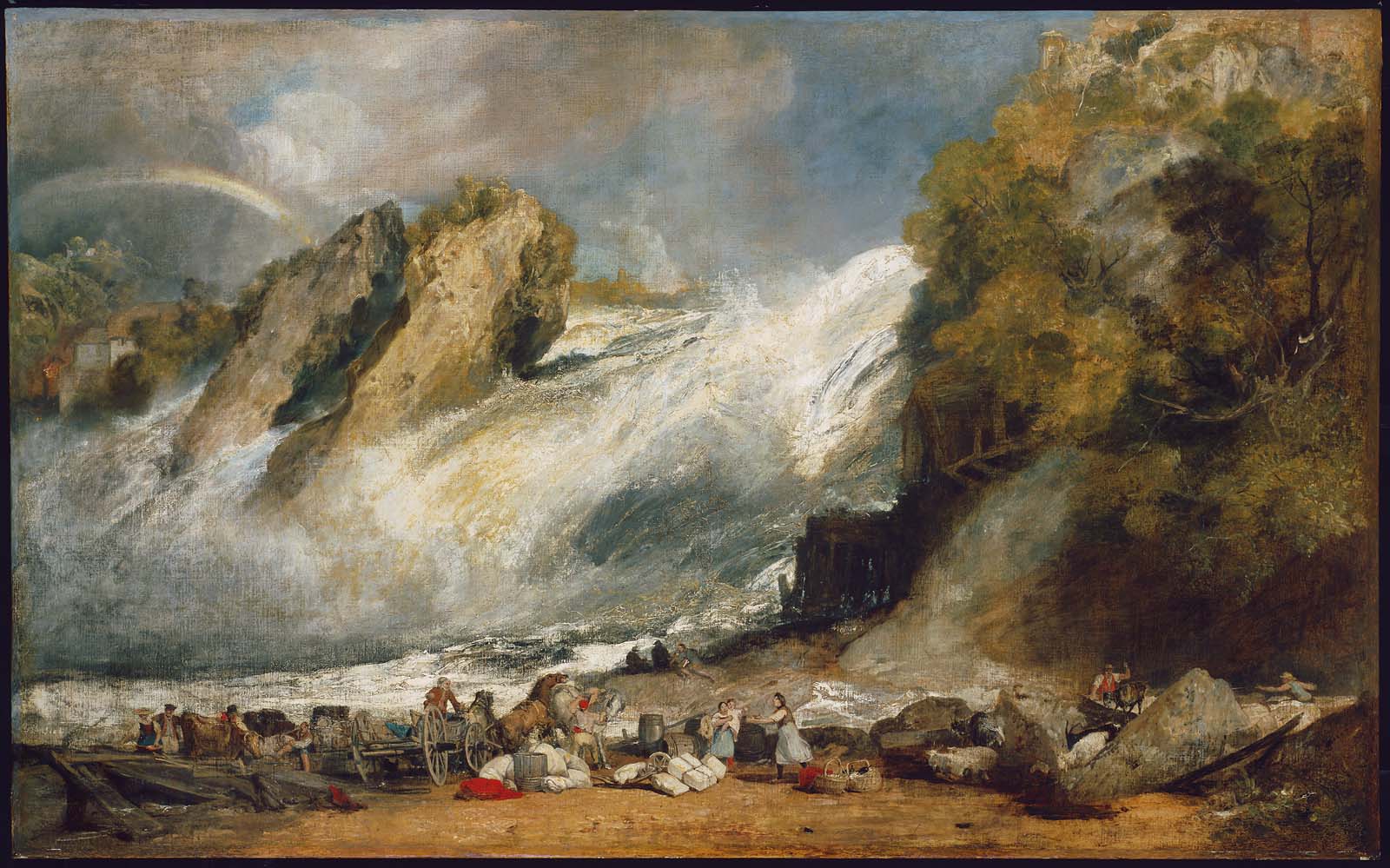
J. M. W. Turner's Fall of the Rhine at Schaffhausen is an immense oil on canvas painted about 1805-06. It measures 148.6 by 239.7 centimetres, or 58 1/2 by 94 3/8 inches, and belongs to the Museum of Fine Arts, Boston, where it has the accession number 13.2723.[1] Turner exhibited it at the Royal Academy in 1806 as catalogue number 182.[4][21]
The painting developed from his first journey through Switzerland in 1802. During that expedition he made more than four hundred drawings that he continued to use for decades.[1] The Boston canvas was neither a hurried transcription nor an oil painted in front of the waterfall. It is a grand studio reconstruction in which experience, drawings, rivalry and exhibition ambition converge.
The subject is the Rhine Falls near Schaffhausen in northern Switzerland. A broad torrent breaks through rocks and descends behind a foreground crowded with carts, horses, boats, goods, workers, women and children. A wooded bank closes the right side, a pale rainbow hangs within the spray at left, and cloud seems to form from the same moisture that rises off the water.[3] Turner does not isolate a natural wonder from ordinary life. He makes a celebrated waterfall and a working transfer point occupy the same enormous field.
That combination distinguishes the canvas from an uncomplicated prospect. The cataract is spectacular, but the foreground is not a decorative platform from which elegant visitors admire it. Barrels, baskets, bales and vehicles indicate transport. People bend, carry, manage animals and protect children. The fall interrupted navigation along the Rhine, so goods had to move between boats and carts in the Schaffhausen area.[5][6] Turner's spectacle has an economy.
The date requires care. Turner saw and drew the falls in 1802, produced the oil about 1805-06, showed it in 1806, and sold it to Sir John Fleming Leicester in February 1807.[1] Later he designed another Fall of the Rhine for an engraving published in 1833 and returned to Schaffhausen to make fresh watercolours, especially in 1841.[8][10][12] These are connected acts of looking, not versions of one object.
The painting claims history-painting scale. Rocks, water and weather take commanding positions while human narrative remains dispersed across the low bank. Turner raises a named place to monumental status without emptying it of work.
Entering the Great Horizontal Canvas
The width is the first physical fact. A viewer cannot absorb the whole composition at one glance without stepping back, yet stepping back makes the finely articulated foreground harder to read. Moving closer reveals harness, wheels, packages and small bodies; withdrawing restores the fall's overwhelming unity. The act of viewing alternates between human incident and natural magnitude.
Across the middle, water descends in several connected movements rather than one smooth curtain. The upper river gathers between wooded banks. It presses around two tall central rocks, breaks into white and blue-grey sheets, then explodes into foam and vapour before continuing toward the lower left. The flow is continuous, but its visible forms change repeatedly.[3][4]
The two rocks left of centre are crucial. One is a dark slab; the other is a warmer, almost golden mass pitched at an uneasy angle. Light picks out fractures and ridges on the taller stone. The torrent curls behind, between and around them, making their resistance a measure of the water's force. They look solid enough to divide the river yet precarious enough to be changed by it.
On the right, land rises into a dense wooded wall. Dark trunks, brown earth, olive foliage and pockets of near-black shadow hold the edge of the cascade. A pale building appears above the trees, while a darker opening or chamber is embedded nearer the water. An early catalogue of Sir John Leicester's collection described travellers approaching a chamber among the rocks, evidence of how closely nineteenth-century viewers examined this area.[14] The exact structure remains less certain than its compositional role: human access has been cut into a bank that still looks forbidding.
At far left, the fall opens into lesser channels, distant banks and small buildings. The eye can travel outward, but the main cataract continually draws it back. There is no single framed window through which the entire topography becomes calm and legible. Turner distributes partial views around an obstacle made of water.
Warm earth, brown goods and dark figures in the lower quarter establish a register of weight. The low viewpoint places the spectator near workers and animals, close enough to imagine cargo's burden yet unable to reach the cataract without crossing their space. The white fall rises behind them like a moving wall.
This arrangement keeps the painting from resolving into a conventional contrast between tiny humanity and mighty nature. Scale certainly dwarfs the people, but their detailed activity controls the foreground rhythm. The fall commands vision; the workers command duration. To understand the picture, one must spend time among both.
Contents
- Fall of the Rhine at Schaffhausen in Boston
- Entering the Great Horizontal Canvas
- The Rhine Falls and the High Rhine
- Water Against Rock
- Rainbow, Spray and Weather
- The Foreground as Transfer Station
- Horses, Cart, Mother and Child
- Workers, Travellers and Social Distance
- A Perspective Deliberately Dislocated
- Paint That Behaves Like Water
The Rhine Falls and the High Rhine
The Rhine Falls lie near Neuhausen am Rheinfall and Schaffhausen on the High Rhine. The location belongs to the northern Swiss landscape rather than to a remote high-Alpine valley. It nevertheless formed part of the broader Swiss and Alpine journey through which British travellers encountered mountains, torrents and new conditions of scale.[4]
Modern descriptions give the fall a width of about 150 metres and a height of 23 metres.[7] Those figures help orient the present physical place but should not be projected backward as Turner's own measurement. Joseph Farington recorded Turner's report after the 1802 journey: he estimated a drop of roughly eighty feet and a width about four and a half times the depth.[22] The reported calculation shows that emotional force did not exclude practical observation.
Volume, rock and seasonal conditions alter the view. Turner sought a relation among breadth, descent, noise, spray and obstructing stone, translating it into a field almost as wide as a large room.
Later guidebooks taught visitors how to approach the falls. John Murray's nineteenth-century account recommended a balcony close to the torrent, where spray, roar and uninterrupted movement produced the fullest impression; morning light might suspend a rainbow in the mist.[4] Such advice reveals a culture of organised intensity. Tourists wanted not only a distant view but a bodily encounter calibrated by time and position.
Turner anticipated that demand while refusing to provide only the expected spectacle. His pale arc at left corresponds to the celebrated rainbow, and the near view conveys immersion, yet the lower bank remains full of practical obstruction. A visitor cannot imagine solitary communion without passing through carts, animals and workers.
Schaffhausen's relation to the river also matters. The rapids and falls interrupted continuous navigation. Regional history records that boatmen and rafters transferred cargo to carts near the dangerous water, contributing to the town's growth as a centre of exchange.[6] The waterfall that attracted travellers also imposed delay and expense on transport.
Turner joins wonder and interruption visually. Mist, rainbow and huge rocks serve the traveller's desire for the sublime; barrels, boats and wheels disclose the same geology's logistical consequences. The fall is valuable as an image because it is difficult as a passage.
Printed views circulated from the sixteenth century, multiplying as tourism expanded in the later eighteenth.[5] Turner encountered a famous subject with established viewpoints and had to make familiar fame physically new.
He does so partly by refusing stable distance. The painted cataract seems closer than the small figures directly before it, and the river's exit toward the lower left is difficult to reconcile with its frontal surge. This instability need not be corrected into a map. It is Turner's method of making the remembered force exceed a tidy diagram.
Water Against Rock
The cataract's drama depends on resistance. If the entire river descended as an uninterrupted pale sheet, width alone would create grandeur but not struggle. Turner inserts jagged rock masses, uneven shelves and shadowed channels so that water must divide, accelerate, curl and rejoin.
The two central stones seem almost animated by pressure. The darker left rock leans into the flow, while the taller warm rock exposes a fractured face to the light. Their edges are neither smoothly outlined nor dissolved. Thick and thin touches make the surfaces appear cut, battered and wet. The water takes their contours for an instant, then breaks away.
Behind them, the upper river appears compressed between wooded banks. A broad pale run slides toward the obstruction, its surface more continuous than the broken foam below. The change from approaching sheet to shattered descent gives the eye a sequence through which to imagine speed. Turner does not freeze one shape of water; he makes several states coexist.
In the central fall, white paint gathers into ridges and swerves. Blue-grey passages remain visible beneath the foam, preserving volume inside brightness. Greenish notes suggest depth where the river has not fully aerated. Brown and ochre appear where reflected earth or exposed rock interrupts the colder current.[1][3]
The lower water does not settle into a transparent pool. Spray rises, currents turn left, and pale force presses toward the foreground. The river seems capable of overflowing the painting's internal space even though it eventually escapes through a side channel. The contradiction between frontal advance and lateral drainage helps make the composition feel unstable.[5]
Rocks on the right bank answer the central forms at a larger scale. Their dark weight makes the water brighter, yet vegetation prevents them from becoming bare geometry. Tree trunks and foliage occupy a world in which growth has adapted to moisture and steep ground. The bank resists the torrent while depending on it.
Turner also uses rock to complicate spectatorship. A historic account describes a chamber among the right-hand formations reached by travellers.[14] Whether every architectural detail can now be named or not, the suggestion of access matters. The natural barrier has become a viewing apparatus, but it remains embedded in dark, irregular stone.
The painting therefore does not divide inert geology from active water. Rock redirects current; water reveals rock. Each gives the other visible form. The MFA observes that Turner flattened thick paint so the cascade acquires something of the solidity and shape of the stones themselves.[1] Substance migrates across the apparent opposition.
This exchange carries a larger argument about painting. Oil colour is naturally static once dry, yet Turner makes its thickness signify movement. The same material can become resistant stone in one passage and racing foam in another. Representation depends less on disguising paint than on assigning its physical behaviour with precision.
The central warm rock makes this clear. Close marks read as crusted pigment; farther away, their ridges become weathered stone. Similar material in the surrounding water becomes opposite force through direction.
Rainbow, Spray and Weather
A faint rainbow rises through the left-hand mist. It is easy to miss because Turner does not isolate it as a bright emblem. Pale yellow, green and blue follow a restrained curve from the lower left toward cloud, partly dissolving into the surrounding moisture.[3]
The arc has an observational basis. Waterfall spray produces the conditions for a rainbow when light and viewpoint align, and later travel advice named morning as a favourable moment at Schaffhausen.[4] Turner turns this expected attraction into a fragile optical event rather than a piece of permanent scenery.
Its incompleteness matters. A fully saturated rainbow might close the left side into a decorative arch. The pale version opens and vanishes. It draws the eye through mist toward the distant bank while refusing a hard boundary. Colour records an angle between sun, droplets and spectator that could alter in seconds.
There is no need to convert the rainbow into a fixed religious promise. Its traditional associations would have been available to Turner's audience, but no document establishes a script of covenant or salvation for this work. Within the visible structure, it does something sufficiently important: it makes airborne water legible as coloured light.
The sky above the fall is built from broad transitions. A pale cloud mass stretches across the upper left and centre, edged by cooler grey and an opening of blue toward the right. Darker weather gathers at the margins. The atmosphere is active without presenting a single named storm.
Cloud and spray meet near the horizon of the cascade. The white torrent rises into vapour, and vapour joins cloud so gradually that the eye cannot always decide where water stops being river. Turner converts a physical cycle into a pictorial continuity: falling liquid, suspended droplets and condensed atmosphere share light while keeping different scales of movement.
The wooded right bank anchors this uncertainty. Against its dark mass, the pale air becomes visible. Tiny branches and trunks stand at the edge of moisture, while the small building above seems exposed to passing weather. The bank gives the cloud a limit, but the spray softens that limit lower down.
Warm earth and cargo occupy the lower register while cooler cloud and water expand behind them. Red, white and blue among clothes, animals and packages prevent a rigid division; local colour enters atmosphere, and atmospheric light enters the human zone.
Turner makes weather temporal. The rainbow is emerging or fading; blue appears between clouds; spray continuously remakes the boundary around the fall. Nothing indicates a permanent meteorological state. This transience intensifies the immense canvas, since a brief effect has been granted monumental duration.
The rainbow positions the spectator indirectly because its arc requires a particular relation to light and moisture. Turner cannot reproduce roar, chill or wetness, but he constructs a viewpoint from which colour becomes possible.
The Foreground as Transfer Station
The lower bank is crowded with the consequences of an unnavigable fall. Barrels, woven baskets, wrapped bales, sacks, boxes and long timber-like forms gather around carts, animals and boats.[3][5] These objects are not random additions introduced to enliven empty earth. They identify a transfer of weight between systems of transport.
On a navigable stretch, a boat could carry heavy goods with comparatively little friction. At Schaffhausen, the cataract broke that continuity. Cargo had to be unloaded, shifted by hand or animal power, moved around the dangerous reach, and loaded again. Regional history connects this enforced transfer to the town's commercial importance.[6]
Turner makes that process visible without illustrating every stage in sequence. At the left, figures bend near goods and animals close to a low river edge. Toward the centre, a cart with large wheels stands among packages. At the right, bodies and a partly hidden craft continue the exchange. The bank reads as one extended working area.
The variety of containers implies different kinds of commodity without allowing secure identification. Woven baskets, casks, bundles and rigid cases protect materials in different ways. It would be tempting to name wine, grain, textiles or tools, but the stronger interpretation stays with handling, volume and portability. Turner paints logistics more clearly than merchandise.
Wheels provide a visual counterpart to the water. Their circles suggest rotation and onward travel, yet the central vehicle is momentarily arrested. The river races while the cart waits. Human transport advances through stages of stopping, unloading and restarting; natural flow appears continuous even as rocks divide it.
Detail carries economic meaning. A basket is both woven object and commercial unit; a barrel is a light-catching cylinder that must be rolled or lifted. Turner does not choose between visual interest and function.
The Swiss National Museum has argued that the contrast in handling reinforces this distinction.[5] Water is painted with broad, forceful movement, while baskets, people and goods receive finer description. The two registers embody different temporalities: rapidly changing current and laboriously managed material.
Yet the detailed foreground is not simply stable. Goods are scattered, animals struggle and figures bend at difficult angles. Human organisation has not mastered the place; it has developed practices for passing through it. The transfer station is an adaptation to obstruction.
The interruption generated work, commerce and settlement, but productivity depended on bodies exposed to slippery ground, animal force and repeated lifting. The sublime view and burdened worker occupy unequal experiences of one landscape.
Turner's low horizon does not conceal this inequality. It places cargo close to the spectator, where its bulk can be imagined. Only after negotiating packages and wheels does the eye reach the white cataract. The painting's natural grandeur rests visually behind the labour that enabled travellers and goods to reach it.
Horses, Cart, Mother and Child
Near the centre of the foreground, two carthorses become the most concentrated human-scale crisis. One is pale, the other darker. Their heads, harness and bodies cross at unstable angles beside the cart, as though they kick, rear or fight. Large wheels and piled goods leave little open ground around them.[2][3]
The Museum of Fine Arts identifies a mother rushing to protect her child from the struggling horses.[2] The episode gives the foreground more than general bustle. An immediate domestic danger unfolds beneath the far larger natural force of the cataract.
Turner does not make the incident melodramatically explicit. Figures are small, their gestures overlap, and the relation must be discovered within the crowded bank. That delayed recognition matters. The viewer may first see picturesque activity, then realise that the central movement involves fear, protection and animal unpredictability.
The horses embody power under partial control. Harness connects them to the vehicle and to human direction, but their present movement resists orderly transport. They are neither wild animals outside commerce nor obedient machines. Their strength is necessary to move cargo around the fall, yet that strength creates a second danger.
This human-scale force answers the water without becoming a simple symbol. The cataract breaks around rocks; the animals pull against harness and one another. White foam and the pale horse echo across depth, while darker water and the brown horse supply counterweights. Turner binds the episodes through colour and direction rather than allegorical labels.
The mother's action introduces care into a field of labour. Goods may be valuable, but a child demands a different urgency. Her movement cuts across the commercial organisation of cart, animals and packages. The foreground becomes a social world in which transport, family and danger cannot be neatly separated.
The child recalibrates scale: vulnerable against horses, which become small with the adults against the fall. Turner creates nested disproportions rather than one blunt human-nature contrast.
There is no need to invent a completed story. The painting does not show what happened before the horses struggled or whether anyone was injured. It preserves a moment in which danger is recognised and response has begun. The uncertainty keeps the figures inside the moving present of the landscape.
The 1857 Manchester handbook noticed the wagon, kicking horses, bales, boxes and cattle when describing the work.[15] That later response confirms that the foreground incident remained legible to viewers even when the painting's fame centred on the fall. Human disturbance was not an incidental curiosity hidden from its exhibition history.
Turner therefore refuses an easy hierarchy in which only the cataract supplies drama. The horses generate a crisis of control, the mother supplies an ethics of attention, and the cart reveals the practical reason they are there. Natural magnitude surrounds this event but does not make it meaningless.
Workers, Travellers and Social Distance
Many figures are too small or entangled for exact identities, yet the foreground differentiates forms of attention. Some bend toward cargo, animals or boats. Others appear more stationary, especially a dark group above the central-right bank. Work and looking occupy different postures.[3][5]
The Swiss National Museum proposes that the darker seated or standing men are affluent travellers, perhaps English, while servants manage luggage and transshipment below.[5] The interpretation is persuasive because tourism at the falls demanded time and money, and the visible division between watching and handling is real. It remains a hypothesis about particular bodies, not a documented group portrait.
Even without assigning nationality, the composition contains social distance. Those who labour are absorbed in things: harness, basket, wheel, boat and animal. Those who watch can direct attention toward the cataract. The capacity to contemplate sublime nature depends partly on release from immediate physical tasks.
Turner does not arrange this difference as a moral cartoon. Workers are not degraded caricatures, and travellers are not marked by extravagant costume. Minute scale and atmospheric colour limit individual character. The social structure emerges through activity and placement.
Marjorie Munsterberg emphasises the foreground people's vitality and dignity.[4] They are outsized by the fall but not psychologically annihilated. Their absorption can even make the viewer more aware of the spectacle, since they do not perform astonishment on our behalf. Nature dominates vision while human life continues.
That continuation separates Turner from a conventional sublime formula in which a lone spectator raises an arm before a precipice. Here there are children to protect, animals to manage and goods to move. The famous view is also a workplace, and the workplace cannot pause merely because a visitor finds the water overwhelming.
Tourism nevertheless shapes the picture. By the later eighteenth century, Rhine Falls imagery and travel grew together.[5] Prints and paintings taught visitors what deserved attention, while viewpoints and guides organised access. Turner's canvas participates in that culture even as it exposes the labour hidden beneath scenic consumption.
The faint rainbow is part of the attraction; the cargo bank is part of the cost. Together they reveal a landscape already mediated by class, transport and expectation. The sublime is not encountered outside society. It is reached through roads, river craft, paid work, lodging and time away from ordinary obligations.
Turner himself occupied an unusual position within this structure. He travelled to gather motifs for a professional practice, undertaking strenuous observation while also benefiting from the expanding market for Swiss scenery. He was worker, traveller and producer of images for collectors at once.
The painting does not resolve these relations into accusation or celebration. Its strength lies in simultaneous visibility. The cataract remains magnificent; the travellers' interest remains understandable; the workers retain purpose; the unequal distribution of effort remains present. A rich landscape painting can contain all four without reducing one to a slogan.
A Perspective Deliberately Dislocated
The composition becomes stranger the longer it is examined. The waterfall seems enormous and close, yet the tiny figures stand nominally in front of it. The lower river advances toward the spectator but also turns away through the left side. A brown middle zone does not settle easily into bank, channel or mist.[5]
These difficulties have sometimes been treated as failures of spatial coherence. The stronger reading recognises a controlled dislocation. Turner knew linear perspective through Royal Academy training and later held its professorship. He manipulates distance because a stable geometric recession would contain the physical sensation he wanted.
The low viewpoint is central. A high station could reveal the river's course, separate foreground from fall and organise banks into receding planes. Turner's near-level view blocks that command. Rocks overlap water, spray erases contours, and foreground activity interrupts the path into depth.
Scale shifts reinforce the effect. The workers are minutely painted as if close enough for inspection, yet their smallness makes them seem farther away than the broad, loosely handled cataract. Detail and size provide conflicting cues. The eye cannot decide whether proximity belongs to finish or magnitude.
The right wooded bank offers apparent stability but not a complete solution. Its dark cliff rises sharply, compressing the fall against the centre. Buildings appear both on its height and within its lower opening, introducing human scale that only makes the rock more difficult to measure.
At left, the rainbow and mist dissolve the transition into distance. The arc suggests atmosphere between viewer and fall, but its faintness can also make it look embedded in the paint surface. The optical event belongs to depth and to the canvas at once.
The Swiss National Museum describes the arrangement as a strenuous chaos that keeps viewers trying to understand what happens.[5] That account captures an important consequence: uncertainty prolongs looking. The image cannot be consumed as a single lucid postcard.
Dislocation also imitates experience. Near a powerful fall, noise, spray, shifting viewpoint and multiple currents prevent the detached overview available from a map. Turner translates bodily confusion into visual relations rather than merely depicting fog or blur.
The foreground incident intensifies that translation. Kicking horses and moving people undermine the stable base from which a landscape is usually surveyed. The spectator's notional ground is busy and unsafe. There is no neutral platform outside the event.
Yet Turner avoids total incoherence. Major masses balance across the rectangle: bright fall against dark bank, central rocks against foreground cart, pale cloud against warm earth. The painting holds together compositionally while refusing topographical ease. Order and disturbance are made interdependent.
Paint That Behaves Like Water
Turner's technique is not an ornamental finish added after composition. It generates the cataract's meaning. The MFA records that he used a palette knife to flatten thick paint, giving water a solidity comparable to the rocks.[1] The physical surface carries the argument that a torrent can be both mobile and massively present.
Loaded colour, scraped light and differentiated touch
Across the fall, loaded strokes and flattened ridges change direction rapidly. Some marks describe long sliding sheets; others break into foam; small white touches hang as spray. The eye combines them at a distance, but close viewing preserves their distinct pressure.[3][4]
The palette knife should not be imagined as the only instrument. Brushes, layered colour and likely modifications participate across the canvas. The museum's observation identifies a significant method, not a complete recipe for every passage. Turner's achievement lies in coordinating varied handling.
Land behaves differently. Munsterberg notes thinner and more sombre treatment across much of the surrounding terrain, while the Swiss National Museum calls attention to the detailed realism of baskets and figures.[4][5] This contrast lets the waterfall erupt from a world rendered through tighter, smaller decisions.
The distinction is not simply broad nature versus precise humanity. Rocks within the fall receive rough materiality, trees combine mass and touch, and foreground earth contains passages of ambiguity. Technique changes according to function, speed, moisture, scale and attention.
White is especially active. It can signify thick foam, a thin veil of spray, a highlight on stone, pale cloud or an accent on clothing. Context and edge determine which substance the viewer perceives. Turner makes one pigment family cross several physical states.
Blue and green prevent the cataract from becoming a blank wall. They reveal depth beneath aerated water and connect the river to the opening sky. Grey carries shadow within foam, while warm reflected tones bind the current to rock and earth. Colour gives the fall a body rather than a symbol for whiteness.
Scraped or flattened paint also registers force through resistance. A knife moving across thick oil leaves evidence of pressure. That action does not copy the movement of the river literally, but it creates an analogous encounter between tool and material. The painted surface has been pushed, just as water appears pushed around stone.
The foreground details establish another kind of labour. Woven basket patterns, spokes, harness and wrapped goods depend on repeated controlled marks. The viewer moves from the artist's measured construction of objects to his forceful construction of torrent. Handling becomes a division of work within the image.
Later audiences have sometimes seen such passages as anticipations of Impressionism or abstraction. The resemblance can be illuminating if kept historical: Turner allows material marks and optical effect to coexist with unusual boldness. But the canvas remains a specific early nineteenth-century landscape grounded in transport, tourism, exhibition and the sublime.
Its modernity does not require stripping away subject matter. The more closely one understands the river's obstruction, the cargo transfer and the social groups, the more radical the handling becomes. Turner invented no empty language of paint; he found a language adequate to water that ordinary descriptive finish could not contain.
The Continental Journey of 1802
Turner's journey began in an unusual interval of peace. The Treaty of Amiens temporarily ended hostilities between Britain and France, making Continental travel possible after years of war. He crossed the Channel in July 1802, endured rough conditions near Calais, studied works in Paris and continued into the Swiss landscape.[23]
The expedition was his first journey beyond Britain. By then he was already a Royal Academician with a formidable practice in watercolour and a growing reputation in oil, not an inexperienced tourist waiting to discover landscape. Continental travel enlarged an established visual intelligence.
Switzerland confronted him with unfamiliar scales and forms: deep valleys, high passes, glaciers, lakes, torrents and rock structures unlike those of the Thames or Welsh mountains. His response was systematic. The MFA's count of more than four hundred Swiss drawings indicates relentless observation across an extended itinerary, not a handful of picturesque souvenirs.[1]
Schaffhausen offered a distinct challenge within that campaign. The Rhine Falls depended less on vertical mountain height than on breadth, volume and collision. Their power was horizontal as well as descending. Turner's later canvas preserves this difference by expanding across almost 2.4 metres.
Farington's record of Turner's reported dimensions suggests the artist discussed the fall soon after returning.[22] Estimating width in relation to drop gave verbal form to a striking disproportion. The same relation drives the oil: broad movement spreads farther than the eye can comfortably hold, while the descent remains concentrated through central rocks.
The journey also sharpened Turner's relation to travel culture. He encountered roads, ferries, inns, guides, customs and cargo movement alongside famous views. The transport bank in the painting may draw on direct observation because the practical infrastructure of travel was inseparable from reaching the falls.
Turner did not follow an empty wilderness itinerary. Schaffhausen was a town of exchange; the falls had a long image history; travellers sought recognised viewpoints. The young Academician entered a field already organised by descriptions and pictures. Originality meant reworking shared knowledge rather than discovering an untouched place.
The Channel crossing represented in Calais Pier helps clarify his method. The National Gallery connects that turbulent marine to Turner's own stormy arrival in 1802, yet the finished oil transforms personal experience into a crowded public drama.[23] Schaffhausen performs a related conversion on land: bodily encounter becomes monumental construction.
There is no contradiction between rapid drawing and slow synthesis. Field sketches preserve fragments, directions and relations that memory can later intensify. A studio oil can be faithful to experience without copying one view. Turner trusted drawing enough to depart from literal continuity.
The 1802 journey therefore belongs inside the painting as a method of acquisition, not simply a date in biography. The low position, observed cargo, rainbow, rock structure and calculated breadth all emerge from a traveller who measured, sketched and endured. The later manipulation of those facts confirms rather than cancels the seriousness of his looking.
From Drawings to the 1806 Oil
Roughly three to four years separate the encounter from the finished canvas. That interval allowed the falls to accumulate meanings. Turner could compare drawings, reconsider British and Continental precedents, choose an exhibition scale and decide how much human activity the composition required.
The exact process remains only partly recoverable. It is misleading to imagine a single small study enlarged mechanically onto canvas. Turner's Swiss material formed a visual archive from which components could be combined, compressed and altered. The painting's spatial tensions suggest active reconstruction rather than passive transfer.
Scale was one of the decisive choices. A canvas 148.6 centimetres high and 239.7 centimetres wide approaches the dimensions expected of ambitious history painting.[1] Landscapes had long carried serious poetic and moral associations, but Turner makes the claim bodily: the waterfall occupies wall and field of vision with institutional confidence.
The human foreground supplies narrative without naming a classical or biblical event. A mother protects a child, horses struggle, workers handle cargo, travellers watch and water descends. These incidents do not culminate in one climax. They turn ordinary modern activity into the temporal structure of a grand picture.
Turner's choice also distinguished the oil from portable travel views. Watercolour could register atmosphere with speed and luminosity; an engraved view could circulate widely; a great oil addressed Academy spectators and collectors through physical presence. Each medium carried a different social encounter.
The date about 1805-06 places the painting amid Turner's early marine and Continental achievements. Calais Pier had been exhibited in 1803, showing his capacity to build storm, crowded craft and fear from the journey outward.[23] Schaffhausen converts the return's accumulated observation into a land-and-water composition of equal ambition.
The painting also emerged near the beginning of the Liber Studiorum, Turner's sustained attempt to demonstrate the range of landscape through print. Although Schaffhausen was not a plate in that project, the timing matters. He was thinking broadly about landscape categories, artistic precedent and the status of his profession.
No commission has been established for the canvas. Sir John Fleming Leicester bought it only after the Royal Academy exhibition.[1] Turner therefore seems to have accepted the initial market risk of making an unusually large and difficult landscape for public display.
That independence helps explain the painting's uncompromising structure. A patron had not requested a polished record of a known estate or a soothing Swiss prospect. Turner could make foreground labour crowded, perspective unstable and water materially aggressive, then test the result before the Academy audience.
The delay between 1802 and 1806 becomes part of the achievement. Sensation was not preserved by refusing thought. Turner allowed memory to work on observation until the fall could become larger than a topographical report while remaining full of exact practical knowledge.
The Sublime beside Daily Work
The sublime offered Turner's culture a language for experiences that exceeded ordinary proportion. Edmund Burke had associated it with power, obscurity, danger and astonishment, especially when terror could be contemplated without immediate destruction. The Rhine Falls supplied water, roar, depth and force on an exemplary scale.[4]
Turner does not simply illustrate a theoretical formula. His figures are not a diagram placed before a natural threat. They complicate the viewer's relation to safety because some of them work within danger rather than contemplate it from a protected balcony.
The spectator stands notionally near carts and animals, close to a child threatened by horses and workers burdened with goods. The cataract may be at a safe pictorial distance, but the foreground is unstable. Turner distributes vulnerability across several kinds of force.
Munsterberg observes that the people are not overwhelmed; they attend to their affairs with energy while nature dominates the viewer's vision.[4] Their lack of theatrical amazement makes the sublime less predictable. No painted figure tells us how to react.
This independence gives human life dignity. The workers cannot stop the fall, yet they possess skills for moving cargo around it. The mother cannot control the river, yet she can act to protect a child. Sublimity does not require helpless paralysis.
At the same time, practical adaptation does not abolish disproportion. The cart, horses and bales remain tiny against the white expanse. A transport system works only by accepting a detour imposed by geology. Human ingenuity is real and bounded.
The rainbow adds another complication. Beauty appears inside spray generated by violence. Its colour may attract tourists precisely because the fall is powerful enough to fill the air with droplets. Pleasure and danger share a physical cause.
Turner also collapses the distinction between a sublime nature and a modern social world. Commerce, tourism and family do not stand outside the grand spectacle. The falls reroute trade, generate employment and attract travellers. Natural force acquires historical consequences.
Although the MFA stresses that local activity is dwarfed by the cascade,[1] cargo and the urgent central incident demand more than a vanishing-humanity formula. Smallness is one relation among several.
The viewer's response can therefore move between awe, curiosity, concern and material inspection. That range is the painting's more demanding sublime. It does not empty thought through one instant of shock; it repeatedly unsettles the proportion between spectacle and work.
Loutherbourg and the Pictorial Tradition
Philippe Jacques de Loutherbourg had exhibited his own Falls of the Rhine at Schaffhausen at the Royal Academy in 1788. The V&A canvas, also large, presents the cataract through an organised foreground and a more contained middle distance.[13] It established a major British exhibition precedent before Turner's journey.
Loutherbourg was renowned for theatrical effects, storms, battles and dramatic scenery. His Schaffhausen painting does not lack energy. Rocks frame the view, water breaks through the centre and figures experience the famous place. Yet its spatial order allows the fall to remain an impressive object within a readable prospect.
Munsterberg uses the comparison to sharpen Turner's difference.[4] In the Boston canvas the viewer is brought lower and nearer; the torrent seems less containable; working people replace a primarily elegant viewing foreground; and the paint surface itself becomes part of the violence.
Turner would have known that landscape subjects entered public judgement through comparison. A famous waterfall invited rivalry with earlier representations, while its scale encouraged viewers to assess whether nature had been rendered grandly enough. The 1806 oil answers through structure rather than quotation.
The answer begins with occupation of the rectangle. Loutherbourg gives surrounding terrain a strong framing role. Turner lets water push against central rocks, bank and lower edge so that containment becomes the issue. The fall is not safely nested inside scenery; scenery struggles to hold it.
The social substitution is equally significant. Turner's baskets, packages, cart and horses make the foreground historically particular. The famous view is not merely visited but worked around. This modern economic activity competes with the established conventions of picturesque tourism.
Turner also had a wider waterfall vocabulary. His British tours had led him to cascades and river gorges, including the Falls of Clyde in 1802.[4] Repeated study taught him that falling water could be represented through distance, spray, channel, rock profile and scale in many combinations.
Old-master landscape remained important, but Schaffhausen cannot be reduced to Claudean light or a generic Salvator Rosa wildness. The subject-specific Loutherbourg comparison and the documented transport foreground offer firmer ground. Turner's originality lies in joining inherited ambition to close modern observation.
There is no surviving statement that he intended to defeat Loutherbourg. Rivalry operates here as a critical relation, not a recorded challenge. The earlier painting demonstrates what a British audience could already recognise; Turner's canvas shows how radically that recognition could be reorganised.
By choosing the Royal Academy, Turner placed the comparison in public. Viewers could bring memories of other waterfall pictures, theories of the sublime and expectations of finish. The work's divided reception suggests that many understood the ambition even when they rejected the result.
Royal Academy Exhibition and Divided Criticism
The 1806 Royal Academy exhibition opened at Somerset House in a difficult institutional year. A newly founded British Institution competed for attention, major artists divided their submissions, and Academy politics affected the public display.[20] Into this unsettled environment Turner sent one of his boldest early landscapes.
The catalogue listed Fall of the Rhine at Schaffhausen as number 182.[21] A title alone would have prepared viewers for a famous Continental spectacle, but not necessarily for the canvas's rough water, crowded transport bank and history-painting dimensions.
Joseph Farington recorded sharply hostile reactions. One response denounced the painting as wild, incoherent and unnatural. Another newspaper judgement reduced the work to madness and Turner to a madman.[4][22] The insults are valuable not because later admiration proved them foolish, but because they reveal what looked genuinely difficult in 1806.
Paint handling lay at the centre of the dispute. A critic compared the froth to snow brushed across the surface.[4] The phrase shows an inability or refusal to separate depicted water from the visible action of paint. What a modern viewer may admire as material equivalence could appear unfinished or perverse to an audience expecting smoother illusion.
Composition also provoked unease. The unstable depth, huge rocks and confusing course of water resisted orderly topographical reading. “Incoherent” names the frustration of a viewer who could not convert the scene into a familiar sequence of planes.
Other critics responded positively to tumult, grandeur and the fall's impressive power.[4] The same properties could be received as a successful translation of natural force. Critical division therefore turned on standards of truth: whether truth meant smooth descriptive legibility or an equivalent of bodily sensation.
Turner's professional status makes the episode more significant. He was not an outsider excluded from academic culture. He had become a full Royal Academician in 1802 and understood exhibition convention intimately. The radical handling came from within institutional expertise.
The exhibition also placed landscape beside portraits, history paintings, genre scenes and other marines. The great width enabled Turner's work to compete for attention, but display conditions could intensify its difficulty. Unlike a solitary modern hanging, an Academy wall demanded quick recognition amid abundance.
Hostility did not prevent sale. Sir John Fleming Leicester acquired the painting in early 1807, confirming that controversial surface could attract ambitious patronage.[1] Public disagreement and private valuation were not opposites; both signalled that the work mattered.
The early responses remain essential to its history because they recover risk. Treating Schaffhausen only as an inevitable masterpiece would make its loaded water look comfortably canonical. In 1806 the canvas tested how far landscape could transform paint, scale and modern life before viewers ceased to call it natural.
Sir John Leicester's Exchange
In February 1807 Sir John Fleming Leicester bought Fall of the Rhine at Schaffhausen directly from Turner. The transaction was unusual: Leicester returned Turner's The Shipwreck in partial exchange and paid an additional fifty guineas.[1]
The exchange should not be narrated as a rejection of The Shipwreck. That painting remained one of Turner's major early marines. Instead, the agreement shows a flexible market in which a collector and artist could renegotiate ownership between two ambitious canvases.
Leicester was a landowner, amateur artist and energetic supporter of contemporary British painting. Tabley House describes him as one of Turner's important early patrons, while Historic England records the celebrated collection he formed and the galleries made for it.[17][18]
His purpose extended beyond private decoration. He sought to advance the standing of living British artists, assembled their works in his London residence and at Tabley, and cultivated a collection with national ambitions. The Schaffhausen canvas therefore entered a polemical environment: a great modern British landscape could answer Continental masters and foreign scenery on equal terms.
The relationship deepened after the purchase. Turner stayed at Tabley in 1808 and produced views of the house, lake and park. A companion now at Petworth belonged to a group of ten Turner oils Leicester bought or commissioned, largely between 1806 and 1809.[19] Schaffhausen stands near the beginning of that concentrated support.
John Young's 1821 descriptive catalogue of Leicester's paintings devoted close attention to the falls.[14] Its account of trees, cliffs, buildings, travellers and the dark chamber preserves an early mode of seeing. The description is not infallible object data, but it proves that foreground and architecture remained integral within the collection.
Leicester's ownership also changes the meaning of scale. The painting was not destined to remain only on an Academy wall. It would inhabit a private gallery where repeated viewing could disclose the small labour incidents missed in a crowded exhibition. Monumental public ambition became sustained domestic experience.
The picture descended within the Leicester Warren family rather than leaving in the 1827 dispersal that separated many Hill Street paintings. Long family ownership preserved a direct line back to the artist, a fact that later made the canvas especially attractive to the Boston museum.[1][16]
Patronage did not tame the painting. Leicester acquired it after its controversial reception, with the unusual handling already fixed. His decision indicates that collectors could value experiment as part of the native school's achievement, not merely tolerate it despite academic disorder.
The exchange finally reveals Turner's own position. By accepting The Shipwreck back and receiving additional money, he retained a valuable work while placing Schaffhausen with a committed collector. Artistic ambition and commercial intelligence operated together, just as water, transport and tourism do within the canvas.
Nineteenth-Century Visibility
Family ownership did not make the painting permanently private. It entered later exhibitions where new audiences and critical vocabularies reinterpreted the great torrent. Among the most important was Manchester's Art Treasures exhibition of 1857, an unprecedented assembly of works from British collections.[15]
The contemporary handbook describes water leaping downward, rocks resisting its passage, and the busy foreground of wagon, kicking horses, bales, boxes and cattle. It also notices the half-formed rainbow.[15] This inventory is valuable because it confirms that the practical and domestic incidents remained visible within a celebration of Turner's natural effects.
By 1857 Turner had been dead for six years, and his reputation was increasingly shaped by John Ruskin's defence. Ruskin's writing on water emphasised structure, velocity, transparency, foam and the disciplined observation required to represent them. His account of Schaffhausen's river is famously intense.[24]
Ruskin later discussed Turner's composition as an example of tumult, attending to the great concave rush and the need to convey movement even where the river's form appears continuous.[24] His analysis helps modern viewers see that Turner's foam is not arbitrary excitement. Large directional structures govern the apparent disorder.
Later praise should not erase the 1806 hostility. The movement from “madman” to recognised master involved changing expectations about finish, natural truth and the expressive potential of visible handling. The painting's material facts did not change; the culture of attention around them did.
Nor should Ruskin's terms be treated as Turner's declared intentions. The critic constructed his own powerful account of art and nature. His descriptions belong to the painting's afterlife, demonstrating what nineteenth-century close looking could find in Turner's water.
The Leicester family's retention also affected access. Unlike works in the Turner Bequest, Schaffhausen did not become national property after 1851. Exhibitions and reproductions created intermittent public encounters, while the original remained tied to private ownership.
This rhythm may have intensified its reputation. An enormous canvas appearing temporarily from a renowned collection could be treated as an event. Historic criticism repeatedly returns to its scale, water and foreground action, the very properties most difficult to convey through a small reproduction.
By the later nineteenth century, Turner's early period was often contrasted with his increasingly luminous late work. Schaffhausen complicates that division. Its rocks and figures retain substantial description, yet its water already makes paint conspicuous and atmosphere destabilises depth.
The painting's visibility across the century therefore produced more than confirmation of greatness. It enabled successive audiences to renegotiate which Turner they valued: topographer, sublime painter, observer of water, experimenter in oil or recorder of modern labour. The canvas could sustain all of these because none exhausts it.
The Other Fall of the Rhine in 1833
Turner returned to the subject for The Keepsake, an annual literary publication illustrated with highly finished engravings. James Baylis Allen engraved the design, which appeared in 1833 under the title Falls of the Rhine.[12]
The Manchester catalogue records an image approximately 94 by 141 millimetres, dramatically smaller than the Boston oil.[12] Its intimate scale and reproductive medium demanded another organisation of water, figures and distance.
The engraved composition contains a more readily contained cataract, mist, a rainbow and human activity near the river. A craft helps articulate the lower field. The fall remains powerful, but it no longer advances through the same massive rocks and packed transfer bank.
An accompanying prose account described an excursion to view the falls by moonlight. Text and image together addressed readers who might imagine travel from the domestic setting of an illustrated annual. Schaffhausen had become a reproducible cultural destination as well as a remembered experience.
The distinction from the oil is absolute. Allen did not engrave the Boston canvas, and the 1833 image is not a reduced copy. Similar motifs reflect Turner's continued engagement with the physical place and its expected signs, especially spray and rainbow.
Engraving changed the relation between touch and effect. The oil's loaded ridges and flattened pigment cannot be transferred directly into printed lines and tones. Allen had to translate water through the disciplined resources of reproductive printmaking, under Turner's design and correction.
The later print helps explain why identity errors are tempting. Artist, subject, rainbow and human foreground recur, and both objects can be shortened to nearly the same title. Only exact medium, date, dimensions and composition keep their histories coherent.
Once separated, the oil's physical confrontation and the engraving's compact poetic encounter expose how thoroughly medium and audience reorganise place.
Returning to Schaffhausen in 1841
Turner revisited the Rhine Falls in 1836 and again in 1841.[4] The later journey produced a remarkable group of watercolours made from different positions around the cascade. Nearly four decades after the first encounter, he was still testing how water could be seen.
National Galleries of Scotland owns a front view associated with the 1841 campaign. Turner used watercolour and bodycolour with pen, ink and scraping, climbing among rocks to reach varied viewpoints.[8] The modest sheet is immediate in a way the great studio oil could never be.
A side view in the same collection uses translucent grey wash, pen contours, rubbing and scraped areas that expose the support as foam.[9] Light is generated by removing or thinning colour as well as adding white. The method differs fundamentally from the thickened oil of 1805-06.
Princeton's circa-1841 Falls of the Rhine at Schaffhausen measures only 22.6 by 28.8 centimetres.[10] Its portability enables rapid atmospheric concentration. Rock, current and spray can be studied without the extended social narrative of the Boston foreground.
Sotheby's has documented another 1841 watercolour, probably one of about ten studies associated with the same stay.[11] Multiple sheets reveal movement around the place. Turner did not seek one final correct view; he allowed approach, angle and changing water to generate a family of perceptions.
The late works often minimise the oil's transport activity, reflecting a different purpose rather than disproving earlier observation. The 1841 sheets concentrate on water, rock, atmosphere and rapid response.
Age did not make Turner less empirical. His late shorthand depended on decades of disciplined looking and technical experiment. Scraping into a wash can describe foam quickly because he understood where light breaks across current.
The returns also complicate a linear account of style. The young Turner used rough, loaded oil for the cataract; the older Turner used transparent and abraded watercolour. Both reject a smooth formula, but they do so through opposite material strategies.
Schaffhausen became a long laboratory. The 1802 drawings gathered information, the 1805-06 canvas constructed monumental memory, the 1833 design addressed print culture, and the 1841 studies renewed direct encounter. Each phase redefines fidelity.
The Boston oil should therefore remain historically exact without being isolated. Its singular grandeur becomes clearer when set against the smaller returns. Turner did not simply move from description toward dissolution. He repeatedly chose the medium and scale that could make a particular encounter with water convincing.
Boston, the Slave Ship and a Modern Legacy
The painting stayed with the Leicester Warren family until the early twentieth century. In 1912 Lady Leicester Warren sold it to the London dealers Arthur J. Sulley and Agnew's on joint account. They sold it to the Museum of Fine Arts in 1913 for $95,460.[1]
The museum accessioned the canvas on 4 September 1913 through the Bequest of Alice Marian Curtis and the Special Picture Fund.[1] Its direct descent from Sir John Leicester, substantial condition and historic exhibition record gave the acquisition exceptional authority.
Research into Boston's collecting history shows that curator Jean Guiffrey supported the purchase and that Richard Norton urged the museum to secure the work.[16] Norton considered it an extraordinary early Turner and stressed both the 1806 Academy history and the Leicester provenance.
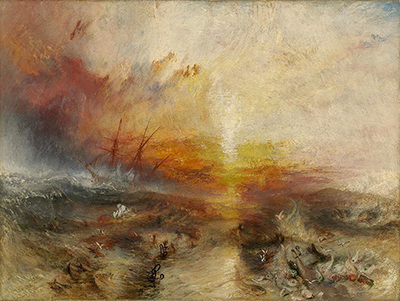
The museum already owned Slave Ship, a late Turner whose violent colour and abolitionist subject had entered Boston through John Taylor Johnston and Alice Sturgis Hooper. The 1913 acquisition was framed as an early counterpart that could balance the late painting.[16]
That institutional logic is historically revealing but should not become a rigid interpretation. Schaffhausen and Slave Ship share water, human vulnerability and radical handling, yet their ethical and narrative stakes differ profoundly. One concerns transport, tourism and sublime force at a European waterfall; the other confronts murder within the Atlantic slave trade.
Together they did allow Boston audiences to see that Turner's experiment did not begin suddenly in the 1840s. The palette-knife cataract of about 1805-06 already makes material paint carry violence, while minute human activity complicates the spectacle.[1]
Modern exhibition has continued to recover the painting's relation to social history. In Turner's Modern World, the MFA placed the canvas near the beginning of an account concerned with war, industry, labour and technological change.[2][25] The mother protecting a child from carthorses helped make modern risk visible within the natural wonder.
The work is currently recorded as on view in the Beal Gallery at the Museum of Fine Arts.[1] Its public setting enables the alternating distances the picture demands: far enough to receive the cascade, close enough to discover baskets, faces, harness and the pale rainbow.
Its legacy lies in that refusal of a single distance. From afar, nature appears to dominate. Up close, labour, family and transport claim attention. At the surface, paint becomes ridge, scrape, touch and film; across the room, those marks become water of extraordinary momentum.
Fall of the Rhine at Schaffhausen is therefore more than an early demonstration of Turner's sublime. It is a painting about how force enters modern life. The cataract interrupts commerce, creates work, attracts travellers, threatens orientation and demands new pictorial means. Rocks resist it, people adapt to it, light colours its spray, and oil paint assumes its weight. Turner gives the famous fall grandeur because he understands not only how it looks, but what happens around it.
Discussion
How does Turner make the Rhine Falls both a sublime natural force and a place of organised transport labour?
Reader Insights
How do the rocks, loaded paint and low viewpoint make the cataract feel physically unstable?
What do the cart, cargo, horses and figures reveal about the falls as a transfer point?
How does the crowded foreground alter the experience of Turner's immense horizontal canvas?
Join the Conversation
Share a close observation or a source-based question for other readers.
References
- Museum of Fine Arts, Boston, “Fall of the Rhine at Schaffhausen,” 13.2723, https://collections.mfa.org/objects/31489/fall-of-the-rhine-at-schaffhausen
- Museum of Fine Arts, Boston, “Turner's Modern World” press release, https://www.mfa.org/press-release/turners-modern-world
- Wikimedia Commons, public-domain MFA image, https://commons.wikimedia.org/wiki/File:Joseph_Mallord_William_Turner_-_Fall_of_the_Rhine_at_Schaffhausen_-_13.2723_-_Museum_of_Fine_Arts.jpg
- Marjorie Munsterberg, “J. M. W. Turner's ‘Falls at Schaffhausen,’” *Record of the Art Museum, Princeton University* 44.2, 1985, https://writingaboutart.org/assets/1985TurnerSchaffPrinceton.pdf
- Swiss National Museum, “Capturing water on canvas,” 2025, https://blog.nationalmuseum.ch/en/2025/04/capturing-water-on-canvas/
- Schaffhauserland/Ostschweiz, regional history, https://ostschweiz.ch/en/region/schaffhauserland.html
- Switzerland Tourism, “The Rhine Falls,” https://www.myswitzerland.com/en-us/experiences/the-rhine-falls/
- National Galleries of Scotland, “The Falls of the Rhine at Schaffhausen (Front View),” D NG 867, https://www.nationalgalleries.org/art-and-artists/19223
- National Galleries of Scotland, “The Falls of the Rhine at Schaffhausen (Side View),” D NG 868, https://www.nationalgalleries.org/art-and-artists/19224
- Princeton University Art Museum, “The Falls of the Rhine at Schaffhausen,” x1982-48, circa 1841, https://artmuseum.princeton.edu/art/collections/objects/15009
- Sotheby's, Turner, “The Falls of the Rhine at Schaffhausen,” 1841, https://www.sothebys.com/buy/d892dde4-fde4-4c80-9db5-56fd0bf88e39/lots/09fee159-3330-4ea1-882a-d02987c8fd06
- University of Manchester, “Falls of the Rhine,” Rawlinson 329, https://jmwturnersprints.manchester.ac.uk/original-publications/46_i_xliic_keepsake/r329-falls-of-the-rhine/state-ii-cvh0422/
- Victoria and Albert Museum, Philippe Jacques de Loutherbourg, “The Falls of the Rhine at Schaffhausen,” O81406, https://collections.vam.ac.uk/item/O81406/the-falls-of-the-rhine-oil-painting-loutherbourg-philip-james/
- John Young, *A Descriptive Catalogue of a Collection of Paintings by British Artists in the Possession of Sir John Fleming Leicester*, 1821, https://upload.wikimedia.org/wikipedia/commons/5/5f/A_descriptive_catalogue_of_a_collection_of_paintings_by_British_artists_in_the_possession_of_Sir_John_Fleming_Leicester%2C_Bart._%28IA_descriptivecatal00care%29.pdf
- *A Handbook to the Gallery of British Paintings in the Art Treasures Exhibition*, Manchester, 1857, https://upload.wikimedia.org/wikipedia/commons/e/e7/A_handbook_to_the_gallery_of_British_paintings_in_the_Art_Treasures_Exhibition_-_being_a_reprint_of_critical_notices_originally_published_in_The_Manchester_Guardian_%28IA_handbooktogaller00unse%29.pdf
- Marjorie L. Harth, “Henry Clay Frick and the Museum of Fine Arts, Boston: the blockbuster exhibition of 1910,” *Journal of the History of Collections* 33.2, 2021, https://academic.oup.com/jhc/article/33/2/341/6123562
- Tabley House, “Turner250” and the Leicester-Turner relationship, https://www.tableyhouse.co.uk/?page_id=2409
- Historic England, “Tabley House, Tabley Inferior,” 1000645, https://historicengland.org.uk/listing/the-list/list-entry/1000645
- National Trust Collections, Turner, “Tabley, Cheshire: Calm Morning,” 486619, https://www.nationaltrustcollections.org.uk/object/486619
- Royal Academy Chronicle, “1806: The Indifference of Sculptors,” https://chronicle250.com/1806
- C. F. Bell, *A List of the Works Contributed to Public Exhibitions by J. M. W. Turner*, catalogue record reproduced in *J. M. W. Turner*, https://www.scribd.com/document/771025502/jmwturner
- Sotheby's, Turner, “The Falls of the Rhine at Schaffhausen,” lot 183, 2008, https://www.sothebys.com/en/auctions/ecatalogue/2008/early-british-drawings-watercolours-and-portrait-miniatures-l08171/lot.183.html
- National Gallery, “Calais Pier,” NG472, https://www.nationalgallery.org.uk/paintings/joseph-mallord-william-turner-calais-pier
- Project Gutenberg, John Ruskin, *Modern Painters*, volume V, https://www.gutenberg.org/files/44329/44329-h/44329-h.htm
- Museum of Fine Arts, Boston, “Turner's Modern World,” exhibition, https://www.mfa.org/exhibition/turners-modern-world