by Tom Gurney
Tom Gurney BSc (Hons) is an art history expert with over 20 years experience
Published on June 19, 2020 / Updated on October 13, 2026
Email: tomgurney1@gmail.com / Phone: +44 7429 011000
Italy as an Artistic Test
Italy gave Turner more than scenery. It gave him an arena in which landscape, antiquity, Old Master precedent, travel and light could be tested against one another. Rome, Venice, Naples and the Italian countryside entered his work through sketchbooks, oils, watercolours and historical imagination. The National Gallery presents Turner as an artist shaped by Claude and the Italianate tradition as well as by Dutch marine painting and British topography.[1] Italy therefore belongs near the centre of his ambition, not at the edge of his travel record.
Turner first travelled to the Continent in 1802, but his major Italian engagement deepened later. He first visited Rome in 1819 and returned in 1828.[8] By then he was already a Royal Academician with a public reputation. Italy did not train him from scratch; it pressed an established painter to rethink scale, memory, colour and art-historical competition.
At a Glance
- Career roleA long artistic test, not one picturesque destination
- Major Italian engagement1819 and later journeys in the 1820s
- RomeAntiquity, empire, Claude and historical landscape
- VeniceWater, reflection, architecture and late colour
- Southern ItalyNaples, Vesuvius and volcanic energy
- MediaSketchbooks, watercolours and oil paintings
- Working methodObservation, memory and studio recombination
- Old Master pressureClaude, Titian, Canaletto and European tradition
- Object distinctionRome and Venice remain separate visual problems
- Topography boundaryNot every Italian subject is a first-hand view
Contents
- Italy as an Artistic Test
- Rome and the Weight of History
- Claude, Competition and Landscape Status
- Rome in the Studio
- Naples, Vesuvius and Volcanic Energy
- Venice and the Italian Light of Water
- Italy and the Late Turner
- Why Italy Matters
- The Louvre Before Rome
- Rome as Theatre of Empire
Rome and the Weight of History
Rome mattered because it held the visible remains of empire and the prestige of classical landscape. For Turner, Roman subject matter could be archaeological, poetic and political at once. Ruins, bridges, distant domes, river bends and ancient associations gave him material for both direct studies and large historical compositions. Tate's works-on-paper research is vital for this territory because the sketchbooks preserve many views, fragments and exploratory records that sit behind later works.[2]
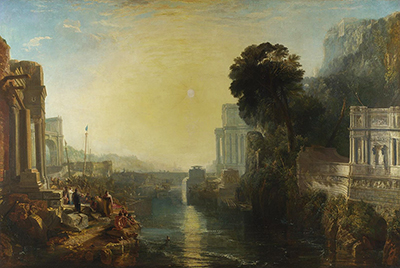
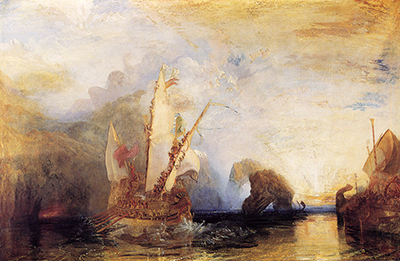
Rome also sharpened Turner's dialogue with Claude. Claude's ideal landscapes had long linked architecture, light and classical story. Turner admired that tradition, but he did not simply repeat it. In works such as Dido Building Carthage and Ulysses Deriding Polyphemus, classical subjects become vehicles for brilliant light, theatrical space and the fragility of human ambition. Dido Building Carthage, painted in 1815, predates his first visit to Rome: these ambitions were already developing through art and literature before firsthand experience of the city.[5][8]
Claude, Competition and Landscape Status
Turner's attachment to Claude is clearest in the Turner Bequest condition that placed Dido Building Carthage and Sun Rising through Vapour beside two Claude paintings at the National Gallery.[3] That condition shows how seriously Turner wanted his own art measured against the European landscape canon. Italy and Rome supplied the historical language for this claim: temples, harbours, myth, empire and radiant distance.
Yet Turner did not accept Claude as a limit. His colour, weather and handling frequently disturb classical order. The sun may ennoble a scene, but it may also dazzle, dissolve or threaten it. His Italian subjects are often about inheritance under pressure: the painter looks back to Old Masters while pushing landscape toward sensations and histories they did not contain.
Rome in the Studio
Turner's Roman material was not confined to views made on the spot. Sketches could be reused, recombined and elevated into compositions that are only partly topographical. His Italian works range from records of place to meditations on history, poetry, light or artistic rivalry; they do not all function as travel documents.
The studio allowed Rome to become layered. A river view could become a recollection of antiquity; an architectural note could become a stage for myth; a remembered sunset could become a statement about painting itself. Turner valued observation, but he also valued transformation. His Italian art repeatedly moves from looking to imagining.
Naples, Vesuvius and Volcanic Energy
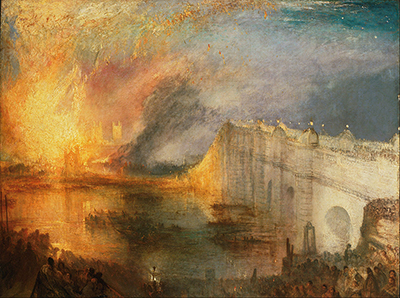
Italian subjects also gave Turner fire, eruption and geologic drama. Vesuvius belongs to a wider fascination with natural force, from Alpine storms to shipwrecks and burning buildings. In Italian contexts, volcanic imagery could join travel spectacle with ancient catastrophe and modern tourism. It extended the range of landscape beyond calm view or classical order.
Turner's Italian subjects extend beyond Roman ruins and Venetian light. Italy gave him multiple energies: archaeology, sea travel, commerce, pilgrimage, volcanic danger and urban brightness. He absorbed all of them into a broad visual language.
Venice and the Italian Light of Water
Venice offered a distinct setting within Turner's Italian work: architecture suspended in reflection, colour broken by water and a city already saturated with artistic precedent. Turner visited Venice and made it one of his most fertile late subjects. The National Gallery of Art, Washington, holds Venice: The Dogana and San Giorgio Maggiore and Approach to Venice. Its object records place these canvases within his mature exploration of the city's light, air and waterways.[4][6][7]
Venice differs from Rome because its history appears through water and atmosphere rather than monumental ruin alone. Buildings shimmer, boats slide across light, and distance often feels unstable. Turner did not erase Venetian architecture; he made it answerable to reflection and air.
Italy and the Late Turner
Italy helped later viewers construct the Turner of light and colour. The brilliance of the Italian and Venetian works also rests on decades of drawing, exhibition painting and technical experiment. Tate's Turner holdings, especially the works on paper, reveal the persistence of preparatory labour behind even the freest effects.[2]
The later Italian subjects can feel almost immaterial, with relationships between colour, highlight and edge sustaining their structure. Watercolour can draw brilliance from transparent washes and reserved paper; oil painting gives Turner different means of layering light and colour. The subject may appear to dissolve, yet the image often remains anchored by architecture, horizon, boat, sun or reflected path.
Why Italy Matters
Turner's Italy is a career-long problem of inheritance. It asked him how a modern British painter could face antiquity, Claude, Renaissance colour, tourism and contemporary exhibition culture without becoming derivative. His answer was not one style. It was a range of responses: classical ambition, luminous watercolour, theatrical oil painting, volcanic drama, Venetian shimmer and Roman memory.
Italy mattered because it allowed Turner to make landscape historical without making it static. In his hands, Rome and Venice are never just old places. They are tests of what painting can remember, rival and transform.
The Louvre Before Rome
Turner's Italian ambitions were prepared before he reached Italy. The 1802 Continental journey gave him access to European collections at a moment when Paris held extraordinary concentrations of art. Encounter with Old Master painting sharpened the question that Italy would later intensify: how could a modern British landscape painter position himself within a European tradition that seemed already occupied by Claude, Poussin, Titian, Canaletto and others?
Rome was not merely a destination on a map. It was an idea formed through paintings, prints, classical texts, guidebooks and Academy culture. By the time Turner saw Italy directly, he already carried an imagined Italy shaped by art history. Direct travel therefore did not replace inherited images; it collided with them. Much of the force of Turner's Italian work comes from that collision between study, expectation and observed light.
This helps explain why some Italian subjects feel both precise and dreamlike. Turner often looked closely, but he was also measuring what he saw against centuries of pictorial authority. A ruin was not just a ruin. It was evidence, motif, memory and challenge.
Rome as Theatre of Empire
Rome gave Turner a landscape of political memory. Arches, temples, bridges and broken masonry allowed him to picture rise and decline without relying solely on human action. In classical and Roman subjects, architecture often becomes a language of power. It tells viewers that history has weight, but also that weight can crumble.
The Carthaginian works belong to this wider Roman and imperial imagination even when their geography is North African rather than Roman. The National Gallery's record for Dido Building Carthage stresses Turner's long engagement with Carthaginian history, empire and historical rise and collapse.[5] Italy helped supply the visual grammar for such meditation: luminous harbours, classical buildings, processions, water and distance.
Turner's empire subjects are rarely simple celebrations. Light can glorify, but it can also expose. Vast architecture may appear grand and vulnerable at the same time. The viewer is invited to admire human construction while sensing the historical forces that will outlast it.
The Campagna and the Edges of Rome
The Roman Campagna gave Turner another kind of subject: open land structured by ruins, roads, aqueducts, distant hills and atmospheric breadth. Such scenery suited his ability to make space feel historical even when no dramatic narrative is shown. A road through the Campagna can suggest travel, antiquity and time without requiring a central event.
This territory also connected Turner with older traditions of the Grand Tour. British artists and patrons had long treated Rome and its surroundings as a place where classical learning and landscape met. Turner entered that tradition late and competitively. His work recognises its prestige but rarely becomes obedient to it. He introduces stronger light, more volatile weather and a more restless sense of pictorial energy.
The Campagna also allowed him to make emptiness meaningful. A broad field, a distant ruin and a changing sky could carry as much historical feeling as a crowded narrative.
Naples, Vesuvius and the Southern Imagination
Southern Italy expanded the emotional range of Italian travel. Vesuvius and the Bay of Naples gave Turner a landscape where beauty, tourism and danger were inseparable. Volcanic imagery joined scientific curiosity, ancient memory and theatrical spectacle. In Turner's hands, eruption belongs to the same larger family as storm, fire and shipwreck: events in which natural force overwhelms human scale.
Naples and Vesuvius also show that Turner's Italy was not only classical balance. It included heat, instability, smoke and disaster. The Italian south let him stage landscape as energy, not simply as inheritance. That energy would matter for later viewers who saw Turner as a painter of elemental effects, but its roots remain historical and geographical.
Venice as a Late Laboratory
Venice was the Italian subject that most fully answered Turner's late interests. The city gave him stone, water, reflection, mist, ceremonial history and commercial traffic all at once. It also came with a powerful visual tradition: Canaletto, Guardi and generations of vedute had made Venice familiar to British collectors. Turner had to find a way through that familiarity.
His solution was not to deny architecture. It was to make architecture porous to light. Domes, palaces and quays remain recognisable, but their edges are softened by reflection and atmosphere. Boats become touches of movement. Distance becomes colour. The city becomes an event of perception.
Venice also allowed Turner to join travel and memory. Some late works feel less like on-the-spot records than meditations on a city already absorbed. Recollection can reshape a view rather than reproduce its topography exactly. These works belong to a practice in which observation and memory continually exchange roles.
Italy, Literature and Exhibition Titles
Italian and classical subjects gave Turner rich opportunities for literary framing. Virgil, Homer, Roman history and modern poetry all entered his titles and exhibition culture. These references gave viewers entry points into the works. A title may identify a subject without explaining every pictorial decision.
Turner often used literary material to enlarge the atmosphere of a work. The quotation or title might point toward destiny, empire, exile or loss, while the picture itself develops those ideas through light and space. In Italian subjects, words and images often operate together but not identically. The painting does not merely illustrate the title; it thinks through it.
Why Rome and Italy Remain Central
Italy and Rome remain central because they reveal Turner's most ambitious self-conception. He was a British painter, but he wanted to stand inside European art history. He was a landscape painter, but he wanted landscape to carry history, poetry, empire and rivalry. He was a traveller, but he did not confuse travel with simple transcription.
The Italian works show Turner negotiating all these identities. They make his art broader than national school, broader than topography and broader than the familiar phrase "painter of light." Italy gave Turner history under light; Rome gave him ruins under time; Venice gave him architecture under reflection. Together they show how he transformed travel into one of the great imaginative structures of nineteenth-century painting.
Italian Colour and British Watercolour
Italy also mattered because it tested Turner's colour. Strong light, old stone, reflected water, heat and distance all demanded decisions about hue and tone. In watercolour, Turner could use transparency and reserve to create brilliance without heavy description. In oil, Italian subjects allowed stronger chromatic drama and more expansive handling.
This colour was not simply a response to southern brightness. It was mediated through British watercolour practice, Academy exhibition, Old Master study and the market for travel images. Turner brought his own techniques to Italy; Italy then stretched them. The result was not an Italian style pasted onto a British painter, but a transformed Turnerian language.
Venice is the clearest case, but Rome and Naples also mattered. Stone, smoke, sunset and water each offered different colour problems. Turner used those problems to make Italian subject matter feel historical and sensory at once.
Italy and the Question of Authenticity
Italian works combine different kinds of experience. Some images derive from firsthand observation; others depend on memory, earlier sketches, printed sources, studio invention or art-historical models. These sources can coexist within a composition. For Turner, Italy was always both seen and mediated.
The same was true for many artists before him. Rome and Venice had long been imagined through paintings, prints and travel writing. Turner's achievement was to make that mediated condition productive. He could let a place appear as a physical location and as a memory of art history simultaneously.
This is why asking whether an Italian Turner is a "view" can be too narrow. Some are views; some are historical landscapes; some are poetic reconstructions; some are atmospheric meditations anchored by identifiable architecture. Italy gave him permission to move between these modes.
Rome After the Visit
Rome continued to work in Turner's imagination after he left it. The city supplied motifs and associations that could be reactivated in later compositions. A sketchbook record might become one layer among several; a remembered light effect might change the mood of a subject; a classical building type might enter a composition not as exact transcription but as historical sign.
This delayed use is important because Turner often painted through accumulation. A subject did not end with the journey. It entered a long store of visual material, and the studio determined its later fate. Rome's afterlife in Turner is therefore as important as his immediate response to Rome.
The same principle applies to Venice and the Italian south. Turner returned to subjects because they remained active in memory. Italian travel was not an episode. It became a reservoir.
Italy and Turner's Viewers
British viewers brought their own expectations to Italian subjects. They knew Italy through Grand Tour culture, literature, collecting and engravings. A Turner painting of Rome or Venice therefore met an audience already prepared to see Italy as art-historical territory. Turner could use that preparation and disturb it.
In Rome, he could give viewers classical grandeur while introducing atmospheric uncertainty. In Venice, he could give recognisable architecture while making it shimmer and dissolve. In volcanic subjects, he could give spectacle while invoking danger and historical catastrophe. Italian art in Turner often works by satisfying and unsettling expectation at once.
This public dimension matters because Italian subjects were part of Turner's reputation. They showed that he could take on the central territories of European art and make them his own.
The Moral Weather of Italy
Turner's Italian light often carries moral pressure. It can make a city glorious, but it can also imply fragility. It can illuminate empire and show its transience. It can make Venice radiant while hinting at decay. Light in Italian Turner is rarely innocent.
That moral pressure connects Italy to Turner's wider historical imagination. Whether he is painting Carthage, Rome, Venice or Vesuvius, he repeatedly asks how splendour survives under time. The answer is not stable. In Turner, splendour often appears at the moment it begins to dissolve.
This is why Italy gave him more than subject matter. It gave him a way to paint history as atmosphere.
Italy and the Bequest
The Turner Bequest gives Italian Turner unusual depth because it preserves not only famous oils and watercolours, but also the working material around them. Sketchbooks, colour notes and unfinished studies help show how Italian subjects moved between observation and later invention. Tate's works-on-paper research is therefore central to understanding this part of the career.[2]
The bequest also reveals how Italian memories could coexist with other geographies. A late Venetian colour study belongs to the same archive as Alpine notes, British topography and studio pictures. Turner did not seal Italy off as a separate world. He brought it into a much larger store of visual problems.
The bequest gives material evidence behind the shimmer. Its surviving drawings and studies connect the light over Venice or Rome with the work of looking, storing, reworking and testing, alongside Turner's poetic imagination.
Italy as Rivalry, Not Escape
Italy did not allow Turner to escape British art; it allowed him to challenge it. By engaging Rome, Claude and Venice, he placed British landscape in direct relation to European traditions. His Italian works say that a painter formed in London and the Royal Academy could contend with the highest inherited models of landscape and history.
This rivalry is more important than picturesque pleasure. Turner certainly found Italy visually rich, but he also found it competitive. Every Roman ruin, Venetian canal and Claudean harbour came loaded with prior art. Turner's task was to make those subjects new without denying their history. His success lies in that difficult balance.
That balance is why Italian Turner can feel both learned and immediate. The pictures know too much art history to be simple travel views, yet they remain alive to heat, water, stone, distance and changing light.
Italy gave Turner a theatre in which looking, rivalry and memory could all operate at once.
That theatre never stopped changing.
It gave old subjects new weather.
Discussion
How does Turner make Italy both a physical place and a field of artistic rivalry, memory and transformation?
Reader Insights
How do antiquity and imperial memory change the meaning of landscape?
How does reflected light make architecture porous without erasing it?
Where do observation, earlier art and later studio invention meet?
Join the Conversation
Share a close observation or a source-based question for other readers.
References
- National Gallery, Joseph Mallord William Turner artist record, https://www.nationalgallery.org.uk/artists/joseph-mallord-william-turner
- Tate Research Publication, J.M.W. Turner: Sketchbooks, Drawings and Watercolours, https://www.tate.org.uk/art/research-publications/jmw-turner
- National Gallery, "The Turner Bequest," https://www.nationalgallery.org.uk/about-us/history/the-turner-bequest
- National Gallery of Art, Washington, Turner Venetian object records, https://www.nga.gov/collection/artist-info.1939.html
- National Gallery, Dido building Carthage, https://www.nationalgallery.org.uk/paintings/joseph-mallord-william-turner-dido-building-carthage
- National Gallery of Art, Washington, Venice: The Dogana and San Giorgio Maggiore, 1834, accession 1942.9.85, https://www.nga.gov/artworks/1224-venice-dogana-and-san-giorgio-maggiore
- National Gallery of Art, Washington, Approach to Venice, 1844, accession 1937.1.110, https://www.nga.gov/artworks/117-approach-venice
- National Galleries of Scotland, Turner & Italy, 2009 exhibition history and sections on Rome and Venice, https://www.nationalgalleries.org/exhibition/turner-italy