 by Tom Gurney
Tom Gurney BSc (Hons) is an art history expert with over 20 years experience
Published on June 19, 2020 / Updated on August 29, 2026
Email: tomgurney1@gmail.com / Phone: +44 7429 011000
A Vessel Held While Everything Else Moves
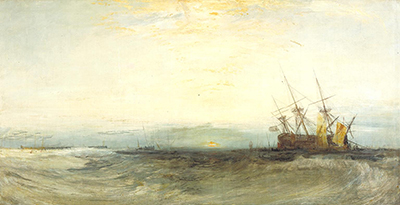
The first surprise in J. M. W. Turner's A Ship Aground, Yarmouth; Sample Study is how little of the painting the ship actually occupies. The canvas is nearly twice as broad as it is high, yet the stranded vessel is pressed into the right third. Above it opens an immense pale sky. Below it, long grey-green ridges of water continue across almost the entire width. A small sun touches the horizon well to the left of the hull. The sea, the light and the distant traffic all seem able to keep moving. Only the largest object has been stopped.
That opposition gives the picture its peculiar force. Turner does not stage a spectacular instant of impact. There is no broken mast plunging into the surf, no named hero, no unmistakable rescue and no visible enemy. The hull remains coherent, its masts and yards still rise, and scraps of warm sail hang among the rigging. Small craft gather nearby, but their work is not explained. The title supplies the decisive fact: the ship is aground. It has met the bottom and can no longer pass freely through the water around it.
The full current title matters. This is not simply Ship Aground, still less a generic shipwreck. Tate catalogues it as A Ship Aground, Yarmouth; Sample Study, dates it to about 1827-28 and records it as oil paint on canvas. At 69.8 by 135.9 centimetres, it is a large, deliberately organised painting rather than a pocket notation. It entered the national collection with the Turner Bequest in 1856 and now carries the accession number N02065.[1] An independent National Gallery of Art checklist confirms the title, measurements and substantial frame.[2]
“Yarmouth” locates Turner's marine invention within years of sustained observation on the Norfolk coast. “Sample Study” points toward a different history: the broad oil has long been associated with the group of possibilities surrounding Turner's commission for the 3rd Earl of Egremont at Petworth. It was not one of the four landscapes installed there, but its format and development place it close to that enterprise. The same pictorial idea remained useful. A few years later Turner transformed a grounded warship against a low sun into the historical drama of Fort Vimieux. What looks at first like an incomplete narrative is therefore better understood as a remarkably fertile one.
Essential Details
Object, Collection and Function
- ArtistJoseph Mallord William Turner
- Current titleA Ship Aground, Yarmouth; Sample Study
- Datecirca 1827-28
- Mediumoil paint on canvas
- Support698 x 1359 mm, or 69.8 x 135.9 cm
- Frame1003 x 1666 x 128 mm, or 100.3 x 166.6 x 12.8 cm
- CollectionTate, accession N02065
- Creditaccepted by the nation as part of the Turner Bequest 1856
- Subject termsTate includes sailing craft, warship, shipwreck, coast, sandbank, sea, wave, sunset and pier among its catalogue categories.[1]
Contents
- A Vessel Held While Everything Else Moves
- The Architecture of an Unequal View
- Sky, Sun and the Refusal of Spectacle
- Hull, Rigging and the Ship as a Dark Machine
- The Sea That Will Not Stop
- Aground Is Not the Same as Destroyed
- Turner at Yarmouth Before the Oil
- Great Yarmouth, Sandbanks and the Roadstead
- A Coast Learning How to Rescue
- What “Sample Study” Means
The punctuation in the title separates two kinds of information. Before the semicolon comes the represented subject and its modern location: a vessel held at Yarmouth. After it comes a functional description: sample study. There is no secure evidence that Turner inscribed this full wording on the canvas. It is a catalogued identity that brings together what the image depicts and how scholars have understood its place among his work.
The word “study” can mislead when it suggests something small, hurried or merely preliminary. This canvas has almost the width of the four horizontal oils eventually set into the Carved Room at Petworth. Its composition has been considered across a large surface: the horizon is held low, the ship is deliberately displaced, the sun is separated from it, and small upright accents carry the eye through the empty distance. The picture may preserve alternatives and visible openness, but those qualities do not make it accidental.
The old National Gallery number, 2065, survives in early discussions of the work. Modern records use Tate N02065. Another historical trap concerns size. A measurement of roughly 65 by 141 centimetres sometimes appears near this group, but the 2007 exhibition checklist assigns that format to the adjacent The Lake, Petworth, Sunset; Sample Study. For A Ship Aground it gives 69.8 by 135.9 centimetres, matching Tate's present data.[2] The distinction matters because the dimensions are part of the evidence connecting, but not conflating, the Petworth candidates.
Colour reproductions also vary. One image makes the ship's rigging and orange canvas unusually prominent; another gives the sea and enormous yellow-white sky greater weight.[3] Such differences advise caution about exact hue and condition. They do not disturb the stable compositional facts: a dark grounded hull at right, a very low sun nearer the middle, a pale atmospheric field, a populated horizon and a broad foreground of moving water.
The Architecture of an Unequal View
Turner builds the painting from an imbalance. The largest object is not the compositional centre, and the brightest light does not fall directly behind it. The vessel occupies a compressed zone at the right, where hull, masts, spars, rigging and hanging canvas form an intricate knot. The left two-thirds remain comparatively open. There, slight tonal bands and tiny interruptions make distance feel extensive without filling it with descriptive incident.
The long horizon is essential. It runs behind the ship and outward beneath the pale sky, but it never becomes a rigid ruler. Faint vessels, dark strokes, a low structure and the tiny warm sun repeatedly interrupt it. Those marks establish scale: the principal ship is large enough to dominate the local cluster, yet small enough to be absorbed into a wider maritime environment. Turner's subject is therefore not only a stranded object. It is the changed relation between a vessel and the expanse through which it ought to travel.
The ship's placement also changes the way a viewer approaches it. Reading from left to right, the eye crosses open light and uncertain distant traffic before reaching the concentration of rigging. Reading outward from the vessel, it escapes into the quiet reach toward the sun. Neither direction produces a neat climax. The picture continually alternates between incident and atmosphere, detail and breadth, weight and vacancy.
That structure would have suited an architectural setting. A low horizontal painting does not need to behave like a conventional upright history scene. It can extend laterally beneath portraits and within carved woodwork, opening a fictive distance across a wall. Scholarship on the Petworth commission notes that the final landscapes were positioned below family portraits and close to the height of seated viewers, so they had to sustain inspection at short range.[11] In A Ship Aground, the broad division is legible from a distance, while the rigging, small boats and fine horizon reward approach.
The format does more than accommodate the scene. It determines the scene's meaning. If the canvas were cropped around the ship, the result would be an emphatic portrait of maritime distress. With the full width preserved, the ship's condition seems local within a much larger continuity. Light spreads beyond it. Water runs past it. Other craft remain upright. Turner makes immobility visible not by freezing the whole image, but by surrounding one arrested mass with systems that carry on.
The far-left projection, perhaps coastal or pier-like, helps close the breadth without balancing the ship symmetrically. It stays low, nearly absorbed into the horizon. The entire left side resists a second dominant object. Emptiness is not unused space here; it is the measure of the freedom the vessel has lost.
Sky, Sun and the Refusal of Spectacle
Sky takes roughly two-thirds of the painted field. Its scale might promise a grand sunset, yet Turner avoids the obvious effects of a theatrical marine evening. The sun is extremely small, close to the horizon and detached from the ship. It does not send a wide golden road toward the foreground. Instead it appears as a concentrated orange-yellow touch within cool and muted bands, a modest source surrounded by an extraordinary quantity of light.
Above it, pale cream, yellow-white, grey and faint warm notes merge without a hard cloud architecture. The upper sky is not empty, but its changes are gradual. Broken marks and slight warmer passages become more noticeable only after sustained looking. The luminous breadth has the effect of enlarging the distance between observer, sun and vessel. It also makes the ship's masts seem more fragile: dark lines cross a field that can almost swallow them.
The low sun introduces time without fixing a precise hour. Tate's subject vocabulary supports “sunset,” but the image does not provide a dated meteorological record.[1] The picture can be described as evening light without claiming that Turner witnessed this exact grounding at this exact moment. His Yarmouth drawings include sunrise studies as well as coast and shipping, evidence that he observed how low light changed maritime visibility.[1] The finished oil brings those interests into a designed conjunction.
Turner also refuses a simple symbolic spotlight. The sun does not rescue the vessel from darkness or crown it as a heroic centre. Its separation may even sharpen the pathos: light remains available everywhere, but illumination cannot restore flotation. The hull is still dense and low. The warm hanging canvas catches some of the surrounding colour, yet the ship does not dissolve entirely into radiance.
Early critic C. Lewis Hind responded to the sunset more violently, describing an angry sun and a helpless vessel amid groundswell.[21] His language is useful because it records how the painting struck an informed viewer in the early twentieth century. It is not a weather report. Modern reproductions can make the sky look tender, bleached, sulphurous or overcast according to photography and display. The stable achievement lies in contrast: an almost weightless expanse presses against a dark machine whose physical mass has suddenly become a liability.
The sky's restraint helps preserve uncertainty. A storm would explain the grounding too quickly. A blazing sunset might turn the event into sublime catastrophe. Here atmosphere is neither benign nor clearly destructive. The small sun, broad light and low misty bands establish a world in which visibility is possible but knowledge remains incomplete. We can see that the ship is held. Turner does not tell us why, how long it has been there or what will happen after the light disappears.
Hull, Rigging and the Ship as a Dark Machine
Against the sky, the vessel is both highly complicated and difficult to read. The hull forms a broad black-brown block close to the waterline. Above it rises a web of masts, yards and cordage. Some lines remain firm; others fade as they cross the luminous atmosphere. The eye recognises the organisation of a large sailing ship, but cannot convert every stroke into dependable nautical inventory.
That partial legibility matters. Turner gives enough structure for the vessel to feel engineered, heavy and worked by many hands. The long yards project sideways, masts divide the pale field, and taut or drooping lines connect them. Yet the grounded state has disturbed the ordinary clarity of propulsion. Sails are not spread to translate wind into forward movement. Warm yellow and orange areas hang low around the right half, slack and irregular, while other spars cut across them.
The ship is frequently called a warship in catalogue vocabulary, and the substantial hull and rig support that broad classification.[1] No locked evidence supplies a name, rate, navy or armament. It would be false precision to count guns from the reproduction or assign the vessel to a documented Yarmouth loss. Turner may have used the authority of a man-of-war type precisely because its grounding reverses expectations. A structure built to carry power across water has become the least mobile thing in the scene.
The darkness of the hull gives it visual gravity. Sea bands pass in front and behind, but the ship's lower edge remains a compressed zone where water, shore or sandbank and timber are hard to separate. This uncertainty creates the sense of contact. The vessel does not ride cleanly above a reflecting surface. It seems embedded in the narrow dark register that runs along the horizon.
Small craft complicate the silhouette. One faint form stands left of the hull; others cluster to the right or near its side. They reduce the enormous ship to a problem that human-scale boats can approach but perhaps not immediately solve. The image does not show clearly whether people are unloading, towing, inspecting, waiting for tide or attempting rescue. That refusal to specify labour keeps the surrounding activity plausible without converting it into anecdote.
Turner's treatment of rigging also creates a second kind of motion. The ship itself is arrested, but the eye repeatedly travels along oblique lines: up masts, across yards, down ropes, through hanging canvas and back toward the water. Mechanical structure becomes a restless drawing suspended in light. Even before any later transformation into a battle subject, the vessel contains latent drama. It is a dense network under strain, held in a place where its entire design was meant to prevent it from remaining.
The Sea That Will Not Stop
The foreground is the painting's most persistent moving element. Broad bands cross the canvas in grey-green, brownish grey, cream and dull white. Their direction is more lateral than plunging. They do not form a single monumental breaker; instead, one ridge follows another, making the lower field feel continuously unsettled.
Turner's marks vary in width and pressure. Some strokes create long shallow sweeps; others catch the tops of waves with lighter paint. Darker passages sink between them. The pattern is neither a polished mirror nor a fully mapped surf zone. It is enough to make the surface resistant, mobile and difficult to cross. Because the canvas is so wide, these rhythms continue well beyond the ship. Water becomes a system, not a decorative base.
Hind called the movement a groundswell, a term that captures the sensation of power arriving from beyond the immediate scene.[21] It should remain a historical reading rather than a precise oceanographic diagnosis. The important visual fact is that the nearest water has energy while the ship lacks progress. Turner turns the difference between motion and displacement into the core of the image. Waves can move without carrying the stranded hull with them.
The sea also blocks easy access. A viewer stands imaginatively offshore or at water level rather than safely on a beach beside the ship. The foreground bands intervene between us and the vessel, while the broad leftward space offers no simple path. Small craft can enter that zone, but their scale emphasises the labour required. Distance in the painting is therefore physical as well as optical.
The low sun does not organise the water into a single reflection. A small warm fleck near the horizon is quickly absorbed by cooler bands. This denies the eye a direct luminous path into depth. Instead it must follow irregular changes of tone and scattered verticals. The sea feels shallow enough to hold a great vessel and deep or active enough to keep assistance uncertain.
Great Yarmouth's nearshore geography makes such tension intelligible. Historic geological evidence describes Yarmouth Roads as an area where shifting sandbanks constrained navigation channels.[18] Tate includes sandbank among the painting's subjects.[1] Those records justify a general environmental context, but not an exact identification of the bank beneath the hull. Turner does not supply a chart. He converts the navigational fact of shallow obstruction into a visual paradox: open water stretches across the picture, yet the largest ship cannot use it.
Aground Is Not the Same as Destroyed
The distinction between a grounding and a wreck is easy to lose because maritime images often invite catastrophe. A grounded ship has touched bottom or shore and ceased to float freely. It may be refloated, damaged, broken up or ultimately lost, but none of those outcomes is contained automatically in the word. Turner's title suspends the vessel between accident and consequence.
The visible structure supports that suspension. The hull remains recognisable as a whole. Masts are standing, yards extend, rigging links the parts and hanging canvas retains colour. No great fragment has separated. At the same time, the ship sits unnaturally low and inert. Small boats cannot make its future obvious. The image shows a dangerous state without supplying a conclusion.
Tate includes both “shipwreck” and “sandbank” in its subject classification.[1] Such indexing broadens the work's discoverability and acknowledges its culture of maritime loss. The preferred title remains more exact for description. Calling the vessel simply wrecked risks importing an ending that Turner withheld. Calling it merely anchored would erase the physical arrest on which the composition depends.
This ambiguity distinguishes the work from paintings that identify a historical calamity. There is no documented ship name, date, cargo, death toll or itinerary. The viewer cannot recognise uniforms or read distress signals with certainty. The low sun may imply diminishing time, but it does not confirm that the tide is falling. The nearby boats might represent aid, routine traffic or an attempt to lighten the vessel. Their uncertainty is part of the subject.
The state of grounding also changes the emotional register. Total destruction can be sublime because it closes ordinary possibility in one overwhelming event. Turner's ship remains within practical time. People may still act. Water level may change. Equipment may arrive. Damage may worsen. That open interval produces a quieter anxiety than a spectacular wreck. The painting asks a viewer to remain with contingency.
This is why the picture could later feed more explicit inventions. The grounded hull is a narrative structure waiting for causes and consequences. In Fort Vimieux, Turner would add historical identity and enemy fire. In the Manby rescue subject, he would add signals, apparatus and outward-moving assistance. Here he preserves the prior condition from which many stories can grow: a powerful ship has lost the ordinary relation between its body, the water and forward time.
Turner at Yarmouth Before the Oil
The Yarmouth identification is supported by more than a resemblance to generic east-coast water. Turner had built a substantial body of observation around the town and its approaches before about 1827-28. Tate records two relevant leaves from the King's Visit to Edinburgh Sketchbook in 1822. One ranges along the Suffolk and Norfolk coast through Southwold, Lowestoft and Pakefield to Great Yarmouth. The next combines Great Yarmouth and the coast near Cromer or Happisburgh with studies of low light at sunrise.[1]
Around 1824 he returned to the region in the Norfolk, Suffolk and Essex Sketchbook. Its small graphite leaves trace a dense sequence rather than one set-piece prospect. At Caister he recorded coast near Great Yarmouth. Several following studies concern scenes on the sands. Another includes sands, a pier and the Marine Tavern, while the next names Nelson's Monument. Leaves titled Scenes at Yarmouth lead into repeated views of buildings and shipping at Yarmouth. Adjacent records add river, quay, carts, a brewer's dray and more harbour traffic.[1]
This range is crucial. Turner did not know Yarmouth only as a distant skyline. He had considered the relation among shore, sand, structures, commercial movement and vessels at different scales. The sketchbook moves between landmarks and work, open coast and built edge. It supplied a vocabulary from which a large oil could be composed without reproducing one view mechanically.
No surviving public record securely singles out one leaf as the direct source for A Ship Aground. That absence should not be repaired by guesswork. Sketchbook evidence is often most revealing as a field of attention. Turner revisited similar problems: how masts break a horizon, how buildings compress near water, how low light reduces detail, how sand and sea meet, and how local traffic establishes scale.
The interval between the circa-1824 sequence and the oil also allowed transformation. A graphite notation could preserve the angle of a yard, a pier-like projection or the spacing of distant shipping without determining colour or final meaning. The large canvas joins such maritime knowledge to the demands of a wide sample composition. It is observationally grounded but pictorially synthetic.
Nicola Moorby's recent study places the Yarmouth identification within a broader reconsideration of Turner and Constable.[12] That scholarship strengthens the current title, yet the picture remains deliberately nonspecific about incident. Place and event operate at different levels of certainty. Turner knew Yarmouth as a maritime environment; we still do not know that he portrayed one recoverable grounding there.
Great Yarmouth, Sandbanks and the Roadstead
Great Yarmouth's physical setting helps explain why a grounded ship could serve as more than picturesque misfortune. The town developed along a narrow coastal strip between the North Sea and the River Yare. Fishing, shipping, quays and harbour access shaped its history, while silting and changing water routes complicated the connection between river and sea.[17]
Offshore and nearshore banks made apparently open water navigationally exacting. British Geological Survey evidence for Yarmouth Roads describes shifting sandbanks and the channels constrained by them.[18] A large sailing vessel depended on local knowledge, depth, tide and weather even within sight of a busy port. Turner's broad horizon captures the visual deceit of such a setting. Nothing in the pale expanse advertises a solid barrier, yet the hull has encountered one.
The painting does not operate as hydrographic evidence. Its bands cannot be assigned to a named bank, and the left-hand structure cannot safely be labelled as a particular pier. Tate's catalogue terms “coast,” “sandbank” and “pier” support the general setting.[1] They do not turn every form into a fixed coordinate. Turner condenses the experiential truth of the roadstead: shallow danger and commercial movement occupy the same field.
The scattered craft matter in this context. A roadstead is neither harbour interior nor empty high sea. Ships may wait, load, transfer people or goods, seek pilots and navigate channels before entering or leaving port. Smaller boats mediate between large vessels and shore. The variety of scale in Turner's image makes the main ship's immobility socially visible. It is not hidden beyond assistance, but neither is assistance effortless.
The low horizontal format resembles the experience of scanning such water. There is no single enclosing bay or headland. Information arrives as slight interruptions along a line: mast, sail, hull, low building, sun. A navigator and an artist both have reasons to attend to small differences in a seemingly continuous reach. Turner turns that attentiveness into composition.
Yarmouth also prevents the picture from becoming an abstract emblem without local substance. The town's maritime economy, sands and rescue history give real pressure to the image. Yet Turner avoids the anecdotal details that would close interpretation. The result is a double achievement: the canvas is credible as an east-coast grounding and expansive enough to speak about the more general vulnerability of engineered power to an almost invisible boundary.
A Coast Learning How to Rescue
By the time Turner painted the sample, Great Yarmouth had become closely associated with efforts to save people from stranded vessels. Captain George William Manby witnessed the loss of the gun-brig Snipe off the town in 1807. The disaster drove his development of a mortar that could fire a line from shore to a ship, allowing a stronger rope and rescue apparatus to be established. Royal Museums Greenwich records the first successful use on the brig Elizabeth at Yarmouth on 12 February 1808.[15]
Organised lifeboat provision followed. The RNLI's history of Great Yarmouth and Gorleston records a disastrous attempted rescue by shoreboat on 23 April 1824, when five men were lost. In 1825 the Norfolk Association placed the first lifeboat at Great Yarmouth.[16] Those dates sit very close to Turner's circa-1824 sketchbook work and the circa-1827-28 oil.
This background changes how the small boats around the grounded ship can be understood, but it does not identify them. There is no visible mortar line that can securely be called Manby's apparatus, no institutional record naming a lifeboat and no proven correspondence to the Snipe, Elizabeth or 1824 loss. The image's restraint must survive the historical context.
What the context does establish is that “ship aground” was not a picturesque phrase detached from practical response. Along this coast it could activate systems of warning, shore labour, specialised equipment and collective risk. The main vessel's size did not guarantee safety; smaller craft and people ashore might determine survival. Turner's scale contrast belongs to a culture in which assistance had become both urgent and technically inventive.
The painting remains poised before that machinery becomes legible. A cluster gathers, but we cannot tell whether a rescue has begun. This state distinguishes it from Turner's later Manby rescue painting. That work's 1831 title identifies equipment, signals, direction and purpose.[14] A Ship Aground gives none of those narrative instructions.
That difference is not a lack. It allows viewers to experience uncertainty similar to the uncertainty faced from shore: a vessel is in difficulty, light is changing, the sea is active, and the efficacy of response is unknown. Historical knowledge makes the stakes clearer while the painting keeps the outcome open. Turner can therefore engage Yarmouth's rescue culture without illustrating a single episode from it.
What “Sample Study” Means
The phrase “sample study” identifies the picture as a developed possibility rather than a reduced copy of an already fixed composition. Turner could test a subject, format, distribution of light and degree of finish at substantial scale. Such a canvas might demonstrate what a finished architectural commission could become while leaving room for selection, redirection or reuse.
Older Tate commentary, preserved in an account of the painting, connects A Ship Aground with initial versions made around the Earl of Egremont's Petworth commission. It notes the shared format and degree of finish and proposes that this seascape was offered as a further alternative but rejected by Turner or patron.[4] The proposal is influential, but its language is conjectural. No locked letter, receipt or diary records Egremont refusing this exact object.
Recent scholarship supplies a firmer group context. Lucy Anne Bailey's 2024 doctoral study, drawing on the principal Petworth literature, describes six sample works that were not taken further before four final paintings were decided upon.[11] This supports a process of alternatives. It does not recover the conversation in which choices were made or assign a documented reason to each unselected canvas.
The modern title handles that uncertainty well. It does not call the work “rejected Petworth decoration,” which would overstate the evidence. It identifies a function visible through scale, format and relation to the commission. The canvas belongs within a preparatory ecology without becoming disposable preparation.
Calling the painting unfinished presents a different problem. Some passages are open and some forms dissolve, but broad handling may be purposeful in a work about atmosphere. The ship itself contains considerable structure. The composition has a carefully maintained imbalance, and the colour accents are strategically placed. A sample can be complete enough to communicate a proposition while remaining available for change.
The category also helps explain why the picture stayed with Turner and entered the Bequest rather than Petworth. Non-selection did not erase its value. The artist retained a large marine construction capable of later development. When he needed a grounded vessel for an 1831 historical painting, the sample offered more than a motif. It held a tested relation among low sun, immobilised hull, surrounding boats and wide water.
The semicolon in the title is therefore more than punctuation. It keeps image and working life together. On one side is Yarmouth and the grounded ship. On the other is a studio and patronage process in which a large oil could propose, demonstrate, remain uninstalled and still generate future art.
Turner, Egremont and the Petworth Commission
George O'Brien Wyndham, 3rd Earl of Egremont, was one of Turner's most important later patrons and hosts. National Trust accounts describe Turner as a frequent guest and friend at Petworth, with unusual freedom to explore the house, park and social life around him. His 1827 visit produced celebrated bodycolour studies of interiors, guests and estate views.[5]
The oil commission addressed a specific architectural problem in the Carved Room. Four broad landscapes were made to occupy carved settings beneath family portraits. Bailey's synthesis emphasises their low position and the close viewing expected in a dining room.[11] The paintings needed to function as part of a decorative ensemble while sustaining independent scrutiny.
That setting clarifies several features of A Ship Aground. Its width could open a long interval beneath an upright portrait. The pale sky would carry light across the surface, while the dark hull would provide a concentrated anchor. At room distance, the image divides simply into sky, water and ship. At close range, rigging, small boats, wave marks and hanging sail complicate that clarity.
The connection must remain architectural and procedural rather than biographical fantasy. There is no evidence that Turner placed the canvas in the Carved Room to solicit an answer, that Egremont discussed the stranded vessel with him or that the patron disliked its mood. The existing substantial frame is not identified as one of the room's carved surrounds.[2] Even the old proposal of rejection leaves open whether artist or patron made the choice.[4]
Petworth nevertheless gives the sample a meaningful horizon of expectation. Turner was not making every large oil solely for Royal Academy exhibition. He was considering how landscape and marine painting could inhabit a country-house interior, converse with portraits and carvings, and reflect a patron's estate or interests. The final group included both local park scenes and modern maritime or transport subjects.
The commission also joined hospitality to experiment. Turner could draw the house's interiors informally while developing formal oils for permanent display. This movement between intimate observation and architectural ambition helps explain why the sample group is stylistically varied. A Ship Aground does not need to resemble an estate prospect in subject to participate in the same exploration of breadth, light and setting.
Its status outside the final four should not be treated as failure. Selection produces remainder, and Turner's remainder stayed active. Petworth supplied the occasion for testing a marine design at unusual scale. The artist's retention of that design allowed it to migrate from the imagined calm of a carved interior into the historical danger of a Royal Academy painting.
The Four Pictures Chosen for the Carved Room
The installed Petworth group demonstrates how broad Turner's range of acceptable subjects could be. Two paintings concern the estate itself: The Lake, Petworth, Sunset; Fighting Bucks and The Lake, Petworth, Sunset; a Stag Drinking. The National Trust records the former at 62 by 146 centimetres and the latter at 63.5 by 132 centimetres.[8][9] Their low proportions stretch park, water, animals and atmosphere across an architectural span.
The other two extend beyond the immediate estate. Chichester Canal, dated 1828-29 and measuring 63.5 by 132 centimetres, refers to infrastructure in which Egremont had invested.[6] Brighton from the Sea, around 1829-30 and the same recorded size, brings the Chain Pier, coast and shipping into the room.[7] A maritime subject was therefore entirely compatible with the commission.
The group combines landed identity with modern movement. Deer, cattle or sporting life articulate Petworth Park; canal and pier point toward engineering, trade and connection. Bailey interprets the four as celebrating Egremont's investment in agricultural and national economic improvement.[11] Whatever the precise programme, the subjects are not interchangeable decorations. Each gives the long format a different temporal rhythm.
A Ship Aground would have complicated that ensemble. Instead of productive transport, it shows transport arrested. Instead of an estate ordered around the patron's view, it presents a vessel caught by an unseen obstruction. That contrast may help a modern viewer understand why it remained an alternative, but it is not evidence of the historical selection decision. Mood alone cannot reconstruct a lost conversation.
The comparison also prevents the sample from seeming radically unfinished. Its dimensions and broad distribution are close to realised works. Like them, it establishes a dominant atmospheric register above a long lower zone. Like Brighton from the Sea, it sets small craft against a marine expanse. Its distinctive choice is to compress the principal vessel at one side and let unused-looking light become an active measure of arrest.
National Trust and country-house research records that the four commissions were restored to their original Carved Room positions in the early 2000s.[5][10] Their present architectural relation makes the sample process easier to imagine without claiming that N02065 itself once hung there. One can compare the wide openings, low viewing height and dialogue with carved surrounds, while keeping the Tate canvas's uninstalled history clear.
The final group and the sample are best understood together. The selected works reveal what the commission became. A Ship Aground reveals what it might also have enabled: a large marine meditation in which economic and naval power meets the stubborn material fact of sand beneath water.
From Yarmouth to Fort Vimieux
The strongest evidence that Turner continued to value the sample lies in Fort Vimieux, exhibited at the Royal Academy in 1831. Sotheby's records the later oil at 71.1 by 106.7 centimetres and identifies its historical subject as a British cruiser driven aground near Wimereux in 1805 while exposed to French fire.[13] Turner transformed the generic vulnerability of the Yarmouth ship into a named episode of the Napoleonic Wars.
The relation is visible without treating the two paintings as duplicates. In each, a large dark vessel lies low in the water against a setting sun. Smaller craft gather around it. Masts and rigging cross luminous atmosphere, while the grounded hull supplies a heavy horizontal centre of danger. Older Tate commentary says Turner adapted the earlier sample for the 1831 work.[4] Sotheby's likewise stresses their compositional closeness while noting that the Yarmouth canvas lacks the later drama.[13]
Adaptation involved concentration. Fort Vimieux is less extremely wide, so the ship occupies a more commanding share of the field. Historical knowledge supplies an enemy and a reason for urgency. Anchors, tide and defensive action become part of the later account. The sunset no longer simply accompanies uncertainty; it intensifies exposure and limited time.
None of those specifics should be pushed backward into A Ship Aground. The Yarmouth vessel is not thereby the British cruiser at Vimieux, and the small boats are not automatically under French fire. The earlier painting provided a pictorial condition, not the documented visual record of the 1805 event.
This distinction reveals Turner's compositional intelligence. He could retain the deep structure of an image while replacing its narrative programme. A grounded ship already reverses the normal purpose of naval architecture. A low sun already limits time. Nearby boats already imply response. By adding historical attack, Turner could make each existing relation more urgent without rebuilding the invention from nothing.
The reuse also revises the meaning of “unselected.” A sample excluded from one commission did not become inert storage. It remained a reservoir of solved and unsolved problems: how to place a massive hull against light, how to surround it with small activity, and how to make arrested movement readable across water. Fort Vimieux is evidence that Turner recognised those resources.
Seen in that sequence, N02065 occupies a rare middle position. It looks backward to Yarmouth observation and the Petworth alternatives, and forward to a public history painting. Its narrative openness is precisely what made it transferable. Because it did not name an incident, it could later accept one.
The Other Marine Drama of 1831
Turner's Royal Academy contribution in 1831 also included Life-Boat and Manby Apparatus Going Off to a Stranded Vessel Making Signal (Blue Lights) of Distress. The full title functions almost like an operational description. It identifies a lifeboat, a rescue invention, an outward direction, a stranded vessel and a recognised signal. The V&A records the work as oil and preserves its institutional identity.[14]
Nicola Moorby connects the two 1831 marine paintings conceptually with the earlier Yarmouth sample.[12] The connection is persuasive because each develops a different narrative from stranding. Fort Vimieux turns grounding into wartime exposure. The Manby painting turns it into modern rescue, technology and collective action. A Ship Aground remains the more elementary proposition beneath both: a vessel has lost free movement and other people must respond.
The Yarmouth context makes the Manby relation especially resonant. The apparatus itself arose from a disaster witnessed at Great Yarmouth, and its first successful use occurred there.[15] The town had a lifeboat by 1825.[16] Turner did not need to paint the specific local episodes in N02065 for the coast to carry associations of rescue and risk.
Yet the three works must remain materially and narratively distinct. The Manby canvas has its own conservation history, and technical findings from it cannot establish how Turner painted N02065. Its storm, blue lights and apparatus cannot be located in the earlier image by analogy. Nor does the 1831 title retroactively turn every small craft beside the Yarmouth ship into a lifeboat.
Comparison is most useful at the level of action. In the sample, action is dispersed and unreadable. In the rescue painting, movement has a destination and technical means. In Fort Vimieux, action is forced by hostile fire. Turner demonstrates how the same marine condition can lead toward modern humanitarian narrative, national military history or unresolved atmospheric study.
This range also complicates any idea that Turner's late marine art abandoned practical knowledge for pure effects. His low suns, storms and luminous distances remain attached to the particular limits of ships, anchors, small boats, signals and shore technology. Even when detail is hard to read, the drama grows from what vessels can and cannot do. N02065 is powerful because it isolates the most basic failure: the ship exists to move through water, and water has become the medium of its arrest.
Constable, Yarmouth and a Later Conversation
Yarmouth also linked Turner retrospectively with John Constable. In 2010 the Museo del Prado included A Ship Aground in Turner and the Masters, an exhibition devoted to Turner's competitive and comparative relation with earlier and contemporary artists. Within the section on contemporaries, the Yarmouth canvas appeared as catalogue 64 beside Constable's Yarmouth Jetty, catalogue 65.[19]
That pairing is a documented curatorial act, not proof that Turner conceived his sample as a direct challenge to Constable. The dates, subjects and later exhibition histories make comparison productive, but no locked statement from Turner announces a contest over Yarmouth in 1827-28. The Spanish state loan notice independently confirms the Tate work's title, oil medium, dimensions and frame for the Prado exhibition.[20]
Moorby's 2025 study develops the relationship more carefully. She notes the revised identification of the sample as Yarmouth and places it near a broader constellation in which Constable exhibited a Yarmouth subject in the 1831 Royal Academy season while Turner showed Fort Vimieux and the Manby rescue painting.[12] That historical simultaneity opens a question about artistic attention to the same coast without providing a simple line of influence.
The comparison brings Turner's spatial decisions into focus. A Ship Aground refuses to make a jetty, town frontage or harbour architecture the dominant framework. The vessel is separated from the low coast by open atmosphere and unstable water. Yarmouth becomes a condition of light, depth, shallow obstruction and dispersed traffic. Its identity lies as much in maritime relations as in a landmark.
The Prado pairing also marks a change in status. A canvas once discussed under the period category of unfinished work could carry a major modern exhibition's argument about rivalry and invention. Its unresolved areas became intellectually useful: they allow viewers to see Turner thinking through format, atmosphere and the narrative potential of a grounded ship.
Retrospective comparison should therefore remain visibly retrospective. It tells us how later scholarship and museums have made the picture speak, not exactly what Turner said when he painted it. The distinction preserves both histories. The oil arose from Turner's Yarmouth observation and Petworth-era experiment; it later entered conversations about Constable that reveal its continuing capacity to generate new readings.
Oil Paint, Canvas and Visible Decision
The secure material description is concise: oil paint on canvas.[1] No locked object-specific scientific report identifies the pigments, primer, binding medium, varnish history or exact sequence of execution. The painting can still be discussed technically, provided visual effects are not mistaken for laboratory facts.
The broad sky appears lightly differentiated, with pale colour allowing fine dark rigging to remain visible. The hull is denser and more opaque-looking. Warm sail passages stand between those extremes, substantial enough to make colour accents but permeable enough to belong to the surrounding light. Across the sea, long strokes and broken lighter touches produce direction rather than minute wave description.
This distribution is compositional as well as material. Dense paint and dense information gather around the ship. Open paint and open information occupy the sky. The eye experiences the hull as weight partly because its marks are compressed against a field with fewer hard boundaries. Turner makes physical handling serve the central opposition between arrest and continuity.
Some passages look unfinished in the everyday sense: a mast may dissolve, a distant craft may be no more than a stroke, and the upper sky may seem barely occupied. But a sample study does not require equal finish everywhere. Selective resolution directs attention and keeps alternatives alive. The developed rigging and hull show that openness cannot simply be equated with neglect.
Joyce Townsend's scientific study of hundreds of Turner canvases and dozens of primings provides valuable general context. It examines the reflectance and absorbency of grounds, Turner's supply patterns and changes in support construction.[23] That corpus cannot tell us which supplier prepared N02065, what colour lies beneath its sky or how its stretcher was built. General practice must remain general.
Reproductions make further caution necessary. A large museum photograph may reveal linear rigging and surface variation while muting the overall sunset; a standard colour image may recover the huge yellow-white field while simplifying local texture.[3] Neither can diagnose fading, abrasion or overcleaning. Differences may arise from lighting, capture, colour balance and scale.
The most reliable technical reading therefore follows visible relationships. Turner laid or worked pale atmospheric areas broadly enough to sustain an immense sky, concentrated dark marks into the grounded hull, threaded fine lines upward, placed warm canvas beside it and drove the foreground laterally. Whatever the precise order or materials, the result makes touch and structure inseparable from meaning.
From “Unfinished” Oil to Major Exhibition Work
The Turner Bequest brought N02065 into the national collection in 1856, but its public identity developed gradually.[1] Early twentieth-century critic C. Lewis Hind reported that a group of Turner's unfinished oils was shown in Tate's Room VII on 5 February 1906 and included A Ship Aground.[22] His account gives a valuable date and a period category through which the work was encountered.
“Unfinished” was then an obvious way to describe visible openness, uncertain detail and a canvas retained by the artist. Hind nevertheless looked closely. In one study he paired the work imaginatively with Turner's old Chain Pier subject and found the stranded vessel helpless against swell and sunset.[21] In another he attended to shallow water and reflection.[22] The picture's apparent incompletion did not prevent sustained response; it stimulated it.
Modern cataloguing shifts emphasis from deficiency to function. “Sample Study” locates selective finish within a process of proposal and choice. The title does not pretend that every question has been solved, but it recognises that a work can be purposeful without having reached installation or exhibition in its initial moment. This is especially apt for a painting that generated a later Royal Academy composition.
Its modern exhibition history confirms that changed valuation. The National Gallery of Art listed it as catalogue 81 in the large 2007-08 Turner exhibition shown in Washington, Dallas and New York.[2] The Prado made it catalogue 64 in Turner and the Masters in 2010, where it entered a direct curatorial comparison with Constable.[19] A canvas outside the final Petworth four had become central evidence in international accounts of Turner's method and rivalry.
That afterlife should not be described as a simple march from neglect to recognition. The Bequest preserved the work, early critics valued its effects, and later scholars altered the questions asked of it. Different labels reveal different priorities. “Unfinished” attends to surface and presumed completion. “Sample” attends to function. “Yarmouth” attends to place. Comparison with Fort Vimieux attends to reuse.
Together these histories return us to the picture's open narrative. It has survived because it does not exhaust itself in a single incident. The canvas records a ship's arrested condition, Turner's knowledge of Yarmouth, an alternative around Petworth and a compositional resource for 1831. Its large spaces are not empty of history. They make room for several histories to remain visible at once.
Why the Painting Still Feels Unresolved
Turner gives viewers many signs and very few answers. A large vessel is too low in the water to be proceeding normally. Sails hang. Small boats gather. The sun is close to setting. Waves move across the foreground, and distant traffic continues. Each fact suggests urgency, yet none identifies the event or guarantees its outcome.
The picture's formal construction maintains that uncertainty. The ship is important but not central. The sun is visible but not triumphant. The sea is active but not a single catastrophic breaker. The sky is immense but not organised into a legible storm. Even the warm canvas around the ship can read as residual life, exposed material or a colour needed to keep the dark hull from becoming inert.
Grounding is the ideal condition for this suspended art. It is neither voyage nor wreck, neither safety nor final ruin. It interrupts forward motion while preserving the possibility of further change. Turner's composition extends that interval across almost 136 centimetres. The eye has time to cross the open left side, find the tiny sun, reach the ship and return through the waves without discovering a conclusion.
Yarmouth makes the uncertainty historically credible. Turner had drawn its sands, shipping, shore structures and working edges.[1] Its changing banks and channels made invisible obstruction a real navigational threat.[18] Its rescue history showed that a stranded ship could mobilise dangerous human effort and new technology.[15][16] The painting condenses those realities without illustrating one named casualty.
Petworth gives the openness another purpose. As a sample, the canvas could test what a marine subject might do within an unusually broad decorative format. Its failure to enter the final four did not cancel the test. Fort Vimieux demonstrates that Turner could later sharpen the same arrangement into history.[13] The Manby painting shows a parallel sharpening toward modern rescue.[14]
The work is impressive because it remains prior to both solutions. It asks what a grounded ship looks like before explanation arrives. Engineered mass becomes helpless beside a slight difference in depth. Human activity becomes too small to read. Sunset measures time but not fate. The sea continues its repeated movement, indifferent to the distinction between a vessel that is travelling and one that merely endures the water passing around it.
That is why the huge pale sky matters so much. It denies catastrophe the whole world. Most of the canvas remains luminous, spacious and available, even as the ship is trapped. Turner does not diminish danger; he gives it scale. The grounding occupies one part of a maritime system larger than any vessel, and the painting's unresolved breadth lets us feel both the immediate predicament and the continuity beyond it.
The canvas also preserves a rare view of invention before a single purpose hardened around it. Its components were sufficiently resolved to survive transfer: the low solar point, lateral water, compact dark hull and surrounding minor craft. Their relationship was sufficiently open to support a country-house alternative, a wartime episode and the wider idea of rescue. That balance between definition and availability explains why the work can feel provisional without feeling slight. Turner had not failed to decide what a ship looked like. He had found a visual structure capable of holding more than one decision.
Discussion
How does Turner make one arrested ship feel vulnerable within a sea and sky that continue to move?
Reader Insights
Why is the grounded vessel displaced into the right third?
What does the painting withhold about incident, rescue and outcome?
How could an uninstalled sample remain useful for later marine paintings?
Join the Conversation
Share a close observation or a source-based question for other readers.
References
- Tate, official open collection data, records N02065, D17510-D17511 and D18201-D18223: https://github.com/tategallery/collection
- National Gallery of Art, *J.M.W. Turner* 2007-08 exhibition checklist, catalogue 81: https://www.nga.gov/content/dam/ngaweb/press/exh/2832/2832-list.pdf
- Wikimedia Commons, *A Ship Aground, Yarmouth; Sample Study*, Google Art Project reproduction: https://commons.wikimedia.org/wiki/File:Joseph_Mallord_William_Turner_-_A_Ship_Aground,_Yarmouth;_Sample_Study_-_Google_Art_Project.jpg
- Tate display commentary preserved by the Victorian Web, “A Ship Aground”: https://victorianweb.org/painting/turner/paintings/26.html
- National Trust, “JMW Turner at Petworth House and Park”: https://www.nationaltrust.org.uk/visit/sussex/petworth/jwm-turner-at-petworth-house-and-park
- National Trust Collections, J. M. W. Turner, *Chichester Canal*, NT 486626: https://www.nationaltrustcollections.org.uk/object/486626
- National Trust Collections, J. M. W. Turner, *Brighton from the Sea*, NT 486628: https://www.nationaltrustcollections.org.uk/object/486628
- National Trust Collections, J. M. W. Turner, *The Lake, Petworth, Sunset; Fighting Bucks*, NT 486627: https://www.nationaltrustcollections.org.uk/object/486627
- National Trust Collections, J. M. W. Turner, *The Lake, Petworth, Sunset; a Stag Drinking*, NT 486629: https://www.nationaltrustcollections.org.uk/object/486629
- Art and the Country House, “Picturing Petworth”: https://www.artandthecountryhouse.com/essays/essays-index/picturing-petworth
- Lucy Anne Bailey, *Walter Fawkes, 1769-1825: Patron of the Arts*, PhD thesis, University of Glasgow, 2024, vol. 1, pp. 165-67: https://theses.gla.ac.uk/84373/4/2024baileyphd%20vol.%201.pdf
- Nicola Moorby, *Turner and Constable: Art, Life, Landscape*, Yale University Press, 2025, especially p. 180: https://yalebooks.yale.edu/book/9780300266481/turner-and-constable/
- Sotheby's, J. M. W. Turner, *Fort Vimieux*, lot 16, 8 July 2004: https://www.sothebys.com/en/auctions/ecatalogue/2004/important-british-pictures-l04121/lot.16.html
- Victoria and Albert Museum, J. M. W. Turner, *Life-Boat and Manby Apparatus Going Off to a Stranded Vessel Making Signal (Blue Lights) of Distress*: https://www.vam.ac.uk/shop/prints/landscapes/life-boat-and-manby-apparatus-going-off-to-a-stranded-vessel-2006AP5295.html
- Royal Museums Greenwich, George Manby's model life-saving apparatus, object SLR0906: https://www.rmg.co.uk/collections/objects/rmgc-object-255756
- RNLI, “Great Yarmouth and Gorleston Lifeboat Station History”: https://rnli.org/find-my-nearest/lifeboat-stations/great-yarmouth-and-gorleston-lifeboat-station/station-history-great-yarmouth
- English Heritage, “History of Great Yarmouth Row Houses and Greyfriars Cloisters”: https://www.english-heritage.org.uk/visit/places/great-yarmouth-row-houses-and-greyfriars-cloisters/history/
- British Geological Survey, *The Geology of the Country Around Great Yarmouth*, discussion of Yarmouth Roads: https://webapps.bgs.ac.uk/memoirs/docs/B01600.html
- Museo Nacional del Prado, “Turner and the Masters,” 2010, exhibition contents and catalogue list: https://www.museodelprado.es/en/whats-on/exhibition/turner-and-the-masters/d8598967-34a2-4de2-8851-353d9de3fb97
- Boletin Oficial del Estado, order concerning loans to *Turner and the Masters*, 11 June 2010: https://www.boe.es/boe/dias/2010/06/11/pdfs/BOE-A-2010-9263.pdf
- C. Lewis Hind, *Turner*, discussion of *A Ship Aground*: https://www.gutenberg.org/files/41694/41694-h/41694-h.htm
- C. Lewis Hind, *Turner's Golden Visions*, 1910, Tate Room VII and *A Ship Aground*: https://m.gutenberg.org/files/56923/56923-h/56923-h.htm
- Joyce H. Townsend, “Turner's Painting Techniques,” *Studies in Conservation*, vol. 39, no. 3, 1994: https://www.tandfonline.com/doi/abs/10.1179/sic.1994.39.3.145