View the source record
at Wikimedia Commons
Guild of St George collection, lent to Museums Sheffield. Public Domain Mark reproduction via Wikimedia Commons.
 by Tom Gurney
Tom Gurney BSc (Hons) is an art history expert with over 20 years experience
Published on June 19, 2020 / Updated on August 29, 2026
Email: tomgurney1@gmail.com / Phone: +44 7429 011000
A Career Made Before Viewers
J. M. W. Turner's career was built in public. He first exhibited at the Royal Academy in 1790, aged fifteen, and remained represented at almost every annual display until 1850. Across sixty years, visitors encountered his work as watercolour and oil, topography and history, calm landscape and chromatic experiment. Public exhibition was not a late addition to private creation. It was one of the conditions under which his art developed.[1][7]
The exhibition room placed a picture among rivals, above or below eye level, under variable light and before a moving crowd. A work had to register from a distance, survive comparison and reward closer inspection. Its title appeared in a printed catalogue; its neighbours might amplify or weaken its colour; critics converted the encounter into words for readers who had not attended.
Turner learned to operate across several forms of access. The Royal Academy supplied prestige and a large annual audience. The British Institution offered living-artist sales displays and old-master comparison. His own gallery gave unusual control over selection, wall colour, lighting and duration. Patrons also saw watercolours privately, while engravings carried designs far beyond London.[3][6]
He treated those venues differently without separating them completely. A painting could appear at the Academy, return to his gallery, be altered and re-emerge years later. A public success might remain unsold by choice. A work ridiculed in print could still strengthen his reputation for ambition.
After his death, exhibition became a national question. Turner's will imagined a dedicated room and carefully staged dialogue with Claude. The Bequest instead forced institutions to classify, store and rotate thousands of objects never intended for the same kind of viewing. Modern audiences therefore know a public Turner partly created after Turner himself.
To follow his exhibition practice is to see paintings as events as well as objects. Their meanings arose through timing, placement, text, response and return.
London's Exhibition Public
Late eighteenth-century London offered artists a rapidly expanding public culture. The Royal Academy's annual exhibition drew paying visitors, buyers, critics, fashionable society, students and the merely curious. Art became part of a seasonal calendar in which reputation could be made before strangers rather than only through court or private commission.[1][4]
Admission created a mixed but not universal public. Money, leisure, geography, literacy and social confidence shaped who entered. A purchased catalogue helped visitors navigate dense displays and carry names or titles away. Newspapers and periodicals extended discussion to readers beyond the room.
The physical experience was crowded. Pictures occupied several levels, often in close arrangements that modern museums would consider visually congested. Portraits dominated numerically and socially, while history painting retained high academic status. Landscape competed for attention within a hierarchy that did not automatically grant it intellectual gravity.
This environment rewarded immediate effect, but not effect alone. A large format or strong contrast could catch the eye; subject, title and handling then had to sustain judgement. Artists also depended on professional networks, patron recognition and repeated exposure across years.
Turner grew with this system. He entered as a young watercolourist, gained institutional rank and eventually became one of the annual exhibition's expected presences. Yet familiarity did not make reception predictable. His changing art repeatedly tested what the same institution and its visitors would accept.
Public exhibition also changed the time of art. A commission might be known mainly to an owner, but an Academy picture entered simultaneous argument. Reviewers compared it with competitors, viewers returned, and jokes circulated quickly. Turner made work for that compressed social intensity.
The annual display could receive more than a thousand visitors in a day, and the one-shilling admission included entry into a social performance as much as a visual survey. People observed one another looking; reputations circulated through conversation; a fashionable portrait drew attention to sitter and painter together. The catalogue, also available for a shilling, gave the temporary gathering a printed order.[8]
This density made exhibition an economy of limited attention. No visitor could inspect every object equally. Artists competed not only for buyers but for remembrance, critical mention and the decision to return. Turner's long practice shows sustained understanding of that economy: an exhibit might announce itself broadly, conceal a detail that rewarded patient looking and supply language memorable enough to survive in print.
Contents
- A Career Made Before Viewers
- London's Exhibition Public
- The Fifteen-Year-Old Exhibitor
- From Contributor to Academician
- Raising Landscape on the Wall
- The Crowded Hang
- Catalogue as Portable Exhibition
- Titles That Make Viewers Search
- Verse Beside Paint
- Critics Extend the Exhibition
The Fifteen-Year-Old Exhibitor
Turner's first Royal Academy contribution appeared in 1790. The young artist had entered the Academy Schools and was already selling or displaying drawings through professional contacts. Exhibition gave his name a public institutional setting rather than inventing his career from nothing.[1][5]
Watercolour occupied an ambiguous position. It was commercially important and increasingly admired, but the Academy's prestige hierarchy remained centred on oil and elevated subject. Turner's early architectural and topographical sheets demonstrated exactness, tonal command and knowledge of admired places. They made skill visible before his biography was famous.
The catalogue connected work to identity. Name, address and title positioned the teenager among established practitioners. An address could also direct patrons towards further contact. Public display and professional availability worked together.
Turner's first oil followed in 1793. Moving between media expanded the kind of claim he could make. Watercolour supported topography and publication work; oil allowed larger exhibition scale and closer competition with history and marine painting. He did not abandon one for the other.
Early reviews helped create a narrative of precocity. Praise for atmospheric effect and drawing encouraged attention, while annual return let viewers measure development. Repetition was crucial: one exhibit could be forgotten, but sustained presence made a career legible.
Youth was itself part of reception. A technically controlled drawing by an established master confirmed reputation; similar command from an adolescent invited predictions about future greatness. Turner benefited from that attention, but it also established expectations he had continually to exceed. Each increase in scale or complexity was read against the public memory of the prodigy.
The Academy provided a dated sequence through which progress could be narrated. Titles, addresses and changing initials after his name recorded professional ascent in small typographic signs. Those signs mattered because exhibition culture joined artistic judgement to institutional biography. Visitors did not encounter an anonymous image; they encountered a contributor whose status and previous appearances were increasingly known.
The 1790 debut therefore matters less as a romantic instant of discovery than as entry into a recurring system. Turner learned that each new work would be seen against his previous exhibits, his contemporaries and the Academy's expectations. Public memory became part of the medium.
From Contributor to Academician
Turner was elected an Associate of the Royal Academy in 1799 and a full Academician in 1802. These distinctions confirmed extraordinary early success and placed a landscape specialist within the institution's governing professional body.[1][5]
Rank changed how a catalogue named him and how viewers understood ambition. An Academician was no longer a hopeful outsider submitting for selection. He carried institutional authority and responsibilities. Election also widened access to professional procedures, teaching and the social world surrounding the annual display.
Status did not guarantee a flattering position or favourable review. Hanging involved collective decisions and crowded constraints. Fellow Academicians remained competitors as well as colleagues. Turner's later disputes show that prestige increased the stakes of placement rather than abolishing them.
Election also sharpened the problem of landscape's standing. Turner had to show that the genre could support historical, poetic and intellectual meaning expected of higher categories. Monumental size, literary title and learned reference became public arguments for that equality.
He used the Academy while developing independence from it. Within two years of full membership, he opened his own exhibition space. The two actions are not contradictory. Institutional legitimacy gave him an audience and professional standing; private display allowed control that the annual show could never offer.
Turner's public identity therefore combined insider and proprietor. He could benefit from Academy authority, challenge its display conditions and still return almost every year. This dual position became one of the engines of his exhibition practice.
Raising Landscape on the Wall
The Academy's inherited hierarchy placed history painting above portrait, genre, landscape and still life because history was thought to demand imagination, learning and moral significance. Turner made public exhibition the arena in which landscape challenged that order.[1][27]
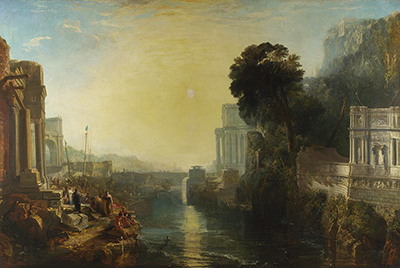
Large canvases were one strategy. Their dimensions claimed wall space associated with ambitious narrative. Biblical plague, ancient empire, shipwreck and Alpine warfare supplied elevated subjects, but landscape did more than contain figures. Weather, architecture and terrain organised the action.
Titles and quotations reinforced the claim. They connected visible atmosphere to Virgil, Ovid, scripture, Thomson, Byron or Turner's own verse. The catalogue could establish an intellectual field before the eye found small narrative details.[27][28]
Classification also mattered. In the Liber Studiorum, Turner presented landscape as Historical, Marine, Mountainous, Architectural, Pastoral and Elevated Pastoral. The printed series supported the exhibition argument by demonstrating genre range beyond one crowded annual display.
Critics did not accept the elevation automatically. Some praised grandeur; others saw pretension, obscurity or improper finish. Such resistance proves that Turner's work pressed against live conventions rather than effortlessly fulfilling them.
The wall made the claim relational. A landscape hung beside portraits or another large canvas asked viewers to compare colour, scale and narrative authority. Turner understood that a picture could argue through adjacency before anyone read a theoretical defence.
The Crowded Hang
Royal Academy exhibitions did not isolate each work within generous empty wall. Pictures were arranged in ranks, with large canvases competing for central or visible positions and smaller objects extending above and below. A visitor's first impression was collective.[8]
Placement altered perception. A high work was viewed from below; a dark picture might lose force in shadow; a pale one could appear weak beside concentrated colour. Frames created boundaries but also contributed gold, depth and visual rhythm. Neighbouring works changed apparent scale and hue.
Turner could not control this environment alone. Hanging committees balanced rank, size, subject, relationships and limited space. Personal judgement and institutional politics inevitably entered. Later anecdotes about rivalry should be read within this structural competition rather than as isolated theatrical quarrels.
Artists adapted. Broad masses and strong contrasts could announce a work across a room. Minute incident rewarded approach after attention had been secured. Turner's late paintings often combine those distances: atmosphere registers first, while titles and small marks establish story slowly.
The crowd was mobile. Viewers talked, consulted catalogues, compared opinions and moved between rooms. A painting's meaning could be interrupted by social encounter or strengthened by repeated return. Exhibition was never the silent, solitary contemplation imagined by some later museum displays.
Turner made this difficulty productive. Dense hanging turned every picture into a participant in a temporary visual argument. His adjustments on Varnishing Day demonstrate that wall conditions were not external inconvenience; they were evidence to which the artist responded.
The “line,” roughly corresponding to eye level, carried particular value, but even a favourable central position did not ensure success. A very large work could dominate at distance and become awkward near at hand. A small picture could disappear collectively yet build intimacy once found. Turner's range across formats gave him practical knowledge of both conditions.
Room transitions also shaped judgement. An effect that seemed brilliant after dark paintings might appear pale after a luminous neighbour. Visitors carried chromatic adaptation and remembered comparisons from one wall to the next. Exhibition was sequential even when critics wrote as though each object had been viewed alone.
Catalogue as Portable Exhibition
The Academy catalogue transformed a room full of objects into a numbered, searchable order. Visitors paid for a compact printed guide that identified artist, title and often address. It helped them locate works whose arrangement could otherwise be bewildering.[2][8]
For Turner, the catalogue was another expressive surface. A short topographical title might secure place. A long narrative title could identify action almost hidden in atmosphere. Literary quotation or verse could supply time, voice and association beyond the painted instant.
Numbers also enabled criticism. Reviewers could point readers to an exhibit, quote its wording and compare title with visible result. Mockery often depended on that gap: a critic claimed to see only colour where the catalogue promised Moses, a steam vessel or history.
The guide travelled beyond the room. It preserved the artist's original public wording after a work acquired a shorter familiar name. Later cataloguers rely on those entries to reconstruct chronology, while changes in title reveal changes in interpretation.[3][27]
The catalogue was not neutral. It organised artists according to institutional conventions and compressed complex works into lines of type. A title could direct attention but not guarantee recognition. Turner's increasingly elaborate entries exploit that limit.
Public exhibition thus had a verbal afterimage. The visitor left with names and phrases that could reshape remembered colour. Turner understood that his pictures would circulate through language immediately, whether in catalogue, conversation or press.
Titles That Make Viewers Search
Turner's titles often describe more than a readily visible location. They name historical actors, weather conditions, times of day, actions and technological procedures. The wording invites the viewer to test paint against a proposition.[6][27]
In marine works, terms such as signals, shoal water, sounding lead or a harbour mouth specify risk that broad waves alone cannot explain. In historical landscape, Hannibal, Caligula, Regulus or Dido activates narrative even when a protagonist is tiny or absent from immediate recognition.
This strategy creates productive delay. Viewers first experience colour or movement, read or remember the title, then return to the image searching for evidence. Failure to find a promised figure can become part of the work's pressure rather than proof that subject does not matter.
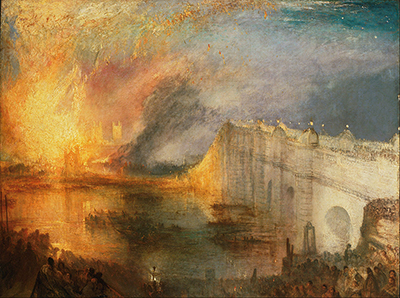
Titles also place painting inside current knowledge. A railway company, parliamentary fire, whaling activity or named port connects atmosphere to modern systems. Turner's language can be exact where his forms are least bounded.
Yet titles do not solve interpretation. They may be long, allusive or grammatically compressed. A literary character can introduce several moments at once. Later shortening often makes a work easier to cite while removing part of its original public address.
The exhibition artist used naming as direction, not captioning after the fact. Words established a threshold for looking. Critics who ridiculed the distance between title and image were responding to a deliberate feature of Turner's public practice.
Verse Beside Paint
Turner began attaching poetic quotation to exhibits early in his career. Lines from established writers lent authority and expanded historical or emotional context. He later used his own verse and attributed excerpts to the Fallacies of Hope.[27][28]
The status of that poem remains uncertain. Catalogue entries prove repeated use of the title; they do not prove that a complete independent work once existed in recoverable form. Public interpretation must begin with the actual lines attached to specific paintings.
Verse can add what an image cannot show directly. It introduces speech, sequence, remembered cause or anticipated end. Avalanche lines describe accumulation and sudden destruction. Maritime poetry can name moral judgement beyond the visible ship. Deluge verses connect morning or evening to human loss.
Reading changes the duration of looking. A visitor must pause over the catalogue, carry language back to the wall and reconcile two difficult forms. Turner did not always make that process easy. His own syntax is compressed, and an allusion may demand literary knowledge.
Poetry also defended landscape's elevation. If history painting claimed learning and narrative, Turner's union of text and natural effect asserted comparable ambition. The strategy could invite accusations of pretension precisely because the claim was serious.
The catalogue verse belongs to exhibition, not merely private authorship. Its audience was constituted by the annual show. Paint and print became a temporary composite object whose parts might later be separated by museums and shortened titles.
Critics Extend the Exhibition
Newspapers, magazines and specialist journals converted a London display into a wider public event. Reviewers described rooms, selected notable works, praised skill and competed in memorable ridicule. Their writing shaped the reputation of pictures many readers never saw.[7][29]
Turner's critical history is not a simple movement from early praise to late rejection. Admiration and hostility coexist across the career. Reviewers could condemn one exhibit and praise another, recognise colour harmony while mocking legibility, or treat daring as either genius or affectation.
The language of ridicule became inventive: soap, salad, whitewash, steam, eggs and other comparisons reduced ambitious painting to familiar substances. Such jokes reveal discomfort with material paint and obscured form, but they also supplied publicity. Turner became difficult to ignore.
Critics were responding under time pressure within crowded displays. Their failure to identify a detail may record genuine exhibition conditions. A modern viewer facing an isolated, conserved canvas under controlled light does not reproduce that encounter.
Turner read or collected some criticism and answered through humour, persistence or further work rather than sustained public prose. He understood that the annual show included a second arena in print.
Reviews are therefore historical evidence, not a referendum whose result modern taste has reversed. They disclose what viewers expected pictures to do, how quickly subjects should become legible and which forms of finish were professionally acceptable. Turner's public art developed inside that argument.
Opening a Gallery of His Own
In 1804 Turner insured an exhibition space connected with his Harley Street property. Architectural evidence suggests visitors passed through the house and rear structures to an upper gallery. Several valuable oils already shown publicly could be gathered there under his control.[9][11]
The timing was significant. Turner had become a full Academician only two years earlier. His own room extended rather than renounced public success. Institutional reputation supplied the name capable of drawing patrons to a privately managed display.
Sir John and Eliza Soane were among the early buyers, acquiring watercolours from the 1804 gallery. The transaction confirms that the room joined exhibition, sociability and market. Visitors could inspect a body of work beyond one annual submission and connect directly with the artist.[10]
The gallery also allowed return. A Royal Academy picture disappeared when the seasonal show closed; a retained work could remain available for later viewers, comparison or alteration. Turner's growing stock became visible as a career rather than a sequence of dispersed events.
Opening his own premises challenged dependence on committee placement. Turner selected neighbours, duration and access. That independence carried costs and labour: property, insurance, construction, lighting and supervision became part of artistic business.[9]
Insurance records make the economic scale concrete. The early display gathered oils whose combined value has been estimated in the thousands of pounds, a substantial concentration of vulnerable property. Fire, theft and building risk belonged to the practical reality of artistic independence. The gallery was an aesthetic experiment secured through the same financial instruments that protected houses and commercial stock.[9]
Turner's decision also converted urban property into professional identity. Visitors crossed from a London street through spaces attached to his residence and working life. Unlike an Academy room shared by hundreds of contributors, every architectural choice returned attention to one artist. That concentration was itself a declaration of confidence.
The 1804 gallery was not a modern commercial dealership or public museum. It was an artist-controlled environment serving connoisseurs, patrons and professional peers. Its importance lies in that hybrid status.
Private Gallery, Qualified Public
Calling Turner's room private can mislead. It belonged to his property and access was managed, but exhibitions invited viewers beyond a household circle. Contemporary language addressed dilettanti, connoisseurs and artists. The room sought reputation as well as intimacy.[11][29]
Its public was selective. Social introduction, knowledge of the opening and comfort entering an artist's premises all mattered. Visitors were more likely to arrive with serious interest or purchasing capacity than the mixed Academy crowd.
The rhythm of opening reinforced that distinction. Between 1804 and 1816 Turner made recurring displays available to connoisseurs, artists and interested visitors, but not with the predictable permanent hours of a later museum. Knowledge travelled through invitation, acquaintance and professional conversation. Access could feel both public and privileged.[11]
The resulting encounter supported longer memory. A visitor might have seen one canvas at the Academy and meet it again among Turner's own choices, where altered neighbours changed its emphasis. Private management did not remove public history; it allowed Turner to replay it under more favourable conditions.
That selectivity changed looking. Fewer objects and less movement permitted comparison across Turner's own career. Conversation with the artist or his associates could shape response. A potential buyer might revisit a work outside the pressure of a brief annual season.
Control could also protect scarcity. Turner did not need to release every major painting for sale. Retained objects accumulated value as examples available through privileged access. The gallery turned possession into reputational capital.
Restrictions mattered. Turner reportedly discouraged drawing or copying within the room. Limiting reproduction preserved control over images that engravers or publishers might later circulate under negotiated conditions.[13]
The qualified public of Queen Anne Street sits between domestic collection and mass exhibition. It demonstrates that nineteenth-century access was not divided neatly into public and private. Turner designed several audiences and moved work among them.
Architecture of the Enlarged Gallery
Turner closed the earlier gallery during building changes beginning in 1816 and negotiated property arrangements that secured longer control. A new gallery at Queen Anne Street West was developed from 1819 and the enlarged adjacent complex was completed around 1822.[10][11]
Top lighting was central. A skylight admitted illumination from above, reducing dependence on windows and freeing wall area. Diffusing material below it moderated glare. The design let Turner shape how light reached surfaces throughout the day.[10]
Walls associated with Pompeian red created a strong chromatic environment. Gold frames, pale skies and dark paintings would all respond differently against that colour. Display background was not an invisible neutral; it became an active relation.
George Jones's remembered interior shows Turner presenting works in a compact top-lit room with red walls and fireplace. The image is invaluable evidence of atmosphere and social encounter, though it should not be treated as an exact measured plan.[12]
The gallery's architecture aligns Turner with Sir John Soane, whose domestic museum and Dulwich Picture Gallery explored top light, compressed movement and carefully staged collections. Influence is plausible within friendship and shared interest, but Turner's room answered his own practical needs.[10]
Top lighting also solved a commercial display problem. Side windows create glare on some surfaces and leave others unevenly illuminated as the sun moves. Light from above can be diffused across walls while preserving more hanging area. The system was not perfectly constant, but it made comparison more controllable than an ordinary domestic room.
Pompeian red connected the space to contemporary historical taste and to Soane's chromatic interiors, while giving Turner's pale and gold-framed works a forceful surround. The room did not pretend that pictures floated outside architecture. It made the visitor conscious, however subtly, of entering a designed visual chamber.
Building a gallery made exhibition permanent infrastructure. Turner invested in the conditions under which his paintings would be judged. Wall, ceiling, filter and sequence became tools alongside canvas and frame.
Light, Walls and Controlled Comparison
At the Academy, Turner had to respond to a temporary position. In his own gallery he could design a stable environment and alter the grouping over time. That control made comparison one of the room's primary functions.[13]
Works from different years could reveal development in colour or ambition. Marine, mountain, classical and modern subjects could establish range. Retaining key pictures allowed Turner to curate a public identity larger than what happened to be for sale.
Top light changed surface. Raised paint caught illumination, glazes deepened and varnish reflected according to angle. Turner could inspect works under the same conditions in which selected visitors saw them, then revise or rehang as needed.[36]
Red walls intensified some hues and competed with others. The choice signalled that no display background is truly neutral. It framed Turner's colour as a deliberate environment rather than isolated property of each canvas.
Sequence mattered too. A visitor entering through domestic and rear spaces arrived after a physical transition from street to controlled room. The approach heightened exclusivity and concentrated attention.
Turner also controlled absence. What he lent, sold, stored or withheld shaped the visible career. Curation included deciding which works would not appear together.
The gallery therefore functioned as a laboratory of reception. It let Turner observe how objects behaved in relation and how viewers responded. Lessons learned there returned to the less controllable Academy wall.
Gallery as Stock, Archive and Memorial Idea
Turner's habit of retaining paintings gave the gallery several roles. It held saleable stock, but also works he priced highly, valued as exemplars, intended to revise or chose not to disperse. Unsold does not automatically mean unwanted by buyers.[9][39]
Over decades, the room became an archive of public ambitions. Early exhibition pictures remained beside later experiments. Visitors could encounter a self-authored history that no patron's collection could provide.
Retention supported comparison with old masters and with Turner's own achievements. It also kept capital tied up in objects while increasing control over reputation. The gallery was economic strategy and artistic memory at once.
Its condition near the end of Turner's life complicates the ideal. Accounts describe restricted access and accumulated works in spaces not maintained like a modern museum. The coherent conceptual gallery and the physical studio estate were not identical.[29][39]
Turner's will translated the private room into a national aspiration. Finished pictures were to remain together in a dedicated public setting, preserving the unity that sale would destroy. The stipulated Claude juxtaposition made arrangement itself part of the gift.[32]
The gallery thus anticipates the Bequest without proving that every retained sketch or unfinished canvas was destined from creation for public display. A lifetime exhibition strategy became, through death and legal settlement, a much larger museum problem.
Academy and Gallery in Alternation
Turner did not simply migrate from the Academy to his own room. He used both, sometimes placing new ambition before the larger annual audience and then drawing selected visitors towards the retained body of work. Each venue supplied what the other lacked.[3][7]
The Academy offered simultaneity with British art. Turner's picture could defeat, complement or suffer beside the season's leading portraits, histories and landscapes. Reviewers concentrated attention there, and professional status was renewed through continued presence.
The Turner Gallery supplied duration. A picture did not vanish when the summer closed. It could be studied among related works, shown to a patron later or altered after critical response. Turner could curate sequence instead of accepting a committee's wall.
Occasional withdrawal from the Academy made independence visible. In 1805 he concentrated on his own exhibition, demonstrating that he could attract serious viewers without the institution. Yet return in following years confirms strategy rather than permanent rupture.
The venues also created different kinds of scarcity. Academy visitors knew an exhibit would be available briefly; private-gallery access was less predictable and socially narrower. Turner could use that distinction to manage attention.
This alternation helped him remain both national figure and guarded proprietor. Public recognition increased desire to enter the private room, while the accumulated gallery strengthened the authority of each annual submission. Turner's exhibition system was a circuit, not a ladder from dependence to autonomy.
The British Institution Alternative
Founded in 1805, the British Institution opened in Pall Mall as a patron-led organisation. It held sale exhibitions of living British artists and displays of old masters. These alternating functions linked contemporary production to collection, market and historical comparison.[14]
Turner exhibited there intermittently. The venue provided another opportunity to reach buyers and connoisseurs, especially when his own relationship with Academy display was strategically limited. It also placed modern works within an organisation governed more directly by elite patrons than artists.
Old-master displays had educational value but could reinforce authority over contemporary practice. Artists studied important loans while resenting institutional decisions or condescension. Turner, who built his identity through dialogue with Claude, Poussin, Titian and Dutch marine painters, could use comparison without accepting passive subordination.
Governance distinguished the Institution from the artist-run Academy. Aristocratic and wealthy subscribers exercised influence, and the living-artist exhibition was explicitly connected to sale. This could bring purchasers close to contemporary work while leaving practitioners with less institutional voice. Turner entered as a successful Academician whose reputation gave him leverage, not as a dependent novice.[14]
The Pall Mall room also put contemporary art near the new National Gallery founded in 1824. Patrons moved through an increasingly dense cultural district in which old-master authority, national collecting and living British production competed for attention. Turner's public strategy unfolded within that changing geography.
Re-exhibition was a major advantage. A work made years earlier could return under changed conditions, with new neighbours and a public whose memory had shifted. Regulus demonstrates how dramatically Turner could exploit that second life.[15]
The Institution's wall therefore differed from a retrospective museum. Paintings remained active in reputation and sale. Revision was possible, and criticism could reopen questions thought settled.
Turner's movement among Academy, Institution and private gallery shows a sophisticated London ecology. No single organisation contained his public career. Competition among venues expanded the artist's room for manoeuvre while making each display politically and commercially distinct.
Re-Exhibition as Revision
A painting's first public appearance did not fix its final state or meaning. Turner retained many works, and later display could prompt physical revision, renewed interpretation or a different market position. Exhibition history belongs to the object, not just its biography.[6][36]
The interval matters. Critical memory fades unevenly; styles change; a work once seen as experimental may appear conservative beside newer painting. Turner could reintroduce an object after years and make its age part of the encounter.
Revision complicates dating. An oil may be associated with an initial exhibition year while carrying substantial later work. Responsible interpretation distinguishes original conception, documented reworking and current surface instead of assigning every passage to one moment.
Re-exhibition also changes adjacency. An object once paired with one contemporary enters a new room and comparison. Colour that worked in Rome might behave differently under Pall Mall light; a composition designed for Turner's red walls might encounter a neutral or crowded setting.
The practice resists the idea that exhibition merely reveals a completed work. For Turner, public appearance could supply evidence for further making. Viewer response, light and competition entered the continuing object.
That openness did not make every picture permanently unfinished. Turner chose moments of release, sale and retention. Re-exhibition was a selective strategy whose most dramatic cases became legends because they exposed creation on the wall.
Varnishing Day as Working Time
Varnishing days gave artists access to hung works shortly before public opening. The nominal purpose was final surface treatment, but Turner became famous for substantial additions and transformations carried out in the room.[8][37]
Finishing in relation
Working after hanging allowed decisions impossible in the studio. Turner could judge actual height, illumination, viewing distance and neighbours. A colour accent could answer an adjacent canvas; a dark passage could be strengthened for a high position; a vague form could be clarified where the crowd would stand.
This was exhibition calibration, but also performance. Fellow artists watched an image change rapidly. Accounts of Turner's speed and confidence circulated, building a public persona of spontaneous mastery even before general admission.
Witness narratives must be treated carefully. They were often recorded later and shaped by admiration. A dramatic account can identify the broad transformation without documenting every tool, pigment or sequence exactly.
The mythology also hides preparation. Turner brought decades of experience, a structured canvas and knowledge of the room. Rapid action was not creation from nothing. Studio planning and wall response formed one process.[36]
Academy tradition allowed several days for this final work, giving artists repeated opportunities to assess the hang. Turner could look, withdraw, return and judge whether an intervention held under changing illumination. The famous instant of inspiration was therefore embedded in a longer professional interval.[8]
Other artists' presence supplied an expert audience before the general crowd. They could recognise how little paint was required to alter a relation and how much risk a major change involved. Their stories helped transform a closed working period into public legend, even though ordinary visitors saw only the resulting surface.
Varnishing Day made visible what ordinary exhibition conceals: paintings are adjusted for environments. Turner's unusual willingness to make major changes turned a professional allowance into part of his artistic method and reputation.
Regulus in 1837
Turner first exhibited Regulus in Rome in 1828. The subject concerns the Roman commander said to have been tortured by exposure to the sun after returning to Carthage. The painting remained in Turner's possession and entered the British Institution in 1837.[15][17]
John Gilbert later recalled Turner transforming it on the wall with repeated pale additions until light became almost unbearable. The account captures the visual direction of the reworking: architecture and figures are subordinated to a blazing field whose intensity embodies punishment.
The event joins subject and exhibition action. Turner did not merely illustrate a victim forced towards the sun; he altered the canvas under institutional light so that viewers themselves confronted glare. The public room became part of the work's rhetoric.
Later witnesses and images helped turn the episode into legend. Charles West Cope's portrait and discussions of Gilbert preserve Turner as concentrated, guarded practitioner.[16] Their value lies in reception as well as documentary detail.
Reworking also separated the 1837 object from its Roman debut. Nine years of artistic development and a different audience entered the surface. Calling it simply an 1828 painting suppresses that exhibition history.
Ruskin later condemned Regulus as a relapse into rivalry with Claude, showing that intense public effect did not guarantee sympathetic afterlife.[15][31] The same object could embody performative genius for one account and aesthetic failure for another. Exhibition kept judgement unsettled.
The Red Buoy and Neighbouring Colour
The most famous Varnishing Day anecdote concerns 1832. Turner's pale marine painting Helvoetsluys hung beside John Constable's large, richly worked Opening of Waterloo Bridge. Turner added a small red buoy, creating a concentrated accent against his broad cool field.[18][19]
Constable reportedly said Turner had fired a gun. The remark survives through recollection rather than an immediate transcript, but it precisely describes the accent's competitive effect. A tiny addition could reorganise not only Turner's picture but the wall around it.
The episode demonstrates simultaneous contrast. Red becomes more forceful because of surrounding restraint. Size is irrelevant to attention when saturation and placement are exact. Turner used the neighbour as part of the visual calculation without touching Constable's canvas.
Rivalry should not erase collegial context. Both men served within the Academy and understood the exhibition's demands. The anecdote became attractive because it stages different surfaces and working tempos as personal combat.
The buoy also had representational function within the marine scene. It was not an abstract spot detached from subject. Turner's brilliance lay in finding an object capable of carrying pictorial and competitive necessity at once.
Crowded hanging made such intervention possible. In an isolated museum room, the accent remains powerful, but the original relational event is absent. Exhibition history restores the neighbouring colour against which the shot was imagined.
Patrons, Prices and the Seen Unsold
Public exhibition offered works to attention, not necessarily immediate purchase. Turner sold successfully, accepted commissions and cultivated patrons, yet retained many major oils. Ownership decisions belonged to a larger strategy of income and reputation.[38][39]
A displayed painting could attract a buyer even if that object remained unavailable or expensive. It demonstrated capacity that led to watercolour commissions, print subscriptions or future acquisitions. Exhibition advertised an artistic range rather than a simple inventory.
Critical attention could itself become value. A controversial work kept Turner's name in circulation, and a retained canvas accumulated history through repeated discussion. Price therefore reflected more than material and labour; it could register the artist's reluctance to lose a key public statement.
Sales also dispersed comparison. Once an oil entered a country house, most Academy visitors could no longer see it directly. Engraving, loan exhibition and published criticism preserved a partial public life. Turner's own gallery countered that dispersal by keeping selected anchors available within a coherent group.
Turner managed prices selectively. High valuation could protect a work while signalling importance. Retention preserved examples for his gallery and eventually contributed to the extraordinary studio estate.
Patrons encountered the artist through social networks. Lord Egremont at Petworth, Walter Fawkes at Farnley, Hugh Munro and others saw groups under conditions different from anonymous annual crowds. Ownership then created semi-public afterlives through house display, loans and reproduction.
The market was therefore distributed. Academy visibility, private-gallery access, dealer or publisher activity and patron houses interacted. A work could be publicly famous while privately held, or widely known through engraving while the original remained difficult to see.
Turner's guardedness should not be confused with indifference to audience. He differentiated audiences and the terms on which they encountered his work. Control over access was itself a commercial and reputational instrument.
Watercolour and Intimate Display
Watercolours reached viewers through Academy exhibits, print commissions, patron collections and carefully staged private presentations. Their smaller scale and sensitivity to light encouraged closer, more controlled encounters than large annual oils.[6][38]
At Farnley Hall, Walter Fawkes assembled an exceptional group and held exhibitions for invited audiences. The setting linked Turner's sheets to hospitality, connoisseurship and personal relationship. Viewers could compare subjects and techniques at close range.
Later Swiss practice made selection part of the work. Turner produced colour beginnings or sample studies from which patrons could commission finished watercolours. The group staged variation in atmosphere and place while preserving scarcity.
Private presentation did not remove public ambition. Finished sheets could become known through collectors, exhibitions and later sale. Their reputation strengthened Turner's command of a medium sometimes treated as secondary to oil.
Light exposure was and remains a material issue. Watercolour's luminosity depends on paper and transparent colour that can be damaged by prolonged illumination. Rotation in modern institutions therefore creates a public rhythm unlike permanent oil display.[34]
The intimate audience trained another kind of attention. Where a crowded wall rewarded broad announcement, a held or closely viewed sheet could make tiny reserve, wash edge and scraped highlight decisive. Turner designed public impact at several scales.
Prints and the Distant Audience
Engraving carried Turner's designs beyond the physical exhibition room. Purchasers encountered landscapes in books, serial parts and separate impressions across Britain and abroad. Reproduction multiplied audience while changing the object.[6][38]
Colour and brush surface had to become line, hatch or mezzotint tone. Turner worked closely with engravers, corrected proofs and sometimes drove collaborators hard. The resulting print was neither a transparent copy nor an unrelated work.
Serial publication created anticipation. Subscribers received parts over time, building a collection gradually. Titles and accompanying text fixed place or literary association. The domestic portfolio became a repeatable private exhibition.
The Liber Studiorum made this circulation theoretical. Its landscape categories presented Turner's range through a coherent print project. Other series connected travel, poetry and national scenery to commercial publishing.
Prints also advertised originals and expanded fame among people unable to attend London shows. A design could become visually familiar even when its oil or watercolour remained with Turner or a patron.
Wider access came with costs and exclusions. Prints had prices, editions and varying quality; collaboration could delay projects; monochrome translation altered the colouristic identity later associated with Turner. Nevertheless, reproductive media made his public far larger than annual attendance alone suggests.
Late Paintings for a Crowded Room
Turner's late exhibition works are often reproduced as isolated fields of colour, encouraging the idea that they were private experiments discovered before their time. Many were instead deliberately submitted to crowded, critical public shows.[7][8]
Their broad structures answered distance. A warm or cool field, circular movement, dark vessel or brilliant opening could register before small narrative forms. Closer approach revealed broken surface and delayed figures rather than conventional finish.
Titles became more elaborate as contours weakened. Maritime procedure, literary source and historical moment supplied interpretive anchors. Turner did not abandon subject; he redistributed it among paint, catalogue and viewer.
Varnishing Day allowed final adjustment under actual conditions. Some canvases may have entered the room in open states, but it is wrong to assume every late painting was improvised entirely on the wall. Different works carry different evidence of preparation and revision.[36]
Critical hostility confirms that Turner knew the risk. He continued submitting paintings that challenged professional expectations because the Academy audience was the point, not an unfortunate obstacle to later appreciation.
The late display also involved timing. Turner could withhold detail until the final working period, ensuring that small signs responded to the actual wall. A dark vessel or sharp colour might need very little physical area to stabilise a broad atmospheric field. What appeared unfinished to a critic could be deliberately resolved at another scale of viewing.
This does not make every hostile review shortsighted. Visitors were entitled to test whether title, narrative and form cohered under public conditions. Turner's practice gains historical force from that disagreement: he asked the annual institution to accommodate modes of recognition it had not been designed to privilege.
The late public picture is therefore a performance across distance and duration. It catches the room, frustrates immediate naming and rewards return. Museum isolation preserves the object but changes the social pressure for which it was made.
The 1843 Pair Across the Wall
In 1843 Turner exhibited two related Deluge paintings: one cool and dark, the other warm and light. Their comparable near-square formats and circular structures invited pairwise viewing, while the morning title explicitly invoked Goethe's colour theory.[20][21]
The Academy exhibition contained more than fifteen hundred works. Within that abundance, chromatic opposition could announce a relation across physical separation. Viewers did not need to identify Moses or every animal before sensing evening against morning.[22]
The Spectator ridiculed apparent octagonal daubs and struggled to locate narrative details. Yet the review recognised deliberate cool and warm harmonies.[23] Reception therefore confirms that Turner's exhibition architecture worked even where subject legibility failed contemporary expectations.
Catalogue title and verse complicated the pair. Deluge chronology, Mosaic authorship, hope and Goethe asked visitors to move between print and wall. The intellectual apparatus did not make the pictures easier in any simple sense.
Their format also separated them from conventional horizontal landscape. Circular movement enclosed atmosphere, while small figures appeared through sustained attention. Each picture altered memory of the other.
The pair demonstrates Turner's mature command of exhibition as sequence. Meaning existed between two canvases, across chromatic adaptation and through the visitor's movement. Reproduction of either work alone necessarily removes part of that original public experiment.
Famous Pictures and Selective Public Memory
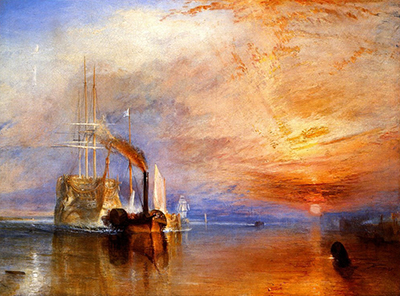
Some works gained immediate or durable public identities that exceeded their initial exhibition. The Fighting Temeraire was praised in 1839 and remained with Turner; its subject, strong silhouette and sunset made it memorable even before later national popularity.[24]
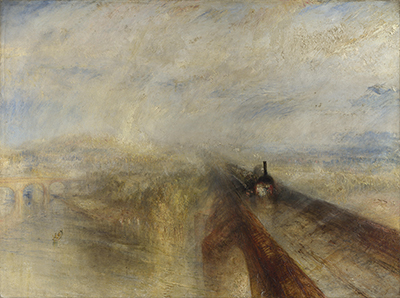
Rain, Steam, and Speed entered the 1844 Academy with modern railway subject partly dispersed through weather. Its current fame can obscure the difficulty of first identifying locomotive, bridge and hare within a crowded room.[25]
Public memory is selective. A few pictures become emblems while equally ambitious exhibits remain specialist knowledge. Reproduction, national display, school texts and later criticism reinforce that hierarchy.
Turner contributed by retaining and bequeathing major works, but he could not determine which images later audiences would prefer. His Claude display instruction shaped one comparison; Ruskin promoted others; museums and publishers continued the selection.
Fame also shortens titles. Complex catalogue language becomes a compact label, improving recognition while losing historical framing. The familiar work may differ verbally from the one first encountered at the Academy.
Public exhibition therefore continues after opening day through repeated acts of choice. What is hung, illustrated, lent and named builds the Turner each generation sees.
The Final Academy Year
Turner's last Royal Academy submissions appeared in 1850, the year before his death. Four canvases treated episodes involving Aeneas and Dido, returning to Virgilian and Carthaginian themes that had occupied him for decades.[2][26]
The group should not be called a formally announced farewell without direct evidence. Its coherence may invite retrospective reading, but contemporary viewers encountered new annual exhibits, not a declared final testament.
Late style and old literary subject met on the public wall. Broad colour, unstable architecture and compressed action carried a classical narrative familiar from Turner's earlier career. Continuity is as important as decline or rupture.
The choice confirms that he remained an exhibition artist to the end. He did not retreat wholly into private abstraction or cease addressing Academy audiences after critical mockery.
Ill health and concealment shaped his final years, but the annual institution still provided a professional endpoint. Sixty years separated the first watercolour from the last oil group.
The 1850 display closes a lifetime sequence without resolving it. Turner left pictures in many states, some publicly tested and others never prepared for exhibition. Death transferred both categories into one contested estate.
Imagining a National Turner Room
Turner began drafting wills long before death and altered his intentions repeatedly. By 1848 he sought to leave his finished pictures together in a dedicated room at the National Gallery. Arrangement was integral to the gift.[32]
He also specified a dialogue with Claude. The exact pair of Turner paintings changed through revisions, but the surviving instruction placed his work beside two celebrated Claude landscapes. Posthumous reputation would be staged through physical adjacency.
The plan translated the private gallery's unity into national form. Pictures retained across a career would remain a collective statement rather than dispersing through sale. Public access would outlive the artist.
The National Gallery itself had changed during Turner's lifetime, moving from a Pall Mall house to Trafalgar Square. Space was already inadequate, and British art occupied a contested place within a collection associated with European old masters.[33]
Turner's desire exceeded simple generosity. He attempted to shape interpretation, institutional identity and comparison after death. The room was a final exhibition work in concept, even though he could not design its realised architecture.
The distinction between finished pictures and total studio contents became crucial. Turner's ideal public group was narrower than the vast material eventually transferred through legal settlement.
From Bequest to Overcrowded Display
Turner died in 1851, and family challenge delayed resolution of his will. The 1856 settlement delivered to the nation nearly three hundred oils and tens of thousands of drawings and watercolours, including studio material far beyond a conventional finished-picture gift.[32][35]
No existing room could fulfil that scale. The National Gallery was already overcrowded. British collections associated with Robert Vernon had occupied separate premises, and Turner works moved through Marlborough House and South Kensington before major paintings returned to expanded Trafalgar Square rooms in 1876.[33]
Movement among buildings changed audience and classification. Marlborough House offered a provisional British display; South Kensington placed the material within another developing museum environment; return to Trafalgar Square connected selected oils more firmly to the national school and European collection. These were not neutral storage changes. Each arrangement proposed a different answer to where Turner belonged.
Physical abundance also made hierarchy unavoidable. Finished Academy oils, abandoned experiments, watercolour beginnings and utilitarian sketchbooks could not receive equal wall treatment. Curators had to decide what counted as exhibit, study material or documentary residue. Those decisions created categories Turner himself had never fixed consistently.
Ruskin examined and organised parts of the Bequest. His Notes on the Turner Gallery at Marlborough House classified periods, praised selected works and condemned others. Display became critical argument: arrangement told viewers which Turner represented achievement or failure.[30][31]
Works on paper presented a different problem. Light sensitivity, enormous quantity and uncertain ordering required storage, inventory and selective access. Finberg's 1909 inventory created a durable scholarly structure while later cataloguing revised many identifications.[35]
The Bequest made private process public. Sketchbooks, colour beginnings and unfinished canvases entered national knowledge despite not having been lifetime exhibition objects. The public Turner expanded from chosen works to working archive.
That expansion fulfilled access in one sense while defeating the unified room in another. The national gift could not be seen all at once, and every display became selection.
National Gallery, Tate and the Divided Public Turner
Most of the Turner Bequest transferred from the National Gallery to the Tate Gallery in 1910, while selected paintings remained at Trafalgar Square. The division created two institutional narratives.[32][34]
At the National Gallery, Turner's stipulated dialogue with Claude remains visible through the paired hang. He appears within a history of European painting and old-master emulation. At Tate Britain, the scale of the Bequest supports career depth, works on paper and British-art context.
The Clore Gallery later gave Turner dedicated architectural prominence, partly answering the long desire for coherent display. Yet conservation and quantity still require rotation, especially for watercolour and drawings. Dedicated space does not mean total visibility.[34]
Institutional division affects interpretation. A visitor seeing Dido with Claude encounters rivalry and canon. A visitor moving through sketchbooks and late colour studies encounters process, repetition and experiment. Both are historically grounded Turners.
Loans and temporary exhibitions create further arrangements. Works return to lifetime pairings, travel internationally or enter thematic displays on colour, modernity, sea or empire. Each context makes different evidence salient.[40]
The public artist is therefore continually rehung. Turner's will exerted lasting force, but museums, conservators and scholars necessarily mediate what can be seen.
How Museums Changed the Work
Modern display offers advantages Turner could not guarantee: controlled illumination, conservation, readable interpretation and sustained access. It also removes works from crowded Academy walls, red private-gallery surroundings and changing relations with contemporary rivals.
Isolation can magnify surface. A late canvas seen alone appears more radically abstract than it may have among narrative paintings and portraits. Conversely, thematic grouping can recover pairings and competition hidden by permanent arrangement.
Frames, varnish and conservation alter experience. Cleaning can reveal colour unavailable to nineteenth-century viewers, while ageing may change balance. Technical knowledge clarifies process but cannot recreate every historic light condition.[36]
Museum language also stabilises identity. Standard titles, dates and accession numbers make objects searchable. They may shorten Turner's original catalogue wording or privilege one state of a long exhibition history.
Digital images widen access dramatically but flatten scale, surface and adjacency. They make sketchbooks inspectable while separating sheets from physical sequence. The contemporary public is larger and less dependent on London, yet encounters another translation.
Recognising these changes does not make the original exhibition uniquely authentic. Turner's works have always moved through rooms, prints, criticism and memory. Their history consists of those successive public forms.
Exhibition as Part of the Art
Turner understood that a painting becomes public through more than opening a door. Venue selects an audience; architecture controls light; hanging creates neighbours; catalogues supply words; criticism extends the event; retention permits return. He worked across that whole system.
His own gallery offered concentrated control, but the Academy's crowded uncertainty remained indispensable. Varnishing Day connected studio decision to wall relation. The British Institution allowed reappearance and revision. Prints and watercolours built publics at different distances and prices.
Late paintings make the system visible because they depend so strongly on duration. Broad colour catches attention, while title and detail delay recognition. The spectator performs part of the work by moving, reading and comparing.
The Bequest carried this logic beyond Turner's control. A hoped-for national room became a vast archive divided across institutions. Unfinished studies gained public authority, and museums created new sequences no lifetime viewer had known.
Public exhibition was therefore not packaging around autonomous masterpieces. It shaped decisions of scale, colour, text, finish, ownership and memory. A Turner painting on a wall is one moment in a longer history of appearance.
That longer history has several clocks. The Academy season concentrated judgement into weeks; a catalogue preserved wording after the walls were cleared; criticism could revive praise or ridicule years later; Turner's own gallery let retained canvases accumulate comparison over decades. Re-exhibition restarted the clock, sometimes after physical revision. The Bequest then transformed temporary professional choices into national heritage whose arrangement would be renegotiated indefinitely.
Audiences changed with each interval. Academy visitors paid for a large mixed display. Connoisseurs entered Queen Anne Street through professional or social knowledge. Patrons handled decisions about commission and purchase. Print buyers met translated versions at home. Museum visitors later encountered objects classified by curators and defended by scholarship. “The public” was never one stable group, and Turner did not address all viewers in the same way.
This stratification helps explain apparent contradictions. He could seek annual attention while guarding private access, court buyers while retaining work, exploit criticism while resenting it and leave pictures to the nation while prescribing their neighbours. These were not failures to decide between commerce and posterity. They were ways of managing different economies of visibility.
Exhibition also made spectators into historical participants. The person who searched for a hidden figure, compared two chromatic fields or watched a canvas altered before opening contributed to the work's public identity. Later museums preserve traces of those encounters but cannot reproduce them automatically. Reconstruction requires catalogue, review, architecture and object to be read together.
The same principle should guide interpretation now. A familiar image deserves to be returned mentally to its first wall, without pretending that historical conditions can be recreated perfectly. Scale, frame, neighbour, title and admission all affect what the object asked of viewers. Its later conservation and display belong to the history too. Turner remains a public artist not because one original encounter can be recovered intact, but because his work repeatedly exposes the systems through which art becomes visible, discussable and memorable.
Every rehanging is consequently an argument: it selects relationships, creates emphasis and asks a new audience to decide which parts of Turner's long public history matter most.
That history explains his unusual modern reach. Turner mastered elite institutions, built private infrastructure, endured mass criticism and left the nation a problem of abundance. Each generation must decide which Turner to place before viewers, knowing that arrangement will change the answer.
Discussion
How did exhibition conditions become part of Turner's artistic method and public identity?
Reader Insights
How might position, neighbours, lighting and crowding alter a painting's effect?
What do catalogues, titles, verse and criticism add to the public encounter?
How do museums create a different public Turner from lifetime exhibitions?
Join the Conversation
Share a close observation or a source-based question for other readers.
References
- Royal Academy of Arts, “J. M. W. Turner RA” and collections guide. https://www.royalacademy.org.uk/art-artists/name/jmw-turner-ra
- Royal Academy Chronicle, annual exhibition records. https://chronicle250.com/
- C. F. Bell, *A List of the Works Contributed to Public Exhibitions by J. M. W. Turner*, 1901. https://archive.org/details/listofworkcontri00bell
- Algernon Graves, *The Royal Academy of Arts: A Complete Dictionary of Contributors*, 1905-06. https://archive.org/details/royalacademyofar01grav
- National Gallery, Judy Egerton, “Joseph Mallord William Turner.” https://www.nationalgallery.org.uk/paintings/catalogues/egerton-2000/joseph-mallord-william-turner
- Tate, “Joseph Mallord William Turner 1775-1851.” https://www.tate.org.uk/art/artists/joseph-mallord-william-turner-558
- Lenbachhaus, *Turner as an Exhibition Artist*, 2023. https://www.lenbachhaus.de/fileadmin/Redaktion/Ausstellungen/2023/10_William_Turner/Turner_Ausstellungstexte_Lenbachhaus_Web_EN.pdf
- LWL Museum, *Turner: Horror and Delight*, “Turner in his day.” https://www.lwl.org/landesmuseum-download/Website/3-19-11-1_KUK_AG_TURNER_Begleitheft_Web.pdf
- Martin Myrone, “Sun Is God: Turner, Angerstein, and Insurance,” *Oxford Art Journal* 47.1, 2024. https://academic.oup.com/oaj/article/47/1/39/7695169
- Sir John Soane's Museum, *Enlightened Turner*. https://www.soane.org/exhibitions/enlightened-turner
- Survey of London, *Queen Anne Street*. https://www.ucl.ac.uk/bartlett/sites/bartlett/files/chapter10_queen_anne_street.pdf
- Ashmolean Museum, George Jones, *Interior of Turner's Gallery*, WA1881.348. https://collections.ashmolean.org/object/365537
- Tate, “Turner's Gallery.” https://www.tate.org.uk/art/artworks/jones-interior-of-turners-gallery-n01988
- British Institution exhibition catalogues. https://archive.org/search?query=british+institution+exhibition+catalogue
- Matthew C. Hunter, “Reason Dazzled: Turner's Regulus,” *British Art Studies* 15, 2020. https://britishartstudies.ac.uk/issues/15/turners-regulus
- National Portrait Gallery, Charles West Cope, *J.M.W. Turner*, NPG 2943. https://www.npg.org.uk/collections/search/portrait/mw06425/JMW-Turner
- Martin Butlin, “A Newly-Discovered Masterpiece by J. M. W. Turner,” National Gallery of Victoria. https://www.ngv.vic.gov.au/essay/a-newly-discovered-masterpiece-by-j-m-w-turner/
- Tate, *Helvoetsluys*, N00502. https://www.tate.org.uk/art/artworks/turner-helvoetsluys-n00502
- Victoria and Albert Museum, John Constable, *The Opening of Waterloo Bridge*. https://collections.vam.ac.uk/item/O82676/
- Tate, *Light and Colour*, N00532. https://www.tate.org.uk/art/artworks/turner-light-and-colour-goethes-theory-the-morning-after-the-deluge-moses-writing-the-book-n00532
- Tate, *Shade and Darkness*, N00531. https://www.tate.org.uk/art/artworks/turner-shade-and-darkness-the-evening-of-the-deluge-n00531
- Catherine Roach, “1843,” *Royal Academy Chronicle*. https://chronicle250.com/1843
- *Spectator*, “Fine Arts: Royal Academy Exhibition,” 13 May 1843. https://archive.spectator.co.uk/article/13th-may-1843/19/fine-arts
- Tate, *The Fighting Temeraire*, N00515. https://www.tate.org.uk/art/artworks/turner-the-fighting-temeraire-tugged-to-her-last-berth-to-be-broken-up-1838-n00515
- National Gallery, *Rain, Steam, and Speed*, NG538. https://www.nationalgallery.org.uk/paintings/joseph-mallord-william-turner-rain-steam-and-speed-the-great-western-railway
- Tate, Turner Aeneas and Dido works, 1850. https://www.tate.org.uk/art/artworks/turner-the-departure-of-the-trojan-fleet-n00539
- Lawrence Gowing, *Turner: Imagination and Reality*, Museum of Modern Art, 1966. https://assets.moma.org/documents/moma_catalogue_2572_300062313.pdf
- Andrew Wilton, *Painting and Poetry: Turner's Verse Book and His Work of 1804-1812*, 1990. https://id.rijksmuseum.nl/300108348
- Walter Thornbury, *The Life of J. M. W. Turner*, 1862. https://archive.org/details/lifeofjmwturnerr00thor
- John Ruskin, *Modern Painters*, vols. 1 and 5. https://www.lancaster.ac.uk/the-ruskin/the-complete-works-of-ruskin/
- John Ruskin, *Notes on the Turner Gallery at Marlborough House*, 1857. https://archive.org/details/notesonturnerga00ruskgoog
- National Gallery, “The Turner Bequest.” https://www.nationalgallery.org.uk/about-us/history/the-turner-bequest
- National Gallery, “Collection History.” https://www.nationalgallery.org.uk/about-us/history/collection-history
- Tate, “The Turner Bequest.” https://www.tate.org.uk/art/research-publications/jmw-turner/the-turner-bequest
- A. J. Finberg, *A Complete Inventory of the Drawings of the Turner Bequest*, 1909. https://archive.org/details/completeinventor01nati
- Joyce H. Townsend, *How Turner Painted: Materials, Methods and Techniques*, 2019.
- William Parrott, *Turner on Varnishing Day*, Museums Sheffield. https://www.sheffieldmuseums.org.uk/whats-on/turner-on-varnishing-day/
- Ian Warrell, *J.M.W. Turner*, Tate, 2007.
- James Hamilton, *Turner: A Life*, 1997.
- Frick Collection, *Turner* exhibition history. https://www.frick.org/exhibitions/turner