View the object record
at Tate
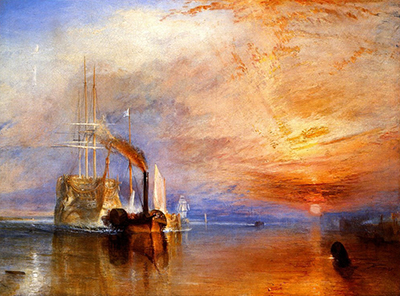
Tate N00489 institutional reproduction retained from the accepted exact-object page.
 by Tom Gurney
Tom Gurney BSc (Hons) is an art history expert with over 20 years experience
Published on June 19, 2020 / Updated on August 29, 2026
Email: tomgurney1@gmail.com / Phone: +44 7429 011000
Landscape That Refuses a Stable View
J. M. W. Turner made landscape capable of unsettling the person who looks at it. Mountains block orientation, water removes firm ground, cloud hides distance and light dissolves the border between objects and atmosphere. A hut, boat or human figure may offer a momentary measure, only to be overwhelmed by the field around it. These are not merely pictures of impressive places. They are structures for experiencing uncertainty.
The term most often used for that experience is the sublime. In Turner's period it described a powerful mixture of fear, astonishment and pleasure produced by ideas of danger, magnitude or force encountered from a position of relative safety. Mountains, storms, precipices, oceans, darkness, fire and ruins could all support it. Yet no subject was sublime automatically. A mountain calmly mapped could remain topography; a small waterfall could become overpowering if its viewpoint, sound and movement were imagined intensely.[1][5]
Turner's achievement lies in construction. He learned the measurable world through architectural drawing and perspective, travelled through difficult terrain, studied earlier art and then reorganised evidence in the studio. His finished landscapes may join observations made at different moments with history, poetry, news and invention. The result often feels immediate because it is highly mediated.
This approach changed over a long career. Early watercolours build grandeur through dark tonal masses and exact landmarks. Large oils of the 1800s and 1810s make avalanche, shipwreck and snowstorm rival history painting. Later works use broken colour, suspended detail and unstable atmosphere to involve the eye more directly. Small Swiss watercolours can make transient light carry an immense sense of duration.[7][8]
The sublime in Turner is therefore neither a style nor a list of spectacular motifs. It is a relation among landscape, medium and observer. The crucial questions are where viewers seem to stand, what they can measure, what remains hidden and whether delight can survive knowledge of actual suffering.
What the Sublime Meant
The idea had a long history before Turner. The ancient critic known as Longinus associated sublimity with elevated expression that transports an audience beyond ordinary persuasion. In eighteenth-century Britain, writers increasingly applied comparable intensity to natural scenery and the mind's response to it. Vast prospects, unfamiliar forms and imagined infinity could stretch perception beyond comfortable possession.[2][5]
Joseph Addison distinguished pleasures arising from greatness, novelty and beauty. A wide horizon or immense mountain range enlarged the imagination because the eye could not easily contain it. William Gilpin later taught travellers to inspect scenery as potential compositions, valuing roughness, variety and changing views. Such habits made landscape an active intellectual and commercial culture rather than a passive rural backdrop.[2][3]
Edmund Burke gave the sublime its most influential British analysis in 1757. He separated it from the beautiful. Smoothness, delicacy and moderate proportion could attract affection; terror, obscurity, power and vastness produced a more forceful astonishment. Danger delighted only when mediated. A storm at sea is not an aesthetic exercise for a person actually drowning.[1]
Kant later distinguished overwhelming magnitude from overwhelming power. His account places sublimity in the mind's effort to confront what sensory imagination cannot encompass. There is no secure evidence that Turner built paintings as applications of Kant, so the distinction is best used as a later analytical aid rather than a biographical claim.[4]
Turner did not need to choose one system. His landscapes combine features the theorists separated. A distant valley may be beautiful while the mountain above threatens; picturesque ruins can supply a foreground to limitless weather; a measured bridge can expose the force it crosses. Painting lets several responses coexist spatially.
Nor should “sublime” become praise without content. The word identifies an experience organised around limitation: the eye cannot survey, the body would be endangered, the event exceeds ordinary scale or history dwarfs an individual life. Turner's best sublime landscapes make those limits tangible rather than merely announcing grandeur.
Contents
- Landscape That Refuses a Stable View
- What the Sublime Meant
- Burke, Terror and Protective Distance
- From Picturesque Framing to Sublime Disruption
- Topographical Discipline Before Disruption
- Where Turner Places the Viewer
- Small Figures and the Problem of Scale
- Obscurity and Delayed Recognition
- Movement, Sound and the Static Image
- Crossing the Alps in 1802
Burke, Terror and Protective Distance
Burke defined terror as the governing principle of the sublime. Whatever suggests pain or destruction can produce the mind's strongest emotion, provided the threat is not immediate enough to abolish reflective pleasure. Painting supplies protective distance by definition. Snow, wave and flame cannot leave the support, even when their representation makes the spectator recoil.[1]
Turner repeatedly tests that protection. A boulder in the Grisons avalanche appears to descend towards the lower edge. In the Hannibal snowstorm, a vast dark curve hangs above an army and seems to continue outside the frame. Marine pictures place the implied observer near troughs whose depth cannot be seen. Such devices weaken the sense of standing before a neatly bounded window.[20][22][27]
Obscurity was essential to Burke because incomplete knowledge allows imagination to magnify danger. Turner uses shadow, spray, snow, smoke and broken contours to withhold information. The spectator may know from a title that a vessel, army or historical figure is present before finding it. Looking becomes a movement from affect to recognition.
Power also matters. Turner's landscapes often show force through effects rather than a single cause. Trees bend, sails strain, architecture burns, spray erases rock and human groups scatter. The visual field behaves as a connected system. This is more disturbing than a theatrical monster because no one point can be confronted and defeated.
Yet Turner is not simply Burke with a brush. Beautiful colour can fill scenes of catastrophe; obscurity can emerge from material experiment rather than a theory of terror; humour and satire sometimes interrupt elevated feeling. Above all, history changes danger. A painted storm associated with the murder of enslaved people cannot be understood only as pleasurable fear.
Burke helps explain the machinery of astonishment, but Turner makes that machinery carry place, politics and memory. Protective distance becomes morally unstable when viewers realise that the danger represented was real for someone else.
From Picturesque Framing to Sublime Disruption
Picturesque tourism trained Turner's generation to seek views. Gilpin's published tours described how a traveller might select a station, use trees or ruins to frame distance and prefer broken surfaces to smooth regularity. A landscape became a sequence of potential compositions discovered along a journey.[3]
Turner mastered that visual grammar. Foreground banks, bridges, vegetation and buildings often guide an eye towards water or mountains. His rapid drawings record turns in a road, profiles of ridges and the changing relation of one landmark to another. Such organisation was indispensable to his work for topographical publishers.[7]
The sublime begins where the organising frame becomes inadequate. A precipice may cut off the expected recession. A waterfall fills the centre with matter that cannot be held still. Cloud merges separate mountains, or a wave breaks the horizontal that should stabilise a sea view. The scene retains enough structure to show what is being lost.
This relation prevents a crude opposition. Picturesque form often prepares sublime disruption. A bridge provides a familiar human span, then exposes the depth or violence beneath it. A cottage makes an avalanche measurable. A carefully placed boat establishes a horizon before weather dissolves it. Without those finite signs, vastness risks becoming empty generality.
Tourism added another tension. Viewers wanted pleasurable danger that could be reached by road, boat or guided passage. Prints and watercolours carried it home. Turner profited from that market while making its security uncertain. His landscapes reveal roads exposed to gallows, coaches beneath threatening hills and travellers reduced by conditions they came to admire.[13]
The picturesque gaze assumes that scenery can be arranged for possession. Turner's sublime landscapes repeatedly begin with that confidence and then disturb it. The person who came to collect a view discovers that wind, water, height and history exceed the frame.
Topographical Discipline Before Disruption
Turner's early reputation rested on architectural and topographical watercolour. He drew buildings with sufficient precision for engravers and patrons, learned perspective at the Royal Academy and travelled to gather visual information. This foundation matters because later dissolution is not evidence that he never understood structure.[7][9]
Exact drawing taught him how scale works. The width of an arch, recession of a road or height of a tower can organise a landscape even when much else remains uncertain. It also taught selection. A view contains more information than a picture can use, so the artist chooses which edges, accents and tonal divisions will orient an observer.
Early mountain works often intensify fact through lighting and format. Dark foregrounds make distant illumination seem inaccessible. A high horizon can compress the viewer beneath weather; a low one expands the sky beyond ordinary measure. Recognisable topography becomes the support for emotional argument rather than its opposite.
Architectural knowledge also gives ruins and bridges their force. A damaged abbey is not merely irregular texture; it preserves the idea of a human system outlasting its founders while being reclaimed by weather and growth. A bridge is both measured engineering and a sign of the gulf it crosses. Stability reveals vulnerability.
Turner's practice remained synthetic. Sketches made before a motif do not guarantee that every feature of a finished work was present at one instant. He changed viewpoints, expanded mountains, moved buildings and joined weather from memory. Topographical credibility allowed invention to feel possible.[8]
The sublime therefore emerges from disciplined deviation. Turner establishes enough measure for the spectator to sense when measure fails. His storms are powerful because masts, hulls, ridges and buildings continue to exert pressure beneath the atmosphere. If all structure vanished, danger would lose its object and scale.
Where Turner Places the Viewer
Viewpoint is one of Turner's most powerful instruments. A conventional prospect offers a secure station from which foreground, middle distance and horizon can be surveyed. Turner often lowers, exposes or destabilises that station. The spectator may seem close to water level, beneath a mountain wall or caught within moving weather.
On Alpine journeys, the road determines what can be seen. Peaks appear and disappear behind nearer masses; a turn suddenly opens a valley; an overhang blocks the sky. Turner's sketches preserve this serial knowledge. Finished pictures can compress several revelations into one structure while retaining the bodily sense of passage.[7][8]
Water creates a more radical uncertainty because it removes a fixed platform. In shipwreck and storm subjects, the implied eye rises and falls with waves even though the support is still. Oblique horizons, tilted vessels and spiralling marks create visual imbalance. Sarah Monks argues that Turner's sea can replace the elevated command often associated with sublimity with an imagined downward pull towards drowning.[27]
An exposed viewpoint also implicates the observer. In the Grisons avalanche, flying mass advances rather than remaining a distant spectacle. At Reichenbach, falling water and spray occupy the path through the image. Staffa's cave is approached from open sea, its darkness a destination that resists entry.[18][20][24]
Not every viewer is placed inside danger. Turner frequently alternates immersion and survey. A distant opening may promise escape from a turbulent foreground; a foreground figure may stand where the spectator could imagine standing. The tension between positions keeps the work active.
Sublime landscape is thus partly a choreography of looking. Turner controls not only what appears but the imagined body from which it appears. Security is never simply outside the frame; it must be established, challenged and sometimes recovered through attention.
Small Figures and the Problem of Scale
Vastness needs comparison. Turner places people, animals, huts, boats and armies within large fields so that the spectator can estimate magnitude. Their smallness is not a fixed moral judgement. A minute figure may be vulnerable, industrious, observant, heroic, culpable or merely distant according to subject.
In an Alpine watercolour, travellers on a road convert rock into bodily scale. At a waterfall, a bridge or building measures height and flow. The Grisons cottage makes descending stone terrifying because its roof belongs to human shelter. Hannibal's troops become a broken band beneath weather that defeats military ambition.[18][20][22]
Turner also withholds the measure. Figures may be difficult to locate until the title directs attention. Their delayed appearance changes a first impression of general atmosphere into a scene of consequence. The spectator moves from enjoying force to recognising those caught within it.
The relation can reverse. A large historical actor may become visually negligible, but the narrative importance supplied by title or verse remains immense. Hannibal is almost lost, yet his ambition organises the entire comparison between empire and storm. Moses in a late Deluge field is tiny but joins perception to scriptural authorship.
Scale can be temporal as well as spatial. Ruins measure centuries, eroded valleys imply durations beyond memory and sunset compresses the end of a day into a historical mood. A person is small before geological process even when no towering peak appears.
This is why the common phrase “man against nature” is inadequate. Turner's landscapes show humans travelling through, working upon, representing and suffering within environments. Nature is not a single opponent, and people are not one moral unit. Scale becomes a way to test claims of mastery while preserving individual stakes.
Obscurity and Delayed Recognition
Turner's obscurity is constructed rather than careless. Dark tonal masses, pale veils, smoke, spray and interrupted contours control when information becomes available. A spectator may first register a dominant movement or colour and only later identify the objects that generate it.
Burke valued obscurity because a clearly bounded danger can seem smaller than an uncertain one. Turner exploits that effect but rarely abandons evidence entirely. A mast, wheel, staff, animal or architectural edge anchors interpretation. The difficulty lies in assembling fragments across atmosphere.[1]
Titles become important in this process. Knowing that a storm contains Hannibal's army, a steam vessel or a cave changes the search. Words do not merely label a transparent image; they identify what paint partly refuses. Turner's long catalogue titles can describe action outside the immediately visible moment and direct viewers towards minute signals.
Obscurity also belongs to natural conditions. Heavy rain genuinely shortens sight; snow merges sky and ground; spray makes rock intermittent; smoke changes colour and depth. Turner converts those effects into material relations rather than applying a uniform blur. Opaque accents, transparent layers and exposed ground can perform different atmospheric roles.[36]
Critics often treated difficulty as incompetence or provocation. Their frustration records expectations about how quickly a public painting should yield its subject. Turner's work made duration part of viewing. Distance may reveal a broad structure while proximity exposes disruptive marks.
Delayed recognition has ethical consequences. When bodies emerge inside a beautiful colour field, visual pleasure is forced to confront narrative fact. Obscurity can make spectators work, but it can also conceal suffering. Turner repeatedly places those possibilities together, preventing a simple claim that less clarity always means more imagination.
Movement, Sound and the Static Image
Painting cannot literally roar, fall or rotate, yet Turner's sublime landscapes stimulate bodily and acoustic imagination. Diagonal forms direct energy; repeated curves imply vortex; broken touches scatter like spray or debris. The eye follows movement and supplies continuation beyond the support.
Waterfalls are exemplary. Parallel descents can suggest volume, while gaps and pale reserve turn solid pigment into airborne moisture. Dark flanks intensify the central fall. A bridge, tree or figure interrupts the downward rhythm just enough to make speed perceptible.[18]
Storms require less regular movement. Waves cross one another, sails pull against wind and cloud curves across the horizon. Turner often refuses a single readable direction, producing collision rather than flow. The spectator cannot predict where force will resolve.
Sound enters through known causes. Falling water, thunder, breaking timber, cannon, wind and surf possess remembered noises. Burke included loudness and suddenness among sublime effects, while Turner's exhibition verse sometimes supplies verbal rhythm for what paint cannot sound.[1]
Material handling supports the illusion. Thick pale paint can give snow or foam visual weight; scraping can open abrupt light; washes spread more continuously across paper. No individual mark equals a natural force. The effect arises from relations among density, direction, contrast and recognisable form.[36]
Movement also unsettles time. A suspended boulder is caught between release and impact. A ship is represented before rescue or loss is known. A storm field seems to contain several instants of observation. Turner makes the still image hold anticipation, event and aftermath together, which increases its pressure on the viewer.
Crossing the Alps in 1802
Turner's first continental journey occurred during the Peace of Amiens in 1802. After studying art in Paris, he travelled through France into the Alps, visiting the Grande Chartreuse, Geneva, Bonneville and Chamonix, moving around Mont Blanc and crossing major passes. The tour gave him direct knowledge of height, glacier, gorge, weather and difficult passage.[7][8]
Alpine experience was sequential. Travel on foot, horseback or in a carriage revealed terrain slowly and sometimes dangerously. Roads clung to slopes, river noise filled confined valleys and clouds could erase a summit. Drawings record not one ideal panorama but repeated encounters during passage.
The journey did not make Turner an eyewitness to every later Alpine event. He travelled in summer, never saw Hannibal and did not visit the eastern Grisons settlement associated with his avalanche painting. What he gained was a reservoir of mountain structures and bodily impressions that could be combined with texts, news and other pictures.[20][23]
He also entered an established culture of Alpine representation. Earlier artists, travel writers and guidebooks had made glaciers and precipices signs of both natural danger and elevated feeling. Turner studied their conventions while testing them against observed terrain.
Political conditions shaped the journey. Peace temporarily opened continental travel after years of war. The same passes carried armies, trade and imperial memory. When Turner later painted Hannibal, ancient crossing could resonate with Napoleon's movement through the Alps and Britain's continuing conflict with France.[22][23]
The 1802 tour therefore joined sensation to history. Mountains were neither pure scenery nor fixed symbols. They were traversed environments whose paths, weather and associations changed with position. Turner's mature sublime depends on that mobile knowledge.
Snowdon and the British Mountain
Turner did not need the Alps to construct mountain sublimity. Welsh tours in the 1790s gave him steep valleys, ruined castles, waterfalls and rapidly changing weather while he was still establishing himself as a topographical watercolourist. Snowdon became a test of how a known British summit could exceed ordinary survey.[16]
In Snowdon from Llyn Nantlle, dark foreground and water lead towards a distant illuminated mountain beneath a broad sky. Small figures and boats provide human scale, while tonal contrast makes the summit seem both geographically present and imaginatively remote. The work remains legible but does not feel easily possessed.
Welsh landscape carried cultural and political histories. Roads, settlements, tourism, conquest and antiquarian interest surrounded mountains presented as wild. Turner's viewpoint is therefore not outside society. The people who occupy foreground and lake belong to the landscape's meaning rather than merely decorating it.
Weather changes scale. Cloud can lower the sky onto the mountain or conceal a ridge, while sudden light separates one mass from another. Watercolour is especially responsive to these transitions because wash can connect sky, slope and reflection without hard borders.
The British mountain also demonstrates how beauty and sublimity coexist. Calm water may attract the eye, but dark framing and uncertain weather create tension. A distant glow offers passage without guaranteeing safety. Turner does not need falling rocks to make the observer aware of limited position.
These early works establish a lasting method: identify a location, provide enough topographical evidence for recognition and then organise tone, scale and weather into an experience larger than description. The sublime grows from place rather than replacing it.
The St Gotthard and the Constricted Pass
The St Gotthard passage offered a different mountain structure from the open prospect. Roads, river, bridge and cliff compress movement through narrow space. The traveller cannot step back to survey the whole system; rock walls and turns dictate the sequence of sight.[17]
Turner's drawings and later watercolours exploit that constraint. High stone masses occupy much of the field, while the path or watercourse appears small and exposed. Architecture provides temporary orientation: a bridge asserts measured span but simultaneously reveals the depth, current or instability it must overcome.
Light is selective. A distant opening can promise release while nearer forms remain dark. That contrast gives the landscape temporal direction, as though the viewer must pass through obscurity to reach air. Yet the picture's surface lets near and far be seen at once, compressing a journey into a single act of looking.
The pass is sublime because power feels local and bodily. Vastness does not require an endless horizon. A confined gorge can overwhelm through height, shadow, loud water and lack of alternative paths. Burke's obscurity and power operate inside enclosure rather than boundlessness.[1]
Human engineering complicates the scene. Roads and bridges show practical adaptation to terrain, not total defeat. Travellers depend upon them, while flood, rockfall or weather can expose their fragility. Turner balances admiration for access with recognition of risk.
Such works resist the notion that sublime nature exists only where people are absent. The St Gotthard is an infrastructure landscape, made dramatic by the relation between movement and obstruction. Its force emerges because humans have attempted to cross it.
Waterfall, Spray and Repeated Descent
Waterfalls offered Turner a natural event that could be observed but never held still. At Reichenbach and other sites, he drew the fall from changing positions, recording rock profile, broken stages and the expansion of water into spray. The finished image must create continuity from discontinuous marks.[18]
The Great Fall of the Reichenbach descends through a narrow mountain structure while small figures and a bridge establish scale. Pale water does not form one smooth column. It breaks, disappears behind rock and re-emerges as mist, so the eye reconstructs movement across intervals.
Sound is unavoidable in imagination. The visible amount of falling water and confined geology imply a roar that exceeds the silent sheet. Moisture also reaches outward. Spray softens edges, making the event occupy atmosphere rather than remain inside a channel.
Viewpoint determines the kind of danger. From below, the fall towers and seems to advance; from above, depth threatens the observer's own footing. Turner could combine sensations gathered during the approach rather than certify one fixed station.
Waterfall imagery crosses categories. It can be topographical record, tourist commodity, demonstration of geology or theatre of elemental power. A bridge and visitors may show access, yet their scale confirms that the spectacle cannot be domesticated completely.
Turner returned to falls such as Schaffhausen in changing media and formats. The repetition is not lack of invention. It tests how transparent wash, opaque bodycolour, oil or print can convert continuous movement into still form. Sublimity resides as much in that impossible translation as in the height of the water.
Institutional comparisons across Turner's mountain and waterfall subjects make that development especially clear. Earlier designs often keep rock, bridge and water as separable tonal masses, while later sheets allow mist and illumination to move across their boundaries. The change is not a journey from accuracy to vagueness. It reflects different questions: one work may explain the approach and structure of a fall; another may concentrate on the instant when airborne moisture changes what can be seen.[25]
Scale also alters with the intended encounter. A large exhibition oil can surround the eye through physical breadth, while a watercolour requires close concentration. In the smaller work, a tiny bridge or figure may become more, rather than less, important because it controls the imagined expansion beyond the support. Turner's sublime waterfalls show that measured dimensions and experienced magnitude are not the same thing.
Avalanche and the Destruction of Measure
In 1810 Turner exhibited an avalanche scene in his own gallery. A cottage lies beneath descending snow, rock and forest; a major boulder projects through the centre-right; a weak warm opening survives under dark storm. No clearly visible fleeing figures organise the disaster. Human vulnerability is carried by shelter itself.[20]
Reports of the December 1808 avalanche at Selva in the Grisons, where twenty-five people died, are the strongest identified historical stimulus. Turner had not visited the settlement or witnessed the event. His picture transforms recent news through Alpine memory, poetry and knowledge of Philip James de Loutherbourg's avalanche paintings.[20][21]
That distinction matters. The image is not reportage. Daylight, exposed rocks and isolated dwelling do not reconstruct the documented night-time destruction of several buildings. Turner condenses catastrophe into a structure of opposing diagonals and imminent impact.
Paint carries unusual force. Thick pale passages make snow weighty, while dark streaks join cloud, mountain and debris. The major rock seems caught in motion rather than embedded as scenery. Turner shifts geological matter from background to agent.[35][36]
His accompanying lines describe accumulated snow breaking a rocky barrier, destroying forests and overwhelming human labour and hope. The verse expands visible impact into duration: material built over time releases suddenly, and work performed over years disappears in a moment.[21]
The sublime here does not depend on sheer dimensions. A cottage, boulder and slope create a concentrated collision. Protective distance is strained because debris seems directed towards the viewer. The landscape destroys the very measures by which its scale becomes known.
Hannibal Beneath the Weather
Two years later, Turner exhibited his vast snowstorm with Hannibal's army crossing the Alps. Ancient history supplied an ambitious subject, but the Carthaginian general is almost impossible to locate. A curved storm mass dominates the upper field, while troops and violence spread as small, broken activity across the lower slope.[22]
The painting joins several times. Livy's account of the crossing in 218 BCE provides the narrative. Napoleon's Alpine passage and Britain's war with France gave Hannibal's ambition contemporary political resonance. Turner's own 1802 journey supplied bodily and visual knowledge of mountains without pretending to witness the historical event.[23]
History painting normally privileges intelligible action and leading figures. Turner reverses that hierarchy. Weather becomes the largest actor, while military purpose fragments beneath it. Human violence continues in the foreground, but no commander controls the total field.
The composition works through scale and obscurity. A pale distant opening may suggest Italy, yet the path towards it is swallowed by snow and cloud. The storm's dark curve resembles a wave, connecting mountain weather to Turner's marine imagination. It also seems too large to fit comfortably within the frame.
Turner's catalogue verse addresses the setting sun, hostile mountain people, fearful army and approaching destruction. Words identify what paint disperses, but they do not restore a conventional hero. Hannibal's fame makes his visual smallness more consequential.
The painting's mountain weather also belongs to a longer series rather than an isolated breakthrough. Later Alpine works revisit snowstorm, thunder and avalanche with different degrees of topographical definition. In the Aosta valley watercolour, transparent atmosphere and abrupt weather marks spread across a more intimate support, replacing the massed ancient army with the traveller's unstable relation to terrain.[30]
Comparison reveals continuity without claiming repetition. Both works deny a fully secure survey, yet the oil makes public history collide with weather on a monumental scale, while the later sheet condenses changing conditions into rapid colour and reserve. Sublime landscape can therefore migrate from Academy ambition to mobile study without losing its concern with exposure.
The sublime becomes political because natural force measures imperial ambition. That does not mean the storm delivers a simple patriotic allegory in which Britain equals nature and Napoleon equals Hannibal. Ancient source, current war and painterly weather remain in productive tension. The landscape does not illustrate history; it tests history's claim to command scale.
When Landscape Becomes Historical Force
Turner wanted landscape to carry the intellectual weight conventionally reserved for history painting. He did not achieve this only by placing a famous event before mountains. Terrain, weather and light become causes that shape action and judgement. The world is not a backdrop behind autonomous heroes.[9][11]
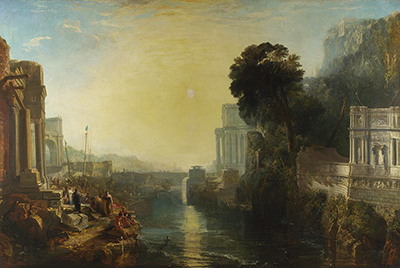
The Tenth Plague of Egypt shows this ambition early. Architecture, darkness and supernatural catastrophe envelop small human reactions. Turner later assigned its engraved design to Historical landscape in the Liber Studiorum, demonstrating that landscape organisation and biblical history were one enterprise rather than competing genres.[11]
Hannibal extends the model by making weather dwarf the protagonist. Waterloo uses mud, smoke, bodies and night to replace triumphant battle order with aftermath. Deluge paintings merge scriptural time with circular atmosphere. In each case, environmental condition changes what history can mean.
The method also applies to imperial decline. Ruins, sunset and encroaching vegetation can measure political duration without representing the instant of collapse. A luminous landscape may seem serene while its title identifies a civilisation moving towards loss. Beauty delays, rather than cancels, historical warning.
Such works complicate the sublime's apparent universality. A storm may overwhelm every person physically, but histories distribute exposure unequally. Soldiers, enslaved people, labourers and tourists do not occupy danger from the same position. Turner's subjects sometimes make that difference visible and sometimes leave it unresolved.
Landscape becomes historical force when natural process and human time can no longer be separated. Fire produces smoke that remakes the city view; war alters the ground; transport enters weather; empire leaves ruins. Turner's sublime is powerful because it does not place history safely outside nature.
Sea Without Firm Ground
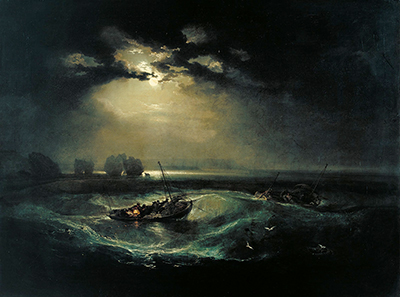
The sea offered Turner a landscape without stable foreground. Horizon may orient the eye, but waves interrupt it and vessels tilt against it. Depth is largely invisible. A painted surface can show foam and reflection while suggesting a volume capable of swallowing every visible object.
In The Shipwreck, broken masts, crowded boats and crossing waves create an unstable network rather than a clear sequence of rescue. Human groups remain legible enough for danger to carry consequence, yet no single figure commands the event. Dark water and pale foam exchange the roles of form and interval.[19]
Marine sublimity differs from the mountain prospect. A spectator before a peak can imagine standing on ground. At sea, the implied viewpoint may be another moving vessel or a position impossible to occupy. The eye is level with forces whose full depth cannot be measured.
Turner knew maritime culture through coastal travel, ports, naval imagery, patrons and repeated observation. Finished storms nevertheless combine experience with pictorial precedent and invention. The existence of observed waves does not convert an oil into an instantaneous record.
The sea also carries labour, trade, war and empire. Fishing boats, transports, slave ships, whalers and steam vessels occupy different economic histories. Treating every craft as a tiny emblem of generic humanity erases those distinctions.
Turner's marine landscapes are most sublime when scale and identity remain in tension. Water threatens to reduce every vessel to matter, while title and detail insist that the people aboard inhabit a specific event. The sea removes firm ground from both body and interpretation.
River estuaries complicate the distinction between open ocean and inhabited landscape. At the junction of the Thames and Medway, shipping, sandbanks, distant shore and broad weather occupy a zone shaped by tide, commerce and naval movement. The horizon may look expansive, but channels and shallows make navigation exacting. Turner could produce sublimity through uncertain depth and atmospheric reach without placing a vessel in a spectacular wreck.[29]
This quieter maritime risk matters because it resists a catalogue of disasters. Boats routinely negotiate forces that a distant spectator might treat as scenery. Wind, tide and visibility belong to labour as well as aesthetic experience. Turner's marine landscapes move between exceptional catastrophe and ordinary exposure, allowing the same water to support commerce, observation and mortal danger.
Staffa and the Resistant Cave
Turner visited Staffa in 1831 during a Scottish journey connected with illustrations for Walter Scott. Fingal's Cave was already famous through geology, tourism, Ossianic association and modern travel. Reaching it required a sea passage that made the destination dependent on weather.[24]
In the exhibited oil, a steam vessel appears on rough water before the island's dark basalt opening. Smoke joins cloud and spray, while the cave remains a nearly black recess. The object of tourism is visible but not surrendered to inspection.
The cave organises several sublime features at once. Its geometric basalt suggests natural architecture, yet its depth remains obscure. Waves and shadow make approach uncertain. Human technology brings visitors near while showing how small and exposed the vessel remains.
Literary association adds another layer. The name invokes Fingal and the Ossianic poems, even though geological process produced the formation. Turner does not choose between scientific, poetic and touristic Staffa. The painting lets all three modes converge at a dark threshold.
Steam is especially important. Modern propulsion does not stand outside sublime nature as a later intrusion. Smoke becomes part of atmosphere, and the vessel's passage creates the viewpoint from which the island is known. Access and danger belong to the same system.[38]
The cave resists the collector's desire for a complete view. Its darkness offers a destination that cannot be visually possessed from outside. Turner's sublime landscape can therefore be concentrated in an opening: a finite shape whose interior activates imagined depth.
The Slave Ship and the Ethics of Spectacle
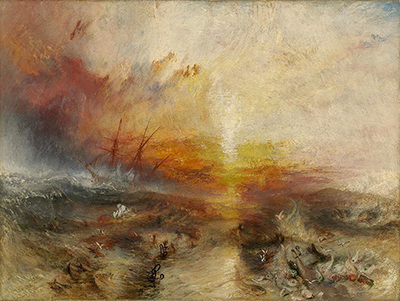
Turner's 1840 painting of enslaved people thrown overboard confronts the gravest problem in sublime art: visual magnificence can make atrocity pleasurable. A blazing sunset, violent sea, distant vessel and bodily fragments create an overwhelming chromatic field, but the subject is not generic shipwreck.[26]
The work responds to histories of the slave trade and the notorious Zong killings, in which enslaved people were murdered for financial calculation. Turner exhibited it when abolitionist debate remained urgent and paired the image with lines from his verse. The title identifies the human crime that atmosphere alone could obscure.
Burkean distance cannot resolve the ethical tension. Gallery viewers face no physical risk, while represented victims had no protective separation from water or violence. Their bodies must not be treated merely as small marks proving oceanic scale.
Turner uses beauty against comfort. Red, orange and gold can suggest sunset splendour, but they also bind sky and sea into a field of blood, heat and judgement. Marine creatures, limbs and chains disturb the lower water. Recognition changes the chromatic experience without cancelling its attraction.
The ship recedes rather than arriving to rescue. Nature is violent, yet human agency has produced the moral catastrophe. Weather cannot absorb responsibility. The sublime here includes terror before a system of commerce as well as before the sea.
This painting establishes an essential limit for any career-wide account. Turner's elemental landscapes are not politically innocent simply because individuals appear small. Titles, histories and material details determine whose danger becomes another person's spectacle. Responsible looking must remain with that asymmetry instead of converting it into universal awe.
The Steam-Boat Storm and Immersive Risk
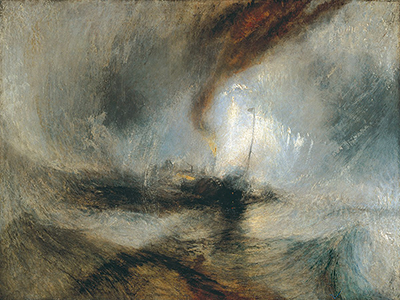
In 1842 Turner exhibited a storm centred on a steam vessel making signals in shallow water and using the lead. The long title claims that the author was present in the storm on the night the Ariel departed Harwich. A later anecdote says he had himself tied to a mast, but that story cannot be independently verified.[28]
The distinction between title and proof matters. Turner deliberately framed the picture through bodily witness, whether the claim reports exact circumstances or constructs artistic authority. Spectators were invited to imagine experience from within weather rather than observation from shore.
The image offers a vortex of dark, pale and brown movement. Vessel and paddle wheel are difficult to stabilise. Sea, snow or spray and sky cross one another, while the circular organisation pulls the eye around a centre that never becomes calm.
Sarah Monks interprets Turner's sea through gravitational depth and the possibility of drowning. This challenges an account of sublimity based on mental elevation above danger. The picture imagines the body pulled downward even as the painting remains on a vertical wall.[27]
Modern steam power does not master the storm. Signals and sounding lead are technologies of navigation under limited visibility; their presence acknowledges uncertainty. The vessel is both industrial machine and vulnerable moving platform.
Critics who called the work soapsuds or whitewash reacted to material difficulty as well as implausible witness. Ruskin later defended Turner's sea knowledge, but the painting's force does not depend on proving every anecdote. It arises from a calculated conflict between claimed experience, obscure image and the spectator's own unstable search.
Fire, Smoke and the Modern Sublime
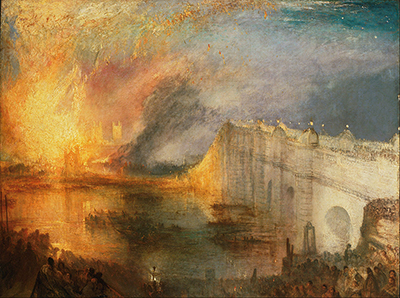
Turner's sublime landscape extends into the modern city. When Parliament burned in October 1834, he observed the event from positions near the Thames and made watercolour studies. The later oils organise flame, smoke, river, crowds and architecture into a public catastrophe.[33]
Fire changes every category of the view. Solid buildings become sources of light; smoke turns air opaque; reflections make water appear to burn; spectators gather at a distance that is physically safer but morally and politically charged. The city becomes an atmospheric system.
The event was not remote myth. Parliament embodied national government, and its destruction was witnessed by large crowds. Turner's paintings convert current news into a scale associated with history painting while preserving modern bridges, boats and spectators.
Obscurity again performs more than concealment. Smoke allows flame to appear through layers and partially erases architecture. The eye oscillates between identifying the building and experiencing a broad collision of warm and cool colour. Material paint reconstructs visibility under exceptional conditions.[33][36]
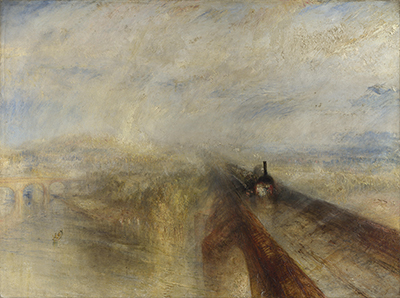
Steam and speed create related effects elsewhere. In Rain, Steam, and Speed, weather, locomotive exhaust and movement weaken the boundaries of track, bridge and landscape. Modern technology generates its own atmosphere rather than appearing as a crisp object laid over timeless nature.[32]
The modern sublime does not mean that machines replace mountains. Fire, rain, river, masonry and engine interact. Turner shows institutions and technologies exposed to forces they also reshape. Landscape becomes the medium through which modern change is experienced.
Tourism and the Managed Encounter
By Turner's lifetime, sublime scenery belonged to expanding systems of travel. Roads improved, guidebooks described stations, inns served visitors and boats carried tourists towards caves, lakes and falls. Danger could be approached according to an itinerary and then converted into memory, print or finished watercolour.[3][7]
Turner participated fully. He travelled persistently, worked for publishers and produced images whose circulation helped define places for audiences. Later Swiss watercolours were offered to collectors through sample studies and commissions, transforming transient effects into luxury objects.[31]
Commercial mediation does not make the experience false. A difficult pass still exposed travellers to weather, and a boat to Staffa remained dependent on sea conditions. But access was unequal and organised. The “wild” view relied upon labour, transport and local knowledge that might remain outside the image.
Turner's compositions often register this infrastructure. Roads curve beneath hills, bridges cross gorges, steam vessels approach islands and figures stop to look. The tourist is not absent from sublime landscape; the tourist is one of its modern actors.
Print changes distance further. A mezzotint can carry a mountain or storm into a domestic interior. Its small scale does not eliminate force because tonal compression and imagined magnitude survive. Reproduction also standardises a view while multiplying possible viewers.[12][14]
The sublime encounter was therefore simultaneously bodily, pictorial and economic. Turner could challenge the security of spectators while selling them mediated risk. That contradiction is part of the work's modernity, not an embarrassment to be removed.
Geology, Weather and Deep Time
Mountains in Turner's art are historical bodies. Strata, broken rock, eroded valley and displaced stone imply formation and decay beyond a human lifespan. Even when geological detail is not scientifically precise, the landscape can make duration visible.
Turner associated with scientists and lived through rapid developments in geology and meteorology. His drawings show close attention to rock profiles, clouds, rain, snow and the relation of water to terrain. Such observation supports informed interpretation, but it does not prove allegiance to one theory in every work.[9][10]
Avalanche makes deep accumulation suddenly active. Snow gathered over time releases; rock and forest move; a dwelling disappears. A waterfall presents continuous erosion, while a cave joins vast formation to the instant of tourist arrival. Ruins bring human history into the same temporal field.
Weather operates at another scale. Cloud and light may change before a drawing can be completed. Turner's rapid notation and later reconstruction bridge fleeting perception and durable object. A momentary effect can reveal forms whose material history is immense.
Modern environmental knowledge adds urgency but should not be projected backwards as intention. Viewers may now see vulnerability, unstable climate and nonhuman agency in Turner's storms. Those readings are valuable when labelled as later questions rather than claims that he predicted current science.
The geological sublime enlarges time instead of size alone. A modest rock face can confront the observer with processes that exceed memory; a calm lake can reflect a mountain altered across ages. Turner's landscapes repeatedly place the brief act of looking against durations it cannot contain.
Liber Studiorum and a Grammar of Landscape
Turner's Liber Studiorum was a visual argument for the range and seriousness of landscape. Between 1807 and 1819, seventy plates plus a frontispiece appeared from a larger projected sequence. Turner generally etched the outlines, while mezzotint engravers developed tone under his close direction.[11][12]
He classified designs as Architectural, Historical, Marine, Mountainous, Pastoral or Elevated Pastoral. The system shows that landscape could bear architecture, narrative, sea, mountain and ideal form without becoming a subordinate genre. It does not contain a separate category named sublime.
Sublime operations cross the labels. Hind Head Hill is Mountainous despite its English road, coach, flock and gallows. A dark hill and threat of execution transform familiar travel into moral exposure.[13] Historical designs place catastrophe within environment, while Marine plates organise danger through tone and water.
Mezzotint was crucial. Its dark ground could be scraped towards light, allowing moon, spray or opening sky to emerge from extensive shadow. Repeated impressions made controlled obscurity portable. Turner used proofs and written instructions to adjust brightness, distance and emphasis.[14]
The series also clarifies that sublime landscape is not one late expressive phase. Turner theorised landscape categories through print while producing major storm and avalanche oils. Reproduction, classification and exhibition experiment developed together.
By placing quiet pasture beside exposed mountain and historical darkness, the Liber prevents the sublime from swallowing the whole genre. Its force depends upon alternatives. Turner could move among modes, combine them and make their boundaries unstable.
Medium Changes the Encounter
Turner did not represent sublime force in one uniform manner. Graphite records path and edge economically. Watercolour can reserve bare support for brilliance, spread atmosphere through wash or lift back into damp colour. Oil provides opacity, scale, texture and extended revision. Mezzotint constructs light from tonal darkness.[7][14][36]
From travel sketch to exhibition surface
A sketch made while travelling answers immediate constraints. Time, weather, footing and transport limit what can be recorded. Abbreviation may indicate speed or selection rather than a desire for abstraction. Several drawings can preserve successive viewpoints later combined in a finished work.
A developed watercolour introduces different control. Transparent layers can join distant mountain to sky, while opaque accents restore near forms. Small dimensions concentrate attention; they do not necessarily reduce imagined scale. The Rigi studies demonstrate how a collectible object can hold changing light and immense duration.[31]
Large oils engage the body through size and surface. Thick paint can make foam, snow or fire assert itself in real light. Thin veils create depth or obscurity. Scraping and revision leave visible evidence of construction, so natural force is experienced through material resistance.
Print introduces collaboration and repetition. An engraver interprets Turner's design; proofs become stages of negotiation; many impressions distribute the result. The sublime moves from unique encounter into a public visual language.
Format also directs feeling. Panoramic width can expose an army beneath a vast storm, while a near-square field can enclose circular movement. Turner's medium choices are not containers for a prior idea. They determine how danger, distance and recognition reach the viewer.
Titles, Verse and Exhibition Address
Turner's exhibition titles often supply narrative information that the image withholds. Hannibal, a steam vessel, a slave ship or a biblical morning may be difficult to identify without words. This is not a failure repaired after painting. Verbal and visual evidence were designed to interact in public display.[22][26][28]
His verse extends that address. Lines accompanying avalanche and snowstorm introduce setting sun, breaking barriers, fear, ambition and extinction. They add time and consequence beyond the represented instant. Their compressed language can be as difficult as the pictures, so text increases rather than resolves interpretation.
Claims attached to the lost or perhaps never completed Fallacies of Hope require caution. Catalogue attributions prove that Turner used the title for excerpts; they do not establish a recoverable finished poem whose complete meaning explains every work.
Long titles also shape viewpoint. The 1842 storm subtitle asks spectators to imagine signals, shallow water, sounding lead and authorial presence. Those actions are only partly visible. Reading creates a set of expectations that looking must test.
Exhibition context intensifies the process. Works hung among hundreds of others needed broad effects that registered at distance, while small details and printed catalogues rewarded closer attention. Turner's colour, scale and obscurity organise movement through that public environment.[15]
Words do not dominate paint. A title constrains subject but cannot fix the exact emotional or spatial experience. Turner uses the gap between naming and seeing as one of the sublime landscape's principal energies.
Ruskin and the Truth of Force
John Ruskin made Turner central to Modern Painters, arguing that the artist represented nature more truthfully and imaginatively than accepted old-master conventions. Mountains, clouds, water and stones became evidence in a larger moral and visual system.[34]
Ruskin's attention was exceptionally precise. He distinguished kinds of cloud, traced geological structure and praised Turner's capacity to show movement. Discussing the avalanche picture, he memorably emphasised the stone in flight and the anger or energy carried by displaced matter.[35]
His defence transformed Turner's reception. Works dismissed as chaotic could be understood as records of complex natural relation. Ruskin also taught later viewers to regard apparent looseness as knowledge rather than negligence.
Yet Ruskin is not neutral. He selected works according to changing moral commitments, sometimes disliked late colour and constructed an ideal Turner whose spiritual truth served his own argument. Praise can be as simplifying as ridicule.
The language of truth requires care. Turner often invented, combined and intensified. A painting can convey the force of snow without documenting one avalanche, or the behaviour of sea without recording one wave. Imaginative synthesis is not the opposite of observed knowledge.
Ruskin matters most as an active interpreter who understood that landscape detail and sublime totality need not conflict. Stones, clouds and water possess specific structures, while their relations can overwhelm a viewer. His criticism remains indispensable when read beside objects, travel evidence and the limits of his own programme.
The Quiet Sublime
Turner's sublime is often associated with noise, darkness and catastrophe, but some late landscapes achieve magnitude through stillness. The Rigi watercolours present a mountain across calm water under changing light. Boats and figures establish ordinary life while distance and duration remain immense.[31]
These works do not fit Burkean terror as directly as an avalanche. Their force lies in transience. Sunrise or fading colour changes rapidly, while the mountain seems to persist beyond individual time. The spectator recognises both the precision of a moment and the impossibility of holding it.
Watercolour supports that balance. Thin wash allows reflection, air and mountain to belong to one luminous continuum. Reserved light appears materially fragile. Small accents prevent the atmosphere from becoming empty.
Quiet sublimity also emerges in late studies where forms approach disappearance. A horizon may survive as a slight interval, or architecture may hover within colour. Such works still depend on remembered place and observed condition. Calling them abstract should not remove their geographical and temporal anchors.
The shift from terror to wonder is not a simple late progression. Turner painted calm and violence throughout his career. What changes is the degree to which atmosphere can carry structure without extensive contour.
Stillness broadens the sublime beyond spectacle. The mind can be exceeded by duration, distance and light as well as immediate danger. A quiet landscape may unsettle possession more gently, asking how a fleeting observer can claim a mountain, dawn or reflection.
Sublime Landscape and Later Abstraction
Later artists and critics often saw Turner's dissolved boundaries, visible marks and enveloping colour as precursors of abstraction. The comparison identifies genuine formal qualities. Figure and ground can become unstable; paint announces its material surface; broad movement may reach the eye before named subject.[6][10]
Chronology should not become destiny. Turner exhibited works with titles, histories, quotations and recognisable motifs. His landscapes were not incomplete steps towards twentieth-century art. Their difficulty served nineteenth-century arguments about nature, history, travel and spectatorship.
Reproduction has strengthened the abstract reading. Cropped details and colour images can detach a passage from scale, title and surrounding forms. That isolation may reveal technique while changing the work's original structure.
The strongest modern comparison concerns participation. Turner's viewer does not simply decode a stable scene. Distance, duration and attention alter what appears. Material mark and represented atmosphere remain simultaneously available. Later abstraction would pursue related tensions under different historical conditions.
Contemporary ecological interpretation opens another afterlife. Storm, flood, fire and unstable ground can speak powerfully to viewers living with climate crisis. Such resonance should prompt new questions about vulnerability and systems, not fabricate prophetic intent.
Exhibitions devoted to Turner's pursuit of the sublime have encouraged this wider career view by placing famous oils beside travel drawings, watercolours and prints. Such juxtapositions reveal that the effect does not reside in one motif or level of finish. A dark early mountain study, a carefully engraved road, a luminous Swiss commission and a late storm can each reorganise the spectator's sense of bodily scale.[37]
They also expose the risk of retrospective selection. When only violent works are gathered, Turner appears to pursue catastrophe continuously; when only luminous late colour is shown, danger and history recede. The full archive instead records alternating demands from patrons, publishers, travel, exhibition and private experiment. Sublimity is one persistent possibility within that range, powerful because Turner could set it against calm, description and ordinary use.
Turner's sublime legacy is therefore plural. It includes formal experiment, bodily viewing, environmental force and moral unease. The paintings remain modern because their historical meanings resist being replaced by one modern label.
The Ethical Unstable View
Turner's sublime landscapes ask viewers to enjoy representations of danger. That pleasure is aesthetically productive but ethically incomplete. Avalanche victims, shipwrecked sailors, enslaved people, soldiers and labourers cannot be reduced to signs proving that nature is large.[20][26]
Specific history is the first safeguard. The Selva disaster may stimulate an imagined avalanche without making the painting documentary. The Zong murders belong to systems of enslavement and insurance, not a universal tragedy at sea. Hannibal's army carries ancient and Napoleonic politics, not merely human smallness.
The second safeguard is attention to agency. Nature may overpower, but human institutions place people in danger, organise travel, conduct war and profit from transport. Turner's landscapes often show elemental and social forces entering one another.
The third is recognition of the observer's position. Gallery spectators possess safety and time. Turner's obscurity can unsettle that privilege by delaying recognition, but it cannot erase the distance. Looking responsibly means noticing whose suffering makes the sublime encounter possible.
This ethical pressure does not invalidate visual power. It explains why Turner's greatest landscapes remain difficult after their storms become familiar. Beauty and terror, control and immersion, knowledge and obscurity do not settle into one answer.
The unstable view is Turner's enduring construction. Topographical measure is established and disturbed; a body is located and exposed; history enters weather; matter becomes light while remaining paint. The landscape exceeds possession without becoming meaningless. Sublimity occurs in that contested interval, where the eye is compelled to continue and certainty never quite returns.
Across the career, that interval takes different forms. A Welsh lake leads towards a mountain made remote by tone; an Alpine road narrows bodily movement; falling water breaks continuity into spray; an avalanche turns stable geology into impact; a historical army disappears beneath weather; a modern vessel loses its orientation inside its own smoke and storm. None of these effects depends on size alone. Each establishes a human measure, then demonstrates its limits.
Medium keeps the argument from becoming formula. Graphite follows a path, watercolour joins transient light to the support, mezzotint releases illumination from darkness and oil makes atmospheric force materially dense. Titles and verse add histories that vision cannot recover unaided. The spectator must negotiate among what is seen, what is named and what remains uncertain.
Turner ultimately makes sublime landscape a discipline of incomplete command. The observer is neither annihilated nor placed securely above events. Looking proceeds through adjustment, comparison and moral recognition. That is why the work can remain powerful after its visual innovations become familiar: danger is not only represented in the scene but built into the limits of the viewing position itself.
Discussion
How does Turner make a landscape feel unstable while retaining enough structure for danger to matter?
Reader Insights
Where is the spectator placed, and which measures of scale remain available?
Which details emerge slowly through cloud, spray, snow, smoke or darkness?
How does historical suffering change the pleasure of mediated danger?
Join the Conversation
Share a close observation or a source-based question for other readers.
References
- Edmund Burke, *A Philosophical Enquiry into the Origin of Our Ideas of the Sublime and Beautiful*, 1757. https://www.gutenberg.org/files/15043/15043-h/15043-h.htm
- Joseph Addison, “The Pleasures of the Imagination,” *The Spectator*, 1712. https://www.gutenberg.org/files/12030/12030-h/12030-h.htm
- William Gilpin, *Observations on the River Wye*, 1782. https://archive.org/details/observationsonri00gilp
- Immanuel Kant, *Critique of Judgment*, 1790, sections 23-29. https://oll.libertyfund.org/title/bernard-the-critique-of-judgement
- Andrew Wilton, *Turner and the Sublime*, British Museum, 1980.
- Tate, *The Art of the Sublime*. https://www.tate.org.uk/art/research-publications/the-sublime
- Tate, *J.M.W. Turner: Sketchbooks, Drawings and Watercolours*. https://www.tate.org.uk/art/research-publications/jmw-turner
- David Hill, *Turner in the Alps*, 1992.
- John Gage, *J.M.W. Turner: A Wonderful Range of Mind*, 1987.
- Sam Smiles, *J.M.W. Turner: The Making of a Modern Artist*, 2007.
- Metropolitan Museum of Art, “Joseph Mallord William Turner (1775-1851).” https://www.metmuseum.org/essays/joseph-mallord-william-turner-1775-1851
- Yale Center for British Art, *Liber Studiorum*. https://britishart.yale.edu/sites/default/files/2025-06/large%20print_third%20floor_02.pdf
- Metropolitan Museum of Art, *Hind Head Hill, on the Portsmouth Road*, 383004. https://www.metmuseum.org/art/collection/search/383004
- Art Gallery of New South Wales, *Little Devil's Bridge*, 2000.48. https://www.artgallery.nsw.gov.au/collection/works/2000.48/
- Royal Academy of Arts, *An Introduction: Collections Guide*. https://royal-academy-production-asset.s3.amazonaws.com/uploads/c2356623-5e68-40da-80a8-3e6007da3d52/ra-collections-guide-1437%281%29.pdf
- Tate, *Snowdon from Llyn Nantlle*, T01746. https://www.tate.org.uk/art/artworks/turner-snowdon-from-llyn-nantlle-t01746
- Tate, *The Passage of the St Gothard*, D04613. https://www.tate.org.uk/art/artworks/turner-the-passage-of-the-st-gothard-d04613
- British Museum, *The Great Fall of the Reichenbach*. https://www.britishmuseum.org/collection/object/P_1958-0712-407
- Tate, *The Shipwreck*, N00476. https://www.tate.org.uk/art/artworks/turner-the-shipwreck-n00476
- Tate, *The Fall of an Avalanche in the Grisons*, N00489. https://www.tate.org.uk/art/artworks/turner-the-fall-of-an-avalanche-in-the-grisons-n00489
- Kunstmuseum Luzern, *Turner: The Sea and the Alps*. https://www.turner2019.ch/en/
- Tate, *Snow Storm: Hannibal and his Army Crossing the Alps*, N00490. https://www.tate.org.uk/art/artworks/turner-snow-storm-hannibal-and-his-army-crossing-the-alps-n00490
- Lynn R. Matteson, “The Poetics and Politics of Alpine Passage,” *Art Bulletin* 62.3, 1980. https://doi.org/10.1080/00043079.1980.10787790
- Tate, *Staffa, Fingal's Cave*, N00546. https://www.tate.org.uk/art/artworks/turner-staffa-fingals-cave-n00546
- National Gallery of Australia, *Turner from the Tate* object records. https://digital.nga.gov.au/archive/exhibition/turner/
- Museum of Fine Arts Boston, *Slave Ship*, 99.22. https://collections.mfa.org/objects/31102/
- Sarah Monks, “Suffer a Sea-Change: Turner, Painting, Drowning,” *Tate Papers* 14, 2010. https://www.tate.org.uk/research/tate-papers/14/suffer-a-sea-change-turner-painting-drowning
- Tate, *Snow Storm - Steam-Boat off a Harbour's Mouth*, N00530. https://www.tate.org.uk/art/artworks/turner-snow-storm-steam-boat-off-a-harbours-mouth-n00530
- National Gallery of Art, *The Junction of the Thames and the Medway*, 1983.1.39. https://www.nga.gov/artworks/1162-junction-thames-and-medway
- Art Institute of Chicago, *Valley of Aosta: Snowstorm, Avalanche, and Thunderstorm*, 1967.34. https://www.artic.edu/artworks/89916/
- Tate, *The Blue Rigi, Sunrise*, T12336. https://www.tate.org.uk/art/artworks/turner-the-blue-rigi-sunrise-t12336
- National Gallery, *Rain, Steam, and Speed*, NG538. https://www.nationalgallery.org.uk/paintings/joseph-mallord-william-turner-rain-steam-and-speed-the-great-western-railway
- Cleveland Museum of Art, *The Burning of the Houses of Lords and Commons*, 1942.647. https://www.clevelandart.org/art/1942.647
- John Ruskin, *Modern Painters*, vols. 1 and 4. https://www.lancaster.ac.uk/the-ruskin/the-complete-works-of-ruskin/
- John Ruskin, *Notes on the Turner Gallery at Marlborough House*, 1857. https://archive.org/details/notesonturnerga00ruskgoog
- Joyce H. Townsend, *How Turner Painted: Materials, Methods and Techniques*, 2019.
- Frist Art Museum, *J.M.W. Turner: Quest for the Sublime* educator guide. https://fristartmuseum.org/wp-content/uploads/APPROVED_2020.02.13_Turner_Educator_Guide.pdf
- Kunstmuseum Luzern, *Turner: The Sea and the Alps* digital exhibition. https://www.turner2019.ch/en/