


 by
Tom Gurney
Tom Gurney BSc (Hons) is an art history expert with over 20 years experience
Published on October 6, 2016 / Updated on October 23, 2026
Email:
tomgurney1@gmail.com
/ Phone:
+44 7429 011000
Fishing Boats at Honfleur
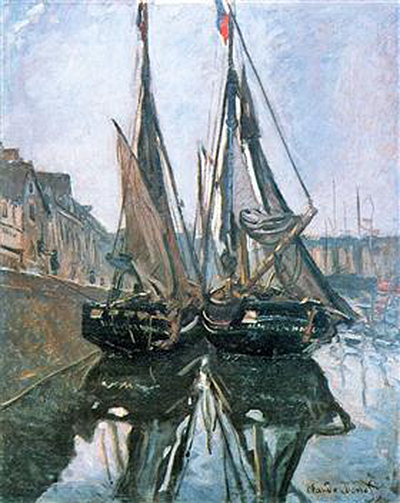
Two fishing boats face the viewer in Claude Monet's Fishing Boats at Honfleur , their dark hulls held above an almost equally imposing pattern of reflections. The masts rise through a pale sky, while a quay and buildings recede along the left. The Calouste Gulbenkian Museum's archive identifies the work as Barcos , about 1868, inventory 449. Wildenstein catalogues the oil as number 116, under the Honfleur title, with dimensions of 100 by 80 centimetres. [1] [2]
At a Glance
The height of the boats
The vertical canvas is especially well suited to a subject whose main forms reach upwards. Masts, ropes and narrow passages of sail rise almost to the top edge. They give the boats a height that would be less emphatic in a broad panorama. The hulls are close and heavy, but their upper structures seem to draw the whole scene towards the sky.
The two vessels are related without being identical. One carries a more openly spread, warm-toned sail; the other has gathered fabric and a denser crossing of rigging. Their differences make the pairing active. The eye passes between similar forms and notices how each is resolved differently.
Small colour accents punctuate this largely restrained arrangement. A red flag high in the rigging is much smaller than the hulls beneath it, yet it catches attention against the pale atmosphere. Monet does not need a brightly coloured harbour to give the scene points of intensity.
A reflection with its own structure
The lower part of the canvas gives substantial space to reflected boats and masts. This is not simply a narrow strip of water completing a maritime view. The reflections extend towards the bottom edge, where their long, inverted shapes become a major element of the design.
They are recognisable but not exact duplicates. Dark masses spread beneath the hulls, interrupted by pale openings and shorter strokes. A mast's straightness becomes less secure in the water, and the rigging breaks into fragments. The boats appear solid precisely because their reflections are allowed a different kind of movement.
Light seems to enter the lower surface from between the vessels and from the more open water at the right. These intervals keep the dark reflections from forming an undifferentiated block. The surface is quiet enough to preserve the boats' general shapes, but disturbed enough to remake their edges continually.
The quay compresses the harbour
The left-hand quay runs diagonally away from the foreground. Its broad wall gives the boats a firm neighbour and establishes a route into the distance. Buildings above it diminish in scale, with a succession of roofs and wall surfaces making the town legible without turning it into the main subject.
On the right, thinner masts and waterfront structures suggest the harbour continuing beyond the two nearest vessels. The view is therefore closely framed rather than completely closed. A concentrated foreground opens into a much lighter, more distant network of activity.
The painting's space depends on this difference in density. The principal boats are entangled with ropes and sails; the background is more lightly indicated. Monet creates a sense of a busy port without filling the canvas with an equal amount of detail everywhere. The scene can feel full while retaining enough air and water to breathe.
Honfleur as a sustained subject
The Normandy coast was a recurring field of work for the young Monet. The Musee cantonal des Beaux-Arts in Lausanne records his painting with Jongkind in 1862 and his arrival with Frederic Bazille at Saint-Simeon in Honfleur in May 1864. It also emphasises that outdoor beginnings could be followed by studio development. [3]
That background helps explain the assurance with which the maritime structures are handled here. The boats are not anonymous triangles added to animate a landscape. Their hulls, fabric and rigging provide much of the picture's organisation. The harbour is a place to investigate how constructed forms behave within changing light and reflected water.
This is a different experience from the exposed shore in Boatyard near Honfleur . There, timber draws the eye along a beach towards open sea. Here, nearby vessels and the quay compress the view, making the water between solid structures especially important.
Distinct from the smaller 1866 boat studies
Several early Monet works have similar fishing-boat titles. The National Heritage Institute in Romania records a separate Bateaux de peche, Honfleur , dated 1866-1867, in the National Museum of Art of Romania, Bucharest. That canvas measures only 37.2 by 45.4 centimetres and has inventory number 8267/301. Its facts must not be substituted for the tall Gulbenkian painting. [4]
Another comparison is the 1866 Boats in the Port of Honfleur , catalogued as 77a. Its broader grouping and prominent pale sail give a different shape to the harbour encounter. Wildenstein's separate entries help keep those images distinct from number 116. [2]
The recurring subject reveals continued investigation, not a single interchangeable image. Canvas proportions matter: in this work, the vertical reach of the rigging and the downward reach of its reflection become central. The format makes the relationship between boat, sky and water unusually concentrated.
Observation across different media
Portland Art Museum's Honfleur, Sailboats, and Lighthouse , dated 1866-1867, shows another side of Monet's attention to the port. Curator Mary Weaver Chapin describes a pastel containing vessels at different stages of development, from summary indications to more resolved forms. The blue paper contributes to both the sea and sky. [5]
The pastel is not established as a direct study for the Gulbenkian oil. It is useful as evidence that Monet looked closely at boats through more than one medium. A briefly suggested mast or hull could still depend on considerable familiarity with maritime forms.
In the oil, that knowledge supports a more sustained arrangement. Ropes connect points across the sky; sails establish broad planes; reflected masses continue the composition below. The scene's liveliness does not require every mark to be spontaneous. Its structure allows observation and pictorial organisation to work together.
The Gulbenkian collection and exhibition record
Wildenstein records the canvas in Calouste S. Gulbenkian's collection by 1920 and identifies it with the Lisbon museum's inventory 449. That is a secure point in its collection history, but it does not establish a complete chain of earlier owners or the precise circumstances of acquisition. [2]
The Foundation's own exhibition archive includes the work in As Idades do Mar , or The Ages of the Sea , held in Lisbon from October 2012 to January 2013. Organised with the Musee d'Orsay's collaboration, the exhibition considered maritime subjects across several centuries. The archive lists Monet's painting under the concise Portuguese title Barcos . [1]
The record places this quiet harbour view within a broader history of representations of the sea. It also confirms that a maritime painting need not depict a storm, distant horizon or spectacular coast. Boats at rest and their reflections can sustain an equally compelling investigation of water.
Stillness without emptiness
The boats seem at rest, but almost every part of the picture contains a change of direction. Sails lean, ropes cross, the quay recedes and reflections open into irregular shapes. The relative calm of the water does not make the scene visually inactive. It allows the boats to acquire a second, less stable life below their hulls.
That balance gives the painting its character. The dark foreground is substantial, the sky comparatively pale, and the architecture partly withheld behind the maritime forms. The image is neither a technical diagram of vessels nor a general view of the town. It is a close encounter with a port through a specific arrangement of boats and water.
Within Monet's Honfleur paintings , this canvas stands out for the way it makes height and depth depend on one another. The masts lead upwards; their reflections pull downwards; the quay carries the eye away. A small part of the harbour becomes a complete spatial experience.
Frequently Asked Questions
No. The Romanian collection holds a different, smaller fishing-boat canvas dated 1866-1867. [4]
Discussion
Look again at the images and ideas explored in Fishing Boats at Honfleur. These editorial prompts invite your observations.
Reader Insights
Compare the boats' outlines with their less stable reflections.
How does the vertical format affect the importance of the masts?
Follow the quay's diagonal into the lighter background.
Join the Conversation
Share a detail, comparison or question about Fishing Boats at Honfleur below.
References
- Calouste Gulbenkian Foundation , As Idades do Mar, exhibition history archive, 2012-2013; Barcos, about 1868, inventory 449, and institutional image. View source .
- Daniel Wildenstein / Wildenstein Plattner Institute , Monet, volume II, 1996, entry 116; object identity, 100 x 80 cm dimensions and Gulbenkian collection record. View source .
- Musee cantonal des Beaux-Arts, Lausanne , Sailing Boats at Sea; institutional context for Monet's early coastal practice. View source .
- Institutul National al Patrimoniului, Romania , Bateaux de peche, Honfleur, 8267/301; separate Bucharest canvas and exact-object controls. View source .
- Mary Weaver Chapin / Portland Art Museum , Daily Art Moment: Claude Monet; separate Honfleur pastel, 1866-1867, 2020.23.1. View source .







