


 by
Tom Gurney
Tom Gurney BSc (Hons) is an art history expert with over 20 years experience
Published on October 6, 2016 / Updated on October 23, 2026
Email:
tomgurney1@gmail.com
/ Phone:
+44 7429 011000
La Lieutenance at Honfleur I
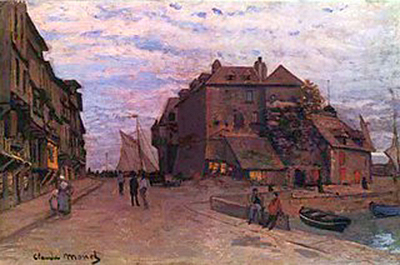
A broad road opens towards an old harbour building in Claude Monet's La Lieutenance at Honfleur I . The architecture occupies the centre and right, while people and small boats give scale to a setting that is neither empty nor crowded. Wildenstein identifies this canvas as number 31, painted in 1864, measuring 48.5 by 73 centimetres. The wider proportions and arrangement of figures distinguish it from a second painting of the Lieutenance made in the same year. [1]
At a Glance
A road that opens the picture
The foreground is unusually generous. Rather than placing the principal building close against the viewer, Monet leaves a broad stretch of road between us and its walls. That open space makes the approach to the Lieutenance part of the subject. The eye has to travel across the ground before arriving at the architecture.
The buildings on the left provide a counterweight. Darker and more closely packed, they form an edge to the open roadway. Their receding line draws attention towards the gap beside the Lieutenance, where a sail and more distant structures connect the town with its harbour.
The road is not described as an evenly filled surface. Changes of tone and short marks make its breadth perceptible, while the figures interrupt it at different distances. These modest variations prevent the foreground from becoming a blank platform. It participates in the same changing light as the roofs, walls and sky.
Architecture built from light and colour
The Lieutenance presents a collection of joined shapes rather than a single flat facade. Roofs rise at different angles; projecting parts interrupt the walls; openings punctuate the broader surfaces. Monet makes these elements readable while allowing their colours to belong to the atmosphere around them.
Warm passages in the masonry are set against cooler shadows. The result is a building that appears substantial without being isolated from the rest of the scene. Its darker features have weight, but the pale areas respond to the surrounding sky.
The broad format also matters. There is room for the building to be seen as part of a place, with neighbouring houses, a roadway and water beside it. This is not an architectural elevation or a detached portrait of a monument. The Lieutenance becomes a meeting point between different kinds of space: the street, the quay and the more distant harbour.
What was the Lieutenance?
The town's historical account identifies the building as a surviving part of Honfleur's fourteenth-century fortifications, associated with the Porte de Caen. Its name comes from accommodation assigned to the king's lieutenant from 1683 until the Revolution. The structure Monet saw was already the product of repeated alterations, not an unchanged medieval gate. [2]
The surrounding space had changed too. In the 1840s, the lower artillery terrace was removed to permit quay development and a road linking parts of the town. That history is particularly relevant to a painting in which the open approach occupies so much of the foreground. [2]
The canvas is therefore a view of an evolving port. An inherited defensive structure has become part of the town's everyday circulation. Monet does not need to illustrate its earlier functions explicitly: the contrast between the old building and the open space around it is already visually productive.
Figures at several distances
The people are small, but they do important work. A pair at the left gives the nearer roadway a human scale. Other figures occupy the middle distance, while a group beside the quay brings attention to the waterfront edge. Their separation helps the eye judge how far the open ground extends.
They are not presented with the specificity of portraits. Clothing is suggested through compact differences of light and dark, and gestures remain economical. The painting gives little basis for assigning names, occupations or a particular event to these people.
Their lack of a single shared action is part of the scene's character. Some figures seem to pass through the space; others gather near its edge. The town is being used in several ordinary ways at once. This dispersed activity keeps the monument within everyday life instead of turning it into an isolated historical relic.
Sky, water and the edge of the quay
Pinkish and lilac passages move through the pale sky. Their softness contrasts with the roofs and vertical walls below, but the colours do not remain confined above the skyline. Related warm and cool notes help bind the architecture and foreground into the same view.
The colour alone does not establish an exact hour. It is more useful to follow how the sky affects the picture's relationships: dark buildings appear stronger beside it, while lighter walls seem to share some of its luminosity. The atmosphere is an active part of the composition rather than a decorative background.
At the right, small boats and a narrow area of water add another set of shapes. Their low, rounded forms differ from the upright mass of the Lieutenance. They also remind us that the roadway reaches a harbour, not simply a town square. The quay's edge holds these two kinds of space together.
A distinct second version
Monet's La Lieutenance at Honfleur II is separately catalogued as Wildenstein 32. It measures 53 by 73 centimetres, making it taller in relation to its width. Its light, figure placement and treatment of the foreground differ from those in this canvas. [1]
Looking between the two reveals how much can change while the principal architecture remains recognisable. Here, the wider proportions give particular emphasis to the road and the relationship between the left-hand houses and the central building. The people are distributed in a way that encourages attention to more than one part of the open space.
The labels I and II are useful for distinguishing the paintings, but do not establish which was executed first. Nor does the shared subject by itself prove that Monet conceived a formally ordered pair. The comparison is valuable without those assumptions: it shows that a familiar setting could support more than one pictorial arrangement.
Honfleur in Monet's early work
The Musee cantonal des Beaux-Arts in Lausanne records Monet's coastal work with Jongkind in 1862 and his arrival with Frederic Bazille at Saint-Simeon in Honfleur in May 1864. Its account also describes a practice in which paintings begun outside could be developed in the studio. [3]
That context places the Lieutenance within an extended engagement with the Normandy coast, rather than an isolated encounter with a picturesque building. In Boatyard near Honfleur , shore and working timber open towards the sea. In Fishing Boats at Honfleur , masts and reflections organise a concentrated harbour view.
The Lieutenance offers another problem: how to give a large architectural mass its place within moving urban life and variable atmosphere. The subject is constructed and historical, but the painting remains attentive to relationships that can change as light passes across a surface.
Collection history and the surviving view
Wildenstein records the painting with Galerie Tanner in Zurich, then in the Rudolf Staechelin Foundation's collection in Basel from 1918. It was deposited at the Kunstmuseum Basel between 1951 and 1967, subsequently passed through Beyeler, and was recorded in a private United States collection around 1970. These are catalogue milestones, not a statement of its present location. [1]
What remains immediately accessible in the image is the balance between permanence and passage. The architecture is heavy and recognisable; the people are lightly indicated; the sky and ground carry subtler variations. None of these elements has to overwhelm the others for the view to feel coherent.
Among Monet's Honfleur paintings , this canvas is distinctive for its spacious urban foreground. The old building anchors the scene, but the approach to it gives the picture much of its life. Looking at the road, figures and small boats is as important as recognising the landmark itself.
Frequently Asked Questions
Wildenstein dates the canvas to 1864 and catalogues it as number 31. [1]
It measures 48.5 by 73 centimetres. The second version is a different, taller canvas. [1]
Not necessarily. The labels distinguish the two views; the catalogue numbers do not by themselves establish their order of execution.
It is a much-altered remnant of Honfleur's fortifications, named for its later use as accommodation for the king's lieutenant. [2]
Discussion
Look again at the images and ideas explored in La Lieutenance at Honfleur I. These editorial prompts invite your observations.
Reader Insights
Follow the road from the foreground to the gap beside the Lieutenance.
Compare the small groups of figures with the scale of the building.
Look at how the wider format differs from the second version.
Join the Conversation
Share a detail, comparison or question about La Lieutenance at Honfleur I below.
References
- Daniel Wildenstein / Wildenstein Plattner Institute , Monet, volume II, 1996, entries 31 and 32; exact-object dimensions, date, separate versions and recorded collection history. View source .
- Ville de Honfleur , L'histoire de la Lieutenance; municipal architectural history and nineteenth-century changes to the quays and roadway. View source .
- Musee cantonal des Beaux-Arts, Lausanne , Sailing Boats at Sea; institutional context for Monet's early Normandy practice, Jongkind and Saint-Simeon. View source .







