


 by
Tom Gurney
Tom Gurney BSc (Hons) is an art history expert with over 20 years experience
Published on October 6, 2016 / Updated on October 23, 2026
Email:
tomgurney1@gmail.com
/ Phone:
+44 7429 011000
La Lieutenance at Honfleur II
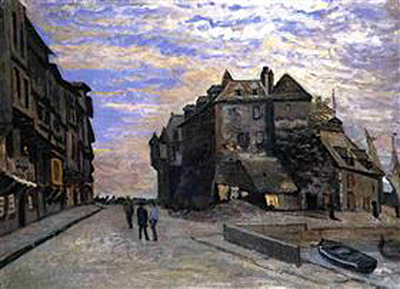
Dark roofs and walls rise against a luminous, broken sky in Claude Monet's La Lieutenance at Honfleur II . Two small walkers cross the open road, while a boat at the lower right draws the harbour into the foreground. Wildenstein catalogues this 1864 painting as number 32, an oil measuring 53 by 73 centimetres. It is a separate canvas from the wider view distinguished as La Lieutenance at Honfleur I . [1]
At a Glance
The building as a dark centre
The Lieutenance is immediately recognisable as the painting's principal mass. Its walls and steep roofs occupy much of the middle distance, leaving only a narrow opening between the monument and the houses at the left. The eye can enter that gap, but the building repeatedly draws attention back towards itself.
This concentration does not make the architecture simple. One roof rises behind another; a tall chimney interrupts the skyline; smaller attached structures extend towards the right. The central wall is broken by windows and darker patches, while the lower roof introduces a strong diagonal.
Monet allows these parts to remain distinct within an overall dark shape. The building has enough internal variation to reward close looking, yet its silhouette is legible before the individual features are examined. That balance between broad mass and local detail is essential to the view's force.
A luminous sky without an exact hour
The sky contains pale gold and cream openings among cooler blue and purple passages. Short, irregular bands make it seem active, in contrast to the weight of the architecture. The lightest intervals sit close to the roofline, sharpening the difference between the building and the atmosphere behind it.
It is tempting to identify a specific hour from these colours, but the picture does not supply a reliable clock. The more securely visible fact is a contrast: dark constructed forms stand against a lighter, restless sky. That relationship gives the scene much of its drama.
The clouds do not form a separate spectacle. Their broken pattern is answered by smaller changes on walls and ground, so that the whole picture remains connected. A narrow mast at the far right and the edges of the roofs provide different kinds of lines against the same moving field of colour.
The foreground turns towards the harbour
The road approaches from the lower left and narrows beside the building. Its perspective is reinforced by the line of houses and pavement, creating a strong movement towards the distant opening. The two walkers occupy this route without blocking it.
At the lower right, the quay wall establishes a second direction. Its edge reaches into the foreground, where a small boat rests below it. This boat is more immediately apparent than the distant harbour structures, and its curved form contrasts with the straighter masonry around it.
Together, the road and quay make the foreground a junction. One line leads into the town; the other brings attention down towards the water. The Lieutenance stands at the meeting of these spaces. The composition would feel very different without the boat, even though it occupies only a small fraction of the canvas.
Two walkers and the scale of the town
The nearest pair of figures is placed just left of the building. Their upright shapes repeat, on a much smaller scale, the verticals of the houses and facade. They give the open ground a measure that architecture alone could not provide.
Their dark clothing sets them apart from the lighter road. One figure is slightly farther forward, preventing the pair from becoming a rigid, symmetrical motif. Their small differences suggest movement without requiring a detailed account of faces or gestures.
Other figures are more scattered and less prominent. The effect is of ordinary circulation through a working town, not a gathering arranged around a monument. Nothing in the image establishes the walkers' names or a particular occasion. Their importance lies in how they animate the space and make the size of the Lieutenance tangible.
An old structure in a changing port
Honfleur's municipal history traces the Lieutenance to the town's fourteenth-century fortifications and the Porte de Caen. The name derives from its accommodation for the king's lieutenant from 1683 to the Revolution. Subsequent changes left a complex building rather than a uniformly medieval structure. [2]
The town also records that the lower artillery terrace was removed in the 1840s to make room for quay development and a connecting road. The open ground in Monet's view belongs to a port that had already undergone substantial alteration before he painted it. [2]
This helps explain why the subject can feel both historic and everyday. The old fabric remains conspicuous, but people pass around it and boats occupy the adjacent water. The painting does not reconstruct a lost fortified town. It shows inherited architecture functioning within a nineteenth-century setting.
Comparing Monet's two Lieutenance canvases
The related first version is catalogued as Wildenstein 31 and measures 48.5 by 73 centimetres. Both paintings date to 1864, but their dimensions, figures and atmospheric relationships differ. The labels I and II distinguish the images without proving an order of execution. [1]
The second canvas's greater height gives the sky and foreground a slightly different relationship to the building. Its darker architectural mass is especially emphatic, and the nearest pair of figures forms a more concentrated human presence than the dispersed groups in the wider view.
These differences make comparison more rewarding than treating the pictures as interchangeable records of a landmark. Monet retained a recognisable subject while changing the distribution of attention. Architecture, atmosphere and everyday movement could be recombined without the building losing its identity. A repeated viewpoint did not require a repeated visual effect.
Architecture within the early Honfleur paintings
Boston's Museum of Fine Arts holds Rue de la Bavole, Honfleur , painted about 1864. Its account emphasises the direct treatment of a traditional street subject and the force of contrasting colours. That separate work provides an institutional comparison for Monet's engagement with the town, not evidence of a direct preparatory relationship. [3]
The National Gallery's Monet & Architecture exhibition placed the Lieutenance within a broader distinction: old buildings could identify the historic character of a place, while modern structures such as the Gare Saint-Lazare carried different associations. [4]
The Lieutenance view makes that distinction visible without reducing the building to a symbol. It remains a material presence, surrounded by light, ground and people. Monet's attention to architecture is inseparable from attention to its setting. The monument is not simply named by the picture; it is experienced through an arrangement of contrasts.
Coastal practice and the canvas's later history
The Lausanne museum records Monet's arrival with Frederic Bazille at Saint-Simeon in May 1864, within an extended period of work along the Normandy coast. It also notes that outdoor studies could be developed in the studio. That context supports a careful account of his practice, rather than an assumption that every passage here was completed in one sitting outside. [5]
Wildenstein's recorded history of this canvas includes Petiet, Mallet and Wildenstein, followed by Mrs Chapman's Grandchildren's Trust in 1968. The catalogue lists sales in London in 1974, Paris in 1978, London in 1979 and New York in 1981, before a private United States collection. It does not establish a current public display. [1]
The surviving image remains a concentrated study of a particular meeting point in Honfleur . Heavy architecture, a light-filled sky, two walkers and a modest boat create a scene whose interest lies in their precise relationship, not in an abundance of incident.
Frequently Asked Questions
No. This canvas is Wildenstein 32, measuring 53 by 73 centimetres. The first version is number 31 and has different proportions and details. [1]
The catalogue dates it to 1864. [1]
No. The label distinguishes the two pictures but does not establish their order of execution.
Their identities are not established by the catalogue evidence used here. They give scale and movement to the roadway.
Discussion
Look again at the images and ideas explored in La Lieutenance at Honfleur II. These editorial prompts invite your observations.
Reader Insights
Compare the dark roofline with the brightest passages in the sky.
Follow the road and quay as two different routes into the composition.
Consider how the small boat changes the balance of the foreground.
Join the Conversation
Share a detail, comparison or question about La Lieutenance at Honfleur II below.
References
- Daniel Wildenstein / Wildenstein Plattner Institute , Monet, volume II, 1996, entries 31 and 32; exact-object dimensions, date, separate versions and collection history. View source .
- Ville de Honfleur , L'histoire de la Lieutenance; municipal architectural and quay history. View source .
- Museum of Fine Arts, Boston , Rue de la Bavole, Honfleur, about 1864, 48.580; separate street painting and institutional interpretation. View source .
- National Gallery, London , The Credit Suisse Exhibition: Monet & Architecture, 2018 press archive; the different roles of historic and modern buildings in Monet's work. View source .
- Musee cantonal des Beaux-Arts, Lausanne , Sailing Boats at Sea; institutional context for early coastal practice and Saint-Simeon. View source .







