


 by
Tom Gurney
Tom Gurney BSc (Hons) is an art history expert with over 20 years experience
Published on October 6, 2016 / Updated on October 23, 2026
Email:
tomgurney1@gmail.com
/ Phone:
+44 7429 011000
Mouth of the Seine at Honfleur
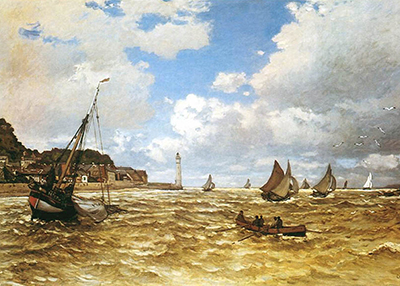
Mouth of the Seine at Honfleur is Claude Monet's 1865 seascape in the Norton Simon Museum, Pasadena. [1] Boats cross a broad, restless stretch of water beneath a sky crowded with clouds. A lighthouse and the town hold the distance in place. This was one of the two marine paintings with which the twenty-four-year-old artist made his Paris Salon debut, an important public achievement well before the independent Impressionist exhibitions. [1] [3]
At a Glance
- Artist Claude Monet
- Date 1865
- Medium Oil on canvas
- Dimensions 89.5 x150.5 cm
- Collection Norton Simon Museum, Pasadena
- Credit The Norton Simon Foundation
- Accession F.1973.33.2.P. [1]
Where the river meets the Channel
The subject is the mouth of the Seine , where the river reaches the English Channel beside Honfleur . The water is part of a working maritime setting, not simply a decorative foreground for a distant town.
At the left, buildings gather below a dark slope. Their varied roofs and pale walls form a compact strip between the land and water. The lighthouse stands farther out, a narrow upright that is easy to recognise despite its small scale.
That relatively fixed shore contrasts with the active water below. The town does not extend evenly across the whole view; it gives way to an open distance occupied by boats and sails. The composition therefore combines a specific coastal place with a sense of movement beyond it.
The Norton Simon Museum describes the viewpoint as a jetty looking across the harbour. [2] This gives the observer a stable position from which to experience the scene, even though much of what lies ahead appears mobile. The painting does not require the viewer to imagine floating among the waves.
Boats at different distances
The large boat at the left enters close to the edge, its dark hull and rigging cutting across the paler background. Its sloping spars make a strong diagonal, while its upright mast reaches into the sky. The vessel provides a near reference point for the smaller craft farther out.
On the right, several filled sails form a sequence across the water. Their warm brown and grey tones differ from the lighter sails in the distance. The changes in size and clarity make the harbour feel extensive without a precisely drawn route through it.
A low rowing boat occupies the foreground nearer the centre-right. Its long profile differs from the high triangular sails, introducing another scale and kind of movement. Tiny figures are visible aboard, but they are not detailed enough to support named identities or a specific narrative.
The boats do not line up like specimens in a catalogue. Their overlapping directions and unequal spacing help animate the scene. Each remains legible, yet each also contributes to a broader rhythm of diagonals, curves and small interruptions on the water.
Waves, birds and an expansive sky
The foreground water is built from short, uneven strokes. Light marks break across darker ochre and green-brown passages, making the surface appear rough without describing every wave as a separate outlined form. The repeated touches gather into a convincing stretch of moving water.
Above it, clouds vary considerably in size and weight. Large pale masses open around a blue area near the upper centre, while darker cloud gathers towards the right. These shifts prevent the sky from acting as a uniform backdrop.
Small birds punctuate the upper air. Their pale or dark marks are much simpler than the nearest boat, but their placement helps connect otherwise broad cloud passages. They are part of the scene's visual rhythm, not evidence for an exact bird count or species.
Water and sky are related through movement but not painted identically. The waves produce a low, broken pattern; the clouds create larger, slower-changing shapes. The lighthouse stands between those two domains as a comparatively firm vertical. Its stillness makes the surrounding activity more apparent.
Outdoor studies and studio construction
The vivid sense of weather can make this look like a large canvas completed directly in front of the harbour. The museum instead explains that Monet developed it in his Paris studio from studies made on site. [2]
That distinction does not make the observation of nature unimportant. It separates the gathering of visual material from the construction of an ambitious exhibition picture. A painter could learn from boats, coast and weather outdoors, then reconsider their relationships on a larger canvas.
The companion La Pointe de la Heve at Low Tide followed a comparable process. The Kimbell Art Museum describes its development from a smaller coastal painting into a large studio version prepared for the Salon. [3]
The National Gallery's related La Pointe de la Heve, Sainte-Adresse is identified as a probable on-site study for that Kimbell canvas, not for the Honfleur picture. [4] Keeping those relationships separate allows a useful comparison without pretending that every surviving early seascape was preparation for this one work.
The importance of the 1865 Salon
The Paris Salon was a state-sponsored exhibition with a large public audience. Acceptance there offered a young artist a kind of visibility very different from a private studio visit or a small circle of supportive friends. The Kimbell Museum places the two 1865 seascapes at the beginning of Monet's public career. [3]
Mouth of the Seine attracted favourable attention. The Norton Simon audio commentary cites Paul Mantz's review in the Gazette des Beaux-Arts, praising Monet's command of tonal relationships, the overall viewpoint and the force with which the picture held a spectator's attention. [1]
This response complicates an easy story in which Monet was always rejected by established institutions. His dealings with the Salon changed over time. For this particular year, acceptance and critical notice are part of the documented history.
The picture should consequently be considered as a successful early public work, not merely as an imperfect prelude to water lilies. Its scale, organisation and marine subject were already capable of making a strong impression in an exhibition setting.
Learning from the Normandy coast
Monet's work around Normandy developed through repeated encounters with familiar places and other artists. The MuMa exhibition account records him working at Honfleur with Boudin and Jongkind in 1864, observing a coastal environment shaped by changing light and tides. [6]
Drawing was also important. James Ganz's Art Institute study places Monet's early maritime sketches within his serious artistic practice, rather than treating them as an incidental activity abandoned once he began to paint. Boats recur in the young artist's albums and later sketchbooks. [5]
That broader practice gives substance to the idea of preparation. Rigging, hulls, shorelines and cloud effects offered material that could be studied individually and then combined. It does not follow that every known boat drawing is a direct study for Mouth of the Seine.
The connection between drawing , observation and studio work is more useful than a simple opposition between realism and spontaneity. This painting contains clearly organised forms while still conveying the instability of wind and water.
An early work with its own authority
The Norton Simon Foundation acquired the painting in 1973. [1] Its modern collection setting allows it to be studied alongside later work, but chronology alone should not determine its value.
Several features give the picture its particular character: the close boat at the left, the lower rowing craft, the line of sails, the lighthouse and the large clouded sky. None is merely a sign pointing towards a future style. Their relationships make a complete and ambitious marine composition.
It is also unnecessary to claim that Monet never mixed his colours or always painted straight from the tube. The interest of his technique lies in how different marks and tonal areas work together here. Preparation and revision are compatible with a lively result.
The painting brings an observed coastal world into the public space of the Salon. Its immediacy was something Monet constructed through careful choices, not proof that the whole canvas had to be made in a single passing moment beside the sea.
Frequently Asked Questions
It is dated 1865. [1]
The museum says it was developed in the Paris studio from on-site studies. [2]
La Pointe de la Heve at Low Tide, now in the Kimbell Art Museum. [3]
In the Norton Simon Museum collection, accession F.1973.33.2.P. [1]
Discussion
Look again at the images and ideas explored in Mouth of the Seine at Honfleur. These editorial prompts invite your observations.
Reader Insights
Which element makes the water seem most active?
How does the lighthouse change the relationship between sky and sea?
Does knowing about the studio process change your impression of immediacy?
Join the Conversation
Share a detail, comparison or question about Mouth of the Seine at Honfleur below.
References
- Norton Simon Museum , Mouth of the Seine at Honfleur, 1865, F.1973.33.2.P, object history and audio transcript. View source .
- Norton Simon Museum , Looking Together: Monet's Mouth of the Seine at Honfleur, studio preparation and harbour viewpoint. View source .
- Kimbell Art Museum , La Pointe de la Heve at Low Tide, 1865, AP1968.07, separate Salon companion. View source .
- National Gallery , La Pointe de la Heve, Sainte-Adresse, NG6565, separate study for the Kimbell painting. View source .
- James A. Ganz , Art Institute of Chicago, Cat.12: Cliffs and Sea, Sainte-Adresse, early maritime drawing context. View source .
- MuMa Le Havre , Monet au Havre, exhibition interpretation: Honfleur and the coastal studies. View source .







