


 by
Tom Gurney
Tom Gurney BSc (Hons) is an art history expert with over 20 years experience
Published on October 6, 2016 / Updated on October 23, 2026
Email:
tomgurney1@gmail.com
/ Phone:
+44 7429 011000
Breakwater at Trouville, Low Tide
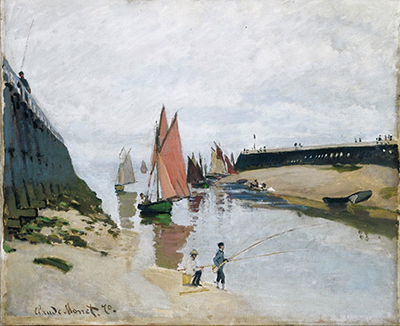
Breakwater at Trouville, Low Tide is Claude Monet's 1870 view of the Touques estuary, now catalogued by the Hungarian National Gallery in Budapest as inventory 367.B. [1] Two anglers occupy a narrow sandy foreground, while sailing boats and harbour structures lead towards the open sea. Its quiet working waters offer a different Trouville from the fashionable beach scenes Monet painted during the same summer.
At a Glance
A harbour opened by the tide
The title identifies low tide as an essential condition of the view. Exposed banks interrupt the water, making the harbour look less like an uninterrupted basin than a set of channels and shallow margins. A boat rests beside the sand on the right, while the foreground figures stand close to the water's edge.
The scene is at the mouth of the Touques, rather than simply an unspecified stretch of beach. AnnaZsofia Kovacs's museum commentary identifies the estuary and the anglers, placing the picture away from the resort's busy holiday crowds. [1]
This distinction matters when looking at the water. It serves boats entering or leaving a harbour and meets the sea beyond the enclosing structures. The painting holds those different spaces together without a map-like account of the coastline.
Low tide also makes a temporarily accessible foreground. The exposed ground gives the figures somewhere to stand and lets the viewer imagine a position close to them. It does not, however, establish whether the tide was still falling or had begun to turn.
Diagonals and an opening to the sea
The near breakwater rises steeply along the left edge before receding towards the centre. Its dark face is one of the painting's strongest shapes. Across the water, the farther pier approaches from the right as a lower, nearly horizontal band.
Together, these structures frame an opening rather than sealing the harbour shut. Small sails occupy the gap, drawing attention from the near figures towards the distant water. The eye has a route through the picture even though much of the view is enclosed by masonry, sand and boats.
The angled fishing rods introduce another set of lines. Their slender curves cross the broad water surface and contrast with the heavy harbour walls. Small human gestures can therefore influence a composition otherwise dominated by large areas of sky and water.
Kovacs relates the slightly elevated viewpoint and arrangement of separate colour areas to Japanese woodcuts. [1] This is a comparison of pictorial organisation, not evidence that Monet copied a particular print or derived every feature from one source.
The anglers in the foreground
The two nearest figures are conspicuous without becoming detailed portraits. One wears a pale upper garment; the other is darker and holds a rod extending across the water. Their contrasting clothes help separate them from each other and from the reflections behind.
They introduce a modest scale of activity. The picture is neither an empty coastal panorama nor a crowded social spectacle. Attention settles on the relation between these small bodies and the much larger harbour environment.
Their placement is also important. They stand below the principal group of sails, not directly against the horizon. This keeps the foreground action distinct from the boats while allowing the eye to connect both parts of the scene.
Nothing in the cited object record names the anglers. There is no need to turn them into Monet's acquaintances or to assign them a dramatic story. Their absorption in the water is enough to establish the quiet character of the view, although that quiet should not be mistaken for proof of the painter's emotional state.
Sails, reflections and restrained colour
The principal sails introduce warm red and orange into a setting otherwise filled with pale greys, muted blues and darker earth colours. Their reflections stretch downwards in broken patches rather than repeating each triangular shape precisely. The boats remain recognisable, but the water changes their appearance.
A smaller pale sail farther left provides a useful contrast. It is lighter and more isolated, separated from the dense group near the centre. Differences in size and spacing make the harbour feel inhabited at several distances.
The sky occupies a large part of the canvas. Cloud marks vary from light, almost white strokes to cooler grey passages, while the water below shares some of those subdued tones. The boundary between air and water is clearer around the harbour structures than it is in the open distance.
The painting rewards comparison with Monet's wider treatment of water and reflections , but it should not be reduced to a universal formula. Here the effect depends on the particular arrangement of sails, exposed sand, piers and clouded light.
Trouville in the summer of 1870
Monet visited Trouville with Camille and their young son Jean during the summer following his marriage. The official history published by Monet's Giverny house records the wedding on 28 June 1870 and identifies the modest Hotel Tivoli as the family's lodging. [4]
The surroundings offered very different subjects within a small area. Hotels, promenades and seated holidaymakers appeared alongside harbour boats and tidal ground. A single label such as seaside resort does not describe everything Monet chose to paint there.
His Hotel des Roches Noires view presents the architecture and public face of the holiday town. The breakwater painting turns towards a less spectacular activity at the river mouth. The contrast is in the subjects themselves, not evidence that one picture is a literal record of pleasure and the other of hardship.
The Franco-Prussian War belongs to the historical setting of that summer, but no battle, soldier or explicit political sign appears here. A calm painted scene cannot tell us that the wider circumstances were equally calm.
A comparison with the beach paintings
The National Gallery's The Beach at Trouville, also dated 1870, brings two seated women close to the viewer. Parasols, clothes and the cropped arrangement make holiday life immediate. In the Budapest picture the nearest people are much smaller, and the harbour occupies the greater share of attention. [3]
The National Gallery also records that Monet and Boudin sometimes worked alongside each other during this stay. Boudin's beach subjects offered a relevant precedent, but Monet did not simply repeat one arrangement across all his Trouville canvases. [3]
Physical evidence needs particular care in this comparison. Sand embedded in the National Gallery painting supports work on the beach for that canvas. It is not technical evidence about the Budapest picture and cannot establish where every brushstroke here was made.
Seeing the beach subject beside the harbour also brings out a difference in scale: a close encounter with holidaymakers in one, and people absorbed into a broad tidal setting in the other.
A documented exhibition and a lasting subject
The Musee d'Orsay's exhibition database records Estacade de Trouville, maree basse as catalogue number 147 at the fourth Impressionist exhibition in Paris in 1879. Its transcription identifies the owner as M. Duez and links the work with Wildenstein number 154 and Budapest. [2]
That evidence supplies a specific public history nine years after the painting's date. It does not by itself prove the work had never been shown before, nor does it provide a complete chain of ownership. The French title, often rendered as Jetty or Breakwater at Trouville, Low Tide, is another way of identifying this same harbour subject.
The painting's interest lies in the balance between firm constructions and unstable appearances. Harbour walls establish the view; water and cloud continually soften it. Small figures make the exposed ground usable, while the boats point towards a sea beyond the frame. Monet makes this particular corner of Normandy compelling through its relationships, not through an invented incident or an idealised empty coast.
Frequently Asked Questions
The Budapest institutional record dates it to 1870. [1]
The Museum of Fine Arts - Hungarian National Gallery, Budapest, inventory 367.B. Check the collection record for changing display information. [1]
The Orsay exhibition database records it in the fourth exhibition of 1879 as catalogue 147. [2]
The cited museum commentary identifies their activity but does not name them. [1]
Discussion
Look again at the images and ideas explored in Breakwater at Trouville, Low Tide. These editorial prompts invite your observations.
Reader Insights
How do the fishing rods affect the larger diagonals of the harbour?
Where do reflected colours differ most from the objects above them?
Does the harbour feel enclosed or open to the sea?
Join the Conversation
Share a detail, comparison or question about Breakwater at Trouville, Low Tide below.
References
- Hungarian National Gallery , Breakwater at Trouville, Low Tide, 367.B, with commentary by AnnaZsofia Kovacs. View source .
- Musee d'Orsay , Base Salons: Estacade de Trouville, maree basse, fourth exhibition, 1879, catalogue147. View source .
- National Gallery , The Beach at Trouville, NG3951, separate work and summer1870 context. View source .
- Maison et jardins de Claude Monet , Aout1870: Claude Monet pose son chevalet a Trouville, historical article. View source .







