


 by
Tom Gurney
Tom Gurney BSc (Hons) is an art history expert with over 20 years experience
Published on October 6, 2016 / Updated on October 23, 2026
Email:
tomgurney1@gmail.com
/ Phone:
+44 7429 011000
Agapanthus Triptych
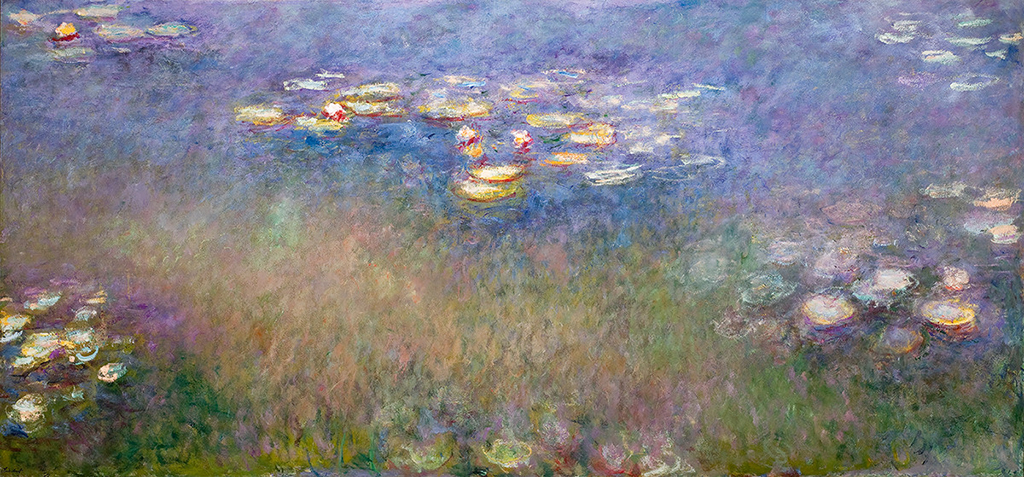
Monet's Agapanthus Triptych, made around 1915-1926, consists of three monumental pond paintings now in separate American museums. [2] [3] [5] The illustration here shows only the right-hand panel, Water Lilies in the Nelson-Atkins Museum of Art, not the complete ensemble. [3]
At a Glance
Three panels, three collections
From left to right, the paintings belong to the Cleveland Museum of Art, the Saint Louis Art Museum and the Nelson-Atkins Museum of Art in Kansas City. [1]
Each canvas is roughly two metres high and more than four metres wide. [1] [2] [3] Their combined span is therefore quite different from the experience of seeing a small photograph of one panel.
The sequence creates a broad environment of water, floating plants and reflected light. It has joints and individual surfaces, but it can also be read across those divisions.
The triptych should not be confused with every three-panel Water Lilies arrangement. Monet investigated related motifs in different ensembles; a shared subject does not establish identical objects, formats or collection histories.
The Water Lilies overview situates the larger production, while these three paintings offer a particularly well-documented example of revision and later separation.
Why call it Agapanthus?
The title preserves something no longer plainly visible. In an earlier state, agapanthus plants occupied the lower-left area of what is now the Cleveland panel. Monet subsequently covered them. [4]
Cleveland's conservators used eighty-four sheets of X-ray film to examine the enormous canvas, later joining the records digitally. The resulting image revealed the buried plant forms.
This is evidence of a changed composition, not a hidden symbolic message awaiting a speculative interpretation. The plant had once provided a more explicit connection with the bank before water and reflected colour took over its position.
The discovery also explains why searching the final painted surface for obvious agapanthus blossoms can be misleading. The name and the surviving appearance belong to different stages of the work.
The Cleveland study found that panel to be the most extensively reworked of the three, although the other two had only been partially X-rayed. [4] The qualification matters: technical examination reveals a history, but the extent of the examination also sets limits on the comparison.
Looking across the right-hand panel
In the Kansas City panel illustrated here, bright flower accents gather across the upper middle and towards the sides. They punctuate a much larger field rather than filling it evenly.
Blue and violet are strongest above, while warmer yellow-green passages spread through much of the lower region. The transition is soft and mottled, with marks crossing between the two.
The flowers give the eye points of focus, but the spaces between them are equally important. Broad passages of coloured water hold the scattered groups together.
Near the bottom, upward and diagonal strokes suggest growth or reflections without resolving into a precise inventory of plants. Their rhythm differs from the smaller, more concentrated marks around the blooms.
Seen close up, such marks insist on paint. Seen farther away, they can gather into the appearance of a pond. The work does not settle permanently into one of those readings.
The Painting Water guide follows that interplay between floating surface and reflected depth, a relationship that becomes especially absorbing at this scale.
A material study of the central canvas
The Saint Louis Museum's technical account identifies five principal pigments in its central panel: lead white, cobalt violet, cobalt blue, cadmium yellow and chrome green. It also describes wet paint applied into wet paint. [1]
These are findings about a particular canvas, not a complete recipe for every Monet. They help explain how a restricted set of materials could support a wide range of mixtures and transitions.
The effect is not produced by colour names alone. A pale passage beside a saturated one can seem luminous; broad mixtures can soften a transition that a hard contour would interrupt.
Visible spontaneity therefore need not mean absence of revision. The Technique article distinguishes the appearance of a brushstroke from the evidence needed to reconstruct its making. Here, photographs and scientific examination allow the question to be investigated rather than guessed.
Plans that changed
Simon Kelly's scholarly account places Agapanthus within an unrealised 1920 plan for a circular display building at the Hotel Biron in Paris. By 1922 Monet had turned towards the Orangerie and considered Agapanthus as a diptych, probably without the right-hand panel; it was then omitted from the final scheme. [5]
The uncertainty in that proposed reduction should be retained. We know the plans changed, but should not turn a probable arrangement into a documented final installation.
Kelly also traces the softening and removal of forms in the Kansas City canvas after its photographed 1921 state. Groups of pads and flowers were covered, and veils of lavender, yellow and pink moderated stronger colours. [5]
The triptych's present effect is consequently the result of decisions made over time. It was not simply a view caught intact during one afternoon beside the pond. The Painting Series article considers how repeated work could include alteration, suppression and reconsideration.
Garden observation and studio space
The garden remained the starting point, but the paintings were worked on in a studio large enough to accommodate their scale. The late Water Lilies project involved a sustained relationship between observation and work indoors, rather than a simple opposition between natural truth and studio invention. [7]
Monet's pond itself was cultivated. Its water supply, planting and maintenance were part of a deliberate landscape created at Giverny. [8]
This makes the absence of banks and horizon especially interesting. The artist was not unable to describe the place; he chose a view that withholds many of the features by which we would measure it.
At full size, a viewer cannot inspect every detail in a single focused glance. Attention moves from one group of lilies to another, then to broad fields of reflected colour. The Giverny garden article gives the physical context, but the triptych creates its own experience of space.
Separation and renewed audiences
The paintings remained in the family after Monet's death before entering the market in the 1950s. Cleveland records the passage of its panel through Katia Granoff and Knoedler before its museum acquisition. [2]
The Nelson-Atkins documentation dates the right panel's purchase from Michel Monet by Granoff to 1956, followed by Knoedler and the museum in 1957. A petition from ninety Kansas City Art Institute students and staff supported that acquisition. [3]
These histories explain why the three panels are not ordinarily encountered as a single permanent installation. Each acquired a separate institutional life.
Reunions have nevertheless restored opportunities to compare them together. The joint museum exhibition in Kansas City in 2011 reunited the ensemble. [6] The Nelson-Atkins exhibition history also records its participation in Painting the Modern Garden in Cleveland and at London's Royal Academy in 2015-2016. [3]
Such exhibitions are historical events, not promises that all three panels are currently on view together. The Reception article examines the wider changes in the audience for Monet's late work.
Continuity without a conventional panorama
A panorama often offers a recognisable succession of landmarks. Agapanthus instead keeps returning attention to water, blossoms and reflections, without a clear horizon or distant destination.
That does not mean it has no context or structure. The floating forms establish intervals, the changes between warm and cool colour create broad movements, and the enormous width changes the viewer's relation to the surface.
The title's vanished plant, the revised forms and the panels' later separation add further layers to what can at first look like an uninterrupted moment of calm.
Understanding those layers does not diminish the painting's visual immediacy. It makes that immediacy more remarkable: an extensively altered work can still give the impression of light moving across water. The triptych asks us to hold its material history and its living appearance together, rather than choosing between them.
Frequently Asked Questions
Cleveland holds the left panel, Saint Louis the centre and the Nelson-Atkins in Kansas City the right. [1]
No. It shows the right-hand Kansas City panel, Water Lilies, 57-26. [3]
They were painted over in the left panel; X-radiography revealed their earlier forms. [4]
No. Agapanthus was excluded from the final installation plan. [5]
Discussion
Look again at the images and ideas explored in Agapanthus Triptych. These editorial prompts invite your observations.
Reader Insights
Compare the bright flower accents with the large spaces between them.
Consider how the experience changes when three panels are encountered together rather than separately.
Think about the relationship between the vanished agapanthus and the title that survived.
Join the Conversation
Share a detail, comparison or question about Agapanthus Triptych below.
References
- Saint Louis Art Museum , Close Look: Claude Monet's Water Lilies; panel order, scale, acquisitions and central-panel technical study. View source .
- Cleveland Museum of Art , Water Lilies (Agapanthus), circa 1915-1926, 1960.81; left-panel record and provenance. View source .
- Nelson-Atkins Museum of Art , Water Lilies, 57-26; right-panel record, acquisition documentation and exhibition history. View source .
- Dean Yoder and Marcia Steele, Cleveland Museum of Art , Agapanthus Exposed, Cleveland Art, July/August 2011; imaging and revisions. View source .
- Simon Kelly, Nelson-Atkins Museum of Art , Water Lilies, catalogue entry in French Paintings and Pastels, 1600-1945; changing display plans and right-panel revisions. View source .
- Nelson-Atkins Museum of Art , Monet's Water Lilies, 2011 exhibition archive; three-panel reunion. View source .
- Ann Temkin and Nora Lawrence, MoMA , Claude Monet: Water Lilies, 2009, pages 5-7; studio and outdoor practice. View source .
- Maison et jardins de Claude Monet , Water lily pond; the cultivated Giverny setting. View source .







